Category Archives: Global Temperatures

September Solar Cycle 24 Activity Increased


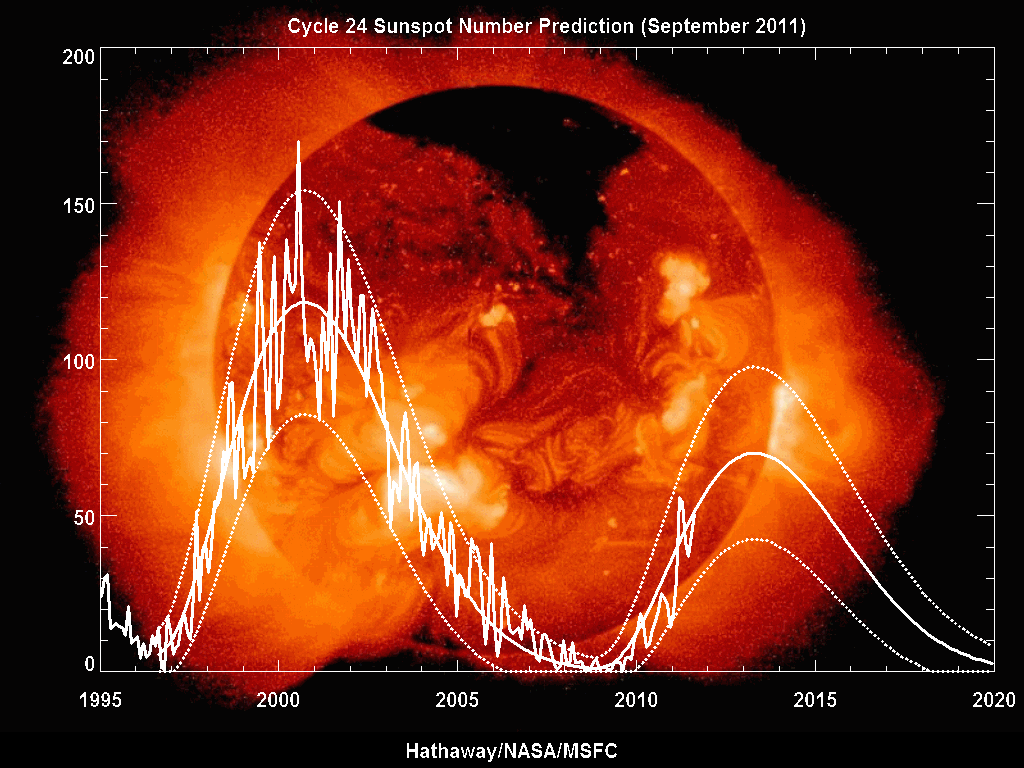
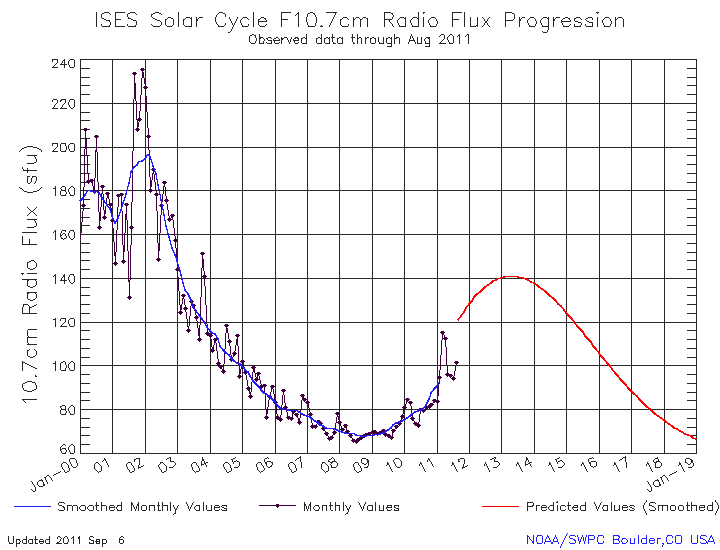
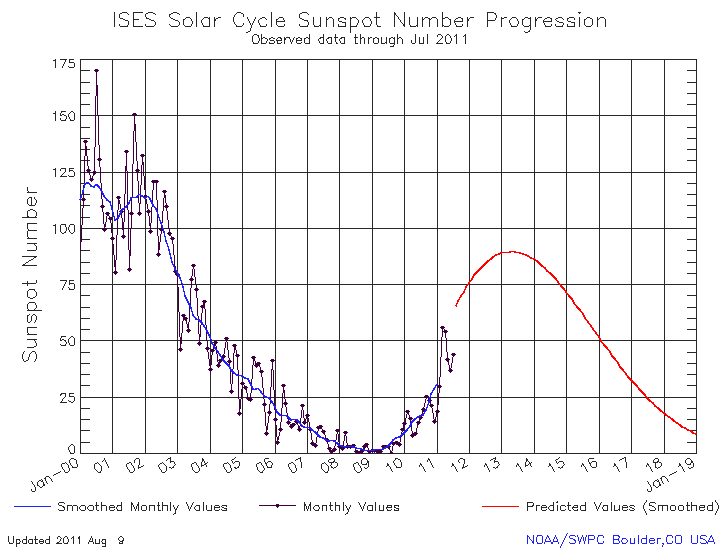
September Sunspot and Flux (F 10.7) data indicate a step change in Cycle 24 activity.  It was enough to cause Dr Hathaway to revise his Sunspot prediction chart once again.  He raised all three ranges, high, mid and low upward.  The mid-range was bumped up about 15%. (Click on Charts for better view.)   The Sunspot chart from NOAA/SWPC shown below indicates a monthly value increase from about 50 to 80 sunspots.  This chart suggests that the actual data is on track to match their prediction. And the Solar Radio             flux is tracking the NOAA/SWPC prediction. The Sun has a mind (or some kind of mechanism) of its own. To date in October   the Planetary A index is low and this usually means a less active Sun.  Will the numbers for Sunspots and Solar Radio Flux for the month of October drop?   Put in a planetary a index.   cbdakota

If They Could REALLY Model Global Climate Only One Model Would Be Needed


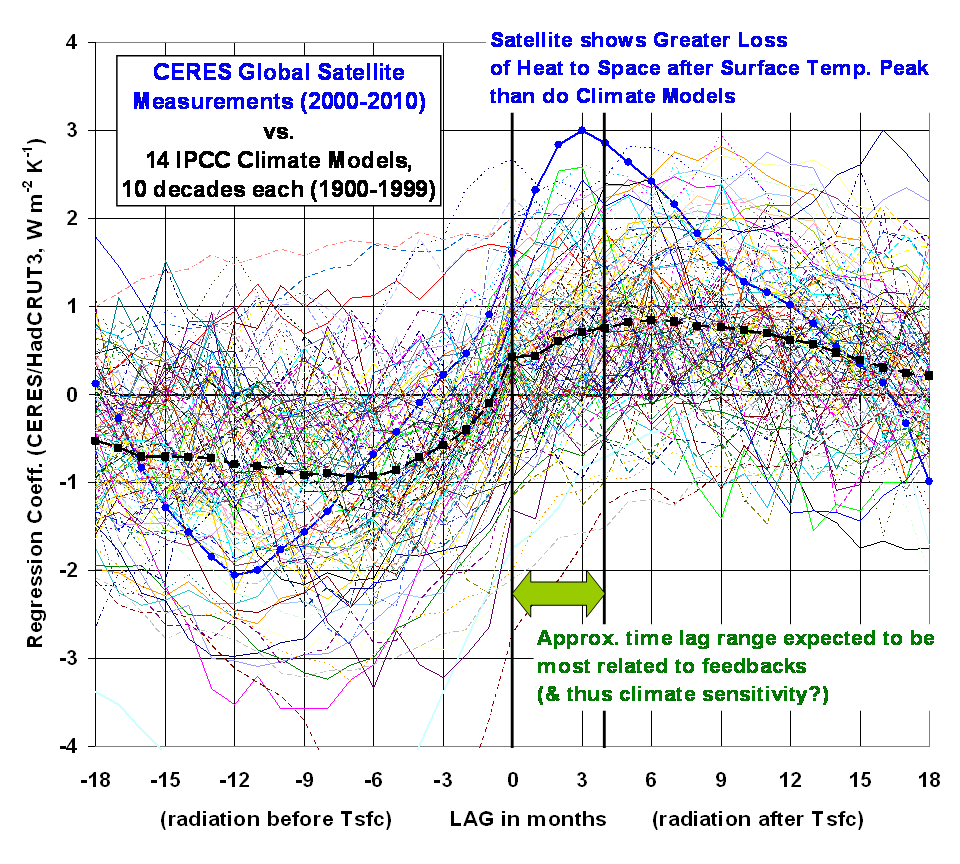
The chart below is from Dr Roy Spencer’s blog “Global Warming”.  It shows the output from 14 different climate models versus the CERES Global satellite measurement of heat loss into space.  This chart was assembled in response to criticism by Warmers that he had cherry picked the climate models he used to contrast their performance versus his work in a recently published paper in Remote Sensing. Following the post publication criticism, Dr Spencer has done a little tweaking but nothing that changes his conclusions.   See here  and here for discussion of this issue.

But this posting is not to review the bidding on Dr Spencer’s paper.   It is to talk about the Warmer’ Global Climate Models.  Whenever I see this assembly of Warmer Global Climate Models output, I wonder why anyone believes the predictions they make.  If they could REALLY model our global climate they would only need one model.   Instead, all 14 give different results!!!   Does that really instill you with a lot of confidence in their ability to do skillful prediction?    What the 14 models do is allow them to make predictions based upon the most extreme model output.  It also allows them to match just about any condition at any time with at least one of the models.  Think—-A stopped watch tells the right time two times a day.

cbdakota

Solar Cycle 24 August Update


Solar Cycle 24 August Sunspot and Solar Flux data continues to paint a picture of a much less active Sun when compared against the previous Cycle 23.

First, David Hathaway’s September edition of his sunspot predictions. Hathaway has a mid, high and low range chart with the actual data slightly below the mid-range forecast.  The Hathaway midrange predicts a maximum monthly high of about 70 Sunspots in early 2013.   Cycle 23 experienced a maximum monthly high of about 120 in 2001.

NOAA  sunspot prediction chart has only a single line which predicts a maximum monthly of about 90 sunspots.    It is shown below:

Solar flux through August appears to be trending below the NOAA prediction for Cycle 24.  The NOAA Cycle 24 solar flux prediction is for a peak of 140 in 2013.   This contrasts with  the Cycle 23 maximum of about 195 in 2002.    See the NOAA chart below:

cbdakota

Can We Really Call Climate Science A Science?


Can We Really Call Climate Science A Science?  That is the question asked in a Forbes Posting.  The author, Paul Roderick Gregory, cites the prevailing warmist’s narrative that says all but a tiny minority of scientist believes that global warming is man- made.  Gregory likens this to Stalin telling Trotsky (the dissident) it is what the poliburo says it is regardless if it is true or not.

Gregory  writes: The “warmist” consensus view of “climate science” is represented at a popular level by advocates like Al Gore and at the scientific and technical level by the UN’s Intergovernmental Panel on Climate Change (IPCC), as supported by researchers at East Anglia (Phil Jones) and Penn State (Michael Mann). This panoply of people and organizations is the equivalent of the Central Committee in my Stalin dialog above.   “Skeptics” (the equivalent of Trotsky above) are individual scientists and advocates who stake out positions at odds with the IPCC-Central Committee orthodoxy.

Gregory says that three recent events make him think of this Stalin analogy:

First, Ivar Giaever, the 1973 winner of the Nobel Prize in physics, resigned from the American Physical Society over his disagreement with its statement that “the evidence (on warming alarmism) is incontrovertible.”

Gregory adds: The Giaever story starkly disputes warmist claims of “inconvertible evidence.   Despite the press’s notable silence on such matters, there are a large number of prominent scientists with solid scholarly credentials who disagree with the IPCC-Central Committee. Those who claim “proven science” and “consensus” conveniently ignore such scientists.

Second, the editor of Remote Sensing resigned and disassociated himself from a skeptical paper co-authored  by University of Alabama Climate Scientist Roy Spencer after an avalanche of criticism by “warmists.

The author believes that the Remote Sensing editor’s action was bizarre and unprofessional. He adds : In all fields of scientific inquiry, journal editors base their publication decisions on reports of referees, who are supposed to be experts in the area. Presumably, in the case of the Spencer paper, referees supported its publication.  Even if there had been a negative report, good editors often publish controversial papers to open a scholarly dialog. (Can anyone think of a topic that is more controversial and more in need of open scholarly dialog than global warming

Third, the New York Times and other major media are ridiculing Texas Governor Rick Perry for saying that global warming is “not proven.” Their message: Anyone who does not sign on to global warming alarmism is an ignorant hayseed and clearly not presidential material.

Regarding the criticism of Rick Perry he says: The media is tarring  and feathering  Rick Perry, we now see,  for agreeing with Nobel laureate Giaever and a host of other prominent scientists.  I guess if Perry is a know-nothing Texas hick (or worse, a pawn of  Big Oil) so is every other scientist who dares to disagree with the IPCC Central Committee. Such intimidation  chillingly makes politicians, public figures, and scientists fearful of deviating one inch from orthodoxy.

He summarizes this situation saying: False claims of consensus and inconvertible truth reveal a political or ideological agenda wrapped in the guise of science.  The incontrovertible bad behavior of the warmists has led skeptics to suspect base motives, and who could blame them.

And I will add that this is why the skeptics suspect the base motives  of the warmist’s allies —- the mainstream media.

Read this Gregory’s full post by clicking here

cbdakota

Should You Worry About CO2 in Our Atmosphere?


Should you worry about CO2 in our atmosphere?

Atmospheric carbon dioxide (CO2) is the basis for nearly all life on our planet.  Plants need at least 150ppm of atmospheric CO2 to grow.  The plants are the source of food for all animals.  There would be no T-Bones steaks were it not for plants.

That would seem to answer the question unless you are one of the radicals that believe to save the Earth, all humans must die.

But there is more.  Many scientists believe that global famine has been avoided by the increase in atmospheric CO2 from a pre-industrial level of about 270ppm to the current level of about 390ppm.   Before examining why scientist think CO2 increases can help avoid famine, let’s look at this VIDEO:

The levels of CO2 used in that video are outside normal considerations.  But much more modest increases in atmospheric CO2 are beneficial,too.    (So you can make the connection with the video and perhaps your own experience, cowpeas, are an important food legume crop in semi-arid tropics covering Asia, southern Europe and Central and South America.   In the Southern US cowpeas are called black eyed peas.)

The CO2 Science’s Plant Growth Data Base has an impressive compilation of peer-reviewed scientific studies that report the growth responses of plants to atmospheric CO2 enrichment.  Click here to see all the plants studied.

The following table lists a selected group of plants and the dry weight response to a 300ppm CO2 increase over ambient.

PLANT No. OF STUDIES DRY WEIGHT INCREASE %(Arithmetic mean)
Corn 20 21.3
Rice 188 35.8
Soy Beans 179 46.5
Wheat 235 32.1
Sugar Cane 11 34

 Effect of Atmospheric CO2 Increased 300ppm Over Ambient

The tables also provide response data on Photosynthesis (Net CO2 exchange rate).

The greater the amount of CO2 not only increases the quantity, its effect on the quality of the plant is not significantly altered.  Some studies have suggested that the protein levels are reduced, but other studies have indicated that the protein levels are increased.  Other factors, such as ozone (O3), soil nitrogen and sulfur dioxide (SO2) effect the outcome both positively and negatively.  Click here for more discussion of the quality of the plants tested.

It is hard to argue with all this data and just the common sense notion that warmer weather, more CO2 and more rainfall will provide bigger crop yields. And that the increase in crop yields will be beneficial in view of the forecast increase in the world’s population.   We all know that it surely will continue to warm as it part of a natural cycle.  We need to worry when the cycle reverses and the temperatures begin to drop.  Surely some one is yelling at his computer display right now shouting about the droughts that are going to occur when man-made global warming really kicks in.    Ok, but for every warmer that says the world will become a desert, there is another taking about the vast rainfall that is and will continue to occur.  It is some kind of an unhealthy theory that every weather or climate event, snow, heat, drought, wind, no wind, rising temperatures, dropping temperatures, sea level rise, sea level drop, you name it, are all caused by CO2.

More on CO2 and famine in the next blog.   Growth enhancement using forecast changes in atmospheric CO2 will be examined.

cbdakota

Solar Cycle 24 Continues to Under Perform the Early Projections.


Cycle 24 Sunspots count continues to underperform early forecasts.   Chief forecaster, David Hathaway, Ph.D., Heliospheric Team Leader, NASA Marshall Space Flight Center, Huntsville, Alabama has frequently revised his forecast of maximum monthly average Sunspot count.  A look at the lowering of the NASA forecast over the years:

Before I pile it too heavily on Dr. Hathaway, most of the experts were as wrong as he was.  One of the few that accurately forecast Cycle 24 was Dr. Lief Svalgaard of the Helioseismic and Magnetic team of Stanford’s Solar Dynamics Observatory (SDO),   Svalgaard predicted 75 as the maximum number in 2004 and has since revised it downward to 72.

Show below is the Cycle 24 recorded Sunspot monthly average numbers through July 2011 versus the current NOAA forecast of 90.

Before you begin to question my grasp of consistency in numbers, please be aware that the Sunspot number is measured several different ways.   The folks in business recognize this and have put together a team to try to bring about uniformity.  One of the more obvious questions is —are we reading more sunspots now because we have much better optics?  The following abstract from this program lays out some of the problems.

The Sunspot number (SSN) record (1610-present) is the primary time sequence of solar and solar-terrestrial physics, with application to studies of the solar dynamo, space weather, and climate change. Contrary to common perception, and despite its importance, the international sunspot number (as well as the alternative widely-used group SSN) series is inhomogeneous and in need of calibration. We trace the evolution of the sunspot record and show that significant discontinuities arose in ~1885 (resulting in a ~50% step in the group SSN) and again when Waldmeier took over from Brunner in 1945 (~20% step in Zürich SSN). We follow Wolf and show how the daily range of geomagnetic activity can be used to maintain the sunspot calibration and use this technique to obtain a revised, homogeneous, and single sunspot series from 1835-2011.

Where do we go from here?

Find and Digitize as many 19thcentury geomagnetic hourly values as possible

Determine improved adjustment factors based on the above and on model of the ionosphere

Co-operate with agencies producing sunspot numbers to harmonize their efforts in order to produce an adjusted and accepted sunspot record that can form a firm basis for solar-terrestrial relations, e.g. reconstructions of solar activity important for climate and environmental changes

To learn more about sunspot counting click here.

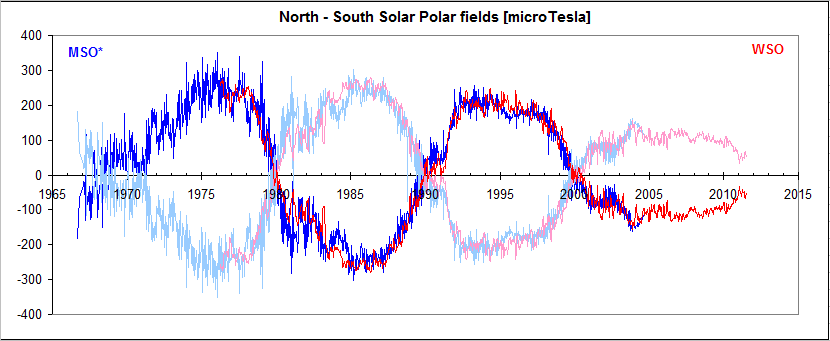
As the magnetic fields are what drive sunspots, here is a current look at Sun’s north and south magnetic fields:

Chart Courtesy of Wilson Solar Observatory

It is obvious that Cycle 24 is different from the Cycles 21, 22 and 23 that precede it.   The magnetic field strength is much weaker and angle of approach to the X axis (0 microTesla line) is very much steeper than that of Cycle 24. Click here, here and here for further discussion of the magnetic field.

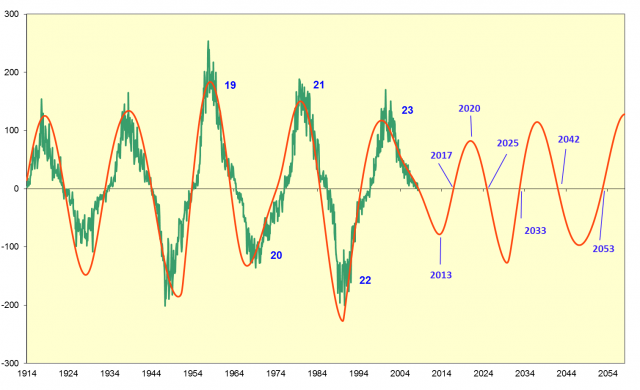
How about a look ahead to cycle 25 and beyond.  I don’t know enough to have much confidence in this forecast Ed Fix, but David Archibald seems to think it is viable.  Click here for more info:

The green line is the solar cycle record from 1914 to 2010, with alternate cycles reversed. Solar Cycles 19 to 23 are annotated. The red line is the model output, from which the lengths of individual solar cycles in the mid-21st Century can be calculated.

Mr. Fix has Cycle 25 duplicating the current Cycle 24.  Cycles 26,and 27 are about half again as large as 24 and 25. Even so his forecast for Cycles through 28 are all considerably less active than Cycles 18 through 23.  Does this mean an extended global cooling?

cbdakota

AGW Computer “Fails” Resource


Following several brief comments about another AGW scientist owning up to the weakness of the computer models, is a site that lists failed AGW climate computer models projections.  Remember it is these computer projection upon which rests the entire rationale for the manmade global warming theory,

Kevin Trenberth is “Distinguished Senior Scientist in the Climate Analysis Section of the National Center for Atmospheric Research”.  Trenberth has been a lead author for IPCC Global Warming Reports. He is also one of the Climategate gang.  In one of the hacked emails he sent to his compatriots he said:   “The fact is that we can’t account for the lack of warming at the moment, and it is a travesty that we can’t. The CERES data published in the August BAMS 09 supplement on 2008 shows there should be even more warming: but the data are surely wrong. Our observing system is inadequate.”  (My emphasis)  He later explained that what he really meant is that the globe is still heating up but nobody can figure out where the heat is going.  Recently Dr Spencer and Dr Braswell seem to have explained this.   See here for their paper On the Misdiagnosis of Climate Feedbacks from Variations in Earth’s Radiant Energy Balance  Roy W. Spencer, and William D. Braswell.

So we are talking about a major leader in the AGW theory crowd.  He recently has published a paper in “Climate Research”.  In that paper according to CO2 Science:

…..(he) compares the projections of state-of-the-art climate models with what is known about the real world with respect to extreme meteorological events related to atmospheric moisture, such as precipitation and various types of storm systems, as well as subsequent extreme consequences such as droughts, floods and wind damage. So what does he find?

 The C3 blog  summarizes that paper as follows:

Specifically, Trenberth takes issue with the climate models’ inadequacies in regards to precipitation. Such as:

                  …all models contain large errors in precipitation simulations, both in terms of mean fields and their annual cycle, as well as their characteristics: the intensity, frequency, and duration of precipitation…”

                  “…relates to poor depiction of transient tropical disturbances, including easterly waves, Madden-Julian Oscillations, tropical storms, and hurricanes…”

                  “…confidence in model results for changes in extremes is tempered by the large scatter among the extremes in modeling today’s climate, especially in the tropics and subtropics…”

                  “…it appears that many, perhaps all, global climate and numerical weather prediction models and even many high-resolution regional models have a premature onset of convection and overly frequent precipitation with insufficient intensity,…”

                  “…model-simulated precipitation “occurs prematurely and too often, and with insufficient intensity, resulting in recycling that is too large…”

                  “…a lifetime of moisture in the atmosphere that is too short, which affects runoff and soil moisture…”

                  and finally, he has a NSS moment…”major challenges remain to improve model simulations of the hydrological cycle.”

Ok we skeptic were pretty sure that was the case.  But remember that group still wants us to bet the future on their models.

I want to lead you  to a treasure trove of AGW computer model “Fails”.  If you click HERE you will get a listing of computer models failures.

Here are some of the recent titles:

NASA Research Reveals Antarctica Ice Sheet Melt Just A Fraction of Climate Model Predictions

New Research: Experts Determine German Flooding Has Not Increased From Global Warming As Predicted

IPCC Prediction That Global Warming Would Cause More Wildfires Proves To Be Wrong

Last Week Had The Global Warming Alarmists Admit To Zero Warming Since 1998, Now An Admission That Models Don’t Work

Since 1990, IPCC’s Climate Predictions Have Been Wrong – Billions Wasted On Worthless Fortunetelling

A Spectacular Failure: Latest HadCrut & NASA Temperatures Significantly Below IPCC Climate Model Predictions

Hansen’s Global Climate Model In Total Fail: Predicted Ocean Heat Goes Missing

Look at the other links that take you to more good information.

cbdakota

Skeptics Ahead on Science but Lag on Politics/Media


The Skeptics are winning the science battle but are still running behind in the political /media arena.  What can we do to help?

SCIENCE

Scientists are abandoning the man-made global warming  (AGW) theory in increasing numbers.  They are recognizing the obvious:  The skeptic’s science is based upon observationally based science whereas the AGWers theory is based on computer projections.

Observationally Based Science versus Computer Projections

Amazingly, the AGWers will often say that the facts are wrong because their computer comes up with different answers.  This is most recently illustrated with respect to the recent reports on global sea level. From a WattsUpWithThat posting:

A few months ago a widely-publicized article by Houston and Dean was published in the Journal of Coastal Research (and on your site), noting that although sea-level is rising; the tide gauge data does not show any increased rate of rise (acceleration) for the 20th and early 21st centuries.  This augmented by a >).”>recent paper authored by an Australian scientist as well.

Houston and Dean (2011) considered only tide-gauge records with lengths greater than 60 years, noting that shorter record lengths are “corrupted” by decadal fluctuations.

Rahmstorf and Vermeer (RV) had previously reported on sea level change using their computer-aided program that provided different results of those of Houston and Dean.  RV attacked the Houston and Dean entry.  Houston and Dean responded to the RV criticism by saying:

RV link sea-level rise with temperature using a simple linear relationship with two free variables of opposite signs that allow them to “fit” any smooth data set. However, they are curve fitting, not modeling physics, so the approach cannot be used to predict future sea level.

A recent workshop of the Intergovernmental Panel on Climate Change (IPCC, 2010) considered the semi-empirical approaches of Rahmstorf (2007), Vermeer and Rahmstorf (2009), and others and concluded, “No physically-based information is contained in such models …” (p. 2) and “The physical basis for the large estimates from these semi-empirical models is therefore currently lacking” (p. 2). Other recent studies show slowing or reversal of the sea level.  See

The AGWers Are Getting Desperate

For some 12 years, global temperatures have not shown any discernable trend upward to match the increasing amounts of atmospheric CO2.   At last the AGWers know the reason, its volcanoes or it might be China’s coal based power plant emission.   Certainly we can be grateful that the computers have resolved (well sort of) this issue.  So coal based power plants actually make the global temperatures cooler and all along we have been told just the opposite.

For more information read this link and if you want a laugh read this link.

POLITICS AND THE MEDIA

The Need For an Informed Public

For the nearly 10 years that I have been actively involved in discussions and reporting on global warming, I have always believed that the science was on the skeptic’s side.   In a status review of global warming prepared for some State Senators in 2003, I stated that being right about the science would probably not be enough to win this struggle with the AGWers.  For example, the taxing and regulating authority that would stem from enacting Cap and Trade legislation will drive the politicians.   I think the beginning of the end of AGW driven legislation will take place when the public began experiencing pain of the resulting financial burden.   But are we going to be reduced to third-world status as a nation before we can turn the ship of state around?

How can we avoid this national  destruction on the altar of the watermelon (red on the outside/green in the inside)  movement?

First principle should be that the people who are going to be asked to pay for these green programs be completely informed of the consequences of the regulations or legislation being enacted.  This is not happening now.

LEGISLATION

Let’s remember that the House of Representatives in 2009 passed legislation for imposing Cap and Trade on fossil fuel use.  The bill was over a thousand pages long.  The Democrat leadership pushed this massive attempt to bring the nation’s energy under the control of the Government without anyone fully understanding what was in the bill.  The committee chairmen said they did not know!!!!!!   In an attempt to mollify the unhappy conservatives, they agreed to have the bill read.  So those clowns hired a speed-reader.  I believe that a legislative rule should be enforced that requires no bill can be voted upon without a minimum of a week’s worth of legislative sessions following proposed law being published unless a ¾ vote in favor of suspending the rule is passed.   This would not impose a significant burden upon the members.  The objective would be to raise their constituents’ understanding and the legislators should not be afraid of doing that.    Fortunately, as you know, the Senate failed to pass companion Cap and Trade legislation and thus it was never enacted.

REGULATION

Regulations for Cap and Trade are being written by the EPA.  Yes, the EPA is writing regulations for legislation that could not get approval in Congress.  Part of the blame for this are five  of the nine members of the Supreme Court.

  Massachusetts v. Environmental Protection Agency, 549 U.S. 497 (2007),[1] is a U.S. Supreme Court case decided 5-4 in which twelve states and several cities of the United States brought suit against the United States Environmental Protection Agency (EPA) to force that federal agency to regulate carbon dioxide and other greenhouse gases as pollutants.

Despite the knowledge that this legislation could not get passed in Congress and despite the fact that CO2 was excluded from the Clear Air Act, the Supremes gave the EPA the authority to determine if CO2 were a threat and if so, to write regulations to control it.

The EPA used the 2007 IPCC Global Warming report as their  science basis.  The EPA  asked for comments on their study and then they ignored any response that said that AGW science was badly flawed.  People within the EPA that expressed doubt were told to be quiet.  The EPA found CO2 to be a threat and began writing regulations.  These regulations are vast and growing.

There is a little irony here in that the environmentalists want all sources of CO2 to be regulated.  The EPA does not want to do that because the enormity of the ensuing burden.   Every furnace exhausts CO2, every hospital, every mall,  almost everything that makes our nation go would have to be monitored and reported.  The regulation overload will quickly result in demands for changes.  In fact I believe the EPA worries that it would result in legislation taking CO2 out of the Clean Air Act again.

Here again, the straightforward thing would be for your representatives to inform you of what the impact on them will be.  Congress should limit the damage the Supreme Court and The Executive (EPA) Branches do when they usurp the Legislatures prerogatives,   by passing legislations that restores the balance of powers.

Any other suggestions?

THE MEDIA

We all value the freedom of the press as guaranteed in the US Constitution. However the media, by and large, is supportive of BIG GOVERNMENT versus more individual freedom and responsibility. So they practice a form of soft censorship themselves by only reporting one side of the story.   One would expect better of them.  Although their domination of “what is fit to print” has been somewhat weakened by the ubiquitous Internet, it still is the primary input of news and information for most of the citizens of the US.  If our citizens would do less American Idol and pay more attention to what the politicians are doing, it would have a salutary effect on the their personal well-being and the nation’s well-being.

Surely some part of their misguided reporting of climate science is because they are not trained scientifically.  They apparently are too lazy or too intimidated to try to research the issues.  A science reporter from a newspaper in my area has obviously no curiosity or no understanding of what a millimeter is.  He reported about the danger of calving Antarctic Ice that would raise sea level several millimeters per year.  Recently he did a fairly straightforward report on the transfer of State Climatologist title from one PhD to another.  The one surrendering the title is a notable skeptic and frequent co-author of papers with other notables such as Willie Soon and Sallie Baliunas.   At the end of the report about the transfer, the reporter took a cheap shot at the skeptic saying that the skeptic was know to be a member of a group that was part of another group that once received money from Exxon.  If the reporter had any level of curiosity he could find out that the most of Exxon’s grant money is for groups that are working on alternative energy.  If the reporter believes funding by an advocate of a particular position is wrong, then why not then report on monies granted by Greenpeace, of the World Wildlife Fund to AGW scientists and groups. Secondly, the grants of money by AGW groups swamp the piddling amount the skeptics receive.  These grants are governmental and NGOs supplied and they total into the billions.  See these reports for further information about the distribution of monies.Here & here & here.

One suggestion is that you keep up with the skeptic blogs like WUWT, Ice Cap, Climate Depot, Heartland, Climate Audit, Science, etc and I hope, Climate Change Sanity and spread the information widely.

Also write to the newspapers.  Tell them when they are off base.  Suggest things they should look into.

If you have some thoughts on all of this, let me know.

cbdakota

Climate Models Not Ready For Prime Time


The preceding posting, Climate Modelers are Wizard of Oz’s Spawn,  noted that the backcasting used to prove the models,  was not scientifically viable/honest. I worked in systems operations in manufacturing facilities where solutions to problems were proposed and then tested to see if they worked in the real world.   The technique of  backcasting to fit an experience curve has been around for a long time. When the model seemed to match history, the  “solution”  resulting from that model was employed going forward.  Sometimes it worked and sometimes it did not work. In the real world, you have to test, test  and retest your premises to assess the confidence of the rightness of the solution.  The concept of proving your solutions is not the standard in the science of global warming climate modeling as far as I can tell.  And my view is that the global climate dynamic is vastly greater that any of the problems we were solving in the operating facilities, thus the likelihood of obtaining a high degree of certainty is problematic.

Lets look at a summary of a recent posting that lists 10 issues that demonstrates that the models are not ready for prime time. This is from The Hockey Schtick blog where more detail is provided in that posting and can be read by clicking here.

1,            IPCC admits climate models have not been verified by empirical observations to assess confidence

2            IPCC admits it is not clear about which tests are critical to verify and assess confidence in the models.

3            Of 16 identified climate forcings, IPCC admits only two have a high level of understanding. Most of the others are said to have a low level of understanding.

4            Of the two identified as having high level of understanding (greenhouse gases and positive feedback) they are actually not well understood with empirical satellite data showing sensitivity to doubling CO2 with feedback is only about 0.7°C which is a factor of 4 less than IPCC climate models.

5            Climate models falsely assume “back-radiation” from greenhouse gases can heat the oceans. In fact IR radiation can only penetrate the surface a few microns with all the energy used  in the phase change of evaporation–which in fact cools the oceans.

6            UV radiation is capable of penetrating the ocean to a depth of several meters. The IPCC models ignore UV.

7            IPCC is not certain whether clouds have a net cooling or warming effect even though it is shown empirically that clouds are many times more important than greenhouse gases.

8            Ocean oscillation can have huge effects on climate and these are not incorporated into the models.

9            The traditional climate models fail to properly reconstruct the correct amplitude of climate oscillations that have clear solar/astronomical signature.

10            Climate models continue to greatly exaggerate sensitivity to CO2 by 67%. Despite the climate modeler having admitted this, they are unwilling or unable to tweak the models to match observed temperatures.

cbdakota

Climate Modelers are Wizard of Oz’s Spawn


If you look closely, it’s not demonstrated science but the climate models that are the basis for all the forecasts of catastrophe will result from manmade global warming.  The models, cited by the IPCC in their reports, supposedly demonstrated that the global temperatures recorded from 1978 to 1998 could only have occurred because of additional atmospheric CO2 from the increased use of fossil fuels.  Thus we are to believe that they have modeled the atmosphere so when the models look to the future they must give accurate projections.

But we know that these same models do not forecast worth a damn.  How can it be the models that all showed agreement with the past don’t get the future right? But perhaps more importantly why is it that the future forecasts don’t agree with one another.  That mystery is explain by Warren Meyer in his 9 June 2011 posting in Forbes:

When I looked at historic temperature and CO2 levels, it was impossible for me to see how they could be in any way consistent with the high climate sensitivities that were coming out of the IPCC models.  

My skepticism was increased when several skeptics pointed out a problem that should have been obvious.  The ten or twelve IPCC climate models all had very different climate sensitivities — how, if they have different climate sensitivities, do they all nearly exactly model past temperatures?  If each embodies a correct model of the climate, and each has different climate sensitivity, only one (at most) should replicate observed data.  But they all do. 

The answer to this paradox came in a 2007 study by climate modeler Jeffrey Kiehl. To understand his findings, we need to understand a bit of background on aerosols. Aerosols are man-made pollutants, mainly combustion products, which are thought to have the effect of cooling the Earth’s climate.

What Kiehl demonstrated was that these aerosols are likely the answer to my old question about how models with high sensitivities are able to accurately model historic temperatures.  When simulating history, scientists add aerosols to their high-sensitivity models in sufficient quantities to cool them to match historic temperatures.  Then, since such aerosols are much easier to eliminate as combustion products than is CO2, they assume these aerosols go away in the future, allowing their models to produce enormous amounts of future warming.

Specifically, when he looked at the climate models used by the IPCC, Kiehl found they all used very different assumptions for aerosol cooling and, most significantly, he found that each of these varying assumptions were exactly what was required to combine with that model’s unique sensitivity assumptions to reproduce historical temperatures.  In my terminology, aerosol cooling was the plug variable.

The problem, of course, is that matching history is merely a test of the model — the ultimate goal is to accurately model the future, and arbitrarily plugging variable values to match history is merely gaming the test, not improving accuracy.

This is why, when run forward, these models seldom do a very credible job predicting the future.  None, for example, predicted the flattening of temperatures over the last decade.  And when we look at the results of these models, or at least their antecedents, from twenty years ago, they are nothing short of awful.  NASA’s James Hansen famously made a presentation to Congress in 1988 showing his model runs for the future, all of which show 2011 temperatures well above what we actually measure today.

Meyer adds that: “Rather than real science, the climate models are in some sense an elaborate methodology for disguising our uncertainty.  They take guesses at the front-end and spit them out at the back-end with three-decimal precision.  In this sense, the models are closer in function to the light and sound show the Wizard of Oz uses to make himself seem more impressive, and that he uses to hide from the audience his shortcomings.”

So there we have it, the modelers jigger the system with enough variables to have the predetermined variables such as the positive feedback that boosts CO2 effect by a multiple of 3 or 4 be over ridden when doing the back cast and then drop the jiggering (in this case, aerosols) for future forecasts.

cbdakota