Category Archives: Global Temperatures

Do The Planets Control Our Climate?


The scientists that believe that the planets have a major influence on the Earth’s climate do not broadcast about aliens and UFOs from a house trailer outside of Elko, Nevada from midnight to six am.  But rather, they are legitimate and they have good arguments/research going for them.
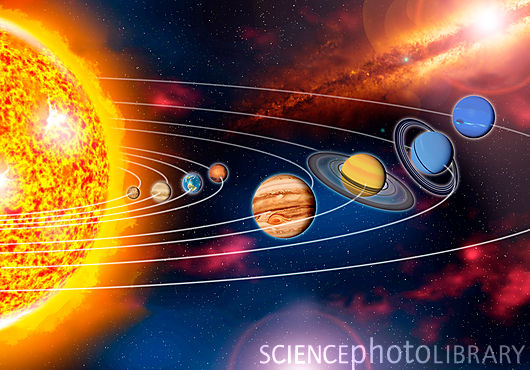
Courtesy of: Jose Antonio Penas/Science Photo Library

They are persuaded that the Sun, not CO2, is the primary driver of the Earth’s climate.  History shows that solar cycles that have low activity are accompanied by cooling climate.   For example, several minimally active cycles in succession have yielded the Maunder Minimum and the Dalton Minimum.  The temperature drop during the Maunder Minimum was so large as to give that Minimum the name—-“little ice age”.   The earlier Minimums were characterized by the low sunspot count.  Now we can add to that the F10.7cm radio flux, the geomagnetic readings, and many other ways to characterize the level of solar activity.  Even as new satellites and other investigative science provide us with greater understanding of the Sun, it still is not clear as to why Solar Cycle 24 is so inactive.  While many observers claim they knew 24 was going to be minimally active, the record shows most forecast that 24 would be pretty robust and not be appreciably different from Cycle 23.  Just like the weatherman that forecast rain for Maryland tomorrow because it is raining in West Virginia today, the solar experts now “know” that Cycle 25 will be like Cycle 24.

Dr. Hathaway of NASA observes that the Sun’s plasma Great Conveyor Belt (GCB) moved very rapidly in 2008 and 2009 but was notably slower in 2000 and 2001.  “I believe this could explain the unusually deep solar minimum we’ve been experiencing,” says Dr. Hathaway. The high speed of the conveyor belt challenges existing models of the solar cycle and it has forced us back to the drawing board for new ideas.”

Well ok, but why did the GCB change speeds?  Could the planets be the forcing  for this and other changes?

Planets as forcing agents

What is the relationship of the planets and Earth’s climate? There is a theory based upon on the conservation of momentum that links every planet to the Sun.  Another theory is the planet induced tidal effect upon the Sun’s plasma surface. Undoubtedly there are more, but two are enough for now.

Refresher:   Some of my readers may need a refresher regarding the solar system planets.

Solar System Planetary Data (rounded)

Body Distance from Sun10^6km Mass10^22kg OrbitDays Orbit Circ.10^6 km OrbitSpeed 10^6km/day
Mercury 58 33 88 364 4.1
Venus 108 487 225 679 3
Earth 150 598 365 942 2.6
Mars 228 64 687 1432 2.1
Jupiter 778 190,000 4332 4887 1.1
Saturn 1429 56,900 10760 8977 0.8
Uranus 2871 8690 30700 18036 0.6
Neptune 4504 10280 60200 28294 0.5

The mass of the Sun is 1048 times that of Jupiter or 1.989X 10^30 .

 The Landschiedt Minimum

In 2003, Dr. Theodor Landscheidt published a paper  “New Little Ice Age Instead of Global Warming?”  In that paper he predicted that the Earth would start cooling with the coolest period about 2030 and that it would be equivalent of the Maunder Minimum (aka, “the Little Ice Age’).   Landscheidt used the Gleissberg cycle of 80 to 90-years to identify periods of cool climate on Earth. He said that within the Gleissberg cycle there is an 83-year cycle in the change of the rotary force driving the Sun’s oscillatory motion about the center of mass of the solar system.  His premise was that the collective angular momentum of the giant outer planets imposed a torque on the Sun that varies the speed of the Sun’s equatorial rotational velocity.  Some people are saying that this minimum should be called the Landscheidt Minimum. (Landscheidt died in 2004.) Landscheidt further predicted that another minimum would occur about 2200.

One might presume that the center of the Sun is the likely solar system center of mass.  Only on occasion is that true.  The center of the solar system’s mass is called the barycenter.  Watch this video to get an appreciation for the effect of the planets on the barycenter.  (no sound)

The following chart shows where the barycenter is relative to the Sun by year.
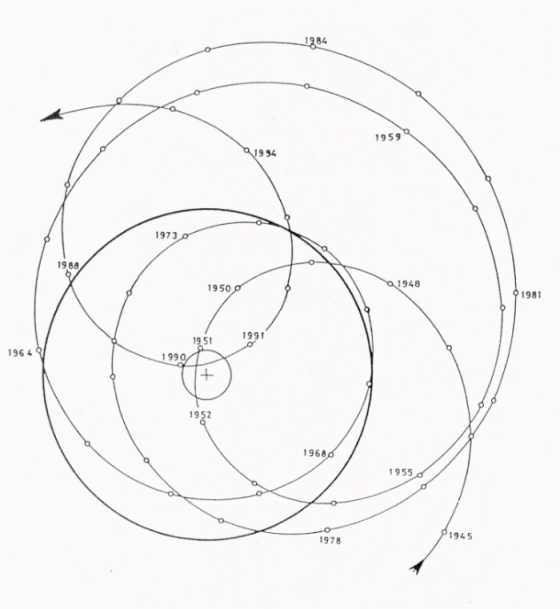
                      Figure 8:  Solar System Barycenter

Landscheidt said:

The solar dynamo theory developed by Babcock, the first still rudimentary theory of solar activity, starts from the premise that the dynamics of the magnetic sunspot cycle is driven by the sun’s rotation. Yet this theory only takes into account the sun’s spin momentum, related to its rotation on its axis, but not its orbital angular momentum linked to its very irregular oscillation about the centre of mass of the solar system (CM). Figure 8 shows this fundamental motion, described by Newton three centuries ago. It is regulated by the distribution of the masses of the giant planets Jupiter, Saturn, Uranus, and Neptune in space. The plot shows the relative ecliptic positions of the centre of mass (small circles) and the sun’s centre (cross) for the years 1945 to 1995 in a heliocentric coordinate system.

The large solid circle marks the sun’s surface. Most of the time, the CM is to be found outside of the sun’s body. Wide oscillations with distances up to 2.2 solar radii between the two centres are followed by narrow orbits which may result in close encounters of the centres as in 1951 and 1990. The contribution of the sun’s orbital angular momentum to its total angular momentum is not negligible. It can reach 25 percent of the spin momentum. The orbital angular momentum varies from -0.1�1047 to 4.3� 1047 g cm2 s-1, or reversely, which is more than a forty-fold increase or decrease (Landscheidt, 1988). Thus it is conceivable that these variations are related to varying phenomena in the sun’s activity, especially if it is considered that the sun’s angular momentum plays an important role in the dynamo theory of the sun’s magnetic activity.

Variations of more than 7% in the sun’s equatorial rotational velocity, going along with variations in solar activity, were observed at irregular intervals (Landscheidt, 1976, 1984). This could be explained if there were transfer of angular momentum from the sun’s orbit to the spin on its axis. I have been proposing such spin-orbit coupling for decades (Landscheidt, 1984, 1986). Part of the coupling could result from the sun’s motion through its own magnetic fields. As Dicke (1964) has shown, the low corona can act as a brake on the sun’s surface. The giant planets, which regulate the sun’s motion about the CM, carry more than 99 percent of the angular momentum in the solar system, whereas the sun is confined to less than 1 percent. So there is a high potential of angular momentum that can be transferred from the outer planets to the revolving sun and eventually to the spinning sun.

From wiki, a somewhat analogous to the Planets/Sun interaction: The conservation of angular momentum in Earth–Moon system results in the transfer of angular momentum from Earth to Moon (due to tidal torque the Moon exerts on the Earth). This in turn results in the slowing down of the rotation rate of Earth (at about 42 nsec/day[citation needed]), and in gradual increase of the radius of Moon’s orbit (at ~4.5 cm/year rate[citation needed]).

If you want to dig further into the concept of angular momentum, the following may be of interest to you:

Angular momentum is conserved in a system where there is no net external torque, and its conservation helps explain many diverse phenomena. For example, the increase in rotational speed of a spinning figure skater as the skater’s arms are contracted is a consequence of conservation of angular momentum.  Moreover, angular momentum conservation has numerous applications in physics and engineering (e.g. the gyrocompass).  See here, here and here to get the math behind conservation of angular momentum, angular momentum, and torque.

 Tidal Effect

Dr Nicola Scafetta of the Active Cavity Radiometer Solar Irradiance Monitor Lab (ACRIM) and Duke University has recently published in the Journal of Atmospheric and Solar-Terrestrial Physics  “Does the Sun Work as a nuclear fusion amplifier of planetary tidal forces?  Etc.”

Lets look at a summary of some of the planetary interactions with the Sun that affect the nominal 11 year solar cycle that he listed in his abstract to the article:

Numerous empirical evidences suggest that planetary tides may influence solar activity. In particular, it has been shown that: (1) the well-known 11-year Schwabe sunspot number cycle is constrained between the spring tidal period of Jupiter and Saturn, 􏰁 9:93 year, and the tidal orbital period of Jupiter, 􏰁 11:86 year, and a model based on these cycles can reconstruct solar dynamics at multiple time scales (Scafetta, in press); (2) a measure of the alignment of Venus, Earth and Jupiter reveals quasi 11.07-year cycles that are well correlated to the 11-year Schwabe solar cycles; and (3) there exists a 11.08 year cyclical recurrence in the solar jerk-shock vector, which is induced mostly by Mercury and Venus

Scafetta proposes that the planets cause surface tides on the Sun.  While very small, he believes the tidal gravitational potential energy dissipated in the Sun by the tides, may produce irradiance output oscillations with a sufficient magnitude to influence the solar dynamo processes.   More from the abstract:

Here we explain how a first order magnification factor can be roughly calculated using an adaptation of the well-known mass-luminosity relation for main-sequence stars similar to the Sun. This strategy yields a conversion factor between the solar luminosity and the potential gravitational power associated to the mass lost by nuclear fusion: the average estimated amplification factor is A􏰂4:25×10^6. We use this magnification factor to evaluate the theoretical luminosity oscillations that planetary tides may potentially stimulate inside the solar core by making its nuclear fusion rate oscillate. By converting the power related to this energy into solar irradiance units at 1 AU we find that the tidal oscillations may be able to theoretically induce an oscillating luminosity increase from 0.05–0.65 W/m^2 to 0.25–1.63 W/m^2, which is a range compatible with the ACRIM satellite observed total solar irradiance fluctuations. In conclusion, the Sun, by means of its nuclear active core, may be working as a great amplifier of the small planetary tidal energy dissipated in it. The amplified signal should be sufficiently energetic to synchronize solar dynamics with the planetary frequencies and activate internal resonance mechanisms, which then generate and interfere with the solar dynamo cycle to shape solar dynamics, as further explained in Scafetta (in press). A section is devoted to explain how the traditional objections to the planetary theory of solar variation can be rebutted.

Both theories have many critics.  I am not knowledgeable enough to support or deny these theories.   However,  Dr Hathaway’s comment about varying speeds in the Great Conveyor Belt would lend some support to these theories especially Landscheidts.   Anyway, the Sun is where the action is with respect to global climate change.  And it will probably be a number of years before any theory wins out.  Remember how much bad press the cosmic ray theory got from the experts, and this case I mean the warmers.  Now after some work at CERN, it is looking like a winner, just not yet announced.  There is hope.

cbdakota
Solar Cycle 24–April Update


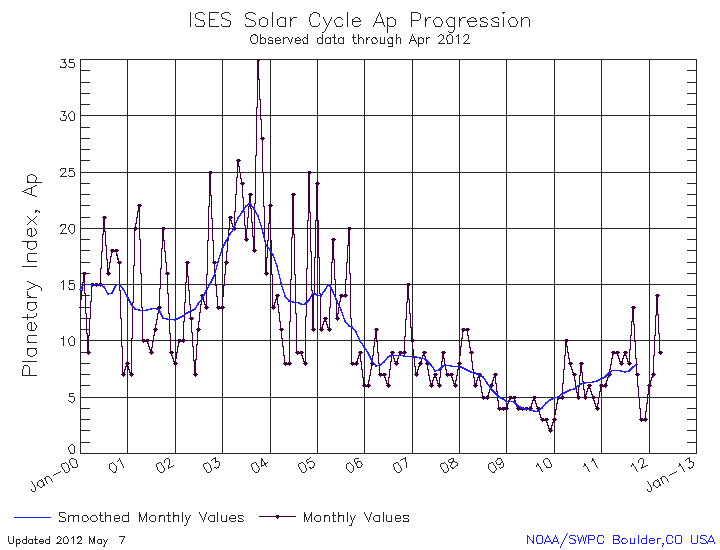
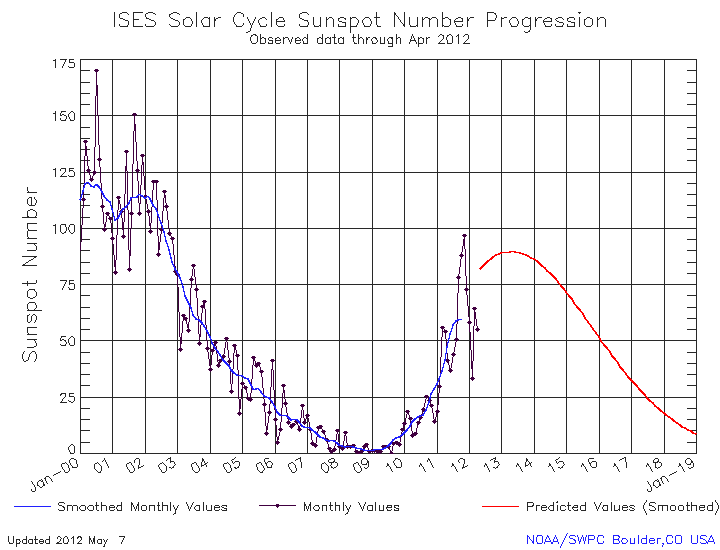
Generally speaking, Solar Cycle 24’s April sunspots numbers, F10.7cm flux and the geomagnetic field Ap index all indicate reduced solar actively.  NASA as well most of the experts in this field agree that Solar Cycle 24 will be a record setter of a sort—least active in about 100 years.  One need not base this on computer models or some consensus, however.  All that is required is to look at the data.  I do not think anyone has a handle on why Cycle 24 is acting this way.  There are many theories and perhaps one of them is correct. Will Cycle 25 continue this downward trend?  Click on the charts to improve clarity.

cbdakota

Japanese Researchers Suggest Cycle 24 Could Be The Start Of A New Maunder Minimum


The Asahi Shimbun* reports that “Officials of the National Astronomical Observatory of Japan and the Riken research foundation said on April 19 that the activity of sunspots appeared to resemble a 70-year period in the 17th century in which London’s Thames froze over and cherry blossoms bloomed later than usual in Kyoto. The sun may be entering a period of reduced activity that could result in lower temperatures on Earth, according to Japanese researchers. “ They are suggesting that solar Cycle 24 is the beginning of an era similar to the Maunder Minimum.

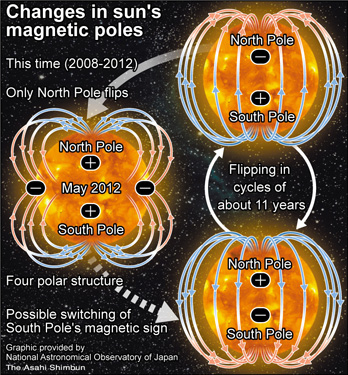
A solar cycle usually lasts about 11 years.  During the cycle, the poles switch polarity at about the time of the solar maximum.   Many scientists are predicting that Cycle 24’s maximum will occur about May of 2013. However, the Japanese researchers found signs of unusual magnetic changes in the sun. They report that the solar observation satellite Hinode found that the north pole of the Sun has already begun to flip—about a year earlier than expected.  They found no noticeable change in the South Pole.

The researchers add: “If that trend continues, the north pole could complete its flip in May 2012 but create a four-pole magnetic structure in the sun, with two new poles created in the vicinity of the equator of our closest star. “

Below is the National Astronomical Observatory of Japan’s representation of the Sun’s poles in May 2012:

 *The Asahi Shimbun has the second highest circulation of Japan’s national newspapers 

cbdakota

Lovelock No Longer an AGW Alarmist


“James Lovelock, the maverick scientist who became a guru to the environmental movement with his “Gaia” theory of the Earth as a single organism, has admitted to being “alarmist” about climate change and says other environmental commentators, such as Al Gore, were too.” according to a report by MSNBC.  Lovelock still supports the theory of man-made global warming (AGW), but clearly he wishes to back away from the Alarmists that dominate that movement and are followed closely by the mass media.

For those who don’t know James Lovelock, he is considered a major force in the AGW movement.  In a 2007 Time magazine special edition titled “Heroes of the Environment”, Lovelock was cited as one of 13 “leaders and visionaries” of the environmental movement.  Also cited in that edition were Gore, Gorbachev, Prince Charles, Angela Merkel, Robert Redford, David Suzuki and several others.  (I know, I know, based on his company in the Time list you may want to question its value.)   Lovelock is a Fellow of the Royal Society.   He has been awarded many prizes including the Wollaston Medal, the Geological Society highest award.  Charles Darwin was a previous winner.  He was made Commander of the Most Excellent Order of the British Empire (CBE) in 1990.

Here are several of Lovelock’s Alarmist positions.

“Even the best democracies agree that when a major war approaches, democracy must be put on hold for the time being. I have a feeling that climate change may be an issue as severe as a war. It may be necessary to put democracy on hold for a while.”

“By 2040, parts of the Sahara desert will have moved into middle Europe. We are talking about Paris – as far north as Berlin. In Britain we will escape because of our oceanic position.”  “If you take the Intergovernmental Panel on Climate Change predictions, then by 2040 every summer in Europe will be as hot as it was in 2003 – between 110F and 120F. It is not the death of people that is the main problem, it is the fact that the plants can’t grow – there will be almost no food grown in Europe.”[25]

In 2006 Dr Lovelock predicted the Earth “would catch a morbid fever” that would destroy six billion people – “the few breeding pairs of people that survive will be in the Arctic where the climate remains tolerable.  In 2009, he told the Guardian that “we may face planet-wide devastation worse even than unrestricted nuclear war between superpowers”.

Lovelock formulated the Gaia hypothesis:  “First formulated by Lovelock during the 1960s as a result of work for NASA concerned with detecting life on Mars the Gaia hypothesis proposes that living and non-living parts of the Earth form a complex interacting system that can be thought of as a single organism.”

So what is he now saying?

“The problem is we don’t know what the climate is doing. We thought we knew 20 years ago. That led to some alarmist books – mine included – because it looked clear-cut, but it hasn’t happened,”

“The climate is doing its usual tricks. There’s nothing much really happening yet. We were supposed to be halfway toward a frying world now,”

“The world has not warmed up very much since the millennium. Twelve years is a reasonable time… it (the temperature) has stayed almost constant, whereas it should have been rising — carbon dioxide is rising, no question about that….”

He adds that Gore’s “An Inconvenient Truth” and Tim Flannery’s “The Weather Makers” as other examples of “alarmist” forecasts of the future.

Well,  we are better off by one Alarmist dousing his flaming rhetoric.  But there are many others out there still untamed and a mass media still happy to pass such rhetoric along as science.

cbdakota

Global Temperature Update-March 2012


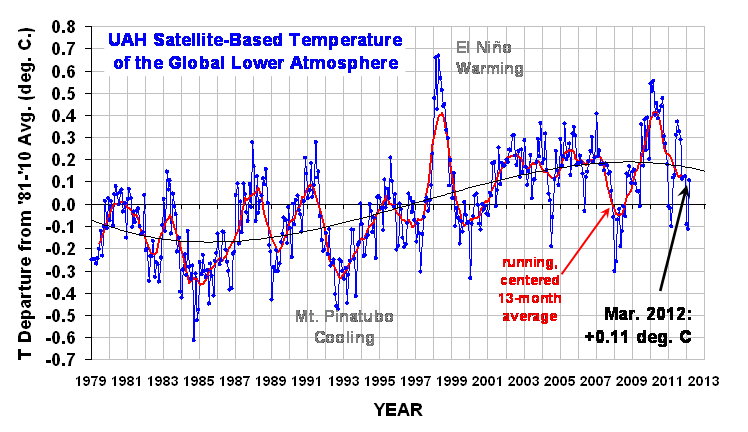
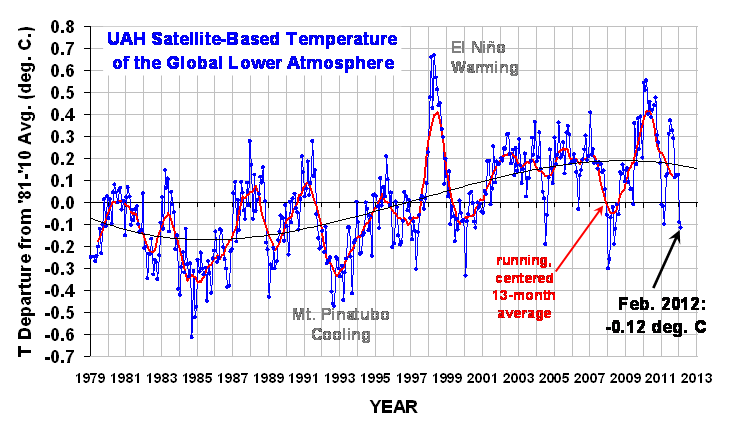
The global temperature bounced upward in March.   March anomaly is +0.11 C.  Below is the UAH satellite temperature anomaly record since the satellite program began.–Chart courtesy of Dr Spencer. (click on the chart for clarity)

Dr Spencer provides some background on these global temperature measurments:

Since 1979, NOAA satellites have been carrying instruments that measure the natural microwave thermal emissions from oxygen in the atmosphere. The signals that these microwave radiometers measure at different microwave frequencies are directly proportional to the temperature of different, deep layers of the atmosphere. Contrary to some reports, the satellite measurements are not calibrated in any way with the global surface-based thermometer records of temperature. They instead use their own on-board precision redundant platinum resistance thermometers calibrated to a laboratory reference standard before launch.

These UAH satellite temperatures are the “gold standard”.

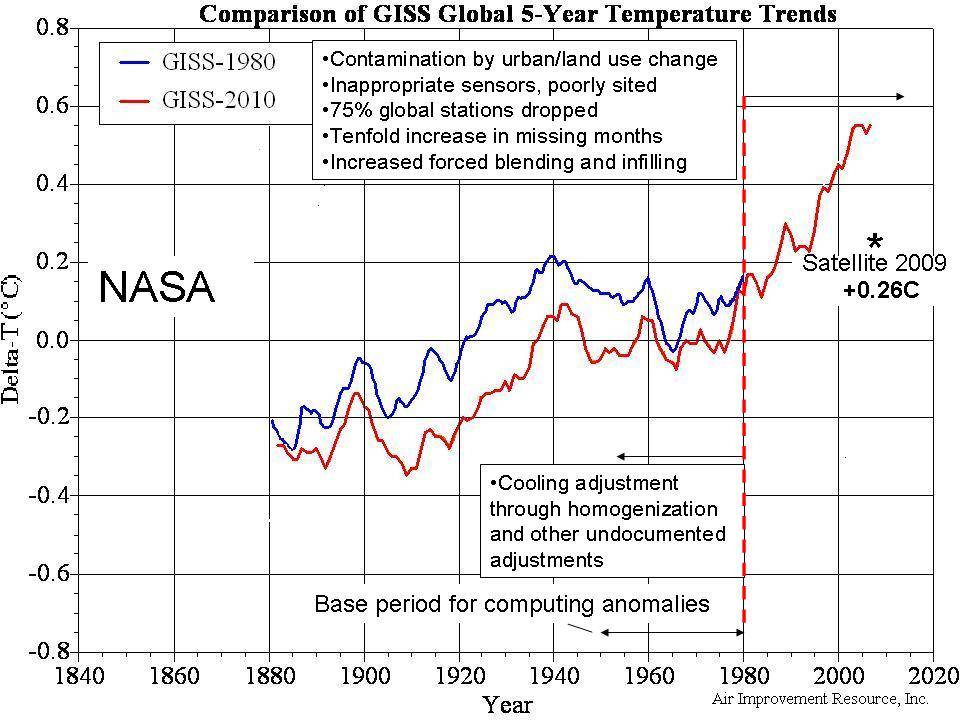
The revisionism that goes on with the so-called respected organizations that report surface temperature invalidates their work in my view.  For the those wondering what I mean,  it is this.  Because their charts are a matter of record,  we can see how they have on various occasions revised the charts.  The temperatures in the 1930tys have been lowered and  the more recent temperatures have been raised.  All of this is to give the illusion that the recent years are warmer and that the rate of increase is more dramatic.  Note the NASA (GISS) chart below.  The data as presented in 1980 are plotted in blue.  The data as presented in 2010 are in red.

Click here for more detail on these two charts.

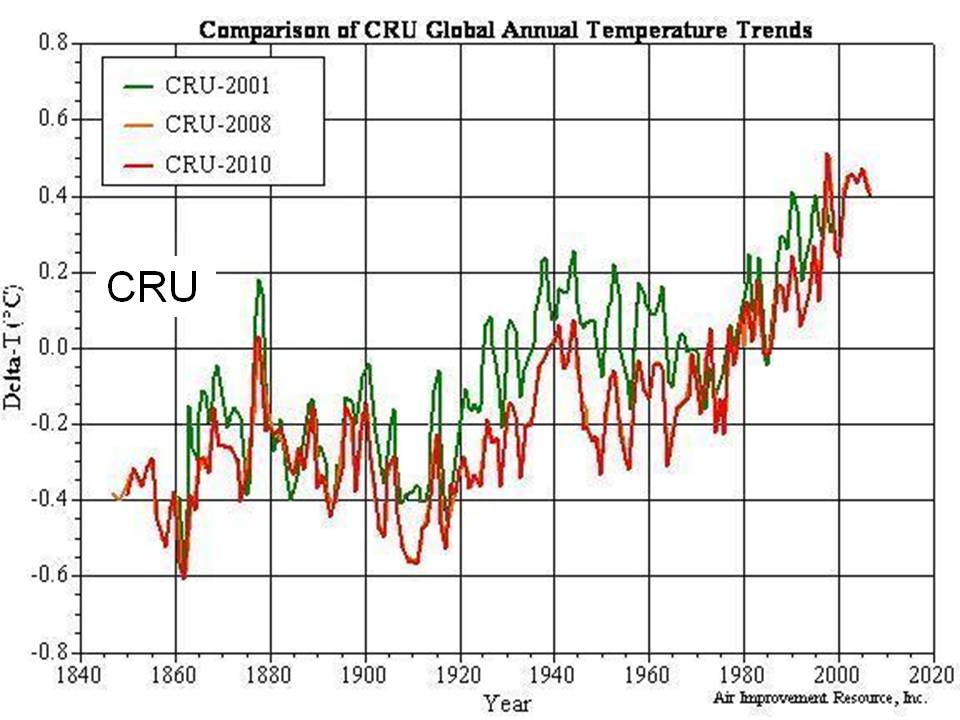
CRU did something similar.  See chart below showing the revisions made between 2001 and 2010.

cbdakota

Global Temperature Update—February 2012


The UAH satellite global temperatures have been posted by Dr Roy Spencer on his website.  The February temperature anomaly is -0.12 C.   That is just slightly down from the January number of -0.09C.

Above is Dr Spencer’s chart (click on it to enlarge) of the global temperature anomalies since the start of the satellite temperature-measuring program in the late seventies.  The average global temperature departure is about 0.16C warmer that the average temperature for the period 1981-2010.  Dr Spencer might not approve of this calculation but 0.16 C over that 30-year period might indicate a warming of about 0.6C per century.  Further, if solar Cycle 24 and the next Cycle 25 perform as many are now forecasting, we may see the anomaly go negative for many years.

cbdakota

Germany Surrenders on Solar Power


The title of this blog is a direct lift from an American Thinker posting of the same name.   Bjorn Lomborg, the Skeptical Environmentalist reports that Germany once was proud to call themselves “photovoltaic world champion”.  But nation has found the solar-power subsidies are expensive and inefficient.  Accordingly Lomborg:’ Using solar, Germany is paying about $1,000 per ton of CO2 reduced. The current CO2price in Europe is $8. Germany could have cut 131 times as much CO2 for the same price. Instead, the Germans are wasting more than 99 cents of every euro that they plow into solar panels.”

The Germans are phasing out these subsidies over a 5 year period.

In the US, we need to get serious about stopping the handouts to the Friends of Obama too.

cbdakota

Warmer “Ethics” Leader Fakes Identity to Steal Documents


Peter Gleick, who stole the Heartland Institute Board of Director documents under false pretenses, is the Chair of the American Geophysical Union (AGU) Task Force on Scientific Integrity!!!!   How is that for irony and perhaps it speaks to the overall integrity of the Warmer cause.

Someone made up a fake cover letter to accompany the stolen documents and sent out a package to Warmer supporters in the media.  In the fake cover letter, Heartland is saying that they are going to spend $100,000 in schools with the objective of providing information that would show that “the topic of climate change is controversial and uncertain – two key points that are effective at dissuading teachers from teaching science”.   NOT TO TEACH SCIENCE!  Heartland did not write the cover letter.  Gleick says he is not guilty of writing the cover letter.  Those are leading the investigation believe he did write it.  He has resigned his position as the head of the Scientific Integrity Task Force.

However Gleick says it really wasn’t his fault:“My judgment was blinded by my frustration with the ongoing efforts — often anonymous, well-funded, and coordinated — to attack climate science and scientists and prevent this debate, and by the lack of transparency of the organizations involved.”   So it is Heartland’s fault. They are so well funded.

Jo Nova’s blog has the following table showing only a few of the Warmer organizations’ funding versus Heartland Institute funding:

Entity USD
Greenpeace  $300m  2010 Annual Report
WWF  $700m  ”  ($524m Euro)
Pew Charitable Trust  $360m 2010 Annual Report
Sierra Club  $56m 2010 Annual Report
US government funding for climate science and technology  $7,000m  “Climate Money” 2009
US government funding for “climate related appropriations” $1,300m USAID 2010
US government funding for skeptical scientists     $ 0
Heartland Institute $7m  (actually $6.4m)

Nova’s table highlights the vast discrepancy in funding.  She adds: “So what the expose shows is that the Heartland Institute punches far above its weight with an incredibly efficient budget.” To see Jo Nova’s full posting click here.

Why are the Skeptics becoming so successful in getting their message across?  It is not that they have a lot of money.  It certainly isn’t the media that seem only interested in press releases from the Warmers.  It is not the Governments of the world that support only Warmer climate research.  Its not the school districts that make Al Gore’s “An Inconvenient Truth” required viewing.

But rather it is the Internet where people can judge the available reports for themselves. It the exposure of the Warmer leaders hiding the truth, gaming the science, denying Skeptics access to publication of their studies etc. as exposed by Climate Gate.  It is also a public that is weary of Warmer shrill claims of impending disaster—which never materialize.

cbdakota

Cycle 24 January Update


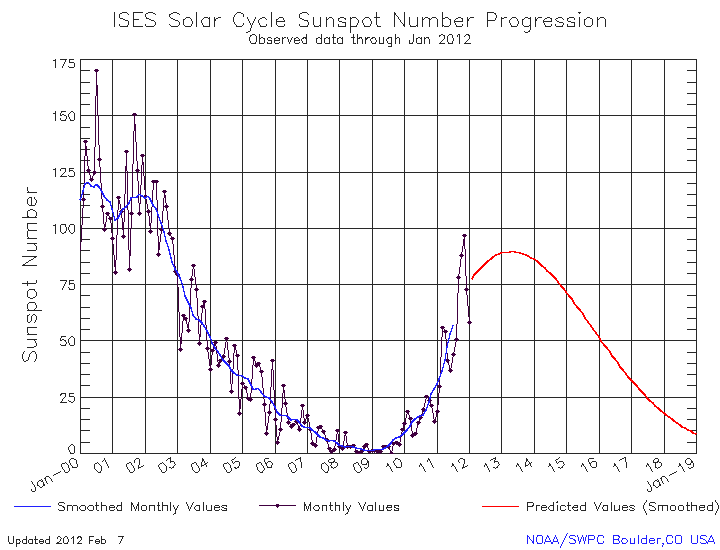
Cycle 24 activity in January was low.  Cycle 24 solar maximum is probably about 18 months away.   The January sunspot number and the F10.7 flux are following the NASA forecast.  The very low Ap index seems confirm that this cycle is likely to be much less active than Cycle 23.  See the charts below, all courtesy of NOAA/SWPC. (click on charts to enlarge)

cbdakota


The Warmers—-The Gang That Can’t Shoot Straight


Last year the Warmers were defending the IPCC’s Fourth Assessment Report’s conclusion that the Himalayan glaciers would disappear by 2035.   Oops, they then said, we meant 2350.  Even so, we are being told that the glaciers were melting and so quickly that the people in Asia would be in big trouble when there was no more melt water.  They believed that melting of Himalayan glacial ice was equivalent to 50 billion tons of water every year.  But now a study  ( lead scientist John Wahr and team) published in Nature tells that the Himalayan glaciers have lost no ice over the last decade. The measurements of global ice for this study were done using satellites.   According to the report:

The reason for the radical reappraisal of ice melting in Asia is the different ways in which the current and previous studies were conducted. Until now, estimates of melt water loss for all the world’s 200,000 glaciers were based on extrapolations of data from a few hundred monitored on the ground. Those glaciers at lower altitudes are much easier for scientists to get to and so were more frequently included, but they were also more prone to melting.

The bias was particularly strong in Asia, said Wahr:

“Their extrapolation is really tough as only a handful of lower-altitude glaciers are monitored and there are thousands there very high up.”

Satellite data for the rest of the world’s glaciers were also measured and the team reported no changes in the melt rate.

Glaciers have been melting for the last 10,000 years.   The question is really— is the present rate particularly unusual?  This study certainly puts into question the warmers previous assertion that it is.  Isn’t this just one more indication that there has been no statistically significant global warming over the past decade.

But whenever a study comes out like this, it is required to say—- nothing has changed, CO2 is still the problem.    Prof Jonathan Bamber, the director of the Bristol Glaciology Centre said:

“The new data does not mean that concerns about climate change are overblown in any way. It means there is a much larger uncertainty in high mountain Asia than we thought. Taken globally all the observations of the Earth’s ice – permafrost, Arctic sea ice, snow cover and glaciers – are going in the same direction.

NOT OVERBLOWN?????  (Just more uncertainty!!)

Professor Bamber also participated in an online Q and A session.  He responded to a question from “On Earth” as follows:

OnEarth. For Antarctica and Greenland the results from this study are in very good agreement with most recent previous estimates of mass loss from the ice sheets so it doesn’t change our view of what these are doing.

I have always had a lot of respect for “most recent previous estimates..” what ever they are.

Are we to assume that much stress is being felt in Asian lands where the Himalayan ice melt is so important according to the IPCC?  If there is no net change in total ice as the study tells us, does that mean there is a vastly reduced melt water flow?  By the way, there are many studies that say the monsoons are the principal source of the water these Asian countries rely upon.

To read more click here and here.

cbdakota