Category Archives: fossil fuels

Bogus Mercury Scare Used To Shutdown Coal Electricity Generating Plants


Before he was elected, President Obama said that he would bankrupt anyone who built a new coal-base power generation plant.  He planed to do this by enacting Cap and Trade legislation that would target coal-based facilities. Because coal-based plants emit more CO2 than do natural gas-based plant per kW of electricity, the CO2 tax levied on coal-based facilities would make them uneconomical to build and operate.  However a bill for his signature could not get out of Congress.  (A little discussion of the regulation of CO2 later.) The administration refocused their efforts to put coal out of business by issuing new regulations that reduced the amount of mercury and other air pollutants in coal plant emissions (CO2 was not included).   Mercury is clearly the poster child for these new regulations and that is obvious by the many press releases and stories in the media. According to the EPA, children exposed to the reduced mercury levels will be healthier and have higher IQs.

How solid is the contention that it will make our children healthier?   A posting by Willie Soon and Paul Driessen, titled “US: The myth of killer mercury” shows the EPA’s actions to not be based on good science:

According to the Centers for Disease Control’s National Health and Nutrition Examination Survey, which actively monitors mercury exposure, blood mercury counts for US women and children decreased steadily 1999-2008, placing today’s counts well below the already excessively “safe” level established by EPA.

A 17-year evaluation of mercury risk to babies and children, by the Seychelles Children Development Study, found “no measurable cognitive or behavioral effects” in children who eat five to twelve servings of ocean fish every week, far more than most Americans do.

The World Health Organization and US Agency for Toxic Substances and Disease Registry assessed these findings in setting mercury risk standards that are 2-3 times less restrictive than EPA’s. Even under WHO and ATSDR guidelines, no American children are even remotely at risk from mercury.

EPA ignored these findings. Instead, the agency based its “safe” mercury criteria on a study of Faroe Islanders, whose diet is far removed from our own. They eat few fruits and vegetables, but do feast on pilot whale meat and blubber that is high in mercury and polychlorinated biphenyls (PCBs) – but very low in selenium. The study is clearly irrelevant to this rulemaking.

Finally, EPA maintains that mercury deposition, its conversion to methylmercury, and MeHg accumulation in fish and humans is a simple process that can be controlled by curtailing emissions from US power plants. That is not correct. In fact, mercury emissions (from all sources) and raw mercury levels in fresh or ocean waters are only part of the story.

Complex, nonlinear interactions among at least 50 natural variables control the biological and chemical processes that govern elemental mercury conversion to methylmercury and MeHg accumulation in fish. Those variables, and selenium levels in fish tissue, are beyond anyone’s ability to control.

So clearly the EPA has grossly exaggerated the threat of mercury.

Another question that needs to be asked is how much mercury is released each year and how much of that comes from US coal-based plants.

Mercury Emissions – Natural and Man-Made

Source Emission Quantity, Mg/Year % of Total
Natural 5207 69
Manmade 2320 31
            TOTAL 7527 100
North American Coal Plants 65 0.9

 Data From Global mercury emissions to the atmosphere from anthropogenic and natural sources” Atmos. Chem. Phys., 10, 5951–5964, 2010 by N. Pirrone, S. Cinnirella, X. Feng, et al.

The mercury emissions total from the North American coal-based plants are less than one per cent of global emissions!!  So the effect on the health of people in the US through reduction of some fraction of the coal-based plants mercury emissions is essentially too small to measure.  However the effect of the increased cost of electricity will directly affect the health of the people in the US and especially the poorest among us.

See this posting by the Institute for Energy Research to get a sense of the loss of generating capacity that this EPA regulation will cause.

Willis Eshenbach developed two charts for his posting “The EPA’s Mecurial Madness” on the WUWT website.   They visually illustrate the futility of the EPA action to make any difference in mercury levels.

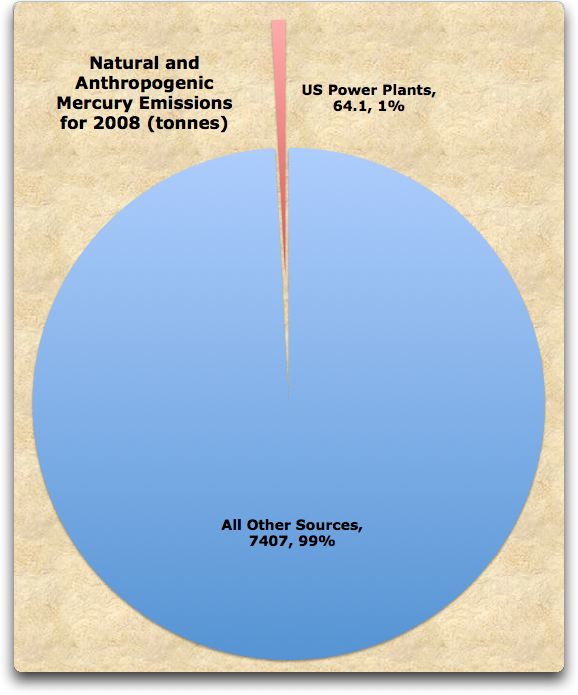
The EPA has more “kill coal-based power generation capacity” arrows in its quiver, and I plan to post on this soon.  As a preview, they are proposing a standard that will not permit the installation of new coal-based plants.

cbdakota

Evaluating The Cost of Ownership–Electric v Gasoline Cars.


The New York Times posts an essay titled “The Electric Car, Unplugged” by John Broder, 25 March 2012.  The Hockey Schtick summarized the NYT article this way:

An article in tomorrow’s New York Times proclaims, “The state of the electric car is dismal, the victim of hyped expectations, technological flops, high costs and a hostile political climate.” In typical NYT fashion, the article concludes with the implication that the failure of electric cars is the fault of the fossil-fuel industry.

Because The Hockey Schtick said it so well, you don’t need to read the NYT article, but if you choose to, click here.

I imagine it is hard for some people to put themselves in the shoes of the car buyer.  Most of us are confined within certain boundaries such as amount of money that can be spent on an automobile and what we need to be able to do with that auto.  Gas prices enter the picture but they are not the sole consideration.

My belief is that the people most hurt by higher gasoline prices are typically those having to drive a lot of miles.  Now, while that doesn’t seem like a particularly profound insight, it probably is better than assuming that a person driving a lot of miles would be disposed to buying an EV or a hybrid.  EVs are really not for the high mileage drivers.  The hybrid might seem to be competitive but it’s advantage goes away after just a few miles.

The DOE has a program for comparing different makes and models of cars to determine the cost of ownership.  Using the DOE calculator, the Chevy Cruze is a better buy than the Volt. The DOE program considers operating cost plus initial investment, expected depreciation and cost of maintenance at today’s prices.   The Volt does beat the Cruze when calculating only the cost of fuel.  The DOE uses a 2011 purchase price for the Volt at $40,280 and the Cruze at $18,125.  To use the DOE program to make your own comparisons, click here.

Now some examples: Imputing $4 per gallon gasoline, and 30,000 annual miles into the DOE program, the Honda Fit gives better cost of ownership than the Prius until the 11the year of ownership.  Hardly any autos are still around at the 300,000 miles so data after ten years seems to be of little value.  The Fit cost of ownership advantage gets better at less than 30.000 miles per year.

So where does that leave the EVs and the hybrids?   Seems to me that those go to the people that have a lot of money.  Most of them don’t really worry too much about the price of gasoline anyway.  If you only drive 10 miles to work and 10 back each day, the EV will serve you nicely but the cost of ownership would be very high due to the initial cost and very little to do with the price of gasoline.  If you use the DOE program to compare the Fit versus the Leaf at 20 mile daily commute and 7000 annual miles total with gasoline at $4 per gallon, the Fit is much lower cost of ownership than the Leaf according to the DOE program.

Another factor that is not necessarily rational but has been experienced often in the last 30 years is that gasoline price peaks and then retreats.  New lows may exceed previous lows but at the lower price, the Honda Fit, for example reaffirms the decision to avoid the costly EVs and hybrids.

The reason that EVs and hybrids are not setting sales records is not some nefarious BIG OIL plot, but rather it is rational decision making on the part of the buyer.

cbdakota

Is This A Prelude To Nationalization Of The US Energy Companies?


On the 16th of March President Obama signed a new Executive Order allowing the President complete control over all US Resources. Click to read the detail.  The rising price of gasoline is considered to be one of the major threats to the reelection of Obama.  He is trying to dodge the blame by pretending that he really wanted the XL pipeline with his sham endorsement today in Oklahoma of the lower portion.   His approval is not needed for this section of the pipeline.  His approval is only required for pipelines that cross the US borders.  He has rejected the upper section of the XL pipeline, which brings in the oil from Canada, because his environmentist campaign fund donors oppose it. His sham of caring about our energy security  is trumped by his need for campaign monies.

So if these tricks don’t fool the public, what is his next act? Read my July 13 2011 posting titled OBAMA PLANS TO NATIONALIZE THE ENERGY COMPANIES.  He will say he is just doing this for our own good.  That he must step in and stop these out-of-control corporate robbers.  His action will be cheered by the media.

If Big Oil is driving up the prices how do they do it?  The American Petroleum Institute (API) listed the 20 Largest Oil and Gas Companies based upon their 2009 oil reserves.  It shows that 72% of the world’s oil reserves are owned by nations (not privately owned companies) such as Iran, Saudi Arabia, Venezuela, and Libya.  The biggest US Company to make the list was Exxon-Mobil at #17.   The Exxon-Mobil reserves as a percent of the world reserves are 0.68%.  Think about this situation where the OPEC type state owned companies have reserves 100 times greater than Exxon-Mobil.  Do you really believe that Exxon-Mobil is able to dictates the price of crude to OPEC?   Of course they can’t do that.

h/t to Steve Glaser

cbdakota

/

$141M Solar Plant Has 5 Full Time Employees.This is a Success?


The Nevada Copper Mountain Solar 1 plant is being visited today, 21 March by President Obama where he will deliver remarks on his Administration’s focus on diversifying our energy portfolio.   Solar 1 is the US’s largest photovoltaic power plant.  It cost $141 million to build.  According to the Nevada Journal: “Funding included $42 million in federal-government tax credits and $12 million in tax-rebate commitments from the state of Nevada.”  It has 5 full-time employees.  About $10 M of incentives per green job.  Apparently the President considers this a success.

President Obama’s visit to the Solar 1 Facility in Boulder City is the perfect illustration of why the president’s economic policies are such a failure,” said Andy Matthews, president of Nevada Policy Research Institute, (NPRI). “The government has spent over $50 million to ‘create’ five permanent jobs and build a plant producing a product — expensive solar energy — that no one would purchase without a government mandate.

“That’s not a path to a vibrant economy; it’s the road to serfdom. This mindset — of government attempting to pick winners and losers in the economy through subsidies and regulation — is a major reason why the national unemployment rate is at 8.3 percent, Nevada’s unemployment rate is 12.7 percent and the national debt is over $15.5 trillion.”

Kyle Gillis, a reporter for the Nevada Journal, the source of much of this posting, adds: “Solar plants aren’t the only government-funded energy projects in Nevada that haven’t lived up to their proponents’ promises. The Reno Gazette-Journal recently reported that seven local windmills that cost taxpayers $1 million to install have only saved the City of Reno $2,785 in electricity costs over their 18 months of existence”.

The Solar 1 plant is associated with Bolder City, NV but the power generated is being sent to Southern California.  California mandate’s power must be 20% renewable by 2010, 33% renewable by 2020. They did not achieve the 2010 level of 20%.  If the California Utilities supplying the energy do not comply, they risk being fined.  Californians seem to want to drive business from their state with many environmental policies that businesses just can’t afford.  California’s electricity price is 9th highest in the nation only surpassed by Hawaii, and group of Northeastern states such as Connecticut, and New York. By the way, hydroelectric power is not considered renewable under this California mandate.

Obama used his “luddite” and “straw man” speech today. I cannot recall a President in my lifetime that has been so incautious with what he says.   I guess it goes with the territory of being on a constant campaign.  I would think the appropriate name for the President is “fabulist”—and of course I am saying that politely.

I want to leave you with a chart that shows the hill that solar and wind have to climb to reach the heights that the President and his sycophants have set.   As you look at the chart below, think of Matt Ridley’s words: “To the nearest whole number, the percentage of the world’s energy that comes from wind turbines today is: zero.

 WORLD ENERGY USE 

This chart is from Wikipedia.   The data is 2006 but it things wont have changed much by 2011 in terms of percentages.

cbdakota