Category Archives: fossil fuels

Russia’s Federal Budget Depends On High Price Crude Sales


A summary of the Russian Federal budget was posted by Reuters in July of this year.  It said that Russian crude oil had to be sold at or above $116 per barrel or the budget would show a deficit for the year.  A cursory look at the Ural blend (Russian Trading System, comparable to the WTI or Brent) crude pricing for the year suggests that it probably fell short of the goal.  To get some feel for whether or not they accomplished the price requirement, understand that the Ural and Brent crude price indices have been essentially the same for 2012.  The posting tables the Draft Three Year Budget:

DRAFT THREE-YEAR BUDGET 2013-2015 (in trillion roubles unless

stated)

Year                                         2012    2013     2014      2015

Break-even oil price ($)  116.2    113.9     106.0    105.4

Average oil price ($)              115      97        101      104

Nominal GDP                         60.6     65.8      73.4     81.5

Revenues                                  12.7     12.4      13.6     15.2

Expenditures                          12.7     13.4      14.1     15.3

Deficit (% GDP)                      – 0.1      1.5       0.6      0.11

Non-oil deficit (% GDP)     10.6     10.1      8.9      8.6

$1  =  31 rubles

By 2015, the draft budget forecasts break even price at $105.4.

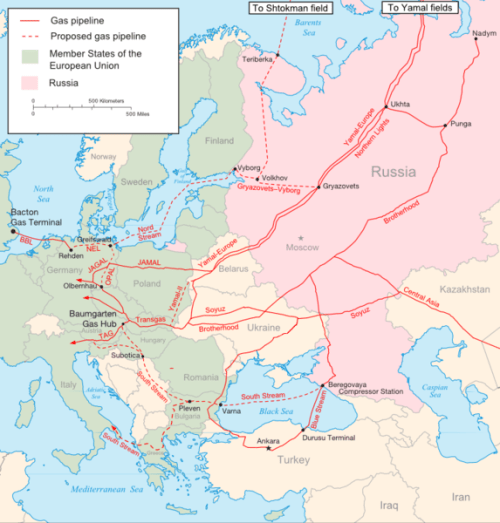
Both Poland and Romania have shale oil and natural gas potential and are known to be evaluating whether it can be profitably exploited.  This is a real threat to Russia.  Any development of Western European shale is a major problem for Russia.  Like crude oil sales, natural gas sales are a major source of income for Russia.  Russia currently provides most of the natural gas and much of the oil to Western Europe.  Russia has not been reluctant to shut off supplies.  In 2009 a dispute between the Ukraine and Russia over unpaid bills resulted in shutting off natural gas to the Ukraine.  Other countries felt the effect with low  pressure or no  pressure in their pipelines.  While the official story was about unpaid bills there was a belief that Russia’s real reason was to warn neighboring countries not to join NATO. They probably are prepared to put pressure on these nations to persuade them to not develop shale gas or oil.

Below is a 2009 map of the Russian natural gas pipelines supplying European nations.
Russiannaturalgassupplylines573px-Major_russian_gas_pipelines_to_europe

Stefano Casertano,  managing director of the Berlin based “The Energy Affairs Company” posted “From Fracks to Riches” on the Stratfor website.  A number of countries are dependent on sale of oil and natural gas to provide the revenue to balance their budgets. In addition to the numbers above for Russia,  Casertano lists what he says are the crude oil prices (in dollars per barrel) to achieve the needed revenue for several other countries as follows:

Iran——-$117

Libya —-$117

Algeria–$105

Iraq—–$112

The US economy can get an enormous boost from an ample supply of low priced fossil fuels. The fear is that the President does not really see this boost as aligning with his political objectives.  He can use his rigged fracking safety study group to impose many “safety” restrictions as a means to cut short this very beneficial exploitation of our shale.  The consequence of slowing or even stopping the US shale boom will be appreciated by Russia and OPEC.

cbdakota
Why Is US Crude Oil Priced Lower Than European Crude?


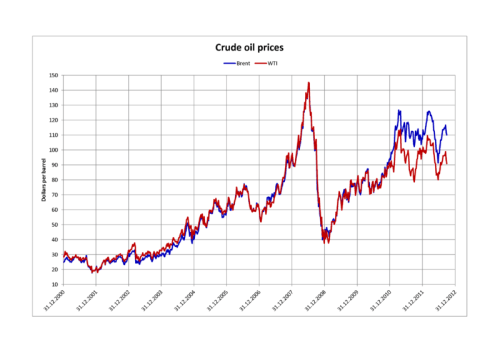
The price standard for US crude oil is West Texas Intermediate (WTI). WTI is called light and sweet referring to its density and relatively low sulfur content.  It is often considered the premium crude and historically has been the benchmark for global oil pricing.  Brent Crude from the North Sea and an OPEC Reference Basket are other standards by which crude is valued.  WTI should carry a wellhead price premium over other crude sources.  But about two years ago,  Brent and WTI prices began separating and the price today, 26 December 2012,(at 4 pmEST) for Brent per barrel is $108.80 and WTI is $88.75.  The  Wikipedia chart below shows the historic trend since the beginning of 2001 through the later part of 2012.   (Click on Charts for clarity.)

WindTurbines Regularly Fail In Weather Extremes


The 12th of December was a cold day in the UK.  Power demand was up, about 20% more than normal.  How much contribution to the total load did renewable wind power provide—–0.6%.  That amounts to about 3% of the wind renewable’s rated capacity.   The fact that these wind farms failed to come through when the weather was cold is nothing out of the ordinary.  It happens all over the world.  The wind farms also fail to provide power in the hotest weather.  This is owing to the fact that during very cold and very hot weather, the wind is very likely not blowing. Read this posting from the Institute for Energy Research to see performance during weather extremes. 
And this from a previous posting on Climate Change Sanity   
 
The Brits are mandated to have, by 2020,  30% of their electrical energy provided by renewables.  For the year 2011,  renewables provided 9.7% of the total.  Wind’s contribution to that was 4.4% and solar’s 0.1%.   To read the full posting “Just Enough To Boil The Kettle” the blog that provided most of this information, click here.
 
I wish them the best, which means, that they elect politicians that recognize that the current course is unsustainable.   
cbdakota

Why Continue To Provide Subsidies For Electric Cars?


The Spark is Chevy’s new entry into the electric vehicle race.  Unlike the Spark’s big brother, the Chevy Volt, the Spark is all electric. (The Volt it is a hibrid as it has a backup internal combustion engine.)  Chevy has not specified a range with a full battery charge or a price.  But the Associated Press (AP) reports that the range will probably be like the Ford Focus—76 miles on a charge–and at a price less than $25,000 when the Fed’s $7,500 is deducted.  
 
What is wrong with this picture?  The gasoline powered Spark sells for $12,245 without any Federal subsidy.  So the production cost with profit (maybe) for the electric Spark is in the range of $32,000.  The gasoline powered Spark goes out of the showroom at roughly $20,000 less.  And even with the Fed Subsidy thrown in for the electric version, the gasoline version cost half as much.    
 
According to the Denver Post: “Since 2008, taxpayers have spent or provided loan guarantees of $6.5 billion for electric vehicles. That includes $2.4 billion for battery and electric drive component manufacturing, $3.1 billion in loan guarantees for electric vehicle projects, and $1 billion in tax credits for the vehicles.”
 
The Detroit News reports that GM plans to build 500,000 electric vehicles by 2017. Assuming they do this and sell that many cars,  you and I–the taxpayers are on the hook for $7,500X500,000= $3.750 billion.  And that would not include the subsidies given for sales of other manufacturer’s electric vehicles in that time period.  Suspending your view of the advisability of having subsidies for these cars in the first place,  do you think that if sales are that robust, they should continue to be given subsidies?  I don’t.
cbdakota

President Obama’s War On Fossil Fuels Slips Into High Gear


The Wall Street Journal (WSJ) summarizes some major Obama Administration regulations (economically significant rules that impose annual costs of $100 million or more) that are soon to be released.  These are largely rules written earlier this year but held up because they were potential liabilities for the Obama presidential campaign.  Now that he has won re-election,  its Katy bar the door.  This posting will feature those that affect energy.  There are others that will also have a very big impact such as Obamacare.  The WSJ’s summary of those can be seen by clicking here.   
The Obama Administration’s war on fossil fuels goes on.  Fracking is not safe even though it has the potential of lifting the economy out of the dole drums.  One has to wonder where the President’s priorities lie.  Is it bring about a recovery or to bring about a socialist state?
The WSJ Energy Rules Summary: 
 
Energy. In the lead-up to November, the Environmental Protection Agency stood down under White House pressure, delaying rules for ozone air quality and industrial boilers, and deferring carbon standards. Now EPA chief Lisa Jackson has the run of the place.
She will resume the Administration’s anti-carbon agenda through “new source performance standards,” which will set greenhouse gas emissions for new power plants so low as to prevent their construction. Look for this early in 2013.
She’ll follow with standards for “existing” sources that make coal-fired plants uneconomic to run. Inside of a decade, Ms. Jackson may wipe out what used to make up more than half of U.S. power generation. Environmentalists will write books about it, even if her agenda has received almost no public scrutiny or debate.
The oil and gas industry is also targeted, hydraulic fracturing (fracking) in particular. The EPA has already issued a rule on shale production emissions and has one coming on diesel fuel in fracking. The Interior Department is promulgating rules on fracking on federal lands, and other rules can’t be far behind, probably using the pretext of drinking water under the Clean Water Act.
The EPA’s sleeper issue is the National Enforcement Initiatives agenda, which is designed to use the agency’s existing legal powers for inspections, requests for information, penalties and so forth to make new de facto rules. The EPA now blackmails businesses into “super compliance,” or settlements far more stringent than the law requires, or else risk years of expensive litigation.
 
cbdakota

Tell Congress To Not Renew The Production Tax Credit


Here’s a deal for you. Its called extending the Production Tax Credit (PTC) for one year.   For $12.2 billion you can prevent the loss of 37,000 jobs.  That translates into a cost of $330,000 per job saved.  And you also get expensive, unreliable wind generated electricity as part of the deal.  Now who is it that thinks we should take this deal?  Let’s see, oh yes, it is the American Wind Energy Association (AWEA).  By-the-way,  you will have to do this deal again the next year and the one after that and……..

World And USA CO2 Emissions


Two good posts accounting for the past and recent CO2 emissions (man-made only, no natural CO2 emissions included).

The first posting has charts prepared by Ed Hoskins and appeared on the WUWT website.

This chart shows that China is now the no. 1 source of man-made CO2 emissions.  Other charts illustrating change in emissions since 1965 can be seen by clicking here.

Another interesting posting is that the US has, over the past six years,  reduced its carbon emissions more than any other nation in the world.  This did not happen because of the Kyoto Protocol.  It occured due to a combination of factors, e.g., natural gas replacing coal, improved efficiency and  lower output resulting from the recession.  Remember that the recession has been a common factor for virtually all nations.  More about this can be read in a posting by Jack Spencer on the CAPCOM Michigan Capitol Confidential website titled “Shhh, US leads World in Carbon Emissions Reductions”  Click here to read more.  It has not been a result of the installation of alternative energy sources.

cbdakota

“US Energy Independent By 2035”-International Energy Agency


The International Energy Agency (IEA) released their 2012 edition of the World Energy Outlook (WEO) on Monday, 12 November 2012. The take-away from the report is:
The WEO finds that the extraordinary growth in oil and natural gas output in the United States will mean a sea-change in global energy flows. In the New Policies Scenario, the WEO’s central scenario, the United States becomes a net exporter of natural gas by 2020 and is almost self-sufficient in energy, in net terms, by 2035. North America emerges as a net oil exporter, accelerating the switch in direction of international oil trade, with almost 90% of Middle Eastern oil exports being drawn to Asia by 2035.  
 
The new oil and natural gas production in the US will not only result in lower domestic prices for gasoline, electricity and heating oil, it could result in delivering our nation from the endless traumata that are the turbulent Middle-Eastern nations.  Will we feel it necessary to defend shipping routes any more?  Will we need to provide F-16 fighter planes to Saudia Arabia? I wonder if the European or perhaps the Saudis, are becoming nervous thinking that they might have to do for themselves what we have been doing for them.  Maybe the Chinese will take up the slack.  I’m not sure that is a comforting thought.  

Fisker Karmas Catch Fire Following Inundation By Sandy-UPDATED 8 November


Sixteen Fisker Karmas, hybrid autos, caught fire as an aftermath of the storm Sandy.   Fisker’s press release concerning the fires follows:

“It was reported today that several Fisker Karmas were damaged by fire at the Port of Newark after being submerged in sea water during Superstorm Sandy.  We can report that there were no injuries and none of the cars were being charged at the time.

“We have confidence in the Fisker Karma and safety is our primary concern.  While we intend to find the cause as quickly as possible, storm damage has restricted access to the port.”

As you can see from the picture the damage was total:

Photo courtesy of Jalopnik.com

Continue reading

Best Fracking Video–Shows How It Is Done


The best video describing the fracking process that I have seen.   Made by MIT, it is well done.

Click here to see the video.

cbdakota