Category Archives: EPA

EPA Gives Honda Fit EV A 118 MPG (eq) Rating


The EPA gave the Honda Fit EV a 118 mpg equivalency rating. This is their best rating yet for a passenger car.  My daughter owns a Fit, IC engine, and gets great mileage and has experienced very low maintenance and up keep costs.  It’s a very good vehicle. But most all of the EPA rating mileage equivalent for EVs and hybrids have come down as the owners face the real world of driving.  The EPA is rating the Leaf at 73 mpg equivalent.  Read my posting of a Tennessee Leaf owner’s trip  here.

The new EPA rating for the Chevy Volt is 38 mpg versus the former 35 mpg.  This change stemmed from an upgraded Li-ion battery that can hold a 16.5 kWH charge versus the former 16 kWH.   Added a half hour to the battery charge time however. To read more click here.

cbdakota

Not Much Joy In EV Land—May Sales Data


The Chevy Volt hybrid May sales were 1680 up from 1462 in April.  The forecast annual sales of 45,000 seem to be a stretch with only 7057 Volts sold year-to-date.  A little arithmetic says that about 38,000 Volts need to be sold in the remaining 7 months of 2012.

The Nissan Leaf sales of 510 in May were up slightly over the 370 sold in May. Year-to-date leaf sales are 2613. The Nisan people maintain that they will sell 20,000 Leafs in 2012.  But the still under construction Smyrna, Tennessee plant, said to be capable of making 150,000 Leafs annually, is not scheduled to startup until late this year.  Until then, Nissan will supply the market from Japan.

Underperforming would seem to be the proper word for hybrid and EV sales in the US.  High gas prices and still the sales are anemic.  One more example of Obama’s costly green energy plan not living up to his overblown promises.

cbdakota

Cuba’s Hopes For Oil In Florida Straits Hits Dry Hole


Cuba’s oil drilling partner, Repsol says that they have hit a dry hole and are calling it quits.  Repsol, an integrated Spanish oil and gas company, has spent more than $100 million drilling only to come up with no oil.  Currently Cuba relies on Venezuela to deliver $3 billion of subsidized oil each year.  Continuation of this program would be in jeopardy if Hugo Chavez were not to be reelected in the October elections.  An additional threat is Chavez’s health. He has been undergoing treatment for cancer for a number of months.

Cuba’s needs a major oil find to revive its struggling economy.   With Repsol out of the picture, Cuba’s fortunes rest with Petronas, the Malaysian oil company, that has began drilling an exploratory well about 180 miles southwest of Repsol’s dry well.

To read more, see this story in Oil Price.

cbdakota

California’s Global Warming Solutions Act”—Part 2.


The Democratic polling firm of Fairbank, Maslin, Maullin, Metz & Associates at the request of the “Vote Solar Initiative” organization polled some 400 Los Angles residents and found according to an Aol Energy blog posting:

“The vast majority of Los Angeles residents are demanding more renewable energy, especially solar power, according to a new survey. Around 87 percent of voters want solar energy to generate more electricity and 79 percent welcome more wind power. Around three out of four voters (76 percent) say the solar power should be generated from rooftop panels.”

Aside from a pro-solar organization hiring a liberal Democrat polling organization to fashion a poll to get them the answers they wanted, the poll results show how far removed from reality are the LA citizens.  They are clamoring for more government intervention which is what has given California the 3rd highest unemployment rate in the country,  the 9th highest electricity rate and the 3rd highest gasoline cost. It’s the poorer people that are suffering the most.  This will be made even worse as the price of electricity continues its climb as they force in more uneconomical solar based production and drive out much lower cost fossil fuel production. This conclusion is also dawning on the Germans according to the Global Warming Policy Foundation: “The current funding of Germany’s green energy transition is anti-social, according to a new report by the Institute of the German Economy. The economic burden due to the Renewable Energy Sources Act (EEG) is up to 10 times higher for low-income households than for high-income households.”

The preliminary 2012 Energy Information Administration’s (EIA) estimates for levelized costs per kilowatt-hour in 2017 are 15.7 cents for a photovoltaic solar plant and 25.1 cents for a thermal solar plant.  That is far more expensive than the 6.7 cents per kilowatt-hour for conventional combined cycle natural gas and the 10 cents per kilowatt-hour for conventional coal in those same EIA estimates.  Also,  the EIA inflates the cost of coal by the equivalent of $15 per metric ton of carbon dioxide emitted to represent the difficulty of obtaining financing for coal plants. Further, it does not appear that the EIA levelized cost for conventional combined cycle natural gas plant is getting credited for the lower price of natural gas resulting from fracking shale.

The survey also said that:

“Most voters believe Los Angeles should create 1,200 megawatts of power from the sun, which is LADWP’s percentage of the state goal of 12,000 megawatts of local clean power by 2020.”  

And they inform us that 1200megawatts is enough to power 260,000 homes.  The calculation for number of homes powered  is suspect as it is varies from solar power promoter to promoter.  Without power storage, some other source of electricity most likely from a fossil fuel powered source is necessary because the lights would go out on these homes at night when the sun is no longer shining.  So much for reducing carbon emissions.  I wonder if California Air Resources Board (CARB) has put that in their solar energy calculations?

More on Solar cell reliability, etc. in my next posting on this topic.

cbdakota

Automotive Engineering Execs Pessimistic About Electric Car Sales


The Society of Automotive Engineers (SAE) World Congress was held April 24 &25 in Detroit.  Ford, GM and Chrysler representatives were pessimistic about the future of electric vehicles according to an article in the Wall Street Journal (WSJ).   This is somewhat surprising in that the President has been promoting electric vehicles as a centerpiece of his auto-industry policy.  President Obama has offered $2.4 billion in grants to boost some 48 projects related to electric vehicles or battery production according to the WSJ. This may have required some amount of courage as we know the Administration is a major partner in both GM and Chrysler.

Obama has set a goal of 1 million electric vehicles on the road by 2015.   But if you listen to the auto company engineering execs, it would seem that Obama’s goal is not likely to be met.  Fundamentally they see the buyers not interested in the high price of the electric vehicles and the execs don’t see the prices dropping real soon.

Joseph Bakaj, vice president for powertrain engineering at Ford said:” “By 2025, we see battery electric vehicles still with too long a payback, and inadequate range,”

Sam Winegarden, executive director of powertrain-engine engineering at General Motors Co. made a similar point with a chart comparing the amount of energy delivered by a given volume or mass of fuel. On his chart, lithium-ion batteries, used in electric cars such as the Nissan Leaf and GM’s plug-in hybrid Chevrolet Volt, were ranked close to zero compared to gasoline and diesel fuels, which delivered the most energy for the least amount of weight and cost to the consumer.”The rumored death of the internal combustion engine is premature,” Mr. Winegarden said.

Chris Cowland, director of advanced powertrains at Chrysler Group LLC, offered some revealing figures. A conventional, gasoline-fueled internal combustion engine and transmission make up about 10% of the cost of a $30,000 car, or about $3,000, he said. Ford Chief Executive Alan Mulally at a green-car forum in New York City last week said batteries for the electric Ford Focus cost $12,000 to $15,000 for a car that is priced at $39,200, about $15,000 more than a petroleum-fueled Focus.

Robert Bienenfeld, senior manager for environment and energy strategy at Honda Motor Co.’s U.S. arm, said that by 2025, a customer who buys a plug-in hybrid could wait 10 years to recover the added upfront costs, compared with a 2025 car outfitted with a more efficient gasoline engine and transmission. The payback for an all-electric car would be even longer

Nissan on the other hand is bullish about electric cars. According to the Nashville Business Journal, Brendan Jones, director of Nissan Leaf Marketing and Sales Strategy said that the Leaf buyers have an average household income of $131,000.

I would be optimistic if the typical buyer were someone in the mid $50s income range.

h/t The Hockey Schtick

cbdakota

Pres. Obama– “Government By Regulation, Not Legislation”


This Administration has never made secrete its wish to put coal, oil and natural gas out of business.  Energy drives our economy and that energy comes from those fossil fuels.  And if the Administration is successful, the US will become a second-class nation with an impoverished citizenry.

They cannot achieve their wish legislatively, so they have employed Executive branch regulators to accomplish their goals.   The EPA is not the only part of the Administration employing “government by regulation not legislation”, but they are the major force.  Now we have a new insight on how the EPA goes about coercing business and local governments into doing their bidding.   The Foundry site posted these comments:

A video surfaced on Wednesday showing a regional administrator of the Environmental Protection Agency comparing his agency’s philosophy with respect to regulation of oil and gas companies to brutal tactics employed by the ancient Roman army to intimidate its foes into submission.

EPA’s “philosophy of enforcement,” said EPA’s Region VI Administrator Al Armendariz, is “kind of like how the Romans used to conquer little villages in the Mediterranean: they’d go into little Turkish towns somewhere, they’d find the first five guys they’d run into, and they’d crucify them.”

“That town was really easy to manage for the next few years,” Armendariz added.

The Armendariz video can be seen by clicking here.

This destruction of our economy will not stop unless we can vote Obama out of office this coming November.

cbdakota

Only One In Three Hybrid Owners Buy Another Hybrid


Edmunds.com commissioned a survey that found that hybrid owners were not likely to buy another one.  Edmunds had R.L. Polk conduct the study that determined only 35% of hybrid car owners bought another electric/gas vehicle as a trade-in during 2011.  If the repurchase behavior among the high volume audience of Toyota Prius owners is not factored in, hybrid loyalty drops to under 25 percent.

It is thought that the increased availability of new high mileage gasoline-powered cars at lower prices is causing the shift away from the hybrid.  Edmunds reports that: “The 40-mpg category has risen from one vehicle in 2010 (the Smart ForTwo) to nine vehicles in 2012. “Even as gas prices soar, the economics of buying a hybrid vehicle don’t make much sense in many cases,” Edmunds.com Chief Economist Lacey Plache explained in a statement. “   To read more click here.

A previous posting on this site, “Evaluating The Cost Of Ownership—Electric v Gasoline Cars” provides the DOE program for comparing different makes and models of cars to determine the cost of ownership

cbdakota


Obama Administration And A UN World Government


Is there a connection between the Obama Administration and a UN world government?

The Obama Administration policy, known as the Global Climate Change Initiative (GCCI), is intended to help developing countries combat the effects of man-made global warming.  Since 2010, the Obama Administration, in the name of GCCI, has given away  $2.5 billion.  Obama has requested another $770 million for 2013.  The objectives of this anti-global warming foreign aid are: adaption, clean energy and sustainable landscapes.  Adaption is to provide better climate data and to teach them how to adapt to floods, droughts, and sea level rise.  Clean energy is to help them develop their own green energy programs.  And sustainable landscapes is to save the forests from over-logging, for example.

The Congressional Research Service (CRS) has voiced some excellent reasons for not spending this money among which are the following:

  • Man-made global warming is at best uncertain.
  • The Nation is facing another year of $1trillion budget deficits so this expenditure could be fiscally responsible.
  • Foreign Aid is often misused or wasted in these countries.

CRS does note that sometimes such a program can be effective in preserving the US leadership role in the world and other intangibles.

The United Nations Climate Change Conferences, e.g. Copenhagen, Cancun, have developed Accords that say the Developed Nations owe the Developing Nations monies as “environmental justice” because the former have prospered at the expense of the latter.

The Cancun Accord summary released December, 2010 by the parties at the Conference outlines the transfer of monies:

“Following negotiations that ran through early Saturday morning, delegates at the 16th Conference of the Parties (COP16) in Cancun adopted by consensus the Cancun Accords, a series of documents that will provide the basis for efforts to confront climate change after the Kyoto Protocol expires.

The accords include a $30 billion-package for 2012 to aid nations taking immediate actions to halt effects of global warming, as well as financing for long-term projects to protect the environment through a Green Fund, which will provide $100 million annually for adaptation and mitigation measures.  Delegates also approved the creation of the forestry program Reducing Emissions from Deforestation and Forest Degradation (REDD+) to facilitate the flow of resources to communities dedicated to forest conservation”.

The reasons given by the Administration for the GCCI seem to mirror those in the UN Cancun Accord.  The US delegates at this conference supported the Cancun Accord, unfortunately.  That of course does not make the Accord law, but it does represent the mindset of the Administration and their delegates

The monies are a part of the Warmers overall objective of giving the UN control of global environmental regulation’s enforcement.  The environmental control would mean that the UN would be able to control energy use, development, etc. —the lifeblood of every nation.  Easy to see how this would make the UN the world government.  Do you want the UN to govern our nation?

cbdakota

Bogus Mercury Scare Used To Shutdown Coal Electricity Generating Plants


Before he was elected, President Obama said that he would bankrupt anyone who built a new coal-base power generation plant.  He planed to do this by enacting Cap and Trade legislation that would target coal-based facilities. Because coal-based plants emit more CO2 than do natural gas-based plant per kW of electricity, the CO2 tax levied on coal-based facilities would make them uneconomical to build and operate.  However a bill for his signature could not get out of Congress.  (A little discussion of the regulation of CO2 later.) The administration refocused their efforts to put coal out of business by issuing new regulations that reduced the amount of mercury and other air pollutants in coal plant emissions (CO2 was not included).   Mercury is clearly the poster child for these new regulations and that is obvious by the many press releases and stories in the media. According to the EPA, children exposed to the reduced mercury levels will be healthier and have higher IQs.

How solid is the contention that it will make our children healthier?   A posting by Willie Soon and Paul Driessen, titled “US: The myth of killer mercury” shows the EPA’s actions to not be based on good science:

According to the Centers for Disease Control’s National Health and Nutrition Examination Survey, which actively monitors mercury exposure, blood mercury counts for US women and children decreased steadily 1999-2008, placing today’s counts well below the already excessively “safe” level established by EPA.

A 17-year evaluation of mercury risk to babies and children, by the Seychelles Children Development Study, found “no measurable cognitive or behavioral effects” in children who eat five to twelve servings of ocean fish every week, far more than most Americans do.

The World Health Organization and US Agency for Toxic Substances and Disease Registry assessed these findings in setting mercury risk standards that are 2-3 times less restrictive than EPA’s. Even under WHO and ATSDR guidelines, no American children are even remotely at risk from mercury.

EPA ignored these findings. Instead, the agency based its “safe” mercury criteria on a study of Faroe Islanders, whose diet is far removed from our own. They eat few fruits and vegetables, but do feast on pilot whale meat and blubber that is high in mercury and polychlorinated biphenyls (PCBs) – but very low in selenium. The study is clearly irrelevant to this rulemaking.

Finally, EPA maintains that mercury deposition, its conversion to methylmercury, and MeHg accumulation in fish and humans is a simple process that can be controlled by curtailing emissions from US power plants. That is not correct. In fact, mercury emissions (from all sources) and raw mercury levels in fresh or ocean waters are only part of the story.

Complex, nonlinear interactions among at least 50 natural variables control the biological and chemical processes that govern elemental mercury conversion to methylmercury and MeHg accumulation in fish. Those variables, and selenium levels in fish tissue, are beyond anyone’s ability to control.

So clearly the EPA has grossly exaggerated the threat of mercury.

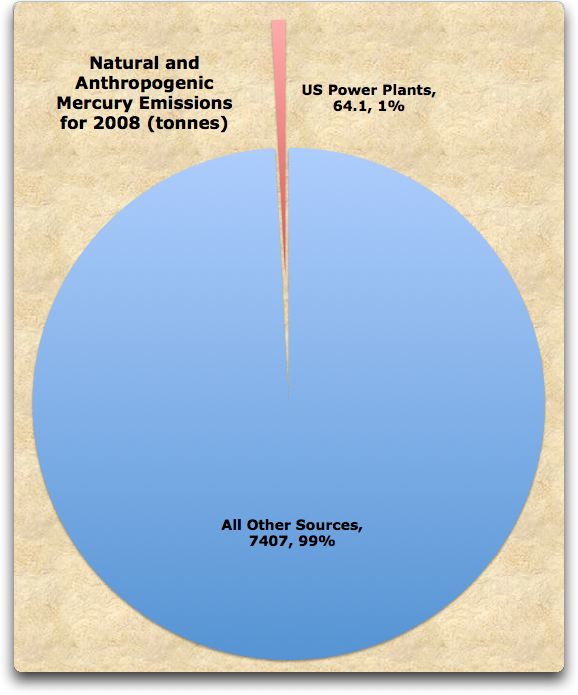
Another question that needs to be asked is how much mercury is released each year and how much of that comes from US coal-based plants.

Mercury Emissions – Natural and Man-Made

Source Emission Quantity, Mg/Year % of Total
Natural 5207 69
Manmade 2320 31
            TOTAL 7527 100
North American Coal Plants 65 0.9

 Data From Global mercury emissions to the atmosphere from anthropogenic and natural sources” Atmos. Chem. Phys., 10, 5951–5964, 2010 by N. Pirrone, S. Cinnirella, X. Feng, et al.

The mercury emissions total from the North American coal-based plants are less than one per cent of global emissions!!  So the effect on the health of people in the US through reduction of some fraction of the coal-based plants mercury emissions is essentially too small to measure.  However the effect of the increased cost of electricity will directly affect the health of the people in the US and especially the poorest among us.

See this posting by the Institute for Energy Research to get a sense of the loss of generating capacity that this EPA regulation will cause.

Willis Eshenbach developed two charts for his posting “The EPA’s Mecurial Madness” on the WUWT website.   They visually illustrate the futility of the EPA action to make any difference in mercury levels.

The EPA has more “kill coal-based power generation capacity” arrows in its quiver, and I plan to post on this soon.  As a preview, they are proposing a standard that will not permit the installation of new coal-based plants.

cbdakota