Category Archives: Domestic Energy

Russia’s Federal Budget Depends On High Price Crude Sales


A summary of the Russian Federal budget was posted by Reuters in July of this year.  It said that Russian crude oil had to be sold at or above $116 per barrel or the budget would show a deficit for the year.  A cursory look at the Ural blend (Russian Trading System, comparable to the WTI or Brent) crude pricing for the year suggests that it probably fell short of the goal.  To get some feel for whether or not they accomplished the price requirement, understand that the Ural and Brent crude price indices have been essentially the same for 2012.  The posting tables the Draft Three Year Budget:

DRAFT THREE-YEAR BUDGET 2013-2015 (in trillion roubles unless

stated)

Year                                         2012    2013     2014      2015

Break-even oil price ($)  116.2    113.9     106.0    105.4

Average oil price ($)              115      97        101      104

Nominal GDP                         60.6     65.8      73.4     81.5

Revenues                                  12.7     12.4      13.6     15.2

Expenditures                          12.7     13.4      14.1     15.3

Deficit (% GDP)                      – 0.1      1.5       0.6      0.11

Non-oil deficit (% GDP)     10.6     10.1      8.9      8.6

$1  =  31 rubles

By 2015, the draft budget forecasts break even price at $105.4.

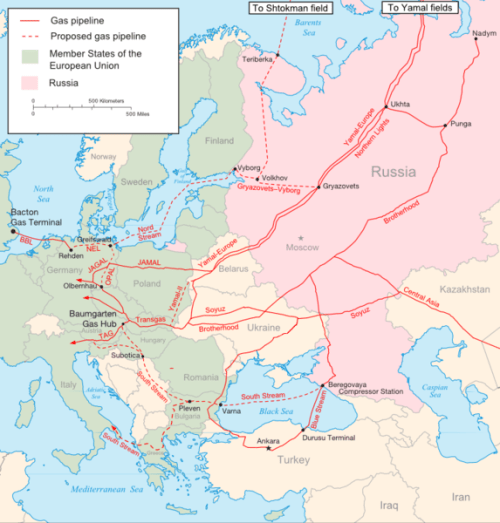
Both Poland and Romania have shale oil and natural gas potential and are known to be evaluating whether it can be profitably exploited.  This is a real threat to Russia.  Any development of Western European shale is a major problem for Russia.  Like crude oil sales, natural gas sales are a major source of income for Russia.  Russia currently provides most of the natural gas and much of the oil to Western Europe.  Russia has not been reluctant to shut off supplies.  In 2009 a dispute between the Ukraine and Russia over unpaid bills resulted in shutting off natural gas to the Ukraine.  Other countries felt the effect with low  pressure or no  pressure in their pipelines.  While the official story was about unpaid bills there was a belief that Russia’s real reason was to warn neighboring countries not to join NATO. They probably are prepared to put pressure on these nations to persuade them to not develop shale gas or oil.

Below is a 2009 map of the Russian natural gas pipelines supplying European nations.
Russiannaturalgassupplylines573px-Major_russian_gas_pipelines_to_europe

Stefano Casertano,  managing director of the Berlin based “The Energy Affairs Company” posted “From Fracks to Riches” on the Stratfor website.  A number of countries are dependent on sale of oil and natural gas to provide the revenue to balance their budgets. In addition to the numbers above for Russia,  Casertano lists what he says are the crude oil prices (in dollars per barrel) to achieve the needed revenue for several other countries as follows:

Iran——-$117

Libya —-$117

Algeria–$105

Iraq—–$112

The US economy can get an enormous boost from an ample supply of low priced fossil fuels. The fear is that the President does not really see this boost as aligning with his political objectives.  He can use his rigged fracking safety study group to impose many “safety” restrictions as a means to cut short this very beneficial exploitation of our shale.  The consequence of slowing or even stopping the US shale boom will be appreciated by Russia and OPEC.

cbdakota
Why Is US Crude Oil Priced Lower Than European Crude?


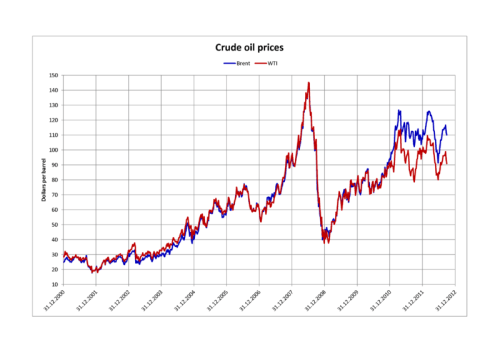
The price standard for US crude oil is West Texas Intermediate (WTI). WTI is called light and sweet referring to its density and relatively low sulfur content.  It is often considered the premium crude and historically has been the benchmark for global oil pricing.  Brent Crude from the North Sea and an OPEC Reference Basket are other standards by which crude is valued.  WTI should carry a wellhead price premium over other crude sources.  But about two years ago,  Brent and WTI prices began separating and the price today, 26 December 2012,(at 4 pmEST) for Brent per barrel is $108.80 and WTI is $88.75.  The  Wikipedia chart below shows the historic trend since the beginning of 2001 through the later part of 2012.   (Click on Charts for clarity.)

President Obama’s War On Fossil Fuels Slips Into High Gear


The Wall Street Journal (WSJ) summarizes some major Obama Administration regulations (economically significant rules that impose annual costs of $100 million or more) that are soon to be released.  These are largely rules written earlier this year but held up because they were potential liabilities for the Obama presidential campaign.  Now that he has won re-election,  its Katy bar the door.  This posting will feature those that affect energy.  There are others that will also have a very big impact such as Obamacare.  The WSJ’s summary of those can be seen by clicking here.   
The Obama Administration’s war on fossil fuels goes on.  Fracking is not safe even though it has the potential of lifting the economy out of the dole drums.  One has to wonder where the President’s priorities lie.  Is it bring about a recovery or to bring about a socialist state?
The WSJ Energy Rules Summary: 
 
Energy. In the lead-up to November, the Environmental Protection Agency stood down under White House pressure, delaying rules for ozone air quality and industrial boilers, and deferring carbon standards. Now EPA chief Lisa Jackson has the run of the place.
She will resume the Administration’s anti-carbon agenda through “new source performance standards,” which will set greenhouse gas emissions for new power plants so low as to prevent their construction. Look for this early in 2013.
She’ll follow with standards for “existing” sources that make coal-fired plants uneconomic to run. Inside of a decade, Ms. Jackson may wipe out what used to make up more than half of U.S. power generation. Environmentalists will write books about it, even if her agenda has received almost no public scrutiny or debate.
The oil and gas industry is also targeted, hydraulic fracturing (fracking) in particular. The EPA has already issued a rule on shale production emissions and has one coming on diesel fuel in fracking. The Interior Department is promulgating rules on fracking on federal lands, and other rules can’t be far behind, probably using the pretext of drinking water under the Clean Water Act.
The EPA’s sleeper issue is the National Enforcement Initiatives agenda, which is designed to use the agency’s existing legal powers for inspections, requests for information, penalties and so forth to make new de facto rules. The EPA now blackmails businesses into “super compliance,” or settlements far more stringent than the law requires, or else risk years of expensive litigation.
 
cbdakota

Best Fracking Video–Shows How It Is Done


The best video describing the fracking process that I have seen.   Made by MIT, it is well done.

Click here to see the video.

cbdakota

Chemicals Manufacturing Looks For Booming Business–Only Obama Can Put This Good News Down.


The price of natural gas has plummeted and chemical manufacturing firms are going to take advantage of the low cost feedstock.   A Forbes posting by Agustino Fontevecchia leads with this:

The $3.5 trillion chemicals industry provides a good vantage point from which to observe the state of the global economy, as many of its products stand at the beginning of the supply chain. From consumers to construction, the chemicals industry is set to boom in the U.S. given the explosion of shale plays and the cheap price of natural gas compared to the rest of the world, according to Anton Ticktin, a partner at chemical industry focused M&A advisory investment bank Valence.

“Chemicals go into everything, they are the part of the first step into the creation of so many different products,” explained Ticktin, “the gives you insight into the state of so many industries and sectors” such as the consumer, through plastic bag volumes for example, and construction, through sales of paints and coatings.

The low priced natural gas will result in many industries improving their balance sheet.  Ticktin adds:

And investors can get a cut of the action. Years ago, major chemical companies like Du Pont and Dow Chemical began to move their operations overseas. But today, companies with access to feed stocks that are associated with the production of natural gas, such as propane and ethane, will see a boost in their performance. Major oil and gas companies like Chevron, Exxon Mobil, and Royal Dutch Shell are well positioned to benefit.

Companies in the coatings and paints business will also do well, according to Ticktin. Sherwin-Williams and PPG, for example, are trading near their 52-week highs, while Du Pont and Dow Chemical are on their way back.

The bottom line is that through the lens that is the chemicals industry, Ticktin is seeing the U.S. recovery strengthening vis-à-vis the rest of the world. While GDP is still lagging, the rise in volume and sales seen in the chemical industry should be a good omen for the broader economy.

Team Obama wants to kill fracking.  The EPA is moving forward with a study to determine the safety of Fracking.  The EPA has chosen not to select, as members of this committee, anyone from industry.  To say it another way, if you know anything about fracking and how safe it is and how it can continue to be that way, they DON’T want you.  API Executive Vice President Marty Durbin makes the case regarding the Science Advisory Board (SAB) being assembled by the EPA:

It’s a perspective the SAB panel needs as it delves into hydraulic fracturing issues. Unfortunately, EPA has declined such expertise in the past. Durbin:

“From our perspective, critical opportunities to leverage the tremendous knowledge and experience base offered by industry have been repeatedly missed.”

For example, no industry experts were selected for SAB’s hydraulic review panel announced in January 2011. Instead, while members were technical experts in their respective fields, most had virtually no relevant knowledge or understanding of oil and natural gas operations in general and hydraulic fracturing in particular related to their respective areas of expertise. Durbin:

“API, therefore, strongly recommends that the ad hoc Panel members have direct experience working in the modern oil and natural gas industry. … We note that industry representatives have a long record of valuable, unbiased participation in many other SAB Communities and Panels. It is those very individuals, with extensive field experience and first-hand knowledge of the techniques used in drilling and completions, who are critical to the examination of the very specialized processes and the research addressing those processes.”

See more from this  posting by clicking here.

cbdakota

New Technologies To Increase Oil Recovery From Shale Studied.


Currently fracking wells recover less than 10% of the oil in the North Dakota’s Bakken fields.  Bismarck, North Dakota TV station KFYR aired a program discussing new technologies that might result in a major boost in the amount of oil recovered per well site.  KFYR said that two technologies are under study.

Walking rigs – Used on Eco-pads that have several well bores at one location and can be moved from one well head to the next in a matter of hours instead of days.

CO2-enhanced recovery – The process has been used at other oil plays but would be new to the Bakken and could extend the life of wells there by 20 to 30 years.

Continue reading

Matt Damon’s Anti-US Oil Companies Film Financed by Abu Dhabi


The documentary film “Gasland” had set the tone. The town of Dimock, Pa had been featured in a scene where fire was blasting out of the sink faucets –all because the natural gas companies were using hydraulic fracturing (fracking) of the subsurface shale to release the trapped natural gas. The presumption was that somehow this fracturing was resulting in leakage of natural gas into the subsurface water from which the locals drew their drinking water.

It seemed like a good idea for a movie script, especially when it would bash those thieving rascals that run those evil oil and natural gas companies.  So, Matt Damon andJohn Krasinski said they would make the movie and it would be about “American identity . . . and what defines us as a country.” Whatever that means.  They planned to title the movie, “Promised Land”.  According to the NY Post, the story line was to have Damon, the big oil and natural gas company representative, exposed by an environmentalist.  The environmentalist would reveal the Damon’s (oil company’s) plan to “exploit, pollute and leave” the small community. 

The wheels began to come off the movie story-line when tests by the State of Pennsylvania and the EPA found that the Dimock water was not contaminated. In addition several other stories were reported further ruining the narrative that Damon, et al had chosen. Again, from the Post:

“There was Wolf Eagle Environmental Engineers in Texas, a group that produced a frightening video of a flaming house water pipe and claimed a gas company had polluted the water. But a judge just found that the tape was an outright fraud — Wolf Eagle connected the house gas pipe to a hose and lit the water.   Other “pollution” cases collapsed in Wyoming and Colorado. Even Josh Fox, who with his Oscar-nominated documentary “Gasland” first raised concerns about flammable water, has had to admit he withheld evidence that fracking was not responsible.”

Surely, the Hollywood crowd will come up with something and you want to know why?  Because Abu Dhabi, one of the oil rich United Arab Emirates, is providing part the financing for this movie.   

Do you suppose that Abu Dhabi has an interest in slowing or stopping fracking altogether? Fracking is propelling the United States to a condition of oil and natural gas self-sufficiency.   The consequence will probably be to cause crude oil prices to drop. Because the Emirates’ economic life is predicated on sales of crude oil, this is a logical conclusion. 

But Damon is smart enough to make that connection.  Yet he is smearing US OIL AND GAS COMPANIES in order to stop fracking.  Liberals, seesh.

Click on the link below to read the entire NY Post story:

www.nypost.com/f/print/news/opinion/opedcolumnists/for_his_next_escape_x46uFSONrAaCey67ZzZV0I

To read more of the Foundry Posting on Abu Dhabi financing the Damon picture  click here: http://blog.heritage.org/2012/09/28/matt-damons-anti-fracking-movie-financed-by-oil-rich-arab-nation/


cbdakota

Will The Solar Industry Survive?


Manufacturers of Solar Panels

Since the demise of the German solar panel industry, the major solar panel manufacturers are mostly Chinese. There are others such as Sunpower (French) and First Solar (American).   Sunpower, formerly an American firm, is now owned by TOTAL, the French petroleum giant.  Sunpower, formed in 1985, had stopped producing solar cells last year.  They were nearing bankruptcy having lost some $600 million.  However, they were able to restructure when TOTAL bought 60% of the company.  While the company has survived, the market does not have much confidence in its future.  In October, 2009 Sunpower shares sold for about $32.  Those shares now sell for $5.   Across the World, the subsidies that have been doled out for solar energy projects are diminished or have vanished altogether.  As of September, none of these firms are making a profit. 

Why Are The Solar Panels Makers Not Making a Profit?

A posting by the Telegraph (UK) reports on the Chinese solar panel makers’ financials: ”China’s big five firms are all reporting disastrous trading and heavily indebted balance sheets. At the end of the first quarter, JA Solar listed debt and liabilities of $1.5 billion, Trina Solar had debts of $1.08 billion, and Yingli had debts of $3.44 billion.  Suntech, once held up as a model company, could have to pay $690m in collateral related to a possible fraud, and it also has a $541m convertible bond payment in early 2013. Its total debts are $3.58 billion.  In the first quarter, LDK lost $185.2m as sales dropped by nearly 75pc.”

The manufacturers, particularly in China are increasing their production capacity so that it far exceeds solar panel demand and ironically, at a time when demand is slowing due to reduced or eliminated US and European government subsidies given to builders of solar farms. Further acerbating the profit problem is that some of the Chinese manufacturers are reported to be selling below the cost of manufacture (this is Dumping). The US has imposed a tariff on imported Chinese solar panels. The Europeans are charging the Chinese with “Dumping” and the result will be that the Chinese will lose that market too.  

China seems to be of two minds here.  The government is supporting these expansions because the government needs new jobs to contain China’s huge, annual increase of job seekers. Many believe that they will continue to build solar farms for the same reason. The competitiveness of all this is often secondary in a government run economy. Remember that the Soviet Union did this before they went broke.  Our government is not too far off of that track themselves when it comes to “renewable energy”.

Are Solar Farms Competitive?

Solar farms are the least competitive form of renewable energy.    

The US Department of Energy’s Energy Information Administration (EIA) says that solar projects provide the most expensive power.   The EIA estimated levelized cost of new generation resources coming on line in 2017 are:

Type of Generation Cost   $/megawatt-h
Natural Gas- Conventional Combined Cycle 66.1
Conventional Coal 97.7**
Advanced Nuclear 111.4
Wind-On-Shore 96.0
Solar 152.7
  **potential C tax included


Solar is 2.3 times more expensive than natural gas.   The only reason anyone builds solar farms is because the Federal government loans the crony capitalists the money at basically no risk to the borrowers and then the States require the utilities pass on the cost on the their customers. The consumer pays at least 50% more for this form of electricity.  

The on-line German “Focus” posted an interview with Klaus Dieter Maubach, the Technology Chairman of E.On a major German power company and Maubach said:  (This quote is a translation from the German by Google translator)  Germany’s solar industry will disappear in the next five years in the face of competition from China. Not a single worker is still working at the German solar companies, as the latter are then all broke, it cited the Bloomberg news agency.”  The English also are becoming tired of supporting renewable solar.  The Spanish and Italian governments are reducing subsidies dramatically.   My guess that no matter which man, Obama or Romney, is elected President, the US government subsidies for solar will not be renew.  

Perhaps more money should be directed toward the development of Thorium reactors. We need to talk about these reactors in a posting.

cbdakota

Contrasting The Keystone Pipeline And Solyndra


Rep. Fred Upton(R- Michigan) illustrates the huge divide between the Obama view and that of Congressional Republicans when he contrasts the difference between the Solyndra and the Keystone Pipeline energy projects. Upton says:

 These two energy projects tell a dramatic yet revealing story, one that explains our slow economic recovery, our burgeoning federal debt, and our over reliance on Middle Eastern oil.   Solyndra – a bankrupt, federally subsidized solar project – and the proposed  Keystone pipeline carrying oil from Canada – are really symbols of a larger narrative, serving as examples of two distinct economic and governing philosophies. The Keystone approach supports free markets, encourages private investment and relies on technology instead of regulatory mandates to produce energy. The Solyndra model advocates prescriptive and detailed Washington planning, massive federal spending, and recasts energy bureaucrats as venture capitalists.”

 President Obama stymied attempts to authorize the Keystone pipeline saying that it was environmentally problematic because it would be built, in part, over a  major mid-American aquifer.  The pipeline’s proposed path was rerouted but still Obama would not give it the go-ahead.  It is widely understood that his in-action was taken to appease extreme environmentalist groups that are major campaign contributors.  Keystone would have the near term effect of employing thousands of people to build the line. It would have added to the Nation’s crude oil reserve and be supplied from a friendly country- Canada.  However, his inaction has resulted in the Canadians signing an oil sales agreement with China to be supplied from this same resource.  And get this— build a pipeline to the Pacific coast where the crude can be shipped by tanker to China.

Instead, Obama has been picking “renewable energy projects” to fund.  Solyndra is just one example of the many companies that his Administration has picked that have gone bankrupt.  Solyndra was given over $500 billion of taxpayer monies and those are all lost.  In Obama’s Presidential Nomination acceptance speech at the Democrat Convention, he promised to do more of this.  UGH!!

Upton sums up his case here:

“It’s time to start looking forward on energy policy and embrace the possibility of North American energy independence. Given the slow pace of Washington’s bureaucracy, policymakers are often busy solving yesterday’s problems. This rearview mirror approach afflicts Mr. Obama and his Democratic allies in Congress. They lack the vision to realize the energy world has changed dramatically even since the president took office. We now have the opportunity to significantly expand our North American energy supply – not through new regulations or federal subsidies, but by simply making commonsense policy decisions. We need to seize these new opportunities and adapt, not continue to support old policies conceived in a world when energy scarcity was in vogue.”

To read the full posting by Representative Upton click here.

cbdakota

President Obama’s Pants-On-Fire Acceptance Speech


The President’s acceptance speech at the Democrat Convention last Thursday was a pants-on-fire moment when it came to his energy program. (There were other topics besides the energy program in that speech that also rated high on the pants-on-fire meter—but this is an energy blog.)

The President claims responsibility for the decline in the use of imported crude oil.  “In the last year alone, we cut oil imports by 1 million barrels a day, more than any administration in recent history”. There are two primary reasons for this decline. First is because the manufacturing sector is still suffering from this less than robust economy—here his claim rings true as he is responsible for this economy.  The second is that the States and Private property owners have managed to overcome his and his administration’s efforts to stymie the development of oil and natural gas fields. Yes, oil and gas production are up but not on Federal lands where the President has the “say so”.  Oil production declined 11% and natural gas declined 6% on Federal lands from fiscal year (FY) 2010 to FY 2011.  At the same time on State and Private Lands’ oil production increased by 14% and natural gas by 12% over that same period.

 He said: “…. where we develop a hundred-year supply of natural gas that’s right beneath our feet. If you choose this path, we can cut our oil imports in half by 2020 and support more than 600,000 new jobs in natural gas alone”. While he is claiming credit for the natural gas, it really is No Thanks to Obama who has sent the EPA out to find reasons to rein in (i.e., reasons to stop fracking of shale) this State and Private land activity.  

Oil and natural gas production from State and Private Lands will continue to increase and will be the driver of the US economic recovery.  Not the “green” jobs that he has been promoting.  We have doubled our use of renewable energy, and thousands of Americans have jobs today building wind turbines and long-lasting batteries”. While Obama wants you think that wind and solar are soon to replace fossil fuels (oil, natural gas and coal) that is not happening. Fossil fuels supplied 78% and nukes another 11% of the US energy needs in 2010.  Wind supplied about 2% and solar was barely above 0 %. That they are that much is a testimonial to the crony capitalism being practiced by the Federal government by subsidizing the capital cost of renewables installation. This practice leaves the rate payers holding the bag for the high cost of the electricity that renewables create.   It looks like the US will be joining most of the rest of the world that have become disillusioned with wind and solar when Congress doesn’t renew the subsidies next year.  Adding to their dismal performance is the fact that for every new Kw of wind and solar power, a corresponding amount of fossil fuel supplied energy must be built because wind and solar are too unreliable (the wind blows sometimes and not at others and we know the sun is not always shining) for the nation’s power grid to rely upon.  So not only are these unreliable renewables not competitively priced, the global warmers don’t get a reduction in CO2 emissions.

After 30 years of inaction, we raised fuel standards so that by the middle of the next decade, cars and trucks will go twice as far on a gallon of gas”. Despite the implication that he has accomplished something, this new standard is in effective 2025 and there are many reasons to question if it can be met. This will only be realized if significant numbers of electric vehicles replace gasoline based vehicles.  And how is that program going? The hybrid Chevy Volt, the leading US manufactured vehicle, has sold through August about 13,170 making it unlikely they will meet the 2012 forecast of 45,000. The Volt is brought to you by Government General Motors (GM).  Through August, the best-selling all-electric car, the Nissan Leaf, had sold 4,228 vehicles versus the 2012 forecast of 20,000.  The electric vehicles are neither affordable nor efficient for the overwhelming majority of consumers who commute for work.  The Volt’s selling price is about $45,000 before the Government tax incentive of $7,500.  Even at that price, a recent report says: “Nearly two years after the introduction of the path-breaking plug-in hybrid, GM is still losing as much as $49,000 on each Volt it builds, according to estimates provided to Reuters by industry analysts and manufacturing experts.”  A little perspective, the projected US  2012 sales of vehicles is about 14 million.  There are something like 250 million registered vehicles in the US.  Even if the Volt were to sell 45,ooo it is drop-in-the-bucket. 

He says that man-made global warming is “not a hoax“.  He is wrong.  His EPA is writing regulations that will imposed a “cap and trade” program on the use of fossil fuels.  Cap and Trade failed attempts at passage in Congress.  Here he is usurping the legislative role of Congress.

The President’s energy program is a threat to all of us, and especially our children who are going to have to pay higher energy cost while having to cope with the massive debt this Administration has racked up.  

cbdakota