Category Archives: Domestic Energy

Bogus Mercury Scare Used To Shutdown Coal Electricity Generating Plants


Before he was elected, President Obama said that he would bankrupt anyone who built a new coal-base power generation plant.  He planed to do this by enacting Cap and Trade legislation that would target coal-based facilities. Because coal-based plants emit more CO2 than do natural gas-based plant per kW of electricity, the CO2 tax levied on coal-based facilities would make them uneconomical to build and operate.  However a bill for his signature could not get out of Congress.  (A little discussion of the regulation of CO2 later.) The administration refocused their efforts to put coal out of business by issuing new regulations that reduced the amount of mercury and other air pollutants in coal plant emissions (CO2 was not included).   Mercury is clearly the poster child for these new regulations and that is obvious by the many press releases and stories in the media. According to the EPA, children exposed to the reduced mercury levels will be healthier and have higher IQs.

How solid is the contention that it will make our children healthier?   A posting by Willie Soon and Paul Driessen, titled “US: The myth of killer mercury” shows the EPA’s actions to not be based on good science:

According to the Centers for Disease Control’s National Health and Nutrition Examination Survey, which actively monitors mercury exposure, blood mercury counts for US women and children decreased steadily 1999-2008, placing today’s counts well below the already excessively “safe” level established by EPA.

A 17-year evaluation of mercury risk to babies and children, by the Seychelles Children Development Study, found “no measurable cognitive or behavioral effects” in children who eat five to twelve servings of ocean fish every week, far more than most Americans do.

The World Health Organization and US Agency for Toxic Substances and Disease Registry assessed these findings in setting mercury risk standards that are 2-3 times less restrictive than EPA’s. Even under WHO and ATSDR guidelines, no American children are even remotely at risk from mercury.

EPA ignored these findings. Instead, the agency based its “safe” mercury criteria on a study of Faroe Islanders, whose diet is far removed from our own. They eat few fruits and vegetables, but do feast on pilot whale meat and blubber that is high in mercury and polychlorinated biphenyls (PCBs) – but very low in selenium. The study is clearly irrelevant to this rulemaking.

Finally, EPA maintains that mercury deposition, its conversion to methylmercury, and MeHg accumulation in fish and humans is a simple process that can be controlled by curtailing emissions from US power plants. That is not correct. In fact, mercury emissions (from all sources) and raw mercury levels in fresh or ocean waters are only part of the story.

Complex, nonlinear interactions among at least 50 natural variables control the biological and chemical processes that govern elemental mercury conversion to methylmercury and MeHg accumulation in fish. Those variables, and selenium levels in fish tissue, are beyond anyone’s ability to control.

So clearly the EPA has grossly exaggerated the threat of mercury.

Another question that needs to be asked is how much mercury is released each year and how much of that comes from US coal-based plants.

Mercury Emissions – Natural and Man-Made

Source Emission Quantity, Mg/Year % of Total
Natural 5207 69
Manmade 2320 31
            TOTAL 7527 100
North American Coal Plants 65 0.9

 Data From Global mercury emissions to the atmosphere from anthropogenic and natural sources” Atmos. Chem. Phys., 10, 5951–5964, 2010 by N. Pirrone, S. Cinnirella, X. Feng, et al.

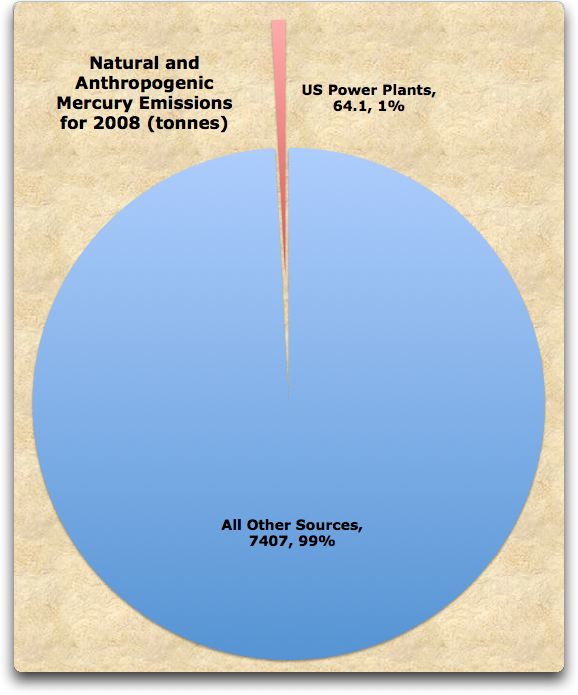
The mercury emissions total from the North American coal-based plants are less than one per cent of global emissions!!  So the effect on the health of people in the US through reduction of some fraction of the coal-based plants mercury emissions is essentially too small to measure.  However the effect of the increased cost of electricity will directly affect the health of the people in the US and especially the poorest among us.

See this posting by the Institute for Energy Research to get a sense of the loss of generating capacity that this EPA regulation will cause.

Willis Eshenbach developed two charts for his posting “The EPA’s Mecurial Madness” on the WUWT website.   They visually illustrate the futility of the EPA action to make any difference in mercury levels.

The EPA has more “kill coal-based power generation capacity” arrows in its quiver, and I plan to post on this soon.  As a preview, they are proposing a standard that will not permit the installation of new coal-based plants.

cbdakota

Fisker’s Quality SWAT Team?


A recall of up to 600+ Fisker Karmas is underway to replace faulty battery packs.  The batteries are manufactured by A123 Systems.  The problem that the Consumer Reports had with the Karma that failed in testing is believed to be the issue with the batteries to be recalled. The Consumer Reports were told by the Karma dealership that the failure was a:  “…fault was found in the battery and inverter cable. Both were replaced as a unit.”

A123 Systems at its Livonia, Michigan facility, said that the problem could result in “battery underperformance and decreased durability.” Fisker  said that the problem was discovered by Fisker’s “Quality SWAT Team.”

One blog has several postings from owners. It seems that besides the power train,  there are some systems problems.   Several quotes:

“I’ve had zero powertrain/drive issues but certainly did have some software glitches involving infotainment/navigation.”

“The car has some rough edges; there have been some software glitches and quirks that lead to erroneous indicator lights and some challenges with the entertainment/nav/climate command center. Many of these have already been addressed by Fisker in software updates, and I’m confident that the remaining issues will likewise ultimately be resolved.”

It seems that the Quality SWAT Team is behind the curve.

According to the Wilmington (De) News Journal:“….. in October, Fisker pushed back its production schedule for the Karma and the Nina, saying it would not begin high-volume production of its second line of hybrids in Delaware until mid- 2013. Production had been expected to get under way this year. “

cbdakota

Is This A Prelude To Nationalization Of The US Energy Companies?


On the 16th of March President Obama signed a new Executive Order allowing the President complete control over all US Resources. Click to read the detail.  The rising price of gasoline is considered to be one of the major threats to the reelection of Obama.  He is trying to dodge the blame by pretending that he really wanted the XL pipeline with his sham endorsement today in Oklahoma of the lower portion.   His approval is not needed for this section of the pipeline.  His approval is only required for pipelines that cross the US borders.  He has rejected the upper section of the XL pipeline, which brings in the oil from Canada, because his environmentist campaign fund donors oppose it. His sham of caring about our energy security  is trumped by his need for campaign monies.

So if these tricks don’t fool the public, what is his next act? Read my July 13 2011 posting titled OBAMA PLANS TO NATIONALIZE THE ENERGY COMPANIES.  He will say he is just doing this for our own good.  That he must step in and stop these out-of-control corporate robbers.  His action will be cheered by the media.

If Big Oil is driving up the prices how do they do it?  The American Petroleum Institute (API) listed the 20 Largest Oil and Gas Companies based upon their 2009 oil reserves.  It shows that 72% of the world’s oil reserves are owned by nations (not privately owned companies) such as Iran, Saudi Arabia, Venezuela, and Libya.  The biggest US Company to make the list was Exxon-Mobil at #17.   The Exxon-Mobil reserves as a percent of the world reserves are 0.68%.  Think about this situation where the OPEC type state owned companies have reserves 100 times greater than Exxon-Mobil.  Do you really believe that Exxon-Mobil is able to dictates the price of crude to OPEC?   Of course they can’t do that.

h/t to Steve Glaser

cbdakota

/

$141M Solar Plant Has 5 Full Time Employees.This is a Success?


The Nevada Copper Mountain Solar 1 plant is being visited today, 21 March by President Obama where he will deliver remarks on his Administration’s focus on diversifying our energy portfolio.   Solar 1 is the US’s largest photovoltaic power plant.  It cost $141 million to build.  According to the Nevada Journal: “Funding included $42 million in federal-government tax credits and $12 million in tax-rebate commitments from the state of Nevada.”  It has 5 full-time employees.  About $10 M of incentives per green job.  Apparently the President considers this a success.

President Obama’s visit to the Solar 1 Facility in Boulder City is the perfect illustration of why the president’s economic policies are such a failure,” said Andy Matthews, president of Nevada Policy Research Institute, (NPRI). “The government has spent over $50 million to ‘create’ five permanent jobs and build a plant producing a product — expensive solar energy — that no one would purchase without a government mandate.

“That’s not a path to a vibrant economy; it’s the road to serfdom. This mindset — of government attempting to pick winners and losers in the economy through subsidies and regulation — is a major reason why the national unemployment rate is at 8.3 percent, Nevada’s unemployment rate is 12.7 percent and the national debt is over $15.5 trillion.”

Kyle Gillis, a reporter for the Nevada Journal, the source of much of this posting, adds: “Solar plants aren’t the only government-funded energy projects in Nevada that haven’t lived up to their proponents’ promises. The Reno Gazette-Journal recently reported that seven local windmills that cost taxpayers $1 million to install have only saved the City of Reno $2,785 in electricity costs over their 18 months of existence”.

The Solar 1 plant is associated with Bolder City, NV but the power generated is being sent to Southern California.  California mandate’s power must be 20% renewable by 2010, 33% renewable by 2020. They did not achieve the 2010 level of 20%.  If the California Utilities supplying the energy do not comply, they risk being fined.  Californians seem to want to drive business from their state with many environmental policies that businesses just can’t afford.  California’s electricity price is 9th highest in the nation only surpassed by Hawaii, and group of Northeastern states such as Connecticut, and New York. By the way, hydroelectric power is not considered renewable under this California mandate.

Obama used his “luddite” and “straw man” speech today. I cannot recall a President in my lifetime that has been so incautious with what he says.   I guess it goes with the territory of being on a constant campaign.  I would think the appropriate name for the President is “fabulist”—and of course I am saying that politely.

I want to leave you with a chart that shows the hill that solar and wind have to climb to reach the heights that the President and his sycophants have set.   As you look at the chart below, think of Matt Ridley’s words: “To the nearest whole number, the percentage of the world’s energy that comes from wind turbines today is: zero.

 WORLD ENERGY USE 

This chart is from Wikipedia.   The data is 2006 but it things wont have changed much by 2011 in terms of percentages.

cbdakota

What Makes Up The Price Of Gasoline?


Given the interest in the “whys and wherefores” of US gasoline price,  this site welcomes the work done by the Institute For Energy Research (IER).    Their full analysis can be found by clicking here,   but the following is a summary of that analysis:

IER’s analysis provides the following facts about gas prices:

  • 76 percent of the price of gasoline is determined by the price of crude oil.
  • 12 percent of the price of gasoline is determined by federal, state, and local taxes.
  • The federal tax on gasoline accounts for 18.4 cents per gallon, while the volume-weighted average state and local tax is 30.4 cents per gallon.
  • Refining costs account for 6 percent of the price of gasoline.
  • Retail dealer’s costs and profits account for a combined 6 percent of the price of gasoline.
  • Less than 5 percent of gas stations are owned by major oil companies.
  • 60 percent of U.S. oil demand is imported from foreign countries.
  • The world consumed 87.9 million barrels of crude and liquid fuels every day in 2011, the highest consumption rate in history.
  • China is now the world’s second-largest consumer of oil behind the United States.  In 2011, Chinese crude imports were up 8.2 percent over 2010 levels.
  • The U.S. produced an average of 5.67 million barrels of crude oil every day in 2011.
  • Production in the Gulf of Mexico is expected to fall by 90,000 barrels per day due to production declines in existing fields, permitting delays, and the Obama moratorium.
  • Crude oil production in Alaska is projected to fall by 20,000 barrels per day both in 2012 and 2013.
  • When President George W. Bush lifted the executive moratorium on offshore drilling, there was an immediate price decrease in the cost of oil.
  • About 25 percent of U.S. supply of oil comes from OPEC countries, which have agreed to a production ceiling of 30 million barrels per day including Iraq’s production and some overproduction by member countries.

U.S. monetary policy — particularly increases in the money supply through quantitative easing — have coincided with a surge in oil prices.  Recent signals from the Federal Reserve that interest rates would remain at near-zero through 2014 have created a ripe environment for hedge funds that bet on commodity plays.

Obama Administration Is Not Helping The Gasoline User


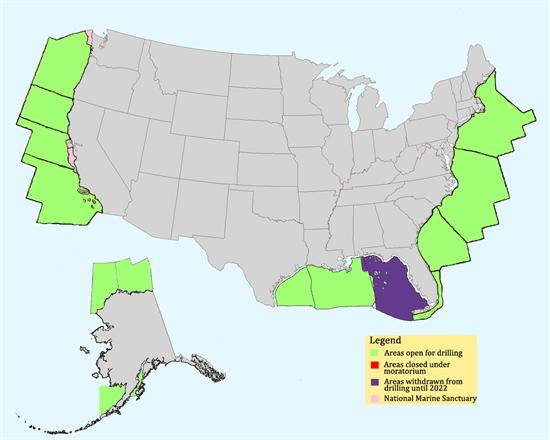
The Obama administration current 5-year offshore drilling proposal will further block access to drilling on Federal lands.  Lets look available and blocked offshore drilling sites under Bush and under Obama.

OFFSHORE UNDER BUSH

OFFSHORE UNDER OBAMA

Maps and history of the Bush and Obama Administrations regarding offshore oil and gas can be read in more detail here.

Raising Onshore Oil Production Costs

In addition to restrictions, Bureau of Land Management Director Bob Abbey said last week at a Senate Appropriations Committee on Interior hearing that federal regulations applied to oil and gas development simply make it more expensive than producing on state or private land according to a posting on Institute for Energy Research website. Then he remarked that the Administration is currently considering raising onshore production royalty rates from 12.5% to the 18.75% that  is charged for offshore oil; in fact, he said that the Department of Interior’s upcoming budget depends on an assumed 50 percent increase in royalty rates.

More blocking of access and higher rates.  How is this helping the US consumer?

Pres. Obama Says US Only Has 2% Of World Oil. Can That Be Right?


Obama said:  “With only 2% of the world’s reserves, we can’t just drill our way to lower gas prices.  Not when we consume 20% of the world’s oil.”  Addressing the 2% part of his statement, if he meant we have only 2% of the “proven reserves” he is correct. But he uses this figure hoping that you will come to an incorrect conclusion. The US is, by every analysis one of the most energy rich nations in the world.   Others, including the Congressional Research Service, say that the US is the most energy rich nation in the world

The second part –consuming 20% of the world’s oil– is a non sequitur, meaning it does not follow logically from the previous part of his statement.  We will talk about that later.

The basis for the President’s statement came from the DOE’s Energy Information Administration.  The US’s “proven” reserves of 20.6 billion barrels of oil are equivalent to 2% of the worlds proven reserves.

DOE’s Energy Information Admin (EIA) Table of US Reserves (Billions of BBL’s) 10/19/2011

Region Proven Inferred Un-discovered Total TechnicallyRecoverable
Onshore 12.7 50.1 51.1 113.9
Offshore 4.3 10.3 42.7 57.4
Alaska 3.5 2.1 42.0 47.6
Total US 20.6 62.5 135.8 218.9

Interpreting the table, Proven reserves are where oil production is underway and the extent of the fields is well known.  Inferred is the volume by which the estimate of total recovery from a known crude reservoir or aggregation of such reservoirs is expected to increase during the time between discovery and permanent abandonment.  Undiscovered is oil that very likely exists, and can be recovered depending in part on technology and/or the price of oil.

This table understates the reserves.  EAI says of the above table: Resources in areas where drilling is officially prohibited are not included.  Estimates of the resources in the Northern Atlantic, Northern and Central Pacific and within a 50-mile buffer off the Mid and Southern Atlantic OCS are excluded from the technically recoverable volumes.  A case in point is that the reserves in ANWR which according to the USGS may contain 12 billion barrels is not included because the Feds have taken it off the table.   Most of our costal waters are off-limits as well.

This table also excludes the shale oil in the Green River Formation in Colorado, Utah and Wyoming. The Feds control roughly ¾ of the public lands on which fossil fuel resources exist. Wiki says that: “The Green River Formation contains the largest oil shale deposits in the world. The 213 billion tons of oil shale contain an estimated 2.38 × 10¹¹ m³ (1.5 trillion US barrels) of shale oil.

When the proven reserves are stated,  how should you interpret the number?  Here is an example from The Institute for Energy Research:

Proved Oil Reserves Are Not Static

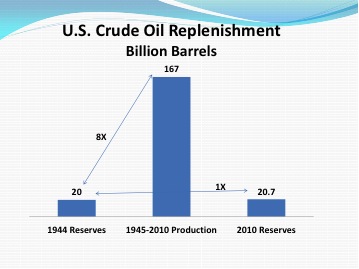
Let’s take a look at history. In 1944, U.S. proven oil reserves were 20 billion barrels — about the same as they are today. Yet, between 1945 and 2010, the United States produced 167 billion barrels of oil. In other words, the United States produced over 8 times more oil than the amount of proven oil reserves it had in 1944.  How can that be? The answer is that proven oil reserves are not stagnant because people keep looking for oil. Proven oil reserves keep changing, are officially recorded every year, tallied country by country, and published in the Oil and Gas Journal, among other publications. And due to U.S. entrepreneurship and ingenuity, more reserves are found and proven each year.

What Does More Recent Data Look Like?

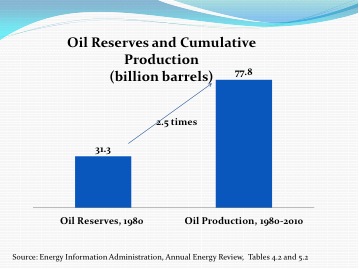
So, is this an historic anomaly? No. Let’s look at more recent data. In 1980, according to the Energy Information Administration, the United States had 31.3 billion barrels of proven oil reserves. However, between 1980 and 2010, the United States produced 77.8 billion barrels of oil and still had 20.7 billion barrels of oil reserves left. In other words, between 1980 and 2010, the United States produced 2.5 times the amount of oil as it has proven oil reserves in 1980.

The preceding illustrates that comparing the proven reserves to oil consumption is at least faulty and perhaps intended to misinform.

The President said that we can’t drill our way to lower prices when we  are the largest consumer.   Now I know that OPEC is the major force in setting the price of crude.   Even so, they are not immune to the laws of supply and demand.  They know that  a substantial excess of supply over demand will cause them to either curtail production within the Cartel  to rebalance supply and demand or the price will drop.  They also know that if they see widespread drilling being undertaken,  lowering the price of crude can cause some marginal production capacity to shutdown.

Every country that has shale oil, will be out there trying to achieve some piece of national security brought about by having their own oil.  So the over supply is likely to happen.  Ask the natural gas suppliers how well their prices have held up in recent years now that the shale natural gas is becoming oversupplied.   It will happen to OPEC too.  And the sooner the better.

cbdakota

Wind Farm’s Non-performance Endangers Lives


Kevin Myers posts “Energy policy based on renewables will win hearts but won’t protect their owners from frostbite and death due to exposure”.  He tells us that the early February cold and blizzard that swept across Europe resulted in the deaths of over three hundred people but it could have been worse.  It seems that Gazprom the principle Russian natural gas supply company was not able to keep up with demand in Europe.

Myers asks:  “Did anyone even think of deploying our wind turbines to make good the energy shortfall from Russia?”  Which he answers:” Of course not. We all know that windmills are a self-indulgent and sanctimonious luxury whose purpose is to make us feel good. Had Europe genuinely depended on green energy on Friday, by Sunday thousands would be dead from frostbite and exposure, and the EU would have suffered an economic body blow to match that of Japan’s tsunami a year ago. No electricity means no water, no trams, no trains, no airports, no traffic lights, no phone systems, no sewerage, no factories, no service stations, no office lifts, no central heating and even no hospitals, once their generators run out of fuel.

Modern cities are incredibly fragile organisms, which tremble on the edge of disaster the entire time. During a severe blizzard, it is electricity alone that prevents a midwinter urban holocaust. We saw what adverse weather can do, when 15,000 people died in the heat wave that hit France in August 2003. But those deaths were spread over a month. Last weekend’s weather, without energy, could have caused many tens of thousands of deaths over a couple of days.

Why does the entire green spectrum, which now incorporates most conventional parties across Europe, deny the most obvious of truths? To play lethal games with our energy systems in order to honour the whimsical god of climate change is as intelligent and scientific as the Aztec sacrifice of their young. Actually, it is far more frivolous, because at least the Aztecs knew how many people they were sacrificing: no one has the least idea of the loss of life that might result from the EU embracing “green” energy policies.”

Myers uses Ireland as an example:  “Wind power in Ireland actually produces only 22pc of its capacity: would you spend ¿100,000 on a car if it meant that ¿78,000 of the purchase price was wasted? It gets worse. On a really cold day, we actually need about 5,000 megawatts, but yesterday wind was producing under 50 megawatts: a grand total of 1pc of requirements. “

To read the whole of Myers’ posting, click here.

This is not untypical of wind farms.  Basically windfarms are anathema to operators of the electrical grids that supply our electricity because they cannot depend on them being a source of power.  Some times the wind blows and sometimes it doesn’t.  Customers cannot accept an electrical supply system that is intermittent.  See here, here, here, and  here for more on the unreliability wind farms power.

Routinely temperatures in many parts of the US match or exceed those experienced in France during their August 2003 heat wave. Few deaths occur in these areas of the US due to the prevalence of Air Conditioning units.  This is another example, echoing Myers, where our lives depend on a steady supply of electricity.

And what would this posting be without some comments by James Delingpole who weighed in on this topic as follows:

“Have a look at this debate between pro-renewables campaigner Jonathan Pyke and Mark Duchamp of the European Platform Against Wind Farms in The Earth Times and you’ll see what I mean:

Q: How accurate is the argument that wind turbines have to be ‘backed-up’ by alternative sources of power, eg nuclear or coal, due to the irregularity of wind?

Jonathan: It’s not accurate and I think it stems from a misunderstanding about what wind energy is for. It’s better to think of wind as the back-up for gas, allowing us to make much better use of our existing fossil fuel power plants than relying on gas alone. There’s no need to burn gas when the wind is blowing, which National Grid can predict extremely accurately. So comparing it to nuclear or coal is misleading because wind serves a different purpose; every time it blows there’s a substantial decrease in carbon emissions, volatile fossil fuel costs, water for cooling, manufacturing and pollution. The ‘back-up’ argument just isn’t valid.

R-i-g-h-t. So what you’re saying, Jonathan, is that the ONLY reason we’re carpeting some of the world’s most attractive wild countryside in horribly costly, economically inefficient, bird-liquidising, noise-polluting, view-blighting, rare-earth-metal-exploiting, property-debasing, horse-frightening, rent-seekers’ uber-horrors, is to save the odd tonne of CO2 emissions, as and when, despite the fact that the science increasingly suggests that the difference this will make to global climate will be so negligible as to be beyond measurement?

At first they said they would replace fossil fuel driven electrical generating plants, but as this has turned out badly for them they now want to convince us that what they really, really, really want to do is play the part of backup.  Yikees, the windfarms were not economic as the primary units how on earth can they be anything but less economic as backup units  and they will still be unreliable.

You can read the Delingpole’s article by clicking here.

cbdakota

Ethanol Subsidies: Not Gone, Just Hidden a Little Better


Mother Jones, an organization with a very liberal viewpoint posted that the subsidies for ethanol fuel have expired but that this doesn’t trouble the ethanol fuel producers.  Kevin Drum authored the posting and I will let him tell you why.

A few years ago I called subsidies for corn ethanol “catastrophically idiotic.” And why not? Corn ethanol, it turns out, is actively worse for the environment than even gasoline. Farmers responded to the subsidies by reducing the amount of farmland used for food production, and this drove up the price of staple food worldwide.  At the end of last year, ethanol subsidies quietly expired and no one tried to extend them.

So why did the powerful corn ethanol lobby let it expire without an apparent fight? The answer lies in legislation known as the Renewable Fuel Standard (RFS), which creates government-guaranteed demand that keeps corn prices high and generates massive farm profits. Removing the tax credit but keeping the RFS is like scraping a little frosting from the ethanol-boondoggle cake.

The RFS mandates that at least 37 percent of the 2011-12 corn crop be converted to ethanol and blended with the gasoline that powers our cars…[As a result] the current price of corn on the Chicago Mercantile Exchange is about $6.50 per bushel—almost triple the pre-mandate level.

 You might not be aware that when the EPA does mpg ratings for new cars, they use gasoline that does not contain any ethanol.  Adding ethanol at 10% of the fuel mix, the energy in a gallon of fuel is about 96.7% of a fuel not containing ethanol.  Ethanol has less energy per gallon than normal unleaded gasoline.  So the MPG rating is probably just a bit high.    See

cbdakota

Geothermal Energy–What’s Its Source?


What is the source of geothermal energy? According to Terrestial Energy, written by William Tucker, if you drill a 1000 feet (305 meters) deep hole, the temperature at the bottom of the hole is 16F (10C) higher than at the top.  Tucker says that the average temperature of the ground is 54F (11C) so the bottom of that hole would be 70F.

The Homestake Gold mine in Lead SD, discovered in 1876, produced 40 million ounces of gold and 9 million ounces of silver. At the time of its closure in 2002, the mine was more than 8000 feet below the surface   Based on Tucker’s formula, the temperature at the 8000 foot level would be around 180F unless cooling air was introduced. .  At one time, one of my relatives (by marriage) was the engineer responsible for keeping the temperature in the mine at a level that would allow people to work.  And his description of what was needed to do that was pretty impressive.

Tucker goes on to say: “At 80 miles down we hit the Mohorovicic Discontinuity, discovered by Yugoslav seismologist Andrija Mohorovicic in 1909. At this point the temperature reaches 900o C and rock turns to liquid “magma.” At 1500 miles deep the temperature rises to 3700o C and another discontinuity – the Gutenberg – marks the place where molten rock becomes pure iron and nickel. Below that tremendous pressures turn the iron core solid once again and temperatures reaching 7,000o C – hotter than the surface of the sun.”

He explains that the source of this heat energy as follows: “Some of it is due to gravitational forces. As the earth is pulled inward, some of this force is translated into heat. Another portion is residual heat from the earth’s formation. According to the commonly accepted theory, originally proposed by Immanuel Kant, the solar system precipitated out of a huge swirling dust cloud, where particles kept colliding with each other until they agglomerated into the sun and the planets.

In the later stages, this involved huge collisions among very large objects. These impacts generate large amounts of heat, some of which still remains in the earth’s core. Together gravitational forces and residual heat probably account for about 40 percent of the earth’s temperature – the exact figure has still not been determined.

The other half of the earth’s heat, however, comes from a remarkable diminutive source – the slow breakdown of two of the 90 elements, uranium and thorium. With 92 protons, uranium is the largest natural atom, while thorium (90) is the third largest. Because of their size, they are unstable, meaning they are “radioactive.”

The internal “binding energy” that overrides the mutual repulsion among positively charged protons is occasionally overcome itself. This releases large quantities of energy, which sets subatomic particles in motion, creating large amounts of heat. Incredibly, the slow breakdown of these two radioactive elements, uranium and thorium, is enough to raise the earth’s internal temperature beyond the level of the surface of the sun.”

Tucker draws some conclusions from this when he says: “Why don’t we just take the source of that heat – the uranium or thorium – bring it to the surface, and reproduce or even accelerate the process that produces this heat in a controlled environment?

This is what we do in a “nuclear reactor.”  “A nuclear reactor is nothing more than terrestrial energy brought to the surface. There is nothing sinful or diabolical about it. We are not defying the laws of nature. Rather, we are working with a process that already takes place in nature.”

h/t Master Resource

cbdakota