Category Archives: Ap index

NASA Revises Cycle 24 Sunspot Prediction.


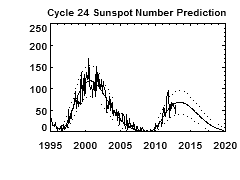
David Hathaway, NASA solar cycle expert, has a revised forecast for Solar Cycle 24 Sunspot number and Maximum timing.  In May 2012, he forecast the smoothed sunspot number maximum at 60 and the timing of the maximum as the spring of 2013.  His January 2013 Cycle 24  revised forecast is for 69 spots and maximum in the Fall of 2013.  He adds:
“ We are currently over four years into Cycle 24. The current predicted and observed size makes this the smallest sunspot cycle since Cycle 14 which had a maximum of 64.2 in February of 1906.”  
 jan13hathawayssn_predict
       Hathaway’s  NASA Revised January 2013 Sunspot Number Prediction

Solar Cycle 24 Nearing Maximum


Solar Cycle 24 is nearing its maximum after which the solar activity will decline.     The maximum is often pegged as the time when the Sun’s  north and south poles swap. The chart below shows the current position of the poles. Projecting their current position suggests that the swap will occur early next year.
(Click on Charts to improve clarity)
december12Solar-Polar-Fields-1966-now
    Solar Polar Field 1966 to Present –Wilcox Solar Observatory

NASA’s Stereo Mission Captures CME–Fastest Ever Recorded


On 23 July 2012, NASA’s Stereo **Mission spacecraft recorded a coronal mass ejection (CME).   The cloud of solar material ejected from the Sun sped out into space at a speed of “between 1,800 and 2,000 miles per second”.  That translates to about 7.2 million miles per hour or about 1.1% of the speed of light.  NASA says it is probably the fastest CME ever measured by any spacecraft.  Incredibly,  it is said that, on average,  the mass ejected into space is  1.6×10¹²kg.   A video of the  23 July CME can be seen by clicking here.

From the NASA announcement of this event:

“Measuring a CME at this speed, traveling in a direction safely away from Earth, represents a fantastic opportunity for researchers studying the sun’s effects. Rebekah Evans is a space scientist working at Goddard’s Space Weather Lab, which works to improve models that could some day be used to improve predictions of space weather and its effects. She says that the team categorizes CMEs for their research in terms of their speed, with the fastest ones – such as this one — labeled “ER” for Extremely Rare.”

**The STEREO mission consists of two spacecraft with orbits that for most of their journey give them views of the sun that cannot be had from Earth. Watching the sun from all sides helps improve our understanding of how events around the sun are connected, as well as gives us glimpses of activity we might not otherwise see.

cbdakota

Solar Cycle 24 Update July 2012


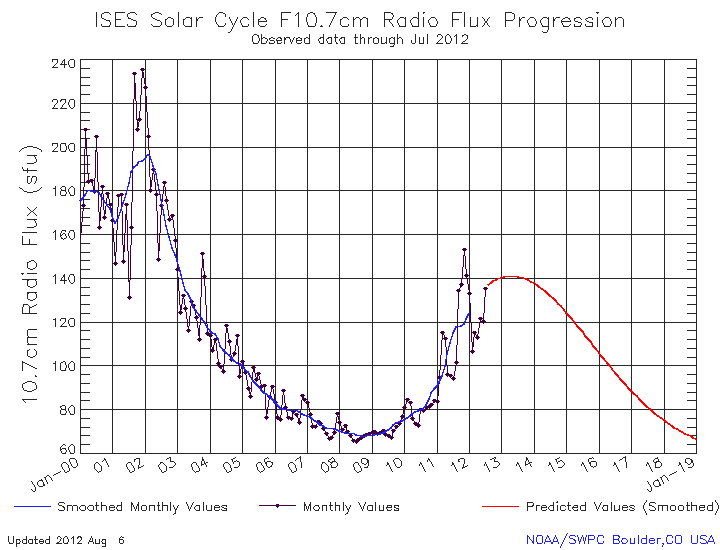
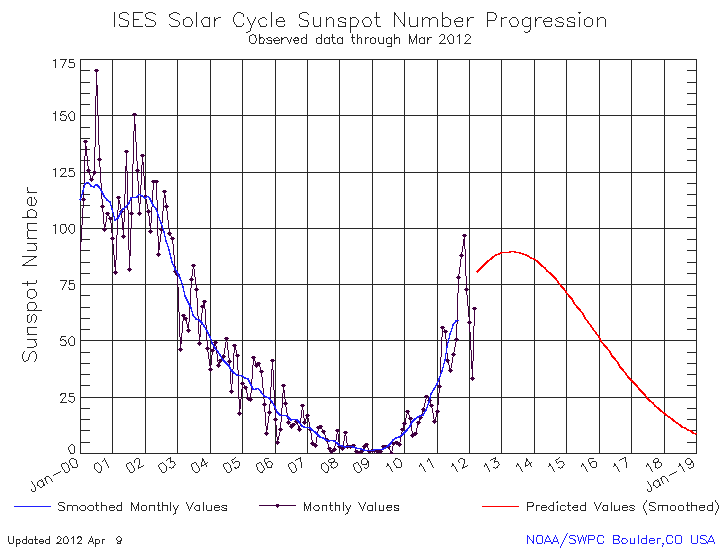
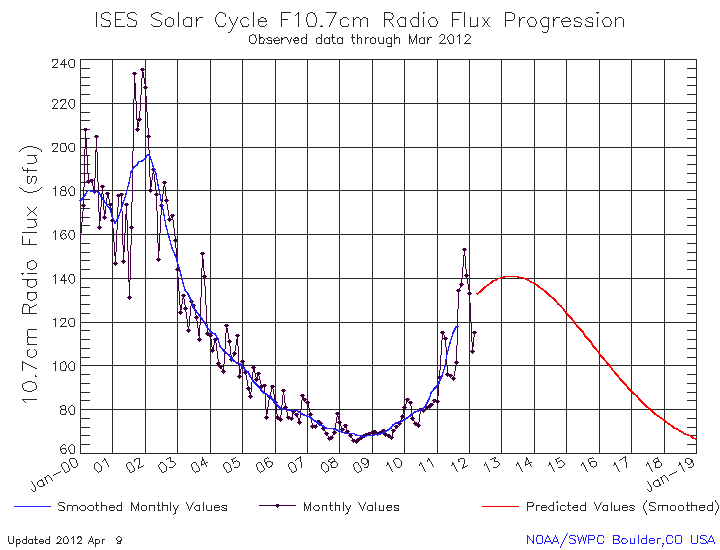
Solar Cycle24 July sunspot and F 10.7cm radio flux numbers are up slightly from June.  Pretty much in line with the activity projection and much below that of Solar Cycle 23. (Click on Graphs for Clarity)

Large Filament on the Sun

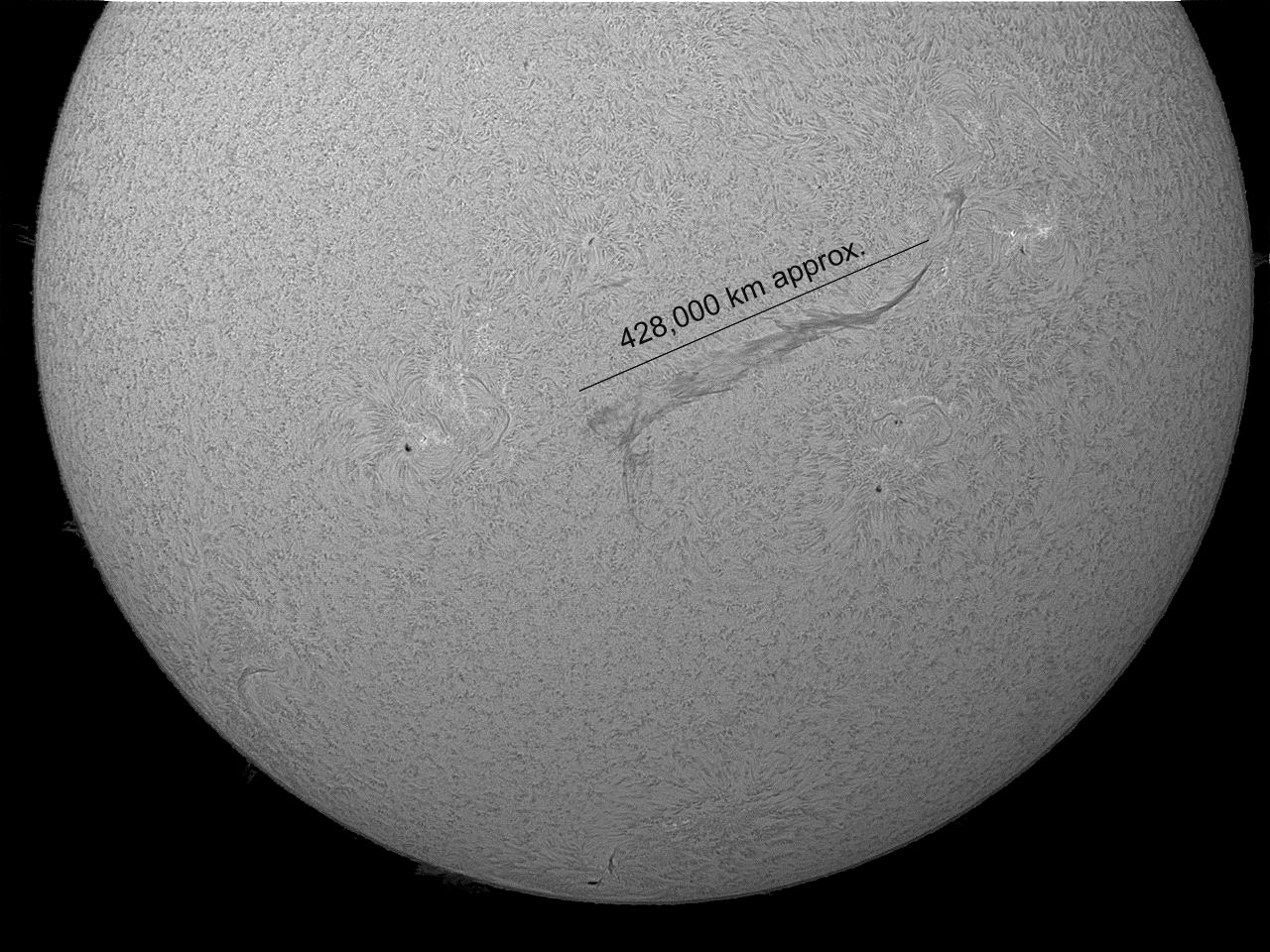
The Sun currently has a filament that stretches more that 400,000km across the face. Filaments are formed in magnetic loops that hold relatively cool, dense gas suspended above the surface of the Sun. Because they are cooler than the photosphere they can look dark.

courtesy of solarham.net

But when viewed in profile they look like a giant loop, called a prominence.

courtesy of NASA

Occasionally when these filaments collapse,  a coronal mass ejection (CME) can occur.   Because the filament is looking directly at the Earth,  a CME could cause problems.   Lets hope this does not happen.

cbdakota

Decoding Solar Flare Classifications


When a solar expert says that there are multiple M-Class solar flares being detected on the Sun, do you know what that means?   From today’s (5 July) posting on Solarham.net:

Solar Update / High Solar Activity:
Solar activity is currently at high levels with multiple M-Class solar flares being detected around mostly large Sunspot 1515 in the southern hemisphere. This region retains its Beta-Gamma-Delta magnetic configuration and may produce an X-Class solar flare within the next 24-48 hours. Sunspot 1513 located in the northern hemisphere did generate an M1.8 event on Wednesday and was associated with a possible Earth directed CME. An impact is expected by July 7 the earliest. Minor geomagnetic activity will be possible.” 

This Solarham.net solar update reports M-Class flares are being detected and that an X-Class flare maybe produced in the next 24 to 48 hours.    Are these conditions a threat to Earth?

Knowing the classifications for Solar Flares  may serve you well. The classifications can be found in this website: The HandyMan’s Guide to Solar/Geomagnetic Conditions by Paul Harden, NA5N

Solar Flare Classification  

Flare Class

Type of Flare

HF Radio Effects

Resulting Geomagnetic Storm

A

Very Small

None

None

B

Small

None

None

C

Moderate

* Low Absorptons

* Active to Minor

M

Large

* High absorption

* Minor to Major

X

Extreme

* Possible Blackout

* Major to Severe*

*Conditions cited if Earth is in the trajectory of the flare emissions

Flare class is further rated from 1-9, ex. M1, M2, M3…M9

The larger the number, the larger the flare within that class. An X7-X9 is considered a “Grand Daddy” flare. Only a few have occurred over the past 30 years and cause total disruptions to communications, huge auroras, power grid failures, etc. Radio and X-Ray emissions from a flare affect the Earth for the duration of the solar event, usually 30 minutes or less. The Earth is 8 light-minutes from the Sun.

Conflicting Sunspot Classifications

I believe the Sunspot classification shown in  The HandyMan’s Guide to Solar/Geomagnetic Conditions by Paul Harden, NA5N groups the consequences reasonably well.  However,  the Sunspots classifications used in the Solar Update follow the Mount Wilson classification system which can be seen here.  It has a more detailed grouping system, including a gamma designation not included in the HandyMan’s Guide.

cbdakota


Solar Cycle 24 March Update


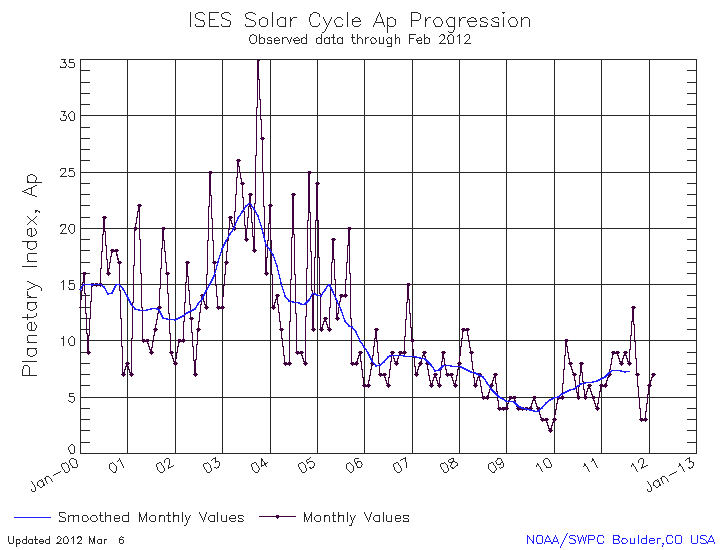
Solar Cycle 24 activity picked up in March.  Several coronal mass ejections (CME) came our way thanks largely to the sunspot group 1429.  March began  with a CME directed toward Earth.  Although the warnings suggested more severe problems than actually occurred,  it still was a reasonably strong storm. The Sun’s rotation brought sunspot 1429 back again at month-end and it provided a little more excitement.   A good summary of the solar activity in March can be found on the Solarham.com site.  To take a look at the summary,  click here.  This solar activity and it’s affect on the Earth’s geomagnetic field can be seen on the chart below: (click on charts to improve clarity)

Both the sunspot number and the F10.7 flux were below the predicted  monthly numbers in March but seem to be generally following the forecast Solar Cycle 24 forecast path.  See charts below:


Cycle 24—February Update


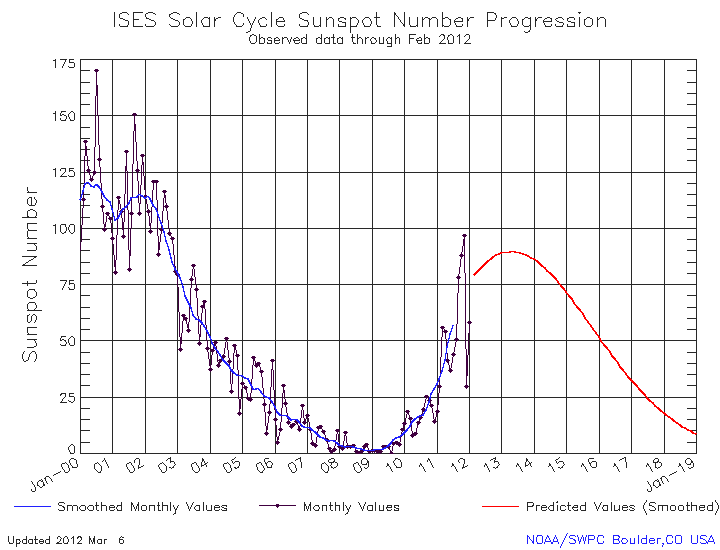
Cycle 24 activity took another drop in February.  The Sunspot number for February was about 30 versus the 60+ in January. (Click on Charts to expand.)

That’s a major drop in the sunspot number.  Cycle 24 certainly looks like it will be the least active cycle in the last hundred years.

Dr Hathaway of NASA has again revised his forecast of Cycle 24 Sunspots.  He now says that  the Cycle 24 sunspot number will peak (maximum) at 59. Below is his March 2012 sunspot number forecast:


F10.7 cm radio flux is down as well.  First shown on the NOAA chart followed by Dr Hathaways revised chart:

And the magnetic activity as indicated by the Ap index remains low:

cbdakota

Cycle 24 January Update


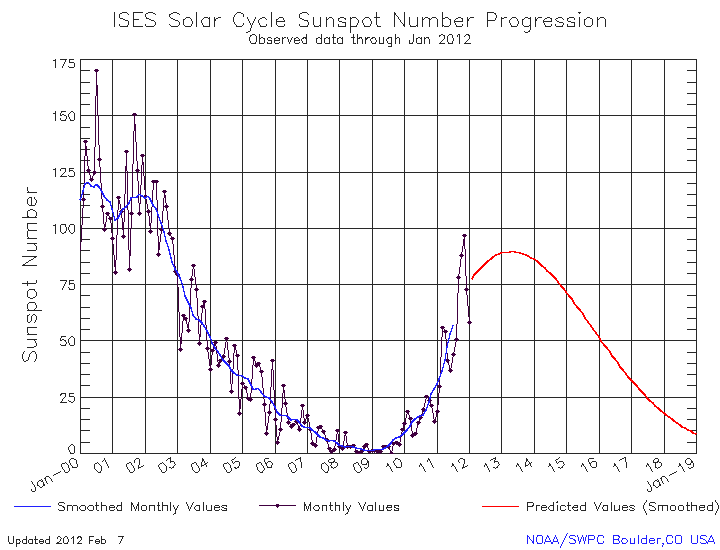
Cycle 24 activity in January was low.  Cycle 24 solar maximum is probably about 18 months away.   The January sunspot number and the F10.7 flux are following the NASA forecast.  The very low Ap index seems confirm that this cycle is likely to be much less active than Cycle 23.  See the charts below, all courtesy of NOAA/SWPC. (click on charts to enlarge)

cbdakota