SUN AND CLIMATE PART 3: SOLAR FLUX & Ap INDEX


In the two prior postings Sun and Climate,Parts 1 and 2,  we have talked about Solar Activity and how it relates to climate.  In Part 1, the discussion was primarily about Solar Insolation, and Part 2 began the discussion about solar activity using Sunspots as a proxy.   Sunspots are popularly used to indicate Solar activity due to their longevity.  Galileo began noting and recording them in the sixteen hundreds.

Ok,   now lets look at some more physical evidence that shows a strong correlation with solar activity/climate change.

Two much newer and probably better proxy measures are Solar Flux and Average Magnetic Planetary Index (Ap index).

SOLAR FLUX

The former is a measure of noise or flux that is emitted at a frequency of 2800 MHz (10.7cm).  This measure is typically referred to as F10.7.  This proxy measures ionization in the ionosphere’s F region.    The solar wind from the Sun contains many atomic particles.  The Earth’s geomagnetic field deflects the majority of the protons and electrons being expelled from the Sun toward the Earth.  But the as the Sun’s activity increases more particles are expelled and more break through into the Earth’s ionosphere where F10.7 measures the increase.    Continuous F10.7 measurement and record maintenance began in 1947. As can be noted from the shape of the current (Nov. 2010) monthly summary chart of F10.7,   it is lagging the same point on the red line where the experts had predicted it would be at this time in Cycle 24.

And as we noted in Sun and Climate Part 2,  the forecast Cycle 24  has been  scaled down several times in the last few years in order to match actual real world results which have consistently come in below each new forecast.  Note that the level of F10.7  at the peak of Cycle 23 in 2001 and 2002 reached nearly 240.

AVERAGE MAGNETIC PLANETARY INDEX –Ap

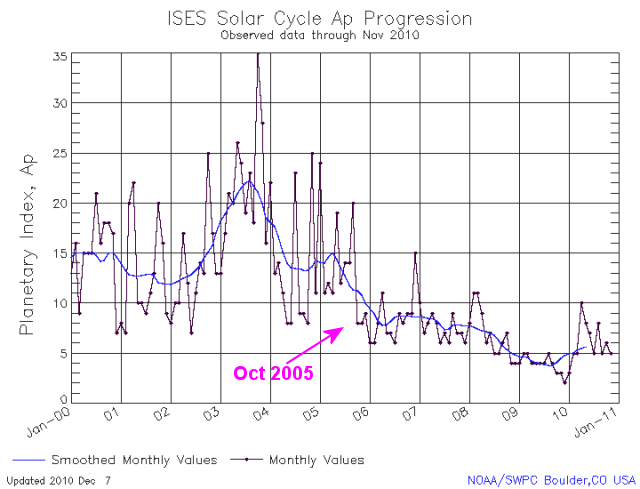
The Sun’s magnetic field extends far out into space.  It not only surrounds Earth, it also extends well beyond Pluto.  The more powerful the Sun’s magnetic field, the more it alters the  Earth’s geomagnetic field.    The Ap index is measure of this alteration.   The Ap index measurements began in the 1930’s.   The chart  that follows shows the Ap index beginning in 2000 through most of  2010.  The peak in the 2003 -2004 time frame is Cycle 23.  The Solar activity was high during that time, reaching an Ap index of 35 at its peak.  In October 2005,  the Ap Index dropped significantly and has remained very low since then.

The  following chart shows the Ap index from October 2010  through the end of December 2010.  Note that the index has bottomed out at zero on several occasions.  This chart also illustrates the how well the Solar Flux, the Sunspot Number and the Ap Index  correlate.

(This chart was prepared by Jan Alvestad)

No one knows exactly the mechanism that causes the Earth to cool when these proxies are low or warm when they are up.  No one knows exactly why the Sun has 11 (+-) year cycles.  Maybe we will never learn enough to be able to predict accurately the future state of the solar activity.  If so,  we will never be able to accurately predict the Earth’s future climate.  But we can reasonably predict that the Earth’s climate will cool as long as these proxies stay low (below normal), indicating low solar activity.
Moreover, we can’t control solar activity.  We can’t control Earth’s orbit around the Sun.  The Sun is in charge of our climate.  Man has precious little control of the climate in the big picture.   Attempts to moderate the Earth’s climate through reduction of CO2, for example, will have limited to no effect on climate although it will have a profound negative impact on our economic well being .

Our efforts should be directed toward adaptation to what every the Sun dishes out.

For more on this topic see posting Part 1 and Part 2 of Sun And Climate.

cbdakota

Sun and Climate Change -PART 2: Sunspots


Following up from the previous posting, Sun and Climate Change Part 1-Solar Activity, we will continue to examine the connection between the Sun and the Earth’s climate.

Sun’s Magnetic Field

On average, the Sun’s magnetic field is thought to be only about twice as strong as Earth’s magnetic field. The magnetic field is generated by the rotation of the Sun acting like a giant electromagnet.  But it has local fields of enormous strength, something in the range of 8000 times greater that Earth’s field.  It is believed that the cause of these local fields is the differential rotation of the Sun’s latitudes.  The observed rotation at the equator is 25 days and near the poles about 35 days is due to the fact that the Sun is made up of plasma and hot gases.  This results in the magnetic field becoming twisted and erupting from the surface in these local fields.  Where this enormous magnetic force exists, you find Sunspots, flares, and coronal mass ejections (CME). The Sun has a cycle of about 11 years from minimum to maximum and back to minimum magnetic activity.  This cycle can be observed by the numbers of Sunspots formed on the surface of the Sun.   During a cycle, the Sunspot number increase until the Sun’s polarity “flips”.  The Sun’s magnetic polar north flips and points south.  This usually is the point at which the so-called solar maximum is reached. The activity on the Sun begins to decrease.  The cycle eventually reaching a point where very few Sunspots are observed.  This is the completion of a cycle.

Sunspots

Sunspots are the product of the enormous magnetic fields (thousands of times stronger than Earths magnetic field) created on the Sun. They appear as dark spots.   The Spots are cooler than the surrounding surface of the Sun.  NASA says that the Spots are about 3700K versus 5700K for the surrounding photosphere.

Sunspots are probably not the best indicators of the Sun’s activity but the better indicators have little history where as Sunspots have been recorded for hundreds of years. What make them especially interesting is that the Earth’s climate and Sunspots have a high degree of correlation.   Periods where the Earth’s climate has cooled off appear to coincide with periods of few Sunspots and periods of warmer climate seem to coincide with periods of high Sunspot counts.

Chart Courtesy of Wikimedia Commons

The telescopic recording of Sunspots began  with Galileo using the newly invented telescope to observe the sunspots in 1610.  He and later others began to count the sunspots.

When a solar cycle is forecast, the y-axis is usually Sunspot numbers and the x-axis is time.   The current solar cycle is 24.   On the chart below, the blue line is the monthly average of Sunspots. It shows  cycle 23 declining from its high and then cycle 24 as it begins to rise.  The orange line was the predicted shape of cycle 24 by NASA experts but the actual Sunspot numbers are lower than forecast. The experts have found it necessary to continue to reduce the numbers (height) of the forecast monthly Sunspot numbers.  In 2006 they forecast a height of cycle 24 at a sunspot number of 156 to 180. The following chart is from a posting by Anthony Watts on his blog,  WattsUpWithThat and can be seen here.

The following chart shows the latest  (Dec 2010) prediction of NASA and how they have found it necessary to continue to lower their expectations over time to new “high Sunspot number” of 64!!!  Although some people think they have a system that allows them to predict these numbers, its clear that no one knows enough to make any forecast that’s good enough to bet on it. The NASA forecast has been downgraded four times since the March 2006 prediction.

(The chart courtesy of Ira Glickstein on WUWT blog and can be seen here.)

There is one additional factor that the reader needs to be aware of, and that is comparing Sunspot counts of old and those of today could be problematic.   The pinpricks that are counted on the sun today with the high-powered equipment were probably not even noticed in years past.   So when it is reported that the sunspot count during period of the Maunder Minimum in lower than today, you cannot be sure we are comparing apples and apples.   Some discussion about this variable can be found here.

But no matter how you count them, the cycle 24 sunspots are out of the norm. Cycle 24 is being compared to Cycle 5 which occurred at the time of the Daulton Minimum.  The indications are Earth’s  climate is in for a period of cooling.

cbdakota


Sun and Climate Change -PART 1: SOLAR ACTIVITY


Two years ago, this December, I wrote an essay titled “Sun and Climate Change”.   The essay opened with this summary statement:

Climate change has always been underway on Earth.  Periods of cooling, then warming, then cooling, etc. are historical facts.  These changes, over millions of years, have had natural causes that do not include burning of fossil fuels.

Correlation might mean causation.  But no correlation clearly means no causation.  The ice core and ocean bottom core data that provide a look back into time, show that atmospheric carbon dioxide (CO2) lags global temperature change.  It says that CO2 begins to increase after the global temperature begins to increase and it decreases after the temperature decreases.  So CO2 does not cause temperature to change. Yes, I am aware that CO2 plays a small role as a greenhouse gas.  But it is water, in the form of vapor and clouds, which does 90% of the greenhouse work.

The Sun, however, has correlation with climate change.  After many years of low solar activity (known as the Sporer, Maunder and Dalton Minimums), a comparatively cool climatic period followed that lasted from 1450 to 1820.  This cool period is known as The Little Ice Age. Then came many years of increasingly greater solar activity that stretched into the 20th century.  Some solar scientists say that this period has been the most active in the last 11,000 years.  Global warming has been a consequence of these more active, recent solar cycles.

So where are we now?   At the moment, the global temperature is falling.  The global temperature is cooler now than it was at the end of the last century.  Figure 1, shows how the global temperature has been declining. The solar activity is down; in fact, August 2008 was the first calendar month in 100 years that no sunspots were recorded.  Sunspots appear to be a reliable proxy for solar activity.   Will this period of cooling last? I don’t know.  I hope that we do not descend into another Ice Age, Little or Big. I would rather have warming.  What I am reasonably confident of is that fossil fuel use restrictions (in order to reduce atmospheric CO2) will make little difference relative to global warming.  I am reasonably confident that the Sun is the critical player here and there is little we can do to change whatever the Sun decides to do.  Even though the exact mechanism linking the Sun and global climate change has not yet been definitively established, it is kind of like gravity–it is obvious even if we cannot fully define it.

Two years later some tweaking could be done to the preceding but for the most part it is accurate and further, the intervening time has provided even more compelling evidence.

Solar Activity,  Solar magnetism, Solar cycles, and Sunspots will be discussed in this and future postings.

SOLAR ACTIVITY

A new peer-reviewed paper was recently published in the Journal of Geophysical Research:  (the source is the Blog IceCap.  To read more click here)

...that reconstructions of total solar irradiance (TSI) show a significant increase since the Maunder minimum in the 1600’s during the Little Ice Age and shows further increases over the 19th and 20th centuries. The TSI is estimated to have increased 1.25 W/m2 since the Maunder minimum ………..

It remarkable that the authors say that most of the warming since 1850 can be accounted for by the increase in solar activity:

Use of the Stefan-Boltzmann equation indicates that a 1.25 W/m2 increase in solar activity could account for an approximate .44C global temperature increase [the HADCRU global warming from 1850 to 2000 is .55C].

The paper is Reconstruction of solar spectral irradiance since the Maunder Minimum, by N.A. Krivova, L.E. A. Vieira, S. K. Solanki

Journal of Geophysical Research

For more on this topic see Sun and Climate Change Part 2 Sun Spots

cbdakota

CANCUN AND WORLD GOVERNMENT–PART 2


From my preceding posting Cancun and World Government—-the meeting in Cancun makes the assumption that emitted CO2 is causing harm to undeveloped or underdeveloped nations.  To make amends for this, the developed nations are to pay reparations to the other nations.  The “Chairman’s note” in the previous blog shows the UN would manage these payments which could be as large as 1.5% of GDP.

NOW WHAT COULD BE WRONG WITH ALL OF THAT, YOU ASK?   Let me count the ways:

1.  There is no scientific evidence that CO2 has or will cause any significant “harm”.  I suppose one could argue that anything that keeps the world from going into another Ice Age is a welcome addition.  And for those advocates of the Precautionary Principle, why not contribute of some activity or fund that might prevent a new Ice Age.  In either direction, hot or cold, I don’t believe your contributions will be able to reverse the direction.

2.  We do know that the underdeveloped and undeveloped nations have been blessed by the developed countries.  Great advances available to all peoples of the world in medicine, chemistry, mathematics, and literature are (for the period of time of the warmist concerns about CO2) products of the developed nations.   Using the Noble Prize as a parameter, the top winners are shown in the chart below as well as several examples of the contribution by some of the loudest wanting reparations:

Nation Total Prizes Won Less Peace and Lit
USA 326 296
UK 115 95
Germany 102 86
France 57 33
Venezuela 1

Bolivia 0 0

Excluding literature and Peace is a questionable exercise but when I see that in this decade, the Peace prize has been won by Obama, Gore and Carter, one has to wonder what value that prize is to anyone.

One also wonders why Venezuela, for example, being a big producer, user and exporter of oil is somehow not classified as one of the payers of reparations rather than a recipient as they see themselves.  Is this the “drug producer and supplier” proviso—you know it’s not their fault it is only the users fault.

Thinking about medicine and health, don’t they owe us a lot for saving the lives of millions?  Real lives, not these hypothetical lost lives the IPCC keeps coming up with.   Polio almost eliminated everywhere.  Small Pox a thing of the past.   Malaria deaths could be down significantly if environmentalists got out of the way.   HIV death rates in reverse everywhere.  Don’t they owe us for all the advances in their lives resulting from the inventions, all the advances in science as well? Click here to see Prize distribution.

3.   Giving the UN money is the surest way to see that it gets into the wrong hands.  Need I remind you of the Iraq Oil for Food program?  I believe that the UN may have the biggest collection of scammers ever to be in one organization.

4.   The UN is made up of countries that are not democratic or only partially democratic.  The Nobel Organization has a nice slide show illustrating the nations that are democratic and those that are not.   In large measure, democracy is the form of government of the successful nations in this world.   The advances in world knowledge come fundamentally from these countries.  The Nobel Prizes illustrate this.

There are only 4 nations in the world that state that they are not democracies.  They are Vatican City, Saudi Arabia, Burma and Brunei.  But in fact most of Asia, with the notable exception of India, and most of Africa with the notable exception of The Republic of South Africa are populated by countries that may have “democratic republic” in their nation’s title but they are not democratic in any sense.  The Slideshow I mentioned says that 3 billion people live in democracies and 3.6 million do not.  I do not want the majority of the world’s people running the UN now, and surely don’t want that organization to be running this country.

To see the slideshow, click here.

Apparently, President Obama’s representatives are in cahoots with these thieves at the Cancun meeting.  Write your Congressional Members and tell we want no part of this reparations plan.

cbdakota

CANCUN AND WORLD GOVERNMENT


The Cancun UN global warming meeting is nearly over.  This is a political get-to-gather where the focus is to extract monies from the developed nations to pay for the harm caused by them to the undeveloped or underdeveloped nations.  This “harm” is the result of the CO2 these developed nations have emitted.  While there is no proof that such harm has actually occurred, never you mind, they want the money in any event.

In Christopher Monckton’s posting on the Science & Public Policy Institute, he summarizes a “33-page Note (FCCC/AWGLCA/2010/CRP.2) by the Chairman of the “Ad-Hoc Working Group on Long-Term Co-operative Action under the United Nations Framework Convention on Climate Change”, entitled Possible elements of the outcome, reveals all.”

Selected parts of Monckton’s summary is as follows:

Finance: Western countries will jointly provide $100 billion a year by 2020 to an unnamed new UN Fund. To keep this sum up with GDP growth, the West may commit itself to pay 1.5% of GDP to the UN each year. That is more than twice the 0.7% of GDP that the UN has recommended the West to pay in foreign aid for the past half century. Several hundred of the provisions in the Chairman’s note will impose huge financial costs on the nations of the West.

The world-government Secretariat: In all but name, the UN Convention’s Secretariat will become a world government directly controlling hundreds of global, supranational, regional, national and sub-national bureaucracies. It will receive the vast sum of taxpayers’ money ostensibly paid by the West to the Third World for adaptation to the supposed adverse consequences of imagined (and imaginary) “global warming”.

Bureaucracy: Hundreds of new interlocking bureaucracies answerable to the world-government Secretariat will vastly extend its power and reach.

Monckton relates what is missing from the Chairman’s note:

Omissions: There are several highly-significant omissions, which jointly and severally establish that the central intent of The Process no longer has anything to do with the climate, if it ever had. The objective is greatly to empower and still more greatly to enrich the international classe politique at the expense of the peoples of the West, using the climate as a pretext, so as to copy the European Union by installing in perpetuity what some delegates here are calling “transnational perma-Socialism” beyond the reach or recall of any electorate. Here are the key omissions:

· The science: The question whether any of this vast expansion of supranational power is scientifically necessary is not addressed. Instead, there is merely a pietistic affirmation of superstitious faith in the IPCC, where the conference will “recognize that deep cuts in global [greenhouse-gas] emissions are required according to science, and as documented in the [IPCC’s] Fourth Assessment Report.

The economics: There is no assessment of the extent to which any of the proposed actions to mitigate “global warming” by cutting emissions of carbon dioxide or to adapt the world to its consequences will be cost-effective. Nor, tellingly, is there any direct comparison between mitigation and adaptation in their cost-effectiveness: indeed, the IPCC was carefully structured so that mitigation and adaptation are considered by entirely separate bureaucracies producing separate reports, making any meaningful comparison difficult. Though every economic analysis of this central economic question, other than that of the now-discredited Lord Stern, shows that mitigation is a pointless fatuity and that focused adaptation to the consequences of any “global warming” that may occur would be orders of magnitude cheaper and more cost-effective, the Cancun conference outcome will continue to treat mitigation as being of equal economic utility with adaptation.

· Termination: Contracts have termination clauses to say what happens when the agreement ends. Nothing better illustrates the intent to create a permanent world-government structure than the absence of any termination provisions whatsoever in the Cancun outcome. The Process, like diamonds, is forever.

Democracy: Forget government of the people, by the people, for the people. Forget the principle of “no taxation without representation” that led to the very foundation of the United States. The provisions for the democratic election of the new, all-powerful, legislating, tax-raising world-government Secretariat by the peoples of the world may be summarized in a single word: None.

Joanne Nova posts on her blog, using Monckton’s information, what it will cost the US, Aussie and Brits if the recommended 1.5% of GDP is agreed to:

The UN wants nothing less than 1.5% of our GDP.

That’s $212 billion from the USA every year ($2700 per family of 4).

That’s $32 billion from the UK every year ($2000 per family of 4).

That’s $13 billion from Australia every year ($2400 per family of 4).

Figures calculated from the CIA world Factbook

To read Monckton’s posting in detail click here

To read Joanne Nova’s posting in more detail, click here.

For more on this topic see Cancun and World Government part 2

cbdakota

AM I MADDER AT MYSELF OR OBAMA?–Wikileaks


Those State Department Wikileaks  that discuss anthropogenic global warming (AGW) show  the Obama Administration plotting to torpedo the UN global warming Pact as much as six months prior to the December 2009  Copenhagen Climate Change summit.  I am mad at myself, because I was unable to figure out the reasons for the failure.  I thought failure of the UN proposal at the Copenhagen summit was a result of the release of the Climategate Emails and the belief that the US Congress would not pass Cap and Trade nor ratify any climate treaty.  But all along it was Obama’s folks out there buying votes.  Well  I did not know,  but a lot of countries did.  They were lining up at the State Department’s door to get their share of our money.

It appears that the US and the EU concluded that the price to play the global warming scam was too high using the UN’s proposed Pact.  That Pact would have made Robin Hood look like a piker doing the “take from the rich and give to the poor” routine.

But I am mad at Obama and all those countries that clearly demonstrate  once again, that the faulty science of AGW does not concern them.  They are in it for the money and the control.

So, I have an answer to my opening question.  My actions did not hurt anyone.  Obama’s, at a high cost, continued to perpetuate the fraud that is AGW.

A posting by the UK Guardian (Guardian is supportive of AGW) ,  discusses their findings as they searched through the leaked State Dept. files.  It seems that the US and the EU wanted what was later called the Copenhagen Accord.   Both the original UN Pact and the Accord contained restrictions on CO2 emissions and offered reparations to those nations that were being or would be “devastated” by AGW.  The difference seemed to be how big the reparations would be and how large the CO2 reductions would be.   There are 193 voting bodies in the UN,  most  would be recipients of the reparations.   By February 2010,  according to the last set of Wikileaks,  140 now support the Copenhagen Accord.

The method used to achieve this “success”  is pretty chilling.  From the Guardian posting is this:

The US diplomatic cables reveal how the US seeks dirt on nations opposed to its approach to tackling global warming; how financial and other aid is used by countries to gain political backing; how distrust, broken promises and creative accounting dog negotiations; and how the US mounted a secret global diplomatic offensive to overwhelm opposition to the controversial “Copenhagen accord”, the unofficial document that emerged from the ruins of the Copenhagen climate change summit in 2009.

Negotiating a climate treaty is a high-stakes game, not just because of the danger warming poses to civilisation but also because re-engineering the global economy to a low-carbon model will see the flow of billions of dollars redirected.

Seeking negotiating chips, the US state department sent a secret cable on 31 July 2009 seeking human intelligence from UN diplomats across a range of issues, including climate change. The request originated with the CIA. As well as countries’ negotiating positions for Copenhagen, diplomats were asked to provide evidence of UN environmental “treaty circumvention” and deals between nations.

The full posting by the Guardian can be read by clicking here.

For those readers who still think that the AGW leaders really care about the science,  stay tuned for the following quotes posted on the American Thinker Blog:

Indeed, for nearly 50-years the U.N. has formulated its own unique brand of “social justice” under the guise of “saving the planet” by demonizing one byproduct of Western economic growth or another.  Carbon Dioxide is, of course, merely the devil’s derivative du jour.

Now, a high-ranking member of the U.N’s Intergovernmental Panel on Climate Change (IPCC) has admitted that climate policy has little to do with environmental protection.

On Sunday, Ottmar Edenhofer, a German economist and IPCC Co-chair of Working Group III on Mitigation of Climate Change, told the Neue Zürcher Zeitung (translated) that “climate policy is redistributing the world’s wealth” and that “it’s a big mistake to discuss climate policy separately from the major themes of globalization.”

Edenhofer went on to explain that in Cancun, the redistribution of not only wealth but also natural resources will be negotiated, adding that:

The climate summit in Cancun at the end of the month is not a climate conference, but one of the largest economic conferences since the Second World War.

To read the full posting click here.

cbdakota

Weakness of AGW Theory- Part 6-A Legal Takedown


The University of Pennsylvania Law School has published Research Paper no. 10-08  titled  “Global Warming Advocacy Science: A Cross Examination” written by Jason Scott Johnston. His technique is a novel way of getting at the truth.  Johnson approaches the question of the validity of Anthropogenic Global Warming (AGW) as if it were in a court of law. While you may know a lot about this topic, my guess is that if you read it you will learn some new things.  I am familiar with the skeptic’s arguments but some of the AGW believer’s arguments were new to me.  Johnston takes a look at the arguments and treats them as if he were cross examining the two sides.

He does a nice job of exposing the weakness of “positive feedback” that is the basis for the computer projections of calamitous happenings if CO2 emissions are not checked. Further that computer projections of future climate are not science.  He highlights the rhetoric used by the alarmists that gets headlines and muddies the waters.

Johnston’s concludes his examination with these thoughts:  (ghg=green house gas)

Even if the reader is at this point persuaded to believe that there remain very important open questions about ghg emissions and global warming, and important areas of disagreement among climate scientists, she may well ask: So what? After all, such a reader might argue, CO2 is a ghg, and if we continue to increase CO2, then it seems clear that despite whatever uncertainty there may be about how much temperatures will increase as a consequence of increasing CO2 in the atmosphere, and about the impacts of such rising temperatures, there is no doubt that temperatures will increase with increasing CO2, and that at some point, such rising temperatures will cause harm, so that one way or another, at one time or another, we simply have to reduce our emissions of CO2.

However beguiling, such an argument not only oversimplifies the policy questions raised by human ghg emissions, it is also misunderstands the significance of the scientific questions revealed by my cross examination for the predictability of anthroprogenically-forced climate change. Consider first the scientific questions. If climate were a simple linear system – with increases in atmospheric CO2 directly and simply determining future warming – then while a detailed understanding of the earth’s climate system might still of scientific interest, there would be little policy justification for expending large amounts of public money to gain such an understanding. But if one thing is clear in climate science it is that the earth’s climate system is not linear, but is instead a highly complex, non-linear system made up of sub-systems – such as the ENSO, and the North Atlantic Oscillation, and the various circulating systems of the oceans – that are themselves highly non-linear. Among other things, such non-linearity means that it may be extremely difficult to separately identify the impact of an external shock to the system – such as what climate scientists call anthropogenic CO2 forcing – from changes that are simply due to natural cycles, or due to other external natural and anthropogenic forces, such as solar variation and human land use changes. Perhaps even more importantly, any given forcing may have impacts that are much larger – in the case of positive feedbacks – or much smaller – in the case of negative feedbacks – than a simple, linear vision of the climate system would suggest. Because of the system’s complexity and non-linearity, without a quite detailed understanding of the system, scientists cannot provide useful guidance regarding the impact on climate of increases in atmospheric ghg concentration.

As a large number of climate scientists have stressed, such an understanding will come about only if theoretical and model-driven predictions are tested against actual observational evidence. This is just to say that to really provide policymakers with the kind of information they need, climate scientists ought to follow the scientific method of developing theories and then testing those theories against the best available evidence. It is here that the cross examination conducted above yields its most valuable lesson, for it reveals what seem to be systematic patterns and practices that diverge from, and problems that impede, the application of basic scientific methods in establishment climate science. Among the most surprising and yet standard practices is a tendency in establishment climate science to simply ignore published studies that develop and/or present evidence tending to disconfirm various predictions or assumptions of the establishment view that increases in CO2 explain virtually all recent climate change.

Perhaps even more troubling, when establishment climate scientists do respond to studies supporting alternative hypotheses to the CO2 primacy view, they more often than not rely upon completely different observational datasets which they say confirm (or at least don’t disconfirm) climate model predictions. The point is important and worth further elucidation: while there are quite a large number of published papers reporting evidence that seems to disconfirm one or another climate model prediction, there is virtually no instance in which establishment climate scientists have taken such disconfirming evidence as an indication that the climate models may simply be wrong. Rather, in every important case, the establishment response is to question the reliability of the disconfirming evidence and then to find other evidence that is consistent with model predictions. Of course, the same point may be made of climate scientists who present the disconfirming studies: they tend to rely upon different datasets than do establishment climate scientists. From either point of view, there seems to be a real problem for climate science: With many crucial, testable predications – as for example the model prediction of differential tropical tropospheric versus surface warming – there is no indication that climate scientists are converging toward the use of standard observational datasets that they agree to be valid and reliable. Without such convergence, the predictions of climate models (and climate change theories more generally) cannot be subject to empirical testing, for it will always be possible for one side in any dispute to use one observational dataset and the other side to use some other observational dataset. Hence perhaps the central policy implication of the cross-examination conducted above is a very concrete and yet perhaps surprising one: public funding for climate science should be concentrated on the development of better, standardized observational datasets that achieve close to universal acceptance as valid and reliable. We should not be using public money to pay for faster and faster computers so that increasingly fine-grained climate models can be subjected to ever larger numbers of simulations until we have got the data to test whether the predictions of existing models are confirmed (or not disconfirmed) by the evidence.

This might seem like a more or less obvious policy recommendation, but if it were taken, it would represent not only a change in climate science funding practices, but also a reaffirmation of the role of basic scientific methodology in guiding publicly funded climate science. As things now stand, the advocates representing the establishment climate science story broadcast (usually with color diagrams) the predictions of climate models as if they were the results of experiments – actual evidence. Alongside these multi-colored multi-century model-simulated time series come stories, anecdotes, and photos – such as the iconic stranded polar bear — dramatically illustrating climate change today. On this rhetorical strategy, the models are to be taken on faith, and the stories and photos as evidence of the models’ truth. Policy carrying potential costs in the trillions of dollars ought not to be based on stories and photos confirming faith in models, but rather on precise and replicable testing of the models’ predictions against solid observational data.

This is a long paper,  some  80 pages, but I suggest that you read the entire document which you can do by clicking here.

Cbdakota

Non-US Companies Lead Wind Energy Program


Some of you might be surprised to learn that non-US companies make most of our wind energy equipment and are the principal beneficiaries of wind related stimulus dollars.  But it is true and the Lobbying Organization that seems to be leading this effort is the American Wind Energy Association (AWEA).  Russ Choma posted “Foreign Firms Dominate Wind Energy in US, Land Stimulus Dollars” in the Energy Tribune in which he discusses the players, who’s building, where is the money going and what part do American manufacturers play.

Look at what Choma reports about the leadership of the AWEA:

AWEA also claims credit for being “the voice of wind energy in the U.S.” by representing “more than 2,500 member companies and offering a possible solution to the government’s dream agenda for energy and environmental policy: a clean, alternative power source spun out of America’s air. But ironically, this political force is dominated by foreign companies, which make up two-thirds of the organization’s event sponsors. AWEA’s current board president, Donald Furman reports to Iberdrola Renewables from Spain and the previous board president, Jim Walker, works for the French corporation EDF Energies Nouvelles. The powerful association’s controlling “leadership council” has 20 slots, and 10 are filled by representatives of European-owned companies that pay $150,000 a year each for a voice in the political agendas AWEA pushes in D.C.

Foreign companies have a right to participate in lobbying organizations but why is AWEA overwhelmingly directed by foreign companies when rank and file membership is probably overwhelmingly American.  My guess is that they probably set up AWEA and have the money to fund its operation.  (Disclosure:  I represented a major chemical company’s particular product line before my retirement.   We and several other major companies with similar interests formed a trade association and we took over management.  We did not conspire to set prices, nor do anything illegal.  So, I am not suggesting that the AWEA is doing anything illegal either.)

What Choma’s posting does expose is that the monies for equipment and the subsidies for promotion of wind energy go mainly to foreign companies.  Lets look at some examples:

Subsidies

The makeup of the AWEA reflects the state of the wind energy industry in the U.S. America’s wind farms now have the capacity to power as many as 9.7 million homes — about 2 percent of the nation’s energy needs — but foreign companies build many of the turbines being installed today. In part, that’s because American utilities lack the expertise, and few American companies manufacture the equipment. Overseas companies also own and manage many of the wind farms sprouted along our amber fields of grain. Last year their U.S. subsidiaries even tapped the 2009 American Recovery and Reinvestment Act, sending billions in federal stimulus dollars to foreign-owned energy and manufacturing conglomerates in Europe and Asia.

Through one stimulus measure — the Section 1603 Grant Program — developers of renewable energy are entitled to a reimbursement of 30 percent of the cost of building a facility. Since last September, that government program has given out $2.3 billion to developers of U.S. wind farms. About 70 percent of the rebates — more than $1.6 billion in U.S. tax dollars — has gone to foreign developers, according to an analysis in February by the Washington-based Investigative Reporting Workshop of grant information released by the Department of Energy.

And Manufacturing

Among other goals, the stimulus package is meant to “create new jobs and save existing ones.” Supporters say this particular stimulus program has generated jobs in construction and maintenance of new wind farms. But the bulk of economic activity from investing in wind, as much as 70 percent according to industry analysts, is in manufacturing of turbines, and most of that manufacturing is done by foreign firms.

Wind turbines are composed of a giant steel tower supporting huge blades and a control unit called a nacelle. Both the tower and the turbine’s nacelle (containing the gear box, speed shafts, generator, brakes, and other parts) require a high-level of manufacturing precision and reliability. At last count, 1,758 of the 2,211 turbines put up under this stimulus grant program were built by foreign companies, according to the most recent analysis by the Investigative Reporting Workshop.

Some of these companies have invested in U.S. factories and others are planning to do so. But the level of investment varies widely, from companies like Spain-based Gamesa, which has the ability to completely manufacture some models at its Pennsylvania plants, to India-based Suzlon, which has only one American plant that builds just one component — hubs.

An example of foreign dominance of wind power is the Meadow Lake Wind Farm in Indiana. The farm, which picked up $113 million in U.S. stimulus funds, was developed by a Portuguese firm, Horizon-EDPR. Horizon hired the Danish firm Vestas to construct the turbines using steel towers built by the Vietnam factory, CS Wind, with blades and giant nacelles from Denmark.

A wind farm built for Puget Sound Energy, also by Vestas, received $28.6 million in stimulus funds. Its steel towers also came from Vietnam and the blades and nacelles from Denmark. And the U.S stimulus grant program gave $91.3 million to the Bull Creek wind farm in Texas — a project that consists of 180 Japanese-built wind turbines constructed under the supervision of a British company for Japanese owners who use a French firm to manage the site.

And our manufacturing position is slipping:

It’s not surprising that foreign companies collected the majority of stimulus dollars spent on the wind industry. Compared to mature and vibrant wind power industries in Europe and Asia, the U.S. has only two homegrown wind turbine manufacturers of any significance: General Electric and Clipper Wind. While both have assembly plants in the U.S., they also import many parts from factories overseas. G.E. and Clipper accounted for 49.3 percent of the U.S. turbine market in 2008. By 2009, that had slipped to 45.7 percent. As of late 2009, the two U.S. companies combined have 32.3 percent of the market for wind plants currently under development, according to AWEA market reports.

G.E. has three turbine manufacturing and assembly facilities in the U.S.: Greenville, S.C., Pensacola, Fla., and Tehachapi, Calif. G.E. also operates three wind turbine component manufacturing facilities in China. The company has opened a plant in Vietnam with the announced purpose of manufacturing up to 10,000 tons of components for use by G.E. in other countries.

Senator Schumer (D NY) wants to introduce a “buy American” bill to refocus stimulus spending to create American jobs.  According to Choma:

The bill attempts to apply the same “Buy American” provision that exists in other areas of the stimulus to renewable energy grants, but includes significant exceptions that make it more about transparency than about blocking imports. The proposed law would not apply to products produced by foreign companies at facilities in the U.S., provides exceptions if no American product exists or is too expensive, and requires the “Buy American” clause be applied in line with existing international trade agreements, many of which prohibit protectionist actions. While the “Buy American” clause might not be ironclad, the proposed legislation would require the administration to disclose to Congress how many American jobs would be created with each grant and why a foreign product was used instead of an American one.

To read all of Choma’s posting click here.

Cbdakota

CLIMATEGATE INQUIRIES! WHAT CLIMATEGATE INQUIRIES?


Oh gentle readers, I know you wondered what would become of those poor misunderstood players that wrote those nasty, revealing Climategate emails once the Inquiries began into their activities.  Well you can relax now—-all is well.  Michael Mann and the rest of the CRU leaders of the  “make believe man-made global warming “ theory were found to be  “just misunderstood”.   The Oxburgh and the Penn State inquires are now in the books arriving at the expected results. Quite fortunately the Muir inquiry has also been packed with true believers in the magical mystery global warming theory so is likely to go our way too.

There is a dark cloud on the horizon I am sorry to report.  It involves the Virginia Attorney General, Ken Cuccinelli, who has begun a civil investigation (CID) into the academic practices of former University of Virginia Professor Michael Mann.

We are gearing up to fight.  We have begun a smear campaign calling Cuccinelli a “comically right-wing Attorney General”.   And the UVA has issued a petition to set aside the Cuccinelli inquiry.  Prominently featured in our petition is the argument that scientists are not subject to the same laws that the rest of the unwashed are.   Isn’t that brilliant!

All right, now for my real voice.

There are two postings that I would like you to read.  The first is one by Steve McIntyre.  As I have said in my previous postings, the one person that the people who packed inquiries did not want on their panels was McIntyre.  After Oxburgh Inquiry findings were published, McIntyre wrote a letter to Oxburgh asking questions about how the inquiry was conducted.  Perfectly reasonable questions.  He received a reply from Oxburgh that said “we aint tell you nuttin”.

McIntyre fisks this letter in a very devastating way.  You can read it by clicking here.

And Chris Horner is on the Case with regard to the UVA Michael Mann CID.  You can read about it by clicking here.

Cbdakota

WHAT IS “GREEN TECH”?


I want to feature green technology in my blog more than I have in recent times.  So, it seems that this should begin with some basics and why not do that by using a  Greg Collins posting titled “Green Tech Defined” on the American Thinker website. The term “green tech” gets a lot of use but what does it really mean?    He breaks down the Green Tech term into three subclasses:  Efficiency Tech, Bull Tech, and Real Tech.

Collins begins with Efficiency Tech:

This is what most people conceive of as Green Tech. It is largely based on the principle of conservation of energy or the use of renewable resources to generate energy and consists of solar panels, LED lights, Toyota Priuses, insulation, and the like. These technologies are proven, but we are nearing the plateau of capability for the scientific principles that underlie them. In other words, each dollar spent on research to improve these items yields smaller and smaller gains.

Efficiency Tech products are also becoming a commodity — it is a dead end for businesses looking for growth. American manufacturers specializing in the assorted paraphernalia of the “Green” market will find that their products are identical in quality to those manufactured more cheaply in Asia. As items become commodities, price becomes the most important factor, slimming profit margins and impeding growth. A similar situation happened to computer manufacturers in the last ten years. Several years ago, IBM realized that PCs had become a commodity and offloaded its PC manufacturing business to the Chinese firm Lenovo in order to focus on the much higher profits of its software business. Thus, all those stimulus dollars we spent creating “Green” jobs by supporting efficiency-tech manufacturing in the U.S. were a short-sighted waste; anyone who believes the U.S. can manufacture commodities cheaper than China ignores the lessons of the last thirty years of economic change.

Adding to what Collins says, wind turbines are produced more cheaply overseas than in the US.  Moreover, Chinese solar cells seem to dominate the world market. Cap and Trade bills are designed to ration our energy thus making fuel prices skyrocket. Further these bills tend to have “Buy- American” clauses which will make the already subsidize, overpriced, renewable energy  alternatives, even more costly.

He next defines Bull Tech thus:

Bull Tech is technology that seems visionary but whose “Green” value is illusory because the real environmental or financial costs are concealed, or the widespread adoption of the technology is impossible, or because it is financially unavailable to most Americans.

Examples of Bull Tech include the Chevy Volt, the Tesla, ethanol, and biofuels. Take for example the much-hyped electric automaker Tesla. Can you guess the average cost of a new car sold in America? $28,400. The price of an absolute, base-model, stripped-down Tesla? $50,000. This is after $7,500 tax credit from Uncle Sam, so the real cost is $57,500 plus the cost of installing a 220-volt plug in your garage. Not only are Teslas financially out of reach for the average American, but they aren’t zero emissions, either. The electricity to manufacture and power them has to come from something, and guess where it most comes from? Coal-fired plants.

Just because their real “Green” value is minimal and their future is dim doesn’t mean Bull Tech companies have no role in modern America. Quite the opposite is true. Their plants provide photo-ops for politicians, their stocks serve as pump-and-dump opportunities for speculators, their products serve as social ornaments for the rich, and, most recently, their popularity serves as means through which other companies can mend their reputations.

And he sums it up with Real Tech:

Let me bury a common misconception about the future of Green Tech. Sorry to break your hearts, millennials, but there will be no green “Manhattan Project” in the U.S. Why? Because we lack the clarity of vision, prioritization of resources, and empowerment of leadership that only the bloodiest and most costly war in history could provide. That would be World War II, milleninals. This isn’t 1943 — it’s 2010, and even with 10% unemployment, things are still pretty good from a historical standpoint. That aside, just imagine the modern regulatory headaches involved with practically everything the Manhattan Project did, from the use of eminent domain to take land from a boys’ private school to the above-ground detonation of a nuke inside the lower 48. These days, it takes decades to get permission to install oversized windmills off the Massachusetts coast; keep in mind that in 1945, there was still concern among physicists that a nuclear explosion would light the atmosphere on fire and destroy the world.

A green job is not a machinist working on the propellers for a wind farm. It’s definitely not that hot new electric car your yuppie neighbor just bought. The “Green” economy is the slow, deliberative problem-solving among a computer programmer, an electrical engineer, and an industrial engineer in a cubicle farm in California determining how their plant in China can most efficiently produce their product. That’s what America does best right now.

The bad news is that Green Tech will be a long, hard slog, not a short, sexy photo-op. The good news is that the future looks more like the words on the back of my iPod — “Designed by Apple in California. Assembled in China.

Ok, and thanks for the definitions, Gregory.

To read his full posting,  click here.

Cbdakota