Geothermal Energy–What’s Its Source?


What is the source of geothermal energy? According to Terrestial Energy, written by William Tucker, if you drill a 1000 feet (305 meters) deep hole, the temperature at the bottom of the hole is 16F (10C) higher than at the top.  Tucker says that the average temperature of the ground is 54F (11C) so the bottom of that hole would be 70F.

The Homestake Gold mine in Lead SD, discovered in 1876, produced 40 million ounces of gold and 9 million ounces of silver. At the time of its closure in 2002, the mine was more than 8000 feet below the surface   Based on Tucker’s formula, the temperature at the 8000 foot level would be around 180F unless cooling air was introduced. .  At one time, one of my relatives (by marriage) was the engineer responsible for keeping the temperature in the mine at a level that would allow people to work.  And his description of what was needed to do that was pretty impressive.

Tucker goes on to say: “At 80 miles down we hit the Mohorovicic Discontinuity, discovered by Yugoslav seismologist Andrija Mohorovicic in 1909. At this point the temperature reaches 900o C and rock turns to liquid “magma.” At 1500 miles deep the temperature rises to 3700o C and another discontinuity – the Gutenberg – marks the place where molten rock becomes pure iron and nickel. Below that tremendous pressures turn the iron core solid once again and temperatures reaching 7,000o C – hotter than the surface of the sun.”

He explains that the source of this heat energy as follows: “Some of it is due to gravitational forces. As the earth is pulled inward, some of this force is translated into heat. Another portion is residual heat from the earth’s formation. According to the commonly accepted theory, originally proposed by Immanuel Kant, the solar system precipitated out of a huge swirling dust cloud, where particles kept colliding with each other until they agglomerated into the sun and the planets.

In the later stages, this involved huge collisions among very large objects. These impacts generate large amounts of heat, some of which still remains in the earth’s core. Together gravitational forces and residual heat probably account for about 40 percent of the earth’s temperature – the exact figure has still not been determined.

The other half of the earth’s heat, however, comes from a remarkable diminutive source – the slow breakdown of two of the 90 elements, uranium and thorium. With 92 protons, uranium is the largest natural atom, while thorium (90) is the third largest. Because of their size, they are unstable, meaning they are “radioactive.”

The internal “binding energy” that overrides the mutual repulsion among positively charged protons is occasionally overcome itself. This releases large quantities of energy, which sets subatomic particles in motion, creating large amounts of heat. Incredibly, the slow breakdown of these two radioactive elements, uranium and thorium, is enough to raise the earth’s internal temperature beyond the level of the surface of the sun.”

Tucker draws some conclusions from this when he says: “Why don’t we just take the source of that heat – the uranium or thorium – bring it to the surface, and reproduce or even accelerate the process that produces this heat in a controlled environment?

This is what we do in a “nuclear reactor.”  “A nuclear reactor is nothing more than terrestrial energy brought to the surface. There is nothing sinful or diabolical about it. We are not defying the laws of nature. Rather, we are working with a process that already takes place in nature.”

h/t Master Resource

cbdakota

Global Warming Not Causing Honeybee Colony Collapse


So “global warming” is not killing the honeybees.  So much for another panic announcement by the Alarmists.   It seems that there are a number of reasons for high levels of bee deaths (Colony Collapse Disorder) and the latest find is a little fly that bores into the bee.  It causes the worker bee to leave the hive and then die.  On average, 7 days later larva emerges from the dead bee.  The study

“A New Threat to Honey Bees, the Parasitic Phorid Fly Apocephalus borealis” has been posted on the Plosone.org website and the abstract can be read by clicking here.  Two photos from the study are shown below:

Parasitic Fly on Bee –above

Larva Emerging From Dead Bee–below.

Studies of Colony Collapse find that parasites and fungal diseases as well as pesticides are also partially responsible for the bee deaths.

Perhaps you remember that frog deaths and malformations were also said to be caused by global warming.  Now it seems clear that it is flukes, unrelated to global warming, that are largely responsible for these deaths and malformations.  See here

It is well known in the scientific community that if you say the problem is caused by global warming, there are monies available from our government and environmental advocate associations for the researcher to continue studying this “alarming” discovery.   But this could result in destruction of the researcher reputation when real scientist determine the actual cause.  Think Michael Mann.

cbdakota

Battery Charge Anxiety Worse Than Gas Gauge Anxiety-Leaf Stops 4X For Charging!!


My dear wife and I have travelled many miles by car. She is content having me do the driving.  However, I am, in her mind, careless about going by any gasoline station without filling up the tank. That is a bit of hyperbole but running out of gasoline is high on her list of things to never do.  Imagine if you will, how she would feel if we owned a Nissan Leaf and used it to drive from Knoxville Tennessee to Antioch, Tennessee, a distance of 182miles (293km).  The Nashville Tennessean reported on such a trip taken by Stephen Smith, Executive Director of the Southern Alliance for Clean Energy, along with his wife and son.  The trip took place on a cool day, about 35F (2C), primarily on Interstate 40.  Fast (30minutes) electric vehicle chargers have been installed at the Cracker Barrel Restaurant chain and they planned to use them as needed.  The 182-mile trip took 6 hours to complete.  It included 4 stops for recharging.

Quoting from the newspaper story:

Only problem was, the Leaf’s charge dropped more rapidly than promised. In what has to be a public relations disaster for Nissan, Smith’s EV was unable to travel no farther than 55 miles on any leg of the trip – and for the most part, much less. The company, and its government backers, proclaimed [5] the Leaf was “built to go 100 miles on a charge” (large print), with a footnoted disclaimer (small print) that it travels shorter distances (like, 70 miles) if the air conditioning or the heater is used. Turns out even that was an exaggeration.   A trip that should take – according to map Web sites – less than three hours, ended up lasting six hours for the Smiths because of all the stops they had to make. The approximate intervals where they paused for recharging were as follows:

  • Knoxville to Harriman: 45 miles
  • Harriman to Crossville: 31 miles
  • Crossville to Cookeville: 31 miles
  • Cookeville to Lebanon: 50 miles

Lebanon to destination in Antioch, just south of Nashville: 22 miles

“It was a little nerve wracking,” Stephen Smith told the Nashville-based newspaper. “I’m finding the range is not 100 percent accurate.”

A further quote from the article:

The Smiths’ experience echoed that of a Consumer Reports reviewer [2] and Los Angeles columnist Rob Eshman [3], who called his Leaf his “2011 Nissan Solyndra.” Eshman, editor-in-chief of The Jewish Journal, experienced the same gauge inaccuracies and range anxiety that came from traversing hills and mountains and the use of his air conditioning in hot, smoggy L.A. 

“My life now revolves around a near-constant calculation of how far I can drive before I’ll have to walk,” Eshman wrote. “The Nissan Leaf, I can report, is perfect if you don’t have enough anxiety in your life.”

Bonus geography question—- How many State of Tennessee towns are named ANTIOCH?    See below.


Antioch, TN, Bedford County

Antioch, TN, Davidson County

Antioch, TN, DeKalb County

Antioch, TN, Haywood County

Antioch, TN, Henderson County

Antioch, TN, Jackson County

Antioch, TN, Knox County

Antioch, TN, Lawrence County

Antioch, TN, Loudon County

Antioch, TN, Montgomery County

Makes you wonder how that ever happened.

cbdakota

Solar Cycle 24—Less Active in December.


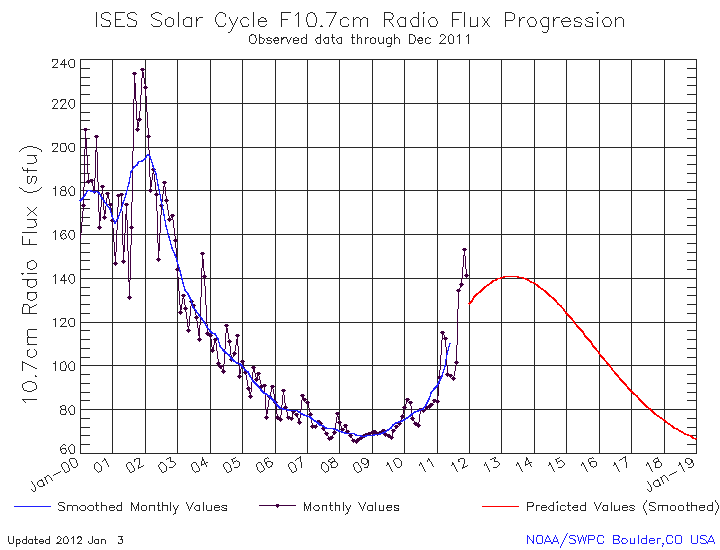
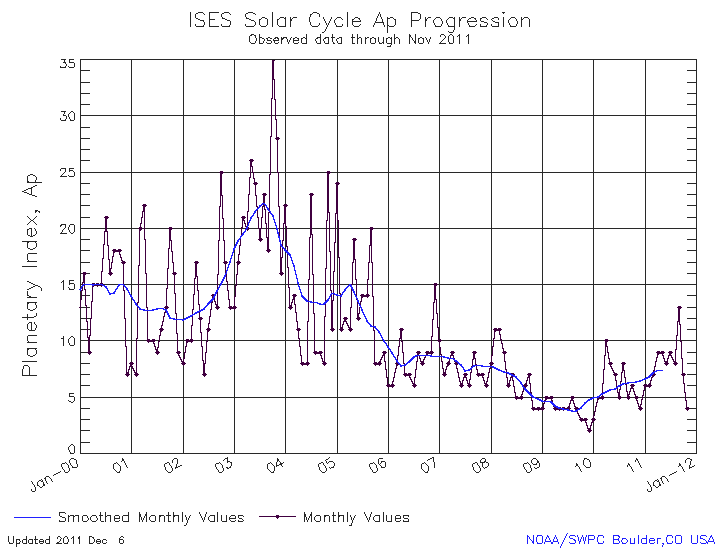
Cycle 24 became a little less active in December.   The charts for Sunspot numbers, F10.7 solar flux and Ap progression are shown below.


cbdakota


Are Sunspots Going to Disappear by 2015?


To reacquaint you with this topic, lets do a little review.  Livingston and Penn have been measuring the umbral intensity of sunspots and the corresponding magnetic field that spawns them since 1990.  In 2006 they submitted a paper to the journal “Science” reporting on their efforts and suggested that if the trend of weaker sunspot magnetic fields continued at its current rate, they would be too weak to produce sunspots.  This paper was rejected in peer review. Undeterred, they have continued to study these phenomena and so far, they seem to be on to something.

Sunspots are the product of the enormous magnetic fields created on the Sun. What make them especially interesting is that the Earth’s climate and sunspots have a high degree of correlation.   Periods where the climate has cooled off seem to coincide with periods of few sunspots and periods of warmer climate seem to coincide with periods of high sunspot counts.

Sunspots appear as dark spots on the face of the Sun.  Very strong magnetic forces (thousands of times stronger than Earths magnetic field) block the hot solar plasma and sunspots are the result.  The spots are cooler than the surrounding surface of the Sun.  NASA says that the spots are about 3700K versus 5700K for the surrounding photosphere.

©UCAR, image courtesy Matthias Rempel, NCAR

The photo sh0ws the “spot” (the umbra) surrounded by the penumbra that is shaped by the magnetic lines of force. 

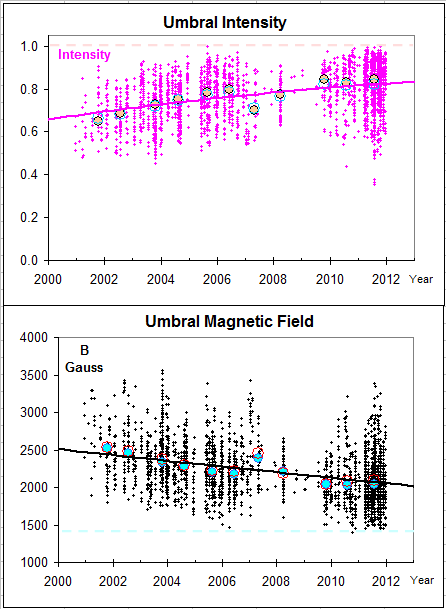
Livingston and Penn have studied over 1700 spots and they see a trend in which the darkest parts of the sunspot umbra have become warmer (45K per year) and their magnetic field strengths have decreased (77 Gauss per year**), independently of the normal 11-year sunspot cycle.

The latest data is shown in the two charts, UMBRAL INTENSITY AND UMBRAL MAGNETIC FIELD.

Charts courtesy of Leif Svalgaard

The umbral intensity is a measurement of the light from the umbra (the dark center) and compared to a measurement of the light from a calm sun surface.  Note that the umbra is getting hotter and brighter as the umbral magnetic field gets weaker.  The two scientists believe that if the magnetic field weakens to ≈1500 gauss, the sunspots will not form.   If the trend continues linearly,  that could happen in this decade. 

If there are no visible sunspots in Cycle 25,  it could mean that we would be experiencing a solar minimum like the Maunder minimum that heralded in the Little Ice Age. It should be noted that while this is a suggestion, rather than a promise, it certainly is consistent with the observable trend of a less energetic Sun.

** Gauss is measure of the strength of a magnetic field.  Its units are Maxwells per square centimeter.  A small bar magnet will range from 40 to 100 gauss. The Sun’s average magnetic field strength is 1 and the Earth’s is 0.5.

cbdakota


DRIVING A VOLT IN WINTER


The Chevy Volt’s driving range is reduced by cold or hot weather. The EPA estimates the Chevy Volt can travel 35 miles on a fully charged battery according to an article written by Doug Wernert, Chevrolet VoltAge Community Manager.   This will vary due to the weather conditions he adds.   If it is cold, using the car heater and front window defrost will have a “high/maximum Impact” on the Volt’s range.  And of course, in hot weather the A/C unit has “high/maximum impact” on range.  (Do you have the feeling that the range estimates are often at odds with the last news release you read?)  Does the EPA account for the weather in their estimated fully charged battery range?  If not, then it would seem that 35 miles might only be good on optimal days, says 68F or something like that (no A/C, no heat) and would result in a lower figure for the rest of the time.   A chart that accompanied Wernert’s article listed some other activities that resulted in “high/maximum impact” on the range.  These are

High speeds (70+mph)

Aggressive Accelerations

Steep incline

So, no driving in the mountains with the pedal to the metal in cold weather.

cbdakota

Visual Comparison of Earthquake Strength


The Atlantic has posted “An Excellent Visual Comparison of Earthquake Strength” in their online magazine.  Click the link below.  But first a little background on the Richter Scale to help you gauge the size of an earthquake.

The Richter Scale, used to gauge the energy contained in an earthquake, is a logarithmic scale, not a linear scale.  According to Wiki,  an earthquake that measures 5 on the Richter Scale has a shaking amplitude 10 times larger and corresponds to an energy release that is 31.6 time greater than one that measures 4 on the Richter Scale.  Every step up in a whole number is a ten-fold increase in the size and severity of the quake.

Click  here to see Atlantic’s visual comparison:

cbdakota

Cycle 24 November 2011 Update


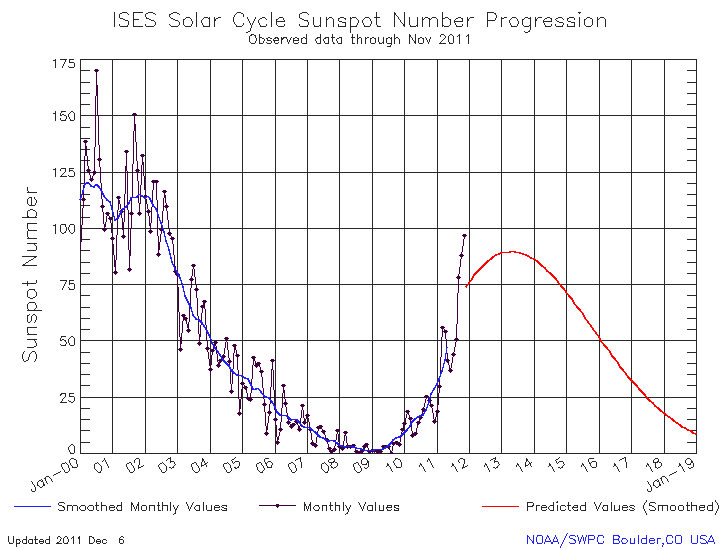
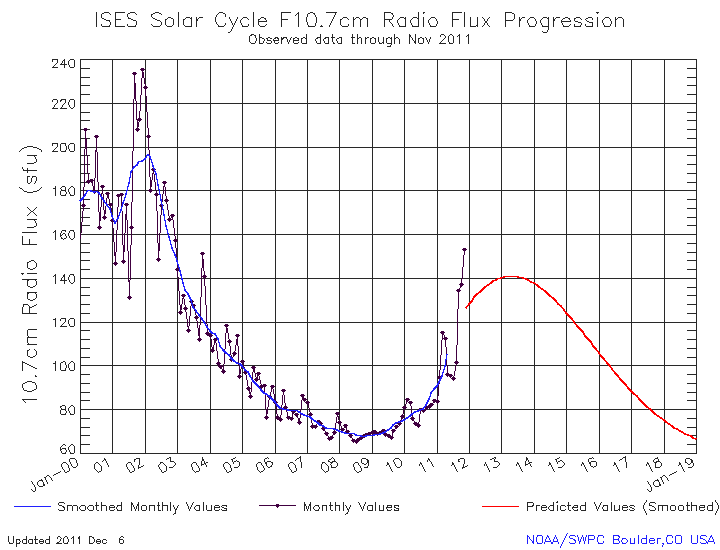
November Cycle 24 monthly sunspot count was nearly 100, which is by far the most active period since the cycle began.    The same goes for the F 10.7 Radio Flux that racked up a value of about 155.  But of these numbers are well below those of Cycle 23 at its peak.  Cycle 23 peak sunspot count was 170 and its F10.7 was about 235.   See the  November NOAA/SWPC charts below:

CLICK ON CHARTS FOR BETTER VIEW

Solar Activity/Geomagnetism

The Ap index is a good proxy for overall solar activity. For two months it has declined.  We are seeing Cycle 24 peaks in F10.7, and sunspots simultaneously with this drop in Ap.  It may mean that the spots and F10.7 may soon be trending downward as well.

If you  are interested,  the following is a brief explanation of the various ways geomagnetism is expressed.

The magnetic activity indices K, Kp and ap are designed to measure the variations in the geomagnetic field that arise from current systems caused by regular solar radiation changes. Other irregular current systems produce magnetic field changes caused by the interaction of the solar wind with the magnetosphere, by the magnetosphere itself, by the interactions between the magnetosphere and ionosphere, and by the ionosphere itself.

The planetary 3-hour range index Kp is the mean K-index from 13 geomagnetic observatories.  The scale is 0 to 9 expressed in thirds of a unit, 5-  is 4 2/3, 5 is 5 and 5+ is 5 1/3.  This planetary index is designed to measure particle radiation by its magnetic effects.  The 3-hourly ap (equivalent range) index is derive from the Kp index as follows:

Kp = 0o   0+   1-   1o   1+   2-   2o   2+   3-   3o   3+   4-   4o   4+

ap =  0     2     3      4     5     6     7       9    12   15    18     22   27   32

Kp = 5-    5o    5+   6-   6o    6+    7-     7o     7+     8-     8o     8+    9-     9o

ap = 39   48   56    67   80   94   111  132    154   179   207  236  300  400

Now one more derivation to get to the Ap index.   The  Ap index is defined as the earliest occurring maximum 24-hour value  obtained by computing an 8-point running average of successive 3-hour ap indices during a geomagnetic storm event.

cbdakota

Rare Earth Elements Background.


If you follow the alternative energy issues (windmills, solar cells, ethanol for fuel, etc) you have very likely encountered discussions about rare earth elements. This posting is designed to provide the reader a little background.    Rare earths are used in lights, batteries, motors, lasers, and many other electronic applications.  In addition some of them are used as oil refinery catalysts, in metal alloys and glass polishing and coloring applications just to mention a few non-electronic uses.  There are 17 rare earth elements on the periodic table.  What makes these metals rare is that they are not often found in concentrations that can be profitably mined.  According to Wikipedia, one of them “Cerium” is the 25th most abundant element in the Earth’s crust,  however they are widely dispersed.  China has the best mines in the world it would seem.  China sold these elements at prices low enough to shut down most of the other mines in the world.

The magnets that can be made from several of the elements are vastly more powerful that those made from cobalt, the previous best permanent magnet making metal. Two of the rare earths commonly used are Neodymium and Samarium.  They are alloyed with other metals to form permanent magnets.  These magnets are replacing non-rare earth alloy magnets in electric motor assemblies because of their magnetic field strength.  These rare earth alloy magnets can be made smaller to reduce weight and still create high magnetic flux for electric motors.  It is said that the magnetic attraction is so powerful that if your finger is between two of these magnets you will likely experience a fractured finger.

Pure Neodymium has a low Curie temperature so it is only magnetic at low temperatures. Above the Curie point it’s parallel alignment of the magnetic field lines become disordered and it loses its magnetism.  To overcome this problem, Neodymium is alloyed with boron and iron to make a permanent magnet that can operate up to approximately 300 C.  The rare earths are also vulnerable to corrosion.  This problem is resolved by plating.

Although Samarium has a higher Curie temperature, it plays a smaller role than Neodymium because it is more expensive and creates a weaker magnetic field.  It is commonly alloyed with Cobalt.

The price and geopolitics are playing a role in the use of rare earths.  According to a November 16, 2011 NYTimes article, the prices of rare earths are dropping:

International prices for some light rare earths, like cerium and lanthanum, used in the polishing of flat-screen televisions and the refining of oil, respectively, have fallen as much as two-thirds since August and are still dropping. Prices have declined by roughly one-third since then for highly magnetic rare earths, like neodymium, needed for products like smartphones, computers and large wind turbines.

A chart of the price versus time for Neodymium is shown below:

The price for Neodymium appears to be at about $350 per kilogram.

There are some geopolitical ramifications surrounding rare earths:  Again from the Times posting:

China mines 94 percent of the rare earth metals in the world. Through 2008, it supplied almost all of the global annual demand outside of China of 50,000 to 55,000 tons. But it cut export quotas to a little more than 30,000 tons last year and again this year and imposed steep export taxes, producing a shortage in the rest of the world.

Together with a two-month Chinese embargo on shipments to Japan during a territorial dispute a year ago, the trade restrictions and shortage resulted in prices outside China reaching as much as 15 times the level within China last winter. That created a big incentive for companies that use rare earths in their products to move factories to China or find alternatives.

The US had some working rare earth working mines before the advent of the Chinese.  I have read that one in California is planning to resume production now that the prices have reached a point where working the mine is economical.

Stay tuned.

cbdakota

Electric Car Update-YTD November


Volt vs. Leaf

The Chevy Volt sales were 1139 vehicles in November bettering last month’s sales of 1108.  That brought the year-to-date Volt sales (YTD) to 6142.  Chevy had forecast Volt sales 10,000 vehicles in 2011 and it looks like they wont make that target.   Chevy is forecasting Volt sales at 45,000 in 2012 and they will export 15,000 more.  I suppose it is possible that they might make that forecast, but I have my doubts unless GE (Obama good buddy Jeffery Immelt CEO of GE) buys the 10,000 Volts they pledged that they would.  The first part of 2011, Chevy maintained that they were production, not sales, limited.  But at the end of 2011, there did not seem to be a lack of Volts for sales.  November’s sales of 1139 are the best month so far this year.

You make your estimate of 2012 sales.

The Volt’s main competitor this year has been Nissan’s Leaf.  Leaf sales dropped for the third consecutive month to 672 vehicles.  Even so, Leaf still leads in the 2011 YTD sales race with 8738 vehicles sold.

Aptera

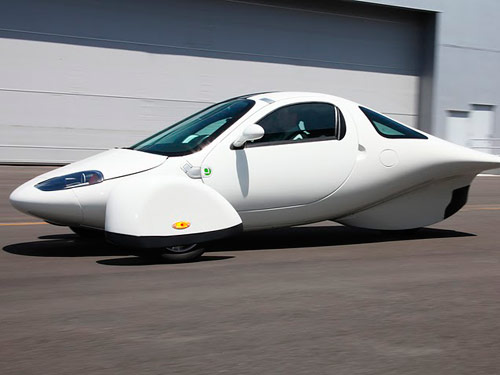
Aptera is an all electric three wheel vehicle with an EPA rating of 200mpg equivalent.   It is a beauty but they can’t get matching loan money to continue operation.  They announced that they are going out of business.

Sorry about that.

cbdakota