Category Archives: Sunspots

Solar Cycle 24–April Update


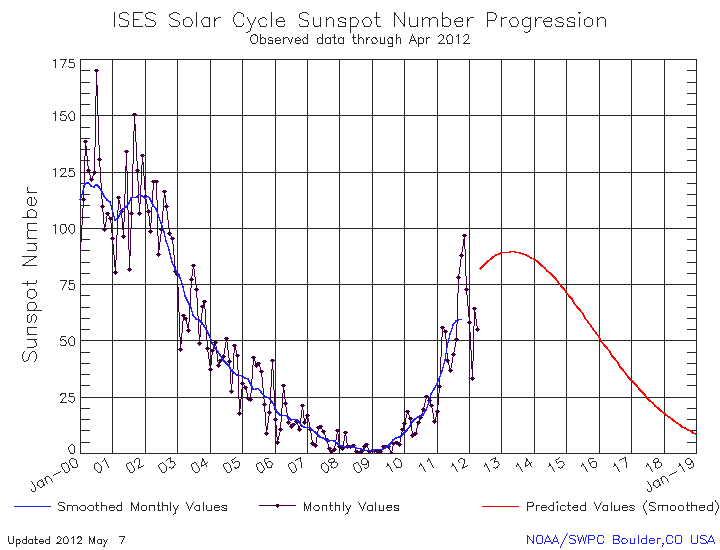
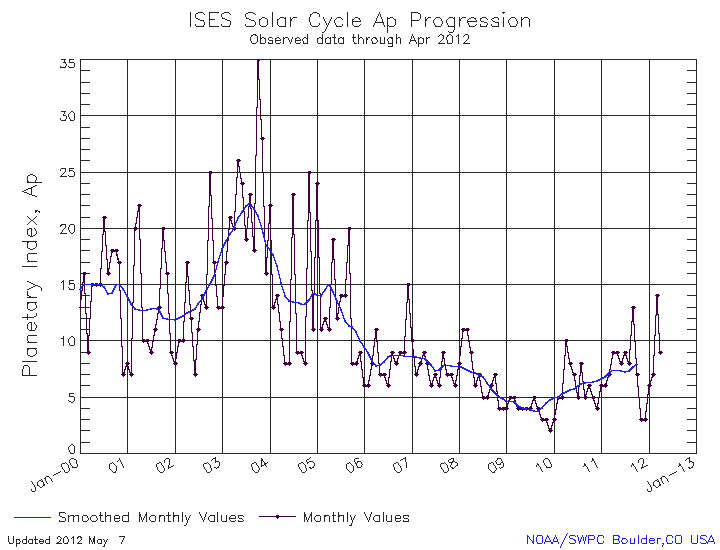
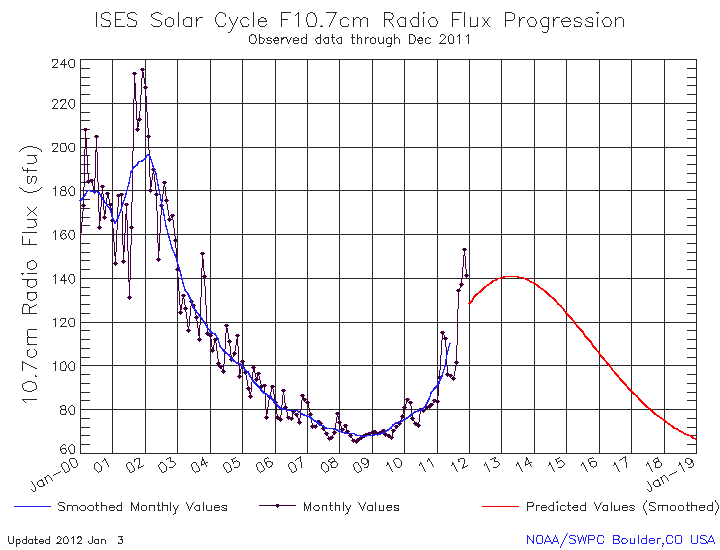
Generally speaking, Solar Cycle 24’s April sunspots numbers, F10.7cm flux and the geomagnetic field Ap index all indicate reduced solar actively.  NASA as well most of the experts in this field agree that Solar Cycle 24 will be a record setter of a sort—least active in about 100 years.  One need not base this on computer models or some consensus, however.  All that is required is to look at the data.  I do not think anyone has a handle on why Cycle 24 is acting this way.  There are many theories and perhaps one of them is correct. Will Cycle 25 continue this downward trend?  Click on the charts to improve clarity.

cbdakota

Revised NASA Cycle 24 Sunspot Forecast


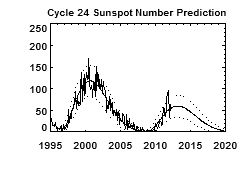
Dr Hathaway of NASA has revised his Cycle 24 sunspot forecast.   He predicts a smoothed sunspot number maximum of about 60 in the Spring of next year.  Cycle 24 will be the smallest in about 100 years.  For the record, his forecast graphed is shown below:

He has revised his prediction method as follows:

Recent work [see Hathaway Solar Physics; 273, 221 (2011)] indicates that the equatorward drift of the sunspot latitudes as seen in the Butterfly Diagram follows a standard path for all cycles provided the dates are taken relative to a starting time determined by fitting the full cycle. Using data for the current sunspot cycle indicates a starting date of May of 2008. Fixing this date and then finding the cycle amplitude that best fits the sunspot number data yields the current (revised) prediction.

To read more of the NASA report click here.

A reminder, Hathaway uses the smoothed International Sunspot Numbers and not the NOAA count. The International Sunspot Number for historical reasons [to be compatible with Rudolf Wolf’s count for 1849 to 1865] is reported as 0.6 x the actual count, while the NOAA count is just the raw count [actually = 10 x number of groups + number of spots].

This has not been an easy road for Cycle 24 sunspot predictions.  See the links below to get an idea how far Cycle 24 has been cut back over recent times.

https://cbdakota.wordpress.com/2012/03/06/cycle-24-february-update/

https://cbdakota.wordpress.com/2011/10/11/september-solar-cycle-24-activity-increased/

https://cbdakota.wordpress.com/2011/09/20/solar-cycle-24-august-update/

https://cbdakota.wordpress.com/2011/08/16/solar-cycle-24-continues-to-under-perform-the-early-projections/

The April Sunspot report will be out early next week and will be posted for your examination.

cbdakota

Japanese Researchers Suggest Cycle 24 Could Be The Start Of A New Maunder Minimum


The Asahi Shimbun* reports that “Officials of the National Astronomical Observatory of Japan and the Riken research foundation said on April 19 that the activity of sunspots appeared to resemble a 70-year period in the 17th century in which London’s Thames froze over and cherry blossoms bloomed later than usual in Kyoto. The sun may be entering a period of reduced activity that could result in lower temperatures on Earth, according to Japanese researchers. “ They are suggesting that solar Cycle 24 is the beginning of an era similar to the Maunder Minimum.

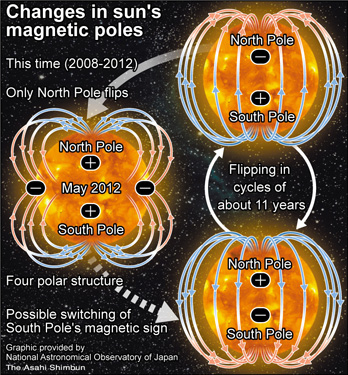
A solar cycle usually lasts about 11 years.  During the cycle, the poles switch polarity at about the time of the solar maximum.   Many scientists are predicting that Cycle 24’s maximum will occur about May of 2013. However, the Japanese researchers found signs of unusual magnetic changes in the sun. They report that the solar observation satellite Hinode found that the north pole of the Sun has already begun to flip—about a year earlier than expected.  They found no noticeable change in the South Pole.

The researchers add: “If that trend continues, the north pole could complete its flip in May 2012 but create a four-pole magnetic structure in the sun, with two new poles created in the vicinity of the equator of our closest star. “

Below is the National Astronomical Observatory of Japan’s representation of the Sun’s poles in May 2012:

 *The Asahi Shimbun has the second highest circulation of Japan’s national newspapers 

cbdakota

Solar Cycle 24 March Update


Solar Cycle 24 activity picked up in March.  Several coronal mass ejections (CME) came our way thanks largely to the sunspot group 1429.  March began  with a CME directed toward Earth.  Although the warnings suggested more severe problems than actually occurred,  it still was a reasonably strong storm. The Sun’s rotation brought sunspot 1429 back again at month-end and it provided a little more excitement.   A good summary of the solar activity in March can be found on the Solarham.com site.  To take a look at the summary,  click here.  This solar activity and it’s affect on the Earth’s geomagnetic field can be seen on the chart below: (click on charts to improve clarity)

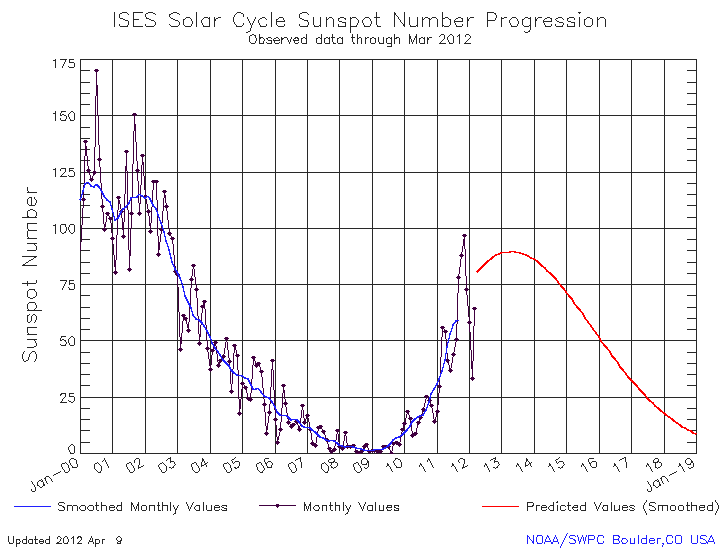
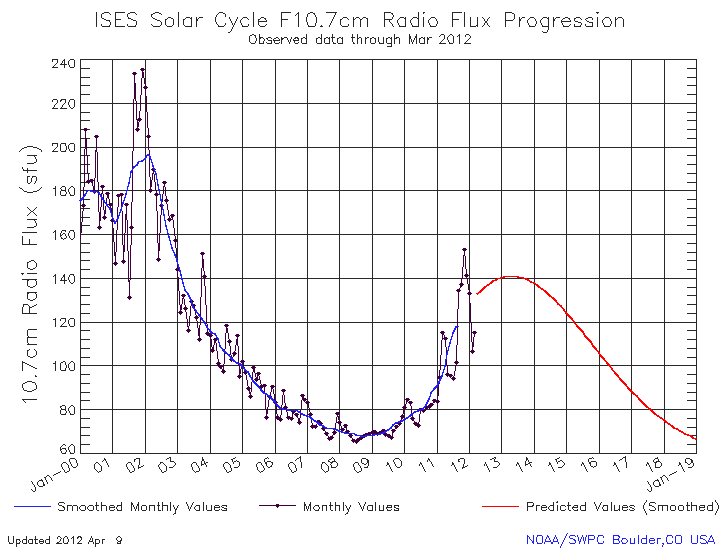
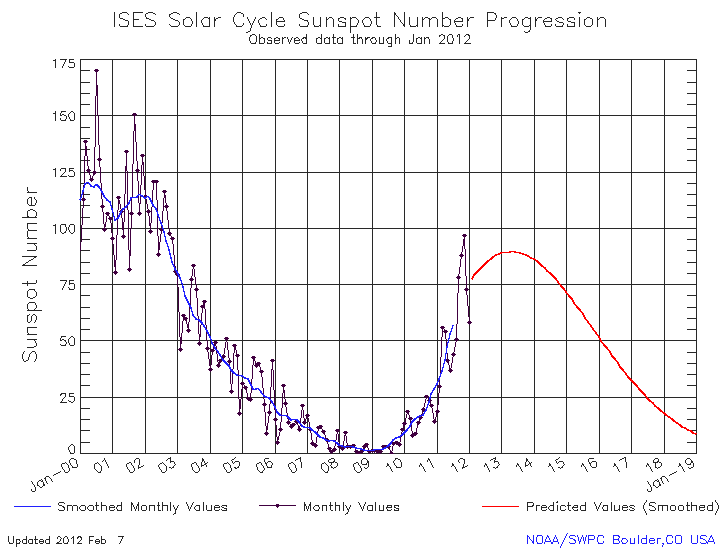
Both the sunspot number and the F10.7 flux were below the predicted  monthly numbers in March but seem to be generally following the forecast Solar Cycle 24 forecast path.  See charts below:


Cycle 24—February Update


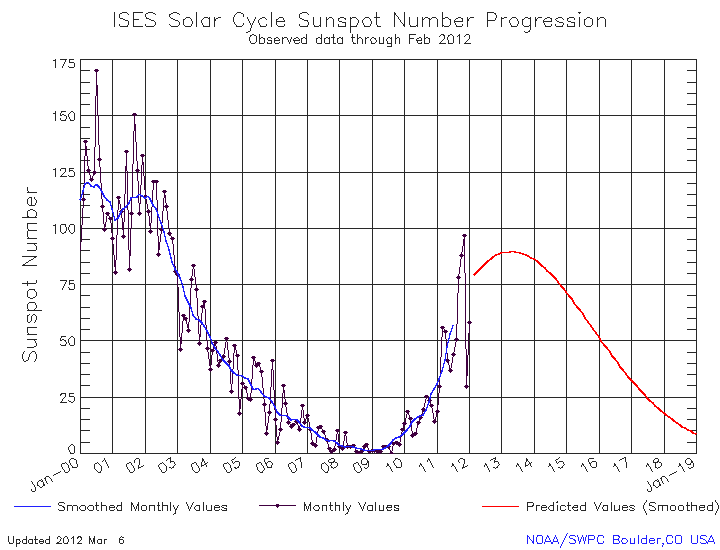
Cycle 24 activity took another drop in February.  The Sunspot number for February was about 30 versus the 60+ in January. (Click on Charts to expand.)

That’s a major drop in the sunspot number.  Cycle 24 certainly looks like it will be the least active cycle in the last hundred years.

Dr Hathaway of NASA has again revised his forecast of Cycle 24 Sunspots.  He now says that  the Cycle 24 sunspot number will peak (maximum) at 59. Below is his March 2012 sunspot number forecast:


F10.7 cm radio flux is down as well.  First shown on the NOAA chart followed by Dr Hathaways revised chart:

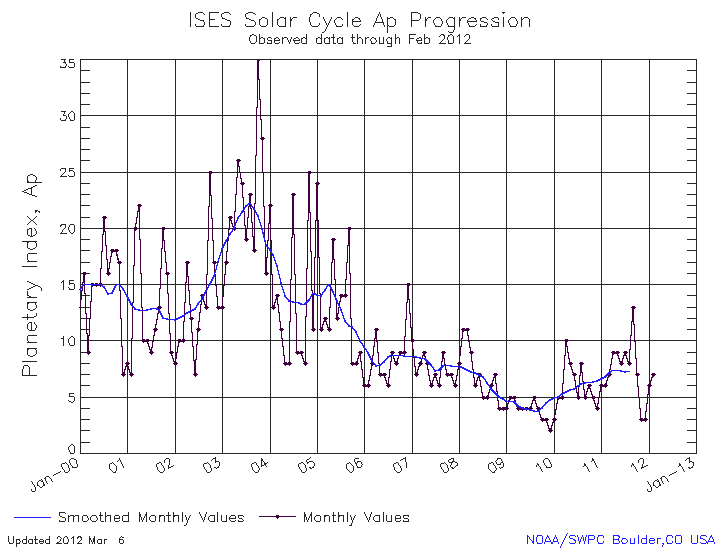
And the magnetic activity as indicated by the Ap index remains low:

cbdakota

Reliable Solar Cycle Forecasting Requirements


Dr David Hathaway is NASA’s solar cycle guru.  In 2010, he published in Solar Physics a review of the methods used to forecast solar cycle activity.   The review, titled TheSolar Cycle” is worth reading.  He discusses many of the techniques currently in use that purport to be the method for solar cycle forecasting. 

This post will only look at the key features that Hathaway says must be explained by any viable theory or model in order to provide a reliable forecast. 

The Abstract for “The Solar Cycle”  follows:

The Solar Cycle is reviewed. The 11-year cycle of solar activity is characterized by the rise and fall in the numbers and surface area of sunspots. We examine a number of other solar activity indicators including the 10.7 cm radio flux, the total solar irradiance, the magnetic field, flares and coronal mass ejections, geomagnetic activity, galactic cosmic ray fluxes, and radioisotopes in tree rings and ice cores that vary in association with the sunspots. We examine the characteristics of individual solar cycles including their maxima and minima, cycle periods and amplitudes, cycle shape, and the nature of active latitudes, hemispheres, and longitudes. We examine long-term variability including the Maunder Minimum, the Gleissberg Cycle, and the Gnevyshev–Ohl Rule. Short-term variability includes the 154-day periodicity, quasi-biennial variations, and double peaked maxima. We conclude with an examination of prediction techniques for the solar cycle.

Hathaway lists the critical features for making an accurate forecast:  

Understanding the solar cycle remains as one of the biggest problems in solar physics. It is also one of the oldest. Several key features of the solar cycle have been reviewed here and must be explained by any viable theory or model.  (I am adding several charts to aid in visualize his thinking.)

  • The solar cycle has a period of about 11 years but varies in length with a standard deviation of about 14 months.
  • Each cycle appears as an outburst of activity that overlaps with both the preceding and following cycles by about 18 months.
  • Solar cycles are asymmetric with respect to their maxima – the rise to maximum is shorter than the decline to minimum and the rise time is shorter for larger amplitude cycles.
  • Big cycles usually start early and leave behind a short preceding cycle and a high minimum of activity.
  • The activity bands widen during the rise to maximum and narrow during the decline to minimum.
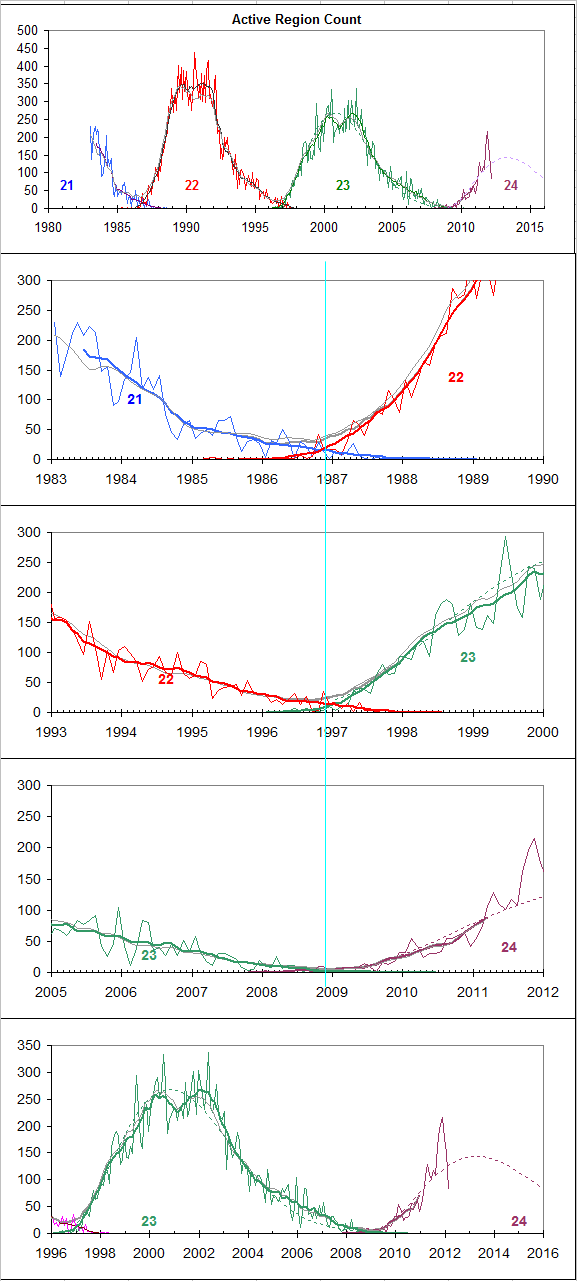
These  sunspot charts show the last stages of cycle 21, cycles 23 and 23 fully and the current status of cycle 24.  The overlapping between the end of one cycle and the start of the other is apparent.   The relatively steep rise in the sunspot count at the begining of a new cycle and the more gradual decent.  Cycle 24’s rise is not nearly as steep as its predecessors.  Charts by Leif Svalgaard.
  • Sunspots erupt in low latitude bands on either side of the equator and these bands drift toward the equator as each cycle progresses.
  • At any time one hemisphere may dominate over the other but the northern and southern hemispheres never get completely out of phase.
  • Sunspots erupt in groups extended in longitude but more constrained in latitude with one magnetic polarity associated with the leading (in the direction of rotation) spots and the opposite polarity associated with the following spots.
  • The leading spots in a group are positioned slightly equatorward of the following spots and this tilt increases with latitude.

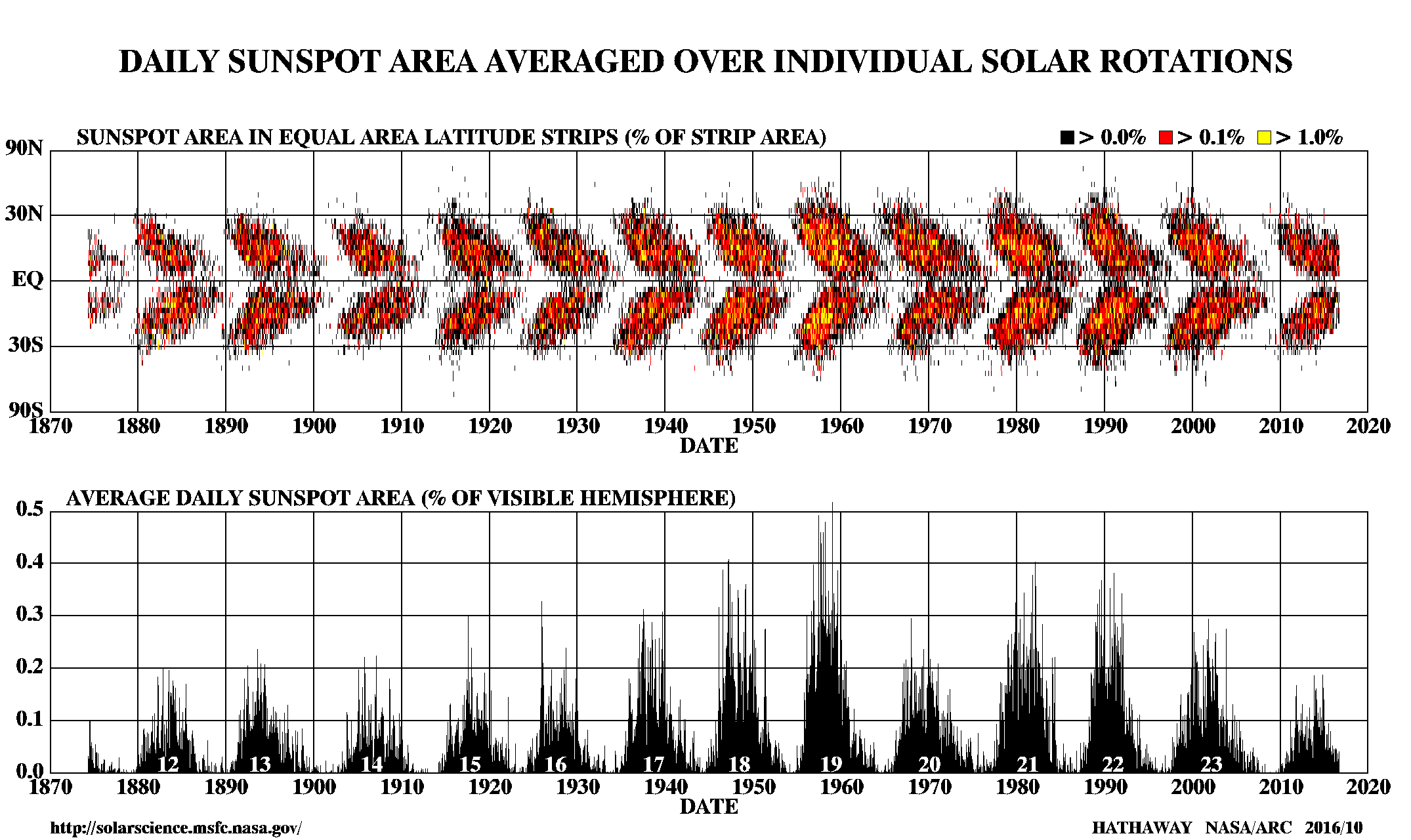
Butterfly Diagram: All the sunspots in a give cycle are plotted on the charts above. The initial sunspots appear at about 30° North and South lattitude. As new spots appear they tend to get closer to the equator. Each solar cycle ends, nominally, when the spots reach the equator. Charts by Solar Physics Group @ NASA

  • The polar fields reverse polarity during each cycle at about the time of cycle maximum.

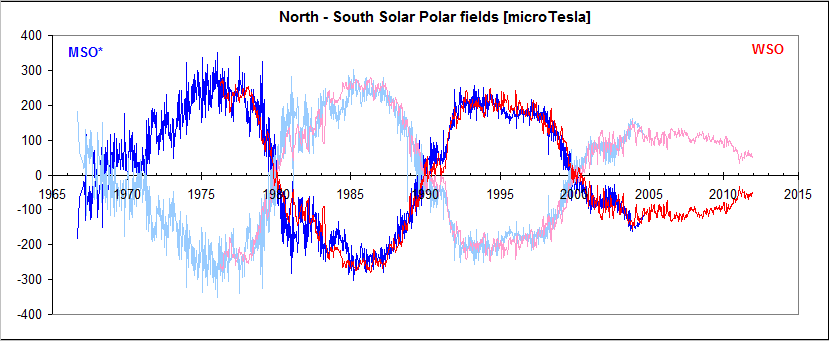
Solar Magnetic Fields: This chart shows the North and South magnetic fields reversing at the end of a solar cycle. Note how weak the magnetic fields are for the start of the current cycle 24. Chart by Leif Svalgaard.

  • Cycle amplitudes exhibit weak quasi-periodicities like the 7 to 8-cycle Gleissberg Cycle.

The Gleissberg Cycle is a period of about 80 to 90 years that overlays the well established 11 year cycle.  The theory is that solar maxima and solar minima are forced by the gravitational pull of the major planets.  The specific alignment, particularily Jupiter and also Saturn Neptune and Uranus have a major effect on the Sun’s activity.  To see graphics of the alignment of these major planets, click here.

  • Cycle amplitudes exhibit extended periods of inactivity like the Maunder Minimum.
  • Solar activity exhibits quasi-periodicities at time scales shorter than 11 years.
  • Predicting the level of solar activity for the remainder of a cycle is reliable 2 – 3 years after cycle minimum.

Hathaway tells us that theory must be able to predict the preceding.  Until then,  people will continue to predict the features of the next solar cycle but it may be just luck if they get it right.

cbdakota

Cycle 24 January Update


Cycle 24 activity in January was low.  Cycle 24 solar maximum is probably about 18 months away.   The January sunspot number and the F10.7 flux are following the NASA forecast.  The very low Ap index seems confirm that this cycle is likely to be much less active than Cycle 23.  See the charts below, all courtesy of NOAA/SWPC. (click on charts to enlarge)

cbdakota


Forecasting Cycle 25—Great Conveyor Belt Theory


The last post reviewed a forecasted solar Cycle 25 based upon measuring the magnetic field of sunspots.   This posting uses the speed of the Sun’s Great Conveyor Belt(GCB) to forecast Cycle 25. This method considers sunspots as an indicator but the GCB speed determines how many sunspots appear.  I am not sure who, but perhaps Dibyendu Nandi of the Indian Institute of Science and Education and Research in Kolkata (aka, Calcutta) and his team  can claim this theory. The GCB has been studied for a number of years.  NASA Science says: “The Great Conveyor Belt is a massive circulating current of fire (hot plasma) within the sun. It has two branches, north and south, each taking about 40 years to complete one circuit.“  “The plasma flows travel along the Sun’s surface and plunge inward at the poles, and reappear again at the Sun’s equator.  When the sunspots begin to decay, surface currents sweep up their magnetic remains and pull them down inside the star; 300,000km below the surface, the sun’s magnetic dynamo amplifies the decaying magnetic fields.  Re-animated the sunspots become buoyant and bob up to the surface like a cork in water—voila! A new solar cycle is born.”

These belts can be likened to the Earth’s ocean currents.
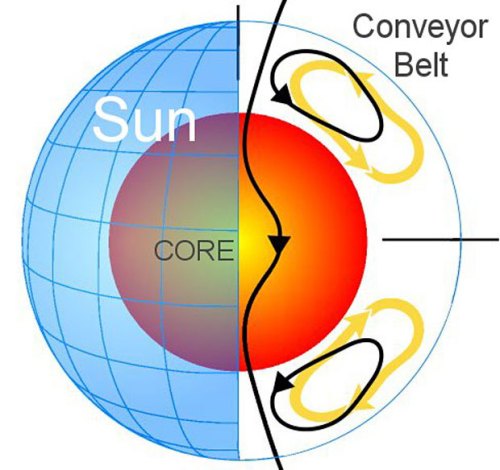
NASA’s artistic sketch of the belt.

A May 2006 posting on Science News has Dr Hathaway predicting that Cycle 24 sunspots numbers would be perhaps greater than Cycle 23 (this part of the prediction is not faring well.) and Cycle 25 would be perhaps half of Cycle 23.  Dr Hathaway said that these predictions were based on a deceleration of these belts to 0.75m/s in the North and 0.35m/s in the south.  He said “We’ve never seen speeds so low”.    Hathaway in a September 2011 posting said:”…….that as the number of sunspots increases on the Sun, the speed of the GCB decreases and vice versa: fewer sunspots and the faster the speed of the Belt.”   This is somewhat contradictory,  because if the GCB speed is slowing down, based on his theory,  there would be more spots.

Dr. Nandi  adds some clarification when he lays out his theory here: “The fast-moving belt rapidly dragged sunspot corpses down to sun’s inner dynamo for amplification. At first glance, this might seem to boost sunspot production, but no. When the remains of old sunspots reached the dynamo, they rode the belt through the amplification zone too hastily for full re-animation.  Sunspot production was stunted.”  Nandi  then adds that late in the decade, “….according to the model, the Conveyor Belt slowed down again, allowing magnetic fields to spend more time in the amplification zone, but the damage was already done.  New sunspots were in short supply.  Adding insult to injury, the slow moving belt did little to assist re-animated sunspots on their journey back to the surface, delaying the onset of Solar Cycle 24.”  

Hathaway’s sunspot predictions are in Red.   Also on this chart, in Pink, are the Cycle 24 sunspot predictions by NCAR’s Mausumi Dikpata and her team based on their observations of the GCB.

Nandi  has made a presentation “Forecasting the Solar Cycle”at the Harvard Smithsonian Center for Astrophysics, Cambridge, USA  but I can not access the paper.

This theory says that the change of speed of the GCB predestines the solar çycle  robustness or lack there of.  For some insight of how they are able to track these plasma flows/GCBs/jet streams, click here.

Like the declining sunspot magnetic field, the theory of the GCB seem to me to be describing consequences of some other forcing that is not known or understood.  I think it likely that Cycle 25 will be weak.  However, until we know more about the functioning of the Sun,  we will be forecasting like the weather casters—tomorrow will be rainy because rain clouds are blowing our way from the west.  Like all of these theories, only time will tell if they are really capable of predicting accurately Cycle strength.

We are not through with Cycle prediction theories.  Next posting will discuss the bicentennial decrease in Total Solar Irradiance (TSI) unbalancing the Earth’s thermal budget.

cbdakota

Forecasting Cycle 25–Livingston and Penn Method


As Cycle 24 has not yet achieved a Solar Maximum, it may seem a little early to begin forecasting Cycle 25.  But several forecasts have been made.  A recent posting in WattsUpWithThat notes such forecasts by Penn and Livingston and by David Hathaway.

You remember from previous postings on this site, that Penn and Livingston have been measuring Sunspot magnetic field strength and the temperature and luminosity of the umbra.   They began this study in 1990 and as of 2010 they have analyzed some 17,000 spots. Plotted on the chart below are data from their paper LONG-TERM EVOLUTION OF SUNSPOT MAGNETIC FIELDS through 2010 and additional readings since:

Chart courtesy of Lief Svalgaard

Focusing on the bottom chart, sunspots are plotted against magnetic field strength and time. The individual dots are representative of sunspots.  The larger blue dot represents the normalized sunspot number for each year. The black line is the trend line for the umbral magnetic field of the sunspots. The horizontal blue line indexes a magnetic field strength of ca. 1500 Gauss. Note that the sunspots extend vertically above the trend line, and below the trend line but not below the 1500 Gauss line.  The two scientists speculate that sunspots do not form when the magnetic field strength is less than 1500 Gauss.  If the trend line continues on this same slope, somewhere around the year 2025+/- at least half of the sunspots will disappear.

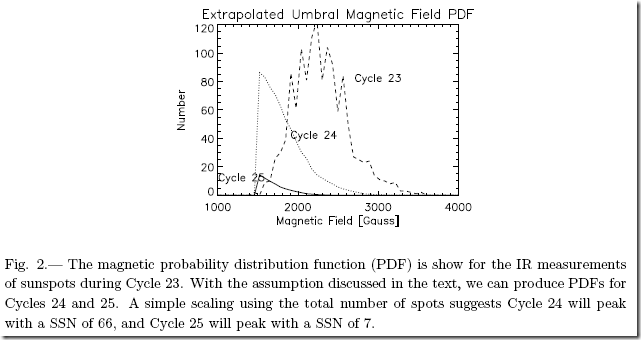
Using a linear decrease of 65 Gauss per year and a cycle duration of 11 years, they computed the magnetic probability distribution function for Cycles 24 and 25. Using this, a sunspot number is forecast. Cycles 24 and 25 are shown along with actual data from Cycle 23 in the chart below from their paper:

Chart provided by David Archibald, from the paper by Livingston and Penn.

The contrast of Cycle 24 and specifically Cycle 25 from the completed Cycle 23 is quite dramatic.  The Cycle 24 forecast, so far, seems to be reasonably in tune with actual data.  At a Cycle 25 sunspot number of 7, David Archibald says it would be the lowest sunspot number for a Cycle in 300 years!!!!

Livingston and Penn say that if the linear decrease were 50 Gauss per year rather than 65, the Cycle 25 sunspot number would be 20 which is still a very low number.

Livingston and Penn caution that it is always risky to extrapolate linear trends.

Next posting on this topic will be an examination of David Hathaway’s 2006 forecast of both Cycle 24 and Cycle 25.  It will also discuss one of the underlying theories for the decrease in sunspots.

cbdakota

Solar Cycle 24—Less Active in December.


Cycle 24 became a little less active in December.   The charts for Sunspot numbers, F10.7 solar flux and Ap progression are shown below.


cbdakota