Category Archives: Renewable Energy

Why Did ExxonMobil Lobby To Stay In The Paris Agreement?


ExxonMobil lobbied President Trump to stay in the Paris Agreement. Can you figure out why that company would wish to do so?

Here are some pickings from the most recent ExxonMobil global energy forecast:

·         Total energy demand by 2040 will be 25% higher than in 2015.

·         Global energy supply in 2040 will be 55% from oil and natural gas. Wind, solar and biofuels will supply only 4% in 2040.

·         Coal use will decline but will still be the third largest supplier of global energy.

·         Global electrical energy demand for transportation will only be 2% of the total global energy demand in 2040.

·         Wind and solar electricity supplies will approach 15% of total electrical energy supply by 2040

·         Although utilization improves over time, intermittency limits worldwide wind and solar capacity utilization to 30% and 20% respectively.

·         By 2040 US and Europe combined CO2 emissions will be about 8 billion tonnes.  The total global emissions in 2040 will be about 36 billion tonnes,

·         Electric cars are a very high-cost option, at about $700/tonne of CO2 avoided.

Continue reading

Batteries May Not Solve Renewable Energy Non-Dispatchable Problem


The greens believe that solar and wind farms will be the way to eliminate the use of fossil fuels.  The reality of today’s solar and wind farms is that these sources are unable to be worked into the grid because of their unreliability. It is necessary to install natural gas powered turbines or diesel power generation along with the solar and wind farms. The fossil fuel units are required to generate electricity to balance the power grid when the sun is not shining and the wind is not blowing.

The greens’ solution is a battery system that stores enough energy to eliminate the need for fossil fueled energy backup systems.  Much research effort is underway to develop a battery to accomplish this objective. To date nothing stands out as a likely candidate for the job. 

But even if a battery that can do the job and does not cost too much emerges, there is another problem.   That problem regarding solar farms is discussed in an American Thinker posting by Viv Forbes titled “Batteries: Another green scam”.  The following is from that posting: 

The idea of producing reliable grid power from intermittent green energy backed up by batteries looks possible in green doodle-diagrams, but it would be absurdly inefficient and expensive.

Solar works a six-hour day

Consider a solar panel rated to collect, say, 100 units of energy per day at full capacity, in full mid-day sunlight, with a clean panel, properly aligned to face the sun.

No solar energy arrives overnight, and only minimal amounts arrive during the three hours after dawn or before dusk.  That means that solar energy can be collected for only about six hours per day, providing it is not cloudy, raining, or snowing.  No amount of research or regulation will change this.  The solar energy union works only a six-hour day and takes quite a few sickies.  So instead of feeding 100 units of energy per day into the grid, at best, the panel supplies just 25 units.

Can the addition of batteries give us 24/7 power from solar?

To deliver 100 units of energy in 24 hours will require an extra 75 units of energy to be collected, stored, and delivered by the batteries every sunny day.  This will require another three solar units devoted solely to recharging batteries in just six sunny hours.

Cloudy and wet days are what really expose the problems of solar plus batteries.  (This is why isolated green power systems must have a diesel generator in the shed.)

To insure against, say, seven days of cloudy weather would require a solar-battery system capable of collecting and storing 700 units of energy while still delivering 100 units to consumers every day.  However, if several consecutive weeks of sunny weather then occur, this bloated system is capable of delivering seven times more power than needed, causing power prices to plunge, driving reliable generators out of business, and wasting the life of solar panels producing unwanted electricity.

Solar energy obviously does best in sunny equatorial deserts, but that is not where most people live.  And the huge Desertec Solar Power Dream for the northern Sahara has failed.

cbdakota

Media Not Providing The Real Facts About Wind And Solar Energy


It is likely that a great many people in the US have been led to believe that solar and wind play significant roles in supplying domestic energy.  Further and even more incredibly they are led to believe that solar  and wind will replace fossil fuels in the not too distant future.  The Paris agreement demands that no fossil fuels  be used after 2050

I am too old to make it to 2050,  so I will not be around to see if no fossil fuels are being used at that time.  If you make it to 2050, I will bet that fossil fuel will still be used.

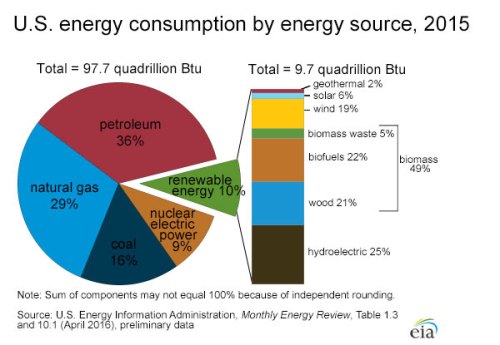
The Energy Information Administration’s(EIA)**, chart on the primary energy sources for the year 2015 is shown below.

Petroleum, natural gas, coal, renewable energy, and nuclear electric power are primary sources of energy. Electricity is a secondary energy source that is generated from primary sources of energy.


Note that renewable energy is only 10% of total energy produced in the US.  And of that 10%, solar is 6% and wind is 19%.   Putting the solar and wind as a percent of the total energy consumed in the US has solar at 0.6% and wind at 1.9%.  So, in  2015 only 2.5% of the US energy came from those two sources. Is this compatible with what you are learning from the media?   And those two are the ones that the greenies are banking on to replace coal, natural gas and petroleum.  And though it is counterintuitive, the warmers want to shut down the nuclear plants as well.

Continue reading

Correcting Harmful Wind Energy-Related Policies


The following are 5  Master Resource postings examining opportunities of the Trump Administration to correct harmful wind energy-related policies,


U.S. Wind Energy Policy: Correcting the Abuse in 100 Days (Part I)      2/2/17

https://www.masterresource.org/wind-power-federal-laws/us-wind-policy-reform-100-days-i/


Federal Energy Efficiency Mandates: DOE’s End Run vs. the Public Interest (Part II)

By Mark Krebs and Tom Tanton — January 31, 2017

https://www.masterresource.org/department-of-energymoniz/eere-end-run-ii/


Big Wind: Threat to Air Navigation, Military Assets (Part III)

By Lisa Linowes — February 16, 2017

https://www.masterresource.org/windpower-vs-radar/wind-versus-radar-iii/


DOE: Breaking the Federal Arm of the Wind Industry (Part IV)

By Lisa Linowes — February 23, 2017

https://www.masterresource.org/department-of-energymoniz/doe-breaking-federal-wind-iv/


Wind Energy and Aviation Safety (Part V)                        3/02/17

https://www.masterresource.org/windpower-safety-issues/wind-aviation-safety-v/


cbdakota

Wind Energy Simply Won’t Work–Google Engineers Say


The following 6 postings discuss renewable wind energy (and some solar). The postings are ones that I think will interest the reader.  The publishing dates range from 2017 back to 2011.


Renewable energy ‘simply WON’T WORK’: Top Google engineers

http://www.theregister.co.uk/2014/11/21/renewable_energy_simply_wont_work_google_renewables_engineers/


James Delingpole Hammers the Great Wind Power Fraud: ‘Green Energy is a Charter For Crooks And Liars’            1/19/17

https://stopthesethings.com/2017/01/19/james-delingpole-hammers-the-great-wind-power-fraud-green-energy-is-a-charter-for-crooks-and-liars/


Benny Peiser: Europe Pulls The Plug On Its Green Future

http://www.thegwpf.com/benny-peiser-europe-pulls-plug-green-future/


Green Power Gridlock: Why Renewable Energy Is No Alternative    10dec13

https://www.forbes.com/sites/larrybell/2013/12/10/green-power-gridlock-why-renewable-energy-is-no-alternative/#10ee659365c8


The myth of renewable energy           22nov2011

http://thebulletin.org/myth-renewable-energy


Study: Wind & Solar up to 5X More Costly than Existing Coal and Nuclear    7/26/15

http://instituteforenergyresearch.org/press/study-wind-solar-5x-costly-existing-coal-nuclear/


cbdakota

Friends Of Science Engineering Critique Of WWS’s Plan For Global Decarbonization


The previous posting, examined the study “A roadmap for rapid decarbonization” published in the Science magazine,  and discussed the major obstacles the warmers face in their attempt to persuade the politicians and the voters to undertake decarbonization.  And do it rapidly.   You may not think thirty years is rapid, but convincing 8 billion people to wipe out the present infrastructure and substitute a new one using as yet unproven methods in 30 years, is moving at a breathtaking speed.

The above noted study, is not the only one that has looked at a way to satisfy the Paris Agreement of holding the global temperature to max.2 ºC rise, with a goal of 1.5ºC rise.  A study by 100% Clean and Renewable Wind, Water and Sunlight (WWS) led by Jacobson, Delucci , et at. is, on the surface (number of pages of detailed discussion), more elaborate than the previous posting.  This  WWS roadmap calls for an 80% reduction of fossil fuels by 2030!  Only 13 years away.

The WWS study is an all-sector roadmap that is said to show how 139 nations could jointly hold the temperature rise to no more than 2ºC.

Friends of Science critique the WWS study with a response titled “WHY RENEWABLE ENERGY CANNOT REPLACE FOSSIL FUELS BY 2050” .  Michael Kelly, Professor of Electrical Engineering at Cambridge says: “Humanity is owed a serious investigation of how we have gone so far with the decarbonization project without a serious challenge in terms of engineering reality”.

That’s what guides this critique.  The critique illustrates the enormous number of new renewable facilities needed, the time necessary to put  these facilities in to operation and the amount of space they require.  It is awesome.

Continue reading

The Paris Agreement Road Map To Zero GHG Emissions–Next Post The Skeptics Response.


I do not think that the developed nations of the world are ready to endorse the actions they have signed onto when they authorized the Paris Agreement (PA).  They liked the applause they were receiving from the media and the environmentalists. But they have not responded in-kind to their commitments for reducing CO2 emissions or contributions to the fund that helps the underdeveloped nations. See here and here. Vox posting on 4 October 2016 said “No country on Earth is taking the 2ºC climate target seriously”.  The Climateactiontracker.org posted this quote: “Right now, with the policies governments have in place, we are heading to a warming of 3.6C said Prof Kornelis Blok of Ecofys.”The developed nations realize that it is time for them to “put up or shut up”. The “put up” part is bedeviled by the fact that most of them are finding that their renewable energy installations, eg solar and wind, are raising the cost of energy to a point where many can no longer afford it.  Further, they are learning that the renewables make their power systems unstable and thus vulnerable to loss of power to supply the customers and industries.


Maybe, just maybe they are becoming aware of the actions they need to undertake to keep the Global temperature rise at no more than the target of  1.5C.  The 24 March 2017 Science magazine published a study titled: “A roadmap for rapid decarbonization”.

Continue reading

EU Does Not Count CO2 Emissions From Wood Burning Power Plants


I am l taking a section out of an excellent posting by James Delingpole title “Delingpole: Why Renewables are doomed and fossil fuels are the future” from the Breitbart website.  It is a very long posting and before I decide to try to summarize it, I want to have you take a look at an ignorant or disingenuous statements by a Brit CEO.

“There is currently in much of the West a vast gulf between where government policy sits on the renewables issue and where reality lies. A good example of this is Britain’s largest power station Drax which has been encouraged by UK government policy introduced in the Labour era – but not opposed by David Cameron’s pretend-Conservatives – to stop using coal and instead burn wood chips, supposedly because they’re carbon neutral, “renewable” and therefore more eco-friendly.

Except in fact this policy has been appalling for the environment – how is it eco-friendly to chop down acres of North Carolina forest and ship them 3,800 miles to be burned for fuel? – and has done nothing to reduce CO2 levels.

It is symptomatic of the bizarre, looking glass world we inhabit that when Christopher Booker pointed this out in this Sunday Telegraph column, the CEO of Drax Dorothy Thompson felt able to reply with this letter:

 woodburningeu


But as Paul Homewood demonstrates here in some detail, many of these claims just aren’t true. The only reason that Dorothy Thompson can get away with them with even a hint of good conscience is simply that she is backed up by an apparatus of official lies.

As he notes, for example, in his reply to her letter:

Dorothy Thompson (Letters, 5th Feb) claims that Drax’s biomass plant makes carbon savings of 80%, compared with coal. However, this is based on EU accounting rules, which classify burning wood as “zero carbon”.

Drax’s own figures show that CO2 emissions from biomass are actually 12% greater than coal for each unit of electricity generated.


Burning wood produces ZERO CARBON EMISSIONS!!!  Based on that EU logic, North Korea might be the most environment friendly nation in the world.  North Korea has cut down nearly every tree in the country. See “Did CO2 Cause North Korea To Collapse?”

cbdakota


The Sad State Of The German Energy Program–By Fritz Vahrenholt


The following is from a posting by PowerEngineeringInternational titled “Vahrenholt rails against the ‘climate priests”.

PowerEngineeringInternation is pretty much into catastrophic man-made global warming (CAGW); but to their credit, they did capture most of the thought of Professor Fritz Vahrenholt on the sad state of the German energy program and the transition to renewables.  At the end of their posting, they list quotes by warmer scientists that provide their thoughts about what Prof. Vahrenholt said presumably to maintain PowerEngineeringIntenational in the good stead with the powers that be in CAGW.  It is instructive that they avoid actually challenging Vahrenholt’s points.  They revert to the “everybody knows the globe is warming” standby.

At a mid-January meeting in parliament buildings in London, Professor Fritz Vahrenholt provided a very detailed monologue on the motivations behind Germany’s energy transition, and why he feels it’s misguided and potentially disastrous.

Had the lecture been delivered by somebody from the coal power sector, they might have been written off as a ‘climate denier’, but given Vahrenholt’s background and pedigree as a backer of renewable energy, he is not so easily dismissed and his position must cause some unease for those so adamant that climate change is manmade.

It should give pause for thought too to the public at large. Governments and media around the world, not just in Germany, are convinced that man is responsible for the recently observed temperature rises and Polar ice cap reduction.

But Vahrenholt believes that the Intergovernmental Panel on Climate Change (IPCC), the main body from which the rest of the world takes its cue on such matters, is not approaching the problem with the correct scientific rigour.

The merits of the science aside, he takes most issue with the behaviour of his own country’s government for ‘trying to save the world.’

Germany has the second highest electricity prices in Europe, and in phasing out nuclear while stimulating over-production of renewables, it has reduced power prices to a pitiful extent, and ironically came to rely on coal. The last two factors mean the prospect of a lack of investment in the country’s future energy infrastructure, while targets for reducing CO2 look likely to be missed.

Much of Germany’s current problems arise from what he believes was an emotional reaction to the Fukushima disaster by Chancellor Angela Merkel – an order to accelerate the phasing out of a power source that had provided 30 per cent of the country’s electricity.

Vahrenholt says there is an endgame for the Energiewende, ‘though this reckless policy has worked until now’, referring to the German proverb ‘the donkey goes on to the ice until it breaks.’

“There will come a point when the rural population, or wildlife protection agencies, or a weakening economy or failures in the grid itself will force a return to conventional generation.”

He said one of the reasons the German population still backed the policy is because they are still relatively economically prosperous, with a weak euro and the work done by Merkel’s predecessor, Gerhard Schroeder, continuing to sustain the economy.

“The second reason it works is that energy intensive industries are exempted from the levy. They are profiting because of the overcapacity from renewables leading to sinking prices.”

Vahrenholt mocked the government’s current strategy of trebling wind farm capacity as the wind cannot be predicted and their output fluctuates enormously.

“Nil multiplied by x is still nil,” he said, while the price keeps mounting, and the carbon price remains too low to encourage carbon capture and storage at lignite plants which remain essential to fill the intermittency gaps, as gas-fired power plants are mothballed or closed completely.

He reserved his gravest criticism for the damage being wrought on the German countryside where the use of biofuels is having a bad impact. Pesticide use and monoculture has led to major declines in bird of prey numbers.

He calculated that to maintain the policy there would have to be a wind turbine ‘every 2.7km whether the landscape is lakes, wood or towns.’

A particularly acute sign of the failure of the policy is the current rate of progress and expense in bringing renewables from wind plants in the north to the south, where nuclear shutdowns are most keenly felt.

“6100 km cables are planned to be built but four years later only 80 km have been laid. Government has underestimated the resistance to the imposition of overhead power lines on this scale– so all plans have been torn up and they areof course also be added on to household bills.”

We are talking about DC cables which have never been built at this scale underground. In the best case scenario these cables will be laid five years after the nuclear shutdown.” now going underground at huge extra cost, which will

Re-dispatching of power is another feature of the new reality for the German electricity system. The grid operator would previously be called upon to interfere between power plants and customers once a day on average. This procedure now occurs 20 times a day, amounting to 6000 interventions a year in order to have guarantee system stability.

Because the merit order that facilitated market prices for power no longer works, thanks to the success of renewable energy, no new conventional power plants are being built. 69 power plants with a total capacity of 8000 MW are in the red as a result, as power plants are no longer profitable in the current scenario.

Due to a lack of supply in southern Germany the government was forced to intervene, creating a law whereby plants were only permitted to close by the grid agency with a minimum lead time of one year. These requests are being denied anyway, according to Vahrenholt, who very much paints a picture of a government making it all up on an ad-hoc basis.

“A term used in banking was system relevancy = the same term is now in use for power plants who are not allowed to close in Germany even on negative figures.”

“The owner of the plant receives only the operational cost,” Vahrenholt said, with obvious implications for investment in new plants.

Noting the latest figures showing a 2.5 per cent rise in CO2 in Germany last year, he also expressed doubt about the claims for storage (prohibitively expensive) and electro mobility (limited solution) as potential answers, making for a very dark narrative indeed.

To add more to an already gloomy picture, the professor said the Energiewende was creating an ‘ecological disaster’ through its assertiveness in building wind farms and biogas plants.

“Turning grassland into monoculture maize means deserts of maize replacing other food sources and ruining ecologies, a disaster for biodiversity. Birds of prey are also victims of the green religion. Take the lesser spotted eagle – there are only 100 braces left in Germany. The red kite lose 1000 each year due to wind turbines. The common buzzard is losing 11000 per year. The environment minister says the red kite could be gone by 2025.”

“The same problem exists for bats. Wind turbines are going into forests and other sensitive areas – because we want to save the world and destroy our nature.”

“In the transportation of equipment to the forest, paths are created and bats take that freeway and fly directly into turbines. They go through but their lungs are bursting and evolution has not prepared them so 240 000 bats are killed each year in Germany even though by law it is forbidden to kill a bat.”

He said the chance of a ‘policy correction’ would only happen under certain circumstances:
The average global temperature doesn’t rise as much as predicted
Loss of German competitiveness becomes acutely felt
or
the spoiling of the German landscape becomes a major political issue.

The glimmer of hope in Vahrenholt’s thinking is that future generations would have technology such as thorium reactors or nuclear fission that could save the day, but ‘it will take a long time to redress this misguided energy policy.

cbdakota


Some EV Sales Improvement, But Still Way Below Obama Forecast


ev-for-postingHave you been keeping up with the car buying public’s interest in electric vehicles (EV)? The many models of EVs that are on the market are quite astonishing.  Nearly all the manufacturers have a model or two.  The sales are still well below the Obama Administrations projections.  But 2016 brought some joy to the makers of plug-in EVs.

Probably most of you that are reading this know about the different versions on the market, but for those that have not been following EVs closely, let me give you some guidance.

The Toyota Prius has been the sales leader. Later on, the Chevy Volt and the Nissan Leaf came on the scene but they have not equaled the Prius sales volume.  Those three vehicles represent the three major categories of EVs.

The Hybrid (HEV) is a vehicle that has both batteries and an internal combustion (IC) or diesel, fossil fuel powered motor to propel the vehicle. The batteries are not charged by an external plug-in arrangement but are charged by the onboard motor. The Prius is a HEV

The PHEV has both a IC or diesel motor and batteries, but in this category the batteries are charged by plugging into an external power supply.     The Chevy Volt is a PHEV.

The BEV vehicle has only batteries for motive power and those batteries are charged from an external power supply.  The Nissan Leaf is a representative of this category as are the Tesla and the GM Bolt.

Continue reading