Category Archives: Personal Automobiles

FISKER HAS ANOTHER FIRE


Another Fisker Karma fire, this time in Anaheim, California.   The owner had driven to a grocery store where he parked the car and went inside.  The fire occured in the left-front side of the vehicle.   Fisker says the fire was not caused by the battery pack which has been implicated in the previous fires.  Fisker has hired a firm to investigate the cause.

This youtube posting captured the firemen putting out the blaze: http://youtu.be/wzQiY4eUygA

This photo was taken after the fire was extinguished:

Photo from USAToday.

What ever the cause,  this is not good news for Fisker.

cbdakota

Gasoline Price and Vehicle Fuel Economy Correlate


The WardsAuto Fuel Economy Index compares the cost of gasoline opposite the average fuel-economy (miles per gallon—mpg) of new vehicles sold each month.   The new vehicle fuel economy peaked in March at 24.1mpg.  It fell to 23.6 mpg in June, the last data point available.  This drop corresponds to the drop in gasoline prices over the past three months.  The chart shown below shows a strong correlation of fuel price and t the fuel economy the car buyers are settling for.

Wards cautions to not assume that the car buyer’s are fickle but it is hard not to draw that conclusion.  Wards cites fleet purchases of Toyota vehicles in March as Toyota was trying to catch up on the losses they encountered in 2011 when the tsunami shutdown a lot of Japanese industry.

Wards notes that the vehicles fuel economy by region looked this way in June: Overall, Asian auto makers combined for a 26 mpg (9.0 L/100 km) rating, followed by the European brands’ 22.8 mpg (10.3 L/100 km) and the Detroit Three’s 21.2 mpg (11.1 L/100 km).

The Detroit Big Three do move a lot of pickup trucks so that may explain the differences in fuel economy.

To read more click here.

cbdakota

Volt And Leaf July Sales And How Hybrids Are Outselling EVs


Nissan Leaf July sales fell to 395 from 535 in the previous month.   The Volt sales were up slightly in July at 1849 against the 1760 in the previous month.  According to Edmunds.com, plug-in hybrids are outselling EVs by 3 to 1.   The public’s choice of hybrids has not gone unnoticed by the automobile manufacturers.  From thedailygreen.com the following are the 2012 offerings of hybrids:

2012 HYBRIDS BY MANUFACTURER-PRICE AND ECONOMY

MODEL PRICE $ CITY ECONO MPG HIGHWAY ECONO MPG
Toyota Prius 23,520 51 48
Toyota Prius V 27,160 42 38
Chevy Volt 40,280 95 90
Ford Fusion Hybrid 28,600 41 36
Hyundai Sonata Hybrid 25,795 35 40
Infiniti M35h 50,000-55,000 27 32
Toyota Camry Hybrid 27,050 31 35
Honda Civic Hybrid 24,050 44 44
Honda Insight 19,000 40 43
Chevrolet Tahoe Hybrid 51,665 20 23
Volkswagen Touareg Supercharged Hybrid 61,110 20 24
Toyota Highlander Hybrid 38,140 28 28
Ford Escape Hybrid 32,320 34 31
Porsche Cayenne Hybrid 67,700 20 24
Porsche Panamera S Hybrid 95,000 18 27
Lexus CT 200h 29,120 43 40
Lexus GS 450h 58,950 22 25
Lexus HS 250h 36,330 35 34
Mercedes-Benz S400 Hybrid 91,000 19 26
Mercedes-Benz ML450 Hybrid 55,790 16 20
Lincoln MKZ Hybrid 34,645 41 36
BMW ActiveHybrid7 97,000-101,000 17 24

About this chart, things change.  Prices and EPA miles per gallon (MPG) may be different, as time has passed since the chart data was assembled.

To find out how well these vehicles are selling, would require more time than I want to put in.  A reasonable guess is that not a big volume for most of them.  But on the upside, Edmunds reports that Toyota is on track to sell 200,000 Prius sub-brand cars in the US this year.  That is impressive.

cbdakota


Corn Should Not Be Used To Make Automobile Fuel


US farms that grow corn are mainly located in the Midwest.  The Midwest is experiencing a drought that the head agriculture meteorologist with MDA EarthSat say is the worst since 1988.  The MDA EarthSat group is estimating a corn yield of about 118 bushels per acre this year.  In a good year, the corn yield is about 150 to 160 bushels per acre which suggests that this year’s yield will be about 75% of normal.  Shortages always have a way of driving the price of a commodity upward.  However making the likelihood of even higher prices for corn is the fact that the ethanol mixed with gasoline is essentially produced from corn.

It is estimated that about 40% of the corn produced last year was used to make ethanol fuel.  The refiners are required to use ethanol and most filling stations have a 10%ethanol/90% gasoline blend.  Last year 14.2 billion gallons of ethanol were blended with gasoline.   By law, in 2012,  15.2 billion gallons of ethanol must be used.  Of that total, 13.2 must be from corn ethanol.  The remainder must be not corn based.  In order to get a better understanding of what is going on, a brief review of the Renewable Fuel Standard will probably be helpful.

In 2005, Congress enacted the Energy Policy Act of 2005.  It mandated minimum ethanol use.  However, two years later the Energy Independence and Security Act superseded and expanded the Energy Policy Act of 05 and set new, larger use requirements as well as added requirements for cellulosic based ethanol. Cellulosic means from corncobs, wood chips, straw, grass, etc.—by and large almost anything but from the corn kernel (corn starch).  These two acts combined are often referred to as Renewable Fuels Standard (RFS2).  Further RFS2 set a maximum use level for cornstarch-based ethanol at 15.0 billion gallons.  The Environmental Protection Agency(EPA) is responsible for establishing and implementing regulations to ensure that the nation’s transportation fuel supply contains the mandated biofuels volumes.

RENEWABLE FUEL STANDARD 2—BILLIONS OF GALLONS

YEAR TOTAL RENEWABLESFUELS CORN ETHANOL CELLULOSIC ETHANOL BIO AND OTHER FUELS
2011 13.95 12.6 0.0066 1.1
2012 15.20 13.2 0.0085 1.5
2015 20.50 15.0 3.00 TBD
2020 30.00 15.0 10.5 TBD
2022 36.00 15.0

16.00

TBD

If you are wondering if the EPA will enforce the law designating mandated minimum use, the following story will be instructive:  The 2011 requirement for minimum usage of cellulosic ethanol is 6.6 million gallons.—(See chart above and note 0.0066.)  No one is making cellulosic ethanol so there is none available for use.   None-the-less, the companies that supply motor fuels are being fined $6 million because they failed to mix cellulosic ethanol into their motor fuels.   Go figure.

Corn is a major source of food for humans and it is also it is a major source of animal feed.  The price of beef, pork and chicken for example are directly affected by the increase in livestock feed prices. Much has been written about the negative impact of soaring corn prices on the well being of people all over the world.

As noted earlier, ethanol is mandated to be used in gasoline. It is said that the some of the corn used for making ethanol is somewhat different from the corn that normally goes into the food chain.  But that corn will also suffer a loss due to the drought making it necessary for the ethanol manufacturers to buy more food corn to supply ethanol to the gasoline suppliers. Thus the fuel chain will be bidding against the food chain for the limited supply of corn.
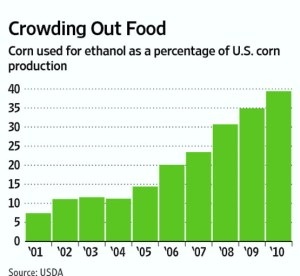
The commodities markets are showing this now.  According to reliable sources, corn that was going for $2.00 a bushel in 2005 when this legislation was enacted now sells for over $8 per bushel.  Because ethanol is mandated, the cost of ethanol for blending has little meaning to a gasoline producer as all gasoline producers must use it regardless of cost.  The cost of the ethanol will be passed on to the motorists.

Actually, ethanol is not viable economically but only used because of the mandate.  It will never be in sufficient supply to be a replacement for gasoline.  According to a study reported by Wikipedia, if you are concerned about greenhouse gases, ethanol’s use is a negative:  “A team led by Searchinger from Princeton University concluded that once direct and indirect effect of land use changes are considered, both corn and cellulosic ethanol increased carbon emissions as compared to gasoline by 93 and 50 percent respectively.”

The driving force for the use of corn to make ethanol is the votes that politicians get from their farming constituents. The other reasons weigh against using an important food source to make an automobile fuel.

cbdakota

Volt: Refund Policy Allows For Tax Credit Abuse and Other Issues


General Motors (GM) provides a 60-day money back policy for all Chevy models.   So if you buy a Volt you can claim a $7500 federal tax credit.  Then 59 days later, return it and get your money back.  But, you may get to keep the tax credit.  According to a posting by Mark Modica, the IRS tax form for plug-in vehicle credit does not have a minimum time requirement for the buyer to own their qualified vehicle.   Ok, so it is doubtful that anyone will buy a series of Volts in order to accumulate tax credits.  But this is just another glitch in the Volt epic.

So how is the Volt doing now as opposed to how GM felt about the Volt in the days before the first sales?  In a November, 2010 posting in WardsAuto the following was reported:

In 2012, the automaker plans to reach production capacity for the Volt at its Detroit-Hamtramck, MI, assembly plant here with about 45,000 units annually for U.S. consumption. Including export to markets such as Canada and China, capacity could reach 60,000 cars annually.

Well, they are missing the 2012 sales forecast by a wide margin.  Sales were not too good even when gasoline prices approached $4 per gallon earlier this year (2012). Will it get any better if the price of gasoline continues it’s current decline?

And in that same WardsAuto posting the following was reported:

General Motors Co. executives call the new-for-’11 Chevrolet Volt a key first step in the electrification of all its products, while also confirming long-held assumptions the car will not make money in the first years of production. However, the typical all-new vehicle program for an automaker averages $1 billion. Given its sophisticated technology, the Volt likely will cost much more to develop, build and sell.

It can’t be making money now if 45,000 units are just breakeven.  Somehow a lot of cars will have to be sold to amortize the $1 billion cost of development.

cbdakota


Volt And Leaf June Sales


The good news is that Chevrolet Volt sales for June were 1,760 versus the previous month’s Volt sales of 1,680.  The bad news is that at the end of June there were 5,300 Volts in stock, an 82 day-supply.  The Volt production line has been idled twice so far this year because of low demand.

Meanwhile the news is not particularly good for the Nissan Leaf because June sales were only 535 and that brings the year-to-date total sales to 3,418.  Nissan still insists that they will sell 20,000 Leafs this year.

cbdakota


Senators Ask If Fisker Loan Is Appropriate


Senator Thune (R-SD) and Grassley (R-IA) have asked Energy Secretary Steven Chu if the $529 million loan granted in 2010 to Fisker is appropriate.   Fisker has received $193 million to date with the remainder being held by the Energy Department while they review the status of certain (undisclosed) benchmarks that Fisker is required to meet.

Thune and Grassley question why monies should be given to Fisker at all when Fisker is partly owned by Qatar.  The Qatar Investment Authority– a branch of the Qatar government–owns about 10% to 15% of Fisker according to Wiki.    Dr. Kamel Maamria, head of the General Investments Portfolio and Executive Director of Qatar Holding LLC, is a member of Fisker’s Board of Directors. The Senators asked in the letter: “Why should the American taxpayer have to accept the credit risk of a company owned by a foreign government?”

According to AutoblogGreen: ”Energy Department spokesman Damien LaVera argues the loan was an appropriate part of the federal government’s effort to help boost fleetwide fuel economy and said Fisker’s delays are “common for start-ups,” according to the report.

Doesn’t sound like Mr. LaVera answered the question.

cbdakota

Washington Post versus Bain Capital


This is posting is not about man-made global warming.   Ok, so why am I posting it,  well because I question the Washington Post’s (WP) understanding of business and also their distorted attempts to paint Mitt Romney, the Republican Candidate for President of the US as a destroyer of US businesses.

I read and report on “alternatively powered” vehicles for this blog, as my regular readers know.  In doing so, I come across a lot of articles about gasoline/diesel powered vehicles.  Not to long ago, General Motors (GM) announced that they were going to build Cadillacs in China.  It seems that up-scale cars are selling pretty well in China.  Sales of the US made Caddies have been encouraging and GM concludes that they will increase their sales if they manufacture the Caddies in China.  Now think about the Toyota and BMW and Nissan vehicles that are being made in the US.  GM wants to do the same thing in China that these companies are doing here in the US.   Sounds like a smart move to me.

The WP published a story on Bain Capital, the business in which Romney had been a partner.  The newspaper’s pitch is that Bain has  “outsourced’ some small US businesses or part of their operation. Because of this, the WP wants to persuade their readers that Romney will be bad for the US business.  This WP article has been taken apart by James Pethokoukis of the American Enterprise Institute.  Pethokoukis shows that much of what the Washington Post reported is inaccurate and in some places just plain wrong. But equally as important is that industries across the globe move some manufacturing out of their homeland at times in order to be competitive.  If the business is not competitive, it goes out of business.

So here is the hypocrisy: General Motors (often called Government Motors) is essentially a branch of the US government as a result of the bail-out several years ago by this administration.   The companies that the Washington Post uses to impugn Bain are so small compared to GM there can be no comparison.  Yet if the WP feels strongly about the issue of outsourcing, why do they not take on GM?  I guess that is easy to figure out.

cbdakota

Not Much Joy In EV Land—May Sales Data


The Chevy Volt hybrid May sales were 1680 up from 1462 in April.  The forecast annual sales of 45,000 seem to be a stretch with only 7057 Volts sold year-to-date.  A little arithmetic says that about 38,000 Volts need to be sold in the remaining 7 months of 2012.

The Nissan Leaf sales of 510 in May were up slightly over the 370 sold in May. Year-to-date leaf sales are 2613. The Nisan people maintain that they will sell 20,000 Leafs in 2012.  But the still under construction Smyrna, Tennessee plant, said to be capable of making 150,000 Leafs annually, is not scheduled to startup until late this year.  Until then, Nissan will supply the market from Japan.

Underperforming would seem to be the proper word for hybrid and EV sales in the US.  High gas prices and still the sales are anemic.  One more example of Obama’s costly green energy plan not living up to his overblown promises.

cbdakota

Garage Fire—Karma Caused?


Although a Fisker Karma was housed in a garage that burned down, early accounts suggest that the EV was not the cause. The U.S. National Highway Traffic Safety Administration (NHTSA) is assisting in the investigation of the early May fire at a home in Sugarland, Texas.

Roger Ormisher, a Fisker spokesman said: “The lithium-ion battery of the Fisker Karma was fully intact after the fire and has been tested and is in full working condition. Currently, the precise ignition source and cause of the garage fire is still to be determined.”

cbdakota