Category Archives: Peak Oil

State By State Study Shows Unconventional Gas Is A Major Boon For The US Economy


A  previous posting, “Fracked Natural Gas Changing The US Economy”,  discussed the impact that fracked gas (aka, shale gas) is having and will continue to have on employment, investment, natural gas (NG) price (current and future), and Governmental Income in the US.  That discussion was based upon a study by IHS Global Insight that they released in December, 2011, This posting will review the details of a new IHS study released in June 2012 which totals all the sources of  unconventional NG— shale gas, tight sands gas and coal bed methane—and projects the total impact these unconventional NG sources have on the Nation and each of the lower 48 States plus DC.

There are 20 States in the lower 48 that are considered unconventional NG producers.  In addition to the TOP 10 employment producers shown in the chart below, the other ten are Alabama, Illinois, Kansas, Kentucky, Mississippi, Montana, New Mexico, New York, Virginia and West Virginia,  The other 28 plus DC are considered non-producers of unconventional NG.

Let’s begin with employment resulting from the exploitation of the unconventional NG. 

TOP 10 UNCONVENTIONAL OIL PROUDUCING STATES
 EMPLOYMENT CONTRIBUTION  
Number of Workers    
 

2010

2015

2035

State      
Texas

288,222

385,318

682,740

Louisiana

81,022

124,782

200,555

Colorado

77,466

126,525

127,843

Pennsylvania

56,884

111,024

270,058

Arkansas

36,698

53,919

79,723

Wyoming

34,787

45,763

78,792

Ohio

31,462

41,366

81,349

Utah

30,561

36,593

50,839

Oklahoma

28,315

41,763

69,261

Michigan

28,063

37,926

63,380

       
Top 10 total

693,481

1,004,979

1,704,541

Prod States

826,355

1,195,346

2,007,902

       
US Total

1,008,658

1,463,450

2,438,877


The order of ranking is based upon the 2010 employment numbers. I have a little trouble with the display as it uses numbers down to the single digits out of millions; however, it does not take away from the forecast of an impressive growth rate.  The “US Total” includes the induced jobs in the non-producing States that benefit from the low-priced plentiful NG.   

IHS uses the following system to develop their results: The analysis of unconventional gas development and its contribution to the US regional economies was conducted using a top-down/bottom-up approach. The contribution was assessed separately for direct, indirect, and induced contributions defined as follow:

• Contributions of unconventional gas are those activities required to explore, produce, transport, and deliver natural gas to consumers or to provide critical supplies or onsite services that support unconventional gas activity.

• Contributions are defined as activities in outside industries that supply equipment, material and services for the development of unconventional gas and its tier suppliers.

• Contributions are the economic effects caused by workers spending their wages and salaries on consumer goods and household items.

Their study forecasts that nearly $3.2 trillion in investments will be made to  develop  unconventional gas  between 2010 and 2035.

The following IHC charts show other effects from their study,


CONTRIBUTION TO GOVERNMENT REVENUE
         
        $ million  
   

2010

2015

2035

2010to2035
Producing States

28,034

41,090

71,806

1,255,034

Non-Producing States

5,758

8,246

13,317

243,701

           
US Total  

33,793

49,335

85,123

1,498,734

These monies in this chart are derived from the expected Federal, State and Local tax revenues and from royalty payments.  The last column is the cumulative no. of dollars for the period 2010 to 2035.

US VALUE ADDED      
      $Millions  
   

2010

2015

2035

         
Producing States

118,077

174,037

295,897

Non-Producing States

15,328

22,479

35,831

         
US Total  

135,405

196,516

331,831


IHC defines this chart as follows: The commonly used measure of GDP, which is simply the sum of the value added across all products and services produced in the United States, is generally considered the broadest measure of the health of the US economy. Value added to US GDP is defined as the sum of labor incomes, corporate profits, indirect business taxes paid, and depreciation. Annual value added to GDP from unconventional gas activities was more than $133 billion in 2010 and, by 2015, is projected to approach $200 billion. The majority of the value added to GDP—nearly 90%—over the 25-year forecast horizon is generated by unconventional gas production activities that take place in the 20 producing states.

IHC concludes that: Unconventional gas activity is expected to make a significant contribution to all of the economies of the lower 48 states over the next 25 years. Traditional oil and gas producing states like Texas and Louisiana will continue to lead the way in terms of their absolute contributions to the US economy. But many new and emerging energy states will drive much of the growth in the coming years, and the economic activity generated by this increase in unconventional gas activity will also reach well beyond the traditional unconventional producing states.

The full report can be seen by clicking here.

cbdakota
Strike Two For Cuba And Gulf Of Mexico Oil


The latest deep-water drilling operation off the West Coast of Cuba has been called off. The exploratory well by PC Gulf, a subsidiary of Malaysia’ Petronas and Gazpomneft of Russia, has been declared not commercially viable.  In May, Repsol’s said their drilling in this field was a failure.

Cuba, as noted in the previous report about this potential oil field, badly needs the money that they hope to obtain from this drilling.  They are also worried about the fate of Hugo Chavez of Venezuela, as he has been supplying Cuba with below market priced crude.  If he dies or is deposed, it could be a real problem for Cuba.

Some estimates of the crude in the field being explored are as high as 9 billion barrels. The field is in ultra deepwater.  Ultra deepwater is defined as where the seafloor at the drilling site is 5000 ft (1524 m) or more below the sea surface. The PC Gulf well was drilled to 15,300 feet below the seafloor.  The lease cost for a platform to accomplish the drilling is about $500,000 per day according to a report by the Associated Press.  There is only one such unit now available for the Cuban drilling and it will be used by the next company to try their luck—-the Venezuelan state oil company PDVSA.

cbdakota

OPEC Provides Low Priced Fuel Internally


The price of crude for the residents within OPEC states is lower than the export price.  As these states are mostly dictatorships, it is one way to placate the ruled.  But it seems that the low prices provides the residents no incentive to be frugal.  In the last decade, Saudi Arabia internal use has nearly doubled.  According to Reuters:

”Consumption has trebled in Angola, doubled in Ecuador and climbed 55 percent in Venezuela. OPEC members also seem to be becoming less efficient. Oil usage per head is up 24 percent since 2000, Deutsche (Bank) says, while it is flat for the globe as a whole.

For importers, the uneven treatment is costly. The wasteful consumption in exporting countries reduces the supply available for the global market, presumably pushing up the price. It also cuts into the potential reserve capacity, making the price more volatile.

But OPEC members don’t really gain, either. Governments lose potential export revenue and state-owned oil producers lose potential income. In 2010, the opportunity cost of discount domestic pricing was roughly 15 percent of OPEC’s total oil export revenue of $770 billion, according to International Energy Agency calculations. Such largesse adds to the fiscal strain on many of these nations – contributing to the exporters’ hunger for ever higher global oil prices.”

I am not sure that this analysis as it is presented is consistent.  First it says that the practice of diverting some fuel to internal use reduces the available supply and results in “pushing up oil prices”.  Ok, that makes some sense.  However the next paragraph seems to say that the practice causes them strain contributing to the exporters hunger for ever higher global oil prices.

What does that mean?  If they had more crude to export they would have more revenue?  But the artificial shortage that OPEC creates is done to get as high global oil prices as they can.  Maybe the author of this analysis saying that OPEC would get all the revenue it wants if it could export more by using less at home. This presumably would allow the exporters to lower the price because they would not need the revenue.  I doubt that.

Well, I probably have spent far too much time on this.   Especially, since OPEC will continue to lower the price of crude.  OPEC knows that there is a lot of untapped crude out there in the world.  Much of it becomes economic to produce as the price of OPEC crude goes up.   I have heard that North Dakota Bakken tight oil needs a price of around $75 per barrel to justify production.  OPEC has lowered world crude prices before to slow down/stop bringing in new supplies of crude.  They will do it again.  They dread the slogan  “drill baby drill” about as much as the liberal Democrats do.

To read more of the Reuter’s posting, click here.

cbdakota

Russia’s Oil Potential In Siberia


You may not have known this but Russia vies with Saudi Arabia for the title of biggest crude oil producer.  According to a June Bloomberg posting, oil and gas provided half of Russia’s income in 2011.  So Putin is pushing for more oil discoveries to keep his government afloat. Exxon has been invited to help drill oil fields in Siberia.  These Siberian oil fields are estimated to hold something like half the proven reserves of the US.  Exxon will joint venture with the Russian government run oil company, OAO Rosneft.  Exxon’s fracking technology is to be used on the Bazhenov shale formation in west Siberia.  Rosneft said these deposits might hold 13.2 billion barrels of oil. As part of the alliance with Exxon, Moscow-based Rosneft in April said it acquired a 30 percent stake in a Texas tight oil¹  project to gain experience with the technology. Exxon will be able to book reserves in a mature oil province without taking on the exploration or environment risk it faces in its offshore projects with Rosneft, which will require an initial $3.2 billion investment to explore in the Arctic Kara Sea and the Black Sea. Exxon is also working with Romania’s Petrom in the Black Sea where they have discovered a major gas find.

But Exxon is not the only player.  According to Bloomberg:

Non-state Russian oil companies, including its second-largest producer OAO Lukoil and fourth-biggest OAO Surgutneftegas, also have resources in the billions of barrels in the Bazhenov formation.

Ronald Paul Smith a Moscow-based oil and gas analyst at Citigroup Inc said: “Lukoil is already using horizontal wells and multistage fracking to support its West Siberian production, and therefore may be the earliest, clearest beneficiary” of the tax breaks.  Lukoil subsidiary Ritek produces about 2,000 barrels a day from the Bazhenov formation……”

“Another competitor, Gazprom Neft, together with Royal Dutch Shell Plc plan to drill an extended reach horizontal well with multistage hydrofractures next year to tap tight oil at their Siberian Salym Petroleum Development venture, Gazprom Neft Deputy Chief Executive Vadim Yakovlev told journalists at June 8 press conference.”

As noted in earlier postings, Exxon has other  fracking joint ventures besides these in Russia and Romania.  They are active in China and have projects in Argentina’s Vaca Muerta formation.  It is my understanding that they have backed out of ventures in Poland saying that there are too many governmental hurdles.

To read more click here,

¹ I am seeing the words “tight oil” being used frequently.  Here is a definition of those words. Tight oil is a play that consists of light crude oil contained in petroleum bearing formations of relatively low porosity and permeability (shales).  It uses the same horizontal well and hydraulic fracturing technology used in recent boom in production of shale gas.  The North Dakota’s Bakken field is a tight oil play.

cbdakota


Shale-Gas Drilling In China


Royal Dutch Shell says the results of early drilling in China for shale-gas looks to be a profitable proposition. In March, Shell signed a production-sharing contract to explore, develop and produce shale gas in China.  According to a Fox Business News Report, Shell will:

“…. apply its technology, operational expertise and global experience to jointly develop shale gas with state-controlled China National Petroleum Corp. over a 3,500-square-kilometer area in the Fushun-Yongchuan block in the Sichuan Basin.”

Shell is not alone in wanting to get into the Chinese shale-gas business as some experts are saying that China has as much potential shale-gas as does the US.  It is reported that Chevron and Total SA (the French multinational oil and gas company) are also seeking relationships with the Chinese.

To read more click here.


Ethanol Subsidies: Not Gone, Just Hidden a Little Better


Mother Jones, an organization with a very liberal viewpoint posted that the subsidies for ethanol fuel have expired but that this doesn’t trouble the ethanol fuel producers.  Kevin Drum authored the posting and I will let him tell you why.

A few years ago I called subsidies for corn ethanol “catastrophically idiotic.” And why not? Corn ethanol, it turns out, is actively worse for the environment than even gasoline. Farmers responded to the subsidies by reducing the amount of farmland used for food production, and this drove up the price of staple food worldwide.  At the end of last year, ethanol subsidies quietly expired and no one tried to extend them.

So why did the powerful corn ethanol lobby let it expire without an apparent fight? The answer lies in legislation known as the Renewable Fuel Standard (RFS), which creates government-guaranteed demand that keeps corn prices high and generates massive farm profits. Removing the tax credit but keeping the RFS is like scraping a little frosting from the ethanol-boondoggle cake.

The RFS mandates that at least 37 percent of the 2011-12 corn crop be converted to ethanol and blended with the gasoline that powers our cars…[As a result] the current price of corn on the Chicago Mercantile Exchange is about $6.50 per bushel—almost triple the pre-mandate level.

 You might not be aware that when the EPA does mpg ratings for new cars, they use gasoline that does not contain any ethanol.  Adding ethanol at 10% of the fuel mix, the energy in a gallon of fuel is about 96.7% of a fuel not containing ethanol.  Ethanol has less energy per gallon than normal unleaded gasoline.  So the MPG rating is probably just a bit high.    See

cbdakota

Dr Evans:”Climate Models Are Violently At Odds With Reality”


Dr. David Evans has posted “Four Fatal Pieces of Evidence” demonstrating that using computer climate models as the basis for man-made global warming (AGW)  theory is,  in Dr. Evans’ view,  “violently at odds with reality”. He maintains there is “no empirical evidence that global warming is mainly man-made.  If there was, we would have heard about it.  Tens of billions of dollars have been spent looking for it.”Dr Evans uses four pieces of evidence to illustrate his position.

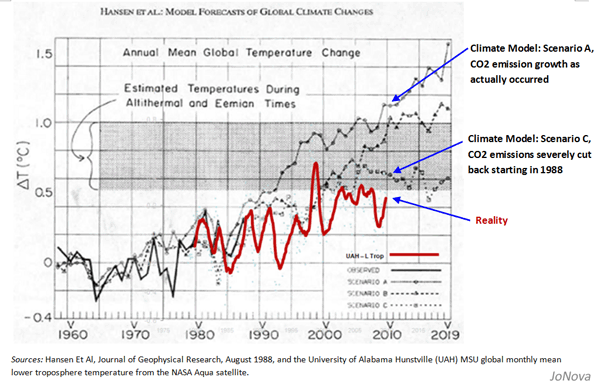
First: Evans examines the Climate Model predictions made by James Hansen (the so-called godfather of AGW) during his testimony to the US Congress in 1988.(click on chart to enlarge)

Evans says:”… the actual temperature rises are about a third of what he predicted. Remember, they have been saying the “science is settled” since the early 80’s, and the models now are essentially the same as they were then.

Furthermore, Hansen’s models predicted the temperature rise if human carbon dioxide emissions were cut back drastically starting in 1988, such that by year 2000 the atmospheric carbon dioxide level was not rising at all. But in reality, the temperature did not even rise that much. Which proves that the climate models don’t have a clue about the effect of carbon dioxide on world temperature.”

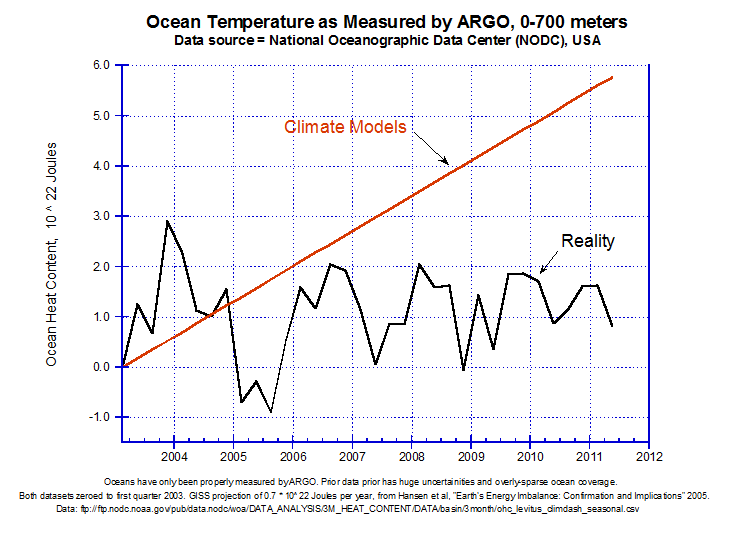
Second: Evans looks at ocean warming.  This is a better gauge of global warming than is measuring atmospheric temperature fluctuations.  The Argo Buoys were put into service in 2003.  The measurements of ocean temperatures prior to the Argo program are suspect in my view.  Nothing before 2003 remotely resembles the scope of Argo measurements.(click on chart to enlarge)

Evans says: the climate models predict the oceans should be warming. We’ve only been measuring ocean temperature properly since 2003, using the ARGO system. In ARGO, a buoy duck dives down to 2000m, slowly ascends and reads the temperatures on the way, then radios the result back by satellite to HQ. Three thousand ARGO buoys patrol the oceans constantly. They say that the ocean temperature since 2003 has been basically flat. Again, reality is very different to the climate models.

Thirdly: Evans looks at the “hotspot” which was  a climate computer prediction  which is the  Warmers’ proof of the positive feedback.  Feedback that is able to take a weak CO2 forcing signal and double or triple it.   Unfortunately for the advocates of this hypothesis, the hotspot does not exist.(click on chart to enlarge)

Evans says: “the climate models predict a particular pattern of atmospheric warming during periods of global warming. In particular, the most prominent change they predict is a warming in the tropics about 10 km up, the so-called “hotspot”. But we have been measuring atmospheric temperatures by weather balloons since the 1960s, and millions of weather balloons say there was no such hotspot during the last warming from 1975 to 2001. The hotspot is integral to their theory, because it would be evidence of the extra evaporation and thickening of the water vapor blanket that produces two thirds of the warming in the climate models…”

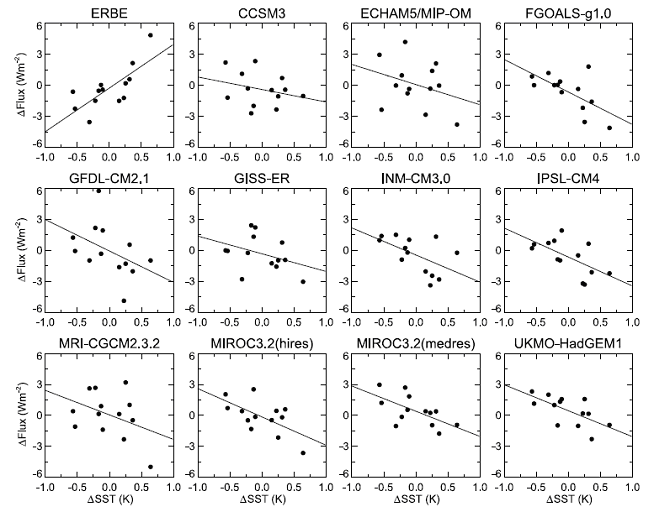
Fourthly:  Evans hits on one of the most discussed topic in recent times—that of outgoing radiation into space.    Note in the chart below that the top row left is the actual measurements of outgoing radiation by the stat elite ERBE program (Earth Radiation Budget Experiment-click here for more information.)   The other boxes are climate model predictions. (Chart source=Lindzen and Choi 2009)

Evans says: “satellites have measured the outgoing radiation from the earth and found that the earth gives off more heat when the surface is warmer, and less heat in months when the earth’s surface is cooler. Who could have guessed? But the climate models say the opposite, that the Earth gives off less heat when the surface is warmer, because they trap heat too aggressively (positive feedback). Again, the climate models are violently at odds with reality.”

Evans sums up saying:” Those are four independent pieces of evidence that the climate models are fundamentally flawed. Anyone one of them, by itself, disproves the theory of man-made global warming. There are also other, more complex, pieces of evidence. Remember, there is no direct evidence that man causes global warming, so if the climate models are wrong then so is the theory.”

Read all of Evan’s posting here.

cbdakota

U.S.Chamber of Commerce to Pres. Obama–How to Create Jobs


The U.S. Chamber of Commerce sent a letter to President Obama and Congress on creating jobs.The letter’s purpose is stated as follows:

OPEN LETTER TO CONGRESS AND THE PRESIDENT OF THE UNITED STATES

The most immediate priority facing our nation is to create jobs for the 25 million Americans who are unemployed, underemployed, or have simply given up looking for work.

To create jobs, we must enact policies that promote and sustain stronger economic growth. We must also address extraordinary fiscal and competitive challenges that are smothering growth and driving away jobs. At the same time, there are specific steps Congress and the administration can take right now to spur faster job growth in America’s private sector without adding to the deficit.

The letter has a number of sections. I have picked out one of them that relates to the Climate Change Sanity blogs theme:

2. PRODUCE MORE AMERICAN ENERGY

Let American energy workers and businesses responsibly develop all sources of domestic energy immediately. This will not only create jobs but will generate new government revenues, protect our energy security, and release us from the grip of some unfriendly governments.

                              Open offshore resources. Almost 190,000 new jobs could be created by 2013 if permitting in the Gulf of Mexico for offshore development returned to pre-moratorium levels. In Alaska, opening up energy production off the coast would create 54,700 jobs.

                              Expand access on federal lands. By expanding oil and gas exploration on federal lands, we could create 530,000 jobs, reduce imports by 44% by 2025, and increase government revenues by $206 billion.

                              Promote development of natural gas. Expanding the development of the nation’s massive shale gas deposits would create hundreds of thousands of jobs and help bring manufacturing back to the United States, especially in the chemicals and steel industries.

By 2020, natural gas production in Western Pennsylvania alone could create 116,000 new jobs, generate more than $2 billion in government revenues, and add $20 billion to the region’s economy.

                        Approve the Keystone XL pipeline. Construction of the Keystone XL oil pipeline connecting Canada to U.S. refineries in Texas would support 250,000 jobs, boost investment in the United States by $20 billion, and generate government revenues totaling $585 million.

Well said, and certainly in line with yesterday’s posting see here.

The other letter sections are as follows and worth reading:

  • Expand Trade and Global Commerce
  • Speed Up Infrastructure Projects
  • Welcome Tourists and Business Visitors to the U.S.
  • Speed Up Permits and Provide Regulatory Certainty and Relief
  • Pass Tax Incentives That Create Jobs While Increasing Revenues

cbdakota


One Billion Motor Vehicles And Peak Oil


Oilprice.com noted that in August, Wards Auto published a story saying that World motor vehicle count now stands at 1 billion.  The U.S. still has the largest registration at about 240 million.   In the Oilprice.com blog, the author considers what 1 billion vehicles and the likelihood of even more being added in the next 25 years might mean. It is interesting reading.  He seems to favor governmental intervention to ameliorate supply (read PEAK OIL) versus demand for fossil fuels.   He says:

It is highly unlikely that there will be anything approaching 240 million registered vehicles in the U.S. 25 years from now. From the vantage point of 2011, it seems probable that many will not be able to afford to own and operate personal motor vehicles of the size and types we have today.

He thinks that the newly mandated CAFÉ standard is just what we need and that we will have to abandon 6 passenger cars and other large sized vehicles. He says:

  In the U.S. we are now facing standards requiring that cars achieve an average of 54.5 MPG 15 years from now. First will come all sorts of weight reductions, such as eliminating spare tires, and adding more plastic and aluminum parts. Engines will become more efficient and car bodies will become more aerodynamic.  Although these changes will be costly, it does not take much arithmetic to conclude that if energy costs are three or four times higher than they are today then mileage will become the key factor by which motor vehicles are judged.

Detractors of these new mileage standards are usually people who have little grasp, or prefer not to think about where real energy costs are going to be 15 years from now. They point out the advanced materials required to build a low-weigh, high mileage, vehicles will be so great that it will push cars beyond what many, if not most, can afford.  

Due to governmental interference, the U.S. is facing an artificial Peak Oil problem.   This artificial Peak Oil Problem is really a part of the Peak Energy Problem that governmental interference is causing.    We have a lot of fossil fuels.  The U.S has the largest reserve of fossil fuels in the world.  It is likely that North America could become energy independent.  Yes, no propping-up Venezuela nor other countries that don’t have our best interest in mind.   And what a break for our balance of payments.  Becoming completely energy independent might possibly be the wrong thing to do because the prices of crude oil could fall below our production cost thanks to the U.S. bringing on more production capacity.  I don’t want the government to dictate how much crude we should produce or purchase.  Let the market decide whether we produce or buy.

Peak Oil will come sometime, but not in the near future.  What the U.S. is facing is an ideological, artificial Peak Oil problem.   The Obama administration gives money to “renewable fuels” programs and tells us that we must do this to reduce the purchase of foreign crude.   How the government thinks they can do this with renewable fuels is beyond comprehension.  Renewable fuels, are now neither economic nor reliable enough to do that.  In fact, the electrical grid people that distribute the nation’s electricity have found it necessary to have fossil fuel powered back-up capacity equal to the wind or solar capacity.  The renewables can’t be scheduled, meaning their supply is too erratic to provide steady voltage and current.  The wind slows down or stops or the sun goes behind clouds and the former balance of supply and demand goes south. They have to have something as a backup to keep the lights on.  Their second argument is that fossil fuels not be used as combustion results in C02.   The fossil fuel back-up capacity blows that argument.  See here and here to read about the folly of renewable fuels.

The Radical Environmentalists fight every attempt to develop our resources.   Oil in Alaska, offshore oil, oil in the Baaken field, nuclear power, low cost coal,etc..  It doesn’t matter, they are against it.   They use global warming, polar bears, darter fish, left-handed ground squirrels  (I guess I made that one up) and one of my favorites–the Houston toad.    According to some reports only 300 Houston Toads remaining in the world and they have been placed on the endangered species list.  “A world without the Houston toad ... is not a world we can physically live in,” says Paul Crump, a reptile and amphibian keeper at the Houston Zoo who works with the small brown toads.  Who knew?  The world is on the way to a collapse. More dangerous issue than the Osama binLaden threat so lets get the Seal Teams to see nothing bad happens to those warty little buggers. (SARC).

Fracking and the oil pipeline from Canada are the causes du jour for the radical environmental crowd.   It is patently clear that they will only be satisfied when this country is reduced to a third world status.   And our Government supports their activities through the EPA and other departments.  God Bless Michelle Bachmann and her vow to eliminate the EPA if she is elected President.  If she is not, she should be given the job as the EPA Administrator.

We will run out of economically recoverable oil some day.  Same for natural gas, iron ore, etc.  But the many forecasts made by experts about when the oil peak would occur have always been vastly overstated.

We quoted The Oilprice.com author saying that in 15 years the price will be 3 to 4 times higher than today.  It could happen but only if we just sit back and let it happen.  For a more realistic assessment of the Peak Oil tipping point, lets look at what has been said on a WardsAuto.com posting titled “Oil’s Price Always Comes Down.”

Five years ago, I believed in the Peak Oil theory. It postulated that global oil production would peak in 2006, and the following shortage would send prices skyrocketing. Sure enough, in 2008 a barrel of oil shot up to $150.

But less than 12 months later, oil plummeted to less than $40 a barrel. Yes, the price now is back up to $100, but I no longer believe in Peak Oil. Here’s why:

Brazil recently discovered massive oil reserves off its coast that match or beat Saudi Arabia’s. Brazil will start tapping those reserves before this decade is out. In Iraq, infrastructure is being put in place to increase oil production six or seven times greater than today, potentially making it the largest oil producer in the world.

And in the U.S., a new drilling technique called hydraulic fracturing is the mother of all game changers. (My emphasis)  Texas wildcatters figured out a way easily extracting natural gas and oil from shale. Using high-pressure water and sand, they fracture the shale, releasing trapped gas. As a result, the U.S. has added 100 years of natural gas use (at current rates), and the price of natural gas has fallen to nearly half from its peak in 2008.

Hydraulic fracturing, or fracking as it’s also called, is controversial. Some environmentalists have seized on it as the next great danger to the planet. A documentary called “Gasland” probably will win an Academy Award for hysterically pointing out the dangers of fracking.

Of course, “Gasland” approaches its topic with the impartiality and evenhandedness of pseudo-documentaries such as “Roger and Me” and “Who Killed The Electric Car?” So far, fracking has been done mostly in the U.S., but it soon will spread to the rest of the world. (My emphasis) Before this decade is out, we are going to see vast increases in the amount of oil and natural gas available. And this will have enormous implications for the auto industry and policy planners.

Closing out is a good time to call for a lesson from “Minnesotans 4 Global Warming”.

http://www.youtube.com/watch?v=nWiKvNDTjB4&feature=player_embedded

cbdakota