Category Archives: Off Shore Resources

Eastern Med Oil and Gas Discoveries—Israel and Cyprus


Natural gas and oil producers normally are not the way that Israel and Cyprus are characterized, but recent discoveries in the Eastern Mediterranean are changing that perception.
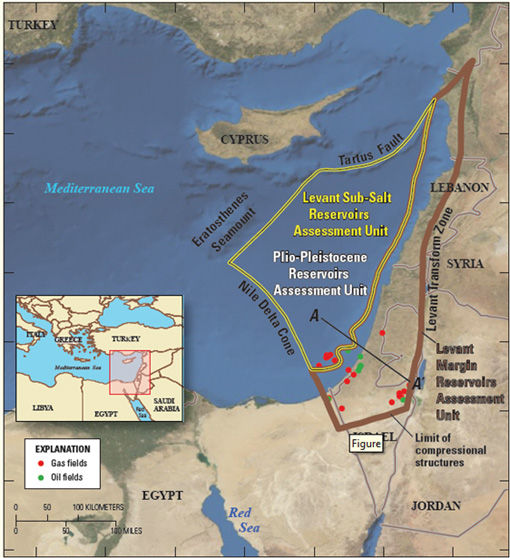
The Levantine Basin in Eastern Mediterranean (Source: USGS)

Israel  Two years ago, in June 2010, the Leviathan, the largest gas field in the Eastern Mediterranean was discovered by Houston’s Noble Energy.  The natural gas reserves in that find that are in Israeli territorial waters are estimated to be something in the range of 25 trillion cubic feet (Tcf).   Some experts are estimating that there might also be up to 600 million barrels of oil.  And that is not all.  The Israeli Tamar field is believed to contain more that 8 Tcf of natural gas. The Energy Tribune’s posting by Michael Economides notes that:

A statement released on Sunday by the Israel Opportunity energy exploration partnership said that prospecting at the Pelagic group of deep-sea fields, west of Haifa, showed a potential of 6.7 Tcf of gas and 1.4 billion barrels of oil.  

These finds are very timely, because Egypt has ended its contract to supply gas to Israel

 Cyprus  In December 2011 Noble Energy announced that their first well in the Cypriot Economic Zone of the Leviathan Field contains up to 9 Tcf of natural gas.   Energy Tribune reports:

The size of the ultimate recoverable gas in the Eastern Mediterranean, according to the United States Geological Survey, is of the order of 200 Tcf of natural gas and 3.7 billion barrels of oil. A dozen new Cypriot blocks, currently in the process of being offered to international bidders, will almost certainly add 50 Tcf, perhaps 75 Tcf to the already discovered.

On-shore delivery from the Levantine basin will not be easy.  The gas is located about 20,000 feet below sea level —6,000 feet to sea bottom and then an additional 14,000 feet of required drilling.) Further it is believed that the gas will need to be liquefied and delivered on shore by tanker because it will be too deep to put in piping. The size and cost of these facilities are the sort of things that can be managed by large oil firms but to date, these companies seem reluctant to work with the Israelis for fear of antagonizing their Arab partners.

The solution as outlined by Economides is:

Israel will need Cyprus to exploit its resources by employing the right size company to construct e.g., LNG or gas-to-liquids (GTL) plants. The size of the resources cannot allow them to even remotely be consumed domestically; export is the only option. The Cypriot and Israel reservoirs should be unified; they are geologically contiguous anyway. Cyprus, in turn, will need the shield provided by Israel in relation to saber rattling Turkey. The Israeli-Cypriot marriage is made in oil and gas heaven.

cbdakota
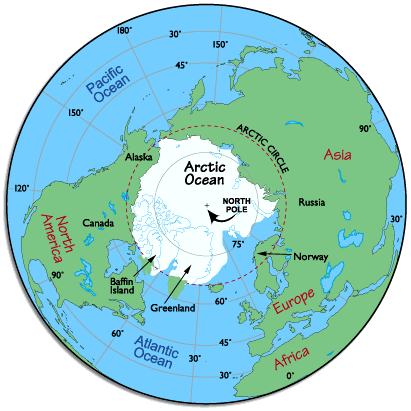
US Asserts Interest In Arctic


According to a story in Reuters, “Secretary of State Hillary Clinton will assert U.S. interest in the Arctic, where the prospects for abundant oil, gas and new trade routes has been likened to a modern-day gold rush, when she visits the region on Saturday.”  (1 June 12)

Interest is high with nations worldwide vying for access to the Arctic.  “Norway has moved its military operational headquarters into the Arctic Circle, China has development plans for Iceland and countries, including Russia, are laying claim to exploration rights in the once pristine Barents Sea.”

Map courtesy of WorldAtlas.com

It is all about energy.  While our politicians dilly-dally about the oil in ANWR, and fuss over any attempt to develop the resources in the Arctic area, the World’s nations are not waiting our approval.

More comments from the Reuters article:  “Even Russia, the largest provider of oil and gas to Europe is keen to accelerate gas production from its offshore gas fields as soon as possible, or as soon as economically viable.”

The U.S. Geological Survey estimates that the Arctic holds about 13 percent of the world’s undiscovered conventional oil and 30 percent of its undiscovered natural gas resources.

“All the major powers are positioning themselves for this development,” said Ole Arve Misund, director of the University Centre in Svalbard. “The resource has become more available and prospects have already been opened in Norway, Russia, Canada, the U.S. and Greenland.”

ExxonMobil is working with Rosneft to develop blocks in the Kara Sea, off Siberia, despite sea ice for up to 300 days a year.

Gazprom is also working with Total and Norway’s Statoil on the 4-trillion-cubic-metre Shtokman gas field 550 km offshore. Statoil has also established a strong Arctic record with its Skrugard and Havis finds, holding up to 600 million barrels of oil.   

Ole Arve Misund is quoted above saying that all major powers are positioning themselves for this development.  But one of the powers, the present US Administration may be deeply distressed by this major source of fossil fuels and who knows what game they will play to prevent exploitation of these resources.

cbdakota

Cuba’s Hopes For Oil In Florida Straits Hits Dry Hole


Cuba’s oil drilling partner, Repsol says that they have hit a dry hole and are calling it quits.  Repsol, an integrated Spanish oil and gas company, has spent more than $100 million drilling only to come up with no oil.  Currently Cuba relies on Venezuela to deliver $3 billion of subsidized oil each year.  Continuation of this program would be in jeopardy if Hugo Chavez were not to be reelected in the October elections.  An additional threat is Chavez’s health. He has been undergoing treatment for cancer for a number of months.

Cuba’s needs a major oil find to revive its struggling economy.   With Repsol out of the picture, Cuba’s fortunes rest with Petronas, the Malaysian oil company, that has began drilling an exploratory well about 180 miles southwest of Repsol’s dry well.

To read more, see this story in Oil Price.

cbdakota

What Makes Up The Price Of Gasoline?


Given the interest in the “whys and wherefores” of US gasoline price,  this site welcomes the work done by the Institute For Energy Research (IER).    Their full analysis can be found by clicking here,   but the following is a summary of that analysis:

IER’s analysis provides the following facts about gas prices:

  • 76 percent of the price of gasoline is determined by the price of crude oil.
  • 12 percent of the price of gasoline is determined by federal, state, and local taxes.
  • The federal tax on gasoline accounts for 18.4 cents per gallon, while the volume-weighted average state and local tax is 30.4 cents per gallon.
  • Refining costs account for 6 percent of the price of gasoline.
  • Retail dealer’s costs and profits account for a combined 6 percent of the price of gasoline.
  • Less than 5 percent of gas stations are owned by major oil companies.
  • 60 percent of U.S. oil demand is imported from foreign countries.
  • The world consumed 87.9 million barrels of crude and liquid fuels every day in 2011, the highest consumption rate in history.
  • China is now the world’s second-largest consumer of oil behind the United States.  In 2011, Chinese crude imports were up 8.2 percent over 2010 levels.
  • The U.S. produced an average of 5.67 million barrels of crude oil every day in 2011.
  • Production in the Gulf of Mexico is expected to fall by 90,000 barrels per day due to production declines in existing fields, permitting delays, and the Obama moratorium.
  • Crude oil production in Alaska is projected to fall by 20,000 barrels per day both in 2012 and 2013.
  • When President George W. Bush lifted the executive moratorium on offshore drilling, there was an immediate price decrease in the cost of oil.
  • About 25 percent of U.S. supply of oil comes from OPEC countries, which have agreed to a production ceiling of 30 million barrels per day including Iraq’s production and some overproduction by member countries.

U.S. monetary policy — particularly increases in the money supply through quantitative easing — have coincided with a surge in oil prices.  Recent signals from the Federal Reserve that interest rates would remain at near-zero through 2014 have created a ripe environment for hedge funds that bet on commodity plays.

Obama Administration Is Not Helping The Gasoline User


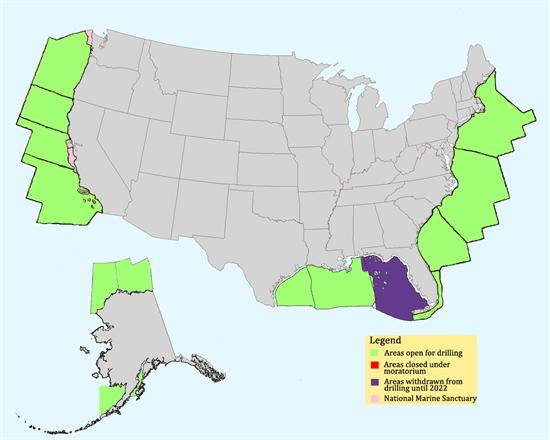
The Obama administration current 5-year offshore drilling proposal will further block access to drilling on Federal lands.  Lets look available and blocked offshore drilling sites under Bush and under Obama.

OFFSHORE UNDER BUSH

OFFSHORE UNDER OBAMA

Maps and history of the Bush and Obama Administrations regarding offshore oil and gas can be read in more detail here.

Raising Onshore Oil Production Costs

In addition to restrictions, Bureau of Land Management Director Bob Abbey said last week at a Senate Appropriations Committee on Interior hearing that federal regulations applied to oil and gas development simply make it more expensive than producing on state or private land according to a posting on Institute for Energy Research website. Then he remarked that the Administration is currently considering raising onshore production royalty rates from 12.5% to the 18.75% that  is charged for offshore oil; in fact, he said that the Department of Interior’s upcoming budget depends on an assumed 50 percent increase in royalty rates.

More blocking of access and higher rates.  How is this helping the US consumer?

Pres. Obama Says US Only Has 2% Of World Oil. Can That Be Right?


Obama said:  “With only 2% of the world’s reserves, we can’t just drill our way to lower gas prices.  Not when we consume 20% of the world’s oil.”  Addressing the 2% part of his statement, if he meant we have only 2% of the “proven reserves” he is correct. But he uses this figure hoping that you will come to an incorrect conclusion. The US is, by every analysis one of the most energy rich nations in the world.   Others, including the Congressional Research Service, say that the US is the most energy rich nation in the world

The second part –consuming 20% of the world’s oil– is a non sequitur, meaning it does not follow logically from the previous part of his statement.  We will talk about that later.

The basis for the President’s statement came from the DOE’s Energy Information Administration.  The US’s “proven” reserves of 20.6 billion barrels of oil are equivalent to 2% of the worlds proven reserves.

DOE’s Energy Information Admin (EIA) Table of US Reserves (Billions of BBL’s) 10/19/2011

Region Proven Inferred Un-discovered Total TechnicallyRecoverable
Onshore 12.7 50.1 51.1 113.9
Offshore 4.3 10.3 42.7 57.4
Alaska 3.5 2.1 42.0 47.6
Total US 20.6 62.5 135.8 218.9

Interpreting the table, Proven reserves are where oil production is underway and the extent of the fields is well known.  Inferred is the volume by which the estimate of total recovery from a known crude reservoir or aggregation of such reservoirs is expected to increase during the time between discovery and permanent abandonment.  Undiscovered is oil that very likely exists, and can be recovered depending in part on technology and/or the price of oil.

This table understates the reserves.  EAI says of the above table: Resources in areas where drilling is officially prohibited are not included.  Estimates of the resources in the Northern Atlantic, Northern and Central Pacific and within a 50-mile buffer off the Mid and Southern Atlantic OCS are excluded from the technically recoverable volumes.  A case in point is that the reserves in ANWR which according to the USGS may contain 12 billion barrels is not included because the Feds have taken it off the table.   Most of our costal waters are off-limits as well.

This table also excludes the shale oil in the Green River Formation in Colorado, Utah and Wyoming. The Feds control roughly ¾ of the public lands on which fossil fuel resources exist. Wiki says that: “The Green River Formation contains the largest oil shale deposits in the world. The 213 billion tons of oil shale contain an estimated 2.38 × 10¹¹ m³ (1.5 trillion US barrels) of shale oil.

When the proven reserves are stated,  how should you interpret the number?  Here is an example from The Institute for Energy Research:

Proved Oil Reserves Are Not Static

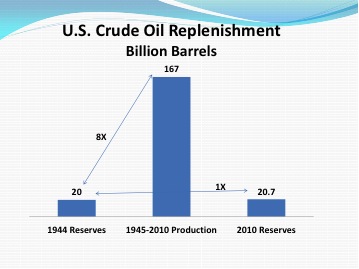
Let’s take a look at history. In 1944, U.S. proven oil reserves were 20 billion barrels — about the same as they are today. Yet, between 1945 and 2010, the United States produced 167 billion barrels of oil. In other words, the United States produced over 8 times more oil than the amount of proven oil reserves it had in 1944.  How can that be? The answer is that proven oil reserves are not stagnant because people keep looking for oil. Proven oil reserves keep changing, are officially recorded every year, tallied country by country, and published in the Oil and Gas Journal, among other publications. And due to U.S. entrepreneurship and ingenuity, more reserves are found and proven each year.

What Does More Recent Data Look Like?

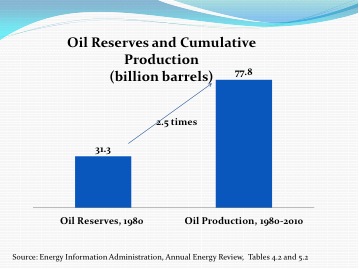
So, is this an historic anomaly? No. Let’s look at more recent data. In 1980, according to the Energy Information Administration, the United States had 31.3 billion barrels of proven oil reserves. However, between 1980 and 2010, the United States produced 77.8 billion barrels of oil and still had 20.7 billion barrels of oil reserves left. In other words, between 1980 and 2010, the United States produced 2.5 times the amount of oil as it has proven oil reserves in 1980.

The preceding illustrates that comparing the proven reserves to oil consumption is at least faulty and perhaps intended to misinform.

The President said that we can’t drill our way to lower prices when we  are the largest consumer.   Now I know that OPEC is the major force in setting the price of crude.   Even so, they are not immune to the laws of supply and demand.  They know that  a substantial excess of supply over demand will cause them to either curtail production within the Cartel  to rebalance supply and demand or the price will drop.  They also know that if they see widespread drilling being undertaken,  lowering the price of crude can cause some marginal production capacity to shutdown.

Every country that has shale oil, will be out there trying to achieve some piece of national security brought about by having their own oil.  So the over supply is likely to happen.  Ask the natural gas suppliers how well their prices have held up in recent years now that the shale natural gas is becoming oversupplied.   It will happen to OPEC too.  And the sooner the better.

cbdakota

The USA Is Energy Rich—Who Is Preventing Us From Using It?


Look at this video, which is based on work done by the Congressional Research Office late last year and further developed by the Institute for Energy Research in their new report North American Energy Inventory.   The USA has more energy resource than any country in the world—that means oil, natural gas and coal are in abundant supply.  North America’s  (USA, Canada and Mexico) combined resources make it the most energy rich region in the world.  So why aren’t we experiences the lower prices for gasoline, heating oil, electricity, etc.  Why are we sending so much of our money to the people in the Middle East and places like Venezuela, where they often us that money to oppose us?  I hope you got the right answer which is –Our Federal Government.

AT STAKE:   1,000,000 new jobs.  Lowered trade imbalance.   Depriving enemies of our money to oppose us.

See also: Keystone Pipeline Delayed  

Obama Administrations war on fossil fuels

Lets Reduce Foreign Crude Oil by Using Our Own 

Between The Rock And The Hard Place US Energy Policy: 

cbdakota

U.S.Chamber of Commerce to Pres. Obama–How to Create Jobs


The U.S. Chamber of Commerce sent a letter to President Obama and Congress on creating jobs.The letter’s purpose is stated as follows:

OPEN LETTER TO CONGRESS AND THE PRESIDENT OF THE UNITED STATES

The most immediate priority facing our nation is to create jobs for the 25 million Americans who are unemployed, underemployed, or have simply given up looking for work.

To create jobs, we must enact policies that promote and sustain stronger economic growth. We must also address extraordinary fiscal and competitive challenges that are smothering growth and driving away jobs. At the same time, there are specific steps Congress and the administration can take right now to spur faster job growth in America’s private sector without adding to the deficit.

The letter has a number of sections. I have picked out one of them that relates to the Climate Change Sanity blogs theme:

2. PRODUCE MORE AMERICAN ENERGY

Let American energy workers and businesses responsibly develop all sources of domestic energy immediately. This will not only create jobs but will generate new government revenues, protect our energy security, and release us from the grip of some unfriendly governments.

                              Open offshore resources. Almost 190,000 new jobs could be created by 2013 if permitting in the Gulf of Mexico for offshore development returned to pre-moratorium levels. In Alaska, opening up energy production off the coast would create 54,700 jobs.

                              Expand access on federal lands. By expanding oil and gas exploration on federal lands, we could create 530,000 jobs, reduce imports by 44% by 2025, and increase government revenues by $206 billion.

                              Promote development of natural gas. Expanding the development of the nation’s massive shale gas deposits would create hundreds of thousands of jobs and help bring manufacturing back to the United States, especially in the chemicals and steel industries.

By 2020, natural gas production in Western Pennsylvania alone could create 116,000 new jobs, generate more than $2 billion in government revenues, and add $20 billion to the region’s economy.

                        Approve the Keystone XL pipeline. Construction of the Keystone XL oil pipeline connecting Canada to U.S. refineries in Texas would support 250,000 jobs, boost investment in the United States by $20 billion, and generate government revenues totaling $585 million.

Well said, and certainly in line with yesterday’s posting see here.

The other letter sections are as follows and worth reading:

  • Expand Trade and Global Commerce
  • Speed Up Infrastructure Projects
  • Welcome Tourists and Business Visitors to the U.S.
  • Speed Up Permits and Provide Regulatory Certainty and Relief
  • Pass Tax Incentives That Create Jobs While Increasing Revenues

cbdakota