Category Archives: Nuclear Energy

Peak Oil Not A Near-Term Threat


Peak Oil is that point in time when the world runs out of new finds of oil and from that point on,  oil becomes more scarce and more costly. The Department of Energy’s Energy Information Agency (EIA) forecast that in the year 2040 about 81% of our energy needs will be satisfied by fossil fuels. The following  data is from the  2014 EIA Annual Energy Outlook for U.S. energy consumption in 2040:

Quadrillion Btu % of total
Petroleum 35.35 33.25
Natural Gas 32.32 30.40
Coal 18.75 17.70
       Fossil fuel subtotal 81.45
Renewables 10.27 9.94
Nuclear 8.49 8.00

The Pacific Research Institute produced this video that reports we are not about to arrive at Peak Oil any time soon.  Which is a good thing as  the EIA does not expect renewables to be a significant contributor to our energy needs by 2040.

.

cbdakota

Is Greenpeace Behind Destruction Of Field Trials Of Golden Rice?


Philippines’ environmental groups destroyed a “Golden Rice” development test plot. Golden Rice is genetically modified rice that is being developed to combat vitamin A deficiency in the developing world.  The Hellen Keller International organization says the around 670,000 children world-wide will die each year from vitamin A deficiency and about 350,000 will go blind from the lack of vitamin A.  It is reported that one cup of Golden Rice will supply half an adult’s recommended daily intake. The International Rice Research Institute reports that: “The rice has been modified by adding extra genes that turn on the plant’s ability to produce beta-carotene, which humans can convert into vitamin A.”

Continue reading

International Nuclear Fusion Project Underway


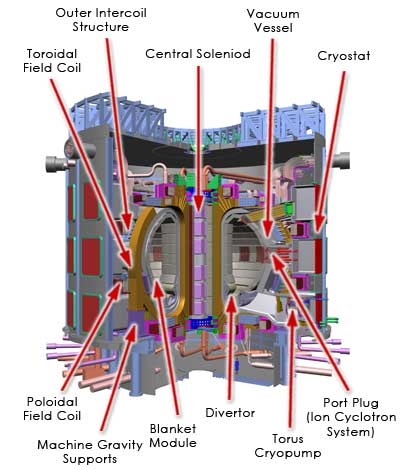
The UK Independent reports that the Iter fusion project gained final approval “ for the design of the most technically challenging component – the fusion reactor’s “blanket” that will handle the super-heated nuclear fuel.”
The Iter project is designed to produce  at a rate of  500 megawatts of energy using an input of 50 megawatts  during a 1000 seconds run. The Iter fusion project is forecast to cost £ 13billion (US $20 billion) .  The project team is an international combine of 46 nations that are contributing  science and money.  The facility is based in Cadarache, France.
Below is a cut-away of the Iter reactor design and brief description of the elements of the reactor from Howstuffworks.com
fusion-reactor-5

“The Magic Washing Machine”—–Limiting Energy Access To The World’s Poor Is Wrong


You have to give credit to the Green NGOs in that they are much more upfront about their goals than most of the Global Governments. Greenies want to stop development of all fossil fuel sources and they would like to see the nuclear industry dismantled and no new nukes built.  The Obama Administration is not quite that ambitious, at least for now, although there is not much difference in their objectives. Examples of goals the Administration have announced are: kill coal,  minimize (and in some cases prevent any) use of Federal lands for accessing the mineral resources and raise the price of gasoline and electricity.
Who is it that will feel the most pain, if this cabal is successful?  It will be the poorest among us, of course.  They justify their actions by saying that the Earth will really, really, really go to hell if we don’t stop burning fossil fuels.  And besides they add, we will have wind and solar farms takeover the job of supplying power.  Wind and solar farms are not ready for prime time and who knows if they will ever be. The experience around the world demonstrates that when and if these renewables do replace fossil fuels, the power supplied will be more costly than that supplied by fossil fuels.  No help for the poor here.

“US Energy Independent By 2035”-International Energy Agency


The International Energy Agency (IEA) released their 2012 edition of the World Energy Outlook (WEO) on Monday, 12 November 2012. The take-away from the report is:
The WEO finds that the extraordinary growth in oil and natural gas output in the United States will mean a sea-change in global energy flows. In the New Policies Scenario, the WEO’s central scenario, the United States becomes a net exporter of natural gas by 2020 and is almost self-sufficient in energy, in net terms, by 2035. North America emerges as a net oil exporter, accelerating the switch in direction of international oil trade, with almost 90% of Middle Eastern oil exports being drawn to Asia by 2035.  
 
The new oil and natural gas production in the US will not only result in lower domestic prices for gasoline, electricity and heating oil, it could result in delivering our nation from the endless traumata that are the turbulent Middle-Eastern nations.  Will we feel it necessary to defend shipping routes any more?  Will we need to provide F-16 fighter planes to Saudia Arabia? I wonder if the European or perhaps the Saudis, are becoming nervous thinking that they might have to do for themselves what we have been doing for them.  Maybe the Chinese will take up the slack.  I’m not sure that is a comforting thought.  

Will The Solar Industry Survive?


Manufacturers of Solar Panels

Since the demise of the German solar panel industry, the major solar panel manufacturers are mostly Chinese. There are others such as Sunpower (French) and First Solar (American).   Sunpower, formerly an American firm, is now owned by TOTAL, the French petroleum giant.  Sunpower, formed in 1985, had stopped producing solar cells last year.  They were nearing bankruptcy having lost some $600 million.  However, they were able to restructure when TOTAL bought 60% of the company.  While the company has survived, the market does not have much confidence in its future.  In October, 2009 Sunpower shares sold for about $32.  Those shares now sell for $5.   Across the World, the subsidies that have been doled out for solar energy projects are diminished or have vanished altogether.  As of September, none of these firms are making a profit. 

Why Are The Solar Panels Makers Not Making a Profit?

A posting by the Telegraph (UK) reports on the Chinese solar panel makers’ financials: ”China’s big five firms are all reporting disastrous trading and heavily indebted balance sheets. At the end of the first quarter, JA Solar listed debt and liabilities of $1.5 billion, Trina Solar had debts of $1.08 billion, and Yingli had debts of $3.44 billion.  Suntech, once held up as a model company, could have to pay $690m in collateral related to a possible fraud, and it also has a $541m convertible bond payment in early 2013. Its total debts are $3.58 billion.  In the first quarter, LDK lost $185.2m as sales dropped by nearly 75pc.”

The manufacturers, particularly in China are increasing their production capacity so that it far exceeds solar panel demand and ironically, at a time when demand is slowing due to reduced or eliminated US and European government subsidies given to builders of solar farms. Further acerbating the profit problem is that some of the Chinese manufacturers are reported to be selling below the cost of manufacture (this is Dumping). The US has imposed a tariff on imported Chinese solar panels. The Europeans are charging the Chinese with “Dumping” and the result will be that the Chinese will lose that market too.  

China seems to be of two minds here.  The government is supporting these expansions because the government needs new jobs to contain China’s huge, annual increase of job seekers. Many believe that they will continue to build solar farms for the same reason. The competitiveness of all this is often secondary in a government run economy. Remember that the Soviet Union did this before they went broke.  Our government is not too far off of that track themselves when it comes to “renewable energy”.

Are Solar Farms Competitive?

Solar farms are the least competitive form of renewable energy.    

The US Department of Energy’s Energy Information Administration (EIA) says that solar projects provide the most expensive power.   The EIA estimated levelized cost of new generation resources coming on line in 2017 are:

Type of Generation Cost   $/megawatt-h
Natural Gas- Conventional Combined Cycle 66.1
Conventional Coal 97.7**
Advanced Nuclear 111.4
Wind-On-Shore 96.0
Solar 152.7
  **potential C tax included


Solar is 2.3 times more expensive than natural gas.   The only reason anyone builds solar farms is because the Federal government loans the crony capitalists the money at basically no risk to the borrowers and then the States require the utilities pass on the cost on the their customers. The consumer pays at least 50% more for this form of electricity.  

The on-line German “Focus” posted an interview with Klaus Dieter Maubach, the Technology Chairman of E.On a major German power company and Maubach said:  (This quote is a translation from the German by Google translator)  Germany’s solar industry will disappear in the next five years in the face of competition from China. Not a single worker is still working at the German solar companies, as the latter are then all broke, it cited the Bloomberg news agency.”  The English also are becoming tired of supporting renewable solar.  The Spanish and Italian governments are reducing subsidies dramatically.   My guess that no matter which man, Obama or Romney, is elected President, the US government subsidies for solar will not be renew.  

Perhaps more money should be directed toward the development of Thorium reactors. We need to talk about these reactors in a posting.

cbdakota

President Obama’s Pants-On-Fire Acceptance Speech


The President’s acceptance speech at the Democrat Convention last Thursday was a pants-on-fire moment when it came to his energy program. (There were other topics besides the energy program in that speech that also rated high on the pants-on-fire meter—but this is an energy blog.)

The President claims responsibility for the decline in the use of imported crude oil.  “In the last year alone, we cut oil imports by 1 million barrels a day, more than any administration in recent history”. There are two primary reasons for this decline. First is because the manufacturing sector is still suffering from this less than robust economy—here his claim rings true as he is responsible for this economy.  The second is that the States and Private property owners have managed to overcome his and his administration’s efforts to stymie the development of oil and natural gas fields. Yes, oil and gas production are up but not on Federal lands where the President has the “say so”.  Oil production declined 11% and natural gas declined 6% on Federal lands from fiscal year (FY) 2010 to FY 2011.  At the same time on State and Private Lands’ oil production increased by 14% and natural gas by 12% over that same period.

 He said: “…. where we develop a hundred-year supply of natural gas that’s right beneath our feet. If you choose this path, we can cut our oil imports in half by 2020 and support more than 600,000 new jobs in natural gas alone”. While he is claiming credit for the natural gas, it really is No Thanks to Obama who has sent the EPA out to find reasons to rein in (i.e., reasons to stop fracking of shale) this State and Private land activity.  

Oil and natural gas production from State and Private Lands will continue to increase and will be the driver of the US economic recovery.  Not the “green” jobs that he has been promoting.  We have doubled our use of renewable energy, and thousands of Americans have jobs today building wind turbines and long-lasting batteries”. While Obama wants you think that wind and solar are soon to replace fossil fuels (oil, natural gas and coal) that is not happening. Fossil fuels supplied 78% and nukes another 11% of the US energy needs in 2010.  Wind supplied about 2% and solar was barely above 0 %. That they are that much is a testimonial to the crony capitalism being practiced by the Federal government by subsidizing the capital cost of renewables installation. This practice leaves the rate payers holding the bag for the high cost of the electricity that renewables create.   It looks like the US will be joining most of the rest of the world that have become disillusioned with wind and solar when Congress doesn’t renew the subsidies next year.  Adding to their dismal performance is the fact that for every new Kw of wind and solar power, a corresponding amount of fossil fuel supplied energy must be built because wind and solar are too unreliable (the wind blows sometimes and not at others and we know the sun is not always shining) for the nation’s power grid to rely upon.  So not only are these unreliable renewables not competitively priced, the global warmers don’t get a reduction in CO2 emissions.

After 30 years of inaction, we raised fuel standards so that by the middle of the next decade, cars and trucks will go twice as far on a gallon of gas”. Despite the implication that he has accomplished something, this new standard is in effective 2025 and there are many reasons to question if it can be met. This will only be realized if significant numbers of electric vehicles replace gasoline based vehicles.  And how is that program going? The hybrid Chevy Volt, the leading US manufactured vehicle, has sold through August about 13,170 making it unlikely they will meet the 2012 forecast of 45,000. The Volt is brought to you by Government General Motors (GM).  Through August, the best-selling all-electric car, the Nissan Leaf, had sold 4,228 vehicles versus the 2012 forecast of 20,000.  The electric vehicles are neither affordable nor efficient for the overwhelming majority of consumers who commute for work.  The Volt’s selling price is about $45,000 before the Government tax incentive of $7,500.  Even at that price, a recent report says: “Nearly two years after the introduction of the path-breaking plug-in hybrid, GM is still losing as much as $49,000 on each Volt it builds, according to estimates provided to Reuters by industry analysts and manufacturing experts.”  A little perspective, the projected US  2012 sales of vehicles is about 14 million.  There are something like 250 million registered vehicles in the US.  Even if the Volt were to sell 45,ooo it is drop-in-the-bucket. 

He says that man-made global warming is “not a hoax“.  He is wrong.  His EPA is writing regulations that will imposed a “cap and trade” program on the use of fossil fuels.  Cap and Trade failed attempts at passage in Congress.  Here he is usurping the legislative role of Congress.

The President’s energy program is a threat to all of us, and especially our children who are going to have to pay higher energy cost while having to cope with the massive debt this Administration has racked up.  

cbdakota

$141M Solar Plant Has 5 Full Time Employees.This is a Success?


The Nevada Copper Mountain Solar 1 plant is being visited today, 21 March by President Obama where he will deliver remarks on his Administration’s focus on diversifying our energy portfolio.   Solar 1 is the US’s largest photovoltaic power plant.  It cost $141 million to build.  According to the Nevada Journal: “Funding included $42 million in federal-government tax credits and $12 million in tax-rebate commitments from the state of Nevada.”  It has 5 full-time employees.  About $10 M of incentives per green job.  Apparently the President considers this a success.

President Obama’s visit to the Solar 1 Facility in Boulder City is the perfect illustration of why the president’s economic policies are such a failure,” said Andy Matthews, president of Nevada Policy Research Institute, (NPRI). “The government has spent over $50 million to ‘create’ five permanent jobs and build a plant producing a product — expensive solar energy — that no one would purchase without a government mandate.

“That’s not a path to a vibrant economy; it’s the road to serfdom. This mindset — of government attempting to pick winners and losers in the economy through subsidies and regulation — is a major reason why the national unemployment rate is at 8.3 percent, Nevada’s unemployment rate is 12.7 percent and the national debt is over $15.5 trillion.”

Kyle Gillis, a reporter for the Nevada Journal, the source of much of this posting, adds: “Solar plants aren’t the only government-funded energy projects in Nevada that haven’t lived up to their proponents’ promises. The Reno Gazette-Journal recently reported that seven local windmills that cost taxpayers $1 million to install have only saved the City of Reno $2,785 in electricity costs over their 18 months of existence”.

The Solar 1 plant is associated with Bolder City, NV but the power generated is being sent to Southern California.  California mandate’s power must be 20% renewable by 2010, 33% renewable by 2020. They did not achieve the 2010 level of 20%.  If the California Utilities supplying the energy do not comply, they risk being fined.  Californians seem to want to drive business from their state with many environmental policies that businesses just can’t afford.  California’s electricity price is 9th highest in the nation only surpassed by Hawaii, and group of Northeastern states such as Connecticut, and New York. By the way, hydroelectric power is not considered renewable under this California mandate.

Obama used his “luddite” and “straw man” speech today. I cannot recall a President in my lifetime that has been so incautious with what he says.   I guess it goes with the territory of being on a constant campaign.  I would think the appropriate name for the President is “fabulist”—and of course I am saying that politely.

I want to leave you with a chart that shows the hill that solar and wind have to climb to reach the heights that the President and his sycophants have set.   As you look at the chart below, think of Matt Ridley’s words: “To the nearest whole number, the percentage of the world’s energy that comes from wind turbines today is: zero.

 WORLD ENERGY USE 

This chart is from Wikipedia.   The data is 2006 but it things wont have changed much by 2011 in terms of percentages.

cbdakota

Wind Farm’s Non-performance Endangers Lives


Kevin Myers posts “Energy policy based on renewables will win hearts but won’t protect their owners from frostbite and death due to exposure”.  He tells us that the early February cold and blizzard that swept across Europe resulted in the deaths of over three hundred people but it could have been worse.  It seems that Gazprom the principle Russian natural gas supply company was not able to keep up with demand in Europe.

Myers asks:  “Did anyone even think of deploying our wind turbines to make good the energy shortfall from Russia?”  Which he answers:” Of course not. We all know that windmills are a self-indulgent and sanctimonious luxury whose purpose is to make us feel good. Had Europe genuinely depended on green energy on Friday, by Sunday thousands would be dead from frostbite and exposure, and the EU would have suffered an economic body blow to match that of Japan’s tsunami a year ago. No electricity means no water, no trams, no trains, no airports, no traffic lights, no phone systems, no sewerage, no factories, no service stations, no office lifts, no central heating and even no hospitals, once their generators run out of fuel.

Modern cities are incredibly fragile organisms, which tremble on the edge of disaster the entire time. During a severe blizzard, it is electricity alone that prevents a midwinter urban holocaust. We saw what adverse weather can do, when 15,000 people died in the heat wave that hit France in August 2003. But those deaths were spread over a month. Last weekend’s weather, without energy, could have caused many tens of thousands of deaths over a couple of days.

Why does the entire green spectrum, which now incorporates most conventional parties across Europe, deny the most obvious of truths? To play lethal games with our energy systems in order to honour the whimsical god of climate change is as intelligent and scientific as the Aztec sacrifice of their young. Actually, it is far more frivolous, because at least the Aztecs knew how many people they were sacrificing: no one has the least idea of the loss of life that might result from the EU embracing “green” energy policies.”

Myers uses Ireland as an example:  “Wind power in Ireland actually produces only 22pc of its capacity: would you spend ¿100,000 on a car if it meant that ¿78,000 of the purchase price was wasted? It gets worse. On a really cold day, we actually need about 5,000 megawatts, but yesterday wind was producing under 50 megawatts: a grand total of 1pc of requirements. “

To read the whole of Myers’ posting, click here.

This is not untypical of wind farms.  Basically windfarms are anathema to operators of the electrical grids that supply our electricity because they cannot depend on them being a source of power.  Some times the wind blows and sometimes it doesn’t.  Customers cannot accept an electrical supply system that is intermittent.  See here, here, here, and  here for more on the unreliability wind farms power.

Routinely temperatures in many parts of the US match or exceed those experienced in France during their August 2003 heat wave. Few deaths occur in these areas of the US due to the prevalence of Air Conditioning units.  This is another example, echoing Myers, where our lives depend on a steady supply of electricity.

And what would this posting be without some comments by James Delingpole who weighed in on this topic as follows:

“Have a look at this debate between pro-renewables campaigner Jonathan Pyke and Mark Duchamp of the European Platform Against Wind Farms in The Earth Times and you’ll see what I mean:

Q: How accurate is the argument that wind turbines have to be ‘backed-up’ by alternative sources of power, eg nuclear or coal, due to the irregularity of wind?

Jonathan: It’s not accurate and I think it stems from a misunderstanding about what wind energy is for. It’s better to think of wind as the back-up for gas, allowing us to make much better use of our existing fossil fuel power plants than relying on gas alone. There’s no need to burn gas when the wind is blowing, which National Grid can predict extremely accurately. So comparing it to nuclear or coal is misleading because wind serves a different purpose; every time it blows there’s a substantial decrease in carbon emissions, volatile fossil fuel costs, water for cooling, manufacturing and pollution. The ‘back-up’ argument just isn’t valid.

R-i-g-h-t. So what you’re saying, Jonathan, is that the ONLY reason we’re carpeting some of the world’s most attractive wild countryside in horribly costly, economically inefficient, bird-liquidising, noise-polluting, view-blighting, rare-earth-metal-exploiting, property-debasing, horse-frightening, rent-seekers’ uber-horrors, is to save the odd tonne of CO2 emissions, as and when, despite the fact that the science increasingly suggests that the difference this will make to global climate will be so negligible as to be beyond measurement?

At first they said they would replace fossil fuel driven electrical generating plants, but as this has turned out badly for them they now want to convince us that what they really, really, really want to do is play the part of backup.  Yikees, the windfarms were not economic as the primary units how on earth can they be anything but less economic as backup units  and they will still be unreliable.

You can read the Delingpole’s article by clicking here.

cbdakota

Geothermal Energy–What’s Its Source?


What is the source of geothermal energy? According to Terrestial Energy, written by William Tucker, if you drill a 1000 feet (305 meters) deep hole, the temperature at the bottom of the hole is 16F (10C) higher than at the top.  Tucker says that the average temperature of the ground is 54F (11C) so the bottom of that hole would be 70F.

The Homestake Gold mine in Lead SD, discovered in 1876, produced 40 million ounces of gold and 9 million ounces of silver. At the time of its closure in 2002, the mine was more than 8000 feet below the surface   Based on Tucker’s formula, the temperature at the 8000 foot level would be around 180F unless cooling air was introduced. .  At one time, one of my relatives (by marriage) was the engineer responsible for keeping the temperature in the mine at a level that would allow people to work.  And his description of what was needed to do that was pretty impressive.

Tucker goes on to say: “At 80 miles down we hit the Mohorovicic Discontinuity, discovered by Yugoslav seismologist Andrija Mohorovicic in 1909. At this point the temperature reaches 900o C and rock turns to liquid “magma.” At 1500 miles deep the temperature rises to 3700o C and another discontinuity – the Gutenberg – marks the place where molten rock becomes pure iron and nickel. Below that tremendous pressures turn the iron core solid once again and temperatures reaching 7,000o C – hotter than the surface of the sun.”

He explains that the source of this heat energy as follows: “Some of it is due to gravitational forces. As the earth is pulled inward, some of this force is translated into heat. Another portion is residual heat from the earth’s formation. According to the commonly accepted theory, originally proposed by Immanuel Kant, the solar system precipitated out of a huge swirling dust cloud, where particles kept colliding with each other until they agglomerated into the sun and the planets.

In the later stages, this involved huge collisions among very large objects. These impacts generate large amounts of heat, some of which still remains in the earth’s core. Together gravitational forces and residual heat probably account for about 40 percent of the earth’s temperature – the exact figure has still not been determined.

The other half of the earth’s heat, however, comes from a remarkable diminutive source – the slow breakdown of two of the 90 elements, uranium and thorium. With 92 protons, uranium is the largest natural atom, while thorium (90) is the third largest. Because of their size, they are unstable, meaning they are “radioactive.”

The internal “binding energy” that overrides the mutual repulsion among positively charged protons is occasionally overcome itself. This releases large quantities of energy, which sets subatomic particles in motion, creating large amounts of heat. Incredibly, the slow breakdown of these two radioactive elements, uranium and thorium, is enough to raise the earth’s internal temperature beyond the level of the surface of the sun.”

Tucker draws some conclusions from this when he says: “Why don’t we just take the source of that heat – the uranium or thorium – bring it to the surface, and reproduce or even accelerate the process that produces this heat in a controlled environment?

This is what we do in a “nuclear reactor.”  “A nuclear reactor is nothing more than terrestrial energy brought to the surface. There is nothing sinful or diabolical about it. We are not defying the laws of nature. Rather, we are working with a process that already takes place in nature.”

h/t Master Resource

cbdakota