Category Archives: Nuclear Energy

New Energy Economy: An Exercise in Magical Thinking Part 7 Moore’s Law Misapplied.


Continuing serialization of Mark Mills’ report New Energy Economy: An Exercise in Magical Thinking.  This is part 7 Moore’s Law Misapplied.  Moore is well known for his prediction  that the number of transistors in a dense integrated circuit would double every two years.  But Mills points out this doesn’t work for renewable energy.

=====================================================

Moore’s Law Misapplied 

Faced with all the realities outlined above regarding green technologies, new energy economy enthusiasts nevertheless believe that true breakthroughs are yet to come and are even inevitable. That’s because, so it is claimed, energy tech will follow the same trajectory as that seen in recent decades with computing and communications. The world will yet see the equivalent of an Amazon or “Apple of clean energy.”70

 This idea is seductive because of the astounding advances in silicon technologies that so few forecasters anticipated decades ago. It is an idea that renders moot any cautions that wind/solar/batteries are too expensive today—such caution is seen as foolish and shortsighted, analogous to asserting, circa 1980, that the average citizen would never be able to afford a computer. Or saying, in 1984 (the year that the world’s first cell phone was released), that a billion people would own a cell phone, when it cost $9,000 (in today’s dollars). It was a two-pound “brick” with a 30-minute talk time.

Today’s smartphones are not only far cheaper; they are far more powerful than a room-size IBM mainframe from 30 years ago. That transformation arose from engineers inexorably shrinking the size and energy appetite of transistors, and consequently increasing their number per chip roughly twofold every two years—the “Moore’s Law” trend, named for Intel cofounder Gordon Moore.

The compound effect of that kind of progress has indeed caused a revolution. Over the past 60 years, Moore’s Law has seen the efficiency of how logic engines use energy improve by over a billionfold.71 But a similar transformation in how energy is produced or stored isn’t just unlikely; it can’t happen with the physics we know today.

In the world of people, cars, planes, and large-scale industrial systems, increasing speed or carrying capacity causes hardware to expand, not shrink. The energy needed to move a ton of people, heat a ton of steel or silicon, or grow a ton of food is determined by properties of nature whose boundaries are set by laws of gravity, inertia, friction, mass, and thermodynamics.

If combustion engines, for example, could achieve the kind of scaling efficiency that computers have since 1971—the year the first widely used integrated circuit was introduced by Intel—a car engine would generate a thousandfold more horsepower and shrink to the size of an ant.72 With such an engine, a car could actually fly, very fast.

If photovoltaics scaled by Moore’s Law, a single postage-stamp-size solar array would power the Empire State Building. If batteries scaled by Moore’s Law, a battery the size of a book, costing three cents, could power an A380 to Asia.

But only in the world of comic books does the physics of propulsion or energy production work like that. In our universe, power scales the other way.

An ant-size engine—which has been built—produces roughly 100,000 times less power than a Prius. An antsize solar PV array (also feasible) produces a thousandfold less energy than an ant’s biological muscles. The energy equivalent of the aviation fuel actually used by an aircraft flying to Asia would take $60 million worth of Tesla-type batteries weighing five times more than that aircraft.73

 The challenge in storing and processing information using the smallest possible amount of energy is distinct from the challenge of producing energy, or of moving or reshaping physical objects. The two domains entail different laws of physics.

The world of logic is rooted in simply knowing and storing the fact of the binary state of a switch—i.e., whether it is on or off. Logic engines don’t produce physical action but are designed to manipulate the idea of the numbers zero and one. Unlike engines that carry people, logic engines can use software to do things such as compress information through clever mathematics and thus reduce energy use. No comparable compression options exist in the world of humans and hardware.

 Of course, wind turbines, solar cells, and batteries will continue to improve significantly in cost and performance; so will drilling rigs and combustion turbines (a subject taken up next). And, of course, Silicon Valley information technology will bring important, even dramatic, efficiency gains in the production and management of energy and physical goods (a prospect also taken up below). But the outcomes won’t be as miraculous as the invention of the integrated circuit, or the discovery of petroleum or nuclear fission

====================================================

Upcoming is Part 8 Sliding Down the Renewable Asymptote.

cbdakota

Can Ocean Going Ships Be Battery Equipped?


Wind and Solar energy assumptions by the warmers greatly exceeds these sources actual capability.  Let’s look at how renewable energy plays out as a possible replacement of diesel fuel for container ships.  This is discussed in a 27 Feburary 19  IEEE Spectrum  posting by Vaclav Smil  titled “Electric Container Ships Are Stuck on the Horizon”.   It opens up with the following:

Just about everything you wear or use around the house once sat in steel boxes on ships whose diesel engines propel them from Asia, emitting particulates and carbon dioxide. Surely, you would think, we can do better.

Why not get electric container ships? Actually, the first one should begin to operate this year: the Yara Birkeland, built by Marin Teknikk, in Norway, is not only the world’s first electric-powered, zero-emissions container ship but also the first autonomous commercial vessel.

When warmers quote emissions from battery powered engines, they always tell us that such engine is “Zero-emissions”.  Most batteries charges are provided by fossil fuel power plants.  So the real emissions are never zero but rather those emissions from the fossil fuel plant that created the energy to charge the batteries.  And more from the posting:

Containers come in different sizes, but most are the standard twenty-foot equivalent units (TEU)—rectangular prisms 6.1 meters (20 feet) long and 2.4 meters wide..  Maersk’s Triple-E class ships load 18,000 TEUs.   At the “super slow steaming,” fuel-saving speed of 16 knots, these ships can make the journey from Hong Kong to Hamburg in 31 days.

Now look at the Yara Birkeland. It will carry just 120 TEU, its service speed will be 6 knots, its longest intended operation will be 30 nautical miles—between Herøya and Larvik, in Norway—and its batteries will deliver 7 to 9 megawatt hours. Today’s state-of-the-art diesel container vessels thus carry 150 times as many boxes over distances 400 times as long at speeds three to four times as fast as the pioneering electric ship can handle.

 The author makes a comparison with a hypothetical battery powered container ship and an actual diesel-powered container ship:

Load the ship with today’s best commercial Li-ion batteries (300 Wh/kg) and still it would have to carry about 100,000 metric tons of them to go nonstop from Asia to Europe in 31 days. Those batteries alone would take up about 40 percent of maximum cargo capacity, an economically ruinous proposition, never mind the difficulties involved in charging and operating the ship. And even if we push batteries to an energy density of 500 Wh/kg sooner than might be expected, an 18,000-TEU vessel would still need nearly 60,000 metric tons of them for a long intercontinental voyage at a relatively slow speed.

The conclusion is obvious. To have an electric ship whose batteries and motors weighed no more than the fuel (about 5,000 metric tons) and the diesel engine (about 2,000 metric tons) in today’s large container vessels, we would need batteries with an energy density more than 10 times as high as today’s best Li-ion units. 

That’s a tall order indeed: In the past 70 years the energy density of the best commercial batteries hasn’t even quadrupled.

I have read accounts of “fuel anxiety” that electric car drivers get as they wonder if they can make the next recharging station before the batteries are totally discharged.  Can you imagine the anxiety the ship’s captain might have knowing there are no recharging stations in mid ocean.

If the container ships were equipped with a nuclear reactor as in our navy’s submarines, we could probably match the performance of the diesel container ships and actually have a no carbon emissions ship.

cbdakota


Paris Agreement—Are the Germans Leading the Developed Nations?


It looks like Chancellor Merkel believes that now that Ex-President Obama has been replaced by President Trump, she is the developed nation’s leader regarding the Paris Agreement.

So, is Germany leading the way? The Chancellor’s plan “Energiewende” (transition to renewable energy) has set out goals with a timetable to reduce CO2 emissions and switch the national’s energy supply to renewables that can replace fossil fuels. The table below summarizes these goals:

The Greenhouse gas emissions reduction goals are spelled out in the table. The goals, for the years 2014 through 2050, are shown as an amount of reduction based away from the1990 emissions of CO2.  That was the year of the reunification of East and West Germany.  The goal in 2050 is a minimum reduction of greenhouse gases of 80 to 95%.

Continue reading

Why Did ExxonMobil Lobby To Stay In The Paris Agreement?


ExxonMobil lobbied President Trump to stay in the Paris Agreement. Can you figure out why that company would wish to do so?

Here are some pickings from the most recent ExxonMobil global energy forecast:

·         Total energy demand by 2040 will be 25% higher than in 2015.

·         Global energy supply in 2040 will be 55% from oil and natural gas. Wind, solar and biofuels will supply only 4% in 2040.

·         Coal use will decline but will still be the third largest supplier of global energy.

·         Global electrical energy demand for transportation will only be 2% of the total global energy demand in 2040.

·         Wind and solar electricity supplies will approach 15% of total electrical energy supply by 2040

·         Although utilization improves over time, intermittency limits worldwide wind and solar capacity utilization to 30% and 20% respectively.

·         By 2040 US and Europe combined CO2 emissions will be about 8 billion tonnes.  The total global emissions in 2040 will be about 36 billion tonnes,

·         Electric cars are a very high-cost option, at about $700/tonne of CO2 avoided.

Continue reading

Media Not Providing The Real Facts About Wind And Solar Energy


It is likely that a great many people in the US have been led to believe that solar and wind play significant roles in supplying domestic energy.  Further and even more incredibly they are led to believe that solar  and wind will replace fossil fuels in the not too distant future.  The Paris agreement demands that no fossil fuels  be used after 2050

I am too old to make it to 2050,  so I will not be around to see if no fossil fuels are being used at that time.  If you make it to 2050, I will bet that fossil fuel will still be used.

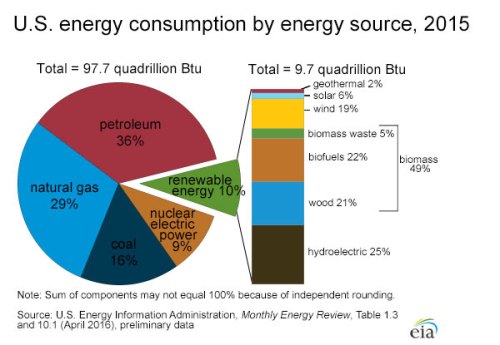
The Energy Information Administration’s(EIA)**, chart on the primary energy sources for the year 2015 is shown below.

Petroleum, natural gas, coal, renewable energy, and nuclear electric power are primary sources of energy. Electricity is a secondary energy source that is generated from primary sources of energy.


Note that renewable energy is only 10% of total energy produced in the US.  And of that 10%, solar is 6% and wind is 19%.   Putting the solar and wind as a percent of the total energy consumed in the US has solar at 0.6% and wind at 1.9%.  So, in  2015 only 2.5% of the US energy came from those two sources. Is this compatible with what you are learning from the media?   And those two are the ones that the greenies are banking on to replace coal, natural gas and petroleum.  And though it is counterintuitive, the warmers want to shut down the nuclear plants as well.

Continue reading

Friends Of Science Engineering Critique Of WWS’s Plan For Global Decarbonization


The previous posting, examined the study “A roadmap for rapid decarbonization” published in the Science magazine,  and discussed the major obstacles the warmers face in their attempt to persuade the politicians and the voters to undertake decarbonization.  And do it rapidly.   You may not think thirty years is rapid, but convincing 8 billion people to wipe out the present infrastructure and substitute a new one using as yet unproven methods in 30 years, is moving at a breathtaking speed.

The above noted study, is not the only one that has looked at a way to satisfy the Paris Agreement of holding the global temperature to max.2 ºC rise, with a goal of 1.5ºC rise.  A study by 100% Clean and Renewable Wind, Water and Sunlight (WWS) led by Jacobson, Delucci , et at. is, on the surface (number of pages of detailed discussion), more elaborate than the previous posting.  This  WWS roadmap calls for an 80% reduction of fossil fuels by 2030!  Only 13 years away.

The WWS study is an all-sector roadmap that is said to show how 139 nations could jointly hold the temperature rise to no more than 2ºC.

Friends of Science critique the WWS study with a response titled “WHY RENEWABLE ENERGY CANNOT REPLACE FOSSIL FUELS BY 2050” .  Michael Kelly, Professor of Electrical Engineering at Cambridge says: “Humanity is owed a serious investigation of how we have gone so far with the decarbonization project without a serious challenge in terms of engineering reality”.

That’s what guides this critique.  The critique illustrates the enormous number of new renewable facilities needed, the time necessary to put  these facilities in to operation and the amount of space they require.  It is awesome.

Continue reading

The Paris Agreement Road Map To Zero GHG Emissions–Next Post The Skeptics Response.


I do not think that the developed nations of the world are ready to endorse the actions they have signed onto when they authorized the Paris Agreement (PA).  They liked the applause they were receiving from the media and the environmentalists. But they have not responded in-kind to their commitments for reducing CO2 emissions or contributions to the fund that helps the underdeveloped nations. See here and here. Vox posting on 4 October 2016 said “No country on Earth is taking the 2ºC climate target seriously”.  The Climateactiontracker.org posted this quote: “Right now, with the policies governments have in place, we are heading to a warming of 3.6C said Prof Kornelis Blok of Ecofys.”The developed nations realize that it is time for them to “put up or shut up”. The “put up” part is bedeviled by the fact that most of them are finding that their renewable energy installations, eg solar and wind, are raising the cost of energy to a point where many can no longer afford it.  Further, they are learning that the renewables make their power systems unstable and thus vulnerable to loss of power to supply the customers and industries.


Maybe, just maybe they are becoming aware of the actions they need to undertake to keep the Global temperature rise at no more than the target of  1.5C.  The 24 March 2017 Science magazine published a study titled: “A roadmap for rapid decarbonization”.

Continue reading

Reblogging: Dear Climate Alarmists – We Will Never Forget nor Forgive.


I am reblogging Adam Piggot’s posting “Dear Climate Alarmists—We Will Never Forget nor Forgive.

The author lays out his complaints about the way the warmers treat the data and as well as how they have treated him.  He believes the catastrophic man-made global warming theory is unraveling and the skeptics will be vindicated. So what do you think about the following?


It’s been a rough ten years as a so-called “climate denier”. Every year the climate data would show a complete refusal to follow the accepted and official line, and every year the faith of the climate change faithful only seemed to get stronger and stronger. And their abuse of heretics like myself only got stronger and stronger. I have lost friendships over my stance on this issue. I have been attacked publicly by those around me on numerous occasions. And I have endured the casual mockery at social gatherings where the accepted response has been to pat me on the head in a condescending manner – here he is; our own climate denier. Isn’t he precious?

I have watched landscapes I love destroyed by the looming figures of gigantic wind farms that stand in mute mockery of my continued resistance to this enormous scam. I have observed with silent loathing the hypocrites who swan around in their enormous SUVs while proudly parading their dubious green credentials, even as ordinary families struggle with the reality of paying their ever-increasing power bills. Only a few months ago, a piece I wrote on the climate change scam elicited concerned emails and calls from people I know who cautioned me with the treacherous path I was taking.

But money talks and bulls— walks, and the money is beginning to drop out of this con to end all cons.

Continue reading

Want-To-Be Warmers Are Only Getting Part Of The Story


This posting uses an article from the Cosmopolitan magazine. Not a place where you would expect to find something about global warming. The title of the piece is “8 Signs You’re Not the Environmentalist You Think You Are” by Yvette d’Entremont. It is not too profound but it has a lot of honest values that most would be environmentalist never are exposed to. I have extracted just pieces of the author’s reasons why they have been misled. If you read all of her article, she makes some more good points

gorecarbonman

The following are the eight signs:

1. You buy only organic.

Organic is definitely not better for you, and it uses older, dirtier farming techniques that are, across the board, not as environmentally friendly. Contrary to rumors, organic farming uses pesticides, in some cases equally toxic pesticides that need to be applied more frequently.

Continue reading

The First US Nuke In 20 Years Goes Online—TVA Project


The Tennessee Valley Authority (TVA) announced that the Watt Bar Unit 2 nuclear generation unit is now online at full power, providing commercial electrical energy.  It is the first new nuclear power generation unit in 20 years.  Good for them. TVA has 6 other Nukes providing power.

wattsbarnukes

TVA president and CEO Bill Johnson said:

“TVA’s mission is to make life better in the Valley by providing reliable, low-cost energy, protecting our area’s natural resources and working to attract business and growth – all priorities simultaneously supported by the completion of Watts Bar Unit 2..”

A Westinghouse pressurized water reactor is expected to generate 1,150 megawatts (summer net capability). The capital cost of the complete generation unit was $4.7 billion.

Continue reading