Category Archives: Government Regulations

Green Energy Stock In Free Fall


The Renewable Energy Industrial Index (RENIXX ®World), is composed of the world’s 30 largest renewable energy companies.  The 30 companies get the majority of their income from wind, solar, biofuel, geothermal, hydropower or fuel cells.  The stock index was set up  to allow the shareholder to profit by the expected surge in value of these companies as the green revolution unfolded. Unfortunately for the investors, the stock value which surged, peaked in the 2007 -2008 timeframe, has been a downhill ride since then.  The glib promises of the performance of these renewables has not materialized and the Nations that have heavily subsidized these renewables can no longer afford them.  
A Washington Times-Community posting authored by Steve Goreham titled “So, how’s your green energy stock doing?” discusses the history of the Index.  For instance,  in a private meeting, Al Gore impressed the Deutsche Bank Asset Management  team causing them to establish the RENIXX and the rest is history. One wonders how many investors have lost money believing that Gore knew some real science. On the other hand,  Mr Gore is rumored to have made $200 to 300 million himself selling carbon offsets and his stake in the Chicago Merc’s Carbon Market. He may be weak on science but he knows how to make a buck.
 
The posting is a good read that I recommend to you. The whole story with the chart of the Index’s rise and fall are in his article. Also he talks of the thirty companies,  of which 10 are headquartered in China, 10 in Europe, and 7 in the US.  Click here to read his posting.
cbdakota

President Obama’s War On Fossil Fuels Slips Into High Gear


The Wall Street Journal (WSJ) summarizes some major Obama Administration regulations (economically significant rules that impose annual costs of $100 million or more) that are soon to be released.  These are largely rules written earlier this year but held up because they were potential liabilities for the Obama presidential campaign.  Now that he has won re-election,  its Katy bar the door.  This posting will feature those that affect energy.  There are others that will also have a very big impact such as Obamacare.  The WSJ’s summary of those can be seen by clicking here.   
The Obama Administration’s war on fossil fuels goes on.  Fracking is not safe even though it has the potential of lifting the economy out of the dole drums.  One has to wonder where the President’s priorities lie.  Is it bring about a recovery or to bring about a socialist state?
The WSJ Energy Rules Summary: 
 
Energy. In the lead-up to November, the Environmental Protection Agency stood down under White House pressure, delaying rules for ozone air quality and industrial boilers, and deferring carbon standards. Now EPA chief Lisa Jackson has the run of the place.
She will resume the Administration’s anti-carbon agenda through “new source performance standards,” which will set greenhouse gas emissions for new power plants so low as to prevent their construction. Look for this early in 2013.
She’ll follow with standards for “existing” sources that make coal-fired plants uneconomic to run. Inside of a decade, Ms. Jackson may wipe out what used to make up more than half of U.S. power generation. Environmentalists will write books about it, even if her agenda has received almost no public scrutiny or debate.
The oil and gas industry is also targeted, hydraulic fracturing (fracking) in particular. The EPA has already issued a rule on shale production emissions and has one coming on diesel fuel in fracking. The Interior Department is promulgating rules on fracking on federal lands, and other rules can’t be far behind, probably using the pretext of drinking water under the Clean Water Act.
The EPA’s sleeper issue is the National Enforcement Initiatives agenda, which is designed to use the agency’s existing legal powers for inspections, requests for information, penalties and so forth to make new de facto rules. The EPA now blackmails businesses into “super compliance,” or settlements far more stringent than the law requires, or else risk years of expensive litigation.
 
cbdakota

“Area of Special Biological Significance” Stinking Up La Jolla Cove


The pitch by the locals is:  
La Jolla Cove is San Diego’s most desirable spot for kayaking, snorkeling and diving. The water is calm and ecologically protected, providing a safe home for colorful garibaldi, yellowtail, rays and even leopard sharks. Because the water is protected, surfboards, boogie boards and other floatation devices are not permitted.”  
The “ecologically protected” part has generated a stench that can be smelled a mile away.  It seems that cormorants and seagulls use a rocky area by the cove, now fenced off, to move their bowels.  The feces keep piling up and are creating a “gross everyday problem for the cove area” according to an editorial by the U-T San Diego paper. The city  says they can’t do anything because :”… complex environmental rules stemming for the cove’s designation as a state-protected “Area of Special Biological Significance” are preventing them from cleaning up the place”. Further the city officials say that: “… it could take two years to get various state agencies to OK cleaning procedures.”   Cleaning procedures?  To clean up poop?  Get a grip. 
 
Talk about unintended consequences. I sure that the people of the La Jolla Cove felt really good about themselves as they were showing all of California, if not the world, how caring they are. 
 
If you wish to read more, click:  Feathers flying over stench in La Jolla.
cbdakota

President Obama’s Pants-On-Fire Acceptance Speech


The President’s acceptance speech at the Democrat Convention last Thursday was a pants-on-fire moment when it came to his energy program. (There were other topics besides the energy program in that speech that also rated high on the pants-on-fire meter—but this is an energy blog.)

The President claims responsibility for the decline in the use of imported crude oil.  “In the last year alone, we cut oil imports by 1 million barrels a day, more than any administration in recent history”. There are two primary reasons for this decline. First is because the manufacturing sector is still suffering from this less than robust economy—here his claim rings true as he is responsible for this economy.  The second is that the States and Private property owners have managed to overcome his and his administration’s efforts to stymie the development of oil and natural gas fields. Yes, oil and gas production are up but not on Federal lands where the President has the “say so”.  Oil production declined 11% and natural gas declined 6% on Federal lands from fiscal year (FY) 2010 to FY 2011.  At the same time on State and Private Lands’ oil production increased by 14% and natural gas by 12% over that same period.

 He said: “…. where we develop a hundred-year supply of natural gas that’s right beneath our feet. If you choose this path, we can cut our oil imports in half by 2020 and support more than 600,000 new jobs in natural gas alone”. While he is claiming credit for the natural gas, it really is No Thanks to Obama who has sent the EPA out to find reasons to rein in (i.e., reasons to stop fracking of shale) this State and Private land activity.  

Oil and natural gas production from State and Private Lands will continue to increase and will be the driver of the US economic recovery.  Not the “green” jobs that he has been promoting.  We have doubled our use of renewable energy, and thousands of Americans have jobs today building wind turbines and long-lasting batteries”. While Obama wants you think that wind and solar are soon to replace fossil fuels (oil, natural gas and coal) that is not happening. Fossil fuels supplied 78% and nukes another 11% of the US energy needs in 2010.  Wind supplied about 2% and solar was barely above 0 %. That they are that much is a testimonial to the crony capitalism being practiced by the Federal government by subsidizing the capital cost of renewables installation. This practice leaves the rate payers holding the bag for the high cost of the electricity that renewables create.   It looks like the US will be joining most of the rest of the world that have become disillusioned with wind and solar when Congress doesn’t renew the subsidies next year.  Adding to their dismal performance is the fact that for every new Kw of wind and solar power, a corresponding amount of fossil fuel supplied energy must be built because wind and solar are too unreliable (the wind blows sometimes and not at others and we know the sun is not always shining) for the nation’s power grid to rely upon.  So not only are these unreliable renewables not competitively priced, the global warmers don’t get a reduction in CO2 emissions.

After 30 years of inaction, we raised fuel standards so that by the middle of the next decade, cars and trucks will go twice as far on a gallon of gas”. Despite the implication that he has accomplished something, this new standard is in effective 2025 and there are many reasons to question if it can be met. This will only be realized if significant numbers of electric vehicles replace gasoline based vehicles.  And how is that program going? The hybrid Chevy Volt, the leading US manufactured vehicle, has sold through August about 13,170 making it unlikely they will meet the 2012 forecast of 45,000. The Volt is brought to you by Government General Motors (GM).  Through August, the best-selling all-electric car, the Nissan Leaf, had sold 4,228 vehicles versus the 2012 forecast of 20,000.  The electric vehicles are neither affordable nor efficient for the overwhelming majority of consumers who commute for work.  The Volt’s selling price is about $45,000 before the Government tax incentive of $7,500.  Even at that price, a recent report says: “Nearly two years after the introduction of the path-breaking plug-in hybrid, GM is still losing as much as $49,000 on each Volt it builds, according to estimates provided to Reuters by industry analysts and manufacturing experts.”  A little perspective, the projected US  2012 sales of vehicles is about 14 million.  There are something like 250 million registered vehicles in the US.  Even if the Volt were to sell 45,ooo it is drop-in-the-bucket. 

He says that man-made global warming is “not a hoax“.  He is wrong.  His EPA is writing regulations that will imposed a “cap and trade” program on the use of fossil fuels.  Cap and Trade failed attempts at passage in Congress.  Here he is usurping the legislative role of Congress.

The President’s energy program is a threat to all of us, and especially our children who are going to have to pay higher energy cost while having to cope with the massive debt this Administration has racked up.  

cbdakota

Gasoline Price and Vehicle Fuel Economy Correlate


The WardsAuto Fuel Economy Index compares the cost of gasoline opposite the average fuel-economy (miles per gallon—mpg) of new vehicles sold each month.   The new vehicle fuel economy peaked in March at 24.1mpg.  It fell to 23.6 mpg in June, the last data point available.  This drop corresponds to the drop in gasoline prices over the past three months.  The chart shown below shows a strong correlation of fuel price and t the fuel economy the car buyers are settling for.

Wards cautions to not assume that the car buyer’s are fickle but it is hard not to draw that conclusion.  Wards cites fleet purchases of Toyota vehicles in March as Toyota was trying to catch up on the losses they encountered in 2011 when the tsunami shutdown a lot of Japanese industry.

Wards notes that the vehicles fuel economy by region looked this way in June: Overall, Asian auto makers combined for a 26 mpg (9.0 L/100 km) rating, followed by the European brands’ 22.8 mpg (10.3 L/100 km) and the Detroit Three’s 21.2 mpg (11.1 L/100 km).

The Detroit Big Three do move a lot of pickup trucks so that may explain the differences in fuel economy.

To read more click here.

cbdakota

Corn Should Not Be Used To Make Automobile Fuel


US farms that grow corn are mainly located in the Midwest.  The Midwest is experiencing a drought that the head agriculture meteorologist with MDA EarthSat say is the worst since 1988.  The MDA EarthSat group is estimating a corn yield of about 118 bushels per acre this year.  In a good year, the corn yield is about 150 to 160 bushels per acre which suggests that this year’s yield will be about 75% of normal.  Shortages always have a way of driving the price of a commodity upward.  However making the likelihood of even higher prices for corn is the fact that the ethanol mixed with gasoline is essentially produced from corn.

It is estimated that about 40% of the corn produced last year was used to make ethanol fuel.  The refiners are required to use ethanol and most filling stations have a 10%ethanol/90% gasoline blend.  Last year 14.2 billion gallons of ethanol were blended with gasoline.   By law, in 2012,  15.2 billion gallons of ethanol must be used.  Of that total, 13.2 must be from corn ethanol.  The remainder must be not corn based.  In order to get a better understanding of what is going on, a brief review of the Renewable Fuel Standard will probably be helpful.

In 2005, Congress enacted the Energy Policy Act of 2005.  It mandated minimum ethanol use.  However, two years later the Energy Independence and Security Act superseded and expanded the Energy Policy Act of 05 and set new, larger use requirements as well as added requirements for cellulosic based ethanol. Cellulosic means from corncobs, wood chips, straw, grass, etc.—by and large almost anything but from the corn kernel (corn starch).  These two acts combined are often referred to as Renewable Fuels Standard (RFS2).  Further RFS2 set a maximum use level for cornstarch-based ethanol at 15.0 billion gallons.  The Environmental Protection Agency(EPA) is responsible for establishing and implementing regulations to ensure that the nation’s transportation fuel supply contains the mandated biofuels volumes.

RENEWABLE FUEL STANDARD 2—BILLIONS OF GALLONS

YEAR TOTAL RENEWABLESFUELS CORN ETHANOL CELLULOSIC ETHANOL BIO AND OTHER FUELS
2011 13.95 12.6 0.0066 1.1
2012 15.20 13.2 0.0085 1.5
2015 20.50 15.0 3.00 TBD
2020 30.00 15.0 10.5 TBD
2022 36.00 15.0

16.00

TBD

If you are wondering if the EPA will enforce the law designating mandated minimum use, the following story will be instructive:  The 2011 requirement for minimum usage of cellulosic ethanol is 6.6 million gallons.—(See chart above and note 0.0066.)  No one is making cellulosic ethanol so there is none available for use.   None-the-less, the companies that supply motor fuels are being fined $6 million because they failed to mix cellulosic ethanol into their motor fuels.   Go figure.

Corn is a major source of food for humans and it is also it is a major source of animal feed.  The price of beef, pork and chicken for example are directly affected by the increase in livestock feed prices. Much has been written about the negative impact of soaring corn prices on the well being of people all over the world.

As noted earlier, ethanol is mandated to be used in gasoline. It is said that the some of the corn used for making ethanol is somewhat different from the corn that normally goes into the food chain.  But that corn will also suffer a loss due to the drought making it necessary for the ethanol manufacturers to buy more food corn to supply ethanol to the gasoline suppliers. Thus the fuel chain will be bidding against the food chain for the limited supply of corn.
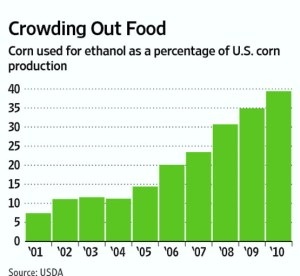
The commodities markets are showing this now.  According to reliable sources, corn that was going for $2.00 a bushel in 2005 when this legislation was enacted now sells for over $8 per bushel.  Because ethanol is mandated, the cost of ethanol for blending has little meaning to a gasoline producer as all gasoline producers must use it regardless of cost.  The cost of the ethanol will be passed on to the motorists.

Actually, ethanol is not viable economically but only used because of the mandate.  It will never be in sufficient supply to be a replacement for gasoline.  According to a study reported by Wikipedia, if you are concerned about greenhouse gases, ethanol’s use is a negative:  “A team led by Searchinger from Princeton University concluded that once direct and indirect effect of land use changes are considered, both corn and cellulosic ethanol increased carbon emissions as compared to gasoline by 93 and 50 percent respectively.”

The driving force for the use of corn to make ethanol is the votes that politicians get from their farming constituents. The other reasons weigh against using an important food source to make an automobile fuel.

cbdakota

Climate Model Forecasts Proven Wrong


Where would the theory of Anthropogenic Global Warming (AGW, aka: man-made global warming) be if it weren’t for the climate models that forecast devastatingly high temperatures, sea level change that will make hundreds of millions of people homeless, mass extinctions of all manner of creatures, etc? What if those forecasts consistently were in error?  You would have to conclude, that the warmers don’t have a viable theory and they would quickly fade away.  Well, the forecasts are consistently in error and warmers still have not faded away.  So what is going on?

Because it is Father’s Day, let’s look at James Hansen’s (father of the current man-made global warming cult) forecast presented to the US Congress in 1988:

Chart from: James Hansen et al. Global Climate Changes as Forecast by Goddard Institute for Space Studies Three-Dimensional Model journal of Geophysical Research.

The chart forecasts a global temperature increase that will be caused by different levels of CO2 emissions.  Scenarios “A” (blue) which postulated an increase in CO2 emissions by 1.5% per year
 and “B” (green): constant increase in CO2 emissions after 2000
 and “C” (red): no increase in CO2 emissions after 2000The black line is the actual global temperature.

Since 2000, the CO2 emissions have increased about 2.5% per year.  So one would expect the observed temperature to have exceeded the blue line “A”. Yet we see the actual temperature increase matching or perhaps coming in lower than that forecast by the red line “C” that was based upon a forecast of O% per year increase in CO2 after 2000. How many ways can you say FAIL!!!

Hansen’s influential presentation was widely broadcast and had a profound effect on Congress.  If you had been in the Capitol that day, you might have become concerned.   But with time, the Hansen forecast has been demonstrated to be very wrong.   The Chart above came from Wattsupwiththat (WUWT) blog and the comments by readers to the WUWT posting are quite interesting.  The warmers that commented essentially said—well, sure, it was wrong but some things happened; volcanoes, less fluorocarbons in the atmosphere, less methane in the atmosphere and the positive feedback he used is now imagined to be less than it was imagined to be at the time of the Hansen forecast.

Wow, that is a lot of things going wrong considering we are still being told that only CO2 really matters.  Isn’t it amazing that when the forecasts play out for a lot of years (in Hansen’s case, 24 years), only then can you find out if they are really any good.  Forecasting today what the world will look like in 2100 is an interesting exercise but only fools would believe that it was likely to be accurate.

We know that money and control drives the warmers and the politicians to continue this charade.  But the media has bought into this lock, stock and barrel.  What drives them?  I know that bad news (fear of global warming caused catastrophe) sells more papers than good news.  And the falling readership that the mainstream media is experiencing, makes them desperate to continue echoing everything the green alarmists say.  Why are there no latter-day Woodwards and Bernsteins that want to expose the lies after some 20 years of flat global temperatures and failed predictions?   Skeptics are gaining the upper hand with regard to public opinion, but if the media owned up to the facts and began questioning the AGW theory, this round of Lysenkoism could be ended.

cbdakota


The Ill-informed Bishop And The Wind Turbines


Continue reading

Solar Panels Don’t Work


Ray Burgess, the President & CEO at Solar Power Technologies Inc posted on the Aol Energy website, “Solar Panels Don’t Work. And No One Knows.” That is a provocative title.  Burgess said: “Solar panels do not work that well. Often far below expectations.  And few know it. Not the owners who depend on power. Not the bankers who finance it. Not the brokers who insure it.”

The economic models that are used to finance, insure and subsidize solar farms assume the solar panels degrade about 0.5% per year. The National Renewable Energy Laboratory (NREL) says that they can degrade as much as 4.5% a year or more.

At this point you may be wondering who or what is the NREL.  According to Wikipedia they are: “The National Renewable Energy Laboratory (NREL), located in Golden, Colorado is the United States primary laboratory for renewable energy and energy efficiency, research and development. The National Renewable Energy Laboratory (NREL) is a government-owned, contractor-operated facility; it is funded through the U.S. Department of Energy (DOE).”   This is not an organization that opposes renewable energy.”

Burgess adds: The latest issue of the leading industry trade journal Photovoltaics International, asks the question: “What is the real quality of the products I am buying?”  Short answer: Nobody knows. In Italy last year, “they discovered that after one year in the field, over 90% of the (solar panels) from a one megawatt project began to delaminate and ended up on the ground.”   “Delaminate: Scientific talk for falling apart. And these panels had all the standard certifications.”

Burgess’ company sells systems that monitor performance of solar farms.  The company’s systems presumably can detect individual problem that are causing substandard performance.  He lists below, some of the performance inhibitors.

“Solar production in the field can go bad for dozens and dozens of reasons: An errant golf ball. A passing flock of geese. Bullets. Leaves. Shadows. Dirt. If a leaf or bird dropping prevents the sun from hitting part of your solar array, that knocks out solar production in an area 36 times the obstruction.”

Now I don’t know how that multiplier works, but I will take him at his word.

The above along with the problem of the inability to schedule energy production due to variability of the Sun, makes this form of energy less appealing.

cbdakota

Cuba’s Hopes For Oil In Florida Straits Hits Dry Hole


Cuba’s oil drilling partner, Repsol says that they have hit a dry hole and are calling it quits.  Repsol, an integrated Spanish oil and gas company, has spent more than $100 million drilling only to come up with no oil.  Currently Cuba relies on Venezuela to deliver $3 billion of subsidized oil each year.  Continuation of this program would be in jeopardy if Hugo Chavez were not to be reelected in the October elections.  An additional threat is Chavez’s health. He has been undergoing treatment for cancer for a number of months.

Cuba’s needs a major oil find to revive its struggling economy.   With Repsol out of the picture, Cuba’s fortunes rest with Petronas, the Malaysian oil company, that has began drilling an exploratory well about 180 miles southwest of Repsol’s dry well.

To read more, see this story in Oil Price.

cbdakota