Category Archives: Fracking/Shale Gas

Greens Want To Kill Fracking By Slashing, Already Minor, Methane Emissions


Paul Driessen’s posting covers a lot of territory. He talks about the new “big” issue, methane (CH4) in the atmosphere and the future of (or perhaps the non-future of)  solar and wind “renewable energy”. The CH4 fraud that Driessen discusses is reminiscent of what EPA has done to the country with their mercury rules. Mercury emissions are primarily from natural sources and the man-made emission sources from the US are a very small part of the whole.

Click here to read about mercury. Read Driessen’s posting below.

cbdakota

Guest essay by Paul Driessen posted on WattsUpWithThat

Quick: What is 17 cents out of $100,000? If you said 0.00017 percent, you win the jackpot.

That number, by sheer coincidence, is also the percentage of methane in Earth’s atmosphere. That’s a trivial amount, you say: 1.7 parts per million. There’s three times more helium and 230 times more carbon dioxide in the atmosphere. You’re absolutely right, again.

Equally relevant, only 19% of that global methane comes from oil, natural gas and coal production and use. Fully 33% comes from agriculture: 12% from rice growing and 21% from meat production. Still more comes from landfills and sewage treatment (11%) and burning wood and animal dung (8%). The remaining 29% comes from natural sources: oceans, wetlands, termites, forest fires and volcanoes.

The manmade portions are different for the USA: 39% energy use, 36% livestock, 18% landfills, and 8% sewage treatment and other sources. But it’s still a piddling contribution to a trivial amount in the air.

Continue reading

Mr President, You Owe American An Apology.


Rebloging a posting from Oilpro.com titled “Mr. President, you owe America an apology. We did drill our way to $2 gas.”  

The President has done about everything imaginable to make the price we pay for energy skyrocket. He has prevented drilling for oil on Federal lands but he obama-rising-gas-prices-cartoon-four-more-yearscould not do anything about State and private land. It is disgraceful that the media lets him get away with his retrospective claims that the lower prices were his doing. He even claimed he had approved oil being pipelined from Canada.

Anyway, Marita Noon tells of the misinformation that the President feeds to low information crowd.

cbdakota

‘’’’’’’’’’’’’’’’’’’’’’’’’’’’’’’’’’’’’’’’’’’’’’’’’’’’’’’’’’’’’’’’’’’’’’’’’’’’’’’’’’’’’’’’’’’’’’’’’’’’’’’’’’’’’’’’’’’’’’’’’’’’’’’’’’’’’’’’’’’’’’’’’’’’’’’’’’’’

MY PRESIDENT YOU OWE AMERICAN AN APOLOGY. WE DID DRILL OUR WAY TO $2.00 GAS.

“We can’t just drill our way to lower gas prices,” President Obama told an audience four years ago at the University of Miami. Like this year, it was an election year and Obama was running for re-election. Later in his speech, he added: “anybody who tells you that we can drill our way out of this problem doesn’t know what they’re talking about, or just isn’t telling you the truth.” He scoffed at the Republicans for believing that drilling would result in $2 gasoline—remember this was when prices at the pump, in many places, spiked to more than $4 a gallon: “You can bet that since it is an election year, they’re already dusting off their three-point plans for $2 gas. I’ll save you the suspense: Step one is drill, step two is drill, step three is drill.”

Well, Mr. President, you owe America, and the Republicans, an apology. Your snarky comments were wrong. The Republican’s supposed three-point plan, which you mocked, was correct.

Continue reading

Why Not Make North America, the New Middle East?


Several years ago, a study done by the Manhattan Institute titled “ Unleashing the North American Energy Colossus: Hydrocarbons Can Fuel Growth and Prosperity”, by Mark P Mills pointed out that we have the capability to replace the Middle East as the major source of crude oil.  This, he says, would be of shaleoilhuge economic benefit to the US, Canada and Mexico. Something like $7 trillion dollars of value over the next 15 or 20 years.

Mills argues that the problems with becoming the New Middle East are political, not geological nor technological. One of the political roadblocks was resolved when the latest Federal budget bill was enacted. The bill included the removal of the prohibition against selling US crude oil on the world market. That prohibition had stood since the Nixon Administration.

While the Executive Summary that follows is probably enough for most readers,  Mill’s full report, some twenty pages in length, can be read by clicking here.

EXECUTIVE SUMMARY

The United States, Canada, and Mexico are awash in hydrocarbon resources: oil, natural gas, and coal. The total North American hydrocarbon resource base is more than four times greater than all the resources extant in the Middle East. And the United States alone is now the fastest-growing producer of oil and natural gas in the world.

The recent growth in hydrocarbons production has already generated hundreds of thousands of jobs and billions in local tax receipts by unlocking billions of barrels of oil and natural gas in the hydrocarbon-dense shales of North Dakota, Ohio, Pennsylvania, Texas, and several other states, as well as the vast resources of Canada’s oil sands.

It is time to appreciate the staggering potential economic and geopolitical benefits that facilitating the development of these resources can bring to the United States. It is no overstatement to say that jobs related to extraction, transport, and trade of hydrocarbons can awaken the United States from its economic doldrums and produce revenue such that key national needs can be met—including renewal of infrastructure and investment in scientific research.

An affirmative policy to expand extraction and export capabilities for all hydrocarbons over the next two decades could yield as much as $7 trillion of value to the North American economy, with $5 trillion of that accruing to the United States, including generating $1–$2 trillion in tax receipts to federal and local governments. Such a policy would also create millions of jobs rippling throughout the economy. While it would require substantial capital investment, essentially all of that would come from the private sector.

The underlying paradigms embedded in American energy policy and regulatory structures are anchored in the idea of shortages and import dependence. A complete reversal in thinking is needed to orient North America around hydrocarbon abundance—and exports.

In collaboration with Canada and Mexico, the United States could—and should—forge a broad pro-development, pro-export policy to realize the benefits of our hydrocarbon resources. Such a policy could lead to North America becoming the largest supplier of fuel to the world by 2030. For the U.S., the single most effective policy change would be to emulate Canada’s solution for permitting major energy projects: create a one-portal, one-permit federal policy for all permits.

The recent preoccupation with technologies directed at creating alternatives to hydrocarbons misses how technology also unleashes alternative sources of hydrocarbons themselves. A number of detailed analyses of the new hydro- carbon realities have emerged, not least of which are excellent ones from Citi, Wood Mackenzie, IHS, and the U.S. Chamber of Commerce.

The authors of Citi’s detailed report “Energy 2020: North America, the New Middle East?” note that “[t]he main obstacles to developing a North American oil surplus are political rather than geological or technological.”

The projected growth in total world energy demand through 2030 is equal to an additional two Americas’ worth of consumption. Every credible forecast shows hydrocarbons fueling the major share of that growth, as they have in the past. While alternative energy has grown rapidly, the overall contribution to U.S. and world supply remains de minimus and stays that way in every credible future scenario.

There will doubtless be objections to the idea of a radical shift in policies and attitudes toward hydrocarbons. But the benefits to the U.S., to the rest of North America, and to the rest of the world are so dramatic and important that abandoning them without serious policy deliberations would be unconscionable.

cbdakota


New Oil And Gas Find In The Mediterranean.


A large field (named Zohr) containing up to 30 trillion cubic feet of natural gas has been discovered off the coast of Egypt. The Italian oil group Eni, owner of rig_3424204bthis field, says it is almost 5000 feet below the water surface and covers an area of about 40 square miles. Eni proposes that it be piped into Egypt for use.

The Telegraph.co.uk posting titled ‘Supergiant’ gas field discovered in Mediterranean” says:

“Egypt consumed 1.7 trillion cubic feet of natural gas last year, according to BP’s most recent Statistical Review of World Energy. At the same rate of consumption, the Zohr discovery could supply the country for almost two decades.

Continue reading

Au Revoir, Adios, Auf Wiedersehen, Goodbye OPEC


OPEC faces serious challenges. Bank of America is quoted as saying that OPEC is frackingamericansimages“effectively dissolved”. And the author of the Telegraph posting “Saudi Arabia may go broke before the US oil industry buckles” reports “The cartel might as well shut down its offices in Vienna to save money.”

OPEC Cartel

Well, is the OPEC collapse imminent?   Probably not, but the major nation in OPEC, Saudi Arabia, appears to be in trouble and quoting from the Telegraph posting:

It is too late for OPEC to stop the shale revolution. The cartel faces the prospect of surging US output whenever oil prices rise. If the oil futures market is correct, Saudi Arabia will start running into trouble within two years. It will be in existential crisis by the end of the decade.

The contract price of US crude oil for delivery in December 2020 is currently $62.05, implying a drastic change in the economic landscape for the Middle East and the petro-rentier** states.

Continue reading

Has OPEC Been Successful In Closing Down The US Shale Oil Business?


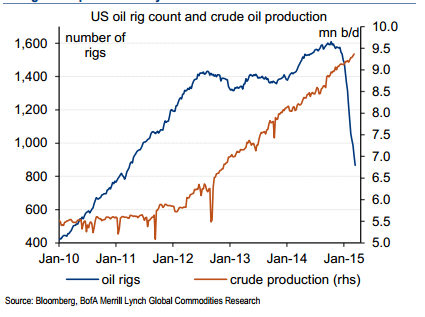
In the fall of 2014, Saudi Arabia began increasing the amount of crude oil they put up for sale. The objective is often thought to be an attempt to drive US oil fracking out of business. The price was expected to drop below the point where it was profitable to put in new wells and perhaps even close off many of those already in production. The oil rig count in October of last year was 1608 and it now stands at 747 Telegraph has posted : “Oil slump may deepen as US shale fights Opec to a standstill” gives a current status in this battle. And it seems to be going pretty well for the US and not so good for Saudi Arabia and the other OPEC members. From the Telegraph posting:

“There was a strong expectation that the US system would crash. It hasn’t,” said Atul Arya, from IHS. “The freight train of North American tight oil has just kept on coming. This is a classic price discovery exercise,” said Rex Tillerson, head of Exxon Mobil, the big brother of the Western oil industry. Mr. Tillerson said shale producers are more agile than critics expected, which means that the price war will go on. “This is going to last for a while,” he said, warning that any rallies are likely to prove false dawns.

The US “rig count” – suddenly the most-watched indicator in global energy – has fallen from 1,608 in October to 747 last week. Yet output has to continued to rise, stabilizing only over the past five weeks.”

usrigcountandcrudeproduction by bloomberg etc

Others are noting that innovation is cutting costs of new wells:

“We’ve really only begun to scratch the surface. Shale can keep growing by 500,000 to 700,000 b/d easily,” said Harold Hamm, founder of Continental Resources. His company has cut costs by 20pc to 25pc over the past four months.

US shale will “roll over” to some degree as producers exhaust their one-year hedges and face the full shock of lower prices. But it is hazardous to bet too heavily on this assumption.

IHS said an astonishing thing is happening as frackers keep discovering cleverer ways to extract oil, and switch tactically to better wells. Costs may plummet by 45pc this year, and by 60pc to 70pc before the end of 2016. “Break-even prices are going down across the board,” said the group’s Raoul LeBlanc.

Shale bosses have been lining up at this year’s “Energy Davos” to proclaim the fracking Gospel. “We have just drilled an 18,000 ft well in 16 days in the Permian Basis. Last year it took 30 days,” said Scott Sheffield, head of Pioneer Natural Resources.”

We’ve cut spud-to-spud time to 19 days,” said Hess Corporation’s John Hess, referring to the turnaround time between drilling. This is half the level in 2012. “We’ve driven down drilling costs by 50pc, and we can see another 30pc ahead,” he said.”

Large scale frackng has precipitated a number of geopolitical issues such as the stability of Middle East nations and on some nations that rely on crude oil sales to balance their budgets.  My next posting will look at some of these problems.

One thing though noted in the Independent posting is that:

“The market is primed for a sudden spike in prices if anything goes wrong. It is more than ever at the mercy of geopolitical events. One thing is for sure. If and when prices rebound, US shale is ready to sweep in with lightning speed to snatch yet more market share. Opec has met its match.”

Thanks to the US oil industry ingenuity, OPEC seems to be losing the fight. cbdakota


Pursuit Of The Dream Of “Carbon-free Energy” Is Creating An Ecological Catastrophe


Christopher Booker writes for the UK’s Sunday Telegraph.  On 4 July 2015, he posted “Why are greens so keen to destroy the world’s wildlife?” From this posting he said:

”All in all, wherever we look, this pursuit of the dream of “carbon-free energy” is creating an ecological catastrophe. Like so many of the great crimes of history, this one is being perpetrated by people who imagine they are doing something praiseworthy. In this case, possessed by their delusion that they are battling for nature and the future of the planet, they are in fact doing as much as anyone to destroy the very things they kid themselves they are trying to save.”

Continue reading

Crude Oil Sales Ban Must Be Lifted


This site has written before (click here)  about the crippling of the US petroleum producers by not permitting them to sell crude oil outside of the US. The posting crude-oil-diagram-barrel-price-32155165warned of continuing loss of American jobs and resulting in higher crude oil prices.   Now the chairman and CEO of Continental Resources (Harold Hamm) tells why the ban on US crude oil sales must be lifted. In a WSJ online posting, he says this:

” The situation is urgent, as OPEC’s recent predatory pricing tactics are also hurting America and prematurely ending the boom in U.S. oil production due to hydraulic fracturing, known as fracking, and horizontal drilling. The U.S. rig count has dropped by more than 50% since Thanksgiving, according to the oilfield services company Baker Hughes. More than 126,000 oil and gas workers have been laid off, and job losses are expected to double if the export ban is not lifted.”

Continue reading

Tenth International Conference on Climate Change


global-warming-south-carolina-political-cartoonI attended the “Tenth International Conference on Climate Change” held in Washington, DC on June 11-12, 2015.   It surpassed my expectations. The panel presentations were uniformly excellent. While I consider myself to be reasonably well informed regarding this topic, I realized that are certain important areas of which I knew little.     For example I learned many things about the way the EPA operates that makes me very angry. Several of the current Republican candidates for President have announced that if they are elected they plan to shut down the EPA and let the State’s environmental groups handle these issues.   I plan a future posting about this topic.

Mainly the Conference covered global warming science. However there were some tributes to contributors who have made an impact.   One interesting presentation was Christopher Monckton’s defense of Dr Willie Soon.

The entire conference is on video. It can be seen by clicking on this link

cbdakota

OPEC Strategy Report Says Two More Years Of A Crude Oil Glut


frackingimagesOPEC meets 5 June in Geneva to discuss the cartel’s strategy for the coming years.  Reuters News Agency has obtained the draft report of OPEC’s long-term strategy. This report’s content will be a key discussion at the meeting. The report suggests that the global oil glut could persist for the next two years.   In general that seems like pretty good news for the world and specifically for U.S. if not for the OPEC cartel and Russia.

The drop in oil prices that began late last year did not shut down the fracking wells that were already producing as the wells continued to operate to cover their variable costs. It did cause drill rigs to be cut every week for 23 weeks. Reuters reports that only one rig was cut the week of 18 May.   Experts seem to agree that fracking can be profitable at a West Texas Intermediate (WTI) price around $60/barrel. That price level should bring on more fracking operations. Today’s price is $59.89. (changes often.)

Continue reading