Category Archives: Environment

NEAR EARTH ASTEROID DUE IN NOVEMBER


There are many asteroids out there and NASA’s Deep Space Network tries to keep track of those that will pass near the Earth.  They are reporting that asteroid 2005 YU55 will fly by at 0.85 lunar distances.  Which is another way of saying it will be closer to us than the moon (1.0 lunar distance).  It is pretty big too, at 400 feet in diameter.  It was discovered in 2005 (note the identification of this asteroid begins with 2005) by Tucson’s Lunar and Planetary Laboratory.

It will be so close that NASA spokesman says:

Yeomans said that with new radar capabilities at Goldstone in California — part of NASA’s Deep Space Network — there is a good chance of obtaining radar imaging of 2005 YU55 down to the 5-meter resolution level. Doing so, he said, would mean obtaining higher spatial resolution of the object than that attained by recent spacecraft flyby missions.

“So we like to think of this opportunity as a close flyby mission with Earth as the spacecraft,” Yeomans told SPACE.com. “When combined with ground-based optical and near-infrared observations, the radar data should provide a fairly complete picture of one of the larger potentially hazardous asteroids,” he said.

More about this flyby is available on the Fox News posting which you can read by clicking here.

There is an interesting site that daily posts the upcoming near Earth fly bys and can be seen by clicking here.

cbdakota

Obama Wants Supreme Court To Throw Out Case Against Utilities


On Tuesday, the Supreme Court will hear oral arguments on a lawsuit brought by several environmental groups as well as several States.  This group is asking the Court to force power plants in 20 states to reduce their CO2 emissions.  The Obama Administration is siding with the power companies asking that the EPA throw out the lawsuit.  Obama on the side of the Utility companies you ask with a stunned look on your face.  Well, they are but not because they don’t want to cut CO2 emissions.  They are arguing that the Supremes should not set the regulations, but rather that should be left to the EPA which has not yet written them.  They say that the Court should not meddle in the powers given to the Executive Branch of which, as you know, the EPA is a member.

Laurence Tribe, lib lawyer extraordinaire, is supporting the Administration in their quest to get the Supremes to drop the case.  In his letter to the Boston Globe he says:

“Congress, through the Clean Air Act and other measures, has empowered the Environmental Protection Agency to regulate greenhouse gases, and that agency has begun to do so, prodded by a Supreme Court ruling in favor of Massachusetts when the state sued the EPA to compel it to take up the problem. The courts should reject the political and administrative roles that would be thrust upon them by litigants dissatisfied with Congress’s decision to entrust the EPA with this challenging mission — or by those dissatisfied with the efforts of the president and the State Department to engage in the international diplomacy required to cope with an obviously international problem.” (underlines are my emphasis)

Give me a break.  The  previous Congress thought it necessary that it write legislation to manage CO2 but could not get a bill to pass. And that was with a Democrat majority in both houses and the Presidency!!!   How does that translate into “…Congress’s decision to entrust the EPA”????  Today, neither the House nor Senate could muster a bill with 50% voting for regulation of CO2.

NOW, Tribe thinks the Supreme’s activities on this topic are a “dangerous perversion of the judicial process and would likely retard efforts to grapple with climate change…..”  It was A-ok to do it in the Massachusetts versus the EPA when it resulted in the Supremes making that horrible decision in Mass.’s favor. Do I smell hypocrisy?

I believe there are two reasons Obama, supported by Tribe, don’t want the Supremes involved any more:

  • Fear that the Supremes will somehow try to make up for their previous error by narrowing the EPA’s power to regulate
  • Hundreds of lawsuits await the EPA if they follow through with their intended path of focusing on the “big polluters–hence Utilities and automobiles” and ignoring everything else.  Folks say that the EPA can’t be selective—- picking and choosing whom they are going to regulate— but rather like with other “pollutants” they must regulate all sources. All the hospitals, the high schools, the office building down the street, your house, etc.  The EPA  doesn’t want anyone to tell them what to regulate.  A decision by the Supremes to set emission limits on these utilities would open the gate for the lawsuits.
UPDATE 19 APRIL 2011  Seems the Supremes are likely to side with Obama. See this posting.
cbdakota

Real Wind Power Data—Disappointing Performance


It is difficult to get comprehensive data on wind farm performance as it is shielded from view by “protection of competitive data” or by contract terms.  A new study bearing comprehensive data from Scotland confirms what skeptics have been saying about windfarm performance. This new study is perhaps the most comprehensive since the Bentek Energy(an energy analytics firm) study of Colorado and Texas windfarms.

Stuart Young Consulting with support from the JOHN MUIR TRUST (emphasis mine, to highlight that this study was commissioned by a green NGO) has released a report studying the ability of wind power to make a significant contribution to the UK’s energy supply. It concludes that the average power output of wind turbines across Scotland is well below the rates often claimed by industry and government.

This report examined 5 common claims by the wind industry and the Scottish Government.   The five claims are in RED with the actual result in BLACK:

1. ‘Wind turbines will generate on average 30% of their rated capacity over a year’ In fact, the average output from wind was 27.18% of metered capacity in 2009, 21.14% in 2010, and 24.08% between November 2008 and December 2010 inclusive.

2. ‘The wind is always blowing somewhere’ On 124 separate occasions from November 2008 to December 2010, the total generation from the windfarms metered by National Grid was less than 20MW (a fraction of the 450MW expected from a capacity in excess of 1600 MW). These periods of low wind lasted an average of 4.5 hours.

3. ‘Periods of widespread low wind are infrequent.’ Actually, low wind occurred every six days throughout the 26-month study period. The report finds that the average frequency and duration of a low wind event of 20MW or less between November 2008 and December 2010 was once every 6.38 days for a period of 4.93 hours.

4. ‘The probability of very low wind output coinciding with peak electricity demand is slight.’ At each of the four highest peak demand points of 2010, wind output was extremely low at 4.72%, 5.51%, 2.59% and 2.51% of capacity at peak demand.

5. ‘Pumped storage hydro can fill the generation gap during prolonged low wind periods.’ The entire pumped storage hydro capacity in the UK can provide up to 2788MW for only 5 hours then it drops to 1060MW, and finally runs out of water after 22 hours.

The final claim about “pumped storage” varies with the area where the windfarms are located.  In the US, an area such as the Great Plains, where wind availability is favorable to siting of windfarms, has little to no pumped storage hydro capacity available.   Availability in most other areas is either used or would be difficult to develop as environmental groups object to the use of dams.  Further there is a loss of efficiency when the windpower electricity is used to pump water to some higher elevation and then recovered in hydroelectric turbines.

The author of the report said:

It was a surprise to find out just how disappointingly wind turbines perform in a supposedly wind-ridden country like Scotland. Based on the data, for one third of the time wind output is less than 10% of capacity, compared to the 30% that is commonly claimed.

At the end of the period studied, the connected capacity of wind power was over 2500MW so the expectation is that the wind network will produce, on average, 750MW of energy. In fact, it’s delivering far less than everyone’s expectations. The total wind capacity metered now is 3226MW but at 3a.m. on Monday 28th March, the total output was 9MW.

To see the John Muir Trust posting in more detail, click here

For further information on the Bentex study mentioned at the begining of this posting click here.

cbdakota

10 Major Failures of the Model Based Virtual World View of Climate.


Joseph D’Aleo has developed a list of the “Ten Major Failures of So-Called Consensus Science”.  To develop this list, he analyzed the Intergovernmental Panel on Climate Change (IPCC) based science.   Then he focuses on “how actual data compares to the consensus science, model based virtual world view of climate”

His ten issues are:

1. Warming is said to be unprecedented and accelerating. It is neither.

2. Global warming is not GLOBAL

3. Winters would grow increasingly warm

4. The entire Northern Hemisphere would experience less snow and snowcover

5. The arctic oscillation (AO) would become increasingly positive, aiding in the warming

6. Global warming would lead to a permanent or semi-permanent El Nino

7. Atmosphere will warm faster than surface (because that is where the heat trapping gases are).

8. Record highs and heat waves are increasing

9. Sea levels are rising at an increasing, alarming rate

10. Droughts and floods will worsen.

There are many other issues, he notes, but his concentration is on the “major findings, assessments or model predictions from the IPCC and other national climate centers and NGOs….”

The listing of the ten above are rather sketchy, but he provides convincing evidence of his convictions which you can access by clicking on the “See the analysis part 1 and part 2” at the bottom of  his posting which is accessible by clicking here.

cbdakota

Does your state have Renewable Electricity Mandates?


Twenty-nine States have passed legislation that requires utilities to sell or produce a certain percentage of electricity from renewable sources.   Electricity prices are higher in those states, partially due to these mandates.

According to the Institute for Energy Research these mandates are an expensive way to reduce carbon dioxide emissions.   In their posting The Status of Renewable Electricity Mandates in the States they note the following:

Some argue that renewable electricity mandates are a good way to reduce carbon dioxide emissions, but renewable electricity mandates are a very expensive way to reduce carbon dioxide emissions. According to the California Air Resources Board, it costs $133 per ton to reduce carbon emissions through the mechanism of a renewable electricity mandate. An internal Obama administration memorandum on subsidies for renewables recently noted that carbon dioxide emissions “would have to be valued at nearly $130 per ton for CO2 for the climate benefits to equal the subsidies.” To put these numbers in perspective, it currently costs about $15 a ton to purchase a certified carbon dioxide allowance traded on the European Climate Exchange.

There are currently no Federal renewable energy mandates. The Heritage Foundation has calculated the economic impact of enacting Fed mandates as follows:

Its researchers found that a mandate starting at 3 percent for 2012, and increasing by 1.5 percent per year until 2035, would:

• Raise electricity prices by 36 percent for households and 60 percent for industry;

• Cut national income (GDP) by $5.2 trillion between 2012 and 2035;

• Cut national income by $2,400 per year for a family of four;

• Reduce employment by more than 1,000,000 jobs; and

• Add more than $10,000 to a family of four’s share of the national debt by 2035.

Similarly, Credit Suisse estimated the capital expenditures necessary to achieve different levels of renewable generation by 2020. The bank noted that a nationwide 10 percent renewable electricity mandate would require capital expenditures of $350 billion, a 15 percent mandate would require $500 billion and a 20 percent requirement would require $750 billion. The California Air Resources Board has estimated that it will cost $115  billion in new infrastructure to meet California’s renewable electricity mandate in 2020 (33 percent).

I recommend that you open up this link to see how your State stacks up.

cbdakota

DELAWARE AND BLUEWATER WIND


For this posting  I want to use my neighboring state of Delaware and the proposed off-shore wind farm as an example of what the rate payers in that state are facing.

Several years ago furious because of what happened when the price of electricity was deregulated Delawareans were led to believe they could protect themselves from this happening again by installing an offshore windfarm to produce “renewable” electricity.   Driven by the perception that the price of electricity would be less expensive and that it would help save the planet by reducing the electricity produced by natural gas or coal,  they willingly accepted the idea of offshore windfarm.  Moreover the State mandated that a percentage of the electricity used in the State had to be produced from “renewable” energy.

With much political pressure being applied, Delaware Power (the major Delaware Utility) began negotiations with Bluewater Wind (BWW).   Delaware Power reluctantly signed a contract to buy the electricity from this proposed wind farm.

Unfortunately for the Delawareans who thought the deregulated price of electricity was high, they are in for a bigger shock if they allow the BWW offshore windfarm to become a fact.  And wherever windfarms are installed, they are so unreliable that equivalent fossil fuel electrical generating capacity must be installed to protect the electrical users from interruption of their supply. This adds more cost and does nothing to reduce carbon dioxide emissions.

PRICE OF ELECTICITY FROM OFF-SHORE WINDFARMS

Lets look first at cost.   The Department of Energy’s Energy Information Agency says that without subsidies the price of electricity from offshore windfarms is not viable.  The following table is the EAI’s latest estimate of the cost of electricity production in 2016 when BWW says they will be producing electricity:

LEVELIZED COSTS OF ELECTRICITY IN 2016

Look at the column “Total System Levelized Costs” for conventional coal, and conventional combined cycle (in the Natural Gas-fired grouping) and then compare these costs to the levelized cost of Wind-Offshore:

Coal is $94.8 per megawatt hour or more familiarly  $0.095 per kilowatt hour.

Natural gas is $0.066 per kilowatt hour

Wind—Offshore is $0.243 per kilowatt hour.

To give you a little background on these numbers, the EAI penalized the natural gas and coal plants estimates with a cost of buying CO2 credits which would be necessary if the our country ever losses its mind and passes “cap and trade”. These penalties do not currently exist but are included anyway.

The Wind—offshore costs do not reflect the subsidies that the government is handing out to cover the real costs shown in this chart.

CAPACITY FACTOR AND ITS AFFECT ON COSTS

The capacity factor is a measure of the percentage of the rated capacity that can be depended upon.  The main natural gas and coal plants operate most of the time at a percentage of rated capacity in the mid to upper 80tys.  The Wind—offshore has a capacity factor of 39.3%.   From what one reads in the literature where actual performance of windfarms is recorded, the number of 39.3% vastly overstates their performance, which is often said to be in the 19 to 20% range.  Were the EAI to use the lower capacity factor,  the cost for wind produced electricity would be even more expensive than the $0.243 per kilowatt hour.

Several of the Natural Gas fired cases are nearly as high as the wind cases.  This is because these cases are for the backup turbine units that utilities must have to meet unexpected changes in supply or demand.  These natural gas turbines have capacity factors of 30% but can achieve a much higher number.  However, they are more costly to operate and are only used, as noted earlier, as backup.

The US has a vast surplus of natural gas.   The forecast cost to produce electricity in a natural gas based plant based upon the Department of Energy’s forecast in 2016, is about 27% of the offshore windfarm for that same year.  Will there ever be a time that these wind farms can compete in the market place or will we rate payers always have to subsidize them?

The fundamental problem with windfarms (and solar) is the fact that they can be working one minute and not the next.  The wind (or cloudless sunny days) can not be scheduled.  The electrical grid operators must be able to rely upon the electrical generation units to provide the power needed to match the user’s demands.  The low cost plants, fueled by coal, natural gas or nuclear are used as the base load.  They are steady and reliable.   These base load units are not capable of rapidly increasing or decreasing the generation of electricity.   Delaware Power, like other producers of electricity have units on hot standby that can be put into service almost immediately to meet peak requirements by their customers.  And as this demand drops off, they can easily be backed down as necessary to stay in balance.

Why have wind farms unless they can provide base load electricity?  They cannot because these farms can not control the wind.    Often when very cold or very hot weather  occurs, the wind does not blow at all.   So instead of base loading they are relegated to being spot suppliers. It is widely understood that, on balance, for every kw of wind farm capacity that is brought on line, the equivalent amount of natural gas turbine capacity must also be added.    For skeptics of the theory of man-made global warming, the fact that windfarms did not result in any less CO2 vented to the atmosphere, is not a big concern.   But it surely should give the believers in manmade global warming a big case of indigestion.

BLUEWATER WIND

Delaware has an excellent source of information about BWW in the “Inside Energy” blog published by the Caesar Rodney Institute.   Recently they posted a blog  RE: Prediction: Bluewater Wind Project Will Crash and Burn. The blog notes that 2016 is the earliest startup date and adds:

The earliest start-up date for the offshore wind facility is now 2016 when the price will be $.142/Kilowatt-hour (KWh). Similar projects off the coasts of New England and Europe have set contract prices between $.19 and $.24/KWh. There is nothing magic about the waters off the coast of Delaware to justify the difference in price.

The higher prices in other locations already account for government construction subsidies which will come to $800 million for the Bluewater Wind project. However, the subsidies only extend to facilities built by the end of 2011. The US Congress, exhibiting symptoms of subsidy fatigue, may not extend the subsidies further for a mature industry that accounted for 39% of all new generating capacity in 2009. So an even higher price increase may be needed to sustain the project next year.

The wind project is expected to provide about 1.1 billion KWh of electricity a year. Wholesale power from conventional sources costs about $.06/KWH. The “Green Premium” for offshore wind power could range between $.08/KWH and $.20/KWh at full price with no government subsidies. This will cost Delaware consumers between $90 and $220 million a year.

There will be hearings on BWW in May and you are encouraged to join with the folks from the Caesar Rodney Institute.  Regarding this hearing they add:

NRG, the owners of Bluewater Wind, will have to seek a significant rate increase to justify the investment in its’ Delaware offshore wind project. The attempt could fail bringing the project to an end. The good news is this will save Delaware electricity consumers hundreds of millions of dollars a year in avoided price increases and could save hundreds of jobs.

In a future posting, I want to let you in on the reasons why there are many big companies pushing these windfarm schemes on the rate payers.

cbdakota

Nukes and Radiation Exposure


The internet is alive with questions and concerns about radiation poisoning that could result from the Japanese nukes that were damaged by the Tsunami.  So to put this into perspective, perhaps some background would be helpful.  Wikipedia discusses the relative exposure and dangers from release of radiation in the following:

The sievert (symbol: Sv) is the SI derived unit of dose equivalent radiation. It attempts to quantitatively evaluate the biological effects of ionizing radiation…. It is named after Rolf Sievert, a Swedish medical physicist…..

Most of you know how to read mSv but just a review for the uninitiated:  mSv=0.001Sv or 1X 10^-3 or stated as milli Sv.    Below you will see that eating a banana is said to dose a person with 0.0001 mSv.  That is equivalent to 0.0000001Sv.  If a lethal does of radiation is 10Sv,  you would have to eat something like 100 million bananas in one setting.

At the other end of the scale,  the lethal dose for a period of one day is 10Sv.

Single dose examples

 Eating one banana: 0.0001 mSv

Dental radiography: 0.005 mSv

Avg. dose within 16 km of TMI accident: 0.08 mSv; maximum dose: 1 mSv

Mammogram: 3 mSv

Brain CT scan: 0.8–5 mSv

Chest CT scan: 6–18 mSv

Gastrointestinal series X-ray investigation: 14 mSv

Yearly dose examples

Living near a nuclear power station: 0.0001–0.01 mSv/year

Living near a coal power station: 0.0003 mSv/year

Sleeping next to a human for 8 hours every night: 0.02 mSv/yr

Cosmic radiation (from sky) at sea level: 0.24 mSv/year

Terrestrial radiation (from ground): 0.28 mSv/year

Natural radiation in the human body: 0.40 mSv/year

Radiation from granite of the US Capitol building: 0.85 mSv/year

New York-Tokyo flights for airline crew: 9 mSv/year

Atmospheric sources (mostly radon): 2 mSv/year

Total average radiation dose for Americans: 6.2 mSv/year

Smoking 1.5 packs/day: 13-60 mSv/year

Current average limit for nuclear workers: 20 mSv/year

Lowest clearly carcinogenic level: 100 mSv/year

Elevated limit for workers during Fukushima emergency: 250 mSv/year

 Wiki makes clear that the severity of exposure is a function of time and amount.  The following shows the effect of high levels of radiation  exposure over a one day period  with the likely consequences:


Symptoms of acute radiation (within one day):

0 – 0.25 Sv (0 – 250 mSv): None


0.25 – 1 Sv (250 – 1000 mSv): Some people feel nausea and loss of appetite; bone marrow, lymph nodes, spleen damaged.


1 – 3 Sv (1000 – 3000 mSv): Mild to severe nausea, loss of appetite, infection; more severe bone marrow, lymph node, spleen damage; recovery probable, not assured.


3 – 6 Sv (3000 – 6000 mSv): Severe nausea, loss of appetite; hemorrhaging, infection, diarrhea, peeling of skin, sterility; death if untreated.

6 – 10 Sv (6000 – 10000 mSv): Above symptoms plus central nervous system impairment; death expected.


Above 10 Sv (10000 mSv): Incapacitation and death.


Another way of  illustrating this data (and more) can be seen by clicking here. The blog “xkcd” has a chart demonstrating in words and pictures the relative levels of radiation exposure from small everyday experiences to death dealing levels.  I recommend that you look at it because for many, it may be easier to  understand than trying to relate milliSvs to Svs.  The chart maker uses microSvs and those are 0.000001 Sv

Good reading

cbdakota


Can The Volt Save Windfarms? Can The Volt Save The Volt?


We often hear that renewable energy will reduce the US’s dependance on foreign crude oil.   Right now it’s difficult to see when that will happen. According to the DOE’s Energy Information Agency (EIA),  only about 1% of this nation’s electricity is produced by oil.
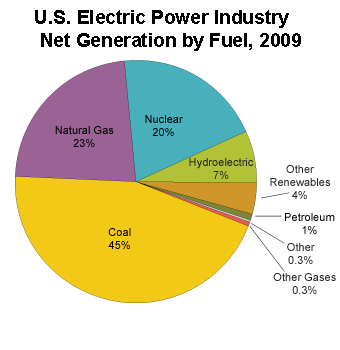
So its clear that displacing foreign crude oil will have to be done some other way than by reducing oil based electrical generating capacity.

If battery powered (EV) cars  become a significant part of our transportation sector,  then some substitution of electical energy for petroleum is likely.  But when?  Windpower installations are not economical and only are currently in the mix because of Federal and State subsidies. (see here for viability)  Further windpower needs electrical storage to be a viable supplier of electricity to the grid. (see here and here for storage)

So what is happening in the field of EVs?   The Poster child EV is the Chevy Volt. The second banana appears to be the Nissan Leaf.

The  Chevy Volt was named by Car and Driver  their “Car of the Year”.  But if the Volt presages the future for the battery powered car,  things  are not looking too strong at present.

Sales of the Volt in January were 321 cars and in February they sold 281.  Added to last years sales,  the total to date (throught February) is 928 cars.  Leaf, the Nissan hybrid has only sold 173 since they came on the market.

General Motors says not to worry.  They will make and sell 10k to 12k Volts this year.   They have not been helped by an underwhelming review by Consumer Reports. On 3 March, USA TODAY posted “Consumer Reports pans electric range of Chevrolet Volt, Nissan Leaf”.  The posting opens with this:

Consumer Reports magazine offers its initial assessment of the two reigning wondercars of our times, the Chevrolet Volt and Nissan Leaf, in its April issue and finds both may not be such good deals after all.

Not only has Consumer Reports’ test car been coming in at the low end of the electric-only mileage range — 23 to 28 miles, not 25 to 50 miles as billed — before the gasoline power kicks in, but CR had to pay over list to the get the car. It says it had to pay $48,700 — full price plus options and a $5,000 windfall to the dealer.

It gets worse. CR figures the cost of recharging the Volt would work out to about 5.7 cents a mile for electric mode and 10 cents a mile for gas. Yet a Toyota Prius, which gets about 50 miles a gallon, would cost 6.8 cents a mile to operate. A Prius costs half as much as a Volt.

CR seems to feel a little better about the all-electric Leaf. It borrowed one from Nissan while it awaits delivery of its own. The $35,270 electric car had its range severely restricted by the cold weather that has gripped the East, much like the Volt. The range has been averaging 65 miles, not the 100 miles that Nissan bills. Plus the mileage gauge isn’t that accurate in the cold when electric heaters gobble up kilowatts. Instead of the 36 miles of range that the car said it had, one tester got 19.

Ok, the Volt is a brand new design and with time, and with increased production, the vehicle will get better and the cost should go down.  While the Volt that Consumer Report bought was $5000 over MSRP,  the price of the Volt with options was still near $44,000.  Even with the Government subsidy of a $7,500 tax credit for the buyer, this is still probably above most buyer’s range.

The Battery

I, for one, worry a bit about the battery warrany that GM is providing.  I don’t believe that there is anywhere near enough actual experience for a 100,000 mile battery warranty. If these batteries don’t live up to the 100,000 miles, it could become very expensive for both the buyer and GM.  From GMs website this is the battery warranty:

Chevrolet Volt Coverage

Propulsion Battery Warranty Policy Like all batteries, the amount of energy that the high voltage “propulsion” battery can store will decrease with time and miles driven. Depending on use, the battery may degrade as little as 10% to as much as 30% of capacity over the warranty period. A dealer service technician will determine if the battery energy capacity (kWh storage) is within the proper limit, given the age and mileage of the vehicle. Typical tests can take up to 24 hours.

Repair If possible, components will be repaired or replaced, and the original battery will be returned to the vehicle.

Replace (If Necessary) Under warranty, the high voltage battery will be replaced with either a new or factory reconditioned high voltage battery with an energy capacity (kWh storage) level at or above that of the original battery prior to the failure. Your Volt battery warranty replacement may not return your vehicle as an “as new” condition, but it will make your Volt fully operational appropriate to its age and mileage.

I have read that these batteries began to wear out from the repeated charge and discharge cycles.  The words in the warranty appear to support this where it says “the battery may degrade from 10% to 30%” as miles are put on the EV.  I have read that the owner is warned not to operate below 20% of battery capacity and not to charge above of 80% of capacity.  What are the consequences regarding the range of the EV between charges when it approaches the 30% degredation?

Charging the Battery

Facilities to recharge batteries are needed to make the new electric car practical and they are few and far between.  Yes, putting in a low voltage system for recharging might not be too complex but the charge time for bringing the battery pack back to a full charge may require more time than you can afford.

The following chart illustrates the required time to place a full charge on several EVs.  The time required is a function of the voltage applied to the charger.

Vehicle EVrange 

Charge time120V Charge time220V Charge time440V
Nissan Leaf* 100 20 8 0.5
Chevy Volt* 60 10 4
Toyota Prius PHV** 13 3 1.5
Fold Focus Elect** 100est 12 6-8
MitsubishiI-MiEV** 100est 16 8

This information was from MSNBC posting and can be seen at these web addresses:

http://www.msnbc.msn.com/id/40200899/ns/technology_and_science-future_of_energy
**http://cosmiclog.msnbc.msn.com/_news/2010/11/20/5500395-cars-take-the-road-to-electrification

MSNBC says that the cost for a 220V charging station for your home is estimated at $2,200.   The 440V systems are likely to be impractical for most owners.  EV charging stations, similar in function to the ubiquitous gasoline station, would use these because of the much more rapid charging rate.   Wikipedia says that very rapid charging stations (10 minutes) carry a certain level of risk.

In practice, the energy efficiency of ten-minute charging is likely to be somewhat lowered in any case due to the ohmic losses caused by the required high current inside the vehicle. The lost energy is converted directly to heat, which could be detrimental to the battery pack or surrounding electronics; additional power may be required for cooling equipment that removes the excess heat. Increasing the capacity of the battery pack increases the required power, current and heat loss linearly,[citation needed] which is why ten-minute charging may require new innovations as vehicles with increased range are developed.

The reason EV manufacturers are looking at a rapid charge is because they hope to duplicate the time to fuel that is typical of the gasoline and diesel stations today.   Can you imagine waiting in line for several hours to get your EV charged?

Wiki points out another issue with very rapid charge stations.

The high peak power requirement of ten-minute charging can also stress the local power grid and might increase the risk of power brown- or black-outs during peak demand if enough vehicles choose to charge at these times.

I wonder if the Volt and its cousins,  might not be a better bet for success than windmills.  The EVs would probably experience lower cost electricity without the windmills in the mix.

cbdakota


Are Windfarms Driving the UK to Third World Status?


It is alarming that the UK is on the verge of plunging into third world status because the political class are so set on eliminating carbon emitting electrical generation facilities and replacing them with renewable energy  (read windmills) generation facilities.   The Telegraph (UK newspaper) carried an article on March 2nd saying that UK electrical customers were going to have to get used to black-outs or brown-outs based on the replacement strategy just mentioned.   Lets look at the article:

Here we have Steve Holliday, Chief Executive of the National Grid telling the Brits that the days of permanently available electricity may be coming to an end as wind farms become bigger suppliers of electricity.  He is quoted as saying “We are going to change our own behaviour and consume it when it is available and available cheaply.”  The National Grid is the electric power transmission network connecting power stations and substations and ensuring that generated electricity can be used to satisfy demand.  The Grid is where the “rubber meets the road” so to speak.  The grid system in the US has the same function.  But many industries cannot function profitable with intermittent power.  If you were a manufacturing company in the UK and you were to hear that power would become intermittent in the future, would you consider moving your business to someplace where zealots did not control the sources of electricity?

Is this the direction we want for the USA?   I think not.  But we have our zealots here as well.  Fortunately they have not gotten the degree of “say so” that is the case in the UK.

cbdakota

Treasury: Few Renewable Energy Projects Deserve Funding


The Treasury Department has been blocking many requests for renewable energy project subsidies.  They are doing this because there are so few that are technically or financially viable in their opinion.  The DOE has been complaining that the Treasury Department should back off.  So the President’s requested that his advisors look into this.  On 10/25/10 a memo from Larry Summers, Carol Browner and Ron Klain was sent to the President with their take on this squabble.

The memo was summed up in The Wall Street Journal (WSJ) posting “Wind Jammers at the White House” on 11/12/10.

“The trio walks through an interagency dispute about Energy Department subsidies for wind, solar and other forms of “renewable” power, which DOE claimed were being held up by the joint Treasury and White House budget office (OMB) reviews.”

The WSJ notes that the DOE has a lot of moneys it wants to spread around.

Recall that the stimulus transformed the government into the world’s largest private equity firm. The many tools now at DOE’s disposal include $6 billion to guarantee loans and another dispensation so that the department can convert an energy investment tax credit equal to 30% of a project’s cost into a direct cash grant to green developers.

The Summers memo notes that these two provisions alone reduce “the cost of a new wind farm by about 55% and solar technologies by about half relative to a no-subsidy case.” So taxpayers are more than majority partners in these private projects, except they get no upside.”

The last sentence is the kicker here,  “So taxpayers are more than majority partners in these projects, except they get no upside.”

The taxpayers not only get the downside because they pay  the capital cost but they then have to pay for the higher cost of electricity.  Now that’s a double whammy if I have ever heard of one.

The memo says that there are few viable projects to fund.   They said they found severe problems with “the economic integrity of government support for renewables.”  The WSJ continues with an example of the problem according to the  memo:

“Treasury and OMB singled out an 845-megawatt wind farm that the Energy Department had guaranteed in Oregon called Shepherds Flat, a $1.9 billion installation of 338 General Electric turbines. Combining the stimulus and other federal and state subsidies, the total taxpayer cost is about $1.2 billion, while sponsors GE and Caithness Energy LLC had invested equity of merely about 11%. The memo also notes the wind farm could sell power at “above-market rates” because of Oregon’s renewable portfolio standard mandate, which requires utilities to buy a certain annual amount of wind, solar, etc.”

“But then GE said it was considering “going to the private market for financing out of frustration with the review process.” Anything but that. The memo dryly observes that “the alternative of private financing would not make the project financially non-viable.”

“Oh, and while Shepherds Flat might result in about 18 million fewer tons of carbon through 2033, “reductions would have to be valued at nearly $130 per ton CO2 for the climate benefits to equal the subsidies (more than 6 times the primary estimate used by the government in evaluating rules).”

“So here we have the government already paying for 65% of a project that doesn’t even meet its normal cost-benefit test, and then the White House has to referee when one of the largest corporations in the world (GE) importunes the Administration to move faster by threatening to find a private financial substitute like any other business. Remind us again why taxpayers should pay for this kind of corporate welfare?”

Any questions?

cbdakota