Category Archives: Environment

Dept. of Energy’s Analysis Says Wind and Solar Not Competitive


The Dept. of Energy’s Energy Information Agency (EIA) publishes their take on the relative cost of electrical generation systems every year.  This year’s “Levelized Cost of New Generation Resources in the Annual Energy Outlook 2011” forecast the dollars per megawatthour prices from different sources of electricity in the year 2016.  The EIA use 2016 because the long lead-time for some technologies are such that they could not be brought on before 2016 unless they were already under construction.

Lets cover some terms here to make sure we understand, before we look at the Levilized cost table, what criteria the EIA used to assemble it.

Levelized cost is often cited as a convenient summary measure of the overall competiveness of different generating technologies.  Levelized cost reflects overnight capital cost, fuel cost, fixed and variable O&M cost, financing costs, and an assumed utilization rate for each plant type. For technologies such as solar and wind generation that have no fuel costs and relatively small O&M costs, levelized cost changes in rough proportion to the estimated overnight capital cost of generation capacity. For technologies with significant fuel cost, both fuel cost and overnight cost estimates significantly affect levelized cost. “

(Overnight capital cost is the total cost, even if it took several years to build, as if it could be built in one day.)

“The availability of various incentives including state or federal tax credits can also impact the calculation of levelized cost. The values shown in the tables below do not incorporate any such incentives.  .”

A 3% penalty is added to fossil fuel plants that have high CO2 emissions, and that adds to the “ …. cost terms      its impact is similar to that of a $15 per metric ton of carbon dioxide (CO2) emissions fee when investing in a new coal plant without CCS,..   The adjustment should not be seen as an increase in the actual cost of financing, but rather as representing the implicit hurdle being added to GHG-intensive projects to account for the possibility they may eventually have to purchase allowances or invest in other GHG emission-reducing projects that offset their emissions.”

This chart gives renewables no credit for available subsidies and fossil fuel plants(coal and natural gas) are penalized for CO2 emissions.

The “total system levelized cost”–  the last column in the chart– is the forecast cost of electricity in 2009 $/megawatthour for each of the examined “plant types”.

The first three natural gas cases would be considered standard power generating facilities and their prices range from $66 to $89 per megawatthour.   The next two are “backup/peak” cases. These unit are natural gas driven turbines designed to be put rapidly into or taken out of service in order to  meet a rapid change in customer electrical demand OR  an unexpected change in supply of electricity.  These turbines are not something you want on-line like a major coal, nuclear or natural gas power generating plant because of their high cost,  but the major plants are not flexible enough to meet rapid demand changes.  In the past, the need for these turbines was, although not exclusively,  to manage rapid demand increases.   But now that wind and solar power are now mandated to be in the mix,  irregular swings in supply must  also be met.  The wind can quit blowing or the sun quit shining resulting in rapid changes in supply that cannot be predicted.   At this time, if the electrical system is required  to take on an electrical supply from either or both wind or solar, the system operators typically have to install matching turbine capacity to meet the swings introduced in the supply by these renewables.

The column labeled “capacity factor” represent the percentage of the rated capacity that is actually delivered by the various types of facilities.  The totally reliable system would operate at capacity 100% all of the time. The major fossil fuel power plant’s inability to produce at rated capacity occurs about 15% of the time.  Often the majority of this loss is due to planned shutdowns for annual maintenance.

Further examination of the chart shows that only the plant type onshore “Wind”   ($97/megawatt hour) is in the ballpark versus the cost for fossil fuel based power-generating facilities.  And none of the wind or solar cases exceeds a capacity factor of  34%,  with solar thermal at 18%.   Many critics say that 34% is misleading high because wind can not be banked upon to meet peak system demand.

What can we conclude from the Department of Energy’s EIA calculations?   Neither wind nor solar are cost competitive versus fossil fuel plants.   And this is likely to remain unchanged for a long time to come.  Through lavish use of subsidies, these facilities can be made to look competitive. However, no matter how the renewable cost looks after subsidies, you are still paying the non-competitive difference as the Federal and State governments are using your tax money to pay for the subsidies.

A final thought on the EIA analysis.  In the real world, duplicate fossil fuel capacity has to be added to match renewable electric supply because it is undependable.  So the backup unit capital cost should be charged against the wind and solar cases to make this comparison reflect reality.  That, of course, would make these renewable energy cases look even less competitive.

To read the EIA levelized cost report click here.

cbdakota

Obama’s Administration Policies Wont Lower Gas Prices


Whenever the price of gasoline takes a sharp rise, I get a flood of emails that have some scheme to beat those wascally waiders of our pocket-book–the usual suspect is Exxon/Mobile.   The scheme calls for us to not buy from Exxon or who ever the scheme writer doesn’t like.   Then this narrative says that to get back into the market the target company will have to lower prices thus start a price war.  This scheme might lower prices a few cents per gallon over time but it would not be  significant.  A more effective scheme would be for automotive community to drive 10% fewer miles each month.  The recent recession did affect supply and demand enough to make a significant change in price.  But now that we seem to be climbing slowly out of this really bad economy, we are driving more and the  gasoline prices are moving up.

Along with more miles being driven, the crude oil traders, fearing loss of producing fields resulting from the turmoil in the Middle-East,  are trying to secure their supply.  Thus bidding up of the price of a barrel of crude is underway.  Couple those two issues with the declining value of the dollar, the price  of crude is now in the vicinity of $100 per barrel.  (Remember, oil trades are denominated in dollars US.)

If the citizens of the US really want to bring crude oil prices down (and thus pump pricing) then it will be necessary to implement a program that will be at odds with the current administrations policies.  The Heritage Foundation has a proposal for doing just that: “THREE POLICY CHANGES TO HELP WITH GASOLINE PRICES” on their WebMemo blog site. The thrust of these three policy changes is summarized here:

A Familiar Pattern. When petroleum and gasoline prices shot up during the energy crisis of  1970, the experts and pundits predicted imminent resource exhaustion, skyrocketing prices, and energy poverty. Instead, markets responded by searching for, discovering, and producing enough oil to provide over two decades of low prices. For instance, in the U.S. alone, the number of drilling rigs more than tripled between September 1973 (before the Yom Kippur War and the subsequent Arab oil embargo) and December 1981. Now, imminent oil depletion and the futility of drilling are again supposedly on the horizon. However, increased drilling activity follows increased petroleum prices. Blunting this natural market response will drive up energy prices and reduce national income. This, plus the Keystone XL pipeline and scaling back EPA expansion of the Clean Air Act, would do much to stabilize gas prices and energy costs in general.

The three policy changes necessary according to the Heritage Foundation are:

1  INCREASE DRILLING

  • Relatively small changes in supply can have large impacts on price, especially when markets are tight. And tight markets are what caused the petroleum price spikes of 2008 and will cause them again if production is shut down while demand from a growing world economy squeezes the spare capacity the world has enjoyed for the past couple of years.
  • The first and most obvious place to drill is where there are already drilling rigs and proven reserves— such as the Gulf of Mexico. Despite the majority recommendation of its own scientific panel, the Obama Administration stopped virtually all new drilling in the Gulf of Mexico. There have been recent signs that this policy might change. “Might” needs to be “will,” and soon.

2 SHELVE “LOW-CARBON FUEL STANDARDS”

  • The concept of “low-carbon fuel standards” is driving opposition to a petroleum pipeline from Canada.  With its oil sands, Canada has more proven petroleum reserves than any country other than Saudi Arabia. A consistent ally and long-time friendly neighbor, Canada is exactly the sort of supplier the U.S. should want to fill the gap in the petroleum it cannot produce on its own. But some policymakers want to put these vast reserves off limits to American consumers.
  • The Keystone XL pipeline would bring the U.S. over a million barrels of petroleum each day—more than it imports from either Saudi Arabia or Venezuela (the U.S.’s two largest suppliers after Canada and Mexico). Secretary of State Hillary Clinton should be applauded for her statements in support of the pipeline.  However, other components of the Administration, notably the Environmental Protection Agency (EPA), have taken steps to slow or stop the pipeline.

STOP EPA ABUSE OF THE CLEAN AIR ACT

  • The EPA’s abuse of the Clean Air Act will drive up refining costs and, therefore, gasoline prices. Though the use of the act to regulate carbon dioxide (CO2) would create large problems in many places, the EPA recently started the process to regulate CO2 emissions from refineries. This regulation goes beyond the gasoline reformulation mandates that balkanize gasoline markets with higher-cost boutique fuels.
  • The new CO2 regulation puts an additional burden on refiners’ costs and subsequently raises prices of gasoline, diesel fuel, and home heating oil. Further, it will increase the amount of refined product the U.S. imports and reduce employment in an industry with wages that are more than 40 percent higher than the national average.

To read the Heritage blog in full  click

cbdakota

WINDPOWER AND ELECTRICAL STORAGE-BOSTON CONSULTING REPORT


Many readers of these posting are familiar with the Boston Consulting Group (BCG). During the years I was active in a business management role, we used BCG to provide consultancy for some of our business ventures.  BCG describes themselves as:

BCG is a global management consulting firm and the world’s leading advisor on business strategy. We partner with clients in all sectors and regions to identify their highest-value opportunities, address their most critical challenges, and transform their businesses.

I cannot speak to their specific claim to be the “world’s leading advisor on business strategy” but I believe that they are among the world’s best.

Why am I qualifying their expertise?   Because I want to use the report they issued in March 2010 as a reference: 1) to increase the reader’s understanding of the issues and 2) for demonstrating that without electricity storage, wind and solar can never make a real impact on electrical supplies.   Their report is titled “Electricity Storage—Making Large-Scale Adoption of Wind and Solar Energies a Reality”.   This report may be seen in total by clicking here.

A prior posting in this blog, WINDPOWER WITHOUT ENERGY STORAGE DOES NOT COMPUTEmakes the case that these alternative energy sources are unreliable and thus cannot be scheduled as necessary to provide reliable transmission to customers.   Our government is offering large subsidies to make these alternatives “competitive”; however, the alternatives will never be truly competitive without energy storage.

These energy sources require something to compensate for the times when the wind doesn’t blow or the sun doesn’t shine.   To compensate, the BCG report discusses four approaches for electricity storage:

  • Grid Extension
  • Conventional Backup Power
  • Demand Side Management
  • Large Scale Storage

Grid Extension “involves linking electricity grids from different regions and transferring power from one to the other to compensate for fluctuations” BCG discusses the problems with this approach and conclude that it “will likely make an important contribution. ……But grid extension is not a standalone solution for the long run.”

Conventional Backup Power is the use of primarily fossil fuel powered generation plants that are brought on line or taken off line to compensate for the swings in Wind and Solar power generation.  BCG’s report presumes that fossil fuel power is the backup and concludes that”…we do not believe conventional backup capacity will be sufficient on its own or sustainable as we move toward a renewables-dominated electricity system in the long term”. (My emphasis added).   There is great momentum for the replacement of fossil fuels, particularly in the political class, as they lust for the attendant taxing and regulating which the removal of fossil fuels from general use would entail.   There is great uncertainty in the science of man-made global warming and thus any taxing and regulating is premature in particular because we are beginning to see an unraveling of this concept at present.

BCG continues by saying “Still we believe that conventional backup capacity will be indispensable for achieving the integration of renewable energy sources into the current power system in the coming years.”

Demand Side Management is described as having customers that are willing to scheduling their production or drying their clothes or what ever around the availability of electricity.   BCG states that this will have limited value and cites studies carried out in Germany and the US  ”found that Demand Side Management offers a demand reduction potential of only approximately 2 percent of peak load.”

Large Scale Storage is the collection of excess power generated, for example, when the wind and sun are peaking.  BCG states the positives for storage “Unlike interregional compensation, storage provides a self-sufficient solution for one specific region and hence is not affected by increases in penetration of fluctuating renewables across the board.

As BCG says,  “The approach is not perfect, however.  All electricity-storage technologies are inefficient to a degree: part of the energy fed into the system cannot be discharged later on and is lost. “ BCG notes that the range of efficiencies ranges from 45% to 80% and BCG states this is a key weakness for storage.  BCG lists the following as possible candidates for commercial storage.

  • Mechanical storage which encompasses pumped hydroelectric               storage, compressed air, and flywheel energy.
  • Thermal storage encompassing hot water, molten-salt, and phase change material storage.
  • Electrical storage including supercapacitors and superconducting magnets
  • Electrochemical storage including flow and static batteries.
  • Chemical or hydrogen storage

BCG looks at the pros and cons of these candidates and you can read the full report and make your own judgment about which ones, if any, will be the winners.

BCG further says:  “While the business case for investing in storage is currently weak, that situation will necessarily change.  Today’s fluctuations in generation are compensated for relatively easily and cheaply by flexible conventional power plants, but the march toward a fossil-fuel free energy landscape continues:……”  and “Wind and solar PV are the most competitive and widely available renewable sources and will certainly account for the lion’s share of the renewable energy produced—-and they require storage to be viable.”

The report is a good source for background information and, and in my view, it supports the obvious conclusion that wind and solar are, at the current time, largely an unnecessary expenditures that the ratepayer must endure.  Two issues are yet to be resolved.  Firstly, to be technically and economically viable electrical storage facility will have to make their way into the system.  Hopefully not, as the BCG report supposes, through yet more subsidies but rather at a time when the market forces are such that these energies are the logical, economic way to go on their own merit.   The second issue is that question of man-made global warming (AGW) theory and the part it is playing.  In my view the time frame for these renewables to make their way into the market should not be predicated on being supported by such a slender reed as AGW.   I believe these renewables will take a hit that will set them back many years when the rate payer revolts against the high price and unreliable delivery brought about by non-economic, government mandates.

cbdakota

WINDPOWER WITHOUT ENERGY STORAGE DOES NOT COMPUTE


Just for starters, lets say it so everyone knows where this posting is coming from:

Because Windpower energy is unreliable and thus cannot be scheduled as necessary  for transmission to customers, it does not make any significant addition to the US energy supply base.  Presently, it thrives only because financial slight of hand (subsidies) and legislative mandates requiring that it be part of the utility’s energy mix.  Moreover, and somewhat ironically, it does not result in a reduction of CO2 from fossil fuel burning; in fact it usually requires additional fossil fuel based generating capacity to provide the backup.

Until such time as reliable and economic energy storages systems are developed wind energy will be an expensive burden to the ratepayers.    If the government wants do spend my money to develop alternative energy sources, put it where it will have real value—energy storage.

Jon Boone posted “Oxymoronic Windpower (Part II:Windspeak)” on the MasterResource site and lists reasons why windpower is not presently a viable energy source:

Let’s examine the evidence.

1.Despite more than 100,000 huge wind turbines in operation around the world, with about 35,000 in North America, no coal plants have been closed because of wind technology. In fact, many more coal plants are in the offing, both in the US and throughout the world. Moreover, a Colorado energetics company, Bentek, recently published a study about wind in Texas and Colorado showing, in its study areas, that wind volatility caused coal plants to perform more inefficiently, “often resulting in greater SO2, NOx, and CO2 emissions than would have occurred if less wind energy were generated and coal generation was not cycled.” Further examination of fuel use for electricity in both states during the time of inquiry suggested that wind caused no reduction in coal consumption.

2.Unpredictable, undispatchable, volatile wind can provide for neither baseload nor peak load situations. It can only be an occasional supplement that itself requires much supplementation. Consequently, as Australian engineer Peter Lang once wrote, since “wind cannot contribute to the capital investment in generating plants… [it] simply is an additional capital investment.”

3.Wind technology does NOT represent alternate energy. Since wind cannot provide controllable power and has no capacity value, it cannot be an alternative for machines that do provide controllable power and high capacity value. Wind therefore is incapable of entering into a zero-sum relationship with fossil-fired capacity—that is, more wind, less coal. All other conditions being equal (demand, supply, weather, etc), more wind generally means more coal.

4.None of the considerable public subsidies for wind, indeed, not even state renewable portfolio standard (RPS) laws, are indexed to measured reductions in carbon dioxide emissions and fossil fuel consumption. Consequently, there is no transparency or accountability for how wind technology will achieve the goals set forth by those policy initiatives. This means that corporations with a lot of fossil-fired marketshare to protect have no obligation to replace it with wind. And they don’t. Because they can’t. Freedom from responsibility is a child’s fairy tale dream come true.

5.The work of a number of independent engineers—Hawkins, Lang, Oswald, Le Pair and De Groot—suggests that even the most effective fossil fuel pairing with wind, natural gas, will very marginally reduce overall natural gas consumption beyond what would occur using only natural gas generators, without any wind whatsoever.

6.Because oil provides barely 1% of the nation’s electricity, wind represents no threat to oil’s marketshare.

Regarding point no. 2 above,  the operator of the electrical distribution system has to provide power that meets the customer’s quantity demand very precisely at a steady voltage and frequency.  With coal, natural gas or hydro the base load can be managed.   To manage the demand peaks and valleys, natural gas turbines are often used as they can be brought on line or taken off line rather rapidly.  These facilities are under the control of power plant operations. Wind however is not controllable.  Sometimes the wind blows,  sometimes it doesn’t and it can change in a matter of minutes from high speed wind to medium speed wind to no wind and vice versa.

If a reliable and cost effective energy storage system were available,   the  windpower unit could direct its production into that system.  The storage system would allow the windpower unit to take advantage of the days when the wind was blowing forcefully and store the power.  This would significantly raise the ratio of delivered power as a function of rated power.  The electrical distribution system operators would know how much power was available and could  schedule it from the storage system.

Alas, no such energy storage system is currently available.

cbdakota

BBC SCIENCE PROPAGANDA


Propelled by the Climategate email scandal, cooling global temperatures, total failure of the Copenhagen climate conference, many false and otherwise erroneous reports in the IPCC 4th report on Climate Change, etc. the public is becoming aware of the bill of goods that has been feed to them in recent years by the mainstream media, Al Gore, and politicians of all stripes who want to tax and regulate you. Polls show waning  support for draconian taxes and regulation  in order to cut fossil fuel CO2 emissions.

This past week, the BBC aired a program they produced titled “Science Under Attack”.   The objective of the program was to bolster the man-made global warming theory (AGW).

So how good was the BBC’s “Science Under Attack”?

A desperate and sleazy program according to Christopher Booker as told in his posting “How BBC warmists abuse the science”:

The formula the BBC uses in its forlorn attempts to counterattack has been familiar ever since its 2008 series Climate Wars. First, a presenter with some scientific credentials comes on, apparently to look impartially at the evidence. Supporters of the cause are allowed to put their case without challenge. Hours of film of climate-change “deniers” are cherrypicked for soundbites that can be shown, out of context, to make them look ridiculous. The presenter can then conclude that the “deniers” are a tiny handful of eccentrics standing out against an overwhelming scientific “consensus”.

The scientist picked to front the progamme was Sir Paul Nurse, a Nobel Prize-winning geneticist, now President of the Royal Society (which has been promoting warmist orthodoxy even longer than the BBC). The cue to justify the programme’s title was all the criticism which greeted those Climategate emails leaked from Sir Paul’s old university, East Anglia, showing how scientists had been manipulating their data to support the claim that temperatures have recently risen to unprecedented levels.

One of the two “deniers” chosen to be stitched up, in classic BBC fashion, was the Telegraph’s James Delingpole. He has spoken for his own experience on our website. Still worse, however, was the treatment of Professor Fred Singer, the distinguished 86-year-old atmospheric physicist who set up the satellite system for the US National Weather Bureau. We saw Nurse cosying up to Singer in a coffee house, then a brief clip of the professor explaining how a particular stalagmite study had shown temperature fluctuations correlating much more neatly with solar activity than with levels of CO2. This snippet enabled Nurse to imply that Singer’s scepticism is based on one tiny local example, whereas real scientists look at the overall big picture. No mention of the 800-page report edited by Singer in which dozens of expert scientists challenge the CO2 orthodoxy from every angle.

For those that attend to the Climate Change Sanity postings routinely  (see) will instantly spot how poor the programming was and how little about the subject, Sir Paul Nurse knows when your read the following Booker comments:

The most telling moment, however, came in an interview between Nurse and a computer-modelling scientist from Nasa, presented as a general climate expert although he is only a specialist in ice studies. Asked to quantify the relative contributions of CO2 to the atmosphere by human and natural causes, his seemingly devastating reply was that 7 gigatons (billion tons) are emitted each year by human activity while only 1 gigaton comes from natural sources such as the oceans. This was so much the message they wanted that Nurse invited him to confirm that human emissions are seven times greater than those from all natural sources.

This was mind-boggling. It is generally agreed that the 7 billion tonnes of CO2 due to human activity represent just over 3 per cent of the total emitted. That given off by natural sources, such as the oceans, is vastly greater than this, more than 96 per cent of the total. One may argue about the “carbon cycle” and how much CO2 the oceans and plants reabsorb. But, as baldly stated, the point was simply a grotesque misrepresentation, serving, like many of the programme’s other assertions, only to give viewers a wholly misleading impression.

You can read James Delingpoles discussion of the Nurse “gotcha interview” here.

For 10 years Peter Sissons was the BBC evening news anchor.   In his recently published memoirs, he says:

“The BBC became a propaganda machine for climate change zealots, and I was treated as a lunatic for daring to dissent”.

The BBC and the Warmists desperation in producing a program like this is palpable and it argues strongly that the BBC has lost its integrity.

cbdakota

COLLEGE STUDENTS LACK SCIENTIFIC LITERACY?-Part2


In the previous posting, College Students Lack Scientific Literacy?, we took a quick look at the role of photosynthesis in the Carbon Cycle.  This posting  will examine the part that burning of fossil fuels play in the carbon cycle and how fossil fuel CO2 affects global warming.

There are those who believe that catastrophic heating of the Earth will result if fossil fuels use is not curbed or perhaps stopped all together.  They think that the extra increment of CO2 from fossil will cause the climate to reach a “tipping point” after which there may be no turning back.

So what is the argument about between skeptics and believers?

Broadly speaking the believers have looked for a cause of a temperature increase of something less than 1C  during the last century.   They say that the measured volume of Carbon Dioxide (CO2) in the atmosphere has gone up coincident with the temperature increase and that since CO2 is a known greenhouse gas, it must be the cause.   And they add that CO2 from industrial and transportation sources, a product of fossil fuel combustion,  is the reason for the atmospheric CO2 increase from the past “steady-state” measurements.

Skeptics, while accepting that the Earth’s temperature has increased in the last century, so has it for the last 10,000 years since the end of the last Ice Age.  And further,  this cold to warm and return to cold has been going on for hundred thousands of years, so the last century’s warming is probably due mostly to natural causes.   Skeptics say that the past history of temperature increases and CO2 variation as charted from the examination of ancient ice cores show the temperature change leads CO2 change both increasing and decreasing.  Stated in another way,  CO2 follows a change in temperature rather than leading the change. By the way, Al Gore’s “An Inconvenient Truth” movie did show it the other way but it is widely agreed that was wrong as was so much  else of that science fiction documentary.

The amount of CO2 in the atmosphere is very small, and the CO2 increment from fossil fuel burning is about 3% of the total atmospheric CO2 content.  If pressed the believers will agree that the primary greenhouse gas is not CO2, but rather water in the form of vapor and clouds.  From 90 to 95% of the greenhouse gas effect results from water in the atmosphere.

An interesting way to look at the CO2 versus water has been made by Art Horn  in his posting “The Utter Futility of Reducing Carbon Emissions”which can be seen by clicking here.  This  posting looks at the Carbon Cycle and it uses the Intergovernmental Panel on Climate Change, as the data source.  This panel is the believer’s bible.   Quoting from his posting:

“…….the Intergovernmental Panel on Climate Change (IPCC) 4th Assessment showed that 3% of the atmospheric CO2 comes from man-made sources. Global gross primary production and respiration, land use changes, plus CO2 from the oceans totals 213 gigatonnes of carbon exchanged each year between the Earth/oceans and the atmosphere. The IPCC figure also shows man-made carbon emissions to be about 7 gigatonnes, bringing the total to 220 gigatonnes per year. So from this, we can see that making energy from fossil fuels is producing about 3% of the carbon dioxide added to the air each year. From that, the total human component of the greenhouse effect is therefore about 3% of the total carbon dioxide component of the greenhouse effect, which is 8%.

That gives us a value of .2% from man-made carbon dioxide. If you think that’s a small number you’re right.”

A little more simple science is necessary to get this picture.

Greenhouse Gas (GHG) effect

To begin with, the simplest view is that GHG is a study of “energy inenergy out”.  The “energy in” is the radiation from the Sun—sunlight, infrared (IR) and ultraviolet  (UV)—that is absorbed by the Earth.  The Earth then radiates this energy back out into space.  On its way back out into space, some of it is delayed by interaction with trace elements in the atmosphere. This interaction increases the temperature of the atmosphere, and the Earth’s temperature rises. The greenhouse effect is real and it allows life, as we know it, to exist.  If the Earth had no atmosphere,  its temperature would be 255K (-18C).  The average temperature of the entire Earth averaged over seasons is, by measurement, about 288K (15C).  Thus the greenhouse effect results in an increase in temperature of about 33K (33C).

Lets look at GHG in more detail.  The Sun energy in the form of visable light, IR, and UV (shortwaves) pass through the Earth’s atmosphere and are absorbed by the ocean, the land, the trees, concrete, road surfaces, etc.  Not all of the Suns energy  makes it to the Earth’s surface due to clouds and surface reflection, along with atmospheric scatter that represent a blockage.  When the Sun’s input ceases, at night for example, these Earth objects begin to emit electromagnetic radiation.  This radiation is in the infrared range but because the temperatures of the objects are much lower than that of the Sun, the wave lengths are different.  They are much longer.  For our purposes the Earth’s radiation will be called the longwaves.

The interaction of the trace compounds in our atmosphere with the outgoing longwave radiation is dictated by atomic absorption.  Each compound  in the atmosphere has a specific wave length band(s) that it absorbs.  If the compound’s wave lengths correspond to the wave lengths of some of the IR radiated from the Earth’s surface, the IR waves can be absorbed. Those IR waves are converted to heat causing the compound to emit IR of a different wave length. The compound is transparent to other IR wave lengths.

Water, CO2 and Methane will absorb IR wave lengths emitted from the Earth.    Of the emitted IR waves that are absorbed, it is estimated that some 4%to 6% are by CO2.  The CO2 greenhouse effect is limited because the wave lengths that CO2 absorbs only represent a small part of the wave length ranges of the reemitted IR from the Earth. In fact, adding more CO2 to the atmosphere has only limited significance because the amount of CO2 already in the atmosphere is nearly sufficient to absorb those particular Earth originated IR waves.

Well, why do the believers think that CO2 will cause the very high Earth temperatures they trot out frequently to scare all the rest of us.  They agree that water is the primary greenhouse gas.   They think that the little upward bumps in temperature that are possible if more CO2 is added to the atmosphere will result in more water vapor in the atmosphere.  They know that CO2 can’t do the deed so they have programmed their computers models (GCM) to  gee-up lots of water vapor to do the deed. This amplification of the total greenhouse gases (GHG) is called positive feedback. Using this positive feedback, the GCMs forecast climate out some 100 years or more and conclude that global temperatures will rise dramatically.   The problem is that this positive feedback is difficult to impossible to demonstrate in the real world.  (Basically the world abhors positive feed back.) Meanwhile a negative feedback has been shown to exist in real world, making run-away global temperatures quiet unlikely.

In summary,

Very little of the CO2 in the atmosphere is due to the burning of fossil fuels.

The  GHG effect is primarily due to water as vapor or clouds

CO2 can only absorb  a limited portion of  the Earth’s radiated IR

The Believers proclamations of catastrophic weather conditions are based computer programs. Those computer predictions that were done sufficiently long ago to be meaningful as a predictions,  have been notorious failures.

And the concept of Positive Feedback  increasing water in the atmosphere resulting in large increases in the Earth’s temperature is a fiction of the computer program as it has not yet been proved in real experimental work.

cbdakota

COLLEGE STUDENTS LACK SCIENTIFIC LITERACY


Last week was one of lows and highs.  I went back to South Dakota to say my goodbyes to my sister. She passed away some 7 hours after I got to the hospital. The highs were the young people that gathered for the funeral.  Mainly grandchildren and other kin of my sister. The children ranged from grade school to Grad school to graduated and off to work.   After spending time with them, it seems clear that we will be putting our nation into good hands.

Some probably do not share my political philosophy, However, I am hopeful that Winston Churchill’s view of the stages of life will play out when he said,  “If you are young and not a liberal, you have no heart.  If you are growing old and are not a conservative, you have no brain.”

But brains they do have no mater their political philosophy.   And those that have thought about Climate Change have open minds.

After reading the result of a recent Michigan State study, which concluded that College Students lack scientific literacy, I wondered if there are college students or grads, unlike my Sister’s kin, that do not have open minds and need a little background to begin formulating their own opinion about climate change.

Quoting the MSU researchers:

The researchers assessed the fundamental science knowledge of more than 500 students at 13 U.S. colleges in courses ranging from introductory biology to advanced ecology.

Most students did not truly understand the processes that transform carbon. They failed to apply principles such as the conservation of matter, which holds that when something changes chemically or physically, the amount of matter at the end of the process needs to equal the amount at the beginning. (Matter doesn’t magically appear or disappear.)

Students trying to explain weight loss, for example, could not trace matter once it leaves the body; instead they used informal reasoning based on their personal experiences (such as the fat “melted away” or was “burned off”). In reality, the atoms in fat molecules leave the body (mostly through breathing) and enter the atmosphere as carbon dioxide and water.

Most students also incorrectly believe plants obtain their mass from the soil rather than primarily from carbon dioxide in the atmosphere. “When you see a tree growing,” Anderson said, “it’s a lot easier to believe that tree is somehow coming out of the soil rather than the scientific reality that it’s coming out of the air.”

The oxygen we breathe is primarily released from plants when photosynthesis takes place breaking the CO2 molecule, recombining it with water to produce a sugar.  The excess oxygen from the photosynthesis reaction is now a waste product and expelled to the atmosphere.

The above Graph is a product of  Onimoto.com

Without atmospheric CO2, there would be no plants.  Without plants there would be no life on this planet.   It offends me when I read media articles that call CO2 a POLLUTANT.

Because the Researcher’s objective for this work is to gain acolytes to the Church of Man Made Global Warming, my next posting will be to show that CO2 is not a big factor in the Greenhouse effect.

To read the MSU press release click here.

cbdakota

SUN AND CLIMATE PART 3: SOLAR FLUX & Ap INDEX


In the two prior postings Sun and Climate,Parts 1 and 2,  we have talked about Solar Activity and how it relates to climate.  In Part 1, the discussion was primarily about Solar Insolation, and Part 2 began the discussion about solar activity using Sunspots as a proxy.   Sunspots are popularly used to indicate Solar activity due to their longevity.  Galileo began noting and recording them in the sixteen hundreds.

Ok,   now lets look at some more physical evidence that shows a strong correlation with solar activity/climate change.

Two much newer and probably better proxy measures are Solar Flux and Average Magnetic Planetary Index (Ap index).

SOLAR FLUX

The former is a measure of noise or flux that is emitted at a frequency of 2800 MHz (10.7cm).  This measure is typically referred to as F10.7.  This proxy measures ionization in the ionosphere’s F region.    The solar wind from the Sun contains many atomic particles.  The Earth’s geomagnetic field deflects the majority of the protons and electrons being expelled from the Sun toward the Earth.  But the as the Sun’s activity increases more particles are expelled and more break through into the Earth’s ionosphere where F10.7 measures the increase.    Continuous F10.7 measurement and record maintenance began in 1947. As can be noted from the shape of the current (Nov. 2010) monthly summary chart of F10.7,   it is lagging the same point on the red line where the experts had predicted it would be at this time in Cycle 24.

And as we noted in Sun and Climate Part 2,  the forecast Cycle 24  has been  scaled down several times in the last few years in order to match actual real world results which have consistently come in below each new forecast.  Note that the level of F10.7  at the peak of Cycle 23 in 2001 and 2002 reached nearly 240.

AVERAGE MAGNETIC PLANETARY INDEX –Ap

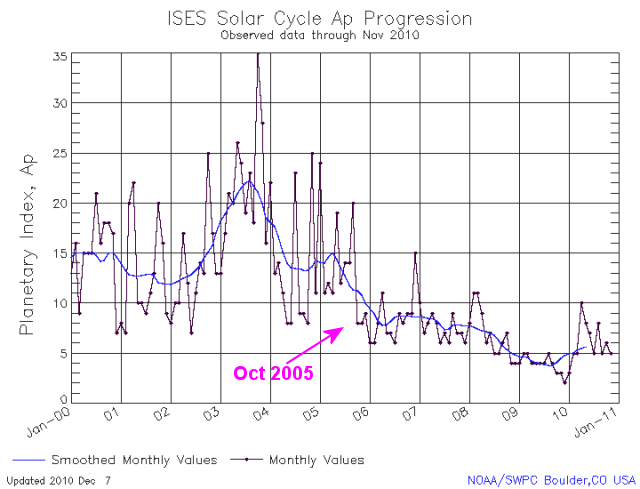
The Sun’s magnetic field extends far out into space.  It not only surrounds Earth, it also extends well beyond Pluto.  The more powerful the Sun’s magnetic field, the more it alters the  Earth’s geomagnetic field.    The Ap index is measure of this alteration.   The Ap index measurements began in the 1930’s.   The chart  that follows shows the Ap index beginning in 2000 through most of  2010.  The peak in the 2003 -2004 time frame is Cycle 23.  The Solar activity was high during that time, reaching an Ap index of 35 at its peak.  In October 2005,  the Ap Index dropped significantly and has remained very low since then.

The  following chart shows the Ap index from October 2010  through the end of December 2010.  Note that the index has bottomed out at zero on several occasions.  This chart also illustrates the how well the Solar Flux, the Sunspot Number and the Ap Index  correlate.

(This chart was prepared by Jan Alvestad)

No one knows exactly the mechanism that causes the Earth to cool when these proxies are low or warm when they are up.  No one knows exactly why the Sun has 11 (+-) year cycles.  Maybe we will never learn enough to be able to predict accurately the future state of the solar activity.  If so,  we will never be able to accurately predict the Earth’s future climate.  But we can reasonably predict that the Earth’s climate will cool as long as these proxies stay low (below normal), indicating low solar activity.
Moreover, we can’t control solar activity.  We can’t control Earth’s orbit around the Sun.  The Sun is in charge of our climate.  Man has precious little control of the climate in the big picture.   Attempts to moderate the Earth’s climate through reduction of CO2, for example, will have limited to no effect on climate although it will have a profound negative impact on our economic well being .

Our efforts should be directed toward adaptation to what every the Sun dishes out.

For more on this topic see posting Part 1 and Part 2 of Sun And Climate.

cbdakota

Sun and Climate Change -PART 2: Sunspots


Following up from the previous posting, Sun and Climate Change Part 1-Solar Activity, we will continue to examine the connection between the Sun and the Earth’s climate.

Sun’s Magnetic Field

On average, the Sun’s magnetic field is thought to be only about twice as strong as Earth’s magnetic field. The magnetic field is generated by the rotation of the Sun acting like a giant electromagnet.  But it has local fields of enormous strength, something in the range of 8000 times greater that Earth’s field.  It is believed that the cause of these local fields is the differential rotation of the Sun’s latitudes.  The observed rotation at the equator is 25 days and near the poles about 35 days is due to the fact that the Sun is made up of plasma and hot gases.  This results in the magnetic field becoming twisted and erupting from the surface in these local fields.  Where this enormous magnetic force exists, you find Sunspots, flares, and coronal mass ejections (CME). The Sun has a cycle of about 11 years from minimum to maximum and back to minimum magnetic activity.  This cycle can be observed by the numbers of Sunspots formed on the surface of the Sun.   During a cycle, the Sunspot number increase until the Sun’s polarity “flips”.  The Sun’s magnetic polar north flips and points south.  This usually is the point at which the so-called solar maximum is reached. The activity on the Sun begins to decrease.  The cycle eventually reaching a point where very few Sunspots are observed.  This is the completion of a cycle.

Sunspots

Sunspots are the product of the enormous magnetic fields (thousands of times stronger than Earths magnetic field) created on the Sun. They appear as dark spots.   The Spots are cooler than the surrounding surface of the Sun.  NASA says that the Spots are about 3700K versus 5700K for the surrounding photosphere.

Sunspots are probably not the best indicators of the Sun’s activity but the better indicators have little history where as Sunspots have been recorded for hundreds of years. What make them especially interesting is that the Earth’s climate and Sunspots have a high degree of correlation.   Periods where the Earth’s climate has cooled off appear to coincide with periods of few Sunspots and periods of warmer climate seem to coincide with periods of high Sunspot counts.

Chart Courtesy of Wikimedia Commons

The telescopic recording of Sunspots began  with Galileo using the newly invented telescope to observe the sunspots in 1610.  He and later others began to count the sunspots.

When a solar cycle is forecast, the y-axis is usually Sunspot numbers and the x-axis is time.   The current solar cycle is 24.   On the chart below, the blue line is the monthly average of Sunspots. It shows  cycle 23 declining from its high and then cycle 24 as it begins to rise.  The orange line was the predicted shape of cycle 24 by NASA experts but the actual Sunspot numbers are lower than forecast. The experts have found it necessary to continue to reduce the numbers (height) of the forecast monthly Sunspot numbers.  In 2006 they forecast a height of cycle 24 at a sunspot number of 156 to 180. The following chart is from a posting by Anthony Watts on his blog,  WattsUpWithThat and can be seen here.

The following chart shows the latest  (Dec 2010) prediction of NASA and how they have found it necessary to continue to lower their expectations over time to new “high Sunspot number” of 64!!!  Although some people think they have a system that allows them to predict these numbers, its clear that no one knows enough to make any forecast that’s good enough to bet on it. The NASA forecast has been downgraded four times since the March 2006 prediction.

(The chart courtesy of Ira Glickstein on WUWT blog and can be seen here.)

There is one additional factor that the reader needs to be aware of, and that is comparing Sunspot counts of old and those of today could be problematic.   The pinpricks that are counted on the sun today with the high-powered equipment were probably not even noticed in years past.   So when it is reported that the sunspot count during period of the Maunder Minimum in lower than today, you cannot be sure we are comparing apples and apples.   Some discussion about this variable can be found here.

But no matter how you count them, the cycle 24 sunspots are out of the norm. Cycle 24 is being compared to Cycle 5 which occurred at the time of the Daulton Minimum.  The indications are Earth’s  climate is in for a period of cooling.

cbdakota


Sun and Climate Change -PART 1: SOLAR ACTIVITY


Two years ago, this December, I wrote an essay titled “Sun and Climate Change”.   The essay opened with this summary statement:

Climate change has always been underway on Earth.  Periods of cooling, then warming, then cooling, etc. are historical facts.  These changes, over millions of years, have had natural causes that do not include burning of fossil fuels.

Correlation might mean causation.  But no correlation clearly means no causation.  The ice core and ocean bottom core data that provide a look back into time, show that atmospheric carbon dioxide (CO2) lags global temperature change.  It says that CO2 begins to increase after the global temperature begins to increase and it decreases after the temperature decreases.  So CO2 does not cause temperature to change. Yes, I am aware that CO2 plays a small role as a greenhouse gas.  But it is water, in the form of vapor and clouds, which does 90% of the greenhouse work.

The Sun, however, has correlation with climate change.  After many years of low solar activity (known as the Sporer, Maunder and Dalton Minimums), a comparatively cool climatic period followed that lasted from 1450 to 1820.  This cool period is known as The Little Ice Age. Then came many years of increasingly greater solar activity that stretched into the 20th century.  Some solar scientists say that this period has been the most active in the last 11,000 years.  Global warming has been a consequence of these more active, recent solar cycles.

So where are we now?   At the moment, the global temperature is falling.  The global temperature is cooler now than it was at the end of the last century.  Figure 1, shows how the global temperature has been declining. The solar activity is down; in fact, August 2008 was the first calendar month in 100 years that no sunspots were recorded.  Sunspots appear to be a reliable proxy for solar activity.   Will this period of cooling last? I don’t know.  I hope that we do not descend into another Ice Age, Little or Big. I would rather have warming.  What I am reasonably confident of is that fossil fuel use restrictions (in order to reduce atmospheric CO2) will make little difference relative to global warming.  I am reasonably confident that the Sun is the critical player here and there is little we can do to change whatever the Sun decides to do.  Even though the exact mechanism linking the Sun and global climate change has not yet been definitively established, it is kind of like gravity–it is obvious even if we cannot fully define it.

Two years later some tweaking could be done to the preceding but for the most part it is accurate and further, the intervening time has provided even more compelling evidence.

Solar Activity,  Solar magnetism, Solar cycles, and Sunspots will be discussed in this and future postings.

SOLAR ACTIVITY

A new peer-reviewed paper was recently published in the Journal of Geophysical Research:  (the source is the Blog IceCap.  To read more click here)

...that reconstructions of total solar irradiance (TSI) show a significant increase since the Maunder minimum in the 1600’s during the Little Ice Age and shows further increases over the 19th and 20th centuries. The TSI is estimated to have increased 1.25 W/m2 since the Maunder minimum ………..

It remarkable that the authors say that most of the warming since 1850 can be accounted for by the increase in solar activity:

Use of the Stefan-Boltzmann equation indicates that a 1.25 W/m2 increase in solar activity could account for an approximate .44C global temperature increase [the HADCRU global warming from 1850 to 2000 is .55C].

The paper is Reconstruction of solar spectral irradiance since the Maunder Minimum, by N.A. Krivova, L.E. A. Vieira, S. K. Solanki

Journal of Geophysical Research

For more on this topic see Sun and Climate Change Part 2 Sun Spots

cbdakota