Category Archives: Domestic Energy

Battery Charge Anxiety Worse Than Gas Gauge Anxiety-Leaf Stops 4X For Charging!!


My dear wife and I have travelled many miles by car. She is content having me do the driving.  However, I am, in her mind, careless about going by any gasoline station without filling up the tank. That is a bit of hyperbole but running out of gasoline is high on her list of things to never do.  Imagine if you will, how she would feel if we owned a Nissan Leaf and used it to drive from Knoxville Tennessee to Antioch, Tennessee, a distance of 182miles (293km).  The Nashville Tennessean reported on such a trip taken by Stephen Smith, Executive Director of the Southern Alliance for Clean Energy, along with his wife and son.  The trip took place on a cool day, about 35F (2C), primarily on Interstate 40.  Fast (30minutes) electric vehicle chargers have been installed at the Cracker Barrel Restaurant chain and they planned to use them as needed.  The 182-mile trip took 6 hours to complete.  It included 4 stops for recharging.

Quoting from the newspaper story:

Only problem was, the Leaf’s charge dropped more rapidly than promised. In what has to be a public relations disaster for Nissan, Smith’s EV was unable to travel no farther than 55 miles on any leg of the trip – and for the most part, much less. The company, and its government backers, proclaimed [5] the Leaf was “built to go 100 miles on a charge” (large print), with a footnoted disclaimer (small print) that it travels shorter distances (like, 70 miles) if the air conditioning or the heater is used. Turns out even that was an exaggeration.   A trip that should take – according to map Web sites – less than three hours, ended up lasting six hours for the Smiths because of all the stops they had to make. The approximate intervals where they paused for recharging were as follows:

  • Knoxville to Harriman: 45 miles
  • Harriman to Crossville: 31 miles
  • Crossville to Cookeville: 31 miles
  • Cookeville to Lebanon: 50 miles

Lebanon to destination in Antioch, just south of Nashville: 22 miles

“It was a little nerve wracking,” Stephen Smith told the Nashville-based newspaper. “I’m finding the range is not 100 percent accurate.”

A further quote from the article:

The Smiths’ experience echoed that of a Consumer Reports reviewer [2] and Los Angeles columnist Rob Eshman [3], who called his Leaf his “2011 Nissan Solyndra.” Eshman, editor-in-chief of The Jewish Journal, experienced the same gauge inaccuracies and range anxiety that came from traversing hills and mountains and the use of his air conditioning in hot, smoggy L.A. 

“My life now revolves around a near-constant calculation of how far I can drive before I’ll have to walk,” Eshman wrote. “The Nissan Leaf, I can report, is perfect if you don’t have enough anxiety in your life.”

Bonus geography question—- How many State of Tennessee towns are named ANTIOCH?    See below.


Antioch, TN, Bedford County

Antioch, TN, Davidson County

Antioch, TN, DeKalb County

Antioch, TN, Haywood County

Antioch, TN, Henderson County

Antioch, TN, Jackson County

Antioch, TN, Knox County

Antioch, TN, Lawrence County

Antioch, TN, Loudon County

Antioch, TN, Montgomery County

Makes you wonder how that ever happened.

cbdakota

Rare Earth Elements Background.


If you follow the alternative energy issues (windmills, solar cells, ethanol for fuel, etc) you have very likely encountered discussions about rare earth elements. This posting is designed to provide the reader a little background.    Rare earths are used in lights, batteries, motors, lasers, and many other electronic applications.  In addition some of them are used as oil refinery catalysts, in metal alloys and glass polishing and coloring applications just to mention a few non-electronic uses.  There are 17 rare earth elements on the periodic table.  What makes these metals rare is that they are not often found in concentrations that can be profitably mined.  According to Wikipedia, one of them “Cerium” is the 25th most abundant element in the Earth’s crust,  however they are widely dispersed.  China has the best mines in the world it would seem.  China sold these elements at prices low enough to shut down most of the other mines in the world.

The magnets that can be made from several of the elements are vastly more powerful that those made from cobalt, the previous best permanent magnet making metal. Two of the rare earths commonly used are Neodymium and Samarium.  They are alloyed with other metals to form permanent magnets.  These magnets are replacing non-rare earth alloy magnets in electric motor assemblies because of their magnetic field strength.  These rare earth alloy magnets can be made smaller to reduce weight and still create high magnetic flux for electric motors.  It is said that the magnetic attraction is so powerful that if your finger is between two of these magnets you will likely experience a fractured finger.

Pure Neodymium has a low Curie temperature so it is only magnetic at low temperatures. Above the Curie point it’s parallel alignment of the magnetic field lines become disordered and it loses its magnetism.  To overcome this problem, Neodymium is alloyed with boron and iron to make a permanent magnet that can operate up to approximately 300 C.  The rare earths are also vulnerable to corrosion.  This problem is resolved by plating.

Although Samarium has a higher Curie temperature, it plays a smaller role than Neodymium because it is more expensive and creates a weaker magnetic field.  It is commonly alloyed with Cobalt.

The price and geopolitics are playing a role in the use of rare earths.  According to a November 16, 2011 NYTimes article, the prices of rare earths are dropping:

International prices for some light rare earths, like cerium and lanthanum, used in the polishing of flat-screen televisions and the refining of oil, respectively, have fallen as much as two-thirds since August and are still dropping. Prices have declined by roughly one-third since then for highly magnetic rare earths, like neodymium, needed for products like smartphones, computers and large wind turbines.

A chart of the price versus time for Neodymium is shown below:

The price for Neodymium appears to be at about $350 per kilogram.

There are some geopolitical ramifications surrounding rare earths:  Again from the Times posting:

China mines 94 percent of the rare earth metals in the world. Through 2008, it supplied almost all of the global annual demand outside of China of 50,000 to 55,000 tons. But it cut export quotas to a little more than 30,000 tons last year and again this year and imposed steep export taxes, producing a shortage in the rest of the world.

Together with a two-month Chinese embargo on shipments to Japan during a territorial dispute a year ago, the trade restrictions and shortage resulted in prices outside China reaching as much as 15 times the level within China last winter. That created a big incentive for companies that use rare earths in their products to move factories to China or find alternatives.

The US had some working rare earth working mines before the advent of the Chinese.  I have read that one in California is planning to resume production now that the prices have reached a point where working the mine is economical.

Stay tuned.

cbdakota

Electric Car Update-YTD November


Volt vs. Leaf

The Chevy Volt sales were 1139 vehicles in November bettering last month’s sales of 1108.  That brought the year-to-date Volt sales (YTD) to 6142.  Chevy had forecast Volt sales 10,000 vehicles in 2011 and it looks like they wont make that target.   Chevy is forecasting Volt sales at 45,000 in 2012 and they will export 15,000 more.  I suppose it is possible that they might make that forecast, but I have my doubts unless GE (Obama good buddy Jeffery Immelt CEO of GE) buys the 10,000 Volts they pledged that they would.  The first part of 2011, Chevy maintained that they were production, not sales, limited.  But at the end of 2011, there did not seem to be a lack of Volts for sales.  November’s sales of 1139 are the best month so far this year.

You make your estimate of 2012 sales.

The Volt’s main competitor this year has been Nissan’s Leaf.  Leaf sales dropped for the third consecutive month to 672 vehicles.  Even so, Leaf still leads in the 2011 YTD sales race with 8738 vehicles sold.

Aptera

Aptera is an all electric three wheel vehicle with an EPA rating of 200mpg equivalent.   It is a beauty but they can’t get matching loan money to continue operation.  They announced that they are going out of business.

Sorry about that.

cbdakota

The USA Is Energy Rich—Who Is Preventing Us From Using It?


Look at this video, which is based on work done by the Congressional Research Office late last year and further developed by the Institute for Energy Research in their new report North American Energy Inventory.   The USA has more energy resource than any country in the world—that means oil, natural gas and coal are in abundant supply.  North America’s  (USA, Canada and Mexico) combined resources make it the most energy rich region in the world.  So why aren’t we experiences the lower prices for gasoline, heating oil, electricity, etc.  Why are we sending so much of our money to the people in the Middle East and places like Venezuela, where they often us that money to oppose us?  I hope you got the right answer which is –Our Federal Government.

AT STAKE:   1,000,000 new jobs.  Lowered trade imbalance.   Depriving enemies of our money to oppose us.

See also: Keystone Pipeline Delayed  

Obama Administrations war on fossil fuels

Lets Reduce Foreign Crude Oil by Using Our Own 

Between The Rock And The Hard Place US Energy Policy: 

cbdakota

Chevy Volt Battery Fires


The National Highway Traffic Safety Administration is conducting a “formal safety defect investigation” into the Chevy Volt’s battery.  Two fires occurred following crash tests.   GM says that the fires started long after the car and battery were crashed.  They added that this does not reflect a problem with the car but rather the protocol used to deal with batteries after a crash.

I think that GM is probably right but people need to know that if leakage from the battery occurs, there is a fire potential.  GM needs to broadcast widely how to handle the problem so as to prevent fires from occurring.

cbdakota

To Maintain Their Integrity, Scientists Need to Become Skeptics


If the first release of Climategate emails in November of 2009 wasn’t enough to convince people that a small group of superwarmer scientists have been advancing the theory of man-made global warming through manipulation, this newly released batch (generally called Climategate 2) should convince them.

First of all, why should anyone care if this “small” group of superwarmers is doing bad things?  The reason is that this small group controls the dialogue on this subject. It manipulates the data to comply with their point of view; it writes the critical parts of the IPCC reports; it decides what is published and what is not published; and, it punishes scientists and organizations that don’t toe the line.  While we are being squeezed financially, they are pulling in millions of dollars in grants and honors.

The people that need to step up and put an end to this charade are the good and descent scientists that have been taken in by the superwarmers.   They suffer from a confirmation bias that has to be pretty hard to sustain these days of no global temperature rise, falling sea levels and all the climategate email revelations, just to name a few things.   These scientists must stand up against the blind allegiance that their professional societies maintain to catastrophic man-made global warming theory.  Certainly there are enough reasons for them to become skeptics.   They should be comfortable in saying that until there is more proof and open discussions of the science of the global climate, they no longer are going to support the  warmer supergroup.  Until that happens, the media will continue to uncritically pass on to the public anything the superwarmers tell them because they always use in their defense “almost all scientist agree with the supergroup”.

By the way, for those of you are under the impression that members of the warmer supergroup have been investigated and exonerated, you need to read up on this and you will learn that the exoneration was predetermined.  For one good read on this, see here.

cbdakota

Keystone Pipeline Delayed For Campaign Contributions


Several months ago, I wrote about the current Administrations efforts to sink coal, natural gas and oil.  They are still planning to do that. Today the Obama Administration announced that they needed more time to ponder the question of the Keystone XL pipeline that will bring Canadian crude oil to the US where we would refine it and market it.  They have studied this issue for 18 months without making a final decision.  The Washington Post’s publication Politico.com said today: President Barack Obama was caught between a green and a blue place on the Keystone XL oil pipeline — the environmentalists who insisted he reject the proposal in order to earn their support in 2012 and labor unions excited at the prospect of jobs.

On Thursday, Obama’s State Department punted a verdict on Keystone until 2013, and while his administration is busy claiming the decision has nothing to do with politics, try telling that to everyone in Washington.   

The Politico gave the reason: Sierra Club Executive Director Michael Brune had recently told reporters Obama’s decision on Keystone would “have a very big impact” on whether the nation’s largest environmental group funnels resources more toward congressional races rather than the race for the White House.

To read more of the Politico.com story click here.

The following excerpt is from my posting  Obama Plans to Nationalize the Energy Companies

Classic wrong headedness is illustrated by diddling over access to Canada’s rich tar sands.  From the IBD posting “China has its eye on Canada’s oil”:

Together, the U.S. and Canada have enough oil and natural gas locked up in shale formations, tar sands, Alaska, the Canadian Arctic and the Outer Continental Shelf to make OPEC pound sand. But we won’t drill for ours and apparently; we don’t want Canada’s.

With more than 170 billion barrels, Alberta has the world’s third-largest oil reserves, behind only Saudi Arabia and Venezuela and ahead of Russia and Iran. Daily production of 1.5 million barrels from the oil sands is expected to nearly triple to 3.7 million by 2025. The only question is, will this crude be flowing south to U.S. refineries or west for export to China?

At issue is the Keystone XL pipeline, parts of which have already been built, that would bring Alberta oil to Texas Gulf Coast refineries. The pipeline also could transport oil extracted from shale formations in the Rocky Mountain West.  The U.S. Geological Survey estimates the region, dubbed the Persia of the West, may hold more than 1.5 trillion barrels of oil, six times the proven reserves of Saudi Arabia, and enough to meet U.S. oil needs for the next two centuries. By 2015, oil executives and industry analysts say, the oil-rich lands of the West, including North Dakota’s booming Bakken formation, could produce 2 million barrels a day, more than the pre-Deepwater Horizon production rate in the Gulf of Mexico.

Environmental groups oppose Keystone XL on the grounds that tar-sands extraction harms the environment through water pollution, greenhouse gas emissions and potential pipeline leaks. The State Department, which must approve any pipeline entering the U.S. across international borders, has withheld its approval pending a final decision Nov. 1.  The Chinese aren’t waiting. Sinopec, a Chinese state-controlled oil company, has a stake in a $5.5 billion plan to build the Northern Gateway Pipeline from Alberta to the Pacific Coast province of British Columbia. Alberta Finance Minister Lloyd Snelgrove met this month with Sinopec and CNOOC, China’s other big oil company, and representatives of China’s banks.

While the U.S. dithers with concerns about “dirty oil” from Alberta’s rich tar sands, energy-hungry China makes Ottawa an offer it might not refuse. Memo to Washington: Pipelines can run west as well as south.

Some of you maybe saying, if you have read this far,  ‘well we have to get off fossil fuels before the Earth experiences a catastrophe from man-made global warming’.  I don’t know how much attention you have been paying to this subject but the Global temperatures have not been increasing for the past 10 to 13 years! The temperature is not rising while at the same time, the boogeyman in all of this controversy, atmospheric CO2 content has been increasing throughout this period.  Just so you don’t think I have invented the idea of a decade or more of flat temperatures, those that favor the theory of man-made global warming agree. Last week, Greenwire published the thoughts of the major warmer scientists  (Hansen, Trenberth, Santer, Solomon, Wild, etc.) about the fact that the temperature is at a standstill.  They are at a loss to explain why the temperature is not rising.  They have many theories but no answers. Some in that group are beginning to see that the quieter-than-usual Sun may be the real reason.    To see the Greenwire story, “Provoked scientists try to explain lag in global temperatures” click here.

cbdakota

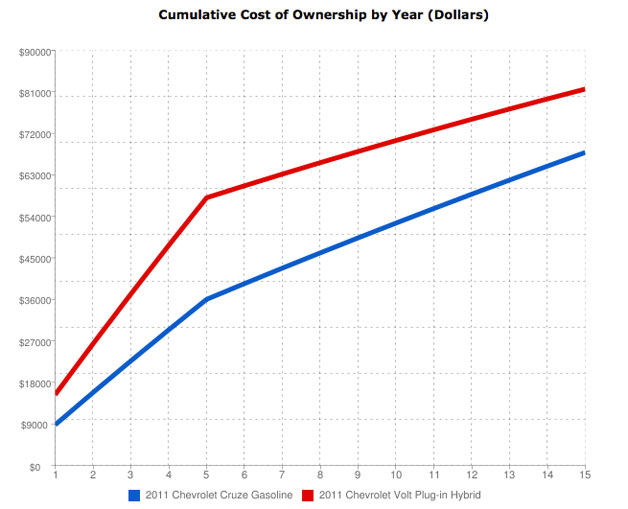
DOE Ownership Cost Calculator–Cruze beats Volt


Using the new DOE cost calculator, the Chevy Cruze is a better buy than the Volt.

The chart above considers operating cost plus initial investment, expected depreciation and cost of maintenance at today’s prices.   The Volt does beat the Cruze when calculating only the cost of fuel.  The DOE uses a 2011  purchase price for the Volt at $40,280 and the Cruze at $18,125.  To make your own comparisons,  click here.

To read additional information, click here.

cbdakota

The Obama Administration’s War on Fossil Fuels Is Taken To a New Level (of absurdity)


If you were writing a fiction novel and used the latest example of the Obama Administration’s war on fossil fuels, your editor would tell you to take the example out because it was not believable.  But it seems that for the Obama Administration nothing is too absurd:  The Wall Street Journal in an editorial published on 29 September says:  “The U.S. Attorney for North

Image by TreeHugger.com

Dakota hauled seven oil and natural gas companies into federal court for killing 28 migratory birds that were found dead near oil waste lagoons. The fine can be up to $15000 and up to six months in jail for each bird killed.    The WSJ adds:”Absurdity aside, this prosecution is all the more remarkable because the wind industry each year kills not 28 birds, or even a few hundred, but some 440,000, according to estimates by the American Bird Conservancy based on Fish and Wildlife Service data. Guess how many legal actions the Obama Administration has brought against wind turbine operators under the Migratory Bird Treaty Act? As far as we can tell, it’s zero.”

I guess the Attorney General is too busy covering up the Solyndra affair to go after the wind industry.

h/t Junk Science  See here

cbdakota

The Federal Government Should Not Be Financing “Renewable Fuels” Projects


Much has been revealed in the recent weeks about Solyndra and the developing scandal that followed the bankruptcy of the company after having received a $523 billion dollar, low interest loan from the Obama Administration.  Much is yet to be learned, and it did not get advanced by the Top Officials of Solyndra pleading the 5th Amendment at the House of Representatives hearing on Friday 23 September.

The Institute for Energy Research condensed a report by ABC on the Solyndra fiasco in to 5 Reasons why the federal government should exit the finance business.  Those reasons are as follows:

First, the government loaned Solyndra money at a really, really low interest rate—a mere 1.025 percent quarterly. In fact, this was the lowest rate provided for any green energy project.

Second, this low rate was in spite of “red flags” about the risk of investing in Solyndra. One outside rating agency rated Solyndra only a B+ and another rated Solyndra only as “Fair” for credit worthiness.

Third, Obama’s Department of Energy announced the loans before the due diligence was complete and even after auditors raised concerns. But this was not for lack of attention because even the President visited the plant and praised Solyndra as an example of the future of energy.

Fourth, according to ABC News, “Solyndra’s most prolific financial backer is George Kaiser, an Oklahoma oil billionaire who was a bundler of campaign donations for Obama’s 2008 race. Kaiser’s Argonaut Ventures and its affiliates have been the single largest shareholder of Solyndra, according to SEC filings and other records.” This connection alone should have caused pause for the federal government when considering an expedited loan arrangement.

And last, and in my mind, by far the worst, Kaiser and his Argonaut Ventures are first in line to recoup their investment in Solynda in bankruptcy proceedings. As ABC News explains, “Energy officials confirmed this arrangement, saying that private investors including Kaiser would first recoup their $75 million, then the U.S. government would have a chance to recover $150 million of its investment. If any money is left, the private investors and the U.S. government would divvy up the remainder in equal shares.”

In sum, the Obama administration rammed through a half billion loan on very favorable terms to a shaky company, run by a George Kaiser, one of President Obama’s largest fundraisers. If Kaiser and his company made money with Solyndra, they would keep the profits and if Solyndra failed, as in this case, they still get their money back while the taxpayer is left holding the bag.”

Any Questions?

cbdakota