Category Archives: Climate Models

SOLAR CYCLE 24 and the SUNSPOT BUTTERFLY DIAGRAM


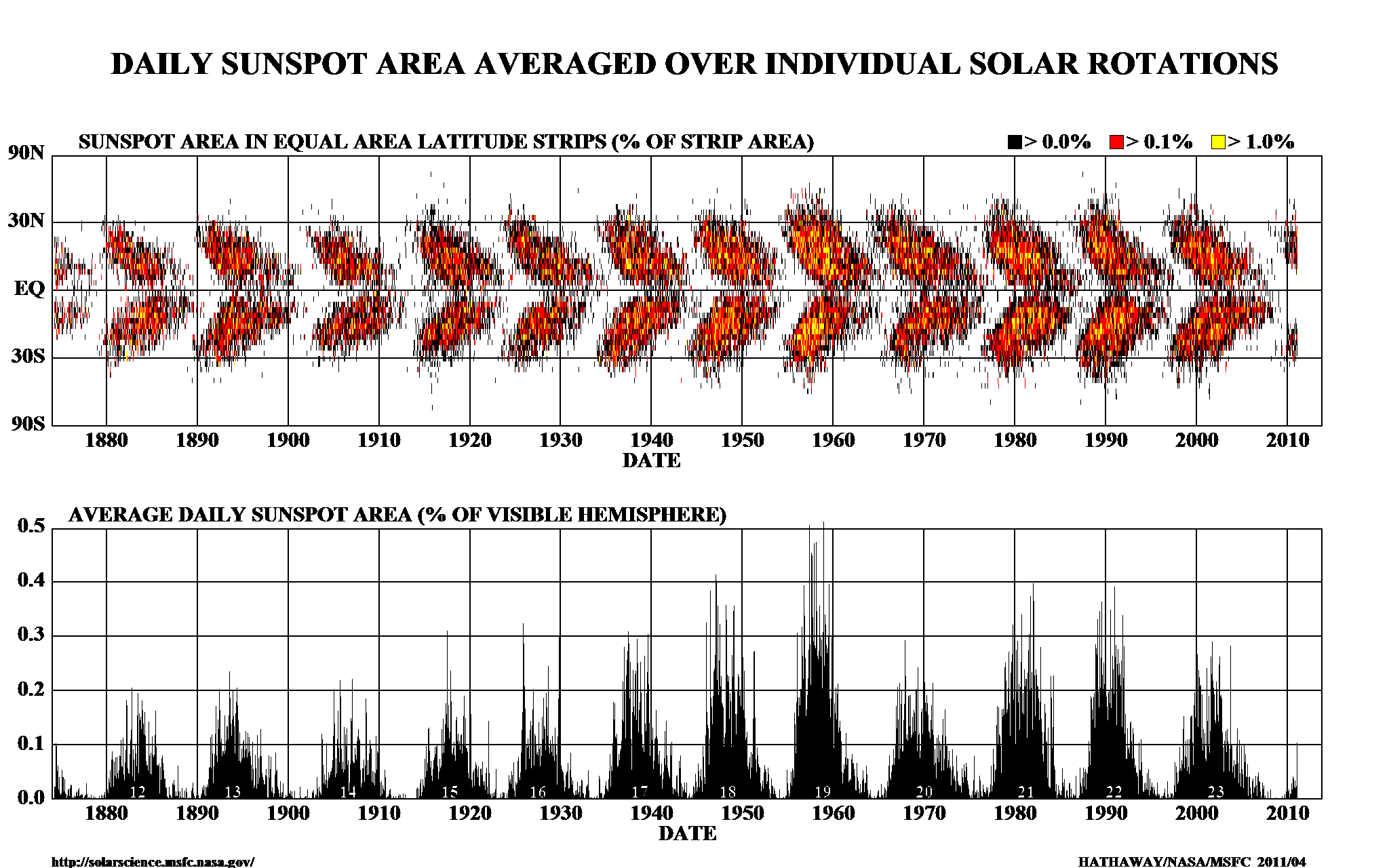
I posted Solar Cycle 24- A Game Changer? which discussed the weak cycle 24 and what it might mean in terms of a cooler global climate.  As the posting was getting quite long, I elected to leave out the Butterfly Diagram for later posting.  So, now is later.

Cycle 24 is the plot just beginning now, 2010 and 2011.  The leftmost “butterfly” is Cycle 11.  (click on the chart to enlarge)

This figure is sometimes known as the Maunder Butterfly Chart as Maunder seems to be the first person to recognize the unique pattern formed by plotting the position of the sunspots on the face of the sun versus time.  When a new solar cycle begins, the sunspots become numerous.  In the beginning they appear away from the equator at about 35 degrees south and 35 degrees north.   With time the spots begin to converge at the equator.  When the “minimum” occurs, the spots  are basically upon the equator.

The butterfly chart for Cycle 24 is perhaps  showing sunspot formations that are relatively fewer than in recent Cycles 22 and 23.  Cycle 24 seems to resemble cycles that occurred many years ago.  If you occasionally check the progress of the spots toward the equator, you might be able to make a good guess on the length of Cycle 24.   Will it be much less than the average of 11 years?  The experts probably have a better feel than we amateurs,  but I am pretty sure that they would not bet the farm on their feel.

There is an interesting paper “First Solar Butterfly Diagram from Schwabe’s Observations 1825 1867” by Rainer Arlt and Anastasia Abdolvand, This paper uses the spots recorded by Schwabe during the named period to assemble butterfly diagrams for Cycles 7, 8 , 9  and 10.  These are the butterfly diagrams that immediately precede those in my first chart.  Cycle 8 was a weak cycle according to the authors.

cbdakota

10 Major Failures of the Model Based Virtual World View of Climate.


Joseph D’Aleo has developed a list of the “Ten Major Failures of So-Called Consensus Science”.  To develop this list, he analyzed the Intergovernmental Panel on Climate Change (IPCC) based science.   Then he focuses on “how actual data compares to the consensus science, model based virtual world view of climate”

His ten issues are:

1. Warming is said to be unprecedented and accelerating. It is neither.

2. Global warming is not GLOBAL

3. Winters would grow increasingly warm

4. The entire Northern Hemisphere would experience less snow and snowcover

5. The arctic oscillation (AO) would become increasingly positive, aiding in the warming

6. Global warming would lead to a permanent or semi-permanent El Nino

7. Atmosphere will warm faster than surface (because that is where the heat trapping gases are).

8. Record highs and heat waves are increasing

9. Sea levels are rising at an increasing, alarming rate

10. Droughts and floods will worsen.

There are many other issues, he notes, but his concentration is on the “major findings, assessments or model predictions from the IPCC and other national climate centers and NGOs….”

The listing of the ten above are rather sketchy, but he provides convincing evidence of his convictions which you can access by clicking on the “See the analysis part 1 and part 2” at the bottom of  his posting which is accessible by clicking here.

cbdakota

BBC SCIENCE PROPAGANDA


Propelled by the Climategate email scandal, cooling global temperatures, total failure of the Copenhagen climate conference, many false and otherwise erroneous reports in the IPCC 4th report on Climate Change, etc. the public is becoming aware of the bill of goods that has been feed to them in recent years by the mainstream media, Al Gore, and politicians of all stripes who want to tax and regulate you. Polls show waning  support for draconian taxes and regulation  in order to cut fossil fuel CO2 emissions.

This past week, the BBC aired a program they produced titled “Science Under Attack”.   The objective of the program was to bolster the man-made global warming theory (AGW).

So how good was the BBC’s “Science Under Attack”?

A desperate and sleazy program according to Christopher Booker as told in his posting “How BBC warmists abuse the science”:

The formula the BBC uses in its forlorn attempts to counterattack has been familiar ever since its 2008 series Climate Wars. First, a presenter with some scientific credentials comes on, apparently to look impartially at the evidence. Supporters of the cause are allowed to put their case without challenge. Hours of film of climate-change “deniers” are cherrypicked for soundbites that can be shown, out of context, to make them look ridiculous. The presenter can then conclude that the “deniers” are a tiny handful of eccentrics standing out against an overwhelming scientific “consensus”.

The scientist picked to front the progamme was Sir Paul Nurse, a Nobel Prize-winning geneticist, now President of the Royal Society (which has been promoting warmist orthodoxy even longer than the BBC). The cue to justify the programme’s title was all the criticism which greeted those Climategate emails leaked from Sir Paul’s old university, East Anglia, showing how scientists had been manipulating their data to support the claim that temperatures have recently risen to unprecedented levels.

One of the two “deniers” chosen to be stitched up, in classic BBC fashion, was the Telegraph’s James Delingpole. He has spoken for his own experience on our website. Still worse, however, was the treatment of Professor Fred Singer, the distinguished 86-year-old atmospheric physicist who set up the satellite system for the US National Weather Bureau. We saw Nurse cosying up to Singer in a coffee house, then a brief clip of the professor explaining how a particular stalagmite study had shown temperature fluctuations correlating much more neatly with solar activity than with levels of CO2. This snippet enabled Nurse to imply that Singer’s scepticism is based on one tiny local example, whereas real scientists look at the overall big picture. No mention of the 800-page report edited by Singer in which dozens of expert scientists challenge the CO2 orthodoxy from every angle.

For those that attend to the Climate Change Sanity postings routinely  (see) will instantly spot how poor the programming was and how little about the subject, Sir Paul Nurse knows when your read the following Booker comments:

The most telling moment, however, came in an interview between Nurse and a computer-modelling scientist from Nasa, presented as a general climate expert although he is only a specialist in ice studies. Asked to quantify the relative contributions of CO2 to the atmosphere by human and natural causes, his seemingly devastating reply was that 7 gigatons (billion tons) are emitted each year by human activity while only 1 gigaton comes from natural sources such as the oceans. This was so much the message they wanted that Nurse invited him to confirm that human emissions are seven times greater than those from all natural sources.

This was mind-boggling. It is generally agreed that the 7 billion tonnes of CO2 due to human activity represent just over 3 per cent of the total emitted. That given off by natural sources, such as the oceans, is vastly greater than this, more than 96 per cent of the total. One may argue about the “carbon cycle” and how much CO2 the oceans and plants reabsorb. But, as baldly stated, the point was simply a grotesque misrepresentation, serving, like many of the programme’s other assertions, only to give viewers a wholly misleading impression.

You can read James Delingpoles discussion of the Nurse “gotcha interview” here.

For 10 years Peter Sissons was the BBC evening news anchor.   In his recently published memoirs, he says:

“The BBC became a propaganda machine for climate change zealots, and I was treated as a lunatic for daring to dissent”.

The BBC and the Warmists desperation in producing a program like this is palpable and it argues strongly that the BBC has lost its integrity.

cbdakota

COLLEGE STUDENTS LACK SCIENTIFIC LITERACY?-Part2


In the previous posting, College Students Lack Scientific Literacy?, we took a quick look at the role of photosynthesis in the Carbon Cycle.  This posting  will examine the part that burning of fossil fuels play in the carbon cycle and how fossil fuel CO2 affects global warming.

There are those who believe that catastrophic heating of the Earth will result if fossil fuels use is not curbed or perhaps stopped all together.  They think that the extra increment of CO2 from fossil will cause the climate to reach a “tipping point” after which there may be no turning back.

So what is the argument about between skeptics and believers?

Broadly speaking the believers have looked for a cause of a temperature increase of something less than 1C  during the last century.   They say that the measured volume of Carbon Dioxide (CO2) in the atmosphere has gone up coincident with the temperature increase and that since CO2 is a known greenhouse gas, it must be the cause.   And they add that CO2 from industrial and transportation sources, a product of fossil fuel combustion,  is the reason for the atmospheric CO2 increase from the past “steady-state” measurements.

Skeptics, while accepting that the Earth’s temperature has increased in the last century, so has it for the last 10,000 years since the end of the last Ice Age.  And further,  this cold to warm and return to cold has been going on for hundred thousands of years, so the last century’s warming is probably due mostly to natural causes.   Skeptics say that the past history of temperature increases and CO2 variation as charted from the examination of ancient ice cores show the temperature change leads CO2 change both increasing and decreasing.  Stated in another way,  CO2 follows a change in temperature rather than leading the change. By the way, Al Gore’s “An Inconvenient Truth” movie did show it the other way but it is widely agreed that was wrong as was so much  else of that science fiction documentary.

The amount of CO2 in the atmosphere is very small, and the CO2 increment from fossil fuel burning is about 3% of the total atmospheric CO2 content.  If pressed the believers will agree that the primary greenhouse gas is not CO2, but rather water in the form of vapor and clouds.  From 90 to 95% of the greenhouse gas effect results from water in the atmosphere.

An interesting way to look at the CO2 versus water has been made by Art Horn  in his posting “The Utter Futility of Reducing Carbon Emissions”which can be seen by clicking here.  This  posting looks at the Carbon Cycle and it uses the Intergovernmental Panel on Climate Change, as the data source.  This panel is the believer’s bible.   Quoting from his posting:

“…….the Intergovernmental Panel on Climate Change (IPCC) 4th Assessment showed that 3% of the atmospheric CO2 comes from man-made sources. Global gross primary production and respiration, land use changes, plus CO2 from the oceans totals 213 gigatonnes of carbon exchanged each year between the Earth/oceans and the atmosphere. The IPCC figure also shows man-made carbon emissions to be about 7 gigatonnes, bringing the total to 220 gigatonnes per year. So from this, we can see that making energy from fossil fuels is producing about 3% of the carbon dioxide added to the air each year. From that, the total human component of the greenhouse effect is therefore about 3% of the total carbon dioxide component of the greenhouse effect, which is 8%.

That gives us a value of .2% from man-made carbon dioxide. If you think that’s a small number you’re right.”

A little more simple science is necessary to get this picture.

Greenhouse Gas (GHG) effect

To begin with, the simplest view is that GHG is a study of “energy inenergy out”.  The “energy in” is the radiation from the Sun—sunlight, infrared (IR) and ultraviolet  (UV)—that is absorbed by the Earth.  The Earth then radiates this energy back out into space.  On its way back out into space, some of it is delayed by interaction with trace elements in the atmosphere. This interaction increases the temperature of the atmosphere, and the Earth’s temperature rises. The greenhouse effect is real and it allows life, as we know it, to exist.  If the Earth had no atmosphere,  its temperature would be 255K (-18C).  The average temperature of the entire Earth averaged over seasons is, by measurement, about 288K (15C).  Thus the greenhouse effect results in an increase in temperature of about 33K (33C).

Lets look at GHG in more detail.  The Sun energy in the form of visable light, IR, and UV (shortwaves) pass through the Earth’s atmosphere and are absorbed by the ocean, the land, the trees, concrete, road surfaces, etc.  Not all of the Suns energy  makes it to the Earth’s surface due to clouds and surface reflection, along with atmospheric scatter that represent a blockage.  When the Sun’s input ceases, at night for example, these Earth objects begin to emit electromagnetic radiation.  This radiation is in the infrared range but because the temperatures of the objects are much lower than that of the Sun, the wave lengths are different.  They are much longer.  For our purposes the Earth’s radiation will be called the longwaves.

The interaction of the trace compounds in our atmosphere with the outgoing longwave radiation is dictated by atomic absorption.  Each compound  in the atmosphere has a specific wave length band(s) that it absorbs.  If the compound’s wave lengths correspond to the wave lengths of some of the IR radiated from the Earth’s surface, the IR waves can be absorbed. Those IR waves are converted to heat causing the compound to emit IR of a different wave length. The compound is transparent to other IR wave lengths.

Water, CO2 and Methane will absorb IR wave lengths emitted from the Earth.    Of the emitted IR waves that are absorbed, it is estimated that some 4%to 6% are by CO2.  The CO2 greenhouse effect is limited because the wave lengths that CO2 absorbs only represent a small part of the wave length ranges of the reemitted IR from the Earth. In fact, adding more CO2 to the atmosphere has only limited significance because the amount of CO2 already in the atmosphere is nearly sufficient to absorb those particular Earth originated IR waves.

Well, why do the believers think that CO2 will cause the very high Earth temperatures they trot out frequently to scare all the rest of us.  They agree that water is the primary greenhouse gas.   They think that the little upward bumps in temperature that are possible if more CO2 is added to the atmosphere will result in more water vapor in the atmosphere.  They know that CO2 can’t do the deed so they have programmed their computers models (GCM) to  gee-up lots of water vapor to do the deed. This amplification of the total greenhouse gases (GHG) is called positive feedback. Using this positive feedback, the GCMs forecast climate out some 100 years or more and conclude that global temperatures will rise dramatically.   The problem is that this positive feedback is difficult to impossible to demonstrate in the real world.  (Basically the world abhors positive feed back.) Meanwhile a negative feedback has been shown to exist in real world, making run-away global temperatures quiet unlikely.

In summary,

Very little of the CO2 in the atmosphere is due to the burning of fossil fuels.

The  GHG effect is primarily due to water as vapor or clouds

CO2 can only absorb  a limited portion of  the Earth’s radiated IR

The Believers proclamations of catastrophic weather conditions are based computer programs. Those computer predictions that were done sufficiently long ago to be meaningful as a predictions,  have been notorious failures.

And the concept of Positive Feedback  increasing water in the atmosphere resulting in large increases in the Earth’s temperature is a fiction of the computer program as it has not yet been proved in real experimental work.

cbdakota

SUN AND CLIMATE PART 3: SOLAR FLUX & Ap INDEX


In the two prior postings Sun and Climate,Parts 1 and 2,  we have talked about Solar Activity and how it relates to climate.  In Part 1, the discussion was primarily about Solar Insolation, and Part 2 began the discussion about solar activity using Sunspots as a proxy.   Sunspots are popularly used to indicate Solar activity due to their longevity.  Galileo began noting and recording them in the sixteen hundreds.

Ok,   now lets look at some more physical evidence that shows a strong correlation with solar activity/climate change.

Two much newer and probably better proxy measures are Solar Flux and Average Magnetic Planetary Index (Ap index).

SOLAR FLUX

The former is a measure of noise or flux that is emitted at a frequency of 2800 MHz (10.7cm).  This measure is typically referred to as F10.7.  This proxy measures ionization in the ionosphere’s F region.    The solar wind from the Sun contains many atomic particles.  The Earth’s geomagnetic field deflects the majority of the protons and electrons being expelled from the Sun toward the Earth.  But the as the Sun’s activity increases more particles are expelled and more break through into the Earth’s ionosphere where F10.7 measures the increase.    Continuous F10.7 measurement and record maintenance began in 1947. As can be noted from the shape of the current (Nov. 2010) monthly summary chart of F10.7,   it is lagging the same point on the red line where the experts had predicted it would be at this time in Cycle 24.

And as we noted in Sun and Climate Part 2,  the forecast Cycle 24  has been  scaled down several times in the last few years in order to match actual real world results which have consistently come in below each new forecast.  Note that the level of F10.7  at the peak of Cycle 23 in 2001 and 2002 reached nearly 240.

AVERAGE MAGNETIC PLANETARY INDEX –Ap

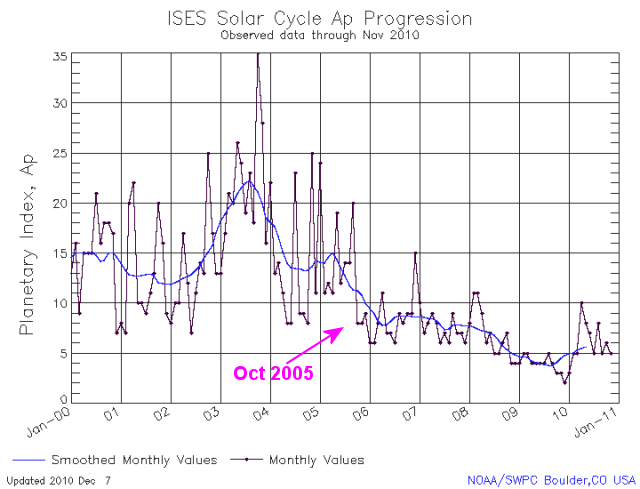
The Sun’s magnetic field extends far out into space.  It not only surrounds Earth, it also extends well beyond Pluto.  The more powerful the Sun’s magnetic field, the more it alters the  Earth’s geomagnetic field.    The Ap index is measure of this alteration.   The Ap index measurements began in the 1930’s.   The chart  that follows shows the Ap index beginning in 2000 through most of  2010.  The peak in the 2003 -2004 time frame is Cycle 23.  The Solar activity was high during that time, reaching an Ap index of 35 at its peak.  In October 2005,  the Ap Index dropped significantly and has remained very low since then.

The  following chart shows the Ap index from October 2010  through the end of December 2010.  Note that the index has bottomed out at zero on several occasions.  This chart also illustrates the how well the Solar Flux, the Sunspot Number and the Ap Index  correlate.

(This chart was prepared by Jan Alvestad)

No one knows exactly the mechanism that causes the Earth to cool when these proxies are low or warm when they are up.  No one knows exactly why the Sun has 11 (+-) year cycles.  Maybe we will never learn enough to be able to predict accurately the future state of the solar activity.  If so,  we will never be able to accurately predict the Earth’s future climate.  But we can reasonably predict that the Earth’s climate will cool as long as these proxies stay low (below normal), indicating low solar activity.
Moreover, we can’t control solar activity.  We can’t control Earth’s orbit around the Sun.  The Sun is in charge of our climate.  Man has precious little control of the climate in the big picture.   Attempts to moderate the Earth’s climate through reduction of CO2, for example, will have limited to no effect on climate although it will have a profound negative impact on our economic well being .

Our efforts should be directed toward adaptation to what every the Sun dishes out.

For more on this topic see posting Part 1 and Part 2 of Sun And Climate.

cbdakota

Sun and Climate Change -PART 2: Sunspots


Following up from the previous posting, Sun and Climate Change Part 1-Solar Activity, we will continue to examine the connection between the Sun and the Earth’s climate.

Sun’s Magnetic Field

On average, the Sun’s magnetic field is thought to be only about twice as strong as Earth’s magnetic field. The magnetic field is generated by the rotation of the Sun acting like a giant electromagnet.  But it has local fields of enormous strength, something in the range of 8000 times greater that Earth’s field.  It is believed that the cause of these local fields is the differential rotation of the Sun’s latitudes.  The observed rotation at the equator is 25 days and near the poles about 35 days is due to the fact that the Sun is made up of plasma and hot gases.  This results in the magnetic field becoming twisted and erupting from the surface in these local fields.  Where this enormous magnetic force exists, you find Sunspots, flares, and coronal mass ejections (CME). The Sun has a cycle of about 11 years from minimum to maximum and back to minimum magnetic activity.  This cycle can be observed by the numbers of Sunspots formed on the surface of the Sun.   During a cycle, the Sunspot number increase until the Sun’s polarity “flips”.  The Sun’s magnetic polar north flips and points south.  This usually is the point at which the so-called solar maximum is reached. The activity on the Sun begins to decrease.  The cycle eventually reaching a point where very few Sunspots are observed.  This is the completion of a cycle.

Sunspots

Sunspots are the product of the enormous magnetic fields (thousands of times stronger than Earths magnetic field) created on the Sun. They appear as dark spots.   The Spots are cooler than the surrounding surface of the Sun.  NASA says that the Spots are about 3700K versus 5700K for the surrounding photosphere.

Sunspots are probably not the best indicators of the Sun’s activity but the better indicators have little history where as Sunspots have been recorded for hundreds of years. What make them especially interesting is that the Earth’s climate and Sunspots have a high degree of correlation.   Periods where the Earth’s climate has cooled off appear to coincide with periods of few Sunspots and periods of warmer climate seem to coincide with periods of high Sunspot counts.

Chart Courtesy of Wikimedia Commons

The telescopic recording of Sunspots began  with Galileo using the newly invented telescope to observe the sunspots in 1610.  He and later others began to count the sunspots.

When a solar cycle is forecast, the y-axis is usually Sunspot numbers and the x-axis is time.   The current solar cycle is 24.   On the chart below, the blue line is the monthly average of Sunspots. It shows  cycle 23 declining from its high and then cycle 24 as it begins to rise.  The orange line was the predicted shape of cycle 24 by NASA experts but the actual Sunspot numbers are lower than forecast. The experts have found it necessary to continue to reduce the numbers (height) of the forecast monthly Sunspot numbers.  In 2006 they forecast a height of cycle 24 at a sunspot number of 156 to 180. The following chart is from a posting by Anthony Watts on his blog,  WattsUpWithThat and can be seen here.

The following chart shows the latest  (Dec 2010) prediction of NASA and how they have found it necessary to continue to lower their expectations over time to new “high Sunspot number” of 64!!!  Although some people think they have a system that allows them to predict these numbers, its clear that no one knows enough to make any forecast that’s good enough to bet on it. The NASA forecast has been downgraded four times since the March 2006 prediction.

(The chart courtesy of Ira Glickstein on WUWT blog and can be seen here.)

There is one additional factor that the reader needs to be aware of, and that is comparing Sunspot counts of old and those of today could be problematic.   The pinpricks that are counted on the sun today with the high-powered equipment were probably not even noticed in years past.   So when it is reported that the sunspot count during period of the Maunder Minimum in lower than today, you cannot be sure we are comparing apples and apples.   Some discussion about this variable can be found here.

But no matter how you count them, the cycle 24 sunspots are out of the norm. Cycle 24 is being compared to Cycle 5 which occurred at the time of the Daulton Minimum.  The indications are Earth’s  climate is in for a period of cooling.

cbdakota


Sun and Climate Change -PART 1: SOLAR ACTIVITY


Two years ago, this December, I wrote an essay titled “Sun and Climate Change”.   The essay opened with this summary statement:

Climate change has always been underway on Earth.  Periods of cooling, then warming, then cooling, etc. are historical facts.  These changes, over millions of years, have had natural causes that do not include burning of fossil fuels.

Correlation might mean causation.  But no correlation clearly means no causation.  The ice core and ocean bottom core data that provide a look back into time, show that atmospheric carbon dioxide (CO2) lags global temperature change.  It says that CO2 begins to increase after the global temperature begins to increase and it decreases after the temperature decreases.  So CO2 does not cause temperature to change. Yes, I am aware that CO2 plays a small role as a greenhouse gas.  But it is water, in the form of vapor and clouds, which does 90% of the greenhouse work.

The Sun, however, has correlation with climate change.  After many years of low solar activity (known as the Sporer, Maunder and Dalton Minimums), a comparatively cool climatic period followed that lasted from 1450 to 1820.  This cool period is known as The Little Ice Age. Then came many years of increasingly greater solar activity that stretched into the 20th century.  Some solar scientists say that this period has been the most active in the last 11,000 years.  Global warming has been a consequence of these more active, recent solar cycles.

So where are we now?   At the moment, the global temperature is falling.  The global temperature is cooler now than it was at the end of the last century.  Figure 1, shows how the global temperature has been declining. The solar activity is down; in fact, August 2008 was the first calendar month in 100 years that no sunspots were recorded.  Sunspots appear to be a reliable proxy for solar activity.   Will this period of cooling last? I don’t know.  I hope that we do not descend into another Ice Age, Little or Big. I would rather have warming.  What I am reasonably confident of is that fossil fuel use restrictions (in order to reduce atmospheric CO2) will make little difference relative to global warming.  I am reasonably confident that the Sun is the critical player here and there is little we can do to change whatever the Sun decides to do.  Even though the exact mechanism linking the Sun and global climate change has not yet been definitively established, it is kind of like gravity–it is obvious even if we cannot fully define it.

Two years later some tweaking could be done to the preceding but for the most part it is accurate and further, the intervening time has provided even more compelling evidence.

Solar Activity,  Solar magnetism, Solar cycles, and Sunspots will be discussed in this and future postings.

SOLAR ACTIVITY

A new peer-reviewed paper was recently published in the Journal of Geophysical Research:  (the source is the Blog IceCap.  To read more click here)

...that reconstructions of total solar irradiance (TSI) show a significant increase since the Maunder minimum in the 1600’s during the Little Ice Age and shows further increases over the 19th and 20th centuries. The TSI is estimated to have increased 1.25 W/m2 since the Maunder minimum ………..

It remarkable that the authors say that most of the warming since 1850 can be accounted for by the increase in solar activity:

Use of the Stefan-Boltzmann equation indicates that a 1.25 W/m2 increase in solar activity could account for an approximate .44C global temperature increase [the HADCRU global warming from 1850 to 2000 is .55C].

The paper is Reconstruction of solar spectral irradiance since the Maunder Minimum, by N.A. Krivova, L.E. A. Vieira, S. K. Solanki

Journal of Geophysical Research

For more on this topic see Sun and Climate Change Part 2 Sun Spots

cbdakota

CANCUN AND WORLD GOVERNMENT–PART 2


From my preceding posting Cancun and World Government—-the meeting in Cancun makes the assumption that emitted CO2 is causing harm to undeveloped or underdeveloped nations.  To make amends for this, the developed nations are to pay reparations to the other nations.  The “Chairman’s note” in the previous blog shows the UN would manage these payments which could be as large as 1.5% of GDP.

NOW WHAT COULD BE WRONG WITH ALL OF THAT, YOU ASK?   Let me count the ways:

1.  There is no scientific evidence that CO2 has or will cause any significant “harm”.  I suppose one could argue that anything that keeps the world from going into another Ice Age is a welcome addition.  And for those advocates of the Precautionary Principle, why not contribute of some activity or fund that might prevent a new Ice Age.  In either direction, hot or cold, I don’t believe your contributions will be able to reverse the direction.

2.  We do know that the underdeveloped and undeveloped nations have been blessed by the developed countries.  Great advances available to all peoples of the world in medicine, chemistry, mathematics, and literature are (for the period of time of the warmist concerns about CO2) products of the developed nations.   Using the Noble Prize as a parameter, the top winners are shown in the chart below as well as several examples of the contribution by some of the loudest wanting reparations:

Nation Total Prizes Won Less Peace and Lit
USA 326 296
UK 115 95
Germany 102 86
France 57 33
Venezuela 1

Bolivia 0 0

Excluding literature and Peace is a questionable exercise but when I see that in this decade, the Peace prize has been won by Obama, Gore and Carter, one has to wonder what value that prize is to anyone.

One also wonders why Venezuela, for example, being a big producer, user and exporter of oil is somehow not classified as one of the payers of reparations rather than a recipient as they see themselves.  Is this the “drug producer and supplier” proviso—you know it’s not their fault it is only the users fault.

Thinking about medicine and health, don’t they owe us a lot for saving the lives of millions?  Real lives, not these hypothetical lost lives the IPCC keeps coming up with.   Polio almost eliminated everywhere.  Small Pox a thing of the past.   Malaria deaths could be down significantly if environmentalists got out of the way.   HIV death rates in reverse everywhere.  Don’t they owe us for all the advances in their lives resulting from the inventions, all the advances in science as well? Click here to see Prize distribution.

3.   Giving the UN money is the surest way to see that it gets into the wrong hands.  Need I remind you of the Iraq Oil for Food program?  I believe that the UN may have the biggest collection of scammers ever to be in one organization.

4.   The UN is made up of countries that are not democratic or only partially democratic.  The Nobel Organization has a nice slide show illustrating the nations that are democratic and those that are not.   In large measure, democracy is the form of government of the successful nations in this world.   The advances in world knowledge come fundamentally from these countries.  The Nobel Prizes illustrate this.

There are only 4 nations in the world that state that they are not democracies.  They are Vatican City, Saudi Arabia, Burma and Brunei.  But in fact most of Asia, with the notable exception of India, and most of Africa with the notable exception of The Republic of South Africa are populated by countries that may have “democratic republic” in their nation’s title but they are not democratic in any sense.  The Slideshow I mentioned says that 3 billion people live in democracies and 3.6 million do not.  I do not want the majority of the world’s people running the UN now, and surely don’t want that organization to be running this country.

To see the slideshow, click here.

Apparently, President Obama’s representatives are in cahoots with these thieves at the Cancun meeting.  Write your Congressional Members and tell we want no part of this reparations plan.

cbdakota

Weakness of AGW Theory- Part 6-A Legal Takedown


The University of Pennsylvania Law School has published Research Paper no. 10-08  titled  “Global Warming Advocacy Science: A Cross Examination” written by Jason Scott Johnston. His technique is a novel way of getting at the truth.  Johnson approaches the question of the validity of Anthropogenic Global Warming (AGW) as if it were in a court of law. While you may know a lot about this topic, my guess is that if you read it you will learn some new things.  I am familiar with the skeptic’s arguments but some of the AGW believer’s arguments were new to me.  Johnston takes a look at the arguments and treats them as if he were cross examining the two sides.

He does a nice job of exposing the weakness of “positive feedback” that is the basis for the computer projections of calamitous happenings if CO2 emissions are not checked. Further that computer projections of future climate are not science.  He highlights the rhetoric used by the alarmists that gets headlines and muddies the waters.

Johnston’s concludes his examination with these thoughts:  (ghg=green house gas)

Even if the reader is at this point persuaded to believe that there remain very important open questions about ghg emissions and global warming, and important areas of disagreement among climate scientists, she may well ask: So what? After all, such a reader might argue, CO2 is a ghg, and if we continue to increase CO2, then it seems clear that despite whatever uncertainty there may be about how much temperatures will increase as a consequence of increasing CO2 in the atmosphere, and about the impacts of such rising temperatures, there is no doubt that temperatures will increase with increasing CO2, and that at some point, such rising temperatures will cause harm, so that one way or another, at one time or another, we simply have to reduce our emissions of CO2.

However beguiling, such an argument not only oversimplifies the policy questions raised by human ghg emissions, it is also misunderstands the significance of the scientific questions revealed by my cross examination for the predictability of anthroprogenically-forced climate change. Consider first the scientific questions. If climate were a simple linear system – with increases in atmospheric CO2 directly and simply determining future warming – then while a detailed understanding of the earth’s climate system might still of scientific interest, there would be little policy justification for expending large amounts of public money to gain such an understanding. But if one thing is clear in climate science it is that the earth’s climate system is not linear, but is instead a highly complex, non-linear system made up of sub-systems – such as the ENSO, and the North Atlantic Oscillation, and the various circulating systems of the oceans – that are themselves highly non-linear. Among other things, such non-linearity means that it may be extremely difficult to separately identify the impact of an external shock to the system – such as what climate scientists call anthropogenic CO2 forcing – from changes that are simply due to natural cycles, or due to other external natural and anthropogenic forces, such as solar variation and human land use changes. Perhaps even more importantly, any given forcing may have impacts that are much larger – in the case of positive feedbacks – or much smaller – in the case of negative feedbacks – than a simple, linear vision of the climate system would suggest. Because of the system’s complexity and non-linearity, without a quite detailed understanding of the system, scientists cannot provide useful guidance regarding the impact on climate of increases in atmospheric ghg concentration.

As a large number of climate scientists have stressed, such an understanding will come about only if theoretical and model-driven predictions are tested against actual observational evidence. This is just to say that to really provide policymakers with the kind of information they need, climate scientists ought to follow the scientific method of developing theories and then testing those theories against the best available evidence. It is here that the cross examination conducted above yields its most valuable lesson, for it reveals what seem to be systematic patterns and practices that diverge from, and problems that impede, the application of basic scientific methods in establishment climate science. Among the most surprising and yet standard practices is a tendency in establishment climate science to simply ignore published studies that develop and/or present evidence tending to disconfirm various predictions or assumptions of the establishment view that increases in CO2 explain virtually all recent climate change.

Perhaps even more troubling, when establishment climate scientists do respond to studies supporting alternative hypotheses to the CO2 primacy view, they more often than not rely upon completely different observational datasets which they say confirm (or at least don’t disconfirm) climate model predictions. The point is important and worth further elucidation: while there are quite a large number of published papers reporting evidence that seems to disconfirm one or another climate model prediction, there is virtually no instance in which establishment climate scientists have taken such disconfirming evidence as an indication that the climate models may simply be wrong. Rather, in every important case, the establishment response is to question the reliability of the disconfirming evidence and then to find other evidence that is consistent with model predictions. Of course, the same point may be made of climate scientists who present the disconfirming studies: they tend to rely upon different datasets than do establishment climate scientists. From either point of view, there seems to be a real problem for climate science: With many crucial, testable predications – as for example the model prediction of differential tropical tropospheric versus surface warming – there is no indication that climate scientists are converging toward the use of standard observational datasets that they agree to be valid and reliable. Without such convergence, the predictions of climate models (and climate change theories more generally) cannot be subject to empirical testing, for it will always be possible for one side in any dispute to use one observational dataset and the other side to use some other observational dataset. Hence perhaps the central policy implication of the cross-examination conducted above is a very concrete and yet perhaps surprising one: public funding for climate science should be concentrated on the development of better, standardized observational datasets that achieve close to universal acceptance as valid and reliable. We should not be using public money to pay for faster and faster computers so that increasingly fine-grained climate models can be subjected to ever larger numbers of simulations until we have got the data to test whether the predictions of existing models are confirmed (or not disconfirmed) by the evidence.

This might seem like a more or less obvious policy recommendation, but if it were taken, it would represent not only a change in climate science funding practices, but also a reaffirmation of the role of basic scientific methodology in guiding publicly funded climate science. As things now stand, the advocates representing the establishment climate science story broadcast (usually with color diagrams) the predictions of climate models as if they were the results of experiments – actual evidence. Alongside these multi-colored multi-century model-simulated time series come stories, anecdotes, and photos – such as the iconic stranded polar bear — dramatically illustrating climate change today. On this rhetorical strategy, the models are to be taken on faith, and the stories and photos as evidence of the models’ truth. Policy carrying potential costs in the trillions of dollars ought not to be based on stories and photos confirming faith in models, but rather on precise and replicable testing of the models’ predictions against solid observational data.

This is a long paper,  some  80 pages, but I suggest that you read the entire document which you can do by clicking here.

Cbdakota

Oceans to Rise 1″ in 526 years. Man the Lifeboats.


Wattsupwiththat.com posts a blog about a University of Leeds press release titled “Melting Icebergs causing sea level rise”.  According to Professor Andrew Shepherd it would be unwise to discount this signal.  After he explains how melting icebergs cause this threat, he provides the punch line which is, “……the net effect is to increase sea level by 2.6% of its volume which is equivalent to 49 micrometers per year spread across the global oceans.”

Now you may already be laughing.  WUWT does the math (49 micrometers equals 0.0019 inches) and concludes, it will take 526 years to result in one inch of sea level rise because of this “threat.”  See the full story here.

The best laugh I got from this press release was a comment made on this story; as follows:

H.R. says:

April 30, 2010 at 12:10 pm

Note to self: in 526 years, send trousers to tailor and have them hemmed up.

Cbdakota