Category Archives: cap and trade

Strip EPA of Carbon Regulation Authority


This week, when Harry Reid opened a small business bill to amendments, Mitch McConnell introduced a rider that would strip the EPA of its ability to regulate carbon.  It is considered possible that enough Democrat Senators will ally with the Republicans Senators to see that this amendment will pass. The vote is schedule this week and may happen tomorrow.

You all probably know that the Clean Air Act did not specify CO2 as pollutant but the Supreme Court after hearing arguments in Massachusetts vs. EPA ruled that if the EPA studied the issue and concluded that CO2 was a hazard, they could regulate CO2.   The Legislative branch of the Federal government was unable to pass legislation to regulate CO2, so the Supreme Court in a gesture too often seen, chose to step outside of their boundaries and in a 5 to 4 vote took on the legislative role which they do not have the justification to do.  In effect the Supremes passed Cap and Trade legislation, which has routinely been defeated in the Senate.  And worse, gave the Executive Branch carte blanche to write the regulations.

The Wall Street Journal’s posting -The Senate EPA Showdown,on this topic says:

But a vote for the McConnell amendment, which would permanently bar the EPA from regulating carbon unless Congress passed new legislation, is justified on democratic prerogatives alone. Whatever one’s views of Massachusetts v. EPA or climate science, no elected representative has ever voted on an EPA plan that has often involved the unilateral redrafting of plain-letter law.

The WSJ posting adds that the potential Democrat Senators that are leaning toward supporting the McConnell amendment are:

Democrats to watch will be Sherrod Brown (Ohio), Bob Casey (Pennsylvania), Tim Johnson (South Dakota), Tom Carper (Delaware), Mary Landrieu (Louisiana), Kent Conrad (North Dakota), Amy Klobuchar (Minnesota), Claire McCaskill (Missouri), Jim Webb (Virginia), Ben Nelson (Nebraska), Carl Levin and Debbie Stabenow (Michigan) and John Rockefeller and Joe Manchin (West Virginia). All of them have been publicly critical of the EPA, and, not incidentally, most of them face a tough re-election.

The WSJ adds:

The McConnell amendment is one of the best proposals for growth and job creation to make it onto the Senate docket in years. If Mr. Obama is intent on defending the EPA’s regulatory assault, then the least Senate Democrats can do is force him to defend his choices himself.

Get in touch with your Senator and urge he/she to vote for growth and job creation by joining the Republicans to pass the McConnell amendment.

cbdakota

DELAWARE AND BLUEWATER WIND


For this posting  I want to use my neighboring state of Delaware and the proposed off-shore wind farm as an example of what the rate payers in that state are facing.

Several years ago furious because of what happened when the price of electricity was deregulated Delawareans were led to believe they could protect themselves from this happening again by installing an offshore windfarm to produce “renewable” electricity.   Driven by the perception that the price of electricity would be less expensive and that it would help save the planet by reducing the electricity produced by natural gas or coal,  they willingly accepted the idea of offshore windfarm.  Moreover the State mandated that a percentage of the electricity used in the State had to be produced from “renewable” energy.

With much political pressure being applied, Delaware Power (the major Delaware Utility) began negotiations with Bluewater Wind (BWW).   Delaware Power reluctantly signed a contract to buy the electricity from this proposed wind farm.

Unfortunately for the Delawareans who thought the deregulated price of electricity was high, they are in for a bigger shock if they allow the BWW offshore windfarm to become a fact.  And wherever windfarms are installed, they are so unreliable that equivalent fossil fuel electrical generating capacity must be installed to protect the electrical users from interruption of their supply. This adds more cost and does nothing to reduce carbon dioxide emissions.

PRICE OF ELECTICITY FROM OFF-SHORE WINDFARMS

Lets look first at cost.   The Department of Energy’s Energy Information Agency says that without subsidies the price of electricity from offshore windfarms is not viable.  The following table is the EAI’s latest estimate of the cost of electricity production in 2016 when BWW says they will be producing electricity:

LEVELIZED COSTS OF ELECTRICITY IN 2016

Look at the column “Total System Levelized Costs” for conventional coal, and conventional combined cycle (in the Natural Gas-fired grouping) and then compare these costs to the levelized cost of Wind-Offshore:

Coal is $94.8 per megawatt hour or more familiarly  $0.095 per kilowatt hour.

Natural gas is $0.066 per kilowatt hour

Wind—Offshore is $0.243 per kilowatt hour.

To give you a little background on these numbers, the EAI penalized the natural gas and coal plants estimates with a cost of buying CO2 credits which would be necessary if the our country ever losses its mind and passes “cap and trade”. These penalties do not currently exist but are included anyway.

The Wind—offshore costs do not reflect the subsidies that the government is handing out to cover the real costs shown in this chart.

CAPACITY FACTOR AND ITS AFFECT ON COSTS

The capacity factor is a measure of the percentage of the rated capacity that can be depended upon.  The main natural gas and coal plants operate most of the time at a percentage of rated capacity in the mid to upper 80tys.  The Wind—offshore has a capacity factor of 39.3%.   From what one reads in the literature where actual performance of windfarms is recorded, the number of 39.3% vastly overstates their performance, which is often said to be in the 19 to 20% range.  Were the EAI to use the lower capacity factor,  the cost for wind produced electricity would be even more expensive than the $0.243 per kilowatt hour.

Several of the Natural Gas fired cases are nearly as high as the wind cases.  This is because these cases are for the backup turbine units that utilities must have to meet unexpected changes in supply or demand.  These natural gas turbines have capacity factors of 30% but can achieve a much higher number.  However, they are more costly to operate and are only used, as noted earlier, as backup.

The US has a vast surplus of natural gas.   The forecast cost to produce electricity in a natural gas based plant based upon the Department of Energy’s forecast in 2016, is about 27% of the offshore windfarm for that same year.  Will there ever be a time that these wind farms can compete in the market place or will we rate payers always have to subsidize them?

The fundamental problem with windfarms (and solar) is the fact that they can be working one minute and not the next.  The wind (or cloudless sunny days) can not be scheduled.  The electrical grid operators must be able to rely upon the electrical generation units to provide the power needed to match the user’s demands.  The low cost plants, fueled by coal, natural gas or nuclear are used as the base load.  They are steady and reliable.   These base load units are not capable of rapidly increasing or decreasing the generation of electricity.   Delaware Power, like other producers of electricity have units on hot standby that can be put into service almost immediately to meet peak requirements by their customers.  And as this demand drops off, they can easily be backed down as necessary to stay in balance.

Why have wind farms unless they can provide base load electricity?  They cannot because these farms can not control the wind.    Often when very cold or very hot weather  occurs, the wind does not blow at all.   So instead of base loading they are relegated to being spot suppliers. It is widely understood that, on balance, for every kw of wind farm capacity that is brought on line, the equivalent amount of natural gas turbine capacity must also be added.    For skeptics of the theory of man-made global warming, the fact that windfarms did not result in any less CO2 vented to the atmosphere, is not a big concern.   But it surely should give the believers in manmade global warming a big case of indigestion.

BLUEWATER WIND

Delaware has an excellent source of information about BWW in the “Inside Energy” blog published by the Caesar Rodney Institute.   Recently they posted a blog  RE: Prediction: Bluewater Wind Project Will Crash and Burn. The blog notes that 2016 is the earliest startup date and adds:

The earliest start-up date for the offshore wind facility is now 2016 when the price will be $.142/Kilowatt-hour (KWh). Similar projects off the coasts of New England and Europe have set contract prices between $.19 and $.24/KWh. There is nothing magic about the waters off the coast of Delaware to justify the difference in price.

The higher prices in other locations already account for government construction subsidies which will come to $800 million for the Bluewater Wind project. However, the subsidies only extend to facilities built by the end of 2011. The US Congress, exhibiting symptoms of subsidy fatigue, may not extend the subsidies further for a mature industry that accounted for 39% of all new generating capacity in 2009. So an even higher price increase may be needed to sustain the project next year.

The wind project is expected to provide about 1.1 billion KWh of electricity a year. Wholesale power from conventional sources costs about $.06/KWH. The “Green Premium” for offshore wind power could range between $.08/KWH and $.20/KWh at full price with no government subsidies. This will cost Delaware consumers between $90 and $220 million a year.

There will be hearings on BWW in May and you are encouraged to join with the folks from the Caesar Rodney Institute.  Regarding this hearing they add:

NRG, the owners of Bluewater Wind, will have to seek a significant rate increase to justify the investment in its’ Delaware offshore wind project. The attempt could fail bringing the project to an end. The good news is this will save Delaware electricity consumers hundreds of millions of dollars a year in avoided price increases and could save hundreds of jobs.

In a future posting, I want to let you in on the reasons why there are many big companies pushing these windfarm schemes on the rate payers.

cbdakota

Obama’s Administration Policies Wont Lower Gas Prices


Whenever the price of gasoline takes a sharp rise, I get a flood of emails that have some scheme to beat those wascally waiders of our pocket-book–the usual suspect is Exxon/Mobile.   The scheme calls for us to not buy from Exxon or who ever the scheme writer doesn’t like.   Then this narrative says that to get back into the market the target company will have to lower prices thus start a price war.  This scheme might lower prices a few cents per gallon over time but it would not be  significant.  A more effective scheme would be for automotive community to drive 10% fewer miles each month.  The recent recession did affect supply and demand enough to make a significant change in price.  But now that we seem to be climbing slowly out of this really bad economy, we are driving more and the  gasoline prices are moving up.

Along with more miles being driven, the crude oil traders, fearing loss of producing fields resulting from the turmoil in the Middle-East,  are trying to secure their supply.  Thus bidding up of the price of a barrel of crude is underway.  Couple those two issues with the declining value of the dollar, the price  of crude is now in the vicinity of $100 per barrel.  (Remember, oil trades are denominated in dollars US.)

If the citizens of the US really want to bring crude oil prices down (and thus pump pricing) then it will be necessary to implement a program that will be at odds with the current administrations policies.  The Heritage Foundation has a proposal for doing just that: “THREE POLICY CHANGES TO HELP WITH GASOLINE PRICES” on their WebMemo blog site. The thrust of these three policy changes is summarized here:

A Familiar Pattern. When petroleum and gasoline prices shot up during the energy crisis of  1970, the experts and pundits predicted imminent resource exhaustion, skyrocketing prices, and energy poverty. Instead, markets responded by searching for, discovering, and producing enough oil to provide over two decades of low prices. For instance, in the U.S. alone, the number of drilling rigs more than tripled between September 1973 (before the Yom Kippur War and the subsequent Arab oil embargo) and December 1981. Now, imminent oil depletion and the futility of drilling are again supposedly on the horizon. However, increased drilling activity follows increased petroleum prices. Blunting this natural market response will drive up energy prices and reduce national income. This, plus the Keystone XL pipeline and scaling back EPA expansion of the Clean Air Act, would do much to stabilize gas prices and energy costs in general.

The three policy changes necessary according to the Heritage Foundation are:

1  INCREASE DRILLING

  • Relatively small changes in supply can have large impacts on price, especially when markets are tight. And tight markets are what caused the petroleum price spikes of 2008 and will cause them again if production is shut down while demand from a growing world economy squeezes the spare capacity the world has enjoyed for the past couple of years.
  • The first and most obvious place to drill is where there are already drilling rigs and proven reserves— such as the Gulf of Mexico. Despite the majority recommendation of its own scientific panel, the Obama Administration stopped virtually all new drilling in the Gulf of Mexico. There have been recent signs that this policy might change. “Might” needs to be “will,” and soon.

2 SHELVE “LOW-CARBON FUEL STANDARDS”

  • The concept of “low-carbon fuel standards” is driving opposition to a petroleum pipeline from Canada.  With its oil sands, Canada has more proven petroleum reserves than any country other than Saudi Arabia. A consistent ally and long-time friendly neighbor, Canada is exactly the sort of supplier the U.S. should want to fill the gap in the petroleum it cannot produce on its own. But some policymakers want to put these vast reserves off limits to American consumers.
  • The Keystone XL pipeline would bring the U.S. over a million barrels of petroleum each day—more than it imports from either Saudi Arabia or Venezuela (the U.S.’s two largest suppliers after Canada and Mexico). Secretary of State Hillary Clinton should be applauded for her statements in support of the pipeline.  However, other components of the Administration, notably the Environmental Protection Agency (EPA), have taken steps to slow or stop the pipeline.

STOP EPA ABUSE OF THE CLEAN AIR ACT

  • The EPA’s abuse of the Clean Air Act will drive up refining costs and, therefore, gasoline prices. Though the use of the act to regulate carbon dioxide (CO2) would create large problems in many places, the EPA recently started the process to regulate CO2 emissions from refineries. This regulation goes beyond the gasoline reformulation mandates that balkanize gasoline markets with higher-cost boutique fuels.
  • The new CO2 regulation puts an additional burden on refiners’ costs and subsequently raises prices of gasoline, diesel fuel, and home heating oil. Further, it will increase the amount of refined product the U.S. imports and reduce employment in an industry with wages that are more than 40 percent higher than the national average.

To read the Heritage blog in full  click

cbdakota

BBC SCIENCE PROPAGANDA


Propelled by the Climategate email scandal, cooling global temperatures, total failure of the Copenhagen climate conference, many false and otherwise erroneous reports in the IPCC 4th report on Climate Change, etc. the public is becoming aware of the bill of goods that has been feed to them in recent years by the mainstream media, Al Gore, and politicians of all stripes who want to tax and regulate you. Polls show waning  support for draconian taxes and regulation  in order to cut fossil fuel CO2 emissions.

This past week, the BBC aired a program they produced titled “Science Under Attack”.   The objective of the program was to bolster the man-made global warming theory (AGW).

So how good was the BBC’s “Science Under Attack”?

A desperate and sleazy program according to Christopher Booker as told in his posting “How BBC warmists abuse the science”:

The formula the BBC uses in its forlorn attempts to counterattack has been familiar ever since its 2008 series Climate Wars. First, a presenter with some scientific credentials comes on, apparently to look impartially at the evidence. Supporters of the cause are allowed to put their case without challenge. Hours of film of climate-change “deniers” are cherrypicked for soundbites that can be shown, out of context, to make them look ridiculous. The presenter can then conclude that the “deniers” are a tiny handful of eccentrics standing out against an overwhelming scientific “consensus”.

The scientist picked to front the progamme was Sir Paul Nurse, a Nobel Prize-winning geneticist, now President of the Royal Society (which has been promoting warmist orthodoxy even longer than the BBC). The cue to justify the programme’s title was all the criticism which greeted those Climategate emails leaked from Sir Paul’s old university, East Anglia, showing how scientists had been manipulating their data to support the claim that temperatures have recently risen to unprecedented levels.

One of the two “deniers” chosen to be stitched up, in classic BBC fashion, was the Telegraph’s James Delingpole. He has spoken for his own experience on our website. Still worse, however, was the treatment of Professor Fred Singer, the distinguished 86-year-old atmospheric physicist who set up the satellite system for the US National Weather Bureau. We saw Nurse cosying up to Singer in a coffee house, then a brief clip of the professor explaining how a particular stalagmite study had shown temperature fluctuations correlating much more neatly with solar activity than with levels of CO2. This snippet enabled Nurse to imply that Singer’s scepticism is based on one tiny local example, whereas real scientists look at the overall big picture. No mention of the 800-page report edited by Singer in which dozens of expert scientists challenge the CO2 orthodoxy from every angle.

For those that attend to the Climate Change Sanity postings routinely  (see) will instantly spot how poor the programming was and how little about the subject, Sir Paul Nurse knows when your read the following Booker comments:

The most telling moment, however, came in an interview between Nurse and a computer-modelling scientist from Nasa, presented as a general climate expert although he is only a specialist in ice studies. Asked to quantify the relative contributions of CO2 to the atmosphere by human and natural causes, his seemingly devastating reply was that 7 gigatons (billion tons) are emitted each year by human activity while only 1 gigaton comes from natural sources such as the oceans. This was so much the message they wanted that Nurse invited him to confirm that human emissions are seven times greater than those from all natural sources.

This was mind-boggling. It is generally agreed that the 7 billion tonnes of CO2 due to human activity represent just over 3 per cent of the total emitted. That given off by natural sources, such as the oceans, is vastly greater than this, more than 96 per cent of the total. One may argue about the “carbon cycle” and how much CO2 the oceans and plants reabsorb. But, as baldly stated, the point was simply a grotesque misrepresentation, serving, like many of the programme’s other assertions, only to give viewers a wholly misleading impression.

You can read James Delingpoles discussion of the Nurse “gotcha interview” here.

For 10 years Peter Sissons was the BBC evening news anchor.   In his recently published memoirs, he says:

“The BBC became a propaganda machine for climate change zealots, and I was treated as a lunatic for daring to dissent”.

The BBC and the Warmists desperation in producing a program like this is palpable and it argues strongly that the BBC has lost its integrity.

cbdakota

SUN AND CLIMATE PART 3: SOLAR FLUX & Ap INDEX


In the two prior postings Sun and Climate,Parts 1 and 2,  we have talked about Solar Activity and how it relates to climate.  In Part 1, the discussion was primarily about Solar Insolation, and Part 2 began the discussion about solar activity using Sunspots as a proxy.   Sunspots are popularly used to indicate Solar activity due to their longevity.  Galileo began noting and recording them in the sixteen hundreds.

Ok,   now lets look at some more physical evidence that shows a strong correlation with solar activity/climate change.

Two much newer and probably better proxy measures are Solar Flux and Average Magnetic Planetary Index (Ap index).

SOLAR FLUX

The former is a measure of noise or flux that is emitted at a frequency of 2800 MHz (10.7cm).  This measure is typically referred to as F10.7.  This proxy measures ionization in the ionosphere’s F region.    The solar wind from the Sun contains many atomic particles.  The Earth’s geomagnetic field deflects the majority of the protons and electrons being expelled from the Sun toward the Earth.  But the as the Sun’s activity increases more particles are expelled and more break through into the Earth’s ionosphere where F10.7 measures the increase.    Continuous F10.7 measurement and record maintenance began in 1947. As can be noted from the shape of the current (Nov. 2010) monthly summary chart of F10.7,   it is lagging the same point on the red line where the experts had predicted it would be at this time in Cycle 24.

And as we noted in Sun and Climate Part 2,  the forecast Cycle 24  has been  scaled down several times in the last few years in order to match actual real world results which have consistently come in below each new forecast.  Note that the level of F10.7  at the peak of Cycle 23 in 2001 and 2002 reached nearly 240.

AVERAGE MAGNETIC PLANETARY INDEX –Ap

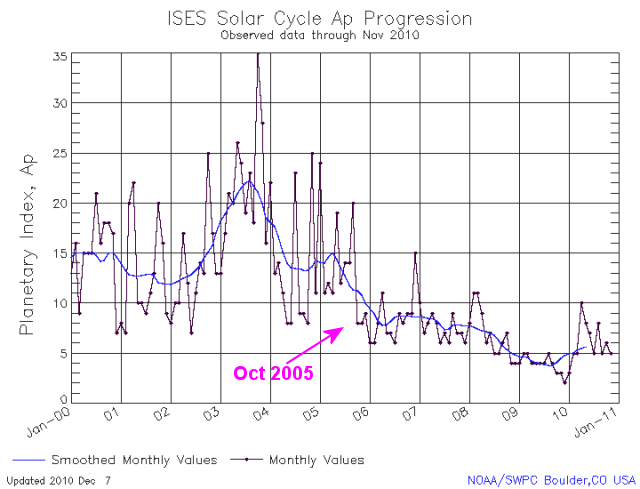
The Sun’s magnetic field extends far out into space.  It not only surrounds Earth, it also extends well beyond Pluto.  The more powerful the Sun’s magnetic field, the more it alters the  Earth’s geomagnetic field.    The Ap index is measure of this alteration.   The Ap index measurements began in the 1930’s.   The chart  that follows shows the Ap index beginning in 2000 through most of  2010.  The peak in the 2003 -2004 time frame is Cycle 23.  The Solar activity was high during that time, reaching an Ap index of 35 at its peak.  In October 2005,  the Ap Index dropped significantly and has remained very low since then.

The  following chart shows the Ap index from October 2010  through the end of December 2010.  Note that the index has bottomed out at zero on several occasions.  This chart also illustrates the how well the Solar Flux, the Sunspot Number and the Ap Index  correlate.

(This chart was prepared by Jan Alvestad)

No one knows exactly the mechanism that causes the Earth to cool when these proxies are low or warm when they are up.  No one knows exactly why the Sun has 11 (+-) year cycles.  Maybe we will never learn enough to be able to predict accurately the future state of the solar activity.  If so,  we will never be able to accurately predict the Earth’s future climate.  But we can reasonably predict that the Earth’s climate will cool as long as these proxies stay low (below normal), indicating low solar activity.
Moreover, we can’t control solar activity.  We can’t control Earth’s orbit around the Sun.  The Sun is in charge of our climate.  Man has precious little control of the climate in the big picture.   Attempts to moderate the Earth’s climate through reduction of CO2, for example, will have limited to no effect on climate although it will have a profound negative impact on our economic well being .

Our efforts should be directed toward adaptation to what every the Sun dishes out.

For more on this topic see posting Part 1 and Part 2 of Sun And Climate.

cbdakota

CANCUN AND WORLD GOVERNMENT–PART 2


From my preceding posting Cancun and World Government—-the meeting in Cancun makes the assumption that emitted CO2 is causing harm to undeveloped or underdeveloped nations.  To make amends for this, the developed nations are to pay reparations to the other nations.  The “Chairman’s note” in the previous blog shows the UN would manage these payments which could be as large as 1.5% of GDP.

NOW WHAT COULD BE WRONG WITH ALL OF THAT, YOU ASK?   Let me count the ways:

1.  There is no scientific evidence that CO2 has or will cause any significant “harm”.  I suppose one could argue that anything that keeps the world from going into another Ice Age is a welcome addition.  And for those advocates of the Precautionary Principle, why not contribute of some activity or fund that might prevent a new Ice Age.  In either direction, hot or cold, I don’t believe your contributions will be able to reverse the direction.

2.  We do know that the underdeveloped and undeveloped nations have been blessed by the developed countries.  Great advances available to all peoples of the world in medicine, chemistry, mathematics, and literature are (for the period of time of the warmist concerns about CO2) products of the developed nations.   Using the Noble Prize as a parameter, the top winners are shown in the chart below as well as several examples of the contribution by some of the loudest wanting reparations:

Nation Total Prizes Won Less Peace and Lit
USA 326 296
UK 115 95
Germany 102 86
France 57 33
Venezuela 1

Bolivia 0 0

Excluding literature and Peace is a questionable exercise but when I see that in this decade, the Peace prize has been won by Obama, Gore and Carter, one has to wonder what value that prize is to anyone.

One also wonders why Venezuela, for example, being a big producer, user and exporter of oil is somehow not classified as one of the payers of reparations rather than a recipient as they see themselves.  Is this the “drug producer and supplier” proviso—you know it’s not their fault it is only the users fault.

Thinking about medicine and health, don’t they owe us a lot for saving the lives of millions?  Real lives, not these hypothetical lost lives the IPCC keeps coming up with.   Polio almost eliminated everywhere.  Small Pox a thing of the past.   Malaria deaths could be down significantly if environmentalists got out of the way.   HIV death rates in reverse everywhere.  Don’t they owe us for all the advances in their lives resulting from the inventions, all the advances in science as well? Click here to see Prize distribution.

3.   Giving the UN money is the surest way to see that it gets into the wrong hands.  Need I remind you of the Iraq Oil for Food program?  I believe that the UN may have the biggest collection of scammers ever to be in one organization.

4.   The UN is made up of countries that are not democratic or only partially democratic.  The Nobel Organization has a nice slide show illustrating the nations that are democratic and those that are not.   In large measure, democracy is the form of government of the successful nations in this world.   The advances in world knowledge come fundamentally from these countries.  The Nobel Prizes illustrate this.

There are only 4 nations in the world that state that they are not democracies.  They are Vatican City, Saudi Arabia, Burma and Brunei.  But in fact most of Asia, with the notable exception of India, and most of Africa with the notable exception of The Republic of South Africa are populated by countries that may have “democratic republic” in their nation’s title but they are not democratic in any sense.  The Slideshow I mentioned says that 3 billion people live in democracies and 3.6 million do not.  I do not want the majority of the world’s people running the UN now, and surely don’t want that organization to be running this country.

To see the slideshow, click here.

Apparently, President Obama’s representatives are in cahoots with these thieves at the Cancun meeting.  Write your Congressional Members and tell we want no part of this reparations plan.

cbdakota

CANCUN AND WORLD GOVERNMENT


The Cancun UN global warming meeting is nearly over.  This is a political get-to-gather where the focus is to extract monies from the developed nations to pay for the harm caused by them to the undeveloped or underdeveloped nations.  This “harm” is the result of the CO2 these developed nations have emitted.  While there is no proof that such harm has actually occurred, never you mind, they want the money in any event.

In Christopher Monckton’s posting on the Science & Public Policy Institute, he summarizes a “33-page Note (FCCC/AWGLCA/2010/CRP.2) by the Chairman of the “Ad-Hoc Working Group on Long-Term Co-operative Action under the United Nations Framework Convention on Climate Change”, entitled Possible elements of the outcome, reveals all.”

Selected parts of Monckton’s summary is as follows:

Finance: Western countries will jointly provide $100 billion a year by 2020 to an unnamed new UN Fund. To keep this sum up with GDP growth, the West may commit itself to pay 1.5% of GDP to the UN each year. That is more than twice the 0.7% of GDP that the UN has recommended the West to pay in foreign aid for the past half century. Several hundred of the provisions in the Chairman’s note will impose huge financial costs on the nations of the West.

The world-government Secretariat: In all but name, the UN Convention’s Secretariat will become a world government directly controlling hundreds of global, supranational, regional, national and sub-national bureaucracies. It will receive the vast sum of taxpayers’ money ostensibly paid by the West to the Third World for adaptation to the supposed adverse consequences of imagined (and imaginary) “global warming”.

Bureaucracy: Hundreds of new interlocking bureaucracies answerable to the world-government Secretariat will vastly extend its power and reach.

Monckton relates what is missing from the Chairman’s note:

Omissions: There are several highly-significant omissions, which jointly and severally establish that the central intent of The Process no longer has anything to do with the climate, if it ever had. The objective is greatly to empower and still more greatly to enrich the international classe politique at the expense of the peoples of the West, using the climate as a pretext, so as to copy the European Union by installing in perpetuity what some delegates here are calling “transnational perma-Socialism” beyond the reach or recall of any electorate. Here are the key omissions:

· The science: The question whether any of this vast expansion of supranational power is scientifically necessary is not addressed. Instead, there is merely a pietistic affirmation of superstitious faith in the IPCC, where the conference will “recognize that deep cuts in global [greenhouse-gas] emissions are required according to science, and as documented in the [IPCC’s] Fourth Assessment Report.

The economics: There is no assessment of the extent to which any of the proposed actions to mitigate “global warming” by cutting emissions of carbon dioxide or to adapt the world to its consequences will be cost-effective. Nor, tellingly, is there any direct comparison between mitigation and adaptation in their cost-effectiveness: indeed, the IPCC was carefully structured so that mitigation and adaptation are considered by entirely separate bureaucracies producing separate reports, making any meaningful comparison difficult. Though every economic analysis of this central economic question, other than that of the now-discredited Lord Stern, shows that mitigation is a pointless fatuity and that focused adaptation to the consequences of any “global warming” that may occur would be orders of magnitude cheaper and more cost-effective, the Cancun conference outcome will continue to treat mitigation as being of equal economic utility with adaptation.

· Termination: Contracts have termination clauses to say what happens when the agreement ends. Nothing better illustrates the intent to create a permanent world-government structure than the absence of any termination provisions whatsoever in the Cancun outcome. The Process, like diamonds, is forever.

Democracy: Forget government of the people, by the people, for the people. Forget the principle of “no taxation without representation” that led to the very foundation of the United States. The provisions for the democratic election of the new, all-powerful, legislating, tax-raising world-government Secretariat by the peoples of the world may be summarized in a single word: None.

Joanne Nova posts on her blog, using Monckton’s information, what it will cost the US, Aussie and Brits if the recommended 1.5% of GDP is agreed to:

The UN wants nothing less than 1.5% of our GDP.

That’s $212 billion from the USA every year ($2700 per family of 4).

That’s $32 billion from the UK every year ($2000 per family of 4).

That’s $13 billion from Australia every year ($2400 per family of 4).

Figures calculated from the CIA world Factbook

To read Monckton’s posting in detail click here

To read Joanne Nova’s posting in more detail, click here.

For more on this topic see Cancun and World Government part 2

cbdakota

AM I MADDER AT MYSELF OR OBAMA?–Wikileaks


Those State Department Wikileaks  that discuss anthropogenic global warming (AGW) show  the Obama Administration plotting to torpedo the UN global warming Pact as much as six months prior to the December 2009  Copenhagen Climate Change summit.  I am mad at myself, because I was unable to figure out the reasons for the failure.  I thought failure of the UN proposal at the Copenhagen summit was a result of the release of the Climategate Emails and the belief that the US Congress would not pass Cap and Trade nor ratify any climate treaty.  But all along it was Obama’s folks out there buying votes.  Well  I did not know,  but a lot of countries did.  They were lining up at the State Department’s door to get their share of our money.

It appears that the US and the EU concluded that the price to play the global warming scam was too high using the UN’s proposed Pact.  That Pact would have made Robin Hood look like a piker doing the “take from the rich and give to the poor” routine.

But I am mad at Obama and all those countries that clearly demonstrate  once again, that the faulty science of AGW does not concern them.  They are in it for the money and the control.

So, I have an answer to my opening question.  My actions did not hurt anyone.  Obama’s, at a high cost, continued to perpetuate the fraud that is AGW.

A posting by the UK Guardian (Guardian is supportive of AGW) ,  discusses their findings as they searched through the leaked State Dept. files.  It seems that the US and the EU wanted what was later called the Copenhagen Accord.   Both the original UN Pact and the Accord contained restrictions on CO2 emissions and offered reparations to those nations that were being or would be “devastated” by AGW.  The difference seemed to be how big the reparations would be and how large the CO2 reductions would be.   There are 193 voting bodies in the UN,  most  would be recipients of the reparations.   By February 2010,  according to the last set of Wikileaks,  140 now support the Copenhagen Accord.

The method used to achieve this “success”  is pretty chilling.  From the Guardian posting is this:

The US diplomatic cables reveal how the US seeks dirt on nations opposed to its approach to tackling global warming; how financial and other aid is used by countries to gain political backing; how distrust, broken promises and creative accounting dog negotiations; and how the US mounted a secret global diplomatic offensive to overwhelm opposition to the controversial “Copenhagen accord”, the unofficial document that emerged from the ruins of the Copenhagen climate change summit in 2009.

Negotiating a climate treaty is a high-stakes game, not just because of the danger warming poses to civilisation but also because re-engineering the global economy to a low-carbon model will see the flow of billions of dollars redirected.

Seeking negotiating chips, the US state department sent a secret cable on 31 July 2009 seeking human intelligence from UN diplomats across a range of issues, including climate change. The request originated with the CIA. As well as countries’ negotiating positions for Copenhagen, diplomats were asked to provide evidence of UN environmental “treaty circumvention” and deals between nations.

The full posting by the Guardian can be read by clicking here.

For those readers who still think that the AGW leaders really care about the science,  stay tuned for the following quotes posted on the American Thinker Blog:

Indeed, for nearly 50-years the U.N. has formulated its own unique brand of “social justice” under the guise of “saving the planet” by demonizing one byproduct of Western economic growth or another.  Carbon Dioxide is, of course, merely the devil’s derivative du jour.

Now, a high-ranking member of the U.N’s Intergovernmental Panel on Climate Change (IPCC) has admitted that climate policy has little to do with environmental protection.

On Sunday, Ottmar Edenhofer, a German economist and IPCC Co-chair of Working Group III on Mitigation of Climate Change, told the Neue Zürcher Zeitung (translated) that “climate policy is redistributing the world’s wealth” and that “it’s a big mistake to discuss climate policy separately from the major themes of globalization.”

Edenhofer went on to explain that in Cancun, the redistribution of not only wealth but also natural resources will be negotiated, adding that:

The climate summit in Cancun at the end of the month is not a climate conference, but one of the largest economic conferences since the Second World War.

To read the full posting click here.

cbdakota

Non-US Companies Lead Wind Energy Program


Some of you might be surprised to learn that non-US companies make most of our wind energy equipment and are the principal beneficiaries of wind related stimulus dollars.  But it is true and the Lobbying Organization that seems to be leading this effort is the American Wind Energy Association (AWEA).  Russ Choma posted “Foreign Firms Dominate Wind Energy in US, Land Stimulus Dollars” in the Energy Tribune in which he discusses the players, who’s building, where is the money going and what part do American manufacturers play.

Look at what Choma reports about the leadership of the AWEA:

AWEA also claims credit for being “the voice of wind energy in the U.S.” by representing “more than 2,500 member companies and offering a possible solution to the government’s dream agenda for energy and environmental policy: a clean, alternative power source spun out of America’s air. But ironically, this political force is dominated by foreign companies, which make up two-thirds of the organization’s event sponsors. AWEA’s current board president, Donald Furman reports to Iberdrola Renewables from Spain and the previous board president, Jim Walker, works for the French corporation EDF Energies Nouvelles. The powerful association’s controlling “leadership council” has 20 slots, and 10 are filled by representatives of European-owned companies that pay $150,000 a year each for a voice in the political agendas AWEA pushes in D.C.

Foreign companies have a right to participate in lobbying organizations but why is AWEA overwhelmingly directed by foreign companies when rank and file membership is probably overwhelmingly American.  My guess is that they probably set up AWEA and have the money to fund its operation.  (Disclosure:  I represented a major chemical company’s particular product line before my retirement.   We and several other major companies with similar interests formed a trade association and we took over management.  We did not conspire to set prices, nor do anything illegal.  So, I am not suggesting that the AWEA is doing anything illegal either.)

What Choma’s posting does expose is that the monies for equipment and the subsidies for promotion of wind energy go mainly to foreign companies.  Lets look at some examples:

Subsidies

The makeup of the AWEA reflects the state of the wind energy industry in the U.S. America’s wind farms now have the capacity to power as many as 9.7 million homes — about 2 percent of the nation’s energy needs — but foreign companies build many of the turbines being installed today. In part, that’s because American utilities lack the expertise, and few American companies manufacture the equipment. Overseas companies also own and manage many of the wind farms sprouted along our amber fields of grain. Last year their U.S. subsidiaries even tapped the 2009 American Recovery and Reinvestment Act, sending billions in federal stimulus dollars to foreign-owned energy and manufacturing conglomerates in Europe and Asia.

Through one stimulus measure — the Section 1603 Grant Program — developers of renewable energy are entitled to a reimbursement of 30 percent of the cost of building a facility. Since last September, that government program has given out $2.3 billion to developers of U.S. wind farms. About 70 percent of the rebates — more than $1.6 billion in U.S. tax dollars — has gone to foreign developers, according to an analysis in February by the Washington-based Investigative Reporting Workshop of grant information released by the Department of Energy.

And Manufacturing

Among other goals, the stimulus package is meant to “create new jobs and save existing ones.” Supporters say this particular stimulus program has generated jobs in construction and maintenance of new wind farms. But the bulk of economic activity from investing in wind, as much as 70 percent according to industry analysts, is in manufacturing of turbines, and most of that manufacturing is done by foreign firms.

Wind turbines are composed of a giant steel tower supporting huge blades and a control unit called a nacelle. Both the tower and the turbine’s nacelle (containing the gear box, speed shafts, generator, brakes, and other parts) require a high-level of manufacturing precision and reliability. At last count, 1,758 of the 2,211 turbines put up under this stimulus grant program were built by foreign companies, according to the most recent analysis by the Investigative Reporting Workshop.

Some of these companies have invested in U.S. factories and others are planning to do so. But the level of investment varies widely, from companies like Spain-based Gamesa, which has the ability to completely manufacture some models at its Pennsylvania plants, to India-based Suzlon, which has only one American plant that builds just one component — hubs.

An example of foreign dominance of wind power is the Meadow Lake Wind Farm in Indiana. The farm, which picked up $113 million in U.S. stimulus funds, was developed by a Portuguese firm, Horizon-EDPR. Horizon hired the Danish firm Vestas to construct the turbines using steel towers built by the Vietnam factory, CS Wind, with blades and giant nacelles from Denmark.

A wind farm built for Puget Sound Energy, also by Vestas, received $28.6 million in stimulus funds. Its steel towers also came from Vietnam and the blades and nacelles from Denmark. And the U.S stimulus grant program gave $91.3 million to the Bull Creek wind farm in Texas — a project that consists of 180 Japanese-built wind turbines constructed under the supervision of a British company for Japanese owners who use a French firm to manage the site.

And our manufacturing position is slipping:

It’s not surprising that foreign companies collected the majority of stimulus dollars spent on the wind industry. Compared to mature and vibrant wind power industries in Europe and Asia, the U.S. has only two homegrown wind turbine manufacturers of any significance: General Electric and Clipper Wind. While both have assembly plants in the U.S., they also import many parts from factories overseas. G.E. and Clipper accounted for 49.3 percent of the U.S. turbine market in 2008. By 2009, that had slipped to 45.7 percent. As of late 2009, the two U.S. companies combined have 32.3 percent of the market for wind plants currently under development, according to AWEA market reports.

G.E. has three turbine manufacturing and assembly facilities in the U.S.: Greenville, S.C., Pensacola, Fla., and Tehachapi, Calif. G.E. also operates three wind turbine component manufacturing facilities in China. The company has opened a plant in Vietnam with the announced purpose of manufacturing up to 10,000 tons of components for use by G.E. in other countries.

Senator Schumer (D NY) wants to introduce a “buy American” bill to refocus stimulus spending to create American jobs.  According to Choma:

The bill attempts to apply the same “Buy American” provision that exists in other areas of the stimulus to renewable energy grants, but includes significant exceptions that make it more about transparency than about blocking imports. The proposed law would not apply to products produced by foreign companies at facilities in the U.S., provides exceptions if no American product exists or is too expensive, and requires the “Buy American” clause be applied in line with existing international trade agreements, many of which prohibit protectionist actions. While the “Buy American” clause might not be ironclad, the proposed legislation would require the administration to disclose to Congress how many American jobs would be created with each grant and why a foreign product was used instead of an American one.

To read all of Choma’s posting click here.

Cbdakota

WHAT IS “GREEN TECH”?


I want to feature green technology in my blog more than I have in recent times.  So, it seems that this should begin with some basics and why not do that by using a  Greg Collins posting titled “Green Tech Defined” on the American Thinker website. The term “green tech” gets a lot of use but what does it really mean?    He breaks down the Green Tech term into three subclasses:  Efficiency Tech, Bull Tech, and Real Tech.

Collins begins with Efficiency Tech:

This is what most people conceive of as Green Tech. It is largely based on the principle of conservation of energy or the use of renewable resources to generate energy and consists of solar panels, LED lights, Toyota Priuses, insulation, and the like. These technologies are proven, but we are nearing the plateau of capability for the scientific principles that underlie them. In other words, each dollar spent on research to improve these items yields smaller and smaller gains.

Efficiency Tech products are also becoming a commodity — it is a dead end for businesses looking for growth. American manufacturers specializing in the assorted paraphernalia of the “Green” market will find that their products are identical in quality to those manufactured more cheaply in Asia. As items become commodities, price becomes the most important factor, slimming profit margins and impeding growth. A similar situation happened to computer manufacturers in the last ten years. Several years ago, IBM realized that PCs had become a commodity and offloaded its PC manufacturing business to the Chinese firm Lenovo in order to focus on the much higher profits of its software business. Thus, all those stimulus dollars we spent creating “Green” jobs by supporting efficiency-tech manufacturing in the U.S. were a short-sighted waste; anyone who believes the U.S. can manufacture commodities cheaper than China ignores the lessons of the last thirty years of economic change.

Adding to what Collins says, wind turbines are produced more cheaply overseas than in the US.  Moreover, Chinese solar cells seem to dominate the world market. Cap and Trade bills are designed to ration our energy thus making fuel prices skyrocket. Further these bills tend to have “Buy- American” clauses which will make the already subsidize, overpriced, renewable energy  alternatives, even more costly.

He next defines Bull Tech thus:

Bull Tech is technology that seems visionary but whose “Green” value is illusory because the real environmental or financial costs are concealed, or the widespread adoption of the technology is impossible, or because it is financially unavailable to most Americans.

Examples of Bull Tech include the Chevy Volt, the Tesla, ethanol, and biofuels. Take for example the much-hyped electric automaker Tesla. Can you guess the average cost of a new car sold in America? $28,400. The price of an absolute, base-model, stripped-down Tesla? $50,000. This is after $7,500 tax credit from Uncle Sam, so the real cost is $57,500 plus the cost of installing a 220-volt plug in your garage. Not only are Teslas financially out of reach for the average American, but they aren’t zero emissions, either. The electricity to manufacture and power them has to come from something, and guess where it most comes from? Coal-fired plants.

Just because their real “Green” value is minimal and their future is dim doesn’t mean Bull Tech companies have no role in modern America. Quite the opposite is true. Their plants provide photo-ops for politicians, their stocks serve as pump-and-dump opportunities for speculators, their products serve as social ornaments for the rich, and, most recently, their popularity serves as means through which other companies can mend their reputations.

And he sums it up with Real Tech:

Let me bury a common misconception about the future of Green Tech. Sorry to break your hearts, millennials, but there will be no green “Manhattan Project” in the U.S. Why? Because we lack the clarity of vision, prioritization of resources, and empowerment of leadership that only the bloodiest and most costly war in history could provide. That would be World War II, milleninals. This isn’t 1943 — it’s 2010, and even with 10% unemployment, things are still pretty good from a historical standpoint. That aside, just imagine the modern regulatory headaches involved with practically everything the Manhattan Project did, from the use of eminent domain to take land from a boys’ private school to the above-ground detonation of a nuke inside the lower 48. These days, it takes decades to get permission to install oversized windmills off the Massachusetts coast; keep in mind that in 1945, there was still concern among physicists that a nuclear explosion would light the atmosphere on fire and destroy the world.

A green job is not a machinist working on the propellers for a wind farm. It’s definitely not that hot new electric car your yuppie neighbor just bought. The “Green” economy is the slow, deliberative problem-solving among a computer programmer, an electrical engineer, and an industrial engineer in a cubicle farm in California determining how their plant in China can most efficiently produce their product. That’s what America does best right now.

The bad news is that Green Tech will be a long, hard slog, not a short, sexy photo-op. The good news is that the future looks more like the words on the back of my iPod — “Designed by Apple in California. Assembled in China.

Ok, and thanks for the definitions, Gregory.

To read his full posting,  click here.

Cbdakota