Category Archives: Alternative Energy

Not Much Joy In EV Land—May Sales Data


The Chevy Volt hybrid May sales were 1680 up from 1462 in April.  The forecast annual sales of 45,000 seem to be a stretch with only 7057 Volts sold year-to-date.  A little arithmetic says that about 38,000 Volts need to be sold in the remaining 7 months of 2012.

The Nissan Leaf sales of 510 in May were up slightly over the 370 sold in May. Year-to-date leaf sales are 2613. The Nisan people maintain that they will sell 20,000 Leafs in 2012.  But the still under construction Smyrna, Tennessee plant, said to be capable of making 150,000 Leafs annually, is not scheduled to startup until late this year.  Until then, Nissan will supply the market from Japan.

Underperforming would seem to be the proper word for hybrid and EV sales in the US.  High gas prices and still the sales are anemic.  One more example of Obama’s costly green energy plan not living up to his overblown promises.

cbdakota

Solar Panels Don’t Work


Ray Burgess, the President & CEO at Solar Power Technologies Inc posted on the Aol Energy website, “Solar Panels Don’t Work. And No One Knows.” That is a provocative title.  Burgess said: “Solar panels do not work that well. Often far below expectations.  And few know it. Not the owners who depend on power. Not the bankers who finance it. Not the brokers who insure it.”

The economic models that are used to finance, insure and subsidize solar farms assume the solar panels degrade about 0.5% per year. The National Renewable Energy Laboratory (NREL) says that they can degrade as much as 4.5% a year or more.

At this point you may be wondering who or what is the NREL.  According to Wikipedia they are: “The National Renewable Energy Laboratory (NREL), located in Golden, Colorado is the United States primary laboratory for renewable energy and energy efficiency, research and development. The National Renewable Energy Laboratory (NREL) is a government-owned, contractor-operated facility; it is funded through the U.S. Department of Energy (DOE).”   This is not an organization that opposes renewable energy.”

Burgess adds: The latest issue of the leading industry trade journal Photovoltaics International, asks the question: “What is the real quality of the products I am buying?”  Short answer: Nobody knows. In Italy last year, “they discovered that after one year in the field, over 90% of the (solar panels) from a one megawatt project began to delaminate and ended up on the ground.”   “Delaminate: Scientific talk for falling apart. And these panels had all the standard certifications.”

Burgess’ company sells systems that monitor performance of solar farms.  The company’s systems presumably can detect individual problem that are causing substandard performance.  He lists below, some of the performance inhibitors.

“Solar production in the field can go bad for dozens and dozens of reasons: An errant golf ball. A passing flock of geese. Bullets. Leaves. Shadows. Dirt. If a leaf or bird dropping prevents the sun from hitting part of your solar array, that knocks out solar production in an area 36 times the obstruction.”

Now I don’t know how that multiplier works, but I will take him at his word.

The above along with the problem of the inability to schedule energy production due to variability of the Sun, makes this form of energy less appealing.

cbdakota

US Asserts Interest In Arctic


According to a story in Reuters, “Secretary of State Hillary Clinton will assert U.S. interest in the Arctic, where the prospects for abundant oil, gas and new trade routes has been likened to a modern-day gold rush, when she visits the region on Saturday.”  (1 June 12)

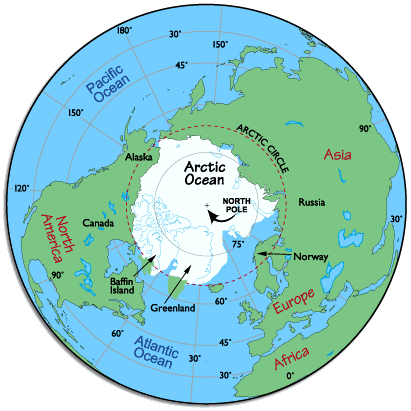
Interest is high with nations worldwide vying for access to the Arctic.  “Norway has moved its military operational headquarters into the Arctic Circle, China has development plans for Iceland and countries, including Russia, are laying claim to exploration rights in the once pristine Barents Sea.”

Map courtesy of WorldAtlas.com

It is all about energy.  While our politicians dilly-dally about the oil in ANWR, and fuss over any attempt to develop the resources in the Arctic area, the World’s nations are not waiting our approval.

More comments from the Reuters article:  “Even Russia, the largest provider of oil and gas to Europe is keen to accelerate gas production from its offshore gas fields as soon as possible, or as soon as economically viable.”

The U.S. Geological Survey estimates that the Arctic holds about 13 percent of the world’s undiscovered conventional oil and 30 percent of its undiscovered natural gas resources.

“All the major powers are positioning themselves for this development,” said Ole Arve Misund, director of the University Centre in Svalbard. “The resource has become more available and prospects have already been opened in Norway, Russia, Canada, the U.S. and Greenland.”

ExxonMobil is working with Rosneft to develop blocks in the Kara Sea, off Siberia, despite sea ice for up to 300 days a year.

Gazprom is also working with Total and Norway’s Statoil on the 4-trillion-cubic-metre Shtokman gas field 550 km offshore. Statoil has also established a strong Arctic record with its Skrugard and Havis finds, holding up to 600 million barrels of oil.   

Ole Arve Misund is quoted above saying that all major powers are positioning themselves for this development.  But one of the powers, the present US Administration may be deeply distressed by this major source of fossil fuels and who knows what game they will play to prevent exploitation of these resources.

cbdakota

Cuba’s Hopes For Oil In Florida Straits Hits Dry Hole


Cuba’s oil drilling partner, Repsol says that they have hit a dry hole and are calling it quits.  Repsol, an integrated Spanish oil and gas company, has spent more than $100 million drilling only to come up with no oil.  Currently Cuba relies on Venezuela to deliver $3 billion of subsidized oil each year.  Continuation of this program would be in jeopardy if Hugo Chavez were not to be reelected in the October elections.  An additional threat is Chavez’s health. He has been undergoing treatment for cancer for a number of months.

Cuba’s needs a major oil find to revive its struggling economy.   With Repsol out of the picture, Cuba’s fortunes rest with Petronas, the Malaysian oil company, that has began drilling an exploratory well about 180 miles southwest of Repsol’s dry well.

To read more, see this story in Oil Price.

cbdakota

Garage Fire—Karma Caused?


Although a Fisker Karma was housed in a garage that burned down, early accounts suggest that the EV was not the cause. The U.S. National Highway Traffic Safety Administration (NHTSA) is assisting in the investigation of the early May fire at a home in Sugarland, Texas.

Roger Ormisher, a Fisker spokesman said: “The lithium-ion battery of the Fisker Karma was fully intact after the fire and has been tested and is in full working condition. Currently, the precise ignition source and cause of the garage fire is still to be determined.”

cbdakota

A123 Systems Li-ion Battery Maker Loses $125M In1Q


A 123 Systems Inc. expects to post a net loss of $125 million(M) for the first quarter on revenue of $10.9M.  A123 Systems revised their 2012 revenue forecast downward from $230M to $300m to $145 M to $175 M.  Because the $300M revenue initially forecast less the $125M first quarter loss equals the new $175M revenue forecast, it looks like they think the rest of the year will be pretty smooth sailing.  That is an optimistic call, it would seem, in view of only $10.9M revenue in the 1st quarter. Part of the first quarter loss was a $51M charge to fix the Fisker batter packs.  To read more click here.

Besides making batteries for Fisker which I suppose is their principal client, A123 systems have made batteries for the GM Spark, BMW, and Shanghai Automotive.  They have supplied batteries for Tata transit buses and Daimler hybrid buses.  They have installed some 90MW of storage capacity for wind farms.

A1213 participated in Obama’s Energy Department and the State of Michigan’s incentives programs.  In September 2010, A123 received a $249 million grant from the Energy Department and $125 million in state of Michigan incentives.

Do you think this company will survive?  It’s a close call,one would think.

cbdakota

California’s Global Warming Solutions Act”—Part 2.


The Democratic polling firm of Fairbank, Maslin, Maullin, Metz & Associates at the request of the “Vote Solar Initiative” organization polled some 400 Los Angles residents and found according to an Aol Energy blog posting:

“The vast majority of Los Angeles residents are demanding more renewable energy, especially solar power, according to a new survey. Around 87 percent of voters want solar energy to generate more electricity and 79 percent welcome more wind power. Around three out of four voters (76 percent) say the solar power should be generated from rooftop panels.”

Aside from a pro-solar organization hiring a liberal Democrat polling organization to fashion a poll to get them the answers they wanted, the poll results show how far removed from reality are the LA citizens.  They are clamoring for more government intervention which is what has given California the 3rd highest unemployment rate in the country,  the 9th highest electricity rate and the 3rd highest gasoline cost. It’s the poorer people that are suffering the most.  This will be made even worse as the price of electricity continues its climb as they force in more uneconomical solar based production and drive out much lower cost fossil fuel production. This conclusion is also dawning on the Germans according to the Global Warming Policy Foundation: “The current funding of Germany’s green energy transition is anti-social, according to a new report by the Institute of the German Economy. The economic burden due to the Renewable Energy Sources Act (EEG) is up to 10 times higher for low-income households than for high-income households.”

The preliminary 2012 Energy Information Administration’s (EIA) estimates for levelized costs per kilowatt-hour in 2017 are 15.7 cents for a photovoltaic solar plant and 25.1 cents for a thermal solar plant.  That is far more expensive than the 6.7 cents per kilowatt-hour for conventional combined cycle natural gas and the 10 cents per kilowatt-hour for conventional coal in those same EIA estimates.  Also,  the EIA inflates the cost of coal by the equivalent of $15 per metric ton of carbon dioxide emitted to represent the difficulty of obtaining financing for coal plants. Further, it does not appear that the EIA levelized cost for conventional combined cycle natural gas plant is getting credited for the lower price of natural gas resulting from fracking shale.

The survey also said that:

“Most voters believe Los Angeles should create 1,200 megawatts of power from the sun, which is LADWP’s percentage of the state goal of 12,000 megawatts of local clean power by 2020.”  

And they inform us that 1200megawatts is enough to power 260,000 homes.  The calculation for number of homes powered  is suspect as it is varies from solar power promoter to promoter.  Without power storage, some other source of electricity most likely from a fossil fuel powered source is necessary because the lights would go out on these homes at night when the sun is no longer shining.  So much for reducing carbon emissions.  I wonder if California Air Resources Board (CARB) has put that in their solar energy calculations?

More on Solar cell reliability, etc. in my next posting on this topic.

cbdakota

California Law “Global Warming Solutions Act”—Is It A Black Hole?


The California environmentalists got Governor Schwarzenegger and the legislators to pass the “Global Warming Solutions Act” in 2006.   The law called “AB 32” is sweeping in its authority to regulate fossil fuels.  The stated objective of AB 32 is to implement a “transformative” standard that will reduce carbon emissions to 1990 levels by 2020.  In 2013, electric power and major industrial emitters of about 160million metric tons of carbon dioxide equivalent (MTCO2e) will be compelled to begin reductions. This will require fuel-switching, new lower-emitting plants and contracting for lower-carbon generated power form out of state. The program is essentially Cap and Trade.  In 2015, transportation, natural gas, smaller emitters, etc accounting for about 230MTCO2e will be required to begin reductions.   How this sector is to accomplish this is not clear and what ever it is, is expected to be expensive.   Off-sets seem to be one way but these are limited and further, no emitter can use more than 8% offsets to comply with the law.

AB32 has not gone unchallenged.  For one challenge, the Renewable Fuel Association (RFA), mainly representing ethanol producers say they will be ruled out of the California market.  The law is based on the study of total emission from “seed to wheel” and California Air Resources Board (CARB) sets a standard that the ethanol producers say makes compliance too expensive.  The RFA  got an injunction to stop implementation saying that the law was  unconstitutional because it violates the commerce clause which was intended to stop states from introducing laws that would discriminate against businesses located in other states.  But the US Court of Appeal (9th District) has now lifted the injunction.  The ruling on AB 32’s constitutionality is expected soon and the lifting of the injunction probably indicates they will say it is constitutional.

AB 32 was the product of Western Climate Initiative (WCI) that was formed in 2007.  The partners in the WCI were California, Arizona, New Mexico, Oregon and Washington and later expanded by the addition of Montana and Utah plus the Canadian Provinces of British Columbia, Manitoba, Ontario and Quebec 2008. Each State or Province would not bound by AB32; they would have to pass similar bills in their respective legislative bodies.

All the US states dropped out when AB 32 was passed obviously not on-board with the size and scope of the act and that it was unlikely to get passed in their respective states.  The four Canadian Provinces have remained and have issued AB 32 as guidelines.   It would seem that the tar sands oil in Canada would be negatively affected by these guidelines if they become law in the four Provinces.

The trend for California to get their electrical power from out of state will be affected by this law as well.  CARB wants to limit “leakage” where emissions drop only because the generation source is out of the state.  So any emissions that occur in the process of generating the imported electricity are to be accounted for.

So why the comment about a black hole?  The size of the California market is huge. In the years past,  if California made an environmental change, the nation often followed. The Federal Clean Air Act was pretty much a product of California. Before retirement I pushed a program to amend the Clean Air Act to permit the use of up to 5% methanol mixed with ethanol in gasoline.  It was necessary to work with CARB if you wanted to do business in California. At that time they wanted to use methanol but not as a low level blend but as the primary fuel.  I think CARB and California have become too zealous.  The fact that all the states dropped out of the WCI is pretty telling.   When the price of electricity, gasoline, and other fossil fuel associated products get way out of step with rest of the nation and more industries flee the cost burden to more friendly states, I hope California residents get the message.

Next posting will look at the Californian’s wanting more solar power.  I don’t believe they know how costly this will be.

cbdakota

Electric Car Sales Update –April 2012


The electric vehicle sales were slower in April than in March.  March sales were about 4,000 and in April the number dropped to about 3,500.

The GM Volt sales were down in April versus March. The March sales of 2,289 were the highest monthly Volt sales ever.  In April,  sales dropped to 1,462. GM had forecast Volt sales in 2011 to be 10,000 but only sold about 7,700.  This year they forecast sales of 45,000 but now are backing off saying they will match supply to demand in view of the year to date sales of 5,377.

Nissan is sticking to its 2012 forecast of Leaf sales of 20,000.  Sales in April were 370 and the year to date shows sales of 2,103.   So they have to sell about 18,000 in the remaining 9 months.  Anyone placing bets on the likelihood of accomplishing that goal?

Two more items of interest.   Ford did not sell any Focus Electrics for the third straight month.  The sales since introduction of the Focus Electric in December 2011 are one dozen.  The second item, according to The Detroit News, is that Toyota Prius sales were the best ever at 1,654 for the month of April.  This is a surprise as it means that the Volt outsold the Prius in March.  Interestingly it was the two hybrids, Prius and Volt  that made up about 90% of the April electric vehicle sales.

cbdakota

Automotive Engineering Execs Pessimistic About Electric Car Sales


The Society of Automotive Engineers (SAE) World Congress was held April 24 &25 in Detroit.  Ford, GM and Chrysler representatives were pessimistic about the future of electric vehicles according to an article in the Wall Street Journal (WSJ).   This is somewhat surprising in that the President has been promoting electric vehicles as a centerpiece of his auto-industry policy.  President Obama has offered $2.4 billion in grants to boost some 48 projects related to electric vehicles or battery production according to the WSJ. This may have required some amount of courage as we know the Administration is a major partner in both GM and Chrysler.

Obama has set a goal of 1 million electric vehicles on the road by 2015.   But if you listen to the auto company engineering execs, it would seem that Obama’s goal is not likely to be met.  Fundamentally they see the buyers not interested in the high price of the electric vehicles and the execs don’t see the prices dropping real soon.

Joseph Bakaj, vice president for powertrain engineering at Ford said:” “By 2025, we see battery electric vehicles still with too long a payback, and inadequate range,”

Sam Winegarden, executive director of powertrain-engine engineering at General Motors Co. made a similar point with a chart comparing the amount of energy delivered by a given volume or mass of fuel. On his chart, lithium-ion batteries, used in electric cars such as the Nissan Leaf and GM’s plug-in hybrid Chevrolet Volt, were ranked close to zero compared to gasoline and diesel fuels, which delivered the most energy for the least amount of weight and cost to the consumer.”The rumored death of the internal combustion engine is premature,” Mr. Winegarden said.

Chris Cowland, director of advanced powertrains at Chrysler Group LLC, offered some revealing figures. A conventional, gasoline-fueled internal combustion engine and transmission make up about 10% of the cost of a $30,000 car, or about $3,000, he said. Ford Chief Executive Alan Mulally at a green-car forum in New York City last week said batteries for the electric Ford Focus cost $12,000 to $15,000 for a car that is priced at $39,200, about $15,000 more than a petroleum-fueled Focus.

Robert Bienenfeld, senior manager for environment and energy strategy at Honda Motor Co.’s U.S. arm, said that by 2025, a customer who buys a plug-in hybrid could wait 10 years to recover the added upfront costs, compared with a 2025 car outfitted with a more efficient gasoline engine and transmission. The payback for an all-electric car would be even longer

Nissan on the other hand is bullish about electric cars. According to the Nashville Business Journal, Brendan Jones, director of Nissan Leaf Marketing and Sales Strategy said that the Leaf buyers have an average household income of $131,000.

I would be optimistic if the typical buyer were someone in the mid $50s income range.

h/t The Hockey Schtick

cbdakota