Category Archives: AGW

If They Could REALLY Model Global Climate Only One Model Would Be Needed


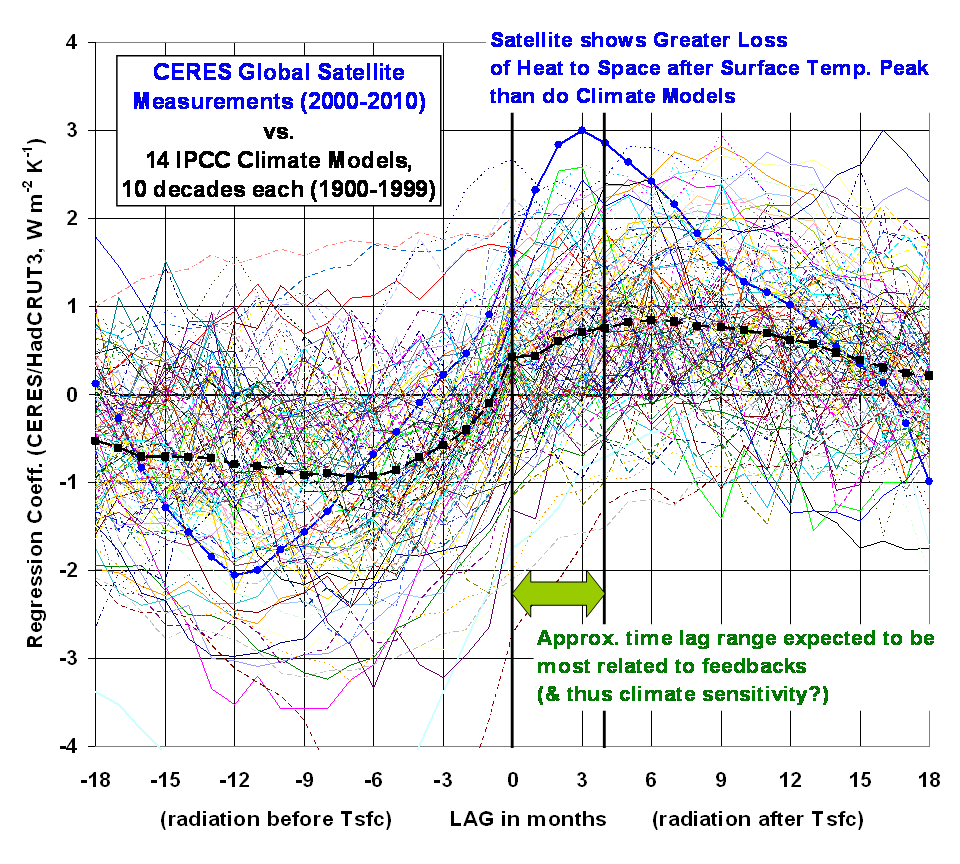
The chart below is from Dr Roy Spencer’s blog “Global Warming”.  It shows the output from 14 different climate models versus the CERES Global satellite measurement of heat loss into space.  This chart was assembled in response to criticism by Warmers that he had cherry picked the climate models he used to contrast their performance versus his work in a recently published paper in Remote Sensing. Following the post publication criticism, Dr Spencer has done a little tweaking but nothing that changes his conclusions.   See here  and here for discussion of this issue.

But this posting is not to review the bidding on Dr Spencer’s paper.   It is to talk about the Warmer’ Global Climate Models.  Whenever I see this assembly of Warmer Global Climate Models output, I wonder why anyone believes the predictions they make.  If they could REALLY model our global climate they would only need one model.   Instead, all 14 give different results!!!   Does that really instill you with a lot of confidence in their ability to do skillful prediction?    What the 14 models do is allow them to make predictions based upon the most extreme model output.  It also allows them to match just about any condition at any time with at least one of the models.  Think—-A stopped watch tells the right time two times a day.

cbdakota

Solar Cycle 24 August Update


Solar Cycle 24 August Sunspot and Solar Flux data continues to paint a picture of a much less active Sun when compared against the previous Cycle 23.

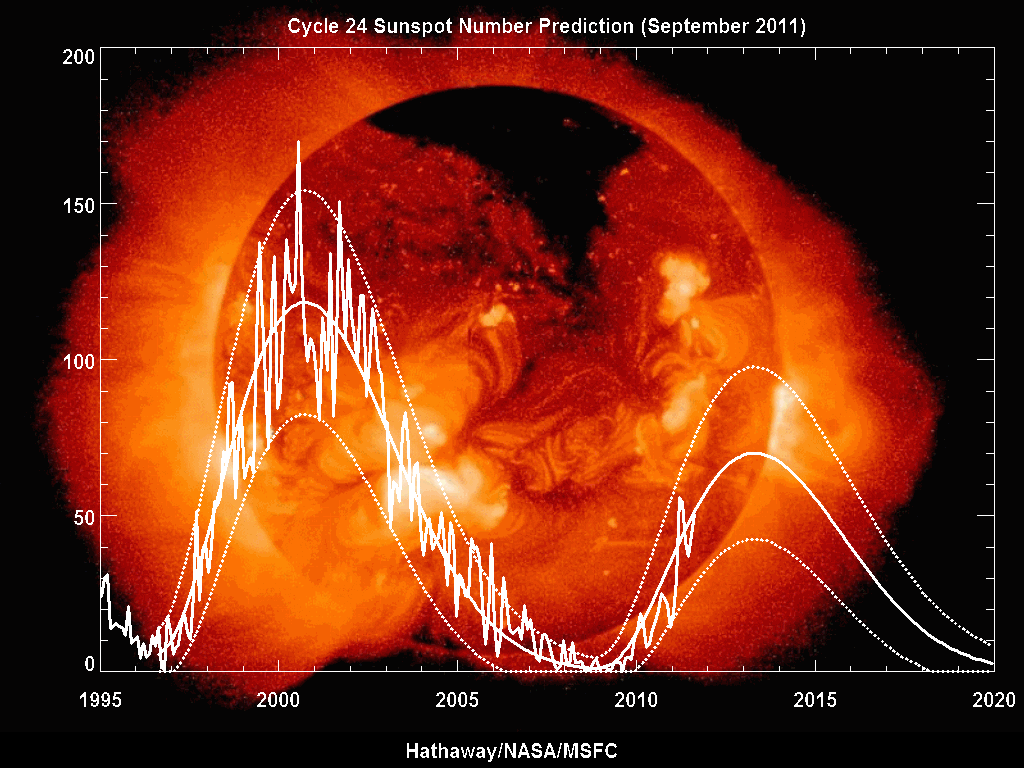
First, David Hathaway’s September edition of his sunspot predictions. Hathaway has a mid, high and low range chart with the actual data slightly below the mid-range forecast.  The Hathaway midrange predicts a maximum monthly high of about 70 Sunspots in early 2013.   Cycle 23 experienced a maximum monthly high of about 120 in 2001.

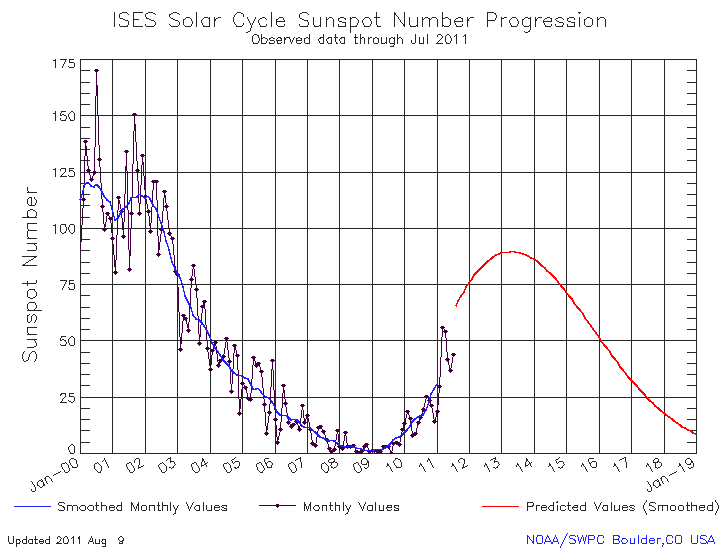
NOAA  sunspot prediction chart has only a single line which predicts a maximum monthly of about 90 sunspots.    It is shown below:

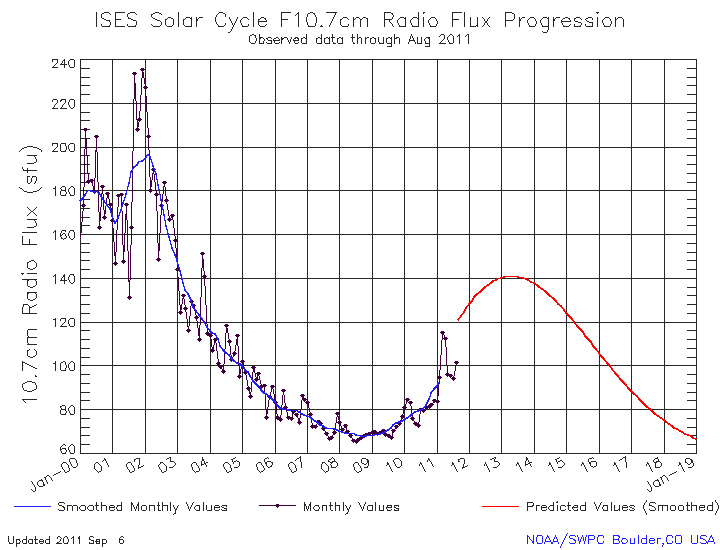
Solar flux through August appears to be trending below the NOAA prediction for Cycle 24.  The NOAA Cycle 24 solar flux prediction is for a peak of 140 in 2013.   This contrasts with  the Cycle 23 maximum of about 195 in 2002.    See the NOAA chart below:

cbdakota

Can We Really Call Climate Science A Science?


Can We Really Call Climate Science A Science?  That is the question asked in a Forbes Posting.  The author, Paul Roderick Gregory, cites the prevailing warmist’s narrative that says all but a tiny minority of scientist believes that global warming is man- made.  Gregory likens this to Stalin telling Trotsky (the dissident) it is what the poliburo says it is regardless if it is true or not.

Gregory  writes: The “warmist” consensus view of “climate science” is represented at a popular level by advocates like Al Gore and at the scientific and technical level by the UN’s Intergovernmental Panel on Climate Change (IPCC), as supported by researchers at East Anglia (Phil Jones) and Penn State (Michael Mann). This panoply of people and organizations is the equivalent of the Central Committee in my Stalin dialog above.   “Skeptics” (the equivalent of Trotsky above) are individual scientists and advocates who stake out positions at odds with the IPCC-Central Committee orthodoxy.

Gregory says that three recent events make him think of this Stalin analogy:

First, Ivar Giaever, the 1973 winner of the Nobel Prize in physics, resigned from the American Physical Society over his disagreement with its statement that “the evidence (on warming alarmism) is incontrovertible.”

Gregory adds: The Giaever story starkly disputes warmist claims of “inconvertible evidence.   Despite the press’s notable silence on such matters, there are a large number of prominent scientists with solid scholarly credentials who disagree with the IPCC-Central Committee. Those who claim “proven science” and “consensus” conveniently ignore such scientists.

Second, the editor of Remote Sensing resigned and disassociated himself from a skeptical paper co-authored  by University of Alabama Climate Scientist Roy Spencer after an avalanche of criticism by “warmists.

The author believes that the Remote Sensing editor’s action was bizarre and unprofessional. He adds : In all fields of scientific inquiry, journal editors base their publication decisions on reports of referees, who are supposed to be experts in the area. Presumably, in the case of the Spencer paper, referees supported its publication.  Even if there had been a negative report, good editors often publish controversial papers to open a scholarly dialog. (Can anyone think of a topic that is more controversial and more in need of open scholarly dialog than global warming

Third, the New York Times and other major media are ridiculing Texas Governor Rick Perry for saying that global warming is “not proven.” Their message: Anyone who does not sign on to global warming alarmism is an ignorant hayseed and clearly not presidential material.

Regarding the criticism of Rick Perry he says: The media is tarring  and feathering  Rick Perry, we now see,  for agreeing with Nobel laureate Giaever and a host of other prominent scientists.  I guess if Perry is a know-nothing Texas hick (or worse, a pawn of  Big Oil) so is every other scientist who dares to disagree with the IPCC Central Committee. Such intimidation  chillingly makes politicians, public figures, and scientists fearful of deviating one inch from orthodoxy.

He summarizes this situation saying: False claims of consensus and inconvertible truth reveal a political or ideological agenda wrapped in the guise of science.  The incontrovertible bad behavior of the warmists has led skeptics to suspect base motives, and who could blame them.

And I will add that this is why the skeptics suspect the base motives  of the warmist’s allies —- the mainstream media.

Read this Gregory’s full post by clicking here

cbdakota

CFL Bulb Prices Going Up


A Junk Science posting says that:

China has crimped the supply of rare earth metals causing CFL light bulbs to rise in price by 37% this year.

According to the New York Times report,

By closing or nationalizing dozens of the producers of rare earth metals — which are used in energy-efficient bulbs and many other green-energy products — China is temporarily shutting down most of the industry and crimping the global supply of the vital resources…

General Electric, facing complaints in the United States about rising prices for its compact fluorescent bulbs, recently noted in a statement that if the rate of inflation over the last 12 months on the rare earth element europium oxide had been applied to a $2 cup of coffee, that coffee would now cost $24.55…

China says it has largely shut down its rare earth industry for three months to address pollution problems. By invoking environmental concerns, China could potentially try to circumvent international trade rules that are supposed to prohibit export restrictions of vital materials.

If you haven’t already said your morning curses, don’t forget to condemn the 110th Congress for passing the incandescent bulb ban, George W. Bush for signing it, and the the 111th and 112th Congresses and Barack Obama for failing to reverse the ban.

One more green initiative that has gone wrong.

cbdakota

One Billion Motor Vehicles And Peak Oil


Oilprice.com noted that in August, Wards Auto published a story saying that World motor vehicle count now stands at 1 billion.  The U.S. still has the largest registration at about 240 million.   In the Oilprice.com blog, the author considers what 1 billion vehicles and the likelihood of even more being added in the next 25 years might mean. It is interesting reading.  He seems to favor governmental intervention to ameliorate supply (read PEAK OIL) versus demand for fossil fuels.   He says:

It is highly unlikely that there will be anything approaching 240 million registered vehicles in the U.S. 25 years from now. From the vantage point of 2011, it seems probable that many will not be able to afford to own and operate personal motor vehicles of the size and types we have today.

He thinks that the newly mandated CAFÉ standard is just what we need and that we will have to abandon 6 passenger cars and other large sized vehicles. He says:

  In the U.S. we are now facing standards requiring that cars achieve an average of 54.5 MPG 15 years from now. First will come all sorts of weight reductions, such as eliminating spare tires, and adding more plastic and aluminum parts. Engines will become more efficient and car bodies will become more aerodynamic.  Although these changes will be costly, it does not take much arithmetic to conclude that if energy costs are three or four times higher than they are today then mileage will become the key factor by which motor vehicles are judged.

Detractors of these new mileage standards are usually people who have little grasp, or prefer not to think about where real energy costs are going to be 15 years from now. They point out the advanced materials required to build a low-weigh, high mileage, vehicles will be so great that it will push cars beyond what many, if not most, can afford.  

Due to governmental interference, the U.S. is facing an artificial Peak Oil problem.   This artificial Peak Oil Problem is really a part of the Peak Energy Problem that governmental interference is causing.    We have a lot of fossil fuels.  The U.S has the largest reserve of fossil fuels in the world.  It is likely that North America could become energy independent.  Yes, no propping-up Venezuela nor other countries that don’t have our best interest in mind.   And what a break for our balance of payments.  Becoming completely energy independent might possibly be the wrong thing to do because the prices of crude oil could fall below our production cost thanks to the U.S. bringing on more production capacity.  I don’t want the government to dictate how much crude we should produce or purchase.  Let the market decide whether we produce or buy.

Peak Oil will come sometime, but not in the near future.  What the U.S. is facing is an ideological, artificial Peak Oil problem.   The Obama administration gives money to “renewable fuels” programs and tells us that we must do this to reduce the purchase of foreign crude.   How the government thinks they can do this with renewable fuels is beyond comprehension.  Renewable fuels, are now neither economic nor reliable enough to do that.  In fact, the electrical grid people that distribute the nation’s electricity have found it necessary to have fossil fuel powered back-up capacity equal to the wind or solar capacity.  The renewables can’t be scheduled, meaning their supply is too erratic to provide steady voltage and current.  The wind slows down or stops or the sun goes behind clouds and the former balance of supply and demand goes south. They have to have something as a backup to keep the lights on.  Their second argument is that fossil fuels not be used as combustion results in C02.   The fossil fuel back-up capacity blows that argument.  See here and here to read about the folly of renewable fuels.

The Radical Environmentalists fight every attempt to develop our resources.   Oil in Alaska, offshore oil, oil in the Baaken field, nuclear power, low cost coal,etc..  It doesn’t matter, they are against it.   They use global warming, polar bears, darter fish, left-handed ground squirrels  (I guess I made that one up) and one of my favorites–the Houston toad.    According to some reports only 300 Houston Toads remaining in the world and they have been placed on the endangered species list.  “A world without the Houston toad ... is not a world we can physically live in,” says Paul Crump, a reptile and amphibian keeper at the Houston Zoo who works with the small brown toads.  Who knew?  The world is on the way to a collapse. More dangerous issue than the Osama binLaden threat so lets get the Seal Teams to see nothing bad happens to those warty little buggers. (SARC).

Fracking and the oil pipeline from Canada are the causes du jour for the radical environmental crowd.   It is patently clear that they will only be satisfied when this country is reduced to a third world status.   And our Government supports their activities through the EPA and other departments.  God Bless Michelle Bachmann and her vow to eliminate the EPA if she is elected President.  If she is not, she should be given the job as the EPA Administrator.

We will run out of economically recoverable oil some day.  Same for natural gas, iron ore, etc.  But the many forecasts made by experts about when the oil peak would occur have always been vastly overstated.

We quoted The Oilprice.com author saying that in 15 years the price will be 3 to 4 times higher than today.  It could happen but only if we just sit back and let it happen.  For a more realistic assessment of the Peak Oil tipping point, lets look at what has been said on a WardsAuto.com posting titled “Oil’s Price Always Comes Down.”

Five years ago, I believed in the Peak Oil theory. It postulated that global oil production would peak in 2006, and the following shortage would send prices skyrocketing. Sure enough, in 2008 a barrel of oil shot up to $150.

But less than 12 months later, oil plummeted to less than $40 a barrel. Yes, the price now is back up to $100, but I no longer believe in Peak Oil. Here’s why:

Brazil recently discovered massive oil reserves off its coast that match or beat Saudi Arabia’s. Brazil will start tapping those reserves before this decade is out. In Iraq, infrastructure is being put in place to increase oil production six or seven times greater than today, potentially making it the largest oil producer in the world.

And in the U.S., a new drilling technique called hydraulic fracturing is the mother of all game changers. (My emphasis)  Texas wildcatters figured out a way easily extracting natural gas and oil from shale. Using high-pressure water and sand, they fracture the shale, releasing trapped gas. As a result, the U.S. has added 100 years of natural gas use (at current rates), and the price of natural gas has fallen to nearly half from its peak in 2008.

Hydraulic fracturing, or fracking as it’s also called, is controversial. Some environmentalists have seized on it as the next great danger to the planet. A documentary called “Gasland” probably will win an Academy Award for hysterically pointing out the dangers of fracking.

Of course, “Gasland” approaches its topic with the impartiality and evenhandedness of pseudo-documentaries such as “Roger and Me” and “Who Killed The Electric Car?” So far, fracking has been done mostly in the U.S., but it soon will spread to the rest of the world. (My emphasis) Before this decade is out, we are going to see vast increases in the amount of oil and natural gas available. And this will have enormous implications for the auto industry and policy planners.

Closing out is a good time to call for a lesson from “Minnesotans 4 Global Warming”.

http://www.youtube.com/watch?v=nWiKvNDTjB4&feature=player_embedded

cbdakota

China Is Having Doubts About EVs


While the US government doesn’t seem to be reconsidering their push behind Electric Vehicles (EVs), ($7500 rebates for buyers of an EV), the Chinese government apparently is considering abandoning their plan of a singular focus on EVs to one of a much broader consideration of ways to reduce transportation fuel use.

From AutoblogGreen:

Beijing – and in some ways, the whole of China – had set out to leapfrog conventional engine technology by developing and manufacturing huge amounts of electric vehicles. In particular, the city had hoped its push to develop plug-ins would give it an advantage over the West in electric vehicle technology. But hopes and dreams don’t always jive with reality.

AutoblogGreen adds this:

Forbes presents a compelling story on this notion that China and its sole focus on electric vehicles don’t mix. Here’s a particularly striking excerpt:

Take Warren Buffett. In September 2008, the “Oracle of Omaha” took a 10-percent stake in BYD, the Shenzhen-based battery and vehicle maker, for $200 million. The move landed him on the cover of Fortune in 2009, inside the company’s e6 model with the now-famous caption, “Warren Buffett hasn’t just seen the car of the future, he’s sitting in the driver’s seat.”

But was he really sitting in the vehicle of future? Forbes says BYD has sold a grand total of 53 (!) e6s since March of 2010, with nearly all of those going to local taxi companies, which leads us to this question: How can a vehicle that doesn’t sell represent the future?

Letting the market place decide seems to have a supporter, but it is odd that it is the Chinese marketplace not the American.

cbdakota

Will There Be Global Famine in 2050?


A report authored by Dr. Craig Idso titled “Estimates of Global Food Production in the Year 2050” asks the question ”Will we produce enough to adequately feed the world?” Idso says that researchers are estimating that global food production must increase by 70 to 100% to adequately feed 9 billion people in 2050.

Idso deals with  this question focusing on the world and also subgroups such as Europe, North America, Africa, etc. To do this, he compares forecast crop growth resulting from higher atmospheric CO2 and improved agricultural technology against the increased demand for food resulting from forecast population growth.

The data used by Idso is sourced from the UN’s Food and Agriculture Organization (FAO) to quantify the food crops, the UN’s IPCC Fourth Assessment Report (IPCC FAR) for an estimate of the atmospheric CO2 concentration in 2050 and the UN’s medium variant population projections for the year 2050.    Additionally he used the Plant Growth Database of CO2 Science to define the effect of increased atmospheric CO2 on plant growth.  Finally he works out food production estimates that will come due to the “Techno-intel effect”.  This “effect” is the advancement in agricultural technology and scientific research that expands our knowledge or intelligence based—e.g., the Green Revolution/GM seed work, etc.

Crops

The FAO database lists 169 crops.  Idso uses 45 of those crops in his work as these 45 crops account for 95% of the world food production.  To provide greater understanding, tabled below are the top 5 crops that together provide more than 55% of the world crop food sources.

Specific Crop % Of Total Production
Sugar Cane 21.240
Maize (corn) 10.283
Rice, paddy 9.441
Wheat 9.372
Potatoes 4.871

              FAO Data Base for World Food Production 2009.

                                               Top 5 Crops

The Specific crops vary in their ranking from subgroup to subgroup.

Population

The UN provides the forecast 2050 world population of nominally 9 billion.  Idso adds:

Another concern with respect to future population is whether or not the use of medium variant data from the United Nations is too conservative. Indeed, the medium variant population estimate for the year 2050 has recently been revised upward from 8.9 to 9.2 billion persons. A more realistic estimate of future population may be to use the constant fertility variant, which is weighted more heavily on current population trends and which foresees a global population of 11 billion in 2050.

Atmospheric CO2

Based on the Intergovernmental Panel on Climate Change’s best median estimate of this number (derived from the A1B scenario, ISAMS, in the IPCC’s Fourth Assessment Report, see http://www.ipcc-data.org/ancilliary/tar-isam.txt), we find that we could expect an increase in atmospheric CO2 concentration of 145 ppm between 2009 and 2050.

Enhanced Growth Via Greater Atmospheric CO2 Content

In my last posting I discussed the results of a vast number of trials done to quantify the results of increased atmospheric CO2 content.  Click here to get more detail, but I have lifted a table from that posting which gives the reader a feel for the enhanced growth that results from increased levels of atmospheric CO2.

PLANT No. OF STUDIES DRY WEIGHT INCREASE %(Arithmetic mean)
Corn 20 21.3
Rice 188 35.8
Soy Beans 179 46.5
Wheat 235 32.1
Sugar Cane 11 34

 Effect of Atmospheric CO2 Increased 300ppm Over Ambient


Techno-intel

Providing seeds that can adapt to growing condition or seeds imbued with resistance to fungus or insects is accomplished by techniques such as mutagenesis and genetic engineering.

Wiki says this about Norman Borlaug, considered the Father of the Green Revolution:

During the mid-20th century, Borlaug led the introduction of these high-yielding varieties combined with modern agricultural production techniques to Mexico, Pakistan, and India. As a result, Mexico became a net exporter of wheat by 1963. Between 1965 and 1970, wheat yields nearly doubled in Pakistan and India, greatly improving the food security in those nations.[4] These collective increases in yield have been labeled the Green Revolution, and Borlaug is often credited with saving over a billion people worldwide from starvation.[5] He was awarded the Nobel Peace Prize in 1970 in recognition of his contributions to world peace through increasing food supply.

From Wiki: 

Genetically modified foods (GM foods or GMO foods) are foods derived from genetically modified organisms, (GMOs). Genetically modified organisms have had specific changes introduced into their DNA by genetic engineering techniques. These techniques are much more precise[1] than mutagenesis (mutation breeding) where an organism is exposed to radiation or chemicals to create a non-specific but stable change.

Idso estimates that the likely increase in food production from 2009 to 2050 will be about 51.5%. Idso assigns 34.5% to Techno-intel and the remaining 17% to CO2 aerial fertilization. Note that the 51.5% is substantially less than the 70 to 100% increase believed by many experts to be needed.

Conclusions

Idso tables the results for the World, the Regions and the Sub Regions.  The calculated food supply has two cases.  Case 1 assumes that the increase in food supply is due only to Techno-intel.  Case 2 assumes that the increase is a result of both Techno-intel AND CO2 aerial fertilization.

World food supplies in 2050 will not be secure in Case 1 nor in the enhanced case 2.  For the Regions, Europe has a secure food source in Case 1 as well as Case 2. This can be explained by the expectation that Europe is the only Region where the population declines.  Africa, Asia, North America, Oceania and South America do not have secure foods supplies in Case 1.  In Case 2, Africa, Asia and Oceania  still do not have food source security.   North America and South America get a “maybe” in Case 2 as regard their food security.

Idso sums it up this way:

It is clear from the results obtained above that a global food security crisis is indeed looming on the horizon. If population projections and estimates of the amounts of additional food needed to feed the rising population of the planet prove correct, humanity will still fall short of being able to adequately feed the 9.1 billion persons expected to be inhabiting the Earth in the year 2050, even utilizing all yield-enhancing benefits associated with technological and intelligence advancements plus the aerial fertilization effect of Earth’s rising atmospheric CO2 content.

So what can be done to deal with the projected food production shortfall? Based on the results described above, there are only three possible avenues to achieving food security in the future: (1) greater gains must be achieved in the techno-intel sector than presently forecasted, (2) benefits from atmospheric CO2 enrichment must be increased, or (3) world population growth must be slowed to reach a lesser value by 2050.

Abstracting Dr. Idso’s report is a perilous undertaking.   The report is 43 pages and this posting is about one tenth that size.  Such reduction can introduce errors or poor assumptions that are not in the full report and can only be chalked-up to me.

Idso’s report  indicates that the world will be better served to have a goodly supply of atmospheric CO2 that can do aerial fertilization of the World’s food supply.  As a skeptic of the CO2 theory of run-away global warming, I can comfortably support the idea that atmospheric CO2 has more benefits than drawbacks.  Further, GM crops are a major benefit.   I like this comment by Borlaug regarding critics of his work:

“some of the environmental lobbyists of the Western nations are the salt of the earth, but many of them are elitists. They’ve never experienced the physical sensation of hunger. They do their lobbying from comfortable office suites in Washington or Brussels…If they lived just one month amid the misery of the developing world, as I have for fifty years, they’d be crying out for tractors and fertilizer and irrigation canals and be outraged that fashionable elitists back home were trying to deny them these things”.[54]

cbdakota

Should You Worry About CO2 in Our Atmosphere?


Should you worry about CO2 in our atmosphere?

Atmospheric carbon dioxide (CO2) is the basis for nearly all life on our planet.  Plants need at least 150ppm of atmospheric CO2 to grow.  The plants are the source of food for all animals.  There would be no T-Bones steaks were it not for plants.

That would seem to answer the question unless you are one of the radicals that believe to save the Earth, all humans must die.

But there is more.  Many scientists believe that global famine has been avoided by the increase in atmospheric CO2 from a pre-industrial level of about 270ppm to the current level of about 390ppm.   Before examining why scientist think CO2 increases can help avoid famine, let’s look at this VIDEO:

The levels of CO2 used in that video are outside normal considerations.  But much more modest increases in atmospheric CO2 are beneficial,too.    (So you can make the connection with the video and perhaps your own experience, cowpeas, are an important food legume crop in semi-arid tropics covering Asia, southern Europe and Central and South America.   In the Southern US cowpeas are called black eyed peas.)

The CO2 Science’s Plant Growth Data Base has an impressive compilation of peer-reviewed scientific studies that report the growth responses of plants to atmospheric CO2 enrichment.  Click here to see all the plants studied.

The following table lists a selected group of plants and the dry weight response to a 300ppm CO2 increase over ambient.

PLANT No. OF STUDIES DRY WEIGHT INCREASE %(Arithmetic mean)
Corn 20 21.3
Rice 188 35.8
Soy Beans 179 46.5
Wheat 235 32.1
Sugar Cane 11 34

 Effect of Atmospheric CO2 Increased 300ppm Over Ambient

The tables also provide response data on Photosynthesis (Net CO2 exchange rate).

The greater the amount of CO2 not only increases the quantity, its effect on the quality of the plant is not significantly altered.  Some studies have suggested that the protein levels are reduced, but other studies have indicated that the protein levels are increased.  Other factors, such as ozone (O3), soil nitrogen and sulfur dioxide (SO2) effect the outcome both positively and negatively.  Click here for more discussion of the quality of the plants tested.

It is hard to argue with all this data and just the common sense notion that warmer weather, more CO2 and more rainfall will provide bigger crop yields. And that the increase in crop yields will be beneficial in view of the forecast increase in the world’s population.   We all know that it surely will continue to warm as it part of a natural cycle.  We need to worry when the cycle reverses and the temperatures begin to drop.  Surely some one is yelling at his computer display right now shouting about the droughts that are going to occur when man-made global warming really kicks in.    Ok, but for every warmer that says the world will become a desert, there is another taking about the vast rainfall that is and will continue to occur.  It is some kind of an unhealthy theory that every weather or climate event, snow, heat, drought, wind, no wind, rising temperatures, dropping temperatures, sea level rise, sea level drop, you name it, are all caused by CO2.

More on CO2 and famine in the next blog.   Growth enhancement using forecast changes in atmospheric CO2 will be examined.

cbdakota

Solar Cycle 24 Continues to Under Perform the Early Projections.


Cycle 24 Sunspots count continues to underperform early forecasts.   Chief forecaster, David Hathaway, Ph.D., Heliospheric Team Leader, NASA Marshall Space Flight Center, Huntsville, Alabama has frequently revised his forecast of maximum monthly average Sunspot count.  A look at the lowering of the NASA forecast over the years:

Before I pile it too heavily on Dr. Hathaway, most of the experts were as wrong as he was.  One of the few that accurately forecast Cycle 24 was Dr. Lief Svalgaard of the Helioseismic and Magnetic team of Stanford’s Solar Dynamics Observatory (SDO),   Svalgaard predicted 75 as the maximum number in 2004 and has since revised it downward to 72.

Show below is the Cycle 24 recorded Sunspot monthly average numbers through July 2011 versus the current NOAA forecast of 90.

Before you begin to question my grasp of consistency in numbers, please be aware that the Sunspot number is measured several different ways.   The folks in business recognize this and have put together a team to try to bring about uniformity.  One of the more obvious questions is —are we reading more sunspots now because we have much better optics?  The following abstract from this program lays out some of the problems.

The Sunspot number (SSN) record (1610-present) is the primary time sequence of solar and solar-terrestrial physics, with application to studies of the solar dynamo, space weather, and climate change. Contrary to common perception, and despite its importance, the international sunspot number (as well as the alternative widely-used group SSN) series is inhomogeneous and in need of calibration. We trace the evolution of the sunspot record and show that significant discontinuities arose in ~1885 (resulting in a ~50% step in the group SSN) and again when Waldmeier took over from Brunner in 1945 (~20% step in Zürich SSN). We follow Wolf and show how the daily range of geomagnetic activity can be used to maintain the sunspot calibration and use this technique to obtain a revised, homogeneous, and single sunspot series from 1835-2011.

Where do we go from here?

Find and Digitize as many 19thcentury geomagnetic hourly values as possible

Determine improved adjustment factors based on the above and on model of the ionosphere

Co-operate with agencies producing sunspot numbers to harmonize their efforts in order to produce an adjusted and accepted sunspot record that can form a firm basis for solar-terrestrial relations, e.g. reconstructions of solar activity important for climate and environmental changes

To learn more about sunspot counting click here.

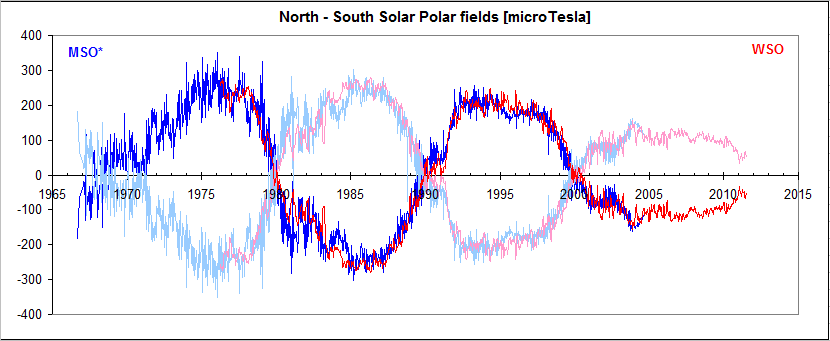
As the magnetic fields are what drive sunspots, here is a current look at Sun’s north and south magnetic fields:

Chart Courtesy of Wilson Solar Observatory

It is obvious that Cycle 24 is different from the Cycles 21, 22 and 23 that precede it.   The magnetic field strength is much weaker and angle of approach to the X axis (0 microTesla line) is very much steeper than that of Cycle 24. Click here, here and here for further discussion of the magnetic field.

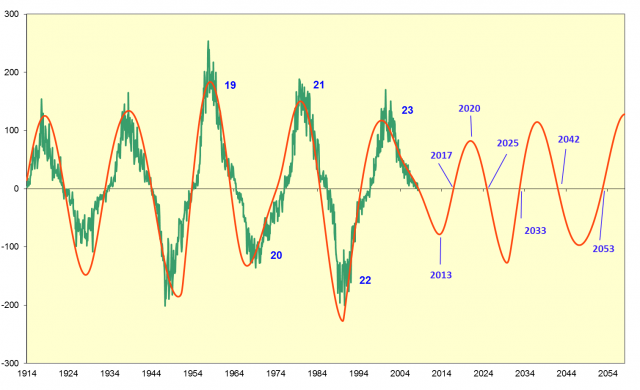
How about a look ahead to cycle 25 and beyond.  I don’t know enough to have much confidence in this forecast Ed Fix, but David Archibald seems to think it is viable.  Click here for more info:

The green line is the solar cycle record from 1914 to 2010, with alternate cycles reversed. Solar Cycles 19 to 23 are annotated. The red line is the model output, from which the lengths of individual solar cycles in the mid-21st Century can be calculated.

Mr. Fix has Cycle 25 duplicating the current Cycle 24.  Cycles 26,and 27 are about half again as large as 24 and 25. Even so his forecast for Cycles through 28 are all considerably less active than Cycles 18 through 23.  Does this mean an extended global cooling?

cbdakota

CHEVY SELLS ONLY 125 VOLTS IN JULY


The competition between the Volt and the Nissan Leaf sales continues to be of interest, it seems, as the numbers are carried in a lot of automotive blogs.  The Leaf’s July sales were lower than in the previous month but at 931 they topped the Volts anemic July sales of 125.   Both Nissan and GM claim that the low year-to-date sales are due to lack of production and that the sales would be much greater had more cars been available.   A comment from Chevrolet Communication to the Torque News Blog said that “Our sales of 125 Volts this month are exactly what we anticipated to sell……”  .  and  that revamping  currently underway will allow them to have production capacity for Volts and Amperas (no specifics about the production capacity split): “…this year will increase to 16,000 units.   In 2012, global production capacity is expected to be 60,000 vehicles with an estimated 45,000 delivered in the United States.”  See here for more detail

This statement was challenged by Mark Modica, associate fellow at the National Legal and Policy Center, who said he found about 125 Volts for sale.

I decided to call a few dealers within 75 miles of my location to determine what the true situation was. I stopped my research after finding that five of the first six dealers I called had Volts in inventory available for immediate sale. Two of the five dealers even had two each in stock. I can now safely assume that GM is, once again, not being entirely honest with its facts. The demand for the Chevy Volt is not as strong as GM would have us believe.”  See here for more detail.

Nissan has announced that they are going to increase the price of the 2012 Leaf from the current suggested price of $33,630 to $36,050.    I understand that the 2012 Leaf will come with a quick charge port that will allow battery charging in 30 minutes.  That should be a decided improvement, but I have often wondered how long the lines would be today, at the gasoline stations, if a fill up required 30 minutes.   See here for more detail

cbdakota