“What Is Endangered: Climate or Freedom?”


The internet is rife with articles about climate modeling.   Many are technical and others are based on performance.    I can be described as a person skeptical about the ability of the AGW’s  General Circulation Models to accurately predict future global climate.  Suppose that the GCMs can accurately describe what effect burning fossil fuels would have on global climate.  Would the global community even care in 2100? Is it logical that you can extrapolate current conditions to those some 100 years hence accurately?    What about the Precautionary Principle?

This conjecture prompts me to repost an entry I made July 2008 titled :

Reviewing Vaclav Klaus’ “Blue Planet in Green Shackles

Vaclav Klaus, the President of the Czech Republic, is the author of “Blue Planet in Green Shackles”.   Klaus, an economist by training and profession before entering politics,  asks “What is Endangered: Climate or Freedom?”.   He makes the case, in his book, that our freedom is endangered by the radical environmentalists.  For many of you that read this blog,  science is your background and probably your major interest.  Yet, an economist like Klaus makes a powerful economic argument against the environmentalist’s plan to have the state control fossil fuel use.

I fear I will not do justice to his arguments, so I urge you to get a copy of the book.   This entry will only cover a few of his points, which I hope you will find thought provoking.

RESOURCES:

We are warned about running out of resources.   Thus the environmentalist want regulations in place to raise the prices and reduce consumption.  In his book, Klaus says there are  “natural resources” and there are “economic resources”.  Natural resources exist in nature and are independent of humans.  Quoting from the book:

“…(natural resources) are just potential resources and have no direct connection with the existing economy (for example, to the pharaohs of Egypt, oil was not a usable resource).  Potential resources may not be used, given existing prices and technologies”.

Klaus goes on to say that

“An economic resource, in contrast, is one that is used by mankind.”

He points out that environmentalists have a static view of the concept of resources, which end logically, in their minds, as catastrophes if the government does not step in and regulate them.  Klaus says:

“Moreover, the environmentalists usually do not trust humankind its freedom(except for their own).  The basis of their illiberal, statist thinking lies in the Malthusian disbelief in humankind (and in its technological progress) and, conversely, in the belief in themselves and in their own abilities.

Klaus comments about the failure of the government attempting to set prices rather that the market setting prices as follows:

“It brings back the well-known Lange-Lerner model, used by socialists to defend the possibility of the functioning of a non-market, communist (although they would say socialist) economy in the 1930’s.  Hayek resolutely rejected the model.  The price cannot be in any way “scientifically” calculated or estimated.  That we should never forget.”

Resources are really a function of the dynamics of price and technology.  He says the exhaustion of resources does not take place as a large scale phenomenon.  He uses an Indur Goklany paraphrase that goes,

“The stone age didn’t end because we ran out of stones,  the iron age because we ran out of iron, or the bronze age because we ran out of bronze

They ended, he states, because humans came up with something new, something better.

Quoting again

“They (the environmentalist) do not know that prices reflect a real scarcity (not a fictitious one) of diverse assets (goods and resources)—of those that are genuinely scarce–better than anything else (and most important, better than the speculations of the environmentalists).  Without scarcity, there can be no price.  They are probably also not aware that as a resource becomes more and more scarce (as it becomes “exhausted”, to use their terminology), the  price increases to a point where the demand drops until it basically equals zero.  Hence the resources are—in economic terms–paradoxically inexhaustible.”

THE INTERGENERATIONAL DISCOUNT RATE AND THE PRECAUTIONARY PRINCIPLE

Most of us have done calculations of economic merit of a course of action by discounting those future dollars based on inflation and/or other criteria.  If inflation is currently running at 3%/year and you want to know the value of a dollar next year, you would calculate that as following:  $1(1-inflation rate) = $1(1-.03)=$1(.97)= $0.97, or ninety-seven cents would be its discounted value.  If inflation continued at 3% out into the future, you would continue to discount your dollar by 3% for every year you were considering.

Klaus explains that economists handle the intergenerational values (a social discount rate) in much the same way.  Recently,  Tony Blair, then Prime Minister, had the “Stern Review on the Economics of Climate Change” prepared to consider these intergenerational issues.  A characteristic of the report was the very low intergenerational discount rate.    Nicholas Stern used, 1.4% which suggested that the future would not be very different from the past.  Based on the low discount rate it was very pessimistic.

Suppose that you lived in New York City in turn of the 20th century.  You looked at the streets,  full of horse draw carriages and wondered what the streets would look like if the population doubled and the horse drawn carriages doubled too.  Maybe it would be necessary to wear hip boots to navigate those PHd (piled higher and deeper), odoriferous streets in the future. Or, being an inventive type of person, you might have thought that the city should install big ditches at the sides of the street to collect the “stuff” every night so it could be taken away and disposed of.   Would you have known that in 20 years the automobile would replace the horse?

As a measure of the way things change consider this: Michael Crichton said that Teddy Roosevelt, a major environmental figure in 1900, would not have known the meaning of the following words:    Airport, Antenna, Antibiotic, Atomic Bomb, Computer, DVD, Ecosystem, Gene, Internet, Laser, Masseur, Microwaves, Neutron, Nuclear Energy, Penicillin, Radio, Tsunami, Video, & Virus.

That tells us something about how well we can peer into the future.  And technological discovery is accelerating. Klaus says:

“In any case, in the future , society clearly will be far richer than it is today.  Moreover, many of the problems we know today will likely no longer exist.  In other words, technological progress will make a radical difference.”

So what does Klaus and what do other economists think of the Stern discount rate.

“In  the February 2007 newsletter of the Center for Economics and Politics, the Czech economist Mojmir Hampl also criticizes the low discount rate in Stern’s model.  According to Hampl, Stern wants to ‘persuade us that future generations who will live tens to hundreds of years after us will evaluate the costs of global warming and the costs of its prevention in the same way as we do today, despite the fact that they will be much richer and much more technically advanced than we are and will perhaps be dealing with completely different issues than we do.’  He adds, ‘As if we did not already have enough theoretical and empirical evidence that the measurements of tomorrow (and especially of the more distant tomorrow) through today’s eyes always leads to predictions that would make our descendants laugh’”.

“The social discount rate is thus the key parameter that compares the significance of the well-being of future generations to that of present generations.  When it equals zero, we are looking at future generations in the same way we look at present ones, which is utterly absurd.”

Surveys of the social discount rate used by economists in different countries, arrived at an average value of 4.6%.   Stern’s work would have the future  (20 years out) only modestly different from that of today—-only 23% dissimilar.  The average discount rate of 4.6% would have the dissimilarity at 60%.

This logic argues strongly against the Precautionary Principle.  The environmentalists say that even if we don’t know the science of man-made global warming exactly,  we should ration carbon just in case—-as a precaution  (The precautionary principle).  Twenty years out the picture is likely to dramatically changed and doing anything as drastic as plans to severely restrict fossil fuel use is more likely to be more disastrous than any threat from global warming.

Roy Spenser is one of the leading scientists working in the field of climatology.  He comments on the Precautionary Principle in one of his recent contributions.  The following is from his blog:

http://www.weatherquestions.com/Roy-Spencer-on-global-warming.htm

“Why Shouldn’t We Act Now?
A Critique of “Most Terrifying Video You’ll Ever See”

“Many people believe that we should act now on global warming, as a sort of “insurance policy”, just in case it ends up being a serious threat. For instance, there has been quite a bit of buzz lately about a YouTube video in which an Oregon high school teacher, Greg Craven, uses logic to convince viewers that the only responsible course of action on global warming is to act as if it is manmade and catastrophic. In other words, the potential risk of doing nothing is so high that we must act, no matter what the science says.

Unfortunately, as in all exercises of logic (as well as of scientific investigation), your conclusions are only as good as your assumptions. The bad assumptions that Mr. Craven makes that end up invalidating his conclusions are these:

1. That there are actions we can take now that will greatly alleviate the global warming problem if it is manmade, and

2. That the cost of those actions to the world will, at worst, be only economic.

Both of these assumptions are false. Humanity’s need for energy is so vast that, until a new energy technology is developed, fossil fuels will continue to dominate our energy mix. The only way to substantially reduce the risk of catastrophic manmade warming in the near-term (the next 20-30 years) would be to bring the daily activities of mankind to a virtual standstill.

Using Mr. Craven’s logic, I could argue that people should stop eating because, no matter how small the risk, people can (and do) die from choking on food. Paraphrasing Mr. Craven, not eating is the only responsible course of action to prevent choking to death. The only problem with this, of course, is that we would all die of starvation if we quit eating.

While this is admittedly an extreme example, in the case of reducing mankind’s greenhouse gas emissions it is much closer to the truth than what Mr. Craven portrays. People tend to forget that every decision we make in life, whether we know it or not, involves weighing risks against benefits. Mr. Craven incorrectly assumes that the benefits of immediate action on global warming will outweigh the risks.”

TESTIMONY BEFORE THE US HOUSE OF REPRESENTATIVES

President Klaus experienced the deceptions and the total failure of Communism and he sees that being reborn as the new environmentalism.

The following is a part of the testimony that Klaus gave to the House of Representatives’ Committee on Energy and Commerce:

As someone who lived under Communism for most of my life, I feel obliged to say that the biggest threat to freedom, democracy, the market economy, and prosperity at the beginning of the 21st century is not Communism or its various softer versions.  Communism was replaced by the threat of ambitious environmentalism.  The ideology preaches Earth and nature, and under the slogans of their protection—similarly to the old Marxists–wants to replace the free and spontaneous evolution of mankind by a sort of central (now global) planning of the whole world.”

“The environmentalists consider their ideas and arguments to be an undisputable  truth and use sophisticated methods of media manipulation and {public relations} campaigns to exert pressure on policymakers to achieve their goals.  Their argument is based on the spreading of fear and panic by declaring the future of the world to be under serious threat.  In such an atmosphere, they continue pushing policymakers to adopt illiberal measures; impose arbitrary limits, regulations, prohibitions, and restrictions on everyday human activities; and make people subject to omnipotent bureaucratic decision making. To use the words of Friedrich Hayek, they try to stop free, spontaneous human action and replace it by their own, very doubtful human design.”

“The policymakers are pushed to follow this media-driven hysteria–based on speculative and hard evidence lacking theories–and to adopt enormously costly programs, which would waste scarce resources, in order to stop the probably unstoppable climate changes, caused not by humans behavior but by various exogenous and endogenous natural processes (such as fluctuation solar activity).”

Two Climate Model Studies


There are two new climate-modeling studies that you might find interesting.

The first study uses global satellite temperature data trends for the period January 1979 through June 2009.  The abstract of this work says:

“The past 12 to 13 years show cooling using both satellite data sets, with lower confidence limits that do not exclude a negative trend until 16 years.”

(The original indicated “..until 16 to 23 years” but that was corrected.)

loehle_fig6_uah

Loehle’s Chart Shows UAH Data and the Model Projection

Loehle’s conclusions are that:

“…the satellite data shows a statistically significant cooling trend for the past 12 to 13 years, with it not being possible to reject a flat trend (0 slope) for …..16 years.  This is a length of time at which disagreement with climate models can no longer be attributed to simple LTP. “

The climate models (General Circulation Models) did not predict this cooling period.  And if the cooling period last for 16 or more years, it could be argued forcefully that the GCMs are not valid predictors of future climate.

I am a skeptic about the GCMs and do not believe that rational people should be planning their future based on their output.    My experience with curve fitting was usually less than successful so as much as I would like to, I can’t say I am willing to buy into this model’s output either.   To read more about this, click here

The other study discusses a New Method to Quantify Climate Modeling Uncertainty.

The good part of this study is based upon the conclusion “…that the range of uncertainty in climate projections may be greater than previously assumed.” The study group looked at global temperature projections under three conditions.  One case, A1F1, is high economic growth and continued use of fossil fuels for the remainder of the century, another, B1, is a major reduction in fossil fuel use and the last case, A2, is a middling scenario.

The study found:

“Interestingly, when the variance or “error bars” are taken into account, there is no statistically significant difference between the projected temperatures resulting form the high fossil fuel use, A1F1 scenario and the middling A2 scenario up through 2050. “ See more of the story here.

The authors included the obligatory statement that we can bank on even higher temperatures and more heat waves after 2050 if fossil fuels are not curtailed.

Still it is refreshing to see that the error bars keep getting bigger as the modelers are beginning to get a little more nervous about their skillfulness in predicting future climate.

Can you explain to me why we have politicians that want to bet our future on climate models that can’t seem to get it right?

Cbdakota

SPPI Monthly CO2 Report–September


This month’s CO2 report highlights charts of atmospheric global temperature, Ocean Heat Content, atmospheric CO2 content, sea level and additional discussions about Arctic and Antarctic sea ice, hurricane and tropical cyclone activity, a discussion of CO2 residence time in the atmosphere, etc.  See full report here

Cbdakota

Revision-Ocean Heat Content Updated


There is a correction to the data I posted on 12 Oct. with regard to the drop in Ocean Heat Content.

The following is a note from Bob Tisdale discussing this error:

After I posted the above, I found that Dr. Geert Jan van Oldenborgh had emailed me to notify me of the correction. I have received his permission to reproduce his email:

Dear Bob Tisdale,

please note that NODC discovered that they had accidentally posted the wrong version of their last file (apr-jun2009), a preliminary version with most data still missing had somehow made it to their web site. A quick look at the map for that quarter showed that there were hardly any anomalies visible and big anomalies in the North Atlantic and Pacific did not persist from the previous quarter, so the data were clearly suspicious. This mix-up has been fixed tonight (Dutch time) at NODC and in the Climate Explorer. A corrected version of the average heat content is attached, the value of apr-jun2009 is now more in line with the values of previous quarters.

Greetings from chilly Holland,

Geert Jan

The revised chart can be seen here

cbdakota


BBC Says The Earth Is Cooling


No hot flashes here, no pun intended, because for most of us, the fact that the Earth is cooling is not new news. However, for one of the biggest media outlets that is seemingly 100% in tune with the man-made global (AGW) warming theory to frankly admit it is cooling is a surprise.  To read their posting, click here.

The biggest laugh in the BBC article is when the UK Met office says their Centre

“…. incorporates solar variation and ocean cycles into its climate models, and that they are nothing new.  In fact, the centre says they are just two of the whole host of known factors that influence global temperatures – all of which are accounted for by its models.

Get that  “all of which are accounted for by its models.”   If all are accounted for, then they would have predicted this cooling.  How it is that scientists of all stripes can hear organizations says such obviously bogus things and be silent?  The only explanation it seems is,  they fear retribution meted out by the AGWers’ right arm,  the media like the BBC.

The BBC says that two years ago a research team seemed to rule out solar influence.

The scientists’ main approach was simple: to look at solar output and cosmic ray intensity over the last 30-40 years, and compare those trends with the graph for global average surface temperature.

And the results were clear. “Warming in the last 20 to 40 years can’t have been caused by solar activity,” said Dr Piers Forster from Leeds University, a leading contributor to this year’s Intergovernmental Panel on Climate Change (IPCC).”

I know I can not prove that the Sun is responsible for global warming and cooling but, come on, the level of solar activity seems to be the most promising correlation anywhere to be found.

I have said this before, and here I go again:  Even though the exact mechanism linking the Sun and global climate change has not yet been definitively established, it is kind of like gravity—it is obvious even if we do not yet fully understand how it works.

cbdakota

Ocean Heat Content Updated


Bob Tisdale has updated the Ocean Heat Content (OHC) charts using data collected from Argo buoys for the first 6 months of 2009.   The global OHC chart, below, shows a drop in heat content that brings it back to levels found in 2003.

globaloceanhtcontent2009dev5ld

Tisdale has updated the various ocean areas and how they contributed to the Global total.   His work can be seen in detail by clicking here.

Several months ago, I reported on comments made in William DiPuccio’s  entry “Have Changes in Ocean Heat Falsified The Global Warming Hypothesis?”  see https://cbdakota.wordpress.com/2009/07/05/ocean-heat-content/.  That posting is still relevant.

To better your understanding of this issues related to OHC,  I recommend that you look through Dr Roger Pielke, sr’s thoughts that can be found  here and here

The OHC, prior to 2003 can not be considered as authoritative as post 2003 when the Argo Buoys were deployed and began providing the data used to compute OHC.  Having said that and in view of the jump in OHC at the time of the turnover, it makes one wonder how the jump can be explained except as a result of poor equilibration of the old and new readings.

cbdakota

The Weakness of the AGW Theory


The “American Thinker” blog has an article by John McLaughlin that shows the weakness of the man-made global warming (AGW) theory.  The article Global Warming ‘Science’ discusses the fact that the Intergovernmental Panel on Climate Change, sponsored by the UN, was ..

Since its inception in 1988, the United Nations’ Intergovernmental Panel on Climate Change (IPCC) has sought to evaluate the risk of climate change brought about by human activity.  There has never been a requirement to also evaluate potential natural causes.”

The author discusses the impact the infamous Hockey Stick Temperature Graph had on the IPCC reports.

Their reports include a graph derived from mathematical models showing average global temperatures back to 1000 AD.  The graph appears relatively flat for over 900 years.  Then, about 1920, temperatures begin to rocket upward with but a brief pause around 1970 before heading still higher with no relief in sight.  So startling was this graph when it first appeared, it became known as the “Hockey Stick” chart.  The IPCC concluded the graph’s sudden change in character during the early 20th Century correlated with the introduction and increasing use of fossil fuel energy in that period, and that production of carbon dioxide (CO2) represented the principal man-made greenhouse gas culprit.

hockey stick graph

The Hockey Stick Temperature Graph

(Note, no medieval warm period & the “hockey stick” jump in temperatures)


Then he walks you through the story of how the Graph was exposed as a fraud:

As political hysteria over “man-made” or anthropogenic global warming (AGW) increased, other scientists began checking the mathematical analysis and measurements behind the hockey stick chart because it did not correlate with other known historical temperature data.  In 2003 Professor McKitrick teamed with a Canadian engineer, Steve McIntyre, in attempting to replicate the chart and finally debunked it as statistical nonsense.  They revealed how the chart was derived from “collation errors, unjustified truncation or extrapolation of source data, obsolete data, incorrect principal component calculations, geographical mislocations and other serious defects” — substantially affecting the temperature index.

And perhaps worse,  the National Academy of Sciences’ Committee on Applied and Theoretical Statistics concluded that:

“……the statistical methodology underpinning the hockey stick version was, indeed, profoundly flawed.  The Wegman panel submitted a report to the U.S. House of Representatives (which should have been available to all House members including Rep. Waxman) which cited results of an earlier National Research Council panel endorsing the work and results of McIntyre and McKitrick.  Wegman’s work also found the McIntyre and McKitrick analysis independently verifiable, their observations of the IPCC flaws correct and “valid,” and their arguments “compelling.”

McLaughlin also demonstrates that man-made carbon dioxide (CO2) can not be a significant cause of global warming.

Numerous gases make up the Earth’s atmosphere.  Of these, nitrogen represents about 78% by volume,  oxygen comprises just under 21%, and other gases (including “greenhouse gases”) make up slightly over 1% by volume remaining.  Of the principal greenhouse gases, water vapor is by far the most prevalent.  Second place belongs to carbon dioxide (CO2) at 0.04% with methane and nitrous oxide finishing a very distant third and fourth.

What complicates analysis of any manmade greenhouse effect is the relatively overwhelming prevalence of water vapor — a gas ignored by the IPCC.  The U.S. Department of Energy estimates water vapor makes up 95% of identified greenhouse gases and, of that amount, less than 0.001% can be attributed to manmade causes.  Thus, the IPCC and AGW proponents have focused on CO2 as the principal anthropogenic greenhouse gas.”

And :

Put another way, if accumulation of greenhouse gases has any impact on global warming, Department of Energy data indicates nearly 99.9% would have to be attributed to natural causes.  Nevertheless, AGW proponents blame approximately 1/1000 of all produced planetary CO2 — this trace gas  which, in its totality, comprises less than 4/10,000 of the atmosphere — as the principal cause of climate change because it provides the only way to link global warming to human activity.

Numerous scientists and climatologists point to the terrible flaw that the IPCC analysis totally ignores the impact upon climate of solar activity, water vapor, and effects of cloud formation on global air pressure, temperature and winds.  As Dr. Tim Ball, a former climate scientist at the University of Winnipeg, put it:  “The analogy that I use is that my car is not running that well, so I’m going to ignore the engine (which is the sun) and I’m going to ignore the transmission (which is the water vapor) and I’m going to look at one nut on the right rear wheel (which is the human-produced CO2) … the science is that bad!

He discusses that fact that actual data regarding global warming and sea level rise contradict the alarmists’ scare stories;  the fallacy of the “Consensus “ argument; and finishes with conclusions that contradict the thinking ChairmanWaxman used to justify the House of Representatives passing of the Cap and Trade bill.  To read the article in its entirety,  click here

Many things have recently come to light that further contradict the man-made global warming theory.    I will try to bring those to you in future blogs.

See    The Weakness of the AGW Theory-Part 2

The Weakness of the AGW Theory-Part 3

Cbdakota

Cap And Trade Cover-up by Obama Administration


While the admistration was coercing the OMB into coming up with the “it will only cost the price of a postage stamp a day (ca. $175/year)” for the impact of the House passed Cap and Trade bill,  it was  burying the Treasury Department’s assessment that the cost would be more than $1700 per family per year.

Ramireztooncapandtax072209

Cartoon by Ramirez—See his marvelous array of cartoons here

We have previously discussed the fact that the OMB’s “postage stamp” was bogus as it neglected to take in the effect on the GNP. see here The Treasury’s number coincides with that of the Heritage Foundation, the Brookings Institute and others.   The Treasury’s figure was pried-out by Chris Horner using the Freedom of Information Act.  Even then much of it was redacted.  So much for Obama’s promise of a “transparent administration”.

See the  full story here

Cbdakota

Arctic Sea Ice Minimum–The Expert Predictions


Several months ago,  the Study of Environmental ARctic Change (SEARCH) ask experts to forecast the low point regarding the extent of Arctic sea ice for 2009.

These forecasts were based upon July sea ice data.  As September is normally the low point,  they were only forecasting 1 to 2 months into the future.   The chart below was prepared by Anthony Watts of the blog,  wattsupwiththat.com  (see blogroll to access this blog)

search_sea_ice_forecast

Inspecting the chart one can see that the experts were all forecasting ice extent at 5 million square kilometers or less. When the chart was made 6 September 09, the ice extent was greater than their predictions at over 5.3 million square kilometers.  The WUWT blog for this chart and comments can be seen here.

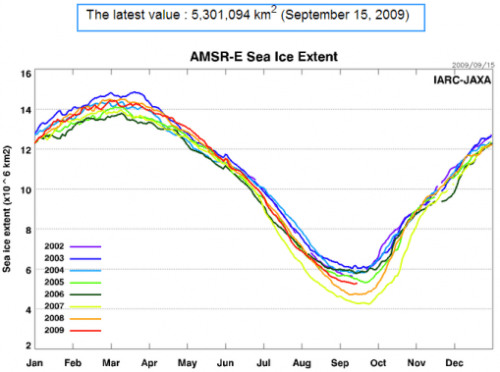
On the 15th of September,  Watts updated the current ice extent.

arctic_seaice_91509-2

Watts prepared a table of daily values for the sea ice and the low will  probably be that of 13 September with a value of 5,249,844 square kilometers. The area increased on the 14 and 15 September to 5,301,094 square kilometers.

It seems the experts were again pessimistic and missed the mark even though they were only predicting 6 weeks in advance of the low point.

For more on this entry by Anthony Watts,  click here.

Cbdakota

August CO2 Report


The Science and Public Policy Institute’s monthly CO2 report is now available.   It contain articles on OCEAN HEAT BUILDUP,  SEA LEVELS,  PREDICTIONS OF ATMOSPHERIC CO2 CONCENTRATIONS IN 2100,  THE QUITE SUN, WHY THE GREAT ICESHEETS WONT COLLAPSE,  ARCTIC  SEA  ICE  AREA, ETC.

Click here to read the report.

Cbdakota