When Tesla Batteries “Brick”–They Can Not Be Fixed


You buy a Tesla Roadster.  Depending on your upgrades, somewhere in the vicinity of $100,000 +.   Great acceleration, 0 to 60 in 3 to 4 seconds.  Looks great.  You are cool and everyone knows it.  You decide to jet off to Tahiti for a month.  When you return you go to the garage, ready to drive down Rodeo Drive to let everyone know you are back— let the good times roll.   But your car won’t start.  You check the battery charge level and it is at Zero.  Ooops, you did not plug it in after you last drove it.  Ok so you put the charger on.  It won’t take a charge.  You call the Tesla dealership and ask them to take it to their shop and fix it.  Oddly they come with a flatbed lift truck and some rolling jacks.  When you ask why they just don’t tow it to the dealership they tell you that because you have a brick, the wheels wont turn.  What is a “brick” you ask? They say that your battery is dead, dead, dead and won’t ever work again.  You ask what a replacement battery costs and they say $40,000.  You say “well, I have only had the car for about 4 months and put on less than 5,000 miles so I guess it is covered by warrantee”.  They say “no, not covered by warrantee cause you let it run down to zero charge, so we are not responsible”

Fiction?   Nope, it has happened to some Tesla owners.   The author, Michael DeGusta of the post “It’s a Brick”, whose Roadster was pronounced a Brick, learned from a Regional Tesla Service Manager that he was personally aware of at least 5 cases of Roadsters being Bricked due to battery depletion. DeGusta says the following about bricking:

A Tesla Roadster that is simply parked without being plugged in will eventually become a “brick”. The parasitic load from the car’s always-on subsystems continually drains the battery and if the battery’s charge is ever totally depleted, it is essentially destroyed. Complete discharge can happen even when the car is plugged in if it isn’t receiving sufficient current to charge, which can be caused by something as simple as using an extension cord. After battery death, the car is completely inoperable.

The amount of time it takes an unplugged Tesla to die varies. Tesla’s Roadster Owners Manual [Full Zipped PDF] states that the battery should take approximately 11 weeks of inactivity to completely discharge [Page 5-2, Column 3: PDF]. However, that is from a full 100% charge. If the car has been driven first, say to be parked at an airport for a long trip, that time can be substantially reduced. If the car is driven to nearly its maximum range and then left unplugged, it could potentially “brick” in about one week. [1] Many other scenarios are possible: for example, the car becomes unplugged by accident, or is unwittingly plugged into an extension cord that is defective or too long.

DeGusta conclusions about the problem with the battery are as follows:

The Bottom Line

Tesla Motors is a public company that’s valued at over $3.5 billion and has received $465 million in US government loans, all on the back of the promise that it can deliver a real world, all-electric car to the mainstream market. Yet today, in my opinion, Tesla seems to be knowingly selling cars that can turn into bricks without any financial protection for the customer.

Until there’s a fundamental change in Tesla’s technology, it would seem the only other option for Tesla is to help its customers insure against this problem. As consumers become aware that a Tesla is possibly just a long trip, a bad extension cord, or an accidental unplugging away from disaster, how many will choose to gamble $40,000 on that not happening? Would you?

cbdakota
Warmer “Ethics” Leader Fakes Identity to Steal Documents


Peter Gleick, who stole the Heartland Institute Board of Director documents under false pretenses, is the Chair of the American Geophysical Union (AGU) Task Force on Scientific Integrity!!!!   How is that for irony and perhaps it speaks to the overall integrity of the Warmer cause.

Someone made up a fake cover letter to accompany the stolen documents and sent out a package to Warmer supporters in the media.  In the fake cover letter, Heartland is saying that they are going to spend $100,000 in schools with the objective of providing information that would show that “the topic of climate change is controversial and uncertain – two key points that are effective at dissuading teachers from teaching science”.   NOT TO TEACH SCIENCE!  Heartland did not write the cover letter.  Gleick says he is not guilty of writing the cover letter.  Those are leading the investigation believe he did write it.  He has resigned his position as the head of the Scientific Integrity Task Force.

However Gleick says it really wasn’t his fault:“My judgment was blinded by my frustration with the ongoing efforts — often anonymous, well-funded, and coordinated — to attack climate science and scientists and prevent this debate, and by the lack of transparency of the organizations involved.”   So it is Heartland’s fault. They are so well funded.

Jo Nova’s blog has the following table showing only a few of the Warmer organizations’ funding versus Heartland Institute funding:

Entity USD
Greenpeace  $300m  2010 Annual Report
WWF  $700m  ”  ($524m Euro)
Pew Charitable Trust  $360m 2010 Annual Report
Sierra Club  $56m 2010 Annual Report
US government funding for climate science and technology  $7,000m  “Climate Money” 2009
US government funding for “climate related appropriations” $1,300m USAID 2010
US government funding for skeptical scientists     $ 0
Heartland Institute $7m  (actually $6.4m)

Nova’s table highlights the vast discrepancy in funding.  She adds: “So what the expose shows is that the Heartland Institute punches far above its weight with an incredibly efficient budget.” To see Jo Nova’s full posting click here.

Why are the Skeptics becoming so successful in getting their message across?  It is not that they have a lot of money.  It certainly isn’t the media that seem only interested in press releases from the Warmers.  It is not the Governments of the world that support only Warmer climate research.  Its not the school districts that make Al Gore’s “An Inconvenient Truth” required viewing.

But rather it is the Internet where people can judge the available reports for themselves. It the exposure of the Warmer leaders hiding the truth, gaming the science, denying Skeptics access to publication of their studies etc. as exposed by Climate Gate.  It is also a public that is weary of Warmer shrill claims of impending disaster—which never materialize.

cbdakota

Wind Farm’s Non-performance Endangers Lives


Kevin Myers posts “Energy policy based on renewables will win hearts but won’t protect their owners from frostbite and death due to exposure”.  He tells us that the early February cold and blizzard that swept across Europe resulted in the deaths of over three hundred people but it could have been worse.  It seems that Gazprom the principle Russian natural gas supply company was not able to keep up with demand in Europe.

Myers asks:  “Did anyone even think of deploying our wind turbines to make good the energy shortfall from Russia?”  Which he answers:” Of course not. We all know that windmills are a self-indulgent and sanctimonious luxury whose purpose is to make us feel good. Had Europe genuinely depended on green energy on Friday, by Sunday thousands would be dead from frostbite and exposure, and the EU would have suffered an economic body blow to match that of Japan’s tsunami a year ago. No electricity means no water, no trams, no trains, no airports, no traffic lights, no phone systems, no sewerage, no factories, no service stations, no office lifts, no central heating and even no hospitals, once their generators run out of fuel.

Modern cities are incredibly fragile organisms, which tremble on the edge of disaster the entire time. During a severe blizzard, it is electricity alone that prevents a midwinter urban holocaust. We saw what adverse weather can do, when 15,000 people died in the heat wave that hit France in August 2003. But those deaths were spread over a month. Last weekend’s weather, without energy, could have caused many tens of thousands of deaths over a couple of days.

Why does the entire green spectrum, which now incorporates most conventional parties across Europe, deny the most obvious of truths? To play lethal games with our energy systems in order to honour the whimsical god of climate change is as intelligent and scientific as the Aztec sacrifice of their young. Actually, it is far more frivolous, because at least the Aztecs knew how many people they were sacrificing: no one has the least idea of the loss of life that might result from the EU embracing “green” energy policies.”

Myers uses Ireland as an example:  “Wind power in Ireland actually produces only 22pc of its capacity: would you spend ¿100,000 on a car if it meant that ¿78,000 of the purchase price was wasted? It gets worse. On a really cold day, we actually need about 5,000 megawatts, but yesterday wind was producing under 50 megawatts: a grand total of 1pc of requirements. “

To read the whole of Myers’ posting, click here.

This is not untypical of wind farms.  Basically windfarms are anathema to operators of the electrical grids that supply our electricity because they cannot depend on them being a source of power.  Some times the wind blows and sometimes it doesn’t.  Customers cannot accept an electrical supply system that is intermittent.  See here, here, here, and  here for more on the unreliability wind farms power.

Routinely temperatures in many parts of the US match or exceed those experienced in France during their August 2003 heat wave. Few deaths occur in these areas of the US due to the prevalence of Air Conditioning units.  This is another example, echoing Myers, where our lives depend on a steady supply of electricity.

And what would this posting be without some comments by James Delingpole who weighed in on this topic as follows:

“Have a look at this debate between pro-renewables campaigner Jonathan Pyke and Mark Duchamp of the European Platform Against Wind Farms in The Earth Times and you’ll see what I mean:

Q: How accurate is the argument that wind turbines have to be ‘backed-up’ by alternative sources of power, eg nuclear or coal, due to the irregularity of wind?

Jonathan: It’s not accurate and I think it stems from a misunderstanding about what wind energy is for. It’s better to think of wind as the back-up for gas, allowing us to make much better use of our existing fossil fuel power plants than relying on gas alone. There’s no need to burn gas when the wind is blowing, which National Grid can predict extremely accurately. So comparing it to nuclear or coal is misleading because wind serves a different purpose; every time it blows there’s a substantial decrease in carbon emissions, volatile fossil fuel costs, water for cooling, manufacturing and pollution. The ‘back-up’ argument just isn’t valid.

R-i-g-h-t. So what you’re saying, Jonathan, is that the ONLY reason we’re carpeting some of the world’s most attractive wild countryside in horribly costly, economically inefficient, bird-liquidising, noise-polluting, view-blighting, rare-earth-metal-exploiting, property-debasing, horse-frightening, rent-seekers’ uber-horrors, is to save the odd tonne of CO2 emissions, as and when, despite the fact that the science increasingly suggests that the difference this will make to global climate will be so negligible as to be beyond measurement?

At first they said they would replace fossil fuel driven electrical generating plants, but as this has turned out badly for them they now want to convince us that what they really, really, really want to do is play the part of backup.  Yikees, the windfarms were not economic as the primary units how on earth can they be anything but less economic as backup units  and they will still be unreliable.

You can read the Delingpole’s article by clicking here.

cbdakota

Ethanol Subsidies: Not Gone, Just Hidden a Little Better


Mother Jones, an organization with a very liberal viewpoint posted that the subsidies for ethanol fuel have expired but that this doesn’t trouble the ethanol fuel producers.  Kevin Drum authored the posting and I will let him tell you why.

A few years ago I called subsidies for corn ethanol “catastrophically idiotic.” And why not? Corn ethanol, it turns out, is actively worse for the environment than even gasoline. Farmers responded to the subsidies by reducing the amount of farmland used for food production, and this drove up the price of staple food worldwide.  At the end of last year, ethanol subsidies quietly expired and no one tried to extend them.

So why did the powerful corn ethanol lobby let it expire without an apparent fight? The answer lies in legislation known as the Renewable Fuel Standard (RFS), which creates government-guaranteed demand that keeps corn prices high and generates massive farm profits. Removing the tax credit but keeping the RFS is like scraping a little frosting from the ethanol-boondoggle cake.

The RFS mandates that at least 37 percent of the 2011-12 corn crop be converted to ethanol and blended with the gasoline that powers our cars…[As a result] the current price of corn on the Chicago Mercantile Exchange is about $6.50 per bushel—almost triple the pre-mandate level.

 You might not be aware that when the EPA does mpg ratings for new cars, they use gasoline that does not contain any ethanol.  Adding ethanol at 10% of the fuel mix, the energy in a gallon of fuel is about 96.7% of a fuel not containing ethanol.  Ethanol has less energy per gallon than normal unleaded gasoline.  So the MPG rating is probably just a bit high.    See

cbdakota

Cycle 24 January Update


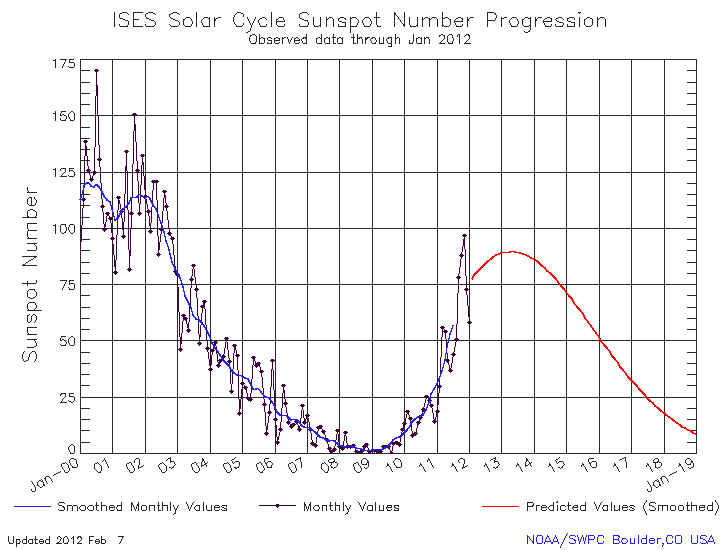
Cycle 24 activity in January was low.  Cycle 24 solar maximum is probably about 18 months away.   The January sunspot number and the F10.7 flux are following the NASA forecast.  The very low Ap index seems confirm that this cycle is likely to be much less active than Cycle 23.  See the charts below, all courtesy of NOAA/SWPC. (click on charts to enlarge)

cbdakota


The Warmers—-The Gang That Can’t Shoot Straight


Last year the Warmers were defending the IPCC’s Fourth Assessment Report’s conclusion that the Himalayan glaciers would disappear by 2035.   Oops, they then said, we meant 2350.  Even so, we are being told that the glaciers were melting and so quickly that the people in Asia would be in big trouble when there was no more melt water.  They believed that melting of Himalayan glacial ice was equivalent to 50 billion tons of water every year.  But now a study  ( lead scientist John Wahr and team) published in Nature tells that the Himalayan glaciers have lost no ice over the last decade. The measurements of global ice for this study were done using satellites.   According to the report:

The reason for the radical reappraisal of ice melting in Asia is the different ways in which the current and previous studies were conducted. Until now, estimates of melt water loss for all the world’s 200,000 glaciers were based on extrapolations of data from a few hundred monitored on the ground. Those glaciers at lower altitudes are much easier for scientists to get to and so were more frequently included, but they were also more prone to melting.

The bias was particularly strong in Asia, said Wahr:

“Their extrapolation is really tough as only a handful of lower-altitude glaciers are monitored and there are thousands there very high up.”

Satellite data for the rest of the world’s glaciers were also measured and the team reported no changes in the melt rate.

Glaciers have been melting for the last 10,000 years.   The question is really— is the present rate particularly unusual?  This study certainly puts into question the warmers previous assertion that it is.  Isn’t this just one more indication that there has been no statistically significant global warming over the past decade.

But whenever a study comes out like this, it is required to say—- nothing has changed, CO2 is still the problem.    Prof Jonathan Bamber, the director of the Bristol Glaciology Centre said:

“The new data does not mean that concerns about climate change are overblown in any way. It means there is a much larger uncertainty in high mountain Asia than we thought. Taken globally all the observations of the Earth’s ice – permafrost, Arctic sea ice, snow cover and glaciers – are going in the same direction.

NOT OVERBLOWN?????  (Just more uncertainty!!)

Professor Bamber also participated in an online Q and A session.  He responded to a question from “On Earth” as follows:

OnEarth. For Antarctica and Greenland the results from this study are in very good agreement with most recent previous estimates of mass loss from the ice sheets so it doesn’t change our view of what these are doing.

I have always had a lot of respect for “most recent previous estimates..” what ever they are.

Are we to assume that much stress is being felt in Asian lands where the Himalayan ice melt is so important according to the IPCC?  If there is no net change in total ice as the study tells us, does that mean there is a vastly reduced melt water flow?  By the way, there are many studies that say the monsoons are the principal source of the water these Asian countries rely upon.

To read more click here and here.

cbdakota

January 2012 Global Temperature


The only global temperature report that I really trust is the UAH satellite readings that Dr Roy Spencer manages.  The temperature in January took the expected drop.

Chart courtesy of Dr Spencer’s  Global Warming blog. (click on chart to enlarge)

The January temperature is equivalent to the January 2011 but below 2009 and 2010 January temps.  If the forecast of a very weak solar Cycle 25  comes to pass, we should see some record lows in coming years.

cbdakota

EV January Sales—Volt and Leaf Sales go South


GM is blaming the drop in Volt sales from 1529 units in December 2011 to 603 in January 2012 on a bad publicity regarding the battery fires that occurred when crash testing the vehicles.  Probably is a factor.   But the realization that the weak performance of the batteries during winter conditions may also have had a negative effect.  More so on the Leaf than the Volt as the Leaf has no IC engine to take over when the battery runs out of juice.  Leaf sales in December were 954 dropping to 676 in January.

cbdakota

Forecasting Cycle 25—Great Conveyor Belt Theory


The last post reviewed a forecasted solar Cycle 25 based upon measuring the magnetic field of sunspots.   This posting uses the speed of the Sun’s Great Conveyor Belt(GCB) to forecast Cycle 25. This method considers sunspots as an indicator but the GCB speed determines how many sunspots appear.  I am not sure who, but perhaps Dibyendu Nandi of the Indian Institute of Science and Education and Research in Kolkata (aka, Calcutta) and his team  can claim this theory. The GCB has been studied for a number of years.  NASA Science says: “The Great Conveyor Belt is a massive circulating current of fire (hot plasma) within the sun. It has two branches, north and south, each taking about 40 years to complete one circuit.“  “The plasma flows travel along the Sun’s surface and plunge inward at the poles, and reappear again at the Sun’s equator.  When the sunspots begin to decay, surface currents sweep up their magnetic remains and pull them down inside the star; 300,000km below the surface, the sun’s magnetic dynamo amplifies the decaying magnetic fields.  Re-animated the sunspots become buoyant and bob up to the surface like a cork in water—voila! A new solar cycle is born.”

These belts can be likened to the Earth’s ocean currents.

NASA’s artistic sketch of the belt.

A May 2006 posting on Science News has Dr Hathaway predicting that Cycle 24 sunspots numbers would be perhaps greater than Cycle 23 (this part of the prediction is not faring well.) and Cycle 25 would be perhaps half of Cycle 23.  Dr Hathaway said that these predictions were based on a deceleration of these belts to 0.75m/s in the North and 0.35m/s in the south.  He said “We’ve never seen speeds so low”.    Hathaway in a September 2011 posting said:”…….that as the number of sunspots increases on the Sun, the speed of the GCB decreases and vice versa: fewer sunspots and the faster the speed of the Belt.”   This is somewhat contradictory,  because if the GCB speed is slowing down, based on his theory,  there would be more spots.

Dr. Nandi  adds some clarification when he lays out his theory here: “The fast-moving belt rapidly dragged sunspot corpses down to sun’s inner dynamo for amplification. At first glance, this might seem to boost sunspot production, but no. When the remains of old sunspots reached the dynamo, they rode the belt through the amplification zone too hastily for full re-animation.  Sunspot production was stunted.”  Nandi  then adds that late in the decade, “….according to the model, the Conveyor Belt slowed down again, allowing magnetic fields to spend more time in the amplification zone, but the damage was already done.  New sunspots were in short supply.  Adding insult to injury, the slow moving belt did little to assist re-animated sunspots on their journey back to the surface, delaying the onset of Solar Cycle 24.”  

Hathaway’s sunspot predictions are in Red.   Also on this chart, in Pink, are the Cycle 24 sunspot predictions by NCAR’s Mausumi Dikpata and her team based on their observations of the GCB.

Nandi  has made a presentation “Forecasting the Solar Cycle”at the Harvard Smithsonian Center for Astrophysics, Cambridge, USA  but I can not access the paper.

This theory says that the change of speed of the GCB predestines the solar çycle  robustness or lack there of.  For some insight of how they are able to track these plasma flows/GCBs/jet streams, click here.

Like the declining sunspot magnetic field, the theory of the GCB seem to me to be describing consequences of some other forcing that is not known or understood.  I think it likely that Cycle 25 will be weak.  However, until we know more about the functioning of the Sun,  we will be forecasting like the weather casters—tomorrow will be rainy because rain clouds are blowing our way from the west.  Like all of these theories, only time will tell if they are really capable of predicting accurately Cycle strength.

We are not through with Cycle prediction theories.  Next posting will discuss the bicentennial decrease in Total Solar Irradiance (TSI) unbalancing the Earth’s thermal budget.

cbdakota

Forecasting Cycle 25–Livingston and Penn Method


As Cycle 24 has not yet achieved a Solar Maximum, it may seem a little early to begin forecasting Cycle 25.  But several forecasts have been made.  A recent posting in WattsUpWithThat notes such forecasts by Penn and Livingston and by David Hathaway.

You remember from previous postings on this site, that Penn and Livingston have been measuring Sunspot magnetic field strength and the temperature and luminosity of the umbra.   They began this study in 1990 and as of 2010 they have analyzed some 17,000 spots. Plotted on the chart below are data from their paper LONG-TERM EVOLUTION OF SUNSPOT MAGNETIC FIELDS through 2010 and additional readings since:

Chart courtesy of Lief Svalgaard

Focusing on the bottom chart, sunspots are plotted against magnetic field strength and time. The individual dots are representative of sunspots.  The larger blue dot represents the normalized sunspot number for each year. The black line is the trend line for the umbral magnetic field of the sunspots. The horizontal blue line indexes a magnetic field strength of ca. 1500 Gauss. Note that the sunspots extend vertically above the trend line, and below the trend line but not below the 1500 Gauss line.  The two scientists speculate that sunspots do not form when the magnetic field strength is less than 1500 Gauss.  If the trend line continues on this same slope, somewhere around the year 2025+/- at least half of the sunspots will disappear.

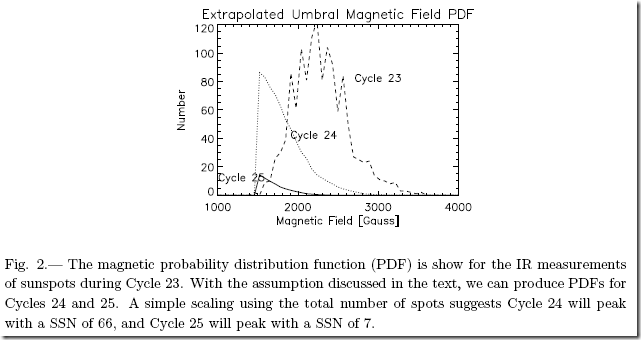
Using a linear decrease of 65 Gauss per year and a cycle duration of 11 years, they computed the magnetic probability distribution function for Cycles 24 and 25. Using this, a sunspot number is forecast. Cycles 24 and 25 are shown along with actual data from Cycle 23 in the chart below from their paper:

Chart provided by David Archibald, from the paper by Livingston and Penn.

The contrast of Cycle 24 and specifically Cycle 25 from the completed Cycle 23 is quite dramatic.  The Cycle 24 forecast, so far, seems to be reasonably in tune with actual data.  At a Cycle 25 sunspot number of 7, David Archibald says it would be the lowest sunspot number for a Cycle in 300 years!!!!

Livingston and Penn say that if the linear decrease were 50 Gauss per year rather than 65, the Cycle 25 sunspot number would be 20 which is still a very low number.

Livingston and Penn caution that it is always risky to extrapolate linear trends.

Next posting on this topic will be an examination of David Hathaway’s 2006 forecast of both Cycle 24 and Cycle 25.  It will also discuss one of the underlying theories for the decrease in sunspots.

cbdakota