Category Archives: Windpower

DRIVING A VOLT IN WINTER


The Chevy Volt’s driving range is reduced by cold or hot weather. The EPA estimates the Chevy Volt can travel 35 miles on a fully charged battery according to an article written by Doug Wernert, Chevrolet VoltAge Community Manager.   This will vary due to the weather conditions he adds.   If it is cold, using the car heater and front window defrost will have a “high/maximum Impact” on the Volt’s range.  And of course, in hot weather the A/C unit has “high/maximum impact” on range.  (Do you have the feeling that the range estimates are often at odds with the last news release you read?)  Does the EPA account for the weather in their estimated fully charged battery range?  If not, then it would seem that 35 miles might only be good on optimal days, says 68F or something like that (no A/C, no heat) and would result in a lower figure for the rest of the time.   A chart that accompanied Wernert’s article listed some other activities that resulted in “high/maximum impact” on the range.  These are

High speeds (70+mph)

Aggressive Accelerations

Steep incline

So, no driving in the mountains with the pedal to the metal in cold weather.

cbdakota

Rare Earth Elements Background.


If you follow the alternative energy issues (windmills, solar cells, ethanol for fuel, etc) you have very likely encountered discussions about rare earth elements. This posting is designed to provide the reader a little background.    Rare earths are used in lights, batteries, motors, lasers, and many other electronic applications.  In addition some of them are used as oil refinery catalysts, in metal alloys and glass polishing and coloring applications just to mention a few non-electronic uses.  There are 17 rare earth elements on the periodic table.  What makes these metals rare is that they are not often found in concentrations that can be profitably mined.  According to Wikipedia, one of them “Cerium” is the 25th most abundant element in the Earth’s crust,  however they are widely dispersed.  China has the best mines in the world it would seem.  China sold these elements at prices low enough to shut down most of the other mines in the world.

The magnets that can be made from several of the elements are vastly more powerful that those made from cobalt, the previous best permanent magnet making metal. Two of the rare earths commonly used are Neodymium and Samarium.  They are alloyed with other metals to form permanent magnets.  These magnets are replacing non-rare earth alloy magnets in electric motor assemblies because of their magnetic field strength.  These rare earth alloy magnets can be made smaller to reduce weight and still create high magnetic flux for electric motors.  It is said that the magnetic attraction is so powerful that if your finger is between two of these magnets you will likely experience a fractured finger.

Pure Neodymium has a low Curie temperature so it is only magnetic at low temperatures. Above the Curie point it’s parallel alignment of the magnetic field lines become disordered and it loses its magnetism.  To overcome this problem, Neodymium is alloyed with boron and iron to make a permanent magnet that can operate up to approximately 300 C.  The rare earths are also vulnerable to corrosion.  This problem is resolved by plating.

Although Samarium has a higher Curie temperature, it plays a smaller role than Neodymium because it is more expensive and creates a weaker magnetic field.  It is commonly alloyed with Cobalt.

The price and geopolitics are playing a role in the use of rare earths.  According to a November 16, 2011 NYTimes article, the prices of rare earths are dropping:

International prices for some light rare earths, like cerium and lanthanum, used in the polishing of flat-screen televisions and the refining of oil, respectively, have fallen as much as two-thirds since August and are still dropping. Prices have declined by roughly one-third since then for highly magnetic rare earths, like neodymium, needed for products like smartphones, computers and large wind turbines.

A chart of the price versus time for Neodymium is shown below:

The price for Neodymium appears to be at about $350 per kilogram.

There are some geopolitical ramifications surrounding rare earths:  Again from the Times posting:

China mines 94 percent of the rare earth metals in the world. Through 2008, it supplied almost all of the global annual demand outside of China of 50,000 to 55,000 tons. But it cut export quotas to a little more than 30,000 tons last year and again this year and imposed steep export taxes, producing a shortage in the rest of the world.

Together with a two-month Chinese embargo on shipments to Japan during a territorial dispute a year ago, the trade restrictions and shortage resulted in prices outside China reaching as much as 15 times the level within China last winter. That created a big incentive for companies that use rare earths in their products to move factories to China or find alternatives.

The US had some working rare earth working mines before the advent of the Chinese.  I have read that one in California is planning to resume production now that the prices have reached a point where working the mine is economical.

Stay tuned.

cbdakota

The Obama Administration’s War on Fossil Fuels Is Taken To a New Level (of absurdity)


If you were writing a fiction novel and used the latest example of the Obama Administration’s war on fossil fuels, your editor would tell you to take the example out because it was not believable.  But it seems that for the Obama Administration nothing is too absurd:  The Wall Street Journal in an editorial published on 29 September says:  “The U.S. Attorney for North

Image by TreeHugger.com

Dakota hauled seven oil and natural gas companies into federal court for killing 28 migratory birds that were found dead near oil waste lagoons. The fine can be up to $15000 and up to six months in jail for each bird killed.    The WSJ adds:”Absurdity aside, this prosecution is all the more remarkable because the wind industry each year kills not 28 birds, or even a few hundred, but some 440,000, according to estimates by the American Bird Conservancy based on Fish and Wildlife Service data. Guess how many legal actions the Obama Administration has brought against wind turbine operators under the Migratory Bird Treaty Act? As far as we can tell, it’s zero.”

I guess the Attorney General is too busy covering up the Solyndra affair to go after the wind industry.

h/t Junk Science  See here

cbdakota

Dr Evans:”Climate Models Are Violently At Odds With Reality”


Dr. David Evans has posted “Four Fatal Pieces of Evidence” demonstrating that using computer climate models as the basis for man-made global warming (AGW)  theory is,  in Dr. Evans’ view,  “violently at odds with reality”. He maintains there is “no empirical evidence that global warming is mainly man-made.  If there was, we would have heard about it.  Tens of billions of dollars have been spent looking for it.”Dr Evans uses four pieces of evidence to illustrate his position.

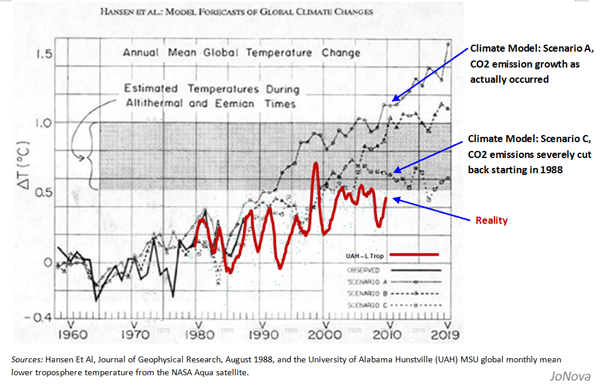
First: Evans examines the Climate Model predictions made by James Hansen (the so-called godfather of AGW) during his testimony to the US Congress in 1988.(click on chart to enlarge)

Evans says:”… the actual temperature rises are about a third of what he predicted. Remember, they have been saying the “science is settled” since the early 80’s, and the models now are essentially the same as they were then.

Furthermore, Hansen’s models predicted the temperature rise if human carbon dioxide emissions were cut back drastically starting in 1988, such that by year 2000 the atmospheric carbon dioxide level was not rising at all. But in reality, the temperature did not even rise that much. Which proves that the climate models don’t have a clue about the effect of carbon dioxide on world temperature.”

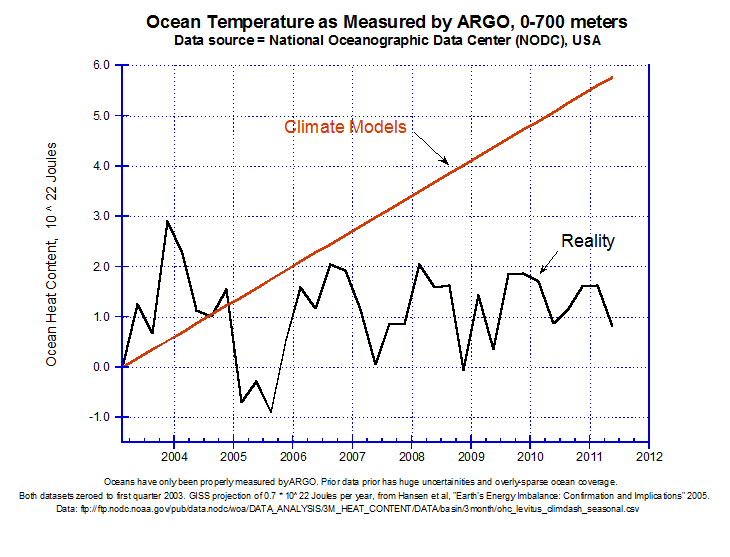
Second: Evans looks at ocean warming.  This is a better gauge of global warming than is measuring atmospheric temperature fluctuations.  The Argo Buoys were put into service in 2003.  The measurements of ocean temperatures prior to the Argo program are suspect in my view.  Nothing before 2003 remotely resembles the scope of Argo measurements.(click on chart to enlarge)

Evans says: the climate models predict the oceans should be warming. We’ve only been measuring ocean temperature properly since 2003, using the ARGO system. In ARGO, a buoy duck dives down to 2000m, slowly ascends and reads the temperatures on the way, then radios the result back by satellite to HQ. Three thousand ARGO buoys patrol the oceans constantly. They say that the ocean temperature since 2003 has been basically flat. Again, reality is very different to the climate models.

Thirdly: Evans looks at the “hotspot” which was  a climate computer prediction  which is the  Warmers’ proof of the positive feedback.  Feedback that is able to take a weak CO2 forcing signal and double or triple it.   Unfortunately for the advocates of this hypothesis, the hotspot does not exist.(click on chart to enlarge)

Evans says: “the climate models predict a particular pattern of atmospheric warming during periods of global warming. In particular, the most prominent change they predict is a warming in the tropics about 10 km up, the so-called “hotspot”. But we have been measuring atmospheric temperatures by weather balloons since the 1960s, and millions of weather balloons say there was no such hotspot during the last warming from 1975 to 2001. The hotspot is integral to their theory, because it would be evidence of the extra evaporation and thickening of the water vapor blanket that produces two thirds of the warming in the climate models…”

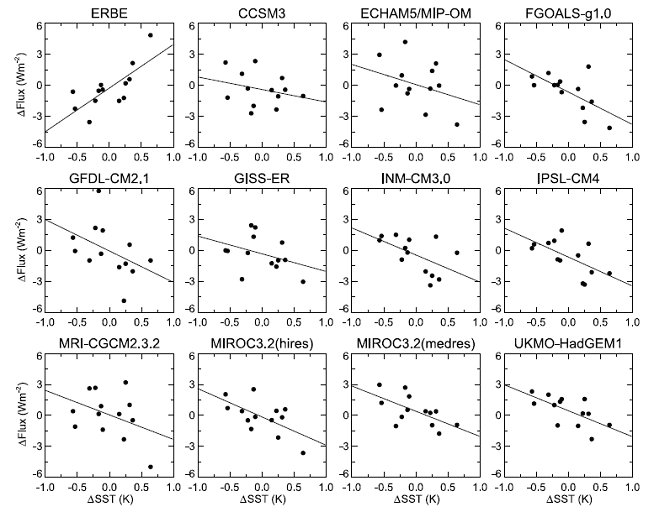
Fourthly:  Evans hits on one of the most discussed topic in recent times—that of outgoing radiation into space.    Note in the chart below that the top row left is the actual measurements of outgoing radiation by the stat elite ERBE program (Earth Radiation Budget Experiment-click here for more information.)   The other boxes are climate model predictions. (Chart source=Lindzen and Choi 2009)

Evans says: “satellites have measured the outgoing radiation from the earth and found that the earth gives off more heat when the surface is warmer, and less heat in months when the earth’s surface is cooler. Who could have guessed? But the climate models say the opposite, that the Earth gives off less heat when the surface is warmer, because they trap heat too aggressively (positive feedback). Again, the climate models are violently at odds with reality.”

Evans sums up saying:” Those are four independent pieces of evidence that the climate models are fundamentally flawed. Anyone one of them, by itself, disproves the theory of man-made global warming. There are also other, more complex, pieces of evidence. Remember, there is no direct evidence that man causes global warming, so if the climate models are wrong then so is the theory.”

Read all of Evan’s posting here.

cbdakota

One Billion Motor Vehicles And Peak Oil


Oilprice.com noted that in August, Wards Auto published a story saying that World motor vehicle count now stands at 1 billion.  The U.S. still has the largest registration at about 240 million.   In the Oilprice.com blog, the author considers what 1 billion vehicles and the likelihood of even more being added in the next 25 years might mean. It is interesting reading.  He seems to favor governmental intervention to ameliorate supply (read PEAK OIL) versus demand for fossil fuels.   He says:

It is highly unlikely that there will be anything approaching 240 million registered vehicles in the U.S. 25 years from now. From the vantage point of 2011, it seems probable that many will not be able to afford to own and operate personal motor vehicles of the size and types we have today.

He thinks that the newly mandated CAFÉ standard is just what we need and that we will have to abandon 6 passenger cars and other large sized vehicles. He says:

  In the U.S. we are now facing standards requiring that cars achieve an average of 54.5 MPG 15 years from now. First will come all sorts of weight reductions, such as eliminating spare tires, and adding more plastic and aluminum parts. Engines will become more efficient and car bodies will become more aerodynamic.  Although these changes will be costly, it does not take much arithmetic to conclude that if energy costs are three or four times higher than they are today then mileage will become the key factor by which motor vehicles are judged.

Detractors of these new mileage standards are usually people who have little grasp, or prefer not to think about where real energy costs are going to be 15 years from now. They point out the advanced materials required to build a low-weigh, high mileage, vehicles will be so great that it will push cars beyond what many, if not most, can afford.  

Due to governmental interference, the U.S. is facing an artificial Peak Oil problem.   This artificial Peak Oil Problem is really a part of the Peak Energy Problem that governmental interference is causing.    We have a lot of fossil fuels.  The U.S has the largest reserve of fossil fuels in the world.  It is likely that North America could become energy independent.  Yes, no propping-up Venezuela nor other countries that don’t have our best interest in mind.   And what a break for our balance of payments.  Becoming completely energy independent might possibly be the wrong thing to do because the prices of crude oil could fall below our production cost thanks to the U.S. bringing on more production capacity.  I don’t want the government to dictate how much crude we should produce or purchase.  Let the market decide whether we produce or buy.

Peak Oil will come sometime, but not in the near future.  What the U.S. is facing is an ideological, artificial Peak Oil problem.   The Obama administration gives money to “renewable fuels” programs and tells us that we must do this to reduce the purchase of foreign crude.   How the government thinks they can do this with renewable fuels is beyond comprehension.  Renewable fuels, are now neither economic nor reliable enough to do that.  In fact, the electrical grid people that distribute the nation’s electricity have found it necessary to have fossil fuel powered back-up capacity equal to the wind or solar capacity.  The renewables can’t be scheduled, meaning their supply is too erratic to provide steady voltage and current.  The wind slows down or stops or the sun goes behind clouds and the former balance of supply and demand goes south. They have to have something as a backup to keep the lights on.  Their second argument is that fossil fuels not be used as combustion results in C02.   The fossil fuel back-up capacity blows that argument.  See here and here to read about the folly of renewable fuels.

The Radical Environmentalists fight every attempt to develop our resources.   Oil in Alaska, offshore oil, oil in the Baaken field, nuclear power, low cost coal,etc..  It doesn’t matter, they are against it.   They use global warming, polar bears, darter fish, left-handed ground squirrels  (I guess I made that one up) and one of my favorites–the Houston toad.    According to some reports only 300 Houston Toads remaining in the world and they have been placed on the endangered species list.  “A world without the Houston toad ... is not a world we can physically live in,” says Paul Crump, a reptile and amphibian keeper at the Houston Zoo who works with the small brown toads.  Who knew?  The world is on the way to a collapse. More dangerous issue than the Osama binLaden threat so lets get the Seal Teams to see nothing bad happens to those warty little buggers. (SARC).

Fracking and the oil pipeline from Canada are the causes du jour for the radical environmental crowd.   It is patently clear that they will only be satisfied when this country is reduced to a third world status.   And our Government supports their activities through the EPA and other departments.  God Bless Michelle Bachmann and her vow to eliminate the EPA if she is elected President.  If she is not, she should be given the job as the EPA Administrator.

We will run out of economically recoverable oil some day.  Same for natural gas, iron ore, etc.  But the many forecasts made by experts about when the oil peak would occur have always been vastly overstated.

We quoted The Oilprice.com author saying that in 15 years the price will be 3 to 4 times higher than today.  It could happen but only if we just sit back and let it happen.  For a more realistic assessment of the Peak Oil tipping point, lets look at what has been said on a WardsAuto.com posting titled “Oil’s Price Always Comes Down.”

Five years ago, I believed in the Peak Oil theory. It postulated that global oil production would peak in 2006, and the following shortage would send prices skyrocketing. Sure enough, in 2008 a barrel of oil shot up to $150.

But less than 12 months later, oil plummeted to less than $40 a barrel. Yes, the price now is back up to $100, but I no longer believe in Peak Oil. Here’s why:

Brazil recently discovered massive oil reserves off its coast that match or beat Saudi Arabia’s. Brazil will start tapping those reserves before this decade is out. In Iraq, infrastructure is being put in place to increase oil production six or seven times greater than today, potentially making it the largest oil producer in the world.

And in the U.S., a new drilling technique called hydraulic fracturing is the mother of all game changers. (My emphasis)  Texas wildcatters figured out a way easily extracting natural gas and oil from shale. Using high-pressure water and sand, they fracture the shale, releasing trapped gas. As a result, the U.S. has added 100 years of natural gas use (at current rates), and the price of natural gas has fallen to nearly half from its peak in 2008.

Hydraulic fracturing, or fracking as it’s also called, is controversial. Some environmentalists have seized on it as the next great danger to the planet. A documentary called “Gasland” probably will win an Academy Award for hysterically pointing out the dangers of fracking.

Of course, “Gasland” approaches its topic with the impartiality and evenhandedness of pseudo-documentaries such as “Roger and Me” and “Who Killed The Electric Car?” So far, fracking has been done mostly in the U.S., but it soon will spread to the rest of the world. (My emphasis) Before this decade is out, we are going to see vast increases in the amount of oil and natural gas available. And this will have enormous implications for the auto industry and policy planners.

Closing out is a good time to call for a lesson from “Minnesotans 4 Global Warming”.

http://www.youtube.com/watch?v=nWiKvNDTjB4&feature=player_embedded

cbdakota

Obama Plans to Nationalize the Energy Companies


This Administration’s actions lead me to believe that President Obama is planning to nationalize the energy companies.  When will he do this?   When gasoline hits somewhere around $10 per gallon as some predict it will this year.  See, see. Maybe you think that if gasoline prices get that high, he wont be re-elected?  That is why he will act.  His narrative will be that he had to do it to save the country. Many of our citizenry will applaud his actions. Unfortunately the idea that the government is everyone’s safety net is becoming too engrained.  If gasoline does not reach $10 in his first term and he gets a second term (and a Democrat majority in Congress, a real possibility if Obama is re-elected) he will wait until then.

Demonizing Energy Companies

So you think that this not something Obama and the Democrats would do.  They nationalized most of the automotive industry and got a way with it.   Obama Care is the first step on the way to nationalizing the Health Care industry.  The Congressional Democrats have long advocated nationalizing the Energy companies as have their echo chamber, the mainstream media. See, see, see, see. President Obama is not standing on the sidelines but rather is leading the charge against energy companies.

What Are The Signs

What is going on is an all out assault on the US energy companies by all of Obama’s administration.  Coal is being regulated out of business.  By managing permitting, Oil can’t increase the supply of crude domestically or from neighbors like Canada which will result in higher crude oil prices.  Natural gas re-emergence, resulting from fracking making available vast quantities of domestic gas, is facing the EPA and other environmental groups that want to outlaw or severely restrict the use of fracking.

And the Administration seems to want to reward our foreign foes or competitors while penalizing domestic Energy Companies.    What other conclusions can be derived from the way this President and his allies are conducting business?

The US has plenty of energy.  A recent study by the Congressional Research Service (CRS) determined that the USA has the world’s most abundant supply of fossil fuels.  The fuel resources counted were oil, coal and natural gas and all were equilibrated to the energy in barrels of oil equivalent  (BOE). The Chart below has the top seven nations from the study.

Nation Total Fossil Fuels in BOE
United States 973    billions of barrels equivalent
Russia 955                     “
China 474                      “
Iran 328                      “
Australia/New Zealand 315                      “
Saudi Arabia 309                      “
India 227                      “

Data from CRS Report “US Fossil Fuel Resources”:Issued 30Nov2010

We have the resources but President Obama does not want to use them.   All this leads to the obvious conclusion that the President is trying to create a “crisis” so he will, as Rahm Emanuel would say, “never let a crisis go to waste.”   Which brings us back to how will he use this crisis.  I believe it will be to nationalize the US energy companies.  If that happens, don’t be deluded into thinking that the Government will be able to provide us with “low prices”.  The private energy companies, e.g. BigOil, are motivated to innovate ways to locate and exploit reserves at the lowest cost possible.  They represent private enterprise at its best.  Don’t expect nationalized oil to provide this leadership or low prices.   Likely there won’t be any benefit to our economy, or boost in jobs and I suspect President Obama knows this.  The reason then must be the ultimate goal of socialists—– redistribution of wealth.

It is hoped, that the following discussion will help one understand the battle the Energy Companies are facing.

OIL

Another investigation is underway to find out if Big Oil (e.g. Exxon-Mobil, Chevron, Shell, BP, Conoco-Phillips) is manipulating the prices.   That Big Oil has been exonerated in all of the previous investigations, and will be in this one, is not the main issue here.  The Liberals know that this technique plants seeds of doubt in the publics mind. Typically, their accusations get all the headlines and the acquittal is seldom mentioned.

If Big Oil is driving up the prices how do they do it?  The American Petroleum Institute (API) listed the 20 Largest Oil and Gas Companies based upon their 2009 oil reserves.  It shows that 72% of the world’s oil reserves are owned by nations (not privately owned companies) such as Iran, Saudi Arabia, Venezuela, and Libya.  The biggest US Company to make the list was Exxon-Mobil at #17.   The Exxon-Mobil reserves as a percent of the world reserves are 0.68%.  Think about this situation where the OPEC type state owned companies have reserves 100 times greater than Exxon-Mobil.  Do you really believe that Exxon-Mobil is able to dictates the price of crude to OPEC?   Of course they can’t do that.

Well, there are those obscene earnings, right?  In 2010 the earnings as a percent of sales for Oil and Natural Gas was 5.7%.  Compare that to 19.4% for Beverages and Pharmaceuticals; 17.3% for Computers; and ALL MANUFACTURING was 8.5%.  So the average for manufacturing was 8.5% and Oil and Gas came in with 5.7%.    So, yes, their earnings are large but not out of line with their sales, in fact they are coming in lower than the average manufacturing business.  And further, U.S. oil and natural gas companies tax rates are considerably higher than the average manufacturing company. In 2010 income tax expenses (as a share of net income before income taxes) averaged 41.1 percent for Oil and Natural Gas companies compared to 26.5 percent for the average  S&P Industrial company.

Domestic oil production could make a real change in supply and it would significantly reduce our balance of payments deficit.  Further it would reduce the income of those countries that use the money to make problems for the US—Iran, Syria, Libya, Venezuela, etc.  It is said that Venezuela’s Chavez needs oil above $40 per barrel to have money to support his dictatorship.   And his friend President Obama wants to see the price much higher than $40, too.

Classic wrong headedness is illustrated by diddling over access to Canada’s rich tar sands.  From the IBD posting “China has its eye on Canada’s oil”:

Together, the U.S. and Canada have enough oil and natural gas locked up in shale formations, tar sands, Alaska, the Canadian Arctic and the Outer Continental Shelf to make OPEC pound sand. But we won’t drill for ours and apparently; we don’t want Canada’s.

With more than 170 billion barrels, Alberta has the world’s third-largest oil reserves, behind only Saudi Arabia and Venezuela and ahead of Russia and Iran. Daily production of 1.5 million barrels from the oil sands is expected to nearly triple to 3.7 million by 2025. The only question is, will this crude be flowing south to U.S. refineries or west for export to China?

At issue is the Keystone XL pipeline, parts of which have already been built, that would bring Alberta oil to Texas Gulf Coast refineries. The pipeline also could transport oil extracted from shale formations in the Rocky Mountain West.  The U.S. Geological Survey estimates the region, dubbed the Persia of the West, may hold more than 1.5 trillion barrels of oil, six times the proven reserves of Saudi Arabia, and enough to meet U.S. oil needs for the next two centuries. By 2015, oil executives and industry analysts say, the oil-rich lands of the West, including North Dakota’s booming Bakken formation, could produce 2 million barrels a day, more than the pre-Deepwater Horizon production rate in the Gulf of Mexico.

Environmental groups oppose Keystone XL on the grounds that tar-sands extraction harms the environment through water pollution, greenhouse gas emissions and potential pipeline leaks. The State Department, which must approve any pipeline entering the U.S. across international borders, has withheld its approval pending a final decision Nov. 1.  The Chinese aren’t waiting. Sinopec, a Chinese state-controlled oil company, has a stake in a $5.5 billion plan to build the Northern Gateway Pipeline from Alberta to the Pacific Coast province of British Columbia. Alberta Finance Minister Lloyd Snelgrove met this month with Sinopec and CNOOC, China’s other big oil company, and representatives of China’s banks.

While the U.S. dithers with concerns about “dirty oil” from Alberta’s rich tar sands, energy-hungry China makes Ottawa an offer it might not refuse. Memo to Washington: Pipelines can run west as well as south.

It is not that the President does not know that the laws of supply and demand are important to price of commodities.   When he pulled the stunt of releasing 30 million barrels of crude from our Strategic Petroleum Reserve (SPR), my guess is that his intent was twofold.  Maybe he thought that OPEC would see it as a threat that he would permit additional releases from the SPR if they did up their production and thus reduce crude prices.  As the 30 million only amounted to two days of US crude requirements, it’s likely they were not too worried.  Probably the real reason was to signal that things were out of control and he was trying one of the possible levers to stop the “runaway” gasoline pricing.

COAL

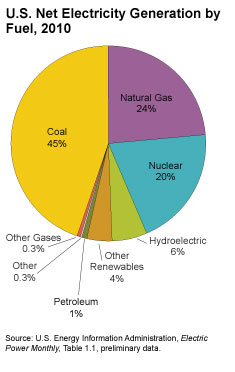
The US has the largest coal resources in the world. It is inexpensive relative to other fossil fuels and it is abundant. Coal is used to produce 45% of the nation’s electricity.    While electricity is very dependant on coal, coal is highly dependent on electricity as 93% of all US coal is used to generate electricity.  But Obama wants to put coal use in the past tense.   Obama announced before he was elected that he was going to put coal out of business and he means to do just that.  He is using the EPA to put very stringent emission restrictions on coal based electrical power plants.  The price increases for the ratepayers in the Mid-Western US States are going to be ugly.

A posting in the TownHall blog, “Clearing the Air”:

EPA’s proposed “mercury and air toxics” rules for power plants are built on the false premise that we are still breathing the smog, soot and poisons that shrouded London, England and Gary, Indiana sixty years ago. In reality, US air quality improved steadily after the 1970 Clean Air Act was enacted.

EPA’s “most wanted” outlaw is mercury. But for Americans this villain is as real as Freddy or Norman Bates. To turn power plant mercury emissions into a mass killer, EPA cherry-picked studies and data, and ignored any that didn’t fit its “slasher” film script. As my colleague Dr. Willie Soon and I pointed out in our Wall Street Journal and Investor’s Business Daily articles, US power plants account for just 0.5% of mercury emitted into North American’s air; the other 99.5% comes from natural and foreign sources.

Energy analyst Roger Bezdek estimates that utilities will have to spend over $130 billion to retrofit older plants, under the measly three year (2014) deadline that EPA is giving them………, On top of that, utilities will have to spend another $30 billion a year for operations, maintenance and extra fuel for the energy-intensive scrubbers and other equipment they will be forced to install.

Many companies simply cannot justify those huge costs for older power plants. Thus Dominion Power, American Electric Power and other utilities have announced that they will simply close dozens of generating units, representing tens of thousands of megawatts – enough to electrify tens of millions of homes and businesses.

Electricity costs are set to skyrocket, just as the President promised. Consumers can expect to pay at least 20% more in many states by 2014 or shortly thereafter. According to the Chicago Tribune, Illinois families and businesses will shell out 40-60% more! How’s that for an incentive to ramp up production and hire more workers? How’s that “hope and change” working out for families that had planned to fix the car, save for college and retirement, take a nice vacation, get that long-postponed surgery?

For a mid-sized hospital or factory that currently pays $500,000 annually for electricity (including peak-demand charges), those rate hikes could add $300,000 a year to its electricity bill.

And it’s not just private businesses that will get hammered. As the Chi Trib notes, if the Chicago public school system wants to keep the lights on and computers running for two semesters, by 2014 it will get hit for an extra $2.7 million it doesn’t have, to pay for skyrocketing electricity costs.

Carry those costs through much of the US economy – especially the 26 states that get 48-98% of their electricity from coal-fired power plants – and we are talking about truly “fundamental transformations.” Millions will be laid off, millions more won’t be hired, millions of jobs will be shipped overseas – and millions will endure brownouts, blackouts and social unrest.

The Chairman of the EPA’s Clean Air Scientific Advisory Committee Jonathan Samet implies there is no limit to the EPA authority according to a Junk Science Posting “Samet” No End To EPA Air Regulations:”

What Samet is saying is that there is no scientific basis for EPA not continually reducing manmade air emissions until there aren’t any. As Samet points out, under the Clean Air Act, the EPA could literally regulate us out of any sort of industry without regard to the consequences.

Classic doublespeak by those who are  our “betters” that want us to use mercury laden lights that are much more expensive than low cost incandescent bulbs (that they are banning) when Energy Secretary Steven Chu said “ We are taking away a choice that continues to let people waste their money.”

Natural Gas

Fracking technology involves pumping high-pressure water, sand and some chemicals into a borehole to create fractures in the shale formations in which natural gas and oil resides.  The fracturing of shale makes paths for the gas and oil to move to the collection piping and up to the surface.   This technology has been used by the oil and gas producers for some while but recently fracking has been used to tap massive quantities of natural gas. The quantities are so large that some estimates of the available natural gas are said to be equal to a 200-year supply for the US.

But the Obama administration never sleeps when it comes to seeking ways to deprive the nation of new supplies of energy.  The EPA has begin to study fracking:  National Review Online’s “The Fracas about Fracking” raises concerns about the likelihood of the study providing a fair review or a predetermined outcome which will reflect unfavorably on the practice of fracking:

In deciding on a policy on fracking, we should not wait for a congressionally mandated EPA report on the impacts of hydraulic fracturing on drinking water, due in 2012. A congressional hearing held in May revealed fatal flaws in what was supposed to be a definitive, vigorously peer-reviewed study. For one thing, it will be an inside job from the EPA; the study’s review panel excludes anyone with professional expertise in current industry practices or the technology of hydraulic fracturing. Under the current administration, industry experts, like highly credentialed professors of petroleum engineering, are assumed to be shills for greedy enterprises.

The EPA study has some other serious defects. It will cherry-pick only four wells, out of hundreds of thousands, for full forensic analysis, and it has excluded representatives of state regulatory agencies — which have six decades of experience in regulating this practice, which began in 1948 — from its review panel. Nor do the researchers seem aware of the difference between, on one hand, models of the assumed effects of hydraulic fracturing and, on the other, physical measurements of the results of hundreds of actual fracking treatments. To learn the fundamentals of this issue, the EPA would have to bother to speak with experts on the technology.

The study seems designed to substantiate a predetermined conclusion: that hydraulic fracturing poses grave risks. Therefore the EPA must either assert regulatory control on all drilling using this technology, or issue a “temporary” moratorium — as in the aftermath of the 2010 Gulf spill — until further study is complete. If fracking is delayed or discontinued, massive resources will remain untapped, hundreds of thousands of jobs will not be created, and billions of dollars of potential federal, state, and local tax revenues will be lost.

And some thoughts about this study from the American Thinker “Obama continues his war on cheap American Energy”:

Even if the panel should somehow miraculously decide that fracking is safe, there is a history of Obama appointees rewriting decisions from panels evaluating the safety of energy development, so as to change the outcomes to suit Obama’s biases against cheap and abundant (and American) energy. When the Gulf of Mexico oil-drilling platform Macondo sprang a leak, a panel’s conclusion regarding the safety of offshore oil drilling was doctored by White House political appointee Carol Browner (or someone operating under her authority) to make it appear that the panel of experts endorsed a moratorium on offshore drilling. When this manipulation of science was brought to light, many members of the panel objected to the distortion of their views and disavowed the “report”.

Stacking panels with ideological soul mates is Barack Obama’s modus operandi. If that does not work to accomplish his goals, creative re-writing is the next step. There is always one more trick in Obama’s pocket that he can use to keep us away from cheap, abundant and American energy.

There are some things we can do—–you probably know what they are.  Anyway, I will list some in my next blog.

cbdakota

MONBIOT ON DISCORD IN THE GREEN RANKS


George Monbiot writes for the UK Guardian newspaper and he is perhaps the most influential green blogger in Europe.  This week, beginning with a blog on 2 May and a follow-up several days latter, he discussed the problems within the green movement.  The title of his 2 May posting is  “Let’s face it: none of our environmental fixes break the planet-wrecking project”.  His subtitle for that posting is:”All of us in the green movement are lost before the planet’s real nightmare: not too little fossil fuel—but too much”.

Monbiot is a believer in catastrophic global warming resulting from fossil fuel use (the “planet-wrecking project”).  And his preferred solution is “sustainability” which means to allocate resources and wealth across the globe while at first reducing and eventually eliminating fossil fuel use.  Ultimately world societies would become less complicated and perhaps more agrarian.  De-developing the Western societies while developing those nations that are second and third world will be necessary to accomplish this.  A tenet of sustainability is that governments will have to exercise more control to assure the outcomes.  Saying it differently, you will surrender much of your freedom to the UN or some like group.

He was hoping that fossil fuels would become less available but he laments, that is not the case.

This posting is not to dispute Mr. Monbiot’s premise of catastrophic global warming due to fossil fuel uses, but rather to examine his view of the sects within the AGW crowd and their differences in beliefs. To begin, Mr. Monbiot is not my kind of guy.   When John Bolton, our UN Ambassador, traveled to England in 2008, Monbiot wanted to arrest him and try him for war crimes. Monbiot also began a campaign to have then Prime Minister Blair taken to court on similar charges related to the Iraq war.  His thoughts on things he thinks we should be doing, IMHO, demonstrate a low level of economic reality and a love of “Big Brother”.   Although our worldviews are quite different, he is quite intelligent so we need to keep track of what he is thinking.

He begins his first posting regarding discussions with his fellow warmers like this:”You think you’re discussing technologies, and you quickly discover that you’re discussing belief systems. The battle among environmentalists over how or whether our future energy is supplied is a cipher for something much bigger: who we are, whom we want to be, how we want society to evolve. Beside these concerns, technical matters – parts per million, costs per megawatt hour, cancers per sievert – carry little weight. We choose our technology – or absence of technology – according to a set of deep beliefs: beliefs that in some cases remain unexamined”.

He makes sense when he defends his recent acceptance of nuclear energy as a vital need going forward, with or without fossil fuels: “The case against abandoning nuclear power, for example, is a simple one: it will be replaced either by fossil fuels or by renewables that would otherwise have replaced fossil fuels. In either circumstance, greenhouse gases, other forms of destruction and human deaths and injuries all rise”.

“The case against reducing electricity supplies is just as clear. For example, the Zero Carbon Britain report published by the Centre for Alternative Technology urges a 55% cut in overall energy demand by 2030 – a goal I strongly support. It also envisages a near-doubling of electricity production. The reason is that the most viable means of decarbonising both transport and heating is to replace the fuels they use with low-carbon electricity. Cut the electricity supply and we’re stuck with oil and gas. If we close down nuclear plants, we must accept an even greater expansion of renewables than currently proposed. Given the tremendous public resistance to even a modest increase in windfarms and new power lines, that’s going to be tough”.

He believes that “accommodation” (read sustainability) is the goal but he says:”But even if we can accept an expansion of infrastructure, the technocentric, carbon-counting vision I’ve favoured runs into trouble. The problem is that it seeks to accommodate a system that cannot be accommodated: a system that demands perpetual economic growth. And adds: Accommodation makes sense only if the economy is reaching a steady state”.

He has been criticized in Simon Fairlie’s posting in the magazine The Land. To which he responds:”There’s a still bigger problem here: even if we make provision for some manufacturing but, like Fairlie, envisage a massive downsizing and a return to a land-based economy, how do we take people with us? Where is the public appetite for this transition?”

Monbiot adds that:   “A third group tries to avoid such conflicts by predicting that the problem will be solved by collapse: doom is our salvation. Economic collapse, these people argue, is imminent and expiatory. I believe this is wrong on both counts”.

He then gets to his central point about too much fossil fuel: “The problem we face is not that we have too little fossil fuel, but too much. As oil declines, economies will switch to tar sands, shale gas and coal; as accessible coal declines, they’ll switch to ultra-deep reserves (using underground gasification to exploit them) and methane clathrates.

Monbiot sums up his view of the current state of the environmental movement:”All of us in the environment movement, in other words – whether we propose accommodation, radical downsizing or collapse – are lost. None of us yet has a convincing account of how humanity can get out of this mess. None of our chosen solutions break the atomising, planet-wrecking project”.

In his second posting is “The green problem: how do we fight without losing what we are fighting for?”.  It is subtitled: “Environmentalism is stuck-factional and uncertain even of the goals we seek.  But we must face facts and engage in reality.”

In this posting he expands upon the point he made in the first posting and he adds some interesting things.  He  enumerats the disagreements that he believes permeate the green community: “We have no idea what to do next. We have no idea what to do next.  Partly as a result, we have started tearing each other apart. This is an understandable but unnecessary reaction. Those seeking to protect the landscape are not our enemies; nor are those advocating that renewables should replace fossil fuel; nor are those promoting nuclear power as the answer; nor are those opposing nuclear power. We are all struggling with the same problem, all bumping up against atmospheric chemistry and physical constraints”.

“The enmity arises when people go into denial. Denial is everywhere. Those opposing windfarms find it convenient to deny that climate change is happening, or that turbines produce much electricity. Those promoting windfarms downplay the landscape impacts. Nuclear enthusiasts ignore the impacts of uranium mining. Opponents of nuclear power dismiss the solid science on the impacts of radiation and embrace wildly-inflated junk numbers instead. Primitivists decry all manufacturing industry, but fail to explain how their medicines and spectacles, scythes and billhooks will be produced. Localists rely on technologies – such as microwind and high-latitude solar power – that cannot deliver. Technocratic greens refuse to see that if economic growth is not addressed, a series of escalating catastrophes is inevitable. Romantic greens insist that the problem can be solved without even engaging in these dilemmas, yet fail to explain how else it can be done”.

“We’re all responding to the same impulses, but we’re all being tripped up by denial. Denial, and a failure to see the whole picture, are our enemies. Or perhaps, as doctors say about alcohol, our false friends”.

He cites Paul Kingsnorth’s posting titled “The quants and the poets”.   Quants are numbers/facts people and poets are people that examine societies values and underlying mythology.  Kingsnorth’s posting is very well written and he too contrasts the various divergent opinions alive in the green world today.  He believes that Monbiot is loosing his credentials as a Poet.

Monbiot responds to this quants/poets issue here: “Perhaps we are less tolerant of myth than we used to be. Perhaps we should be. Is creating new, opposing myths the best way of confronting the founding myths of neoliberal capitalism? I don’t think so. Is it not better to fight them with withering analysis, quantification and exposure? But can we do this without becoming insensible to beauty, and to the impulse – a love for the world and its people, its places and its living creatures – which turned us green in the first place? I don’t know”.

Well this has been a long post and I thank all of you that read it all the way to the end.

cbdakota

Real Wind Power Data—Disappointing Performance


It is difficult to get comprehensive data on wind farm performance as it is shielded from view by “protection of competitive data” or by contract terms.  A new study bearing comprehensive data from Scotland confirms what skeptics have been saying about windfarm performance. This new study is perhaps the most comprehensive since the Bentek Energy(an energy analytics firm) study of Colorado and Texas windfarms.

Stuart Young Consulting with support from the JOHN MUIR TRUST (emphasis mine, to highlight that this study was commissioned by a green NGO) has released a report studying the ability of wind power to make a significant contribution to the UK’s energy supply. It concludes that the average power output of wind turbines across Scotland is well below the rates often claimed by industry and government.

This report examined 5 common claims by the wind industry and the Scottish Government.   The five claims are in RED with the actual result in BLACK:

1. ‘Wind turbines will generate on average 30% of their rated capacity over a year’ In fact, the average output from wind was 27.18% of metered capacity in 2009, 21.14% in 2010, and 24.08% between November 2008 and December 2010 inclusive.

2. ‘The wind is always blowing somewhere’ On 124 separate occasions from November 2008 to December 2010, the total generation from the windfarms metered by National Grid was less than 20MW (a fraction of the 450MW expected from a capacity in excess of 1600 MW). These periods of low wind lasted an average of 4.5 hours.

3. ‘Periods of widespread low wind are infrequent.’ Actually, low wind occurred every six days throughout the 26-month study period. The report finds that the average frequency and duration of a low wind event of 20MW or less between November 2008 and December 2010 was once every 6.38 days for a period of 4.93 hours.

4. ‘The probability of very low wind output coinciding with peak electricity demand is slight.’ At each of the four highest peak demand points of 2010, wind output was extremely low at 4.72%, 5.51%, 2.59% and 2.51% of capacity at peak demand.

5. ‘Pumped storage hydro can fill the generation gap during prolonged low wind periods.’ The entire pumped storage hydro capacity in the UK can provide up to 2788MW for only 5 hours then it drops to 1060MW, and finally runs out of water after 22 hours.

The final claim about “pumped storage” varies with the area where the windfarms are located.  In the US, an area such as the Great Plains, where wind availability is favorable to siting of windfarms, has little to no pumped storage hydro capacity available.   Availability in most other areas is either used or would be difficult to develop as environmental groups object to the use of dams.  Further there is a loss of efficiency when the windpower electricity is used to pump water to some higher elevation and then recovered in hydroelectric turbines.

The author of the report said:

It was a surprise to find out just how disappointingly wind turbines perform in a supposedly wind-ridden country like Scotland. Based on the data, for one third of the time wind output is less than 10% of capacity, compared to the 30% that is commonly claimed.

At the end of the period studied, the connected capacity of wind power was over 2500MW so the expectation is that the wind network will produce, on average, 750MW of energy. In fact, it’s delivering far less than everyone’s expectations. The total wind capacity metered now is 3226MW but at 3a.m. on Monday 28th March, the total output was 9MW.

To see the John Muir Trust posting in more detail, click here

For further information on the Bentex study mentioned at the begining of this posting click here.

cbdakota

Does your state have Renewable Electricity Mandates?


Twenty-nine States have passed legislation that requires utilities to sell or produce a certain percentage of electricity from renewable sources.   Electricity prices are higher in those states, partially due to these mandates.

According to the Institute for Energy Research these mandates are an expensive way to reduce carbon dioxide emissions.   In their posting The Status of Renewable Electricity Mandates in the States they note the following:

Some argue that renewable electricity mandates are a good way to reduce carbon dioxide emissions, but renewable electricity mandates are a very expensive way to reduce carbon dioxide emissions. According to the California Air Resources Board, it costs $133 per ton to reduce carbon emissions through the mechanism of a renewable electricity mandate. An internal Obama administration memorandum on subsidies for renewables recently noted that carbon dioxide emissions “would have to be valued at nearly $130 per ton for CO2 for the climate benefits to equal the subsidies.” To put these numbers in perspective, it currently costs about $15 a ton to purchase a certified carbon dioxide allowance traded on the European Climate Exchange.

There are currently no Federal renewable energy mandates. The Heritage Foundation has calculated the economic impact of enacting Fed mandates as follows:

Its researchers found that a mandate starting at 3 percent for 2012, and increasing by 1.5 percent per year until 2035, would:

• Raise electricity prices by 36 percent for households and 60 percent for industry;

• Cut national income (GDP) by $5.2 trillion between 2012 and 2035;

• Cut national income by $2,400 per year for a family of four;

• Reduce employment by more than 1,000,000 jobs; and

• Add more than $10,000 to a family of four’s share of the national debt by 2035.

Similarly, Credit Suisse estimated the capital expenditures necessary to achieve different levels of renewable generation by 2020. The bank noted that a nationwide 10 percent renewable electricity mandate would require capital expenditures of $350 billion, a 15 percent mandate would require $500 billion and a 20 percent requirement would require $750 billion. The California Air Resources Board has estimated that it will cost $115  billion in new infrastructure to meet California’s renewable electricity mandate in 2020 (33 percent).

I recommend that you open up this link to see how your State stacks up.

cbdakota

DELAWARE AND BLUEWATER WIND


For this posting  I want to use my neighboring state of Delaware and the proposed off-shore wind farm as an example of what the rate payers in that state are facing.

Several years ago furious because of what happened when the price of electricity was deregulated Delawareans were led to believe they could protect themselves from this happening again by installing an offshore windfarm to produce “renewable” electricity.   Driven by the perception that the price of electricity would be less expensive and that it would help save the planet by reducing the electricity produced by natural gas or coal,  they willingly accepted the idea of offshore windfarm.  Moreover the State mandated that a percentage of the electricity used in the State had to be produced from “renewable” energy.

With much political pressure being applied, Delaware Power (the major Delaware Utility) began negotiations with Bluewater Wind (BWW).   Delaware Power reluctantly signed a contract to buy the electricity from this proposed wind farm.

Unfortunately for the Delawareans who thought the deregulated price of electricity was high, they are in for a bigger shock if they allow the BWW offshore windfarm to become a fact.  And wherever windfarms are installed, they are so unreliable that equivalent fossil fuel electrical generating capacity must be installed to protect the electrical users from interruption of their supply. This adds more cost and does nothing to reduce carbon dioxide emissions.

PRICE OF ELECTICITY FROM OFF-SHORE WINDFARMS

Lets look first at cost.   The Department of Energy’s Energy Information Agency says that without subsidies the price of electricity from offshore windfarms is not viable.  The following table is the EAI’s latest estimate of the cost of electricity production in 2016 when BWW says they will be producing electricity:

LEVELIZED COSTS OF ELECTRICITY IN 2016

Look at the column “Total System Levelized Costs” for conventional coal, and conventional combined cycle (in the Natural Gas-fired grouping) and then compare these costs to the levelized cost of Wind-Offshore:

Coal is $94.8 per megawatt hour or more familiarly  $0.095 per kilowatt hour.

Natural gas is $0.066 per kilowatt hour

Wind—Offshore is $0.243 per kilowatt hour.

To give you a little background on these numbers, the EAI penalized the natural gas and coal plants estimates with a cost of buying CO2 credits which would be necessary if the our country ever losses its mind and passes “cap and trade”. These penalties do not currently exist but are included anyway.

The Wind—offshore costs do not reflect the subsidies that the government is handing out to cover the real costs shown in this chart.

CAPACITY FACTOR AND ITS AFFECT ON COSTS

The capacity factor is a measure of the percentage of the rated capacity that can be depended upon.  The main natural gas and coal plants operate most of the time at a percentage of rated capacity in the mid to upper 80tys.  The Wind—offshore has a capacity factor of 39.3%.   From what one reads in the literature where actual performance of windfarms is recorded, the number of 39.3% vastly overstates their performance, which is often said to be in the 19 to 20% range.  Were the EAI to use the lower capacity factor,  the cost for wind produced electricity would be even more expensive than the $0.243 per kilowatt hour.

Several of the Natural Gas fired cases are nearly as high as the wind cases.  This is because these cases are for the backup turbine units that utilities must have to meet unexpected changes in supply or demand.  These natural gas turbines have capacity factors of 30% but can achieve a much higher number.  However, they are more costly to operate and are only used, as noted earlier, as backup.

The US has a vast surplus of natural gas.   The forecast cost to produce electricity in a natural gas based plant based upon the Department of Energy’s forecast in 2016, is about 27% of the offshore windfarm for that same year.  Will there ever be a time that these wind farms can compete in the market place or will we rate payers always have to subsidize them?

The fundamental problem with windfarms (and solar) is the fact that they can be working one minute and not the next.  The wind (or cloudless sunny days) can not be scheduled.  The electrical grid operators must be able to rely upon the electrical generation units to provide the power needed to match the user’s demands.  The low cost plants, fueled by coal, natural gas or nuclear are used as the base load.  They are steady and reliable.   These base load units are not capable of rapidly increasing or decreasing the generation of electricity.   Delaware Power, like other producers of electricity have units on hot standby that can be put into service almost immediately to meet peak requirements by their customers.  And as this demand drops off, they can easily be backed down as necessary to stay in balance.

Why have wind farms unless they can provide base load electricity?  They cannot because these farms can not control the wind.    Often when very cold or very hot weather  occurs, the wind does not blow at all.   So instead of base loading they are relegated to being spot suppliers. It is widely understood that, on balance, for every kw of wind farm capacity that is brought on line, the equivalent amount of natural gas turbine capacity must also be added.    For skeptics of the theory of man-made global warming, the fact that windfarms did not result in any less CO2 vented to the atmosphere, is not a big concern.   But it surely should give the believers in manmade global warming a big case of indigestion.

BLUEWATER WIND

Delaware has an excellent source of information about BWW in the “Inside Energy” blog published by the Caesar Rodney Institute.   Recently they posted a blog  RE: Prediction: Bluewater Wind Project Will Crash and Burn. The blog notes that 2016 is the earliest startup date and adds:

The earliest start-up date for the offshore wind facility is now 2016 when the price will be $.142/Kilowatt-hour (KWh). Similar projects off the coasts of New England and Europe have set contract prices between $.19 and $.24/KWh. There is nothing magic about the waters off the coast of Delaware to justify the difference in price.

The higher prices in other locations already account for government construction subsidies which will come to $800 million for the Bluewater Wind project. However, the subsidies only extend to facilities built by the end of 2011. The US Congress, exhibiting symptoms of subsidy fatigue, may not extend the subsidies further for a mature industry that accounted for 39% of all new generating capacity in 2009. So an even higher price increase may be needed to sustain the project next year.

The wind project is expected to provide about 1.1 billion KWh of electricity a year. Wholesale power from conventional sources costs about $.06/KWH. The “Green Premium” for offshore wind power could range between $.08/KWH and $.20/KWh at full price with no government subsidies. This will cost Delaware consumers between $90 and $220 million a year.

There will be hearings on BWW in May and you are encouraged to join with the folks from the Caesar Rodney Institute.  Regarding this hearing they add:

NRG, the owners of Bluewater Wind, will have to seek a significant rate increase to justify the investment in its’ Delaware offshore wind project. The attempt could fail bringing the project to an end. The good news is this will save Delaware electricity consumers hundreds of millions of dollars a year in avoided price increases and could save hundreds of jobs.

In a future posting, I want to let you in on the reasons why there are many big companies pushing these windfarm schemes on the rate payers.

cbdakota