Category Archives: Sunspots

Are Sunspots Going to Disappear by 2015?


To reacquaint you with this topic, lets do a little review.  Livingston and Penn have been measuring the umbral intensity of sunspots and the corresponding magnetic field that spawns them since 1990.  In 2006 they submitted a paper to the journal “Science” reporting on their efforts and suggested that if the trend of weaker sunspot magnetic fields continued at its current rate, they would be too weak to produce sunspots.  This paper was rejected in peer review. Undeterred, they have continued to study these phenomena and so far, they seem to be on to something.

Sunspots are the product of the enormous magnetic fields created on the Sun. What make them especially interesting is that the Earth’s climate and sunspots have a high degree of correlation.   Periods where the climate has cooled off seem to coincide with periods of few sunspots and periods of warmer climate seem to coincide with periods of high sunspot counts.

Sunspots appear as dark spots on the face of the Sun.  Very strong magnetic forces (thousands of times stronger than Earths magnetic field) block the hot solar plasma and sunspots are the result.  The spots are cooler than the surrounding surface of the Sun.  NASA says that the spots are about 3700K versus 5700K for the surrounding photosphere.

©UCAR, image courtesy Matthias Rempel, NCAR

The photo sh0ws the “spot” (the umbra) surrounded by the penumbra that is shaped by the magnetic lines of force. 

Livingston and Penn have studied over 1700 spots and they see a trend in which the darkest parts of the sunspot umbra have become warmer (45K per year) and their magnetic field strengths have decreased (77 Gauss per year**), independently of the normal 11-year sunspot cycle.

The latest data is shown in the two charts, UMBRAL INTENSITY AND UMBRAL MAGNETIC FIELD.
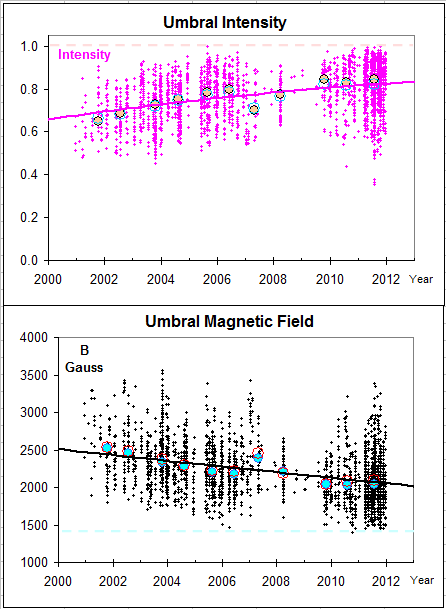
Charts courtesy of Leif Svalgaard

The umbral intensity is a measurement of the light from the umbra (the dark center) and compared to a measurement of the light from a calm sun surface.  Note that the umbra is getting hotter and brighter as the umbral magnetic field gets weaker.  The two scientists believe that if the magnetic field weakens to ≈1500 gauss, the sunspots will not form.   If the trend continues linearly,  that could happen in this decade. 

If there are no visible sunspots in Cycle 25,  it could mean that we would be experiencing a solar minimum like the Maunder minimum that heralded in the Little Ice Age. It should be noted that while this is a suggestion, rather than a promise, it certainly is consistent with the observable trend of a less energetic Sun.

** Gauss is measure of the strength of a magnetic field.  Its units are Maxwells per square centimeter.  A small bar magnet will range from 40 to 100 gauss. The Sun’s average magnetic field strength is 1 and the Earth’s is 0.5.

cbdakota
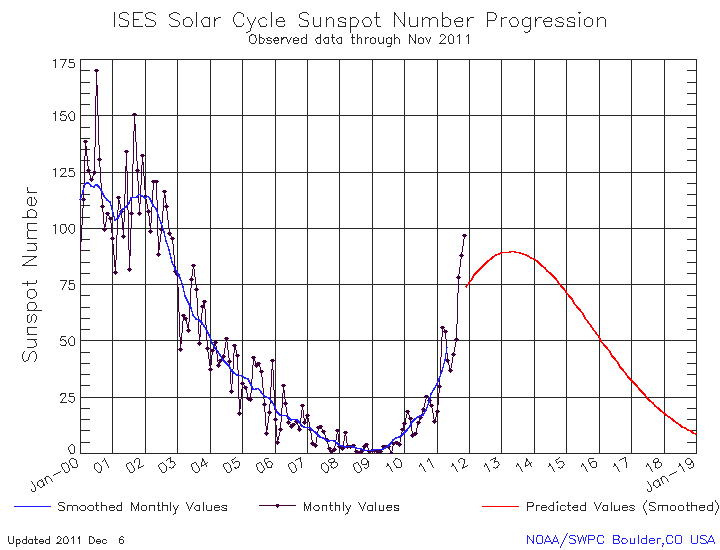


Cycle 24 November 2011 Update


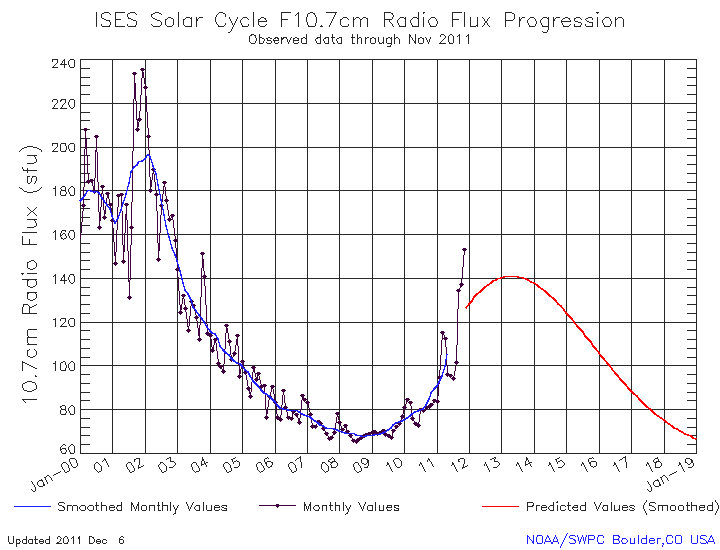
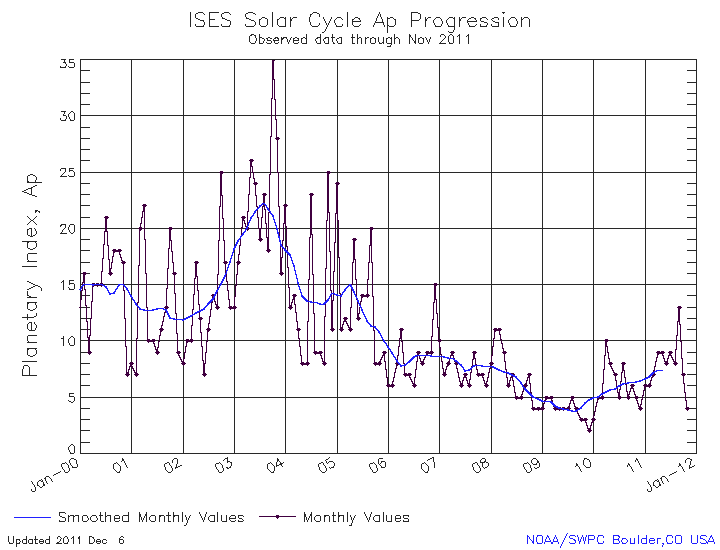
November Cycle 24 monthly sunspot count was nearly 100, which is by far the most active period since the cycle began.    The same goes for the F 10.7 Radio Flux that racked up a value of about 155.  But of these numbers are well below those of Cycle 23 at its peak.  Cycle 23 peak sunspot count was 170 and its F10.7 was about 235.   See the  November NOAA/SWPC charts below:

CLICK ON CHARTS FOR BETTER VIEW

Solar Activity/Geomagnetism

The Ap index is a good proxy for overall solar activity. For two months it has declined.  We are seeing Cycle 24 peaks in F10.7, and sunspots simultaneously with this drop in Ap.  It may mean that the spots and F10.7 may soon be trending downward as well.

If you  are interested,  the following is a brief explanation of the various ways geomagnetism is expressed.

The magnetic activity indices K, Kp and ap are designed to measure the variations in the geomagnetic field that arise from current systems caused by regular solar radiation changes. Other irregular current systems produce magnetic field changes caused by the interaction of the solar wind with the magnetosphere, by the magnetosphere itself, by the interactions between the magnetosphere and ionosphere, and by the ionosphere itself.

The planetary 3-hour range index Kp is the mean K-index from 13 geomagnetic observatories.  The scale is 0 to 9 expressed in thirds of a unit, 5-  is 4 2/3, 5 is 5 and 5+ is 5 1/3.  This planetary index is designed to measure particle radiation by its magnetic effects.  The 3-hourly ap (equivalent range) index is derive from the Kp index as follows:

Kp = 0o   0+   1-   1o   1+   2-   2o   2+   3-   3o   3+   4-   4o   4+

ap =  0     2     3      4     5     6     7       9    12   15    18     22   27   32

Kp = 5-    5o    5+   6-   6o    6+    7-     7o     7+     8-     8o     8+    9-     9o

ap = 39   48   56    67   80   94   111  132    154   179   207  236  300  400

Now one more derivation to get to the Ap index.   The  Ap index is defined as the earliest occurring maximum 24-hour value  obtained by computing an 8-point running average of successive 3-hour ap indices during a geomagnetic storm event.

cbdakota

September Solar Cycle 24 Activity Increased


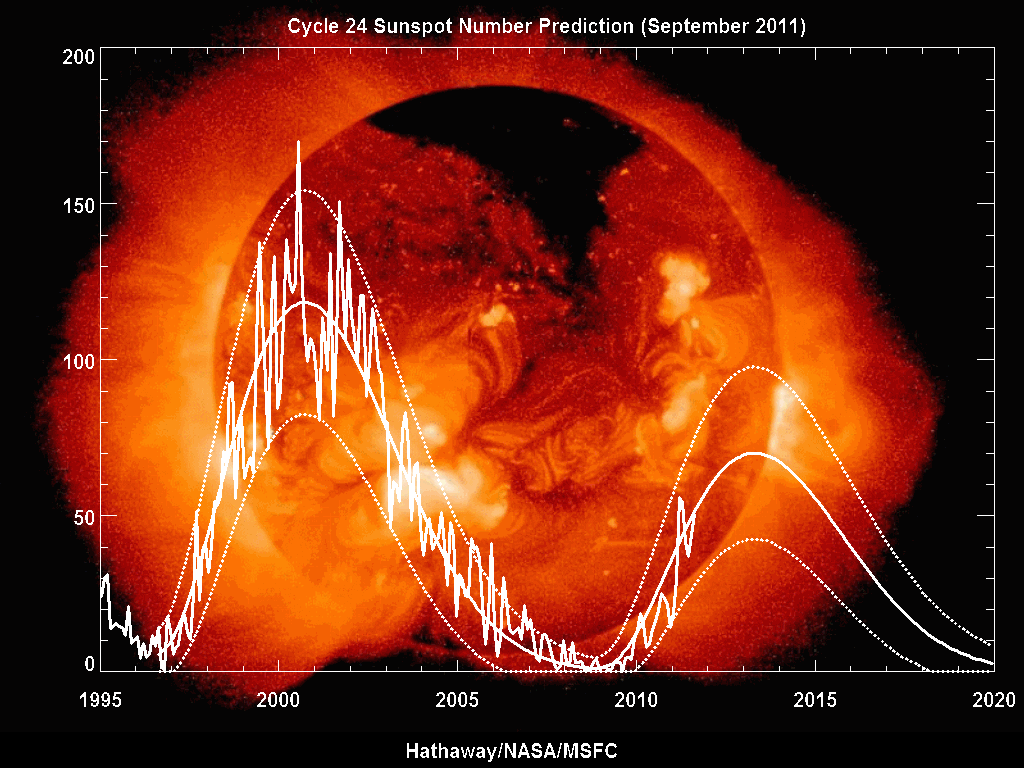
September Sunspot and Flux (F 10.7) data indicate a step change in Cycle 24 activity.  It was enough to cause Dr Hathaway to revise his Sunspot prediction chart once again.  He raised all three ranges, high, mid and low upward.  The mid-range was bumped up about 15%. (Click on Charts for better view.)   The Sunspot chart from NOAA/SWPC shown below indicates a monthly value increase from about 50 to 80 sunspots.  This chart suggests that the actual data is on track to match their prediction. And the Solar Radio             flux is tracking the NOAA/SWPC prediction. The Sun has a mind (or some kind of mechanism) of its own. To date in October   the Planetary A index is low and this usually means a less active Sun.  Will the numbers for Sunspots and Solar Radio Flux for the month of October drop?   Put in a planetary a index.   cbdakota

Solar Cycle 24 August Update


Solar Cycle 24 August Sunspot and Solar Flux data continues to paint a picture of a much less active Sun when compared against the previous Cycle 23.

First, David Hathaway’s September edition of his sunspot predictions. Hathaway has a mid, high and low range chart with the actual data slightly below the mid-range forecast.  The Hathaway midrange predicts a maximum monthly high of about 70 Sunspots in early 2013.   Cycle 23 experienced a maximum monthly high of about 120 in 2001.

NOAA  sunspot prediction chart has only a single line which predicts a maximum monthly of about 90 sunspots.    It is shown below:

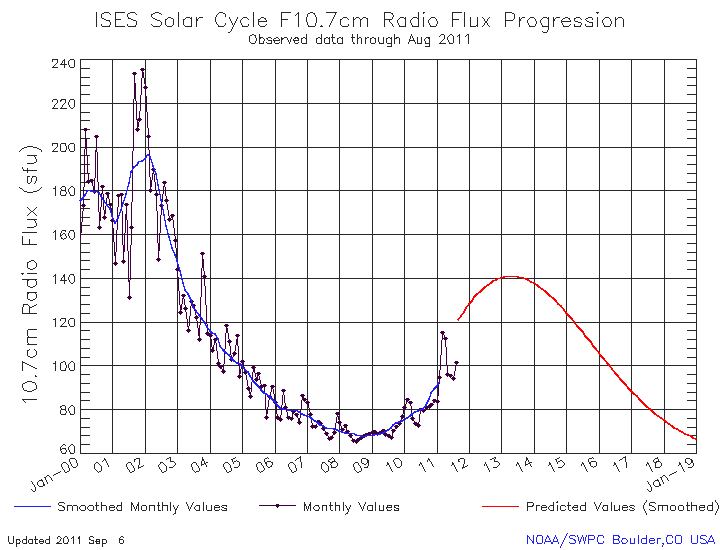
Solar flux through August appears to be trending below the NOAA prediction for Cycle 24.  The NOAA Cycle 24 solar flux prediction is for a peak of 140 in 2013.   This contrasts with  the Cycle 23 maximum of about 195 in 2002.    See the NOAA chart below:

cbdakota