Category Archives: Solar Cycle 25

No Global Warming For 16 Years


On October 13, 2012 the UK’s Daily Mail posted:  Global warming stopped 16 years ago, reveals Met Office report quietly released… and here is the chart to prove it”.  My posting of several months ago (July 19, 2012) How Many Years Of No Global Warming Are Required To Disprove CO2 As The Primary Factor In Global Warming? reported this pause.  The Daily Mail’s posting is worth a read as it contains interviews with the head of the University of East Anglia’s Climate Research Unit,  Dr. Phil Jones and Professor Judith Curry from Georgia Tech. 

“Some climate scientists, such as Professor Phil Jones, director of the Climatic Research Unit at the University of East Anglia, last week dismissed the significance of the plateau, saying that 15 or 16 years is too short a period from which to draw conclusions.

Others disagreed.  Professor Judith Curry, who is the head of the climate science department at America’s prestigious Georgia Tech university, told The Mail on Sunday that it was clear that the computer models used to predict future warming were ‘deeply flawed’.

Even Prof Jones admitted that he and his colleagues did not understand the impact of ‘natural variability’ – factors such as long-term ocean temperature cycles and changes in the output of the sun. However, he said he was still convinced that the current decade would end up significantly warmer than the previous two.”

Professor Curry’s statement about computer models is spot on.  Jones, however, is not about to give up the source of his income (climate research money) which requires that he and his colleagues continue to alarm and frighten people.

Several other excerpts from the Mail’s posting:

 “Professor Phil Jones, director of the Climate Research Unit at the University of East Anglia, who found himself at the centre of the ‘Climategate’ scandal over leaked emails three years ago, would not normally be expected to agree with her. Yet on two important points, he did.

The data does suggest a plateau, he admitted, and without a major El Nino event – the sudden, dramatic warming of the southern Pacific which takes place unpredictably and always has a huge effect on global weather – ‘it could go on for a while’.

Like Prof Curry, Prof Jones also admitted that the climate models were imperfect: ‘We don’t fully understand how to input things like changes in the oceans, and because we don’t fully understand it you could say that natural variability is now working to suppress the warming. We don’t know what natural variability is doing.’

Yet he insisted that 15 or 16 years is not a significant period: pauses of such length had always been expected, he said.

Yet in 2009, when the plateau was already becoming apparent and being discussed by scientists, he told a colleague in one of the Climategate emails: ‘Bottom line: the “no upward trend” has to continue for a total of 15 years before we get worried.’

But although that point has now been passed, he said that he hadn’t changed his mind about the models’ gloomy predictions: ‘I still think that the current decade which began in 2010 will be warmer by about 0.17 degrees than the previous one, which was warmer than the Nineties.’

Only if that did not happen would he seriously begin to wonder whether something more profound might be happening. In other words, though five years ago he seemed to be saying that 15 years without warming would make him ‘worried’, that period has now become 20 years.”


The author of the posting, David Rose makes the following comment:

 Yet it has steadily become apparent since the 2008 crash that both the statistics and the modelling are extremely unreliable. To plan the future around them makes about as much sense as choosing a wedding date three months’ hence on the basis of a long-term weather forecast.”

Solar Cycle 24 is indicating the least active Sun in the past 100 years.  Most solar scientists predict that Solar Cycle 25 will be even weaker than Cycle 24.  What does this mean?  Such performance in the past has resulted in “solar minimums” that coincided with significantly lower global temperatures. The correlation of solar activity (often indicated by number and size of the sunspots) and global temperatures has been very good over the centuries. 

To read more of the Daily Mail posting: http://www.dailymail.co.uk/sciencetech/article-2217286/Global-warming-stopped-16-years-ago-reveals-Met-Office-report-quietly-released–chart-prove-it.html#ixzz29U2Gb6uW

To read my posting “How Many Years Of No Global Warming Are Required To Disprove CO2 As The Primary Factor In Global Warming?” click here:https://cbdakota.wordpress.com/2012/07/19/how-many-years-of-no-global-warming-are-required-to-disprove-co2-as-the-primary-factor-in-global-warming/

cbdakota

Cycle 24 May Update


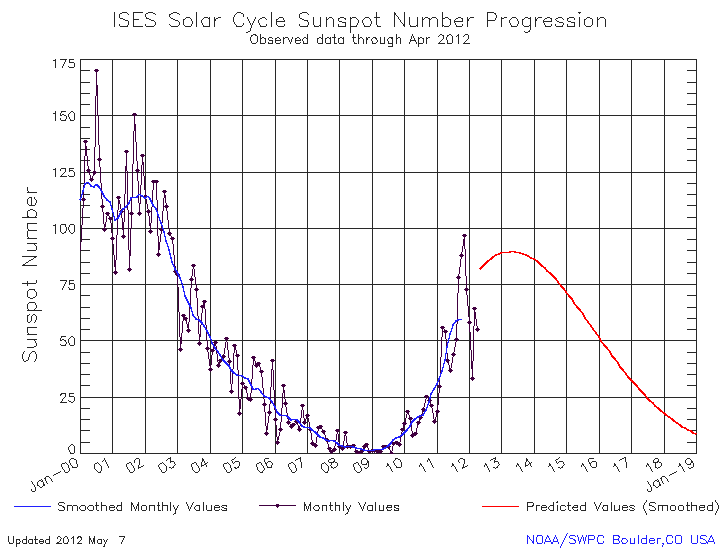
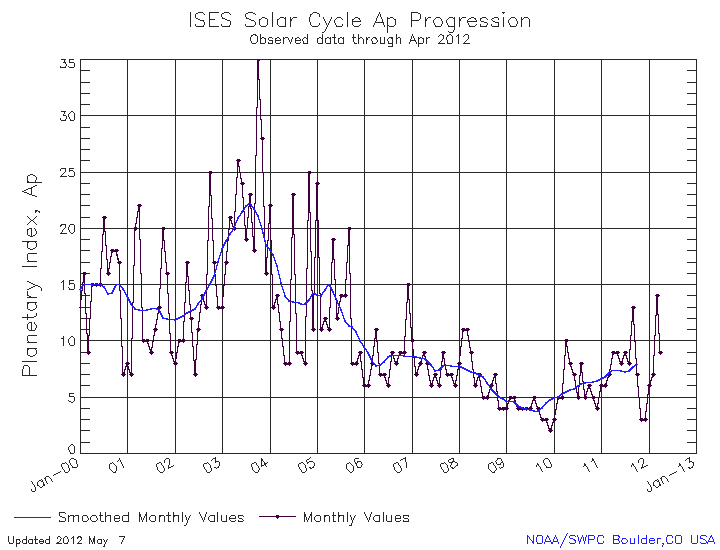
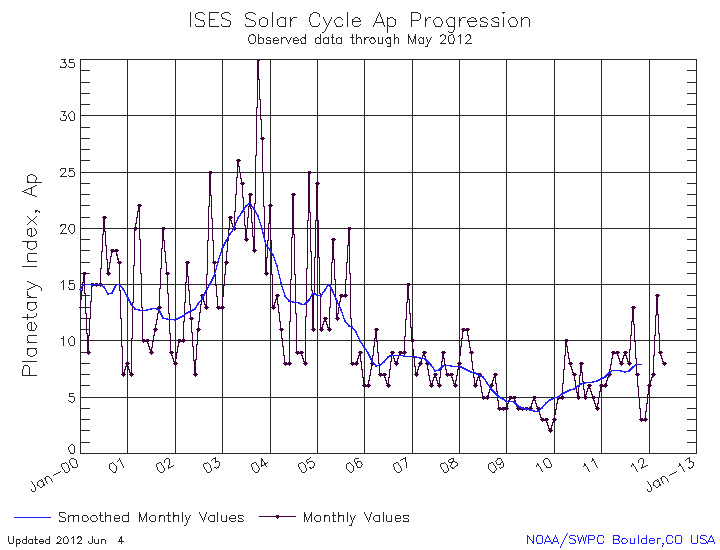
Not much new. Solar Cycle 24 is tracking the recent forecasts and should reach a Maximum in the Spring of 2013.  Below are the updated through May charts (click on charts to clarify):

cbdakota Continue reading

Do The Planets Control Our Climate?


The scientists that believe that the planets have a major influence on the Earth’s climate do not broadcast about aliens and UFOs from a house trailer outside of Elko, Nevada from midnight to six am.  But rather, they are legitimate and they have good arguments/research going for them.
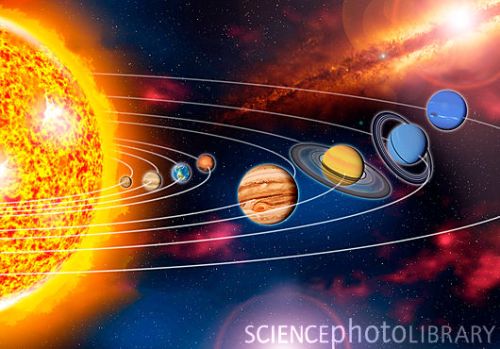
Courtesy of: Jose Antonio Penas/Science Photo Library

They are persuaded that the Sun, not CO2, is the primary driver of the Earth’s climate.  History shows that solar cycles that have low activity are accompanied by cooling climate.   For example, several minimally active cycles in succession have yielded the Maunder Minimum and the Dalton Minimum.  The temperature drop during the Maunder Minimum was so large as to give that Minimum the name—-“little ice age”.   The earlier Minimums were characterized by the low sunspot count.  Now we can add to that the F10.7cm radio flux, the geomagnetic readings, and many other ways to characterize the level of solar activity.  Even as new satellites and other investigative science provide us with greater understanding of the Sun, it still is not clear as to why Solar Cycle 24 is so inactive.  While many observers claim they knew 24 was going to be minimally active, the record shows most forecast that 24 would be pretty robust and not be appreciably different from Cycle 23.  Just like the weatherman that forecast rain for Maryland tomorrow because it is raining in West Virginia today, the solar experts now “know” that Cycle 25 will be like Cycle 24.

Dr. Hathaway of NASA observes that the Sun’s plasma Great Conveyor Belt (GCB) moved very rapidly in 2008 and 2009 but was notably slower in 2000 and 2001.  “I believe this could explain the unusually deep solar minimum we’ve been experiencing,” says Dr. Hathaway. The high speed of the conveyor belt challenges existing models of the solar cycle and it has forced us back to the drawing board for new ideas.”

Well ok, but why did the GCB change speeds?  Could the planets be the forcing  for this and other changes?

Planets as forcing agents

What is the relationship of the planets and Earth’s climate? There is a theory based upon on the conservation of momentum that links every planet to the Sun.  Another theory is the planet induced tidal effect upon the Sun’s plasma surface. Undoubtedly there are more, but two are enough for now.

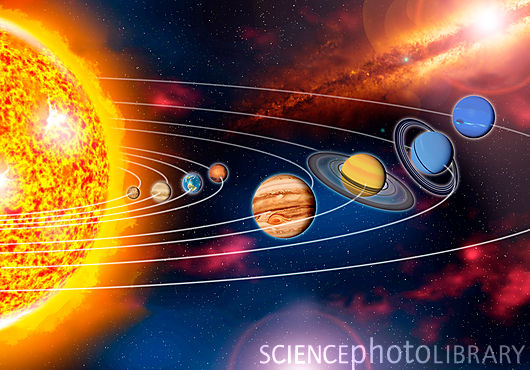
Refresher:   Some of my readers may need a refresher regarding the solar system planets.

Solar System Planetary Data (rounded)

Body Distance from Sun10^6km Mass10^22kg OrbitDays Orbit Circ.10^6 km OrbitSpeed 10^6km/day
Mercury 58 33 88 364 4.1
Venus 108 487 225 679 3
Earth 150 598 365 942 2.6
Mars 228 64 687 1432 2.1
Jupiter 778 190,000 4332 4887 1.1
Saturn 1429 56,900 10760 8977 0.8
Uranus 2871 8690 30700 18036 0.6
Neptune 4504 10280 60200 28294 0.5

The mass of the Sun is 1048 times that of Jupiter or 1.989X 10^30 .

 The Landschiedt Minimum

In 2003, Dr. Theodor Landscheidt published a paper  “New Little Ice Age Instead of Global Warming?”  In that paper he predicted that the Earth would start cooling with the coolest period about 2030 and that it would be equivalent of the Maunder Minimum (aka, “the Little Ice Age’).   Landscheidt used the Gleissberg cycle of 80 to 90-years to identify periods of cool climate on Earth. He said that within the Gleissberg cycle there is an 83-year cycle in the change of the rotary force driving the Sun’s oscillatory motion about the center of mass of the solar system.  His premise was that the collective angular momentum of the giant outer planets imposed a torque on the Sun that varies the speed of the Sun’s equatorial rotational velocity.  Some people are saying that this minimum should be called the Landscheidt Minimum. (Landscheidt died in 2004.) Landscheidt further predicted that another minimum would occur about 2200.

One might presume that the center of the Sun is the likely solar system center of mass.  Only on occasion is that true.  The center of the solar system’s mass is called the barycenter.  Watch this video to get an appreciation for the effect of the planets on the barycenter.  (no sound)

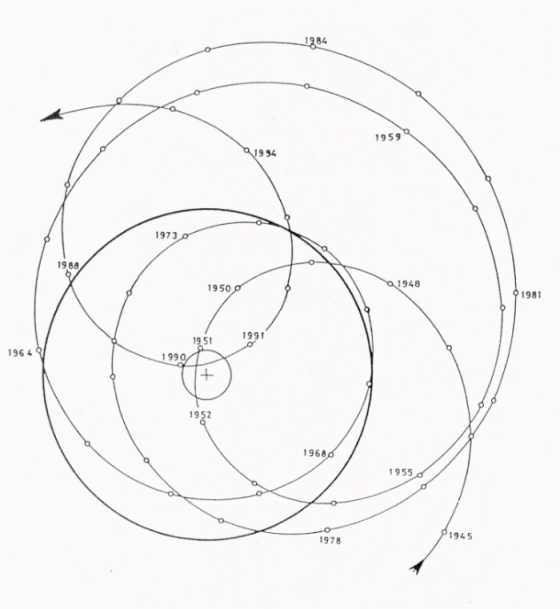
The following chart shows where the barycenter is relative to the Sun by year.
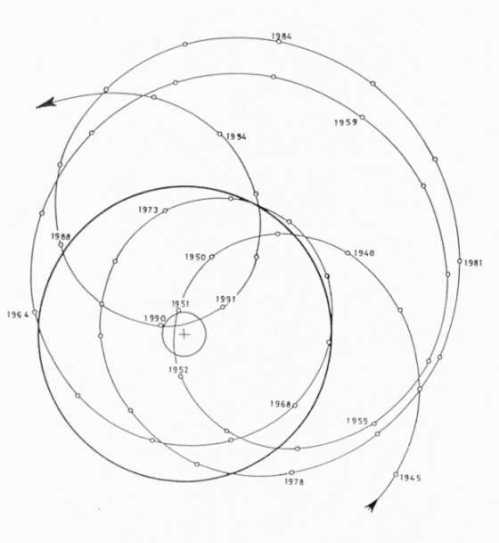
                      Figure 8:  Solar System Barycenter

Landscheidt said:

The solar dynamo theory developed by Babcock, the first still rudimentary theory of solar activity, starts from the premise that the dynamics of the magnetic sunspot cycle is driven by the sun’s rotation. Yet this theory only takes into account the sun’s spin momentum, related to its rotation on its axis, but not its orbital angular momentum linked to its very irregular oscillation about the centre of mass of the solar system (CM). Figure 8 shows this fundamental motion, described by Newton three centuries ago. It is regulated by the distribution of the masses of the giant planets Jupiter, Saturn, Uranus, and Neptune in space. The plot shows the relative ecliptic positions of the centre of mass (small circles) and the sun’s centre (cross) for the years 1945 to 1995 in a heliocentric coordinate system.

The large solid circle marks the sun’s surface. Most of the time, the CM is to be found outside of the sun’s body. Wide oscillations with distances up to 2.2 solar radii between the two centres are followed by narrow orbits which may result in close encounters of the centres as in 1951 and 1990. The contribution of the sun’s orbital angular momentum to its total angular momentum is not negligible. It can reach 25 percent of the spin momentum. The orbital angular momentum varies from -0.1�1047 to 4.3� 1047 g cm2 s-1, or reversely, which is more than a forty-fold increase or decrease (Landscheidt, 1988). Thus it is conceivable that these variations are related to varying phenomena in the sun’s activity, especially if it is considered that the sun’s angular momentum plays an important role in the dynamo theory of the sun’s magnetic activity.

Variations of more than 7% in the sun’s equatorial rotational velocity, going along with variations in solar activity, were observed at irregular intervals (Landscheidt, 1976, 1984). This could be explained if there were transfer of angular momentum from the sun’s orbit to the spin on its axis. I have been proposing such spin-orbit coupling for decades (Landscheidt, 1984, 1986). Part of the coupling could result from the sun’s motion through its own magnetic fields. As Dicke (1964) has shown, the low corona can act as a brake on the sun’s surface. The giant planets, which regulate the sun’s motion about the CM, carry more than 99 percent of the angular momentum in the solar system, whereas the sun is confined to less than 1 percent. So there is a high potential of angular momentum that can be transferred from the outer planets to the revolving sun and eventually to the spinning sun.

From wiki, a somewhat analogous to the Planets/Sun interaction: The conservation of angular momentum in Earth–Moon system results in the transfer of angular momentum from Earth to Moon (due to tidal torque the Moon exerts on the Earth). This in turn results in the slowing down of the rotation rate of Earth (at about 42 nsec/day[citation needed]), and in gradual increase of the radius of Moon’s orbit (at ~4.5 cm/year rate[citation needed]).

If you want to dig further into the concept of angular momentum, the following may be of interest to you:

Angular momentum is conserved in a system where there is no net external torque, and its conservation helps explain many diverse phenomena. For example, the increase in rotational speed of a spinning figure skater as the skater’s arms are contracted is a consequence of conservation of angular momentum.  Moreover, angular momentum conservation has numerous applications in physics and engineering (e.g. the gyrocompass).  See here, here and here to get the math behind conservation of angular momentum, angular momentum, and torque.

 Tidal Effect

Dr Nicola Scafetta of the Active Cavity Radiometer Solar Irradiance Monitor Lab (ACRIM) and Duke University has recently published in the Journal of Atmospheric and Solar-Terrestrial Physics  “Does the Sun Work as a nuclear fusion amplifier of planetary tidal forces?  Etc.”

Lets look at a summary of some of the planetary interactions with the Sun that affect the nominal 11 year solar cycle that he listed in his abstract to the article:

Numerous empirical evidences suggest that planetary tides may influence solar activity. In particular, it has been shown that: (1) the well-known 11-year Schwabe sunspot number cycle is constrained between the spring tidal period of Jupiter and Saturn, 􏰁 9:93 year, and the tidal orbital period of Jupiter, 􏰁 11:86 year, and a model based on these cycles can reconstruct solar dynamics at multiple time scales (Scafetta, in press); (2) a measure of the alignment of Venus, Earth and Jupiter reveals quasi 11.07-year cycles that are well correlated to the 11-year Schwabe solar cycles; and (3) there exists a 11.08 year cyclical recurrence in the solar jerk-shock vector, which is induced mostly by Mercury and Venus

Scafetta proposes that the planets cause surface tides on the Sun.  While very small, he believes the tidal gravitational potential energy dissipated in the Sun by the tides, may produce irradiance output oscillations with a sufficient magnitude to influence the solar dynamo processes.   More from the abstract:

Here we explain how a first order magnification factor can be roughly calculated using an adaptation of the well-known mass-luminosity relation for main-sequence stars similar to the Sun. This strategy yields a conversion factor between the solar luminosity and the potential gravitational power associated to the mass lost by nuclear fusion: the average estimated amplification factor is A􏰂4:25×10^6. We use this magnification factor to evaluate the theoretical luminosity oscillations that planetary tides may potentially stimulate inside the solar core by making its nuclear fusion rate oscillate. By converting the power related to this energy into solar irradiance units at 1 AU we find that the tidal oscillations may be able to theoretically induce an oscillating luminosity increase from 0.05–0.65 W/m^2 to 0.25–1.63 W/m^2, which is a range compatible with the ACRIM satellite observed total solar irradiance fluctuations. In conclusion, the Sun, by means of its nuclear active core, may be working as a great amplifier of the small planetary tidal energy dissipated in it. The amplified signal should be sufficiently energetic to synchronize solar dynamics with the planetary frequencies and activate internal resonance mechanisms, which then generate and interfere with the solar dynamo cycle to shape solar dynamics, as further explained in Scafetta (in press). A section is devoted to explain how the traditional objections to the planetary theory of solar variation can be rebutted.

Both theories have many critics.  I am not knowledgeable enough to support or deny these theories.   However,  Dr Hathaway’s comment about varying speeds in the Great Conveyor Belt would lend some support to these theories especially Landscheidts.   Anyway, the Sun is where the action is with respect to global climate change.  And it will probably be a number of years before any theory wins out.  Remember how much bad press the cosmic ray theory got from the experts, and this case I mean the warmers.  Now after some work at CERN, it is looking like a winner, just not yet announced.  There is hope.

cbdakota

Solar Cycle 24–April Update


Generally speaking, Solar Cycle 24’s April sunspots numbers, F10.7cm flux and the geomagnetic field Ap index all indicate reduced solar actively.  NASA as well most of the experts in this field agree that Solar Cycle 24 will be a record setter of a sort—least active in about 100 years.  One need not base this on computer models or some consensus, however.  All that is required is to look at the data.  I do not think anyone has a handle on why Cycle 24 is acting this way.  There are many theories and perhaps one of them is correct. Will Cycle 25 continue this downward trend?  Click on the charts to improve clarity.

cbdakota

January 2012 Global Temperature


The only global temperature report that I really trust is the UAH satellite readings that Dr Roy Spencer manages.  The temperature in January took the expected drop.

Chart courtesy of Dr Spencer’s  Global Warming blog. (click on chart to enlarge)

The January temperature is equivalent to the January 2011 but below 2009 and 2010 January temps.  If the forecast of a very weak solar Cycle 25  comes to pass, we should see some record lows in coming years.

cbdakota

Forecasting Cycle 25—Great Conveyor Belt Theory


The last post reviewed a forecasted solar Cycle 25 based upon measuring the magnetic field of sunspots.   This posting uses the speed of the Sun’s Great Conveyor Belt(GCB) to forecast Cycle 25. This method considers sunspots as an indicator but the GCB speed determines how many sunspots appear.  I am not sure who, but perhaps Dibyendu Nandi of the Indian Institute of Science and Education and Research in Kolkata (aka, Calcutta) and his team  can claim this theory. The GCB has been studied for a number of years.  NASA Science says: “The Great Conveyor Belt is a massive circulating current of fire (hot plasma) within the sun. It has two branches, north and south, each taking about 40 years to complete one circuit.“  “The plasma flows travel along the Sun’s surface and plunge inward at the poles, and reappear again at the Sun’s equator.  When the sunspots begin to decay, surface currents sweep up their magnetic remains and pull them down inside the star; 300,000km below the surface, the sun’s magnetic dynamo amplifies the decaying magnetic fields.  Re-animated the sunspots become buoyant and bob up to the surface like a cork in water—voila! A new solar cycle is born.”

These belts can be likened to the Earth’s ocean currents.

NASA’s artistic sketch of the belt.

A May 2006 posting on Science News has Dr Hathaway predicting that Cycle 24 sunspots numbers would be perhaps greater than Cycle 23 (this part of the prediction is not faring well.) and Cycle 25 would be perhaps half of Cycle 23.  Dr Hathaway said that these predictions were based on a deceleration of these belts to 0.75m/s in the North and 0.35m/s in the south.  He said “We’ve never seen speeds so low”.    Hathaway in a September 2011 posting said:”…….that as the number of sunspots increases on the Sun, the speed of the GCB decreases and vice versa: fewer sunspots and the faster the speed of the Belt.”   This is somewhat contradictory,  because if the GCB speed is slowing down, based on his theory,  there would be more spots.

Dr. Nandi  adds some clarification when he lays out his theory here: “The fast-moving belt rapidly dragged sunspot corpses down to sun’s inner dynamo for amplification. At first glance, this might seem to boost sunspot production, but no. When the remains of old sunspots reached the dynamo, they rode the belt through the amplification zone too hastily for full re-animation.  Sunspot production was stunted.”  Nandi  then adds that late in the decade, “….according to the model, the Conveyor Belt slowed down again, allowing magnetic fields to spend more time in the amplification zone, but the damage was already done.  New sunspots were in short supply.  Adding insult to injury, the slow moving belt did little to assist re-animated sunspots on their journey back to the surface, delaying the onset of Solar Cycle 24.”  

Hathaway’s sunspot predictions are in Red.   Also on this chart, in Pink, are the Cycle 24 sunspot predictions by NCAR’s Mausumi Dikpata and her team based on their observations of the GCB.

Nandi  has made a presentation “Forecasting the Solar Cycle”at the Harvard Smithsonian Center for Astrophysics, Cambridge, USA  but I can not access the paper.

This theory says that the change of speed of the GCB predestines the solar çycle  robustness or lack there of.  For some insight of how they are able to track these plasma flows/GCBs/jet streams, click here.

Like the declining sunspot magnetic field, the theory of the GCB seem to me to be describing consequences of some other forcing that is not known or understood.  I think it likely that Cycle 25 will be weak.  However, until we know more about the functioning of the Sun,  we will be forecasting like the weather casters—tomorrow will be rainy because rain clouds are blowing our way from the west.  Like all of these theories, only time will tell if they are really capable of predicting accurately Cycle strength.

We are not through with Cycle prediction theories.  Next posting will discuss the bicentennial decrease in Total Solar Irradiance (TSI) unbalancing the Earth’s thermal budget.

cbdakota

Forecasting Cycle 25–Livingston and Penn Method


As Cycle 24 has not yet achieved a Solar Maximum, it may seem a little early to begin forecasting Cycle 25.  But several forecasts have been made.  A recent posting in WattsUpWithThat notes such forecasts by Penn and Livingston and by David Hathaway.

You remember from previous postings on this site, that Penn and Livingston have been measuring Sunspot magnetic field strength and the temperature and luminosity of the umbra.   They began this study in 1990 and as of 2010 they have analyzed some 17,000 spots. Plotted on the chart below are data from their paper LONG-TERM EVOLUTION OF SUNSPOT MAGNETIC FIELDS through 2010 and additional readings since:

Chart courtesy of Lief Svalgaard

Focusing on the bottom chart, sunspots are plotted against magnetic field strength and time. The individual dots are representative of sunspots.  The larger blue dot represents the normalized sunspot number for each year. The black line is the trend line for the umbral magnetic field of the sunspots. The horizontal blue line indexes a magnetic field strength of ca. 1500 Gauss. Note that the sunspots extend vertically above the trend line, and below the trend line but not below the 1500 Gauss line.  The two scientists speculate that sunspots do not form when the magnetic field strength is less than 1500 Gauss.  If the trend line continues on this same slope, somewhere around the year 2025+/- at least half of the sunspots will disappear.

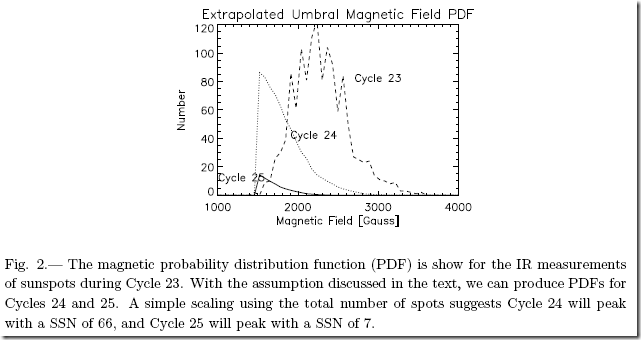
Using a linear decrease of 65 Gauss per year and a cycle duration of 11 years, they computed the magnetic probability distribution function for Cycles 24 and 25. Using this, a sunspot number is forecast. Cycles 24 and 25 are shown along with actual data from Cycle 23 in the chart below from their paper:

Chart provided by David Archibald, from the paper by Livingston and Penn.

The contrast of Cycle 24 and specifically Cycle 25 from the completed Cycle 23 is quite dramatic.  The Cycle 24 forecast, so far, seems to be reasonably in tune with actual data.  At a Cycle 25 sunspot number of 7, David Archibald says it would be the lowest sunspot number for a Cycle in 300 years!!!!

Livingston and Penn say that if the linear decrease were 50 Gauss per year rather than 65, the Cycle 25 sunspot number would be 20 which is still a very low number.

Livingston and Penn caution that it is always risky to extrapolate linear trends.

Next posting on this topic will be an examination of David Hathaway’s 2006 forecast of both Cycle 24 and Cycle 25.  It will also discuss one of the underlying theories for the decrease in sunspots.

cbdakota