Category Archives: OPEC

Russia’s Federal Budget Depends On High Price Crude Sales


A summary of the Russian Federal budget was posted by Reuters in July of this year.  It said that Russian crude oil had to be sold at or above $116 per barrel or the budget would show a deficit for the year.  A cursory look at the Ural blend (Russian Trading System, comparable to the WTI or Brent) crude pricing for the year suggests that it probably fell short of the goal.  To get some feel for whether or not they accomplished the price requirement, understand that the Ural and Brent crude price indices have been essentially the same for 2012.  The posting tables the Draft Three Year Budget:

DRAFT THREE-YEAR BUDGET 2013-2015 (in trillion roubles unless

stated)

Year                                         2012    2013     2014      2015

Break-even oil price ($)  116.2    113.9     106.0    105.4

Average oil price ($)              115      97        101      104

Nominal GDP                         60.6     65.8      73.4     81.5

Revenues                                  12.7     12.4      13.6     15.2

Expenditures                          12.7     13.4      14.1     15.3

Deficit (% GDP)                      – 0.1      1.5       0.6      0.11

Non-oil deficit (% GDP)     10.6     10.1      8.9      8.6

$1  =  31 rubles

By 2015, the draft budget forecasts break even price at $105.4.

Both Poland and Romania have shale oil and natural gas potential and are known to be evaluating whether it can be profitably exploited.  This is a real threat to Russia.  Any development of Western European shale is a major problem for Russia.  Like crude oil sales, natural gas sales are a major source of income for Russia.  Russia currently provides most of the natural gas and much of the oil to Western Europe.  Russia has not been reluctant to shut off supplies.  In 2009 a dispute between the Ukraine and Russia over unpaid bills resulted in shutting off natural gas to the Ukraine.  Other countries felt the effect with low  pressure or no  pressure in their pipelines.  While the official story was about unpaid bills there was a belief that Russia’s real reason was to warn neighboring countries not to join NATO. They probably are prepared to put pressure on these nations to persuade them to not develop shale gas or oil.

Below is a 2009 map of the Russian natural gas pipelines supplying European nations.
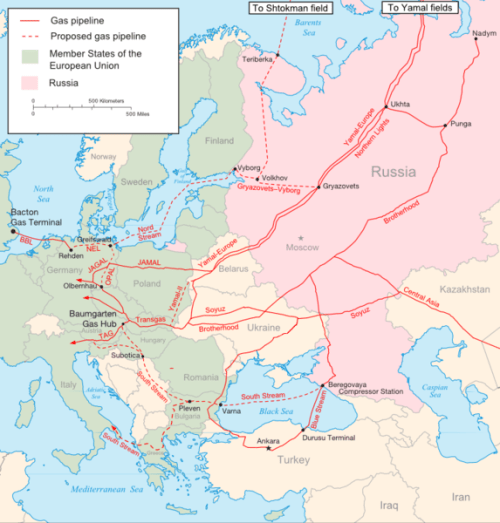
Russiannaturalgassupplylines573px-Major_russian_gas_pipelines_to_europe

Stefano Casertano,  managing director of the Berlin based “The Energy Affairs Company” posted “From Fracks to Riches” on the Stratfor website.  A number of countries are dependent on sale of oil and natural gas to provide the revenue to balance their budgets. In addition to the numbers above for Russia,  Casertano lists what he says are the crude oil prices (in dollars per barrel) to achieve the needed revenue for several other countries as follows:

Iran——-$117

Libya —-$117

Algeria–$105

Iraq—–$112

The US economy can get an enormous boost from an ample supply of low priced fossil fuels. The fear is that the President does not really see this boost as aligning with his political objectives.  He can use his rigged fracking safety study group to impose many “safety” restrictions as a means to cut short this very beneficial exploitation of our shale.  The consequence of slowing or even stopping the US shale boom will be appreciated by Russia and OPEC.

cbdakota

Strike Two For Cuba And Gulf Of Mexico Oil


The latest deep-water drilling operation off the West Coast of Cuba has been called off. The exploratory well by PC Gulf, a subsidiary of Malaysia’ Petronas and Gazpomneft of Russia, has been declared not commercially viable.  In May, Repsol’s said their drilling in this field was a failure.

Cuba, as noted in the previous report about this potential oil field, badly needs the money that they hope to obtain from this drilling.  They are also worried about the fate of Hugo Chavez of Venezuela, as he has been supplying Cuba with below market priced crude.  If he dies or is deposed, it could be a real problem for Cuba.

Some estimates of the crude in the field being explored are as high as 9 billion barrels. The field is in ultra deepwater.  Ultra deepwater is defined as where the seafloor at the drilling site is 5000 ft (1524 m) or more below the sea surface. The PC Gulf well was drilled to 15,300 feet below the seafloor.  The lease cost for a platform to accomplish the drilling is about $500,000 per day according to a report by the Associated Press.  There is only one such unit now available for the Cuban drilling and it will be used by the next company to try their luck—-the Venezuelan state oil company PDVSA.

cbdakota

Why Does The US Have The Lead On Shale Gas?


The United States (US) is now ranked as the world’s leading producer of natural gas.  The Wall Street Journal (WSJ) says that this lead is partly due to the abundant shale resources we have—though many other countries have those too.   Partly due to our technological leadership in developing hydraulic fracturing (fracking)—but these techniques are known all over the world now.  The edge is really a result of private ownership of subsurface mineral resources.   Almost no major country recognizes full subsurface private property rights, except the US.  Quoting from the WJS: “….this blessing of American jurisprudence helps explain one of the few bright patches in the Obama economy—the booming production of shale gas and increasingly, oil.”

There is a profit motive driving the property owner as well as the driller. Typically the property owners get a royalty checks from the driller representing a percentage of the worth of the value of oil produced. Often the royalty percentage is 12.5%.  (My home in Texas was built well after the East Texas oil boom.  By then all the subsurface mineral rights had been sold/leased and my deed spelled out that I had no ownership. There were number of wells back in the woods behind my house. Someone was getting royalty checks, but alas, it was not I.)

But many people in North Dakota (Bakken Shale) and Pennsylvania (Marcellus Shale), for example, have leased their mineral rights and natural gas is being produced.  And the landowners are getting royalty checks!

France and Bulgaria have banned fracking. Because these governments own the subsurface property rights, there has been no pushback from the landowners.   In other countries where fracking has not been banned, the governments are moving at a glacial pace.

Quoting the WSJ: “ ….the deeper lesson is that this is a revolution that came about not through government planning or foresight, but through a combination of individual risk-taking and private property. “

Thank heavens for these privately owned resources.  Unfortunately, favorable outcomes are not happening where the US government has control of natural gas and oil.  The Obama Administration puts up road blocks in the way of the exploitation of resources found in places like  Off-Shore, Federal lands, and the Arctic National Wildlife Reserve.

cbdakota

OPEC Provides Low Priced Fuel Internally


The price of crude for the residents within OPEC states is lower than the export price.  As these states are mostly dictatorships, it is one way to placate the ruled.  But it seems that the low prices provides the residents no incentive to be frugal.  In the last decade, Saudi Arabia internal use has nearly doubled.  According to Reuters:

”Consumption has trebled in Angola, doubled in Ecuador and climbed 55 percent in Venezuela. OPEC members also seem to be becoming less efficient. Oil usage per head is up 24 percent since 2000, Deutsche (Bank) says, while it is flat for the globe as a whole.

For importers, the uneven treatment is costly. The wasteful consumption in exporting countries reduces the supply available for the global market, presumably pushing up the price. It also cuts into the potential reserve capacity, making the price more volatile.

But OPEC members don’t really gain, either. Governments lose potential export revenue and state-owned oil producers lose potential income. In 2010, the opportunity cost of discount domestic pricing was roughly 15 percent of OPEC’s total oil export revenue of $770 billion, according to International Energy Agency calculations. Such largesse adds to the fiscal strain on many of these nations – contributing to the exporters’ hunger for ever higher global oil prices.”

I am not sure that this analysis as it is presented is consistent.  First it says that the practice of diverting some fuel to internal use reduces the available supply and results in “pushing up oil prices”.  Ok, that makes some sense.  However the next paragraph seems to say that the practice causes them strain contributing to the exporters hunger for ever higher global oil prices.

What does that mean?  If they had more crude to export they would have more revenue?  But the artificial shortage that OPEC creates is done to get as high global oil prices as they can.  Maybe the author of this analysis saying that OPEC would get all the revenue it wants if it could export more by using less at home. This presumably would allow the exporters to lower the price because they would not need the revenue.  I doubt that.

Well, I probably have spent far too much time on this.   Especially, since OPEC will continue to lower the price of crude.  OPEC knows that there is a lot of untapped crude out there in the world.  Much of it becomes economic to produce as the price of OPEC crude goes up.   I have heard that North Dakota Bakken tight oil needs a price of around $75 per barrel to justify production.  OPEC has lowered world crude prices before to slow down/stop bringing in new supplies of crude.  They will do it again.  They dread the slogan  “drill baby drill” about as much as the liberal Democrats do.

To read more of the Reuter’s posting, click here.

cbdakota