Category Archives: IPCC

COLLEGE STUDENTS LACK SCIENTIFIC LITERACY?-Part2


In the previous posting, College Students Lack Scientific Literacy?, we took a quick look at the role of photosynthesis in the Carbon Cycle.  This posting  will examine the part that burning of fossil fuels play in the carbon cycle and how fossil fuel CO2 affects global warming.

There are those who believe that catastrophic heating of the Earth will result if fossil fuels use is not curbed or perhaps stopped all together.  They think that the extra increment of CO2 from fossil will cause the climate to reach a “tipping point” after which there may be no turning back.

So what is the argument about between skeptics and believers?

Broadly speaking the believers have looked for a cause of a temperature increase of something less than 1C  during the last century.   They say that the measured volume of Carbon Dioxide (CO2) in the atmosphere has gone up coincident with the temperature increase and that since CO2 is a known greenhouse gas, it must be the cause.   And they add that CO2 from industrial and transportation sources, a product of fossil fuel combustion,  is the reason for the atmospheric CO2 increase from the past “steady-state” measurements.

Skeptics, while accepting that the Earth’s temperature has increased in the last century, so has it for the last 10,000 years since the end of the last Ice Age.  And further,  this cold to warm and return to cold has been going on for hundred thousands of years, so the last century’s warming is probably due mostly to natural causes.   Skeptics say that the past history of temperature increases and CO2 variation as charted from the examination of ancient ice cores show the temperature change leads CO2 change both increasing and decreasing.  Stated in another way,  CO2 follows a change in temperature rather than leading the change. By the way, Al Gore’s “An Inconvenient Truth” movie did show it the other way but it is widely agreed that was wrong as was so much  else of that science fiction documentary.

The amount of CO2 in the atmosphere is very small, and the CO2 increment from fossil fuel burning is about 3% of the total atmospheric CO2 content.  If pressed the believers will agree that the primary greenhouse gas is not CO2, but rather water in the form of vapor and clouds.  From 90 to 95% of the greenhouse gas effect results from water in the atmosphere.

An interesting way to look at the CO2 versus water has been made by Art Horn  in his posting “The Utter Futility of Reducing Carbon Emissions”which can be seen by clicking here.  This  posting looks at the Carbon Cycle and it uses the Intergovernmental Panel on Climate Change, as the data source.  This panel is the believer’s bible.   Quoting from his posting:

“…….the Intergovernmental Panel on Climate Change (IPCC) 4th Assessment showed that 3% of the atmospheric CO2 comes from man-made sources. Global gross primary production and respiration, land use changes, plus CO2 from the oceans totals 213 gigatonnes of carbon exchanged each year between the Earth/oceans and the atmosphere. The IPCC figure also shows man-made carbon emissions to be about 7 gigatonnes, bringing the total to 220 gigatonnes per year. So from this, we can see that making energy from fossil fuels is producing about 3% of the carbon dioxide added to the air each year. From that, the total human component of the greenhouse effect is therefore about 3% of the total carbon dioxide component of the greenhouse effect, which is 8%.

That gives us a value of .2% from man-made carbon dioxide. If you think that’s a small number you’re right.”

A little more simple science is necessary to get this picture.

Greenhouse Gas (GHG) effect

To begin with, the simplest view is that GHG is a study of “energy inenergy out”.  The “energy in” is the radiation from the Sun—sunlight, infrared (IR) and ultraviolet  (UV)—that is absorbed by the Earth.  The Earth then radiates this energy back out into space.  On its way back out into space, some of it is delayed by interaction with trace elements in the atmosphere. This interaction increases the temperature of the atmosphere, and the Earth’s temperature rises. The greenhouse effect is real and it allows life, as we know it, to exist.  If the Earth had no atmosphere,  its temperature would be 255K (-18C).  The average temperature of the entire Earth averaged over seasons is, by measurement, about 288K (15C).  Thus the greenhouse effect results in an increase in temperature of about 33K (33C).

Lets look at GHG in more detail.  The Sun energy in the form of visable light, IR, and UV (shortwaves) pass through the Earth’s atmosphere and are absorbed by the ocean, the land, the trees, concrete, road surfaces, etc.  Not all of the Suns energy  makes it to the Earth’s surface due to clouds and surface reflection, along with atmospheric scatter that represent a blockage.  When the Sun’s input ceases, at night for example, these Earth objects begin to emit electromagnetic radiation.  This radiation is in the infrared range but because the temperatures of the objects are much lower than that of the Sun, the wave lengths are different.  They are much longer.  For our purposes the Earth’s radiation will be called the longwaves.

The interaction of the trace compounds in our atmosphere with the outgoing longwave radiation is dictated by atomic absorption.  Each compound  in the atmosphere has a specific wave length band(s) that it absorbs.  If the compound’s wave lengths correspond to the wave lengths of some of the IR radiated from the Earth’s surface, the IR waves can be absorbed. Those IR waves are converted to heat causing the compound to emit IR of a different wave length. The compound is transparent to other IR wave lengths.

Water, CO2 and Methane will absorb IR wave lengths emitted from the Earth.    Of the emitted IR waves that are absorbed, it is estimated that some 4%to 6% are by CO2.  The CO2 greenhouse effect is limited because the wave lengths that CO2 absorbs only represent a small part of the wave length ranges of the reemitted IR from the Earth. In fact, adding more CO2 to the atmosphere has only limited significance because the amount of CO2 already in the atmosphere is nearly sufficient to absorb those particular Earth originated IR waves.

Well, why do the believers think that CO2 will cause the very high Earth temperatures they trot out frequently to scare all the rest of us.  They agree that water is the primary greenhouse gas.   They think that the little upward bumps in temperature that are possible if more CO2 is added to the atmosphere will result in more water vapor in the atmosphere.  They know that CO2 can’t do the deed so they have programmed their computers models (GCM) to  gee-up lots of water vapor to do the deed. This amplification of the total greenhouse gases (GHG) is called positive feedback. Using this positive feedback, the GCMs forecast climate out some 100 years or more and conclude that global temperatures will rise dramatically.   The problem is that this positive feedback is difficult to impossible to demonstrate in the real world.  (Basically the world abhors positive feed back.) Meanwhile a negative feedback has been shown to exist in real world, making run-away global temperatures quiet unlikely.

In summary,

Very little of the CO2 in the atmosphere is due to the burning of fossil fuels.

The  GHG effect is primarily due to water as vapor or clouds

CO2 can only absorb  a limited portion of  the Earth’s radiated IR

The Believers proclamations of catastrophic weather conditions are based computer programs. Those computer predictions that were done sufficiently long ago to be meaningful as a predictions,  have been notorious failures.

And the concept of Positive Feedback  increasing water in the atmosphere resulting in large increases in the Earth’s temperature is a fiction of the computer program as it has not yet been proved in real experimental work.

cbdakota

COLLEGE STUDENTS LACK SCIENTIFIC LITERACY


Last week was one of lows and highs.  I went back to South Dakota to say my goodbyes to my sister. She passed away some 7 hours after I got to the hospital. The highs were the young people that gathered for the funeral.  Mainly grandchildren and other kin of my sister. The children ranged from grade school to Grad school to graduated and off to work.   After spending time with them, it seems clear that we will be putting our nation into good hands.

Some probably do not share my political philosophy, However, I am hopeful that Winston Churchill’s view of the stages of life will play out when he said,  “If you are young and not a liberal, you have no heart.  If you are growing old and are not a conservative, you have no brain.”

But brains they do have no mater their political philosophy.   And those that have thought about Climate Change have open minds.

After reading the result of a recent Michigan State study, which concluded that College Students lack scientific literacy, I wondered if there are college students or grads, unlike my Sister’s kin, that do not have open minds and need a little background to begin formulating their own opinion about climate change.

Quoting the MSU researchers:

The researchers assessed the fundamental science knowledge of more than 500 students at 13 U.S. colleges in courses ranging from introductory biology to advanced ecology.

Most students did not truly understand the processes that transform carbon. They failed to apply principles such as the conservation of matter, which holds that when something changes chemically or physically, the amount of matter at the end of the process needs to equal the amount at the beginning. (Matter doesn’t magically appear or disappear.)

Students trying to explain weight loss, for example, could not trace matter once it leaves the body; instead they used informal reasoning based on their personal experiences (such as the fat “melted away” or was “burned off”). In reality, the atoms in fat molecules leave the body (mostly through breathing) and enter the atmosphere as carbon dioxide and water.

Most students also incorrectly believe plants obtain their mass from the soil rather than primarily from carbon dioxide in the atmosphere. “When you see a tree growing,” Anderson said, “it’s a lot easier to believe that tree is somehow coming out of the soil rather than the scientific reality that it’s coming out of the air.”

The oxygen we breathe is primarily released from plants when photosynthesis takes place breaking the CO2 molecule, recombining it with water to produce a sugar.  The excess oxygen from the photosynthesis reaction is now a waste product and expelled to the atmosphere.

The above Graph is a product of  Onimoto.com

Without atmospheric CO2, there would be no plants.  Without plants there would be no life on this planet.   It offends me when I read media articles that call CO2 a POLLUTANT.

Because the Researcher’s objective for this work is to gain acolytes to the Church of Man Made Global Warming, my next posting will be to show that CO2 is not a big factor in the Greenhouse effect.

To read the MSU press release click here.

cbdakota

SUN AND CLIMATE PART 3: SOLAR FLUX & Ap INDEX


In the two prior postings Sun and Climate,Parts 1 and 2,  we have talked about Solar Activity and how it relates to climate.  In Part 1, the discussion was primarily about Solar Insolation, and Part 2 began the discussion about solar activity using Sunspots as a proxy.   Sunspots are popularly used to indicate Solar activity due to their longevity.  Galileo began noting and recording them in the sixteen hundreds.

Ok,   now lets look at some more physical evidence that shows a strong correlation with solar activity/climate change.

Two much newer and probably better proxy measures are Solar Flux and Average Magnetic Planetary Index (Ap index).

SOLAR FLUX

The former is a measure of noise or flux that is emitted at a frequency of 2800 MHz (10.7cm).  This measure is typically referred to as F10.7.  This proxy measures ionization in the ionosphere’s F region.    The solar wind from the Sun contains many atomic particles.  The Earth’s geomagnetic field deflects the majority of the protons and electrons being expelled from the Sun toward the Earth.  But the as the Sun’s activity increases more particles are expelled and more break through into the Earth’s ionosphere where F10.7 measures the increase.    Continuous F10.7 measurement and record maintenance began in 1947. As can be noted from the shape of the current (Nov. 2010) monthly summary chart of F10.7,   it is lagging the same point on the red line where the experts had predicted it would be at this time in Cycle 24.

And as we noted in Sun and Climate Part 2,  the forecast Cycle 24  has been  scaled down several times in the last few years in order to match actual real world results which have consistently come in below each new forecast.  Note that the level of F10.7  at the peak of Cycle 23 in 2001 and 2002 reached nearly 240.

AVERAGE MAGNETIC PLANETARY INDEX –Ap

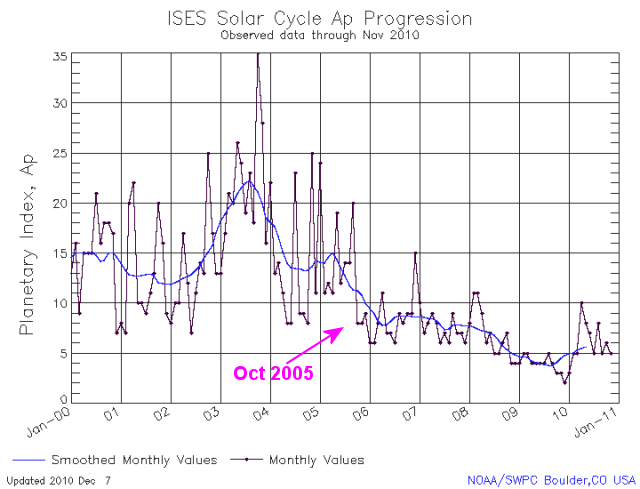
The Sun’s magnetic field extends far out into space.  It not only surrounds Earth, it also extends well beyond Pluto.  The more powerful the Sun’s magnetic field, the more it alters the  Earth’s geomagnetic field.    The Ap index is measure of this alteration.   The Ap index measurements began in the 1930’s.   The chart  that follows shows the Ap index beginning in 2000 through most of  2010.  The peak in the 2003 -2004 time frame is Cycle 23.  The Solar activity was high during that time, reaching an Ap index of 35 at its peak.  In October 2005,  the Ap Index dropped significantly and has remained very low since then.

The  following chart shows the Ap index from October 2010  through the end of December 2010.  Note that the index has bottomed out at zero on several occasions.  This chart also illustrates the how well the Solar Flux, the Sunspot Number and the Ap Index  correlate.

(This chart was prepared by Jan Alvestad)

No one knows exactly the mechanism that causes the Earth to cool when these proxies are low or warm when they are up.  No one knows exactly why the Sun has 11 (+-) year cycles.  Maybe we will never learn enough to be able to predict accurately the future state of the solar activity.  If so,  we will never be able to accurately predict the Earth’s future climate.  But we can reasonably predict that the Earth’s climate will cool as long as these proxies stay low (below normal), indicating low solar activity.
Moreover, we can’t control solar activity.  We can’t control Earth’s orbit around the Sun.  The Sun is in charge of our climate.  Man has precious little control of the climate in the big picture.   Attempts to moderate the Earth’s climate through reduction of CO2, for example, will have limited to no effect on climate although it will have a profound negative impact on our economic well being .

Our efforts should be directed toward adaptation to what every the Sun dishes out.

For more on this topic see posting Part 1 and Part 2 of Sun And Climate.

cbdakota

Sun and Climate Change -PART 2: Sunspots


Following up from the previous posting, Sun and Climate Change Part 1-Solar Activity, we will continue to examine the connection between the Sun and the Earth’s climate.

Sun’s Magnetic Field

On average, the Sun’s magnetic field is thought to be only about twice as strong as Earth’s magnetic field. The magnetic field is generated by the rotation of the Sun acting like a giant electromagnet.  But it has local fields of enormous strength, something in the range of 8000 times greater that Earth’s field.  It is believed that the cause of these local fields is the differential rotation of the Sun’s latitudes.  The observed rotation at the equator is 25 days and near the poles about 35 days is due to the fact that the Sun is made up of plasma and hot gases.  This results in the magnetic field becoming twisted and erupting from the surface in these local fields.  Where this enormous magnetic force exists, you find Sunspots, flares, and coronal mass ejections (CME). The Sun has a cycle of about 11 years from minimum to maximum and back to minimum magnetic activity.  This cycle can be observed by the numbers of Sunspots formed on the surface of the Sun.   During a cycle, the Sunspot number increase until the Sun’s polarity “flips”.  The Sun’s magnetic polar north flips and points south.  This usually is the point at which the so-called solar maximum is reached. The activity on the Sun begins to decrease.  The cycle eventually reaching a point where very few Sunspots are observed.  This is the completion of a cycle.

Sunspots

Sunspots are the product of the enormous magnetic fields (thousands of times stronger than Earths magnetic field) created on the Sun. They appear as dark spots.   The Spots are cooler than the surrounding surface of the Sun.  NASA says that the Spots are about 3700K versus 5700K for the surrounding photosphere.

Sunspots are probably not the best indicators of the Sun’s activity but the better indicators have little history where as Sunspots have been recorded for hundreds of years. What make them especially interesting is that the Earth’s climate and Sunspots have a high degree of correlation.   Periods where the Earth’s climate has cooled off appear to coincide with periods of few Sunspots and periods of warmer climate seem to coincide with periods of high Sunspot counts.

Chart Courtesy of Wikimedia Commons

The telescopic recording of Sunspots began  with Galileo using the newly invented telescope to observe the sunspots in 1610.  He and later others began to count the sunspots.

When a solar cycle is forecast, the y-axis is usually Sunspot numbers and the x-axis is time.   The current solar cycle is 24.   On the chart below, the blue line is the monthly average of Sunspots. It shows  cycle 23 declining from its high and then cycle 24 as it begins to rise.  The orange line was the predicted shape of cycle 24 by NASA experts but the actual Sunspot numbers are lower than forecast. The experts have found it necessary to continue to reduce the numbers (height) of the forecast monthly Sunspot numbers.  In 2006 they forecast a height of cycle 24 at a sunspot number of 156 to 180. The following chart is from a posting by Anthony Watts on his blog,  WattsUpWithThat and can be seen here.

The following chart shows the latest  (Dec 2010) prediction of NASA and how they have found it necessary to continue to lower their expectations over time to new “high Sunspot number” of 64!!!  Although some people think they have a system that allows them to predict these numbers, its clear that no one knows enough to make any forecast that’s good enough to bet on it. The NASA forecast has been downgraded four times since the March 2006 prediction.

(The chart courtesy of Ira Glickstein on WUWT blog and can be seen here.)

There is one additional factor that the reader needs to be aware of, and that is comparing Sunspot counts of old and those of today could be problematic.   The pinpricks that are counted on the sun today with the high-powered equipment were probably not even noticed in years past.   So when it is reported that the sunspot count during period of the Maunder Minimum in lower than today, you cannot be sure we are comparing apples and apples.   Some discussion about this variable can be found here.

But no matter how you count them, the cycle 24 sunspots are out of the norm. Cycle 24 is being compared to Cycle 5 which occurred at the time of the Daulton Minimum.  The indications are Earth’s  climate is in for a period of cooling.

cbdakota


Sun and Climate Change -PART 1: SOLAR ACTIVITY


Two years ago, this December, I wrote an essay titled “Sun and Climate Change”.   The essay opened with this summary statement:

Climate change has always been underway on Earth.  Periods of cooling, then warming, then cooling, etc. are historical facts.  These changes, over millions of years, have had natural causes that do not include burning of fossil fuels.

Correlation might mean causation.  But no correlation clearly means no causation.  The ice core and ocean bottom core data that provide a look back into time, show that atmospheric carbon dioxide (CO2) lags global temperature change.  It says that CO2 begins to increase after the global temperature begins to increase and it decreases after the temperature decreases.  So CO2 does not cause temperature to change. Yes, I am aware that CO2 plays a small role as a greenhouse gas.  But it is water, in the form of vapor and clouds, which does 90% of the greenhouse work.

The Sun, however, has correlation with climate change.  After many years of low solar activity (known as the Sporer, Maunder and Dalton Minimums), a comparatively cool climatic period followed that lasted from 1450 to 1820.  This cool period is known as The Little Ice Age. Then came many years of increasingly greater solar activity that stretched into the 20th century.  Some solar scientists say that this period has been the most active in the last 11,000 years.  Global warming has been a consequence of these more active, recent solar cycles.

So where are we now?   At the moment, the global temperature is falling.  The global temperature is cooler now than it was at the end of the last century.  Figure 1, shows how the global temperature has been declining. The solar activity is down; in fact, August 2008 was the first calendar month in 100 years that no sunspots were recorded.  Sunspots appear to be a reliable proxy for solar activity.   Will this period of cooling last? I don’t know.  I hope that we do not descend into another Ice Age, Little or Big. I would rather have warming.  What I am reasonably confident of is that fossil fuel use restrictions (in order to reduce atmospheric CO2) will make little difference relative to global warming.  I am reasonably confident that the Sun is the critical player here and there is little we can do to change whatever the Sun decides to do.  Even though the exact mechanism linking the Sun and global climate change has not yet been definitively established, it is kind of like gravity–it is obvious even if we cannot fully define it.

Two years later some tweaking could be done to the preceding but for the most part it is accurate and further, the intervening time has provided even more compelling evidence.

Solar Activity,  Solar magnetism, Solar cycles, and Sunspots will be discussed in this and future postings.

SOLAR ACTIVITY

A new peer-reviewed paper was recently published in the Journal of Geophysical Research:  (the source is the Blog IceCap.  To read more click here)

...that reconstructions of total solar irradiance (TSI) show a significant increase since the Maunder minimum in the 1600’s during the Little Ice Age and shows further increases over the 19th and 20th centuries. The TSI is estimated to have increased 1.25 W/m2 since the Maunder minimum ………..

It remarkable that the authors say that most of the warming since 1850 can be accounted for by the increase in solar activity:

Use of the Stefan-Boltzmann equation indicates that a 1.25 W/m2 increase in solar activity could account for an approximate .44C global temperature increase [the HADCRU global warming from 1850 to 2000 is .55C].

The paper is Reconstruction of solar spectral irradiance since the Maunder Minimum, by N.A. Krivova, L.E. A. Vieira, S. K. Solanki

Journal of Geophysical Research

For more on this topic see Sun and Climate Change Part 2 Sun Spots

cbdakota

CANCUN AND WORLD GOVERNMENT–PART 2


From my preceding posting Cancun and World Government—-the meeting in Cancun makes the assumption that emitted CO2 is causing harm to undeveloped or underdeveloped nations.  To make amends for this, the developed nations are to pay reparations to the other nations.  The “Chairman’s note” in the previous blog shows the UN would manage these payments which could be as large as 1.5% of GDP.

NOW WHAT COULD BE WRONG WITH ALL OF THAT, YOU ASK?   Let me count the ways:

1.  There is no scientific evidence that CO2 has or will cause any significant “harm”.  I suppose one could argue that anything that keeps the world from going into another Ice Age is a welcome addition.  And for those advocates of the Precautionary Principle, why not contribute of some activity or fund that might prevent a new Ice Age.  In either direction, hot or cold, I don’t believe your contributions will be able to reverse the direction.

2.  We do know that the underdeveloped and undeveloped nations have been blessed by the developed countries.  Great advances available to all peoples of the world in medicine, chemistry, mathematics, and literature are (for the period of time of the warmist concerns about CO2) products of the developed nations.   Using the Noble Prize as a parameter, the top winners are shown in the chart below as well as several examples of the contribution by some of the loudest wanting reparations:

Nation Total Prizes Won Less Peace and Lit
USA 326 296
UK 115 95
Germany 102 86
France 57 33
Venezuela 1

Bolivia 0 0

Excluding literature and Peace is a questionable exercise but when I see that in this decade, the Peace prize has been won by Obama, Gore and Carter, one has to wonder what value that prize is to anyone.

One also wonders why Venezuela, for example, being a big producer, user and exporter of oil is somehow not classified as one of the payers of reparations rather than a recipient as they see themselves.  Is this the “drug producer and supplier” proviso—you know it’s not their fault it is only the users fault.

Thinking about medicine and health, don’t they owe us a lot for saving the lives of millions?  Real lives, not these hypothetical lost lives the IPCC keeps coming up with.   Polio almost eliminated everywhere.  Small Pox a thing of the past.   Malaria deaths could be down significantly if environmentalists got out of the way.   HIV death rates in reverse everywhere.  Don’t they owe us for all the advances in their lives resulting from the inventions, all the advances in science as well? Click here to see Prize distribution.

3.   Giving the UN money is the surest way to see that it gets into the wrong hands.  Need I remind you of the Iraq Oil for Food program?  I believe that the UN may have the biggest collection of scammers ever to be in one organization.

4.   The UN is made up of countries that are not democratic or only partially democratic.  The Nobel Organization has a nice slide show illustrating the nations that are democratic and those that are not.   In large measure, democracy is the form of government of the successful nations in this world.   The advances in world knowledge come fundamentally from these countries.  The Nobel Prizes illustrate this.

There are only 4 nations in the world that state that they are not democracies.  They are Vatican City, Saudi Arabia, Burma and Brunei.  But in fact most of Asia, with the notable exception of India, and most of Africa with the notable exception of The Republic of South Africa are populated by countries that may have “democratic republic” in their nation’s title but they are not democratic in any sense.  The Slideshow I mentioned says that 3 billion people live in democracies and 3.6 million do not.  I do not want the majority of the world’s people running the UN now, and surely don’t want that organization to be running this country.

To see the slideshow, click here.

Apparently, President Obama’s representatives are in cahoots with these thieves at the Cancun meeting.  Write your Congressional Members and tell we want no part of this reparations plan.

cbdakota

CANCUN AND WORLD GOVERNMENT


The Cancun UN global warming meeting is nearly over.  This is a political get-to-gather where the focus is to extract monies from the developed nations to pay for the harm caused by them to the undeveloped or underdeveloped nations.  This “harm” is the result of the CO2 these developed nations have emitted.  While there is no proof that such harm has actually occurred, never you mind, they want the money in any event.

In Christopher Monckton’s posting on the Science & Public Policy Institute, he summarizes a “33-page Note (FCCC/AWGLCA/2010/CRP.2) by the Chairman of the “Ad-Hoc Working Group on Long-Term Co-operative Action under the United Nations Framework Convention on Climate Change”, entitled Possible elements of the outcome, reveals all.”

Selected parts of Monckton’s summary is as follows:

Finance: Western countries will jointly provide $100 billion a year by 2020 to an unnamed new UN Fund. To keep this sum up with GDP growth, the West may commit itself to pay 1.5% of GDP to the UN each year. That is more than twice the 0.7% of GDP that the UN has recommended the West to pay in foreign aid for the past half century. Several hundred of the provisions in the Chairman’s note will impose huge financial costs on the nations of the West.

The world-government Secretariat: In all but name, the UN Convention’s Secretariat will become a world government directly controlling hundreds of global, supranational, regional, national and sub-national bureaucracies. It will receive the vast sum of taxpayers’ money ostensibly paid by the West to the Third World for adaptation to the supposed adverse consequences of imagined (and imaginary) “global warming”.

Bureaucracy: Hundreds of new interlocking bureaucracies answerable to the world-government Secretariat will vastly extend its power and reach.

Monckton relates what is missing from the Chairman’s note:

Omissions: There are several highly-significant omissions, which jointly and severally establish that the central intent of The Process no longer has anything to do with the climate, if it ever had. The objective is greatly to empower and still more greatly to enrich the international classe politique at the expense of the peoples of the West, using the climate as a pretext, so as to copy the European Union by installing in perpetuity what some delegates here are calling “transnational perma-Socialism” beyond the reach or recall of any electorate. Here are the key omissions:

· The science: The question whether any of this vast expansion of supranational power is scientifically necessary is not addressed. Instead, there is merely a pietistic affirmation of superstitious faith in the IPCC, where the conference will “recognize that deep cuts in global [greenhouse-gas] emissions are required according to science, and as documented in the [IPCC’s] Fourth Assessment Report.

The economics: There is no assessment of the extent to which any of the proposed actions to mitigate “global warming” by cutting emissions of carbon dioxide or to adapt the world to its consequences will be cost-effective. Nor, tellingly, is there any direct comparison between mitigation and adaptation in their cost-effectiveness: indeed, the IPCC was carefully structured so that mitigation and adaptation are considered by entirely separate bureaucracies producing separate reports, making any meaningful comparison difficult. Though every economic analysis of this central economic question, other than that of the now-discredited Lord Stern, shows that mitigation is a pointless fatuity and that focused adaptation to the consequences of any “global warming” that may occur would be orders of magnitude cheaper and more cost-effective, the Cancun conference outcome will continue to treat mitigation as being of equal economic utility with adaptation.

· Termination: Contracts have termination clauses to say what happens when the agreement ends. Nothing better illustrates the intent to create a permanent world-government structure than the absence of any termination provisions whatsoever in the Cancun outcome. The Process, like diamonds, is forever.

Democracy: Forget government of the people, by the people, for the people. Forget the principle of “no taxation without representation” that led to the very foundation of the United States. The provisions for the democratic election of the new, all-powerful, legislating, tax-raising world-government Secretariat by the peoples of the world may be summarized in a single word: None.

Joanne Nova posts on her blog, using Monckton’s information, what it will cost the US, Aussie and Brits if the recommended 1.5% of GDP is agreed to:

The UN wants nothing less than 1.5% of our GDP.

That’s $212 billion from the USA every year ($2700 per family of 4).

That’s $32 billion from the UK every year ($2000 per family of 4).

That’s $13 billion from Australia every year ($2400 per family of 4).

Figures calculated from the CIA world Factbook

To read Monckton’s posting in detail click here

To read Joanne Nova’s posting in more detail, click here.

For more on this topic see Cancun and World Government part 2

cbdakota

AM I MADDER AT MYSELF OR OBAMA?–Wikileaks


Those State Department Wikileaks  that discuss anthropogenic global warming (AGW) show  the Obama Administration plotting to torpedo the UN global warming Pact as much as six months prior to the December 2009  Copenhagen Climate Change summit.  I am mad at myself, because I was unable to figure out the reasons for the failure.  I thought failure of the UN proposal at the Copenhagen summit was a result of the release of the Climategate Emails and the belief that the US Congress would not pass Cap and Trade nor ratify any climate treaty.  But all along it was Obama’s folks out there buying votes.  Well  I did not know,  but a lot of countries did.  They were lining up at the State Department’s door to get their share of our money.

It appears that the US and the EU concluded that the price to play the global warming scam was too high using the UN’s proposed Pact.  That Pact would have made Robin Hood look like a piker doing the “take from the rich and give to the poor” routine.

But I am mad at Obama and all those countries that clearly demonstrate  once again, that the faulty science of AGW does not concern them.  They are in it for the money and the control.

So, I have an answer to my opening question.  My actions did not hurt anyone.  Obama’s, at a high cost, continued to perpetuate the fraud that is AGW.

A posting by the UK Guardian (Guardian is supportive of AGW) ,  discusses their findings as they searched through the leaked State Dept. files.  It seems that the US and the EU wanted what was later called the Copenhagen Accord.   Both the original UN Pact and the Accord contained restrictions on CO2 emissions and offered reparations to those nations that were being or would be “devastated” by AGW.  The difference seemed to be how big the reparations would be and how large the CO2 reductions would be.   There are 193 voting bodies in the UN,  most  would be recipients of the reparations.   By February 2010,  according to the last set of Wikileaks,  140 now support the Copenhagen Accord.

The method used to achieve this “success”  is pretty chilling.  From the Guardian posting is this:

The US diplomatic cables reveal how the US seeks dirt on nations opposed to its approach to tackling global warming; how financial and other aid is used by countries to gain political backing; how distrust, broken promises and creative accounting dog negotiations; and how the US mounted a secret global diplomatic offensive to overwhelm opposition to the controversial “Copenhagen accord”, the unofficial document that emerged from the ruins of the Copenhagen climate change summit in 2009.

Negotiating a climate treaty is a high-stakes game, not just because of the danger warming poses to civilisation but also because re-engineering the global economy to a low-carbon model will see the flow of billions of dollars redirected.

Seeking negotiating chips, the US state department sent a secret cable on 31 July 2009 seeking human intelligence from UN diplomats across a range of issues, including climate change. The request originated with the CIA. As well as countries’ negotiating positions for Copenhagen, diplomats were asked to provide evidence of UN environmental “treaty circumvention” and deals between nations.

The full posting by the Guardian can be read by clicking here.

For those readers who still think that the AGW leaders really care about the science,  stay tuned for the following quotes posted on the American Thinker Blog:

Indeed, for nearly 50-years the U.N. has formulated its own unique brand of “social justice” under the guise of “saving the planet” by demonizing one byproduct of Western economic growth or another.  Carbon Dioxide is, of course, merely the devil’s derivative du jour.

Now, a high-ranking member of the U.N’s Intergovernmental Panel on Climate Change (IPCC) has admitted that climate policy has little to do with environmental protection.

On Sunday, Ottmar Edenhofer, a German economist and IPCC Co-chair of Working Group III on Mitigation of Climate Change, told the Neue Zürcher Zeitung (translated) that “climate policy is redistributing the world’s wealth” and that “it’s a big mistake to discuss climate policy separately from the major themes of globalization.”

Edenhofer went on to explain that in Cancun, the redistribution of not only wealth but also natural resources will be negotiated, adding that:

The climate summit in Cancun at the end of the month is not a climate conference, but one of the largest economic conferences since the Second World War.

To read the full posting click here.

cbdakota

Weakness of AGW Theory- Part 6-A Legal Takedown


The University of Pennsylvania Law School has published Research Paper no. 10-08  titled  “Global Warming Advocacy Science: A Cross Examination” written by Jason Scott Johnston. His technique is a novel way of getting at the truth.  Johnson approaches the question of the validity of Anthropogenic Global Warming (AGW) as if it were in a court of law. While you may know a lot about this topic, my guess is that if you read it you will learn some new things.  I am familiar with the skeptic’s arguments but some of the AGW believer’s arguments were new to me.  Johnston takes a look at the arguments and treats them as if he were cross examining the two sides.

He does a nice job of exposing the weakness of “positive feedback” that is the basis for the computer projections of calamitous happenings if CO2 emissions are not checked. Further that computer projections of future climate are not science.  He highlights the rhetoric used by the alarmists that gets headlines and muddies the waters.

Johnston’s concludes his examination with these thoughts:  (ghg=green house gas)

Even if the reader is at this point persuaded to believe that there remain very important open questions about ghg emissions and global warming, and important areas of disagreement among climate scientists, she may well ask: So what? After all, such a reader might argue, CO2 is a ghg, and if we continue to increase CO2, then it seems clear that despite whatever uncertainty there may be about how much temperatures will increase as a consequence of increasing CO2 in the atmosphere, and about the impacts of such rising temperatures, there is no doubt that temperatures will increase with increasing CO2, and that at some point, such rising temperatures will cause harm, so that one way or another, at one time or another, we simply have to reduce our emissions of CO2.

However beguiling, such an argument not only oversimplifies the policy questions raised by human ghg emissions, it is also misunderstands the significance of the scientific questions revealed by my cross examination for the predictability of anthroprogenically-forced climate change. Consider first the scientific questions. If climate were a simple linear system – with increases in atmospheric CO2 directly and simply determining future warming – then while a detailed understanding of the earth’s climate system might still of scientific interest, there would be little policy justification for expending large amounts of public money to gain such an understanding. But if one thing is clear in climate science it is that the earth’s climate system is not linear, but is instead a highly complex, non-linear system made up of sub-systems – such as the ENSO, and the North Atlantic Oscillation, and the various circulating systems of the oceans – that are themselves highly non-linear. Among other things, such non-linearity means that it may be extremely difficult to separately identify the impact of an external shock to the system – such as what climate scientists call anthropogenic CO2 forcing – from changes that are simply due to natural cycles, or due to other external natural and anthropogenic forces, such as solar variation and human land use changes. Perhaps even more importantly, any given forcing may have impacts that are much larger – in the case of positive feedbacks – or much smaller – in the case of negative feedbacks – than a simple, linear vision of the climate system would suggest. Because of the system’s complexity and non-linearity, without a quite detailed understanding of the system, scientists cannot provide useful guidance regarding the impact on climate of increases in atmospheric ghg concentration.

As a large number of climate scientists have stressed, such an understanding will come about only if theoretical and model-driven predictions are tested against actual observational evidence. This is just to say that to really provide policymakers with the kind of information they need, climate scientists ought to follow the scientific method of developing theories and then testing those theories against the best available evidence. It is here that the cross examination conducted above yields its most valuable lesson, for it reveals what seem to be systematic patterns and practices that diverge from, and problems that impede, the application of basic scientific methods in establishment climate science. Among the most surprising and yet standard practices is a tendency in establishment climate science to simply ignore published studies that develop and/or present evidence tending to disconfirm various predictions or assumptions of the establishment view that increases in CO2 explain virtually all recent climate change.

Perhaps even more troubling, when establishment climate scientists do respond to studies supporting alternative hypotheses to the CO2 primacy view, they more often than not rely upon completely different observational datasets which they say confirm (or at least don’t disconfirm) climate model predictions. The point is important and worth further elucidation: while there are quite a large number of published papers reporting evidence that seems to disconfirm one or another climate model prediction, there is virtually no instance in which establishment climate scientists have taken such disconfirming evidence as an indication that the climate models may simply be wrong. Rather, in every important case, the establishment response is to question the reliability of the disconfirming evidence and then to find other evidence that is consistent with model predictions. Of course, the same point may be made of climate scientists who present the disconfirming studies: they tend to rely upon different datasets than do establishment climate scientists. From either point of view, there seems to be a real problem for climate science: With many crucial, testable predications – as for example the model prediction of differential tropical tropospheric versus surface warming – there is no indication that climate scientists are converging toward the use of standard observational datasets that they agree to be valid and reliable. Without such convergence, the predictions of climate models (and climate change theories more generally) cannot be subject to empirical testing, for it will always be possible for one side in any dispute to use one observational dataset and the other side to use some other observational dataset. Hence perhaps the central policy implication of the cross-examination conducted above is a very concrete and yet perhaps surprising one: public funding for climate science should be concentrated on the development of better, standardized observational datasets that achieve close to universal acceptance as valid and reliable. We should not be using public money to pay for faster and faster computers so that increasingly fine-grained climate models can be subjected to ever larger numbers of simulations until we have got the data to test whether the predictions of existing models are confirmed (or not disconfirmed) by the evidence.

This might seem like a more or less obvious policy recommendation, but if it were taken, it would represent not only a change in climate science funding practices, but also a reaffirmation of the role of basic scientific methodology in guiding publicly funded climate science. As things now stand, the advocates representing the establishment climate science story broadcast (usually with color diagrams) the predictions of climate models as if they were the results of experiments – actual evidence. Alongside these multi-colored multi-century model-simulated time series come stories, anecdotes, and photos – such as the iconic stranded polar bear — dramatically illustrating climate change today. On this rhetorical strategy, the models are to be taken on faith, and the stories and photos as evidence of the models’ truth. Policy carrying potential costs in the trillions of dollars ought not to be based on stories and photos confirming faith in models, but rather on precise and replicable testing of the models’ predictions against solid observational data.

This is a long paper,  some  80 pages, but I suggest that you read the entire document which you can do by clicking here.

Cbdakota

The IPCC Must Go-Part 4: Failing Grades


Further evidence that the IPCC should be disbanded is the extent of non-peer reviewed literature that supports the “findings” in Assessment Report 4 (AR-4).  A team of people  (43 Citizen Authors) from 12 countries participated in a review of AR-4.   And they found that 21 of the 44 chapters that make up AR-4 had flunking grades.  The Non-consensus.org blog supplied the following summary and table:

United Nations countries belong to an organization called the Intergovernmental Panel on Climate Change (IPCC), which publishes a report every six years. Often referred to as the “climate bible” the latest one was released in 2007 and is relied on by governments around the world. Billions of dollars are spent on national and international policies based on its findings. Judges consult it when trying cases. Scholars and journalists cite it thousands of times a year.

The IPCC report contains 44 chapters and is nearly 3,000 pages long. Written by people organized into three teams – Working Group 1, 2 and 3 – it consists of three smaller reports bundled into one.

This Citizen Audit focused its attention on the peer-reviewed literature claim. A team of 43 volunteers from 12 countries examined the list of references at the end of each chapter. We sorted these references into two groups – articles published in peer-reviewed academic journals and other references. (Non-peer-reviewed material is often called “grey literature”.)

21 out of 44 chapters contain so few peer-reviewed references that the IPCC received an F. The IPCC relied on peer-reviewed literature less than 60 percent of the time in these chapters.

5,587 references in the IPCC report were not peer-reviewed. Among these documents are press releases, newspaper and magazine articles, discussion papers, MA and PhD theses, working papers, and advocacy literature published by environmental groups.  To read the full report click here.

A look at the details indicates that Working Group 1—PHYSICAL SCIENCE BASIS, got all of the “A’s” and 3 of the 5 “B’s”.     Although they did not meet the standard that EVERYTHING was peer-reviewed literature, they came by far the closest to that standard of the three Working Groups.  We noted in a previous blog that the Oxburgh Committee reviewing the CRU fiasco had excused the CRU scientists saying that they may have made mistakes, but it was the IPCC AR-4 authors that put in the temperature exaggerations.  However, the Coordinating Lead Authors for the WG-1, Chapter (3), Observations:  Surface and Atmospheric Climate Change were none other than Phillip Jones and Kevin Trenberth.  Those two gentlemen are featured prominently in the Climategate leaked e-mail and this puts to lie the Oxburgh Committee excuses.

WG-2— IMPACTS, ADAPTATION AND VULNERABILITY had 0 “A’s”, 2 “B’s”, 5 “C’s”, 3 “D’s” and 10 “F’s”.

WG-3—MITIGATION OF CLIMATE CHANGE had no “A’s or B’s”, 1 “C”, 1 “D” and 11 “F’s”.

The Summary For Policy Makers was loosely based upon the AR-4.   The juicy part for the media was the terrible things that were going to happen to the Earth if CO2 emissions were not brought under control.  And most of this came from the failing-grade WG-2 and WG-3.

See also  The IPCC Must Go-Part 3

The IPCC Must Go-Part 2

The IPCC Must Go-Part 1

Cbdakota