Category Archives: Global Temperatures

SUN AND CLIMATE PART 3: SOLAR FLUX & Ap INDEX


In the two prior postings Sun and Climate,Parts 1 and 2,  we have talked about Solar Activity and how it relates to climate.  In Part 1, the discussion was primarily about Solar Insolation, and Part 2 began the discussion about solar activity using Sunspots as a proxy.   Sunspots are popularly used to indicate Solar activity due to their longevity.  Galileo began noting and recording them in the sixteen hundreds.

Ok,   now lets look at some more physical evidence that shows a strong correlation with solar activity/climate change.

Two much newer and probably better proxy measures are Solar Flux and Average Magnetic Planetary Index (Ap index).

SOLAR FLUX

The former is a measure of noise or flux that is emitted at a frequency of 2800 MHz (10.7cm).  This measure is typically referred to as F10.7.  This proxy measures ionization in the ionosphere’s F region.    The solar wind from the Sun contains many atomic particles.  The Earth’s geomagnetic field deflects the majority of the protons and electrons being expelled from the Sun toward the Earth.  But the as the Sun’s activity increases more particles are expelled and more break through into the Earth’s ionosphere where F10.7 measures the increase.    Continuous F10.7 measurement and record maintenance began in 1947. As can be noted from the shape of the current (Nov. 2010) monthly summary chart of F10.7,   it is lagging the same point on the red line where the experts had predicted it would be at this time in Cycle 24.

And as we noted in Sun and Climate Part 2,  the forecast Cycle 24  has been  scaled down several times in the last few years in order to match actual real world results which have consistently come in below each new forecast.  Note that the level of F10.7  at the peak of Cycle 23 in 2001 and 2002 reached nearly 240.

AVERAGE MAGNETIC PLANETARY INDEX –Ap

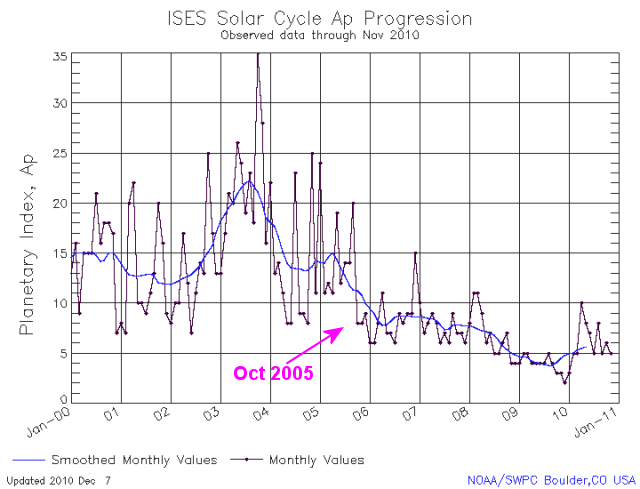
The Sun’s magnetic field extends far out into space.  It not only surrounds Earth, it also extends well beyond Pluto.  The more powerful the Sun’s magnetic field, the more it alters the  Earth’s geomagnetic field.    The Ap index is measure of this alteration.   The Ap index measurements began in the 1930’s.   The chart  that follows shows the Ap index beginning in 2000 through most of  2010.  The peak in the 2003 -2004 time frame is Cycle 23.  The Solar activity was high during that time, reaching an Ap index of 35 at its peak.  In October 2005,  the Ap Index dropped significantly and has remained very low since then.

The  following chart shows the Ap index from October 2010  through the end of December 2010.  Note that the index has bottomed out at zero on several occasions.  This chart also illustrates the how well the Solar Flux, the Sunspot Number and the Ap Index  correlate.

(This chart was prepared by Jan Alvestad)

No one knows exactly the mechanism that causes the Earth to cool when these proxies are low or warm when they are up.  No one knows exactly why the Sun has 11 (+-) year cycles.  Maybe we will never learn enough to be able to predict accurately the future state of the solar activity.  If so,  we will never be able to accurately predict the Earth’s future climate.  But we can reasonably predict that the Earth’s climate will cool as long as these proxies stay low (below normal), indicating low solar activity.
Moreover, we can’t control solar activity.  We can’t control Earth’s orbit around the Sun.  The Sun is in charge of our climate.  Man has precious little control of the climate in the big picture.   Attempts to moderate the Earth’s climate through reduction of CO2, for example, will have limited to no effect on climate although it will have a profound negative impact on our economic well being .

Our efforts should be directed toward adaptation to what every the Sun dishes out.

For more on this topic see posting Part 1 and Part 2 of Sun And Climate.

cbdakota

Sun and Climate Change -PART 2: Sunspots


Following up from the previous posting, Sun and Climate Change Part 1-Solar Activity, we will continue to examine the connection between the Sun and the Earth’s climate.

Sun’s Magnetic Field

On average, the Sun’s magnetic field is thought to be only about twice as strong as Earth’s magnetic field. The magnetic field is generated by the rotation of the Sun acting like a giant electromagnet.  But it has local fields of enormous strength, something in the range of 8000 times greater that Earth’s field.  It is believed that the cause of these local fields is the differential rotation of the Sun’s latitudes.  The observed rotation at the equator is 25 days and near the poles about 35 days is due to the fact that the Sun is made up of plasma and hot gases.  This results in the magnetic field becoming twisted and erupting from the surface in these local fields.  Where this enormous magnetic force exists, you find Sunspots, flares, and coronal mass ejections (CME). The Sun has a cycle of about 11 years from minimum to maximum and back to minimum magnetic activity.  This cycle can be observed by the numbers of Sunspots formed on the surface of the Sun.   During a cycle, the Sunspot number increase until the Sun’s polarity “flips”.  The Sun’s magnetic polar north flips and points south.  This usually is the point at which the so-called solar maximum is reached. The activity on the Sun begins to decrease.  The cycle eventually reaching a point where very few Sunspots are observed.  This is the completion of a cycle.

Sunspots

Sunspots are the product of the enormous magnetic fields (thousands of times stronger than Earths magnetic field) created on the Sun. They appear as dark spots.   The Spots are cooler than the surrounding surface of the Sun.  NASA says that the Spots are about 3700K versus 5700K for the surrounding photosphere.

Sunspots are probably not the best indicators of the Sun’s activity but the better indicators have little history where as Sunspots have been recorded for hundreds of years. What make them especially interesting is that the Earth’s climate and Sunspots have a high degree of correlation.   Periods where the Earth’s climate has cooled off appear to coincide with periods of few Sunspots and periods of warmer climate seem to coincide with periods of high Sunspot counts.

Chart Courtesy of Wikimedia Commons

The telescopic recording of Sunspots began  with Galileo using the newly invented telescope to observe the sunspots in 1610.  He and later others began to count the sunspots.

When a solar cycle is forecast, the y-axis is usually Sunspot numbers and the x-axis is time.   The current solar cycle is 24.   On the chart below, the blue line is the monthly average of Sunspots. It shows  cycle 23 declining from its high and then cycle 24 as it begins to rise.  The orange line was the predicted shape of cycle 24 by NASA experts but the actual Sunspot numbers are lower than forecast. The experts have found it necessary to continue to reduce the numbers (height) of the forecast monthly Sunspot numbers.  In 2006 they forecast a height of cycle 24 at a sunspot number of 156 to 180. The following chart is from a posting by Anthony Watts on his blog,  WattsUpWithThat and can be seen here.

The following chart shows the latest  (Dec 2010) prediction of NASA and how they have found it necessary to continue to lower their expectations over time to new “high Sunspot number” of 64!!!  Although some people think they have a system that allows them to predict these numbers, its clear that no one knows enough to make any forecast that’s good enough to bet on it. The NASA forecast has been downgraded four times since the March 2006 prediction.

(The chart courtesy of Ira Glickstein on WUWT blog and can be seen here.)

There is one additional factor that the reader needs to be aware of, and that is comparing Sunspot counts of old and those of today could be problematic.   The pinpricks that are counted on the sun today with the high-powered equipment were probably not even noticed in years past.   So when it is reported that the sunspot count during period of the Maunder Minimum in lower than today, you cannot be sure we are comparing apples and apples.   Some discussion about this variable can be found here.

But no matter how you count them, the cycle 24 sunspots are out of the norm. Cycle 24 is being compared to Cycle 5 which occurred at the time of the Daulton Minimum.  The indications are Earth’s  climate is in for a period of cooling.

cbdakota


Sun and Climate Change -PART 1: SOLAR ACTIVITY


Two years ago, this December, I wrote an essay titled “Sun and Climate Change”.   The essay opened with this summary statement:

Climate change has always been underway on Earth.  Periods of cooling, then warming, then cooling, etc. are historical facts.  These changes, over millions of years, have had natural causes that do not include burning of fossil fuels.

Correlation might mean causation.  But no correlation clearly means no causation.  The ice core and ocean bottom core data that provide a look back into time, show that atmospheric carbon dioxide (CO2) lags global temperature change.  It says that CO2 begins to increase after the global temperature begins to increase and it decreases after the temperature decreases.  So CO2 does not cause temperature to change. Yes, I am aware that CO2 plays a small role as a greenhouse gas.  But it is water, in the form of vapor and clouds, which does 90% of the greenhouse work.

The Sun, however, has correlation with climate change.  After many years of low solar activity (known as the Sporer, Maunder and Dalton Minimums), a comparatively cool climatic period followed that lasted from 1450 to 1820.  This cool period is known as The Little Ice Age. Then came many years of increasingly greater solar activity that stretched into the 20th century.  Some solar scientists say that this period has been the most active in the last 11,000 years.  Global warming has been a consequence of these more active, recent solar cycles.

So where are we now?   At the moment, the global temperature is falling.  The global temperature is cooler now than it was at the end of the last century.  Figure 1, shows how the global temperature has been declining. The solar activity is down; in fact, August 2008 was the first calendar month in 100 years that no sunspots were recorded.  Sunspots appear to be a reliable proxy for solar activity.   Will this period of cooling last? I don’t know.  I hope that we do not descend into another Ice Age, Little or Big. I would rather have warming.  What I am reasonably confident of is that fossil fuel use restrictions (in order to reduce atmospheric CO2) will make little difference relative to global warming.  I am reasonably confident that the Sun is the critical player here and there is little we can do to change whatever the Sun decides to do.  Even though the exact mechanism linking the Sun and global climate change has not yet been definitively established, it is kind of like gravity–it is obvious even if we cannot fully define it.

Two years later some tweaking could be done to the preceding but for the most part it is accurate and further, the intervening time has provided even more compelling evidence.

Solar Activity,  Solar magnetism, Solar cycles, and Sunspots will be discussed in this and future postings.

SOLAR ACTIVITY

A new peer-reviewed paper was recently published in the Journal of Geophysical Research:  (the source is the Blog IceCap.  To read more click here)

...that reconstructions of total solar irradiance (TSI) show a significant increase since the Maunder minimum in the 1600’s during the Little Ice Age and shows further increases over the 19th and 20th centuries. The TSI is estimated to have increased 1.25 W/m2 since the Maunder minimum ………..

It remarkable that the authors say that most of the warming since 1850 can be accounted for by the increase in solar activity:

Use of the Stefan-Boltzmann equation indicates that a 1.25 W/m2 increase in solar activity could account for an approximate .44C global temperature increase [the HADCRU global warming from 1850 to 2000 is .55C].

The paper is Reconstruction of solar spectral irradiance since the Maunder Minimum, by N.A. Krivova, L.E. A. Vieira, S. K. Solanki

Journal of Geophysical Research

For more on this topic see Sun and Climate Change Part 2 Sun Spots

cbdakota

Weakness of AGW Theory- Part 6-A Legal Takedown


The University of Pennsylvania Law School has published Research Paper no. 10-08  titled  “Global Warming Advocacy Science: A Cross Examination” written by Jason Scott Johnston. His technique is a novel way of getting at the truth.  Johnson approaches the question of the validity of Anthropogenic Global Warming (AGW) as if it were in a court of law. While you may know a lot about this topic, my guess is that if you read it you will learn some new things.  I am familiar with the skeptic’s arguments but some of the AGW believer’s arguments were new to me.  Johnston takes a look at the arguments and treats them as if he were cross examining the two sides.

He does a nice job of exposing the weakness of “positive feedback” that is the basis for the computer projections of calamitous happenings if CO2 emissions are not checked. Further that computer projections of future climate are not science.  He highlights the rhetoric used by the alarmists that gets headlines and muddies the waters.

Johnston’s concludes his examination with these thoughts:  (ghg=green house gas)

Even if the reader is at this point persuaded to believe that there remain very important open questions about ghg emissions and global warming, and important areas of disagreement among climate scientists, she may well ask: So what? After all, such a reader might argue, CO2 is a ghg, and if we continue to increase CO2, then it seems clear that despite whatever uncertainty there may be about how much temperatures will increase as a consequence of increasing CO2 in the atmosphere, and about the impacts of such rising temperatures, there is no doubt that temperatures will increase with increasing CO2, and that at some point, such rising temperatures will cause harm, so that one way or another, at one time or another, we simply have to reduce our emissions of CO2.

However beguiling, such an argument not only oversimplifies the policy questions raised by human ghg emissions, it is also misunderstands the significance of the scientific questions revealed by my cross examination for the predictability of anthroprogenically-forced climate change. Consider first the scientific questions. If climate were a simple linear system – with increases in atmospheric CO2 directly and simply determining future warming – then while a detailed understanding of the earth’s climate system might still of scientific interest, there would be little policy justification for expending large amounts of public money to gain such an understanding. But if one thing is clear in climate science it is that the earth’s climate system is not linear, but is instead a highly complex, non-linear system made up of sub-systems – such as the ENSO, and the North Atlantic Oscillation, and the various circulating systems of the oceans – that are themselves highly non-linear. Among other things, such non-linearity means that it may be extremely difficult to separately identify the impact of an external shock to the system – such as what climate scientists call anthropogenic CO2 forcing – from changes that are simply due to natural cycles, or due to other external natural and anthropogenic forces, such as solar variation and human land use changes. Perhaps even more importantly, any given forcing may have impacts that are much larger – in the case of positive feedbacks – or much smaller – in the case of negative feedbacks – than a simple, linear vision of the climate system would suggest. Because of the system’s complexity and non-linearity, without a quite detailed understanding of the system, scientists cannot provide useful guidance regarding the impact on climate of increases in atmospheric ghg concentration.

As a large number of climate scientists have stressed, such an understanding will come about only if theoretical and model-driven predictions are tested against actual observational evidence. This is just to say that to really provide policymakers with the kind of information they need, climate scientists ought to follow the scientific method of developing theories and then testing those theories against the best available evidence. It is here that the cross examination conducted above yields its most valuable lesson, for it reveals what seem to be systematic patterns and practices that diverge from, and problems that impede, the application of basic scientific methods in establishment climate science. Among the most surprising and yet standard practices is a tendency in establishment climate science to simply ignore published studies that develop and/or present evidence tending to disconfirm various predictions or assumptions of the establishment view that increases in CO2 explain virtually all recent climate change.

Perhaps even more troubling, when establishment climate scientists do respond to studies supporting alternative hypotheses to the CO2 primacy view, they more often than not rely upon completely different observational datasets which they say confirm (or at least don’t disconfirm) climate model predictions. The point is important and worth further elucidation: while there are quite a large number of published papers reporting evidence that seems to disconfirm one or another climate model prediction, there is virtually no instance in which establishment climate scientists have taken such disconfirming evidence as an indication that the climate models may simply be wrong. Rather, in every important case, the establishment response is to question the reliability of the disconfirming evidence and then to find other evidence that is consistent with model predictions. Of course, the same point may be made of climate scientists who present the disconfirming studies: they tend to rely upon different datasets than do establishment climate scientists. From either point of view, there seems to be a real problem for climate science: With many crucial, testable predications – as for example the model prediction of differential tropical tropospheric versus surface warming – there is no indication that climate scientists are converging toward the use of standard observational datasets that they agree to be valid and reliable. Without such convergence, the predictions of climate models (and climate change theories more generally) cannot be subject to empirical testing, for it will always be possible for one side in any dispute to use one observational dataset and the other side to use some other observational dataset. Hence perhaps the central policy implication of the cross-examination conducted above is a very concrete and yet perhaps surprising one: public funding for climate science should be concentrated on the development of better, standardized observational datasets that achieve close to universal acceptance as valid and reliable. We should not be using public money to pay for faster and faster computers so that increasingly fine-grained climate models can be subjected to ever larger numbers of simulations until we have got the data to test whether the predictions of existing models are confirmed (or not disconfirmed) by the evidence.

This might seem like a more or less obvious policy recommendation, but if it were taken, it would represent not only a change in climate science funding practices, but also a reaffirmation of the role of basic scientific methodology in guiding publicly funded climate science. As things now stand, the advocates representing the establishment climate science story broadcast (usually with color diagrams) the predictions of climate models as if they were the results of experiments – actual evidence. Alongside these multi-colored multi-century model-simulated time series come stories, anecdotes, and photos – such as the iconic stranded polar bear — dramatically illustrating climate change today. On this rhetorical strategy, the models are to be taken on faith, and the stories and photos as evidence of the models’ truth. Policy carrying potential costs in the trillions of dollars ought not to be based on stories and photos confirming faith in models, but rather on precise and replicable testing of the models’ predictions against solid observational data.

This is a long paper,  some  80 pages, but I suggest that you read the entire document which you can do by clicking here.

Cbdakota

Oceans to Rise 1″ in 526 years. Man the Lifeboats.


Wattsupwiththat.com posts a blog about a University of Leeds press release titled “Melting Icebergs causing sea level rise”.  According to Professor Andrew Shepherd it would be unwise to discount this signal.  After he explains how melting icebergs cause this threat, he provides the punch line which is, “……the net effect is to increase sea level by 2.6% of its volume which is equivalent to 49 micrometers per year spread across the global oceans.”

Now you may already be laughing.  WUWT does the math (49 micrometers equals 0.0019 inches) and concludes, it will take 526 years to result in one inch of sea level rise because of this “threat.”  See the full story here.

The best laugh I got from this press release was a comment made on this story; as follows:

H.R. says:

April 30, 2010 at 12:10 pm

Note to self: in 526 years, send trousers to tailor and have them hemmed up.

Cbdakota

The IPCC Must Go-Part 4: Failing Grades


Further evidence that the IPCC should be disbanded is the extent of non-peer reviewed literature that supports the “findings” in Assessment Report 4 (AR-4).  A team of people  (43 Citizen Authors) from 12 countries participated in a review of AR-4.   And they found that 21 of the 44 chapters that make up AR-4 had flunking grades.  The Non-consensus.org blog supplied the following summary and table:

United Nations countries belong to an organization called the Intergovernmental Panel on Climate Change (IPCC), which publishes a report every six years. Often referred to as the “climate bible” the latest one was released in 2007 and is relied on by governments around the world. Billions of dollars are spent on national and international policies based on its findings. Judges consult it when trying cases. Scholars and journalists cite it thousands of times a year.

The IPCC report contains 44 chapters and is nearly 3,000 pages long. Written by people organized into three teams – Working Group 1, 2 and 3 – it consists of three smaller reports bundled into one.

This Citizen Audit focused its attention on the peer-reviewed literature claim. A team of 43 volunteers from 12 countries examined the list of references at the end of each chapter. We sorted these references into two groups – articles published in peer-reviewed academic journals and other references. (Non-peer-reviewed material is often called “grey literature”.)

21 out of 44 chapters contain so few peer-reviewed references that the IPCC received an F. The IPCC relied on peer-reviewed literature less than 60 percent of the time in these chapters.

5,587 references in the IPCC report were not peer-reviewed. Among these documents are press releases, newspaper and magazine articles, discussion papers, MA and PhD theses, working papers, and advocacy literature published by environmental groups.  To read the full report click here.

A look at the details indicates that Working Group 1—PHYSICAL SCIENCE BASIS, got all of the “A’s” and 3 of the 5 “B’s”.     Although they did not meet the standard that EVERYTHING was peer-reviewed literature, they came by far the closest to that standard of the three Working Groups.  We noted in a previous blog that the Oxburgh Committee reviewing the CRU fiasco had excused the CRU scientists saying that they may have made mistakes, but it was the IPCC AR-4 authors that put in the temperature exaggerations.  However, the Coordinating Lead Authors for the WG-1, Chapter (3), Observations:  Surface and Atmospheric Climate Change were none other than Phillip Jones and Kevin Trenberth.  Those two gentlemen are featured prominently in the Climategate leaked e-mail and this puts to lie the Oxburgh Committee excuses.

WG-2— IMPACTS, ADAPTATION AND VULNERABILITY had 0 “A’s”, 2 “B’s”, 5 “C’s”, 3 “D’s” and 10 “F’s”.

WG-3—MITIGATION OF CLIMATE CHANGE had no “A’s or B’s”, 1 “C”, 1 “D” and 11 “F’s”.

The Summary For Policy Makers was loosely based upon the AR-4.   The juicy part for the media was the terrible things that were going to happen to the Earth if CO2 emissions were not brought under control.  And most of this came from the failing-grade WG-2 and WG-3.

See also  The IPCC Must Go-Part 3

The IPCC Must Go-Part 2

The IPCC Must Go-Part 1

Cbdakota

Apocalypse Fatigue


Before we get back to the task of showing why the IPCC must go, lets looks at the Weekly Standard’s takedown of the AGW climate campaign.

The Weekly Standard’s posting  is titled “In Denial-The meltdown of the climate campaign.  It is a tour de force by Steven Hayward.  It is comprehensive at some six pages long. I have selected some of the notable sections for you:

The U.N.’s Intergovernmental Panel on Climate Change (IPCC), hitherto the gold standard in climate science, is under fire for shoddy work and facing calls for a serious shakeup. The U.S. Climate Action Partnership, the self-serving coalition of environmentalists and big business hoping to create a carbon cartel, is falling apart in the wake of the collapse of any prospect of enacting cap and trade in Congress. Meanwhile, the climate campaign’s fallback plan to have the EPA regulate greenhouse gas emissions through the cumbersome Clean Air Act is generating bipartisan opposition.

Al Gore is in for some scathing comments:

Al Gore was conspicuously missing in action before surfacing with a long article in the New York Times on February 28, reiterating his familiar parade of horribles: The sea level will rise! Monster storms! Climate refugees in the hundreds of millions! Political chaos the world over! It was the rhetorical equivalent of stamping his feet and saying “It is too so!” In a sign of how dramatic the reversal of fortune has been for the climate campaign, it is now James Inhofe, the leading climate skeptic in the Senate, who is eager to have Gore testify before Congress.

How are the AGWers holding up in this storm of criticism?

The rout has opened up serious divisions within the formerly closed ranks of the climate campaign. Before Climategate, expressing skepticism about catastrophic global warming typically got the hefty IPCC report thrown in your face along with the mantra that “2,500 of the world’s top scientists all agree” about climate change. Now the IPCC is being disavowed like a Mission Impossible team with its cover blown.

And:

As Gore put it in his February 28 Times article, “the overwhelming consensus on global warming remains unchanged.” I note in passing that the 2007 Working Group I report uses the terms “uncertain” or “uncertainty” more than 1,300 times in its 987 pages, including what it identified as 54 “key uncertainties” limiting our mastery of climate prediction.

This central pillar of the climate campaign is unlikely to survive much longer, and each repetition of the “science-is-settled” mantra inflicts more damage on the credibility of the climate science community. The scientist at the center of the Climategate scandal at East Anglia University, Phil (“hide the decline”) Jones dealt the science-is-settled narrative a huge blow with his candid admission in a BBC interview that his surface temperature data are in such disarray they probably cannot be verified or replicated, that the medieval warm period may have been as warm as today, and that he agrees that there has been no statistically significant global warming for the last 15 years—all three points that climate campaigners have been bitterly contesting. And Jones specifically disavowed the “science-is-settled” slogan.

Are the skeptics at fault?

The climate campaign camp followers are exhausting their invective against skeptics. Harvard’s Jeffrey Sachs wrote in the Guardian that climate skeptics are akin to tobacco scientists—some of the same people, in fact, though he gave no names and offered no facts to establish such a claim. In the Los Angeles Times Bill McKibben compared climate skeptics to O.J. Simpson’s “dream team” of defense attorneys able to twist incontrovertible scientific evidence. Not to be outdone, Senator Bernie Sanders (Socialist-VT) compared climate skeptics to appeasers of Hitler in the 1930s, a comparison, to be sure, that Al Gore has been making since the early 1990s, but Sanders delivered it with his patented popping-neck-veins style that makes you worry for his health.

In addition to being a sign of desperation, these ad hominem arguments from the climate campaigners also make clear which camp is truly guilty of anti-intellectualism. Gore and the rest of the chorus simply will not discuss any of the scientific anomalies and defects in the conventional climate narrative that scientists such as Christy have pointed out to the IPCC.

What about “Apocalypse Fatigue”:

The lingering question is whether the collapse of the climate campaign is also a sign of a broader collapse in public enthusiasm for environmentalism in general. Ted Nordhaus and Michael Shellenberger, two of the more thoughtful and independent-minded figures in the environmental movement, have been warning their green friends that the public has reached the point of “apocalypse fatigue.” They’ve been met with denunciations from the climate campaign enforcers for their heresy. The climate campaign has no idea that it is on the cusp of becoming as ludicrous and forlorn as the World -Esperanto Association.

This is really a good read and you can see it in its entirety by clicking here.

Cbdakota

The IPCC Must Go-Part 1


It is satisfying to see the leaders of the Anthropogenic Global Warming (AGW) theory discussing what should be done about the Intergovernmental Panel on Climate Change (IPCC) in the wake of the scandals surrounding that organization.   Unfortunately, all they think is needed is a slight tweak here and another there.

What is it that they do not understand? The IPCC is irreparably broken. The IPCC report conclusions are based on science produced by fabulist masquerading as scientists and false prophets using their unproven computer forecasts. The foregoing are the people in charge of the IPCC input and output from the IPCC and should never be trusted again.

Next, the United Nations (UN) has demonstrated it isn’t an organization that can be trusted to provide impartial, honest leadership.   For example, following the expulsion of Iraq from Kuwait,  the Oil for Food program was designed to  allow Iraq to sell just enough oil to provide for the medical and food needs of its citizens.    The UN people in charge of the program siphoned off vast amounts of money for themselves and further allowed the moneys Iraq did receive to be used to line the pocket of Saddam Hussein.   We are now becoming aware of how misreporting of data in the 2007 IPCC climate report AR4 has been used to scam some funds.  The gold mine awaits these grifters, if they can control the use of carbon fuels and the sales of carbon credits.

Many national governments are using the global warming “threat” as a way to grab power.  The result of the cap and trade programs is really to tax and regulate.  This is the goal of every socialist society.  Others are using it to extract money from the developed nations.  On the surface most of these nations are asking for aid from the developed nations in the name of helping their people but history has shown that these despots usually keep the money  for themselves.  Neither of these groups necessarily believes the theory of man-made global warming, but they do like what the theory will allow them to do.  When asked about the details of the theory after the House passed their version of cap and trade last year,  Henry Waxman, Chairman of the Committee sponsoring the bill said he did not know anything about it but he said that did not matter to him.

The national governments are the enablers.  The last time I looked, the US alone had funded global warming studies to the tune of $5 billion.

So the IPCC must go.   It must be completely exposed for the hoax it has perpetuated.   Only then can the study of global climate be restarted having the appropriate protocols and controls so that  conclusions  based on the science, can be accepted with confidence.

In the next posting, we will show how the global temperature data has been manipulated to the point where it should not be accepted as proof of anything except blatant misrepresentation of facts.

Cbdakota

January Global Temp Highest in 32 Year Satellite Record


The January global temperature had an anomaly of +0.72C, which is the warmest January in the 32 years of satellite temperature measurements.

Dr Spenser thinks this is probably a function of sea surface temperature and he says:

I’m sure part of the reason is warm El Nino conditions in the Pacific. Less certain is my guess that when the Northern Hemisphere continents are unusually cold in winter, then ocean surface temperatures, at least in the Northern Hemisphere, should be unusually warm. But this is just speculation on my part, based on the idea that cold continental air masses can intensify when they get land-locked, with less flow of maritime air masses over the continents, and less flow of cold air masses over the ocean. Maybe the Arctic Oscillation is an index of this, as a few of you have suggested, but I really don’t know.

Also, remember that there are always quasi-monthly oscillations in the amount of heat flux from the ocean to the atmosphere, primarily in the tropics, which is why a monthly up-tick in tropospheric temperatures is usually followed by a down-tick the next month, and vice-versa.

So, it could be that all factors simply conspired to give an unusually warm spike in January…only time will tell.

So keep tuned.  To see Spencer’s full post  click here.

Cbdakota

Weakness of the AGW Theory-Part 4. Atmospheric IR Absorption is Self Regulating


According to Dr Ferenc  Miskolczi, increases in CO2 levels have not increased the global average IR (longwaves) absorbing power of the atmosphere.

He adds:

Our atmosphere, with its infinite degree of freedom, is able to maintain its global average infrared absorption at an optimal level. In technical terms, this “greenhouse constant” is the total infrared optical thickness of the atmosphere, and its theoretical value is 1.87. Despite the 30 per cent increase of CO2 in the last 61 years, this value has not changed. The atmosphere is not increasing its absorption power as was predicted by the IPCC.

In theoretical radiative transfer, the absorbing power of infrared active gases are measured by the total infrared optical depth (TIOD). This dimensionless quantity is the negative natural logarithm of the ratio of the absorbed surface upward radiation by the atmosphere to the total emitted surface upward radiation.

With relatively simply computations, we show that in the last 61 years, despite the 30 percent increase in the atmospheric CO2 concentration, the cumulative greenhouse effect of all atmospheric greenhouse gases has not been changed – that is, the atmospheric TIOD is constant.

According to the most plausible explanation of the above fact, the equilibrium atmospheric H2O content is constrained with the theoretical optimal TIOD.

To read the complete posting , click here.

For other postings on AGW Theory weakness click here.

Cbdakota