Category Archives: Famine

Dr Evans:”Climate Models Are Violently At Odds With Reality”


Dr. David Evans has posted “Four Fatal Pieces of Evidence” demonstrating that using computer climate models as the basis for man-made global warming (AGW)  theory is,  in Dr. Evans’ view,  “violently at odds with reality”. He maintains there is “no empirical evidence that global warming is mainly man-made.  If there was, we would have heard about it.  Tens of billions of dollars have been spent looking for it.”Dr Evans uses four pieces of evidence to illustrate his position.

First: Evans examines the Climate Model predictions made by James Hansen (the so-called godfather of AGW) during his testimony to the US Congress in 1988.(click on chart to enlarge)
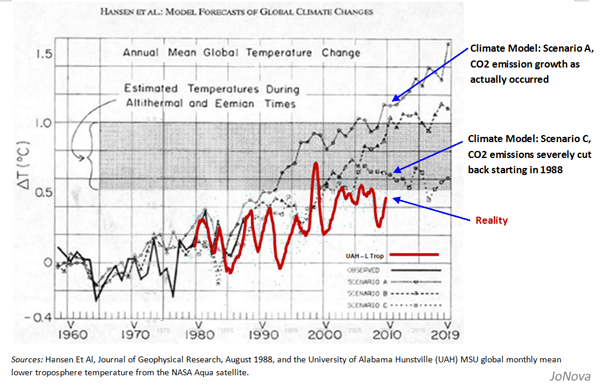
Evans says:”… the actual temperature rises are about a third of what he predicted. Remember, they have been saying the “science is settled” since the early 80’s, and the models now are essentially the same as they were then.

Furthermore, Hansen’s models predicted the temperature rise if human carbon dioxide emissions were cut back drastically starting in 1988, such that by year 2000 the atmospheric carbon dioxide level was not rising at all. But in reality, the temperature did not even rise that much. Which proves that the climate models don’t have a clue about the effect of carbon dioxide on world temperature.”

Second: Evans looks at ocean warming.  This is a better gauge of global warming than is measuring atmospheric temperature fluctuations.  The Argo Buoys were put into service in 2003.  The measurements of ocean temperatures prior to the Argo program are suspect in my view.  Nothing before 2003 remotely resembles the scope of Argo measurements.(click on chart to enlarge)
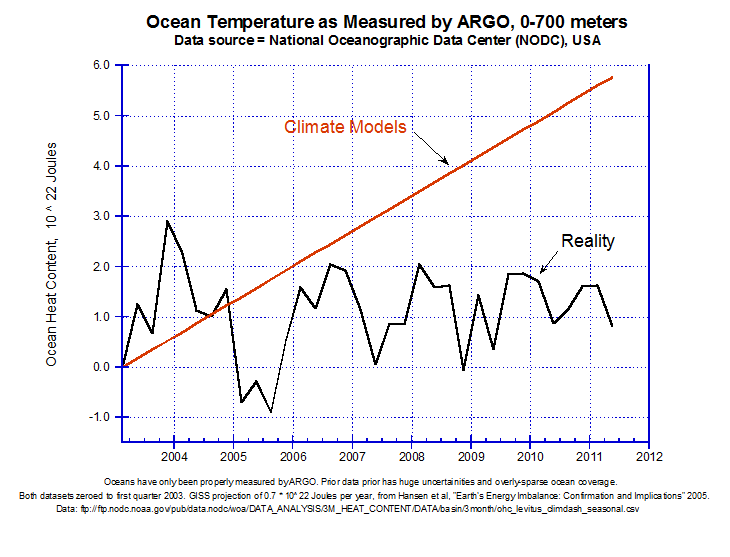
Evans says: the climate models predict the oceans should be warming. We’ve only been measuring ocean temperature properly since 2003, using the ARGO system. In ARGO, a buoy duck dives down to 2000m, slowly ascends and reads the temperatures on the way, then radios the result back by satellite to HQ. Three thousand ARGO buoys patrol the oceans constantly. They say that the ocean temperature since 2003 has been basically flat. Again, reality is very different to the climate models.

Thirdly: Evans looks at the “hotspot” which was  a climate computer prediction  which is the  Warmers’ proof of the positive feedback.  Feedback that is able to take a weak CO2 forcing signal and double or triple it.   Unfortunately for the advocates of this hypothesis, the hotspot does not exist.(click on chart to enlarge)

Evans says: “the climate models predict a particular pattern of atmospheric warming during periods of global warming. In particular, the most prominent change they predict is a warming in the tropics about 10 km up, the so-called “hotspot”. But we have been measuring atmospheric temperatures by weather balloons since the 1960s, and millions of weather balloons say there was no such hotspot during the last warming from 1975 to 2001. The hotspot is integral to their theory, because it would be evidence of the extra evaporation and thickening of the water vapor blanket that produces two thirds of the warming in the climate models…”

Fourthly:  Evans hits on one of the most discussed topic in recent times—that of outgoing radiation into space.    Note in the chart below that the top row left is the actual measurements of outgoing radiation by the stat elite ERBE program (Earth Radiation Budget Experiment-click here for more information.)   The other boxes are climate model predictions. (Chart source=Lindzen and Choi 2009)
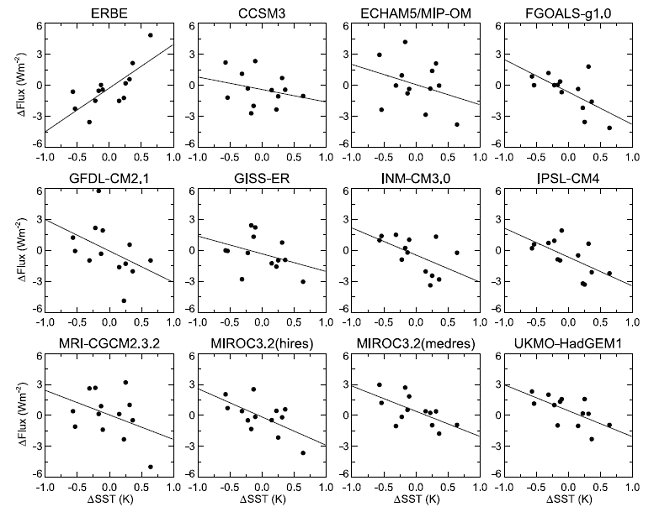
Evans says: “satellites have measured the outgoing radiation from the earth and found that the earth gives off more heat when the surface is warmer, and less heat in months when the earth’s surface is cooler. Who could have guessed? But the climate models say the opposite, that the Earth gives off less heat when the surface is warmer, because they trap heat too aggressively (positive feedback). Again, the climate models are violently at odds with reality.”

Evans sums up saying:” Those are four independent pieces of evidence that the climate models are fundamentally flawed. Anyone one of them, by itself, disproves the theory of man-made global warming. There are also other, more complex, pieces of evidence. Remember, there is no direct evidence that man causes global warming, so if the climate models are wrong then so is the theory.”

Read all of Evan’s posting here.

cbdakota

Will There Be Global Famine in 2050?


A report authored by Dr. Craig Idso titled “Estimates of Global Food Production in the Year 2050” asks the question ”Will we produce enough to adequately feed the world?” Idso says that researchers are estimating that global food production must increase by 70 to 100% to adequately feed 9 billion people in 2050.

Idso deals with  this question focusing on the world and also subgroups such as Europe, North America, Africa, etc. To do this, he compares forecast crop growth resulting from higher atmospheric CO2 and improved agricultural technology against the increased demand for food resulting from forecast population growth.

The data used by Idso is sourced from the UN’s Food and Agriculture Organization (FAO) to quantify the food crops, the UN’s IPCC Fourth Assessment Report (IPCC FAR) for an estimate of the atmospheric CO2 concentration in 2050 and the UN’s medium variant population projections for the year 2050.    Additionally he used the Plant Growth Database of CO2 Science to define the effect of increased atmospheric CO2 on plant growth.  Finally he works out food production estimates that will come due to the “Techno-intel effect”.  This “effect” is the advancement in agricultural technology and scientific research that expands our knowledge or intelligence based—e.g., the Green Revolution/GM seed work, etc.

Crops

The FAO database lists 169 crops.  Idso uses 45 of those crops in his work as these 45 crops account for 95% of the world food production.  To provide greater understanding, tabled below are the top 5 crops that together provide more than 55% of the world crop food sources.

Specific Crop % Of Total Production
Sugar Cane 21.240
Maize (corn) 10.283
Rice, paddy 9.441
Wheat 9.372
Potatoes 4.871

              FAO Data Base for World Food Production 2009.

                                               Top 5 Crops

The Specific crops vary in their ranking from subgroup to subgroup.

Population

The UN provides the forecast 2050 world population of nominally 9 billion.  Idso adds:

Another concern with respect to future population is whether or not the use of medium variant data from the United Nations is too conservative. Indeed, the medium variant population estimate for the year 2050 has recently been revised upward from 8.9 to 9.2 billion persons. A more realistic estimate of future population may be to use the constant fertility variant, which is weighted more heavily on current population trends and which foresees a global population of 11 billion in 2050.

Atmospheric CO2

Based on the Intergovernmental Panel on Climate Change’s best median estimate of this number (derived from the A1B scenario, ISAMS, in the IPCC’s Fourth Assessment Report, see http://www.ipcc-data.org/ancilliary/tar-isam.txt), we find that we could expect an increase in atmospheric CO2 concentration of 145 ppm between 2009 and 2050.

Enhanced Growth Via Greater Atmospheric CO2 Content

In my last posting I discussed the results of a vast number of trials done to quantify the results of increased atmospheric CO2 content.  Click here to get more detail, but I have lifted a table from that posting which gives the reader a feel for the enhanced growth that results from increased levels of atmospheric CO2.

PLANT No. OF STUDIES DRY WEIGHT INCREASE %(Arithmetic mean)
Corn 20 21.3
Rice 188 35.8
Soy Beans 179 46.5
Wheat 235 32.1
Sugar Cane 11 34

 Effect of Atmospheric CO2 Increased 300ppm Over Ambient


Techno-intel

Providing seeds that can adapt to growing condition or seeds imbued with resistance to fungus or insects is accomplished by techniques such as mutagenesis and genetic engineering.

Wiki says this about Norman Borlaug, considered the Father of the Green Revolution:

During the mid-20th century, Borlaug led the introduction of these high-yielding varieties combined with modern agricultural production techniques to Mexico, Pakistan, and India. As a result, Mexico became a net exporter of wheat by 1963. Between 1965 and 1970, wheat yields nearly doubled in Pakistan and India, greatly improving the food security in those nations.[4] These collective increases in yield have been labeled the Green Revolution, and Borlaug is often credited with saving over a billion people worldwide from starvation.[5] He was awarded the Nobel Peace Prize in 1970 in recognition of his contributions to world peace through increasing food supply.

From Wiki: 

Genetically modified foods (GM foods or GMO foods) are foods derived from genetically modified organisms, (GMOs). Genetically modified organisms have had specific changes introduced into their DNA by genetic engineering techniques. These techniques are much more precise[1] than mutagenesis (mutation breeding) where an organism is exposed to radiation or chemicals to create a non-specific but stable change.

Idso estimates that the likely increase in food production from 2009 to 2050 will be about 51.5%. Idso assigns 34.5% to Techno-intel and the remaining 17% to CO2 aerial fertilization. Note that the 51.5% is substantially less than the 70 to 100% increase believed by many experts to be needed.

Conclusions

Idso tables the results for the World, the Regions and the Sub Regions.  The calculated food supply has two cases.  Case 1 assumes that the increase in food supply is due only to Techno-intel.  Case 2 assumes that the increase is a result of both Techno-intel AND CO2 aerial fertilization.

World food supplies in 2050 will not be secure in Case 1 nor in the enhanced case 2.  For the Regions, Europe has a secure food source in Case 1 as well as Case 2. This can be explained by the expectation that Europe is the only Region where the population declines.  Africa, Asia, North America, Oceania and South America do not have secure foods supplies in Case 1.  In Case 2, Africa, Asia and Oceania  still do not have food source security.   North America and South America get a “maybe” in Case 2 as regard their food security.

Idso sums it up this way:

It is clear from the results obtained above that a global food security crisis is indeed looming on the horizon. If population projections and estimates of the amounts of additional food needed to feed the rising population of the planet prove correct, humanity will still fall short of being able to adequately feed the 9.1 billion persons expected to be inhabiting the Earth in the year 2050, even utilizing all yield-enhancing benefits associated with technological and intelligence advancements plus the aerial fertilization effect of Earth’s rising atmospheric CO2 content.

So what can be done to deal with the projected food production shortfall? Based on the results described above, there are only three possible avenues to achieving food security in the future: (1) greater gains must be achieved in the techno-intel sector than presently forecasted, (2) benefits from atmospheric CO2 enrichment must be increased, or (3) world population growth must be slowed to reach a lesser value by 2050.

Abstracting Dr. Idso’s report is a perilous undertaking.   The report is 43 pages and this posting is about one tenth that size.  Such reduction can introduce errors or poor assumptions that are not in the full report and can only be chalked-up to me.

Idso’s report  indicates that the world will be better served to have a goodly supply of atmospheric CO2 that can do aerial fertilization of the World’s food supply.  As a skeptic of the CO2 theory of run-away global warming, I can comfortably support the idea that atmospheric CO2 has more benefits than drawbacks.  Further, GM crops are a major benefit.   I like this comment by Borlaug regarding critics of his work:

“some of the environmental lobbyists of the Western nations are the salt of the earth, but many of them are elitists. They’ve never experienced the physical sensation of hunger. They do their lobbying from comfortable office suites in Washington or Brussels…If they lived just one month amid the misery of the developing world, as I have for fifty years, they’d be crying out for tractors and fertilizer and irrigation canals and be outraged that fashionable elitists back home were trying to deny them these things”.[54]

cbdakota

Should You Worry About CO2 in Our Atmosphere?


Should you worry about CO2 in our atmosphere?

Atmospheric carbon dioxide (CO2) is the basis for nearly all life on our planet.  Plants need at least 150ppm of atmospheric CO2 to grow.  The plants are the source of food for all animals.  There would be no T-Bones steaks were it not for plants.

That would seem to answer the question unless you are one of the radicals that believe to save the Earth, all humans must die.

But there is more.  Many scientists believe that global famine has been avoided by the increase in atmospheric CO2 from a pre-industrial level of about 270ppm to the current level of about 390ppm.   Before examining why scientist think CO2 increases can help avoid famine, let’s look at this VIDEO:

The levels of CO2 used in that video are outside normal considerations.  But much more modest increases in atmospheric CO2 are beneficial,too.    (So you can make the connection with the video and perhaps your own experience, cowpeas, are an important food legume crop in semi-arid tropics covering Asia, southern Europe and Central and South America.   In the Southern US cowpeas are called black eyed peas.)

The CO2 Science’s Plant Growth Data Base has an impressive compilation of peer-reviewed scientific studies that report the growth responses of plants to atmospheric CO2 enrichment.  Click here to see all the plants studied.

The following table lists a selected group of plants and the dry weight response to a 300ppm CO2 increase over ambient.

PLANT No. OF STUDIES DRY WEIGHT INCREASE %(Arithmetic mean)
Corn 20 21.3
Rice 188 35.8
Soy Beans 179 46.5
Wheat 235 32.1
Sugar Cane 11 34

 Effect of Atmospheric CO2 Increased 300ppm Over Ambient

The tables also provide response data on Photosynthesis (Net CO2 exchange rate).

The greater the amount of CO2 not only increases the quantity, its effect on the quality of the plant is not significantly altered.  Some studies have suggested that the protein levels are reduced, but other studies have indicated that the protein levels are increased.  Other factors, such as ozone (O3), soil nitrogen and sulfur dioxide (SO2) effect the outcome both positively and negatively.  Click here for more discussion of the quality of the plants tested.

It is hard to argue with all this data and just the common sense notion that warmer weather, more CO2 and more rainfall will provide bigger crop yields. And that the increase in crop yields will be beneficial in view of the forecast increase in the world’s population.   We all know that it surely will continue to warm as it part of a natural cycle.  We need to worry when the cycle reverses and the temperatures begin to drop.  Surely some one is yelling at his computer display right now shouting about the droughts that are going to occur when man-made global warming really kicks in.    Ok, but for every warmer that says the world will become a desert, there is another taking about the vast rainfall that is and will continue to occur.  It is some kind of an unhealthy theory that every weather or climate event, snow, heat, drought, wind, no wind, rising temperatures, dropping temperatures, sea level rise, sea level drop, you name it, are all caused by CO2.

More on CO2 and famine in the next blog.   Growth enhancement using forecast changes in atmospheric CO2 will be examined.

cbdakota