Category Archives: Energy Development

Obama Administration Is Not Helping The Gasoline User


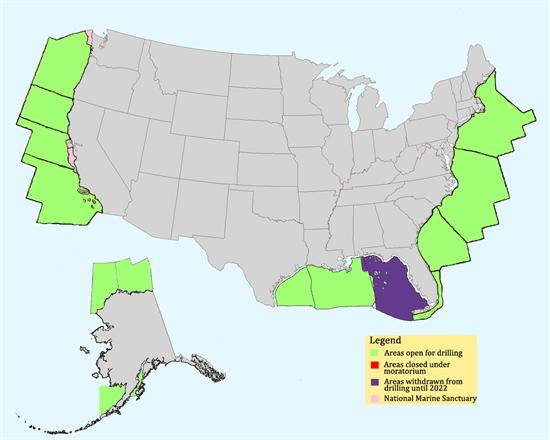
The Obama administration current 5-year offshore drilling proposal will further block access to drilling on Federal lands.  Lets look available and blocked offshore drilling sites under Bush and under Obama.

OFFSHORE UNDER BUSH

OFFSHORE UNDER OBAMA

Maps and history of the Bush and Obama Administrations regarding offshore oil and gas can be read in more detail here.

Raising Onshore Oil Production Costs

In addition to restrictions, Bureau of Land Management Director Bob Abbey said last week at a Senate Appropriations Committee on Interior hearing that federal regulations applied to oil and gas development simply make it more expensive than producing on state or private land according to a posting on Institute for Energy Research website. Then he remarked that the Administration is currently considering raising onshore production royalty rates from 12.5% to the 18.75% that  is charged for offshore oil; in fact, he said that the Department of Interior’s upcoming budget depends on an assumed 50 percent increase in royalty rates.

More blocking of access and higher rates.  How is this helping the US consumer?

Pres. Obama Says US Only Has 2% Of World Oil. Can That Be Right?


Obama said:  “With only 2% of the world’s reserves, we can’t just drill our way to lower gas prices.  Not when we consume 20% of the world’s oil.”  Addressing the 2% part of his statement, if he meant we have only 2% of the “proven reserves” he is correct. But he uses this figure hoping that you will come to an incorrect conclusion. The US is, by every analysis one of the most energy rich nations in the world.   Others, including the Congressional Research Service, say that the US is the most energy rich nation in the world

The second part –consuming 20% of the world’s oil– is a non sequitur, meaning it does not follow logically from the previous part of his statement.  We will talk about that later.

The basis for the President’s statement came from the DOE’s Energy Information Administration.  The US’s “proven” reserves of 20.6 billion barrels of oil are equivalent to 2% of the worlds proven reserves.

DOE’s Energy Information Admin (EIA) Table of US Reserves (Billions of BBL’s) 10/19/2011

Region Proven Inferred Un-discovered Total TechnicallyRecoverable
Onshore 12.7 50.1 51.1 113.9
Offshore 4.3 10.3 42.7 57.4
Alaska 3.5 2.1 42.0 47.6
Total US 20.6 62.5 135.8 218.9

Interpreting the table, Proven reserves are where oil production is underway and the extent of the fields is well known.  Inferred is the volume by which the estimate of total recovery from a known crude reservoir or aggregation of such reservoirs is expected to increase during the time between discovery and permanent abandonment.  Undiscovered is oil that very likely exists, and can be recovered depending in part on technology and/or the price of oil.

This table understates the reserves.  EAI says of the above table: Resources in areas where drilling is officially prohibited are not included.  Estimates of the resources in the Northern Atlantic, Northern and Central Pacific and within a 50-mile buffer off the Mid and Southern Atlantic OCS are excluded from the technically recoverable volumes.  A case in point is that the reserves in ANWR which according to the USGS may contain 12 billion barrels is not included because the Feds have taken it off the table.   Most of our costal waters are off-limits as well.

This table also excludes the shale oil in the Green River Formation in Colorado, Utah and Wyoming. The Feds control roughly ¾ of the public lands on which fossil fuel resources exist. Wiki says that: “The Green River Formation contains the largest oil shale deposits in the world. The 213 billion tons of oil shale contain an estimated 2.38 × 10¹¹ m³ (1.5 trillion US barrels) of shale oil.

When the proven reserves are stated,  how should you interpret the number?  Here is an example from The Institute for Energy Research:

Proved Oil Reserves Are Not Static

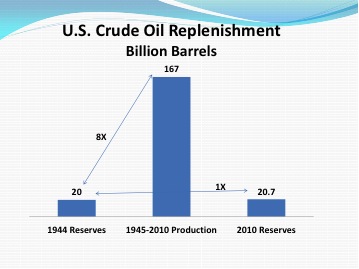
Let’s take a look at history. In 1944, U.S. proven oil reserves were 20 billion barrels — about the same as they are today. Yet, between 1945 and 2010, the United States produced 167 billion barrels of oil. In other words, the United States produced over 8 times more oil than the amount of proven oil reserves it had in 1944.  How can that be? The answer is that proven oil reserves are not stagnant because people keep looking for oil. Proven oil reserves keep changing, are officially recorded every year, tallied country by country, and published in the Oil and Gas Journal, among other publications. And due to U.S. entrepreneurship and ingenuity, more reserves are found and proven each year.

What Does More Recent Data Look Like?

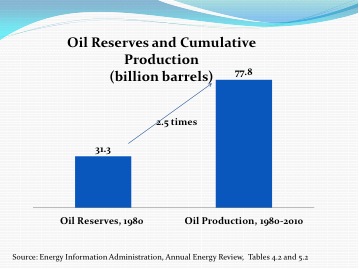
So, is this an historic anomaly? No. Let’s look at more recent data. In 1980, according to the Energy Information Administration, the United States had 31.3 billion barrels of proven oil reserves. However, between 1980 and 2010, the United States produced 77.8 billion barrels of oil and still had 20.7 billion barrels of oil reserves left. In other words, between 1980 and 2010, the United States produced 2.5 times the amount of oil as it has proven oil reserves in 1980.

The preceding illustrates that comparing the proven reserves to oil consumption is at least faulty and perhaps intended to misinform.

The President said that we can’t drill our way to lower prices when we  are the largest consumer.   Now I know that OPEC is the major force in setting the price of crude.   Even so, they are not immune to the laws of supply and demand.  They know that  a substantial excess of supply over demand will cause them to either curtail production within the Cartel  to rebalance supply and demand or the price will drop.  They also know that if they see widespread drilling being undertaken,  lowering the price of crude can cause some marginal production capacity to shutdown.

Every country that has shale oil, will be out there trying to achieve some piece of national security brought about by having their own oil.  So the over supply is likely to happen.  Ask the natural gas suppliers how well their prices have held up in recent years now that the shale natural gas is becoming oversupplied.   It will happen to OPEC too.  And the sooner the better.

cbdakota

Fisker Has A New Problem


The Securities and Exchange Commissions (SEC) issued Wells Notices to the brokers (Advanced Equities, Inc) who raised most of the private financing for taxpayer-backed Fisker Automotive in connection with a private offering in 2009.  A Wells Notices tells the recipients that charges may be brought against them. According to SEC.com,  “Receiving a Wells Notice is hardly a positive event, as it signifies that you are the subject of an investigation and that enforcement proceedings are going to be commenced against you”.

There is speculation that this action by the SEC followed the filing of a lawsuit against Fisker and Advanced Equities by investor, Daniel Wray, for their alleged failure to perform fiduciary duties and for fraud, according to a posting by the National Legal and Policy Center.   This may be why the Energy Department (DOE) is holding up further distribution of a loan set aside for Fisker.  As noted in previous postings DOE said Fisker had not met the required “milestones”.

The National Legal and Policy Center posting, written by Paul Chesser, does some editorializing that is pretty much on the mark.

“It seems every week taxpayers learn something new about the clean energy “bets” the Obama administration has demanded they finance – especially Fisker. So far, before the loan was halted, $193 million in public money poured into the maker of an EV that only rich people can afford, who also get a $7,500 tax credit (plus whatever California is handing out lately) per vehicle purchase to boot. Beyond that the taxpayer support for Fisker enhanced the stock of its political allies like Kleiner Perkins (where Gore is a senior partner), and also helped pay for connected lobbyists to get the loan, while crony lawyers got paid to work inside DOE to see the loan to completion.

And now we discover The Chicago Way may have been behind Fisker’s private fundraising, and the SEC plans to find out more. This dog has a lot of fleas.

Last week,  the President announced that he wants  to up the rebate for the purchase of a hybrid or an EV. Currently the buyer can to receive up to a $7500 tax credit.  Obama  now wants to give the buyer a $10,000 check at the time of purchase.

cbdakota

Volt and Leaf February sales


The February sales numbers for Volt and Leaf are in.   Volt numbers were 1023 which bettered January sales of 603.    Leaf numbers were 478 which trailed January sales of 679.   Y-T-D  sales for Volt are 1,626 and Leaf 1,157.  Chevy’s 4 cylinder ICE sales were up 46 percent.  The Cruze, one of the GM 4cylinder line,  put up big numbers at 18,556 units in February.   The public is obviously moving to more fuel-efficient vehicles with gasoline prices skyrocketing.   But their choice continues to be the more affordable ICEs than the all-electrics or hybrids.

cbdakota

Germany Surrenders on Solar Power


The title of this blog is a direct lift from an American Thinker posting of the same name.   Bjorn Lomborg, the Skeptical Environmentalist reports that Germany once was proud to call themselves “photovoltaic world champion”.  But nation has found the solar-power subsidies are expensive and inefficient.  Accordingly Lomborg:’ Using solar, Germany is paying about $1,000 per ton of CO2 reduced. The current CO2price in Europe is $8. Germany could have cut 131 times as much CO2 for the same price. Instead, the Germans are wasting more than 99 cents of every euro that they plow into solar panels.”

The Germans are phasing out these subsidies over a 5 year period.

In the US, we need to get serious about stopping the handouts to the Friends of Obama too.

cbdakota

Fisker Appoints New CEO- Can He Save This Company?


Fisker has appointed Tom LaSorda CEO replacing Henrik Fisker.  Fisker, founder and co-owner of Fisker Motors, will assume the role of executive chairman.  LaSorda’s skill is said to be manufacturing.

The first model from Fisker is the Karma.  A terrific looking automobile but beauty may only be skin deep as the vehicle interior is rated a sub-compact by the EPA.  The Karma’s range is 32 miles on the battery.  It is a hybrid so the gasoline driven generator comes on when the battery is exhausted, at which point the EPA rating becomes 20 mpg.

According to a Bloomberg posting, Jeremy Anwyl, vice chairman of Edmunds.com, an automotive data and pricing company had this to say about the Karma: “The odds are stacked against Fisker.  The car may be an interesting toy for people who have $100,000 to spend on such a thing, but Fisker will run out of those people quickly, and how tolerant of glitches will those people be?”  He probably was referring to the recent recall to fix the battery cooling system.

The current issue for Fisker is the DOE $529 million in loans granted to Fisker in June 2009.   The first part, $169 million was for engineering of the Karma and the second part of$360 million for the development of the NINA, a mid-sized hybrid to built in the old GM plant in Wilmington, DE.  Fisker, according to Bloomberg, has used $193 million of the loans.  But Fisker stopped work at the old GM plant when the DOE blocked further access to the loan saying that Fisker had not met the required milestones.

The battery supplier for Fisker is A123.   It has had to lay off workers due to the Fisker delays.  A123 is also an investor in Fisker.  A share of A123 stock closed on the 28 Feb at $1.91.  The 52-week range is $1.51 to $9.60.  Earnings per share are   $-1.88.

A posting late last year by Discovery asked: IS FISKER A ‘GREEN CAR’ SOLYNDRA SCANDAl? The author, John Voelker, GreenCarReports.com said:   “We’d like to see three specific questions answered.

— Since Fisker backers have contributed to Democratic party causes, is there any hard evidence of improper influence over the DoE loan process by the White House?

— How did Fisker come to select a closed assembly plant located in Vice President Joe Biden’s home state, since Delaware is no longer an obvious place to build cars?

— What steps does the DoE take to monitor compliance with the loan terms–and why won’t it release the revised terms of the Fisker loans?”

Good questions.

cbdakota

When Tesla Batteries “Brick”–They Can Not Be Fixed


You buy a Tesla Roadster.  Depending on your upgrades, somewhere in the vicinity of $100,000 +.   Great acceleration, 0 to 60 in 3 to 4 seconds.  Looks great.  You are cool and everyone knows it.  You decide to jet off to Tahiti for a month.  When you return you go to the garage, ready to drive down Rodeo Drive to let everyone know you are back— let the good times roll.   But your car won’t start.  You check the battery charge level and it is at Zero.  Ooops, you did not plug it in after you last drove it.  Ok so you put the charger on.  It won’t take a charge.  You call the Tesla dealership and ask them to take it to their shop and fix it.  Oddly they come with a flatbed lift truck and some rolling jacks.  When you ask why they just don’t tow it to the dealership they tell you that because you have a brick, the wheels wont turn.  What is a “brick” you ask? They say that your battery is dead, dead, dead and won’t ever work again.  You ask what a replacement battery costs and they say $40,000.  You say “well, I have only had the car for about 4 months and put on less than 5,000 miles so I guess it is covered by warrantee”.  They say “no, not covered by warrantee cause you let it run down to zero charge, so we are not responsible”

Fiction?   Nope, it has happened to some Tesla owners.   The author, Michael DeGusta of the post “It’s a Brick”, whose Roadster was pronounced a Brick, learned from a Regional Tesla Service Manager that he was personally aware of at least 5 cases of Roadsters being Bricked due to battery depletion. DeGusta says the following about bricking:

A Tesla Roadster that is simply parked without being plugged in will eventually become a “brick”. The parasitic load from the car’s always-on subsystems continually drains the battery and if the battery’s charge is ever totally depleted, it is essentially destroyed. Complete discharge can happen even when the car is plugged in if it isn’t receiving sufficient current to charge, which can be caused by something as simple as using an extension cord. After battery death, the car is completely inoperable.

The amount of time it takes an unplugged Tesla to die varies. Tesla’s Roadster Owners Manual [Full Zipped PDF] states that the battery should take approximately 11 weeks of inactivity to completely discharge [Page 5-2, Column 3: PDF]. However, that is from a full 100% charge. If the car has been driven first, say to be parked at an airport for a long trip, that time can be substantially reduced. If the car is driven to nearly its maximum range and then left unplugged, it could potentially “brick” in about one week. [1] Many other scenarios are possible: for example, the car becomes unplugged by accident, or is unwittingly plugged into an extension cord that is defective or too long.

DeGusta conclusions about the problem with the battery are as follows:

The Bottom Line

Tesla Motors is a public company that’s valued at over $3.5 billion and has received $465 million in US government loans, all on the back of the promise that it can deliver a real world, all-electric car to the mainstream market. Yet today, in my opinion, Tesla seems to be knowingly selling cars that can turn into bricks without any financial protection for the customer.

Until there’s a fundamental change in Tesla’s technology, it would seem the only other option for Tesla is to help its customers insure against this problem. As consumers become aware that a Tesla is possibly just a long trip, a bad extension cord, or an accidental unplugging away from disaster, how many will choose to gamble $40,000 on that not happening? Would you?

cbdakota

Wind Farm’s Non-performance Endangers Lives


Kevin Myers posts “Energy policy based on renewables will win hearts but won’t protect their owners from frostbite and death due to exposure”.  He tells us that the early February cold and blizzard that swept across Europe resulted in the deaths of over three hundred people but it could have been worse.  It seems that Gazprom the principle Russian natural gas supply company was not able to keep up with demand in Europe.

Myers asks:  “Did anyone even think of deploying our wind turbines to make good the energy shortfall from Russia?”  Which he answers:” Of course not. We all know that windmills are a self-indulgent and sanctimonious luxury whose purpose is to make us feel good. Had Europe genuinely depended on green energy on Friday, by Sunday thousands would be dead from frostbite and exposure, and the EU would have suffered an economic body blow to match that of Japan’s tsunami a year ago. No electricity means no water, no trams, no trains, no airports, no traffic lights, no phone systems, no sewerage, no factories, no service stations, no office lifts, no central heating and even no hospitals, once their generators run out of fuel.

Modern cities are incredibly fragile organisms, which tremble on the edge of disaster the entire time. During a severe blizzard, it is electricity alone that prevents a midwinter urban holocaust. We saw what adverse weather can do, when 15,000 people died in the heat wave that hit France in August 2003. But those deaths were spread over a month. Last weekend’s weather, without energy, could have caused many tens of thousands of deaths over a couple of days.

Why does the entire green spectrum, which now incorporates most conventional parties across Europe, deny the most obvious of truths? To play lethal games with our energy systems in order to honour the whimsical god of climate change is as intelligent and scientific as the Aztec sacrifice of their young. Actually, it is far more frivolous, because at least the Aztecs knew how many people they were sacrificing: no one has the least idea of the loss of life that might result from the EU embracing “green” energy policies.”

Myers uses Ireland as an example:  “Wind power in Ireland actually produces only 22pc of its capacity: would you spend ¿100,000 on a car if it meant that ¿78,000 of the purchase price was wasted? It gets worse. On a really cold day, we actually need about 5,000 megawatts, but yesterday wind was producing under 50 megawatts: a grand total of 1pc of requirements. “

To read the whole of Myers’ posting, click here.

This is not untypical of wind farms.  Basically windfarms are anathema to operators of the electrical grids that supply our electricity because they cannot depend on them being a source of power.  Some times the wind blows and sometimes it doesn’t.  Customers cannot accept an electrical supply system that is intermittent.  See here, here, here, and  here for more on the unreliability wind farms power.

Routinely temperatures in many parts of the US match or exceed those experienced in France during their August 2003 heat wave. Few deaths occur in these areas of the US due to the prevalence of Air Conditioning units.  This is another example, echoing Myers, where our lives depend on a steady supply of electricity.

And what would this posting be without some comments by James Delingpole who weighed in on this topic as follows:

“Have a look at this debate between pro-renewables campaigner Jonathan Pyke and Mark Duchamp of the European Platform Against Wind Farms in The Earth Times and you’ll see what I mean:

Q: How accurate is the argument that wind turbines have to be ‘backed-up’ by alternative sources of power, eg nuclear or coal, due to the irregularity of wind?

Jonathan: It’s not accurate and I think it stems from a misunderstanding about what wind energy is for. It’s better to think of wind as the back-up for gas, allowing us to make much better use of our existing fossil fuel power plants than relying on gas alone. There’s no need to burn gas when the wind is blowing, which National Grid can predict extremely accurately. So comparing it to nuclear or coal is misleading because wind serves a different purpose; every time it blows there’s a substantial decrease in carbon emissions, volatile fossil fuel costs, water for cooling, manufacturing and pollution. The ‘back-up’ argument just isn’t valid.

R-i-g-h-t. So what you’re saying, Jonathan, is that the ONLY reason we’re carpeting some of the world’s most attractive wild countryside in horribly costly, economically inefficient, bird-liquidising, noise-polluting, view-blighting, rare-earth-metal-exploiting, property-debasing, horse-frightening, rent-seekers’ uber-horrors, is to save the odd tonne of CO2 emissions, as and when, despite the fact that the science increasingly suggests that the difference this will make to global climate will be so negligible as to be beyond measurement?

At first they said they would replace fossil fuel driven electrical generating plants, but as this has turned out badly for them they now want to convince us that what they really, really, really want to do is play the part of backup.  Yikees, the windfarms were not economic as the primary units how on earth can they be anything but less economic as backup units  and they will still be unreliable.

You can read the Delingpole’s article by clicking here.

cbdakota

Ethanol Subsidies: Not Gone, Just Hidden a Little Better


Mother Jones, an organization with a very liberal viewpoint posted that the subsidies for ethanol fuel have expired but that this doesn’t trouble the ethanol fuel producers.  Kevin Drum authored the posting and I will let him tell you why.

A few years ago I called subsidies for corn ethanol “catastrophically idiotic.” And why not? Corn ethanol, it turns out, is actively worse for the environment than even gasoline. Farmers responded to the subsidies by reducing the amount of farmland used for food production, and this drove up the price of staple food worldwide.  At the end of last year, ethanol subsidies quietly expired and no one tried to extend them.

So why did the powerful corn ethanol lobby let it expire without an apparent fight? The answer lies in legislation known as the Renewable Fuel Standard (RFS), which creates government-guaranteed demand that keeps corn prices high and generates massive farm profits. Removing the tax credit but keeping the RFS is like scraping a little frosting from the ethanol-boondoggle cake.

The RFS mandates that at least 37 percent of the 2011-12 corn crop be converted to ethanol and blended with the gasoline that powers our cars…[As a result] the current price of corn on the Chicago Mercantile Exchange is about $6.50 per bushel—almost triple the pre-mandate level.

 You might not be aware that when the EPA does mpg ratings for new cars, they use gasoline that does not contain any ethanol.  Adding ethanol at 10% of the fuel mix, the energy in a gallon of fuel is about 96.7% of a fuel not containing ethanol.  Ethanol has less energy per gallon than normal unleaded gasoline.  So the MPG rating is probably just a bit high.    See

cbdakota

Geothermal Energy–What’s Its Source?


What is the source of geothermal energy? According to Terrestial Energy, written by William Tucker, if you drill a 1000 feet (305 meters) deep hole, the temperature at the bottom of the hole is 16F (10C) higher than at the top.  Tucker says that the average temperature of the ground is 54F (11C) so the bottom of that hole would be 70F.

The Homestake Gold mine in Lead SD, discovered in 1876, produced 40 million ounces of gold and 9 million ounces of silver. At the time of its closure in 2002, the mine was more than 8000 feet below the surface   Based on Tucker’s formula, the temperature at the 8000 foot level would be around 180F unless cooling air was introduced. .  At one time, one of my relatives (by marriage) was the engineer responsible for keeping the temperature in the mine at a level that would allow people to work.  And his description of what was needed to do that was pretty impressive.

Tucker goes on to say: “At 80 miles down we hit the Mohorovicic Discontinuity, discovered by Yugoslav seismologist Andrija Mohorovicic in 1909. At this point the temperature reaches 900o C and rock turns to liquid “magma.” At 1500 miles deep the temperature rises to 3700o C and another discontinuity – the Gutenberg – marks the place where molten rock becomes pure iron and nickel. Below that tremendous pressures turn the iron core solid once again and temperatures reaching 7,000o C – hotter than the surface of the sun.”

He explains that the source of this heat energy as follows: “Some of it is due to gravitational forces. As the earth is pulled inward, some of this force is translated into heat. Another portion is residual heat from the earth’s formation. According to the commonly accepted theory, originally proposed by Immanuel Kant, the solar system precipitated out of a huge swirling dust cloud, where particles kept colliding with each other until they agglomerated into the sun and the planets.

In the later stages, this involved huge collisions among very large objects. These impacts generate large amounts of heat, some of which still remains in the earth’s core. Together gravitational forces and residual heat probably account for about 40 percent of the earth’s temperature – the exact figure has still not been determined.

The other half of the earth’s heat, however, comes from a remarkable diminutive source – the slow breakdown of two of the 90 elements, uranium and thorium. With 92 protons, uranium is the largest natural atom, while thorium (90) is the third largest. Because of their size, they are unstable, meaning they are “radioactive.”

The internal “binding energy” that overrides the mutual repulsion among positively charged protons is occasionally overcome itself. This releases large quantities of energy, which sets subatomic particles in motion, creating large amounts of heat. Incredibly, the slow breakdown of these two radioactive elements, uranium and thorium, is enough to raise the earth’s internal temperature beyond the level of the surface of the sun.”

Tucker draws some conclusions from this when he says: “Why don’t we just take the source of that heat – the uranium or thorium – bring it to the surface, and reproduce or even accelerate the process that produces this heat in a controlled environment?

This is what we do in a “nuclear reactor.”  “A nuclear reactor is nothing more than terrestrial energy brought to the surface. There is nothing sinful or diabolical about it. We are not defying the laws of nature. Rather, we are working with a process that already takes place in nature.”

h/t Master Resource

cbdakota