Category Archives: Electric Vehicles

Obama Plans to Nationalize the Energy Companies


This Administration’s actions lead me to believe that President Obama is planning to nationalize the energy companies.  When will he do this?   When gasoline hits somewhere around $10 per gallon as some predict it will this year.  See, see. Maybe you think that if gasoline prices get that high, he wont be re-elected?  That is why he will act.  His narrative will be that he had to do it to save the country. Many of our citizenry will applaud his actions. Unfortunately the idea that the government is everyone’s safety net is becoming too engrained.  If gasoline does not reach $10 in his first term and he gets a second term (and a Democrat majority in Congress, a real possibility if Obama is re-elected) he will wait until then.

Demonizing Energy Companies

So you think that this not something Obama and the Democrats would do.  They nationalized most of the automotive industry and got a way with it.   Obama Care is the first step on the way to nationalizing the Health Care industry.  The Congressional Democrats have long advocated nationalizing the Energy companies as have their echo chamber, the mainstream media. See, see, see, see. President Obama is not standing on the sidelines but rather is leading the charge against energy companies.

What Are The Signs

What is going on is an all out assault on the US energy companies by all of Obama’s administration.  Coal is being regulated out of business.  By managing permitting, Oil can’t increase the supply of crude domestically or from neighbors like Canada which will result in higher crude oil prices.  Natural gas re-emergence, resulting from fracking making available vast quantities of domestic gas, is facing the EPA and other environmental groups that want to outlaw or severely restrict the use of fracking.

And the Administration seems to want to reward our foreign foes or competitors while penalizing domestic Energy Companies.    What other conclusions can be derived from the way this President and his allies are conducting business?

The US has plenty of energy.  A recent study by the Congressional Research Service (CRS) determined that the USA has the world’s most abundant supply of fossil fuels.  The fuel resources counted were oil, coal and natural gas and all were equilibrated to the energy in barrels of oil equivalent  (BOE). The Chart below has the top seven nations from the study.

Nation Total Fossil Fuels in BOE
United States 973    billions of barrels equivalent
Russia 955                     “
China 474                      “
Iran 328                      “
Australia/New Zealand 315                      “
Saudi Arabia 309                      “
India 227                      “

Data from CRS Report “US Fossil Fuel Resources”:Issued 30Nov2010

We have the resources but President Obama does not want to use them.   All this leads to the obvious conclusion that the President is trying to create a “crisis” so he will, as Rahm Emanuel would say, “never let a crisis go to waste.”   Which brings us back to how will he use this crisis.  I believe it will be to nationalize the US energy companies.  If that happens, don’t be deluded into thinking that the Government will be able to provide us with “low prices”.  The private energy companies, e.g. BigOil, are motivated to innovate ways to locate and exploit reserves at the lowest cost possible.  They represent private enterprise at its best.  Don’t expect nationalized oil to provide this leadership or low prices.   Likely there won’t be any benefit to our economy, or boost in jobs and I suspect President Obama knows this.  The reason then must be the ultimate goal of socialists—– redistribution of wealth.

It is hoped, that the following discussion will help one understand the battle the Energy Companies are facing.

OIL

Another investigation is underway to find out if Big Oil (e.g. Exxon-Mobil, Chevron, Shell, BP, Conoco-Phillips) is manipulating the prices.   That Big Oil has been exonerated in all of the previous investigations, and will be in this one, is not the main issue here.  The Liberals know that this technique plants seeds of doubt in the publics mind. Typically, their accusations get all the headlines and the acquittal is seldom mentioned.

If Big Oil is driving up the prices how do they do it?  The American Petroleum Institute (API) listed the 20 Largest Oil and Gas Companies based upon their 2009 oil reserves.  It shows that 72% of the world’s oil reserves are owned by nations (not privately owned companies) such as Iran, Saudi Arabia, Venezuela, and Libya.  The biggest US Company to make the list was Exxon-Mobil at #17.   The Exxon-Mobil reserves as a percent of the world reserves are 0.68%.  Think about this situation where the OPEC type state owned companies have reserves 100 times greater than Exxon-Mobil.  Do you really believe that Exxon-Mobil is able to dictates the price of crude to OPEC?   Of course they can’t do that.

Well, there are those obscene earnings, right?  In 2010 the earnings as a percent of sales for Oil and Natural Gas was 5.7%.  Compare that to 19.4% for Beverages and Pharmaceuticals; 17.3% for Computers; and ALL MANUFACTURING was 8.5%.  So the average for manufacturing was 8.5% and Oil and Gas came in with 5.7%.    So, yes, their earnings are large but not out of line with their sales, in fact they are coming in lower than the average manufacturing business.  And further, U.S. oil and natural gas companies tax rates are considerably higher than the average manufacturing company. In 2010 income tax expenses (as a share of net income before income taxes) averaged 41.1 percent for Oil and Natural Gas companies compared to 26.5 percent for the average  S&P Industrial company.

Domestic oil production could make a real change in supply and it would significantly reduce our balance of payments deficit.  Further it would reduce the income of those countries that use the money to make problems for the US—Iran, Syria, Libya, Venezuela, etc.  It is said that Venezuela’s Chavez needs oil above $40 per barrel to have money to support his dictatorship.   And his friend President Obama wants to see the price much higher than $40, too.

Classic wrong headedness is illustrated by diddling over access to Canada’s rich tar sands.  From the IBD posting “China has its eye on Canada’s oil”:

Together, the U.S. and Canada have enough oil and natural gas locked up in shale formations, tar sands, Alaska, the Canadian Arctic and the Outer Continental Shelf to make OPEC pound sand. But we won’t drill for ours and apparently; we don’t want Canada’s.

With more than 170 billion barrels, Alberta has the world’s third-largest oil reserves, behind only Saudi Arabia and Venezuela and ahead of Russia and Iran. Daily production of 1.5 million barrels from the oil sands is expected to nearly triple to 3.7 million by 2025. The only question is, will this crude be flowing south to U.S. refineries or west for export to China?

At issue is the Keystone XL pipeline, parts of which have already been built, that would bring Alberta oil to Texas Gulf Coast refineries. The pipeline also could transport oil extracted from shale formations in the Rocky Mountain West.  The U.S. Geological Survey estimates the region, dubbed the Persia of the West, may hold more than 1.5 trillion barrels of oil, six times the proven reserves of Saudi Arabia, and enough to meet U.S. oil needs for the next two centuries. By 2015, oil executives and industry analysts say, the oil-rich lands of the West, including North Dakota’s booming Bakken formation, could produce 2 million barrels a day, more than the pre-Deepwater Horizon production rate in the Gulf of Mexico.

Environmental groups oppose Keystone XL on the grounds that tar-sands extraction harms the environment through water pollution, greenhouse gas emissions and potential pipeline leaks. The State Department, which must approve any pipeline entering the U.S. across international borders, has withheld its approval pending a final decision Nov. 1.  The Chinese aren’t waiting. Sinopec, a Chinese state-controlled oil company, has a stake in a $5.5 billion plan to build the Northern Gateway Pipeline from Alberta to the Pacific Coast province of British Columbia. Alberta Finance Minister Lloyd Snelgrove met this month with Sinopec and CNOOC, China’s other big oil company, and representatives of China’s banks.

While the U.S. dithers with concerns about “dirty oil” from Alberta’s rich tar sands, energy-hungry China makes Ottawa an offer it might not refuse. Memo to Washington: Pipelines can run west as well as south.

It is not that the President does not know that the laws of supply and demand are important to price of commodities.   When he pulled the stunt of releasing 30 million barrels of crude from our Strategic Petroleum Reserve (SPR), my guess is that his intent was twofold.  Maybe he thought that OPEC would see it as a threat that he would permit additional releases from the SPR if they did up their production and thus reduce crude prices.  As the 30 million only amounted to two days of US crude requirements, it’s likely they were not too worried.  Probably the real reason was to signal that things were out of control and he was trying one of the possible levers to stop the “runaway” gasoline pricing.

COAL

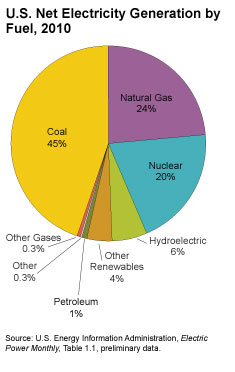
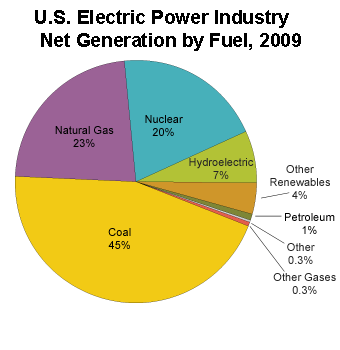
The US has the largest coal resources in the world. It is inexpensive relative to other fossil fuels and it is abundant. Coal is used to produce 45% of the nation’s electricity.    While electricity is very dependant on coal, coal is highly dependent on electricity as 93% of all US coal is used to generate electricity.  But Obama wants to put coal use in the past tense.   Obama announced before he was elected that he was going to put coal out of business and he means to do just that.  He is using the EPA to put very stringent emission restrictions on coal based electrical power plants.  The price increases for the ratepayers in the Mid-Western US States are going to be ugly.
A posting in the TownHall blog, “Clearing the Air”:

EPA’s proposed “mercury and air toxics” rules for power plants are built on the false premise that we are still breathing the smog, soot and poisons that shrouded London, England and Gary, Indiana sixty years ago. In reality, US air quality improved steadily after the 1970 Clean Air Act was enacted.

EPA’s “most wanted” outlaw is mercury. But for Americans this villain is as real as Freddy or Norman Bates. To turn power plant mercury emissions into a mass killer, EPA cherry-picked studies and data, and ignored any that didn’t fit its “slasher” film script. As my colleague Dr. Willie Soon and I pointed out in our Wall Street Journal and Investor’s Business Daily articles, US power plants account for just 0.5% of mercury emitted into North American’s air; the other 99.5% comes from natural and foreign sources.

Energy analyst Roger Bezdek estimates that utilities will have to spend over $130 billion to retrofit older plants, under the measly three year (2014) deadline that EPA is giving them………, On top of that, utilities will have to spend another $30 billion a year for operations, maintenance and extra fuel for the energy-intensive scrubbers and other equipment they will be forced to install.

Many companies simply cannot justify those huge costs for older power plants. Thus Dominion Power, American Electric Power and other utilities have announced that they will simply close dozens of generating units, representing tens of thousands of megawatts – enough to electrify tens of millions of homes and businesses.

Electricity costs are set to skyrocket, just as the President promised. Consumers can expect to pay at least 20% more in many states by 2014 or shortly thereafter. According to the Chicago Tribune, Illinois families and businesses will shell out 40-60% more! How’s that for an incentive to ramp up production and hire more workers? How’s that “hope and change” working out for families that had planned to fix the car, save for college and retirement, take a nice vacation, get that long-postponed surgery?

For a mid-sized hospital or factory that currently pays $500,000 annually for electricity (including peak-demand charges), those rate hikes could add $300,000 a year to its electricity bill.

And it’s not just private businesses that will get hammered. As the Chi Trib notes, if the Chicago public school system wants to keep the lights on and computers running for two semesters, by 2014 it will get hit for an extra $2.7 million it doesn’t have, to pay for skyrocketing electricity costs.

Carry those costs through much of the US economy – especially the 26 states that get 48-98% of their electricity from coal-fired power plants – and we are talking about truly “fundamental transformations.” Millions will be laid off, millions more won’t be hired, millions of jobs will be shipped overseas – and millions will endure brownouts, blackouts and social unrest.

The Chairman of the EPA’s Clean Air Scientific Advisory Committee Jonathan Samet implies there is no limit to the EPA authority according to a Junk Science Posting “Samet” No End To EPA Air Regulations:”

What Samet is saying is that there is no scientific basis for EPA not continually reducing manmade air emissions until there aren’t any. As Samet points out, under the Clean Air Act, the EPA could literally regulate us out of any sort of industry without regard to the consequences.

Classic doublespeak by those who are  our “betters” that want us to use mercury laden lights that are much more expensive than low cost incandescent bulbs (that they are banning) when Energy Secretary Steven Chu said “ We are taking away a choice that continues to let people waste their money.”

Natural Gas

Fracking technology involves pumping high-pressure water, sand and some chemicals into a borehole to create fractures in the shale formations in which natural gas and oil resides.  The fracturing of shale makes paths for the gas and oil to move to the collection piping and up to the surface.   This technology has been used by the oil and gas producers for some while but recently fracking has been used to tap massive quantities of natural gas. The quantities are so large that some estimates of the available natural gas are said to be equal to a 200-year supply for the US.

But the Obama administration never sleeps when it comes to seeking ways to deprive the nation of new supplies of energy.  The EPA has begin to study fracking:  National Review Online’s “The Fracas about Fracking” raises concerns about the likelihood of the study providing a fair review or a predetermined outcome which will reflect unfavorably on the practice of fracking:

In deciding on a policy on fracking, we should not wait for a congressionally mandated EPA report on the impacts of hydraulic fracturing on drinking water, due in 2012. A congressional hearing held in May revealed fatal flaws in what was supposed to be a definitive, vigorously peer-reviewed study. For one thing, it will be an inside job from the EPA; the study’s review panel excludes anyone with professional expertise in current industry practices or the technology of hydraulic fracturing. Under the current administration, industry experts, like highly credentialed professors of petroleum engineering, are assumed to be shills for greedy enterprises.

The EPA study has some other serious defects. It will cherry-pick only four wells, out of hundreds of thousands, for full forensic analysis, and it has excluded representatives of state regulatory agencies — which have six decades of experience in regulating this practice, which began in 1948 — from its review panel. Nor do the researchers seem aware of the difference between, on one hand, models of the assumed effects of hydraulic fracturing and, on the other, physical measurements of the results of hundreds of actual fracking treatments. To learn the fundamentals of this issue, the EPA would have to bother to speak with experts on the technology.

The study seems designed to substantiate a predetermined conclusion: that hydraulic fracturing poses grave risks. Therefore the EPA must either assert regulatory control on all drilling using this technology, or issue a “temporary” moratorium — as in the aftermath of the 2010 Gulf spill — until further study is complete. If fracking is delayed or discontinued, massive resources will remain untapped, hundreds of thousands of jobs will not be created, and billions of dollars of potential federal, state, and local tax revenues will be lost.

And some thoughts about this study from the American Thinker “Obama continues his war on cheap American Energy”:

Even if the panel should somehow miraculously decide that fracking is safe, there is a history of Obama appointees rewriting decisions from panels evaluating the safety of energy development, so as to change the outcomes to suit Obama’s biases against cheap and abundant (and American) energy. When the Gulf of Mexico oil-drilling platform Macondo sprang a leak, a panel’s conclusion regarding the safety of offshore oil drilling was doctored by White House political appointee Carol Browner (or someone operating under her authority) to make it appear that the panel of experts endorsed a moratorium on offshore drilling. When this manipulation of science was brought to light, many members of the panel objected to the distortion of their views and disavowed the “report”.

Stacking panels with ideological soul mates is Barack Obama’s modus operandi. If that does not work to accomplish his goals, creative re-writing is the next step. There is always one more trick in Obama’s pocket that he can use to keep us away from cheap, abundant and American energy.

There are some things we can do—–you probably know what they are.  Anyway, I will list some in my next blog.

cbdakota
Volt and the Leaf News—May Sales and Other Items


The numbers are in for sales of the Volt and the Leaf.    Leafs outsold Volts in May.  Leaf numbers were 1142, up from 573 in April.  The Volt sales in May were 481, down from the 493 in April.   Year-to-date sales of the Volt are 2184 while the Leaf’s total is 2167.

The US sales goal for the Leaf was originally set at 20,000 in 2011.   They now are estimating between 10,000 and 12,000 this year.  Nissan began accepting “reservation” in April 2010.  You had to submit $99 to be put on the list.  Nissan stopped accepting reservations in September when they had reached 20,000.   They now report that only about half are resulting in sales.   Nissan say there are many reasons why only about half are resulting in purchases.   To read the full report and the reasons,  click here.

And lastly,  some disturbing news regarding the Leaf.  Apparently some of them wont start.   Torque News posting about this problem is as follows:

Since Nissan hasn’t determined the exact cause of the Leaf electric vehicles that won’t start, the automaker has not yet decided whether they will issue a safety bulletin but if the problem continues to grow and they cannot discover a fix – a recall could be in order even though this issue doesn’t propose a direct safety issue. Right now, reports indicate that the company is looking at both the electrical components and programming involved with the air conditioning system but the longer it takes Nissan to figure out what is causing the no-start issues and how to address them, the consumer perception of the Leaf could take a massive hit.

cbdakota

Ideology vs Economics-Feds Plan to Buy 116 Electric Cars


Obama plans to buy some $4plus million dollars on Electric Vehicles to save $116 thousand annual fuel cost.  USA Today reports that the Obama Administration is planning on buying 116 electric vehicles and installing charging stations in five cities.

The usual ideology that the country needs to boost alternatively powered vehicles to reduce CO2 emissions and reduce foreign crude oil use is in play here.  This administration’s devotion to the man-made global warming theory is going to drive us to third world status if we don’t vote them out of power at the next election.

Based on Consumer Report’s analysis, the government would be better off to buy a Prius at half the cost and the Prius gets better mileage.  On March 3, 2011 USA Today posted the following:

Consumer Reports magazine offers its initial assessment of the two reigning wondercars of our times, the Chevrolet Volt and Nissan Leaf, in its April issue and finds both may not be such good deals after all.

Not only has Consumer Reports’ test car been coming in at the low end of the electric-only mileage range — 23 to 28 miles, not 25 to 50 miles as billed — before the gasoline power kicks in, but CR had to pay over list to the get the car. It says it had to pay $48,700 — full price plus options and a $5,000 windfall to the dealer.

It gets worse. CR figures the cost of recharging the Volt would work out to about 5.7 cents a mile for electric mode and 10 cents a mile for gas. Yet a Toyota Prius, which gets about 50 miles a gallon, would cost 6.8 cents a mile to operate. A Prius costs half as much as a Volt.

Using the Consumer Report price of $48,700 and a Prius price of nominally $28,000, the extra cost for getting the Volt would be about $20,000 per car. Is the actual price of the Volt $48thou versus the MSRP of $41thou?     The Los Angles Times reports that some Volt dealers are inflating the selling prices “more than $20,000 above GMs suggested retail price of $41,000”.

Using the difference in the purchase price, $20,000×116= $2.3 million premium for the same (or possibly worse) gas mileage. There is also a cost for the charging stations.    Chuck Rogers in an American Thinker posting estimated the five charging stations at…. “$75,000, including any and all land purchase or site lease costs.
Roughly we have about $2.4million dollars premium to save the same amount of annual fuel costs that could be achieved by buying the same number of Prius.  (Are more than one Prius, Prii?)

Ok, so “buy US” is a good thing for our government to do.  But my guess is that the Chevy Cruise would be a better buy.   Ideology gets in the way of common sense.

Cbdakota


A RE-VOLT-ING DEVELOPMENT


Even in the face of high gasoline prices, Volt sales dropped from 608 cars in March to 493 in April.    The year-to-date sales of the Volt are 1703.  General Motors announced that they would produce in 2011 and 2012 a total of 100,000 Volts.

In January of this year, President Obama named Jeffery Immelt, CEO General Electric, to replace Paul Volcker as the Chairman of the Council on Jobs and Competiveness.  Following the announcement, Immelt promised to buy 50,000 Volts over the next two years.   A little math says that if GE does buy half the production run of 100,000, then GM only has to find 48,297 customers for the other half in the next 20 months.  That is a 566% monthly sales increase over the current monthly sales average.

But what signals are we getting from Immelt?   According to Junk Science Immelt has signaled that jobs are going to be more important to him than a “comprehensive energy strategy”.

At an event at the Massachusetts Institute of Technology on Tuesday, Immelt said,

“If I had one thing to do over again I would not have talked so much about green… Even though I believe in global warming and I believe in the science … it just took on a connotation that was too elitist; it was too precious and it let opponents think that if you had a green initiative, you didn’t care about jobs. I’m a businessman. That’s all I care about, is jobs… I’m kind of over the stage of arguing for a comprehensive energy policy. I’m back to keeping my head down and working. [Emphasis added]

If he means what he appears to be  saying, then one might infer that he will renege on his pledge or perhaps more realistically buy many less that 50,000 Volts.

That would be re-Volt-ing development.  For GM!!

cbdakota


MONBIOT ON DISCORD IN THE GREEN RANKS


George Monbiot writes for the UK Guardian newspaper and he is perhaps the most influential green blogger in Europe.  This week, beginning with a blog on 2 May and a follow-up several days latter, he discussed the problems within the green movement.  The title of his 2 May posting is  “Let’s face it: none of our environmental fixes break the planet-wrecking project”.  His subtitle for that posting is:”All of us in the green movement are lost before the planet’s real nightmare: not too little fossil fuel—but too much”.

Monbiot is a believer in catastrophic global warming resulting from fossil fuel use (the “planet-wrecking project”).  And his preferred solution is “sustainability” which means to allocate resources and wealth across the globe while at first reducing and eventually eliminating fossil fuel use.  Ultimately world societies would become less complicated and perhaps more agrarian.  De-developing the Western societies while developing those nations that are second and third world will be necessary to accomplish this.  A tenet of sustainability is that governments will have to exercise more control to assure the outcomes.  Saying it differently, you will surrender much of your freedom to the UN or some like group.

He was hoping that fossil fuels would become less available but he laments, that is not the case.

This posting is not to dispute Mr. Monbiot’s premise of catastrophic global warming due to fossil fuel uses, but rather to examine his view of the sects within the AGW crowd and their differences in beliefs. To begin, Mr. Monbiot is not my kind of guy.   When John Bolton, our UN Ambassador, traveled to England in 2008, Monbiot wanted to arrest him and try him for war crimes. Monbiot also began a campaign to have then Prime Minister Blair taken to court on similar charges related to the Iraq war.  His thoughts on things he thinks we should be doing, IMHO, demonstrate a low level of economic reality and a love of “Big Brother”.   Although our worldviews are quite different, he is quite intelligent so we need to keep track of what he is thinking.

He begins his first posting regarding discussions with his fellow warmers like this:”You think you’re discussing technologies, and you quickly discover that you’re discussing belief systems. The battle among environmentalists over how or whether our future energy is supplied is a cipher for something much bigger: who we are, whom we want to be, how we want society to evolve. Beside these concerns, technical matters – parts per million, costs per megawatt hour, cancers per sievert – carry little weight. We choose our technology – or absence of technology – according to a set of deep beliefs: beliefs that in some cases remain unexamined”.

He makes sense when he defends his recent acceptance of nuclear energy as a vital need going forward, with or without fossil fuels: “The case against abandoning nuclear power, for example, is a simple one: it will be replaced either by fossil fuels or by renewables that would otherwise have replaced fossil fuels. In either circumstance, greenhouse gases, other forms of destruction and human deaths and injuries all rise”.

“The case against reducing electricity supplies is just as clear. For example, the Zero Carbon Britain report published by the Centre for Alternative Technology urges a 55% cut in overall energy demand by 2030 – a goal I strongly support. It also envisages a near-doubling of electricity production. The reason is that the most viable means of decarbonising both transport and heating is to replace the fuels they use with low-carbon electricity. Cut the electricity supply and we’re stuck with oil and gas. If we close down nuclear plants, we must accept an even greater expansion of renewables than currently proposed. Given the tremendous public resistance to even a modest increase in windfarms and new power lines, that’s going to be tough”.

He believes that “accommodation” (read sustainability) is the goal but he says:”But even if we can accept an expansion of infrastructure, the technocentric, carbon-counting vision I’ve favoured runs into trouble. The problem is that it seeks to accommodate a system that cannot be accommodated: a system that demands perpetual economic growth. And adds: Accommodation makes sense only if the economy is reaching a steady state”.

He has been criticized in Simon Fairlie’s posting in the magazine The Land. To which he responds:”There’s a still bigger problem here: even if we make provision for some manufacturing but, like Fairlie, envisage a massive downsizing and a return to a land-based economy, how do we take people with us? Where is the public appetite for this transition?”

Monbiot adds that:   “A third group tries to avoid such conflicts by predicting that the problem will be solved by collapse: doom is our salvation. Economic collapse, these people argue, is imminent and expiatory. I believe this is wrong on both counts”.

He then gets to his central point about too much fossil fuel: “The problem we face is not that we have too little fossil fuel, but too much. As oil declines, economies will switch to tar sands, shale gas and coal; as accessible coal declines, they’ll switch to ultra-deep reserves (using underground gasification to exploit them) and methane clathrates.

Monbiot sums up his view of the current state of the environmental movement:”All of us in the environment movement, in other words – whether we propose accommodation, radical downsizing or collapse – are lost. None of us yet has a convincing account of how humanity can get out of this mess. None of our chosen solutions break the atomising, planet-wrecking project”.

In his second posting is “The green problem: how do we fight without losing what we are fighting for?”.  It is subtitled: “Environmentalism is stuck-factional and uncertain even of the goals we seek.  But we must face facts and engage in reality.”

In this posting he expands upon the point he made in the first posting and he adds some interesting things.  He  enumerats the disagreements that he believes permeate the green community: “We have no idea what to do next. We have no idea what to do next.  Partly as a result, we have started tearing each other apart. This is an understandable but unnecessary reaction. Those seeking to protect the landscape are not our enemies; nor are those advocating that renewables should replace fossil fuel; nor are those promoting nuclear power as the answer; nor are those opposing nuclear power. We are all struggling with the same problem, all bumping up against atmospheric chemistry and physical constraints”.

“The enmity arises when people go into denial. Denial is everywhere. Those opposing windfarms find it convenient to deny that climate change is happening, or that turbines produce much electricity. Those promoting windfarms downplay the landscape impacts. Nuclear enthusiasts ignore the impacts of uranium mining. Opponents of nuclear power dismiss the solid science on the impacts of radiation and embrace wildly-inflated junk numbers instead. Primitivists decry all manufacturing industry, but fail to explain how their medicines and spectacles, scythes and billhooks will be produced. Localists rely on technologies – such as microwind and high-latitude solar power – that cannot deliver. Technocratic greens refuse to see that if economic growth is not addressed, a series of escalating catastrophes is inevitable. Romantic greens insist that the problem can be solved without even engaging in these dilemmas, yet fail to explain how else it can be done”.

“We’re all responding to the same impulses, but we’re all being tripped up by denial. Denial, and a failure to see the whole picture, are our enemies. Or perhaps, as doctors say about alcohol, our false friends”.

He cites Paul Kingsnorth’s posting titled “The quants and the poets”.   Quants are numbers/facts people and poets are people that examine societies values and underlying mythology.  Kingsnorth’s posting is very well written and he too contrasts the various divergent opinions alive in the green world today.  He believes that Monbiot is loosing his credentials as a Poet.

Monbiot responds to this quants/poets issue here: “Perhaps we are less tolerant of myth than we used to be. Perhaps we should be. Is creating new, opposing myths the best way of confronting the founding myths of neoliberal capitalism? I don’t think so. Is it not better to fight them with withering analysis, quantification and exposure? But can we do this without becoming insensible to beauty, and to the impulse – a love for the world and its people, its places and its living creatures – which turned us green in the first place? I don’t know”.

Well this has been a long post and I thank all of you that read it all the way to the end.

cbdakota

Can The Volt Save Windfarms? Can The Volt Save The Volt?


We often hear that renewable energy will reduce the US’s dependance on foreign crude oil.   Right now it’s difficult to see when that will happen. According to the DOE’s Energy Information Agency (EIA),  only about 1% of this nation’s electricity is produced by oil.

So its clear that displacing foreign crude oil will have to be done some other way than by reducing oil based electrical generating capacity.

If battery powered (EV) cars  become a significant part of our transportation sector,  then some substitution of electical energy for petroleum is likely.  But when?  Windpower installations are not economical and only are currently in the mix because of Federal and State subsidies. (see here for viability)  Further windpower needs electrical storage to be a viable supplier of electricity to the grid. (see here and here for storage)

So what is happening in the field of EVs?   The Poster child EV is the Chevy Volt. The second banana appears to be the Nissan Leaf.

The  Chevy Volt was named by Car and Driver  their “Car of the Year”.  But if the Volt presages the future for the battery powered car,  things  are not looking too strong at present.

Sales of the Volt in January were 321 cars and in February they sold 281.  Added to last years sales,  the total to date (throught February) is 928 cars.  Leaf, the Nissan hybrid has only sold 173 since they came on the market.

General Motors says not to worry.  They will make and sell 10k to 12k Volts this year.   They have not been helped by an underwhelming review by Consumer Reports. On 3 March, USA TODAY posted “Consumer Reports pans electric range of Chevrolet Volt, Nissan Leaf”.  The posting opens with this:

Consumer Reports magazine offers its initial assessment of the two reigning wondercars of our times, the Chevrolet Volt and Nissan Leaf, in its April issue and finds both may not be such good deals after all.

Not only has Consumer Reports’ test car been coming in at the low end of the electric-only mileage range — 23 to 28 miles, not 25 to 50 miles as billed — before the gasoline power kicks in, but CR had to pay over list to the get the car. It says it had to pay $48,700 — full price plus options and a $5,000 windfall to the dealer.

It gets worse. CR figures the cost of recharging the Volt would work out to about 5.7 cents a mile for electric mode and 10 cents a mile for gas. Yet a Toyota Prius, which gets about 50 miles a gallon, would cost 6.8 cents a mile to operate. A Prius costs half as much as a Volt.

CR seems to feel a little better about the all-electric Leaf. It borrowed one from Nissan while it awaits delivery of its own. The $35,270 electric car had its range severely restricted by the cold weather that has gripped the East, much like the Volt. The range has been averaging 65 miles, not the 100 miles that Nissan bills. Plus the mileage gauge isn’t that accurate in the cold when electric heaters gobble up kilowatts. Instead of the 36 miles of range that the car said it had, one tester got 19.

Ok, the Volt is a brand new design and with time, and with increased production, the vehicle will get better and the cost should go down.  While the Volt that Consumer Report bought was $5000 over MSRP,  the price of the Volt with options was still near $44,000.  Even with the Government subsidy of a $7,500 tax credit for the buyer, this is still probably above most buyer’s range.

The Battery

I, for one, worry a bit about the battery warrany that GM is providing.  I don’t believe that there is anywhere near enough actual experience for a 100,000 mile battery warranty. If these batteries don’t live up to the 100,000 miles, it could become very expensive for both the buyer and GM.  From GMs website this is the battery warranty:

Chevrolet Volt Coverage

Propulsion Battery Warranty Policy Like all batteries, the amount of energy that the high voltage “propulsion” battery can store will decrease with time and miles driven. Depending on use, the battery may degrade as little as 10% to as much as 30% of capacity over the warranty period. A dealer service technician will determine if the battery energy capacity (kWh storage) is within the proper limit, given the age and mileage of the vehicle. Typical tests can take up to 24 hours.

Repair If possible, components will be repaired or replaced, and the original battery will be returned to the vehicle.

Replace (If Necessary) Under warranty, the high voltage battery will be replaced with either a new or factory reconditioned high voltage battery with an energy capacity (kWh storage) level at or above that of the original battery prior to the failure. Your Volt battery warranty replacement may not return your vehicle as an “as new” condition, but it will make your Volt fully operational appropriate to its age and mileage.

I have read that these batteries began to wear out from the repeated charge and discharge cycles.  The words in the warranty appear to support this where it says “the battery may degrade from 10% to 30%” as miles are put on the EV.  I have read that the owner is warned not to operate below 20% of battery capacity and not to charge above of 80% of capacity.  What are the consequences regarding the range of the EV between charges when it approaches the 30% degredation?

Charging the Battery

Facilities to recharge batteries are needed to make the new electric car practical and they are few and far between.  Yes, putting in a low voltage system for recharging might not be too complex but the charge time for bringing the battery pack back to a full charge may require more time than you can afford.

The following chart illustrates the required time to place a full charge on several EVs.  The time required is a function of the voltage applied to the charger.

Vehicle EVrange 

Charge time120V Charge time220V Charge time440V
Nissan Leaf* 100 20 8 0.5
Chevy Volt* 60 10 4
Toyota Prius PHV** 13 3 1.5
Fold Focus Elect** 100est 12 6-8
MitsubishiI-MiEV** 100est 16 8

This information was from MSNBC posting and can be seen at these web addresses:

http://www.msnbc.msn.com/id/40200899/ns/technology_and_science-future_of_energy
**http://cosmiclog.msnbc.msn.com/_news/2010/11/20/5500395-cars-take-the-road-to-electrification

MSNBC says that the cost for a 220V charging station for your home is estimated at $2,200.   The 440V systems are likely to be impractical for most owners.  EV charging stations, similar in function to the ubiquitous gasoline station, would use these because of the much more rapid charging rate.   Wikipedia says that very rapid charging stations (10 minutes) carry a certain level of risk.

In practice, the energy efficiency of ten-minute charging is likely to be somewhat lowered in any case due to the ohmic losses caused by the required high current inside the vehicle. The lost energy is converted directly to heat, which could be detrimental to the battery pack or surrounding electronics; additional power may be required for cooling equipment that removes the excess heat. Increasing the capacity of the battery pack increases the required power, current and heat loss linearly,[citation needed] which is why ten-minute charging may require new innovations as vehicles with increased range are developed.

The reason EV manufacturers are looking at a rapid charge is because they hope to duplicate the time to fuel that is typical of the gasoline and diesel stations today.   Can you imagine waiting in line for several hours to get your EV charged?

Wiki points out another issue with very rapid charge stations.

The high peak power requirement of ten-minute charging can also stress the local power grid and might increase the risk of power brown- or black-outs during peak demand if enough vehicles choose to charge at these times.

I wonder if the Volt and its cousins,  might not be a better bet for success than windmills.  The EVs would probably experience lower cost electricity without the windmills in the mix.

cbdakota


WHAT IS “GREEN TECH”?


I want to feature green technology in my blog more than I have in recent times.  So, it seems that this should begin with some basics and why not do that by using a  Greg Collins posting titled “Green Tech Defined” on the American Thinker website. The term “green tech” gets a lot of use but what does it really mean?    He breaks down the Green Tech term into three subclasses:  Efficiency Tech, Bull Tech, and Real Tech.

Collins begins with Efficiency Tech:

This is what most people conceive of as Green Tech. It is largely based on the principle of conservation of energy or the use of renewable resources to generate energy and consists of solar panels, LED lights, Toyota Priuses, insulation, and the like. These technologies are proven, but we are nearing the plateau of capability for the scientific principles that underlie them. In other words, each dollar spent on research to improve these items yields smaller and smaller gains.

Efficiency Tech products are also becoming a commodity — it is a dead end for businesses looking for growth. American manufacturers specializing in the assorted paraphernalia of the “Green” market will find that their products are identical in quality to those manufactured more cheaply in Asia. As items become commodities, price becomes the most important factor, slimming profit margins and impeding growth. A similar situation happened to computer manufacturers in the last ten years. Several years ago, IBM realized that PCs had become a commodity and offloaded its PC manufacturing business to the Chinese firm Lenovo in order to focus on the much higher profits of its software business. Thus, all those stimulus dollars we spent creating “Green” jobs by supporting efficiency-tech manufacturing in the U.S. were a short-sighted waste; anyone who believes the U.S. can manufacture commodities cheaper than China ignores the lessons of the last thirty years of economic change.

Adding to what Collins says, wind turbines are produced more cheaply overseas than in the US.  Moreover, Chinese solar cells seem to dominate the world market. Cap and Trade bills are designed to ration our energy thus making fuel prices skyrocket. Further these bills tend to have “Buy- American” clauses which will make the already subsidize, overpriced, renewable energy  alternatives, even more costly.

He next defines Bull Tech thus:

Bull Tech is technology that seems visionary but whose “Green” value is illusory because the real environmental or financial costs are concealed, or the widespread adoption of the technology is impossible, or because it is financially unavailable to most Americans.

Examples of Bull Tech include the Chevy Volt, the Tesla, ethanol, and biofuels. Take for example the much-hyped electric automaker Tesla. Can you guess the average cost of a new car sold in America? $28,400. The price of an absolute, base-model, stripped-down Tesla? $50,000. This is after $7,500 tax credit from Uncle Sam, so the real cost is $57,500 plus the cost of installing a 220-volt plug in your garage. Not only are Teslas financially out of reach for the average American, but they aren’t zero emissions, either. The electricity to manufacture and power them has to come from something, and guess where it most comes from? Coal-fired plants.

Just because their real “Green” value is minimal and their future is dim doesn’t mean Bull Tech companies have no role in modern America. Quite the opposite is true. Their plants provide photo-ops for politicians, their stocks serve as pump-and-dump opportunities for speculators, their products serve as social ornaments for the rich, and, most recently, their popularity serves as means through which other companies can mend their reputations.

And he sums it up with Real Tech:

Let me bury a common misconception about the future of Green Tech. Sorry to break your hearts, millennials, but there will be no green “Manhattan Project” in the U.S. Why? Because we lack the clarity of vision, prioritization of resources, and empowerment of leadership that only the bloodiest and most costly war in history could provide. That would be World War II, milleninals. This isn’t 1943 — it’s 2010, and even with 10% unemployment, things are still pretty good from a historical standpoint. That aside, just imagine the modern regulatory headaches involved with practically everything the Manhattan Project did, from the use of eminent domain to take land from a boys’ private school to the above-ground detonation of a nuke inside the lower 48. These days, it takes decades to get permission to install oversized windmills off the Massachusetts coast; keep in mind that in 1945, there was still concern among physicists that a nuclear explosion would light the atmosphere on fire and destroy the world.

A green job is not a machinist working on the propellers for a wind farm. It’s definitely not that hot new electric car your yuppie neighbor just bought. The “Green” economy is the slow, deliberative problem-solving among a computer programmer, an electrical engineer, and an industrial engineer in a cubicle farm in California determining how their plant in China can most efficiently produce their product. That’s what America does best right now.

The bad news is that Green Tech will be a long, hard slog, not a short, sexy photo-op. The good news is that the future looks more like the words on the back of my iPod — “Designed by Apple in California. Assembled in China.

Ok, and thanks for the definitions, Gregory.

To read his full posting,  click here.

Cbdakota

Is Ethanol Fuel Causing Starvation?


Is the corn used to produce ethanol motor fuel causing a massive increase in undernourished people in the  world?   A posting in the Energy Tribune suggests that using corn to produce ethanol is doing just that.  Their posting is based upon an Earth Policy Institute study which states that the grain consumed for the production of ethanol in 2009  was enough to feed 330 million people for one year at average world consumption.

I am always made a little uneasy by Organizations that can come up with numbers of starving people or homeless people or people without insurance.  Often they are advocates of something just as World Wildlife Fund is, among other things, a creator of lots of  global warming “facts”. There is a comment that follows the posting in the Energy Tribune that makes some pretty good sense too, about why you might want to question the total numbers of people that could have used the corn for food.

However,  the concept that the supported price of ethanol fuel can outbid food uses for the available corn seems very logical; thus it seems likely to have some effect on the amount of corn that was not available for food use. I expect the various interest groups will begin to battle this out and we will learn more in time. Some excerpts from the Energy Tribune blog follows:

The US, says the think tank:

is far and away the world’s leading grain exporter, exporting more than Argentina, Australia, Canada, and Russia combined. In a globalized food economy, increased demand for food to fuel American vehicles puts additional pressure on world food supplies.

From an agricultural vantage point, the automotive hunger for crop-based fuels is insatiable. The Earth Policy Institute has noted that even if the entire US grain crop were converted to ethanol (leaving no domestic crop to make bread, rice, pasta, or feed the animals from which we get meat, milk, and eggs), it would satisfy at most 18 percent of US automotive fuel needs.

When the growing demand for corn for ethanol helped to push world grain prices to record highs between late 2006 and 2008, people in low-income grain-importing countries were hit the hardest. The unprecedented spike in food prices drove up the number of hungry people in the world to over 1 billion for the first time in 2009. Though the worst economic crisis since the Great Depression has recently brought food prices down from their peak, they still remain well above their long-term average levels.

The full posting, including graphs can be read by clicking here.  Be sure to read the interesting comment (probably  by an etoh fuel advocate) at the end of the posting.

Cbdakota

Would You Buy A Chevy Volt?


The Chevy Volt seems to be the most ballyhooed electric vehicle not yet available for sale. The vehicle is scheduled to be in the showrooms November 2010 with a price tag of about $40,000 before a government subsidy of $7, 200.

volt-garage-470-050-9

Chevy Volt

Courtesy of Popular Mechanics Magazine

It’s wheels are driven by an electric motor.  The power for the electric motor is a lithium-ion battery pack.  The pack can be charged either by plugging it into an electrical outlet or by the on-board 71hp Internal Combustion Engine (ICE) which can keep the battery pack charged. The range of the battery pack is about 40 miles before requiring recharging.   The range using the on-board ICE charger is essentially unlimited.  When operating on the  ICE charger, the MPG is said to be about 50.

Depending on the type of driving you do, you might like this car.  If you seldom drive more than 40 miles a day, you have a garage where you can recharge the battery pack and  you don’t expect high performance, then this may be the vehicle for you. Because you are happy getting 50 MPG,  you don’t mind the under performance you get from a battery pack charged by a  71 hp engine,  it could work for you.  For those of you that like to be seen as “early adopters” or like to let people know of your environmental credentials,   this could be the car for you.

Before you buy—–

If you find that the above noted specs fit you, there are a couple of things more that you should consider.   First consideration is the price of the Volt.   An Edmund’s study compares the Volt’s high purchase price versus other lower priced hybrids with nearly as good mileage. That study says, despite the estimated 230 miles per gallon for the Volt, the $11+thousand higher purchase price would not the Volt owner to  break even with the Prius for 17.4 years.  See that study here.

voltpayback-thumb-555x364

The mileage of these all-electric vehicles will use the expression “miles per gallon equivalent” (MPGe).  This term is based upon the electrical energy consumed expressed as the equivalent energy in a gallon of gasoline.   A gallon of gasoline is pegged at 115,000 btu per gallon.  The electrical equivalent is 33.7KWh.  For example if your electric vehicle uses 150 W-h per mile,  it’s MPGe = (1/150  W-h/mile)(33,700W-h/gal)= 225 MPGe

The big issue

The battery pack is probably the most problematic issue with respect to the Volt and for that matter for every all-electric vehicle.   In my next posting, I will discuss some of the potential pot holes in the road that the battery pack may represent.

Cbdakota


Automobile X Prize (AXP) for Super Efficient Vehicles


Progressive Insurance has put up $10 million prize money to be won by cars that average over 100/200 (see table below) miles per gallon (equivalent), emit no more than 200 grams per mile of greenhouse gases, meet automobile safety standards, are comfortable, and capable of being mass produced and sold for a profit.   Over ninety teams have registered to compete.   These vehicles can be all electric, hybrid, or use alternative fuels (ethanol, biodiesel, hydrogen, natural gas, for example).  The entries are divided into two categories: Mainstream and Alternative.

REQUIREMENTS                     MAINSTREAM              ALTERNATIVE

Min # Of Occupants 4 2
Type of Seating Front seats side-by-side Tandem or side-by-side
Min # of Wheels 4 No minimum
Min Range, Miles 200 100
Min Accel, 0-60 in seconds 10 18
Required Features Air, Heat and Audio sys. None

All qualified teams will participate in semi-finals begining in early May 2010.  After the finalists are determined, a 2 to 4 week hiatus will take place for working on and testing the vehicles.  The final race, consisting of 4 to 6 stages, will begin in mid-August 2010.  The racing rules are not particularly complex, but there are too many to note in this entry.  Also a note of caution,  some of the rules are still being written or rewritten.

The Mainstream winner will win a $5 million prize and the two Alternative classes, Tandem and Side-By-Side will each win $2.5million.

Progressive Insurance says they want “to inspire a new generation of super-efficient vehicles that help break our addition to oil and stem the effects of climate change. “  Getting the best ideas out there for more efficient vehicles is great idea even if Progressive’s stated premise is wrong-headed in my view.

Now you might think that GM, Ford, Toyota, etc would be competing at least in the Mainstream category, but that is not the case.   The biggest manufacturing company, in my not too sophisticated view, is TATA from India.   Some of the claims by the big manufactures would seem to indicate that their cars would be competitive. Although, because of the tight standards of the XPrize, they might not fare too well.  However,   I suspect that the real reason is that they view their participation as nothing to gain and a lot to loose.   Anyway, in my next blog I will do a review of the GM, Toyota, etc as well as smaller companies like Tesla.

The XPrize has a team listing.    Most of the team’s discuss the category they are competing in, the type of power train, some blovation, and often a picture of the car or cars they are entering.   Some really slick looking cars, an occasional truck, revamped Saturn’s and a foam body car (Spira) that is good in a crash the team says and besides it can float.  Aptera is a neat Alternative.   This is the best place to see the latest    click here.

See Aptera video here

Just for big pictures of the cars,  take a look at this entry at a time when there were about 25 teams versus the new total of nearly 100.  Click here

Stay tuned. I will up-date the status of the program on occasion.

Cbdakota