Category Archives: CAFE Standards

Dr Evans:”Climate Models Are Violently At Odds With Reality”


Dr. David Evans has posted “Four Fatal Pieces of Evidence” demonstrating that using computer climate models as the basis for man-made global warming (AGW)  theory is,  in Dr. Evans’ view,  “violently at odds with reality”. He maintains there is “no empirical evidence that global warming is mainly man-made.  If there was, we would have heard about it.  Tens of billions of dollars have been spent looking for it.”Dr Evans uses four pieces of evidence to illustrate his position.

First: Evans examines the Climate Model predictions made by James Hansen (the so-called godfather of AGW) during his testimony to the US Congress in 1988.(click on chart to enlarge)
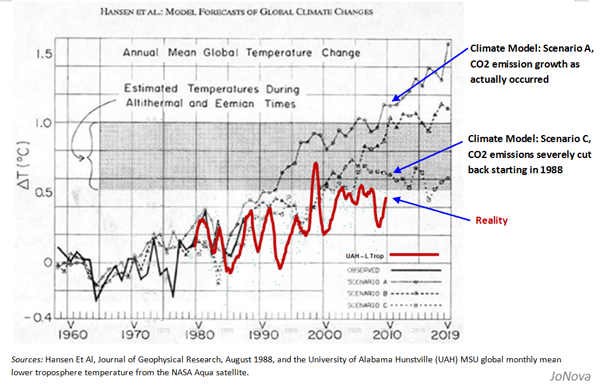
Evans says:”… the actual temperature rises are about a third of what he predicted. Remember, they have been saying the “science is settled” since the early 80’s, and the models now are essentially the same as they were then.

Furthermore, Hansen’s models predicted the temperature rise if human carbon dioxide emissions were cut back drastically starting in 1988, such that by year 2000 the atmospheric carbon dioxide level was not rising at all. But in reality, the temperature did not even rise that much. Which proves that the climate models don’t have a clue about the effect of carbon dioxide on world temperature.”

Second: Evans looks at ocean warming.  This is a better gauge of global warming than is measuring atmospheric temperature fluctuations.  The Argo Buoys were put into service in 2003.  The measurements of ocean temperatures prior to the Argo program are suspect in my view.  Nothing before 2003 remotely resembles the scope of Argo measurements.(click on chart to enlarge)
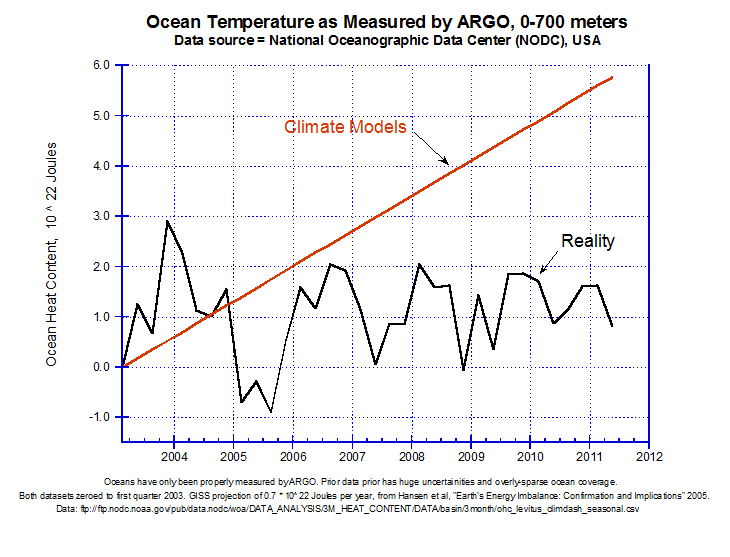
Evans says: the climate models predict the oceans should be warming. We’ve only been measuring ocean temperature properly since 2003, using the ARGO system. In ARGO, a buoy duck dives down to 2000m, slowly ascends and reads the temperatures on the way, then radios the result back by satellite to HQ. Three thousand ARGO buoys patrol the oceans constantly. They say that the ocean temperature since 2003 has been basically flat. Again, reality is very different to the climate models.

Thirdly: Evans looks at the “hotspot” which was  a climate computer prediction  which is the  Warmers’ proof of the positive feedback.  Feedback that is able to take a weak CO2 forcing signal and double or triple it.   Unfortunately for the advocates of this hypothesis, the hotspot does not exist.(click on chart to enlarge)

Evans says: “the climate models predict a particular pattern of atmospheric warming during periods of global warming. In particular, the most prominent change they predict is a warming in the tropics about 10 km up, the so-called “hotspot”. But we have been measuring atmospheric temperatures by weather balloons since the 1960s, and millions of weather balloons say there was no such hotspot during the last warming from 1975 to 2001. The hotspot is integral to their theory, because it would be evidence of the extra evaporation and thickening of the water vapor blanket that produces two thirds of the warming in the climate models…”

Fourthly:  Evans hits on one of the most discussed topic in recent times—that of outgoing radiation into space.    Note in the chart below that the top row left is the actual measurements of outgoing radiation by the stat elite ERBE program (Earth Radiation Budget Experiment-click here for more information.)   The other boxes are climate model predictions. (Chart source=Lindzen and Choi 2009)

Evans says: “satellites have measured the outgoing radiation from the earth and found that the earth gives off more heat when the surface is warmer, and less heat in months when the earth’s surface is cooler. Who could have guessed? But the climate models say the opposite, that the Earth gives off less heat when the surface is warmer, because they trap heat too aggressively (positive feedback). Again, the climate models are violently at odds with reality.”

Evans sums up saying:” Those are four independent pieces of evidence that the climate models are fundamentally flawed. Anyone one of them, by itself, disproves the theory of man-made global warming. There are also other, more complex, pieces of evidence. Remember, there is no direct evidence that man causes global warming, so if the climate models are wrong then so is the theory.”

Read all of Evan’s posting here.

cbdakota

U.S.Chamber of Commerce to Pres. Obama–How to Create Jobs


The U.S. Chamber of Commerce sent a letter to President Obama and Congress on creating jobs.The letter’s purpose is stated as follows:

OPEN LETTER TO CONGRESS AND THE PRESIDENT OF THE UNITED STATES

The most immediate priority facing our nation is to create jobs for the 25 million Americans who are unemployed, underemployed, or have simply given up looking for work.

To create jobs, we must enact policies that promote and sustain stronger economic growth. We must also address extraordinary fiscal and competitive challenges that are smothering growth and driving away jobs. At the same time, there are specific steps Congress and the administration can take right now to spur faster job growth in America’s private sector without adding to the deficit.

The letter has a number of sections. I have picked out one of them that relates to the Climate Change Sanity blogs theme:

2. PRODUCE MORE AMERICAN ENERGY

Let American energy workers and businesses responsibly develop all sources of domestic energy immediately. This will not only create jobs but will generate new government revenues, protect our energy security, and release us from the grip of some unfriendly governments.

                              Open offshore resources. Almost 190,000 new jobs could be created by 2013 if permitting in the Gulf of Mexico for offshore development returned to pre-moratorium levels. In Alaska, opening up energy production off the coast would create 54,700 jobs.

                              Expand access on federal lands. By expanding oil and gas exploration on federal lands, we could create 530,000 jobs, reduce imports by 44% by 2025, and increase government revenues by $206 billion.

                              Promote development of natural gas. Expanding the development of the nation’s massive shale gas deposits would create hundreds of thousands of jobs and help bring manufacturing back to the United States, especially in the chemicals and steel industries.

By 2020, natural gas production in Western Pennsylvania alone could create 116,000 new jobs, generate more than $2 billion in government revenues, and add $20 billion to the region’s economy.

                        Approve the Keystone XL pipeline. Construction of the Keystone XL oil pipeline connecting Canada to U.S. refineries in Texas would support 250,000 jobs, boost investment in the United States by $20 billion, and generate government revenues totaling $585 million.

Well said, and certainly in line with yesterday’s posting see here.

The other letter sections are as follows and worth reading:

  • Expand Trade and Global Commerce
  • Speed Up Infrastructure Projects
  • Welcome Tourists and Business Visitors to the U.S.
  • Speed Up Permits and Provide Regulatory Certainty and Relief
  • Pass Tax Incentives That Create Jobs While Increasing Revenues

cbdakota


One Billion Motor Vehicles And Peak Oil


Oilprice.com noted that in August, Wards Auto published a story saying that World motor vehicle count now stands at 1 billion.  The U.S. still has the largest registration at about 240 million.   In the Oilprice.com blog, the author considers what 1 billion vehicles and the likelihood of even more being added in the next 25 years might mean. It is interesting reading.  He seems to favor governmental intervention to ameliorate supply (read PEAK OIL) versus demand for fossil fuels.   He says:

It is highly unlikely that there will be anything approaching 240 million registered vehicles in the U.S. 25 years from now. From the vantage point of 2011, it seems probable that many will not be able to afford to own and operate personal motor vehicles of the size and types we have today.

He thinks that the newly mandated CAFÉ standard is just what we need and that we will have to abandon 6 passenger cars and other large sized vehicles. He says:

  In the U.S. we are now facing standards requiring that cars achieve an average of 54.5 MPG 15 years from now. First will come all sorts of weight reductions, such as eliminating spare tires, and adding more plastic and aluminum parts. Engines will become more efficient and car bodies will become more aerodynamic.  Although these changes will be costly, it does not take much arithmetic to conclude that if energy costs are three or four times higher than they are today then mileage will become the key factor by which motor vehicles are judged.

Detractors of these new mileage standards are usually people who have little grasp, or prefer not to think about where real energy costs are going to be 15 years from now. They point out the advanced materials required to build a low-weigh, high mileage, vehicles will be so great that it will push cars beyond what many, if not most, can afford.  

Due to governmental interference, the U.S. is facing an artificial Peak Oil problem.   This artificial Peak Oil Problem is really a part of the Peak Energy Problem that governmental interference is causing.    We have a lot of fossil fuels.  The U.S has the largest reserve of fossil fuels in the world.  It is likely that North America could become energy independent.  Yes, no propping-up Venezuela nor other countries that don’t have our best interest in mind.   And what a break for our balance of payments.  Becoming completely energy independent might possibly be the wrong thing to do because the prices of crude oil could fall below our production cost thanks to the U.S. bringing on more production capacity.  I don’t want the government to dictate how much crude we should produce or purchase.  Let the market decide whether we produce or buy.

Peak Oil will come sometime, but not in the near future.  What the U.S. is facing is an ideological, artificial Peak Oil problem.   The Obama administration gives money to “renewable fuels” programs and tells us that we must do this to reduce the purchase of foreign crude.   How the government thinks they can do this with renewable fuels is beyond comprehension.  Renewable fuels, are now neither economic nor reliable enough to do that.  In fact, the electrical grid people that distribute the nation’s electricity have found it necessary to have fossil fuel powered back-up capacity equal to the wind or solar capacity.  The renewables can’t be scheduled, meaning their supply is too erratic to provide steady voltage and current.  The wind slows down or stops or the sun goes behind clouds and the former balance of supply and demand goes south. They have to have something as a backup to keep the lights on.  Their second argument is that fossil fuels not be used as combustion results in C02.   The fossil fuel back-up capacity blows that argument.  See here and here to read about the folly of renewable fuels.

The Radical Environmentalists fight every attempt to develop our resources.   Oil in Alaska, offshore oil, oil in the Baaken field, nuclear power, low cost coal,etc..  It doesn’t matter, they are against it.   They use global warming, polar bears, darter fish, left-handed ground squirrels  (I guess I made that one up) and one of my favorites–the Houston toad.    According to some reports only 300 Houston Toads remaining in the world and they have been placed on the endangered species list.  “A world without the Houston toad ... is not a world we can physically live in,” says Paul Crump, a reptile and amphibian keeper at the Houston Zoo who works with the small brown toads.  Who knew?  The world is on the way to a collapse. More dangerous issue than the Osama binLaden threat so lets get the Seal Teams to see nothing bad happens to those warty little buggers. (SARC).

Fracking and the oil pipeline from Canada are the causes du jour for the radical environmental crowd.   It is patently clear that they will only be satisfied when this country is reduced to a third world status.   And our Government supports their activities through the EPA and other departments.  God Bless Michelle Bachmann and her vow to eliminate the EPA if she is elected President.  If she is not, she should be given the job as the EPA Administrator.

We will run out of economically recoverable oil some day.  Same for natural gas, iron ore, etc.  But the many forecasts made by experts about when the oil peak would occur have always been vastly overstated.

We quoted The Oilprice.com author saying that in 15 years the price will be 3 to 4 times higher than today.  It could happen but only if we just sit back and let it happen.  For a more realistic assessment of the Peak Oil tipping point, lets look at what has been said on a WardsAuto.com posting titled “Oil’s Price Always Comes Down.”

Five years ago, I believed in the Peak Oil theory. It postulated that global oil production would peak in 2006, and the following shortage would send prices skyrocketing. Sure enough, in 2008 a barrel of oil shot up to $150.

But less than 12 months later, oil plummeted to less than $40 a barrel. Yes, the price now is back up to $100, but I no longer believe in Peak Oil. Here’s why:

Brazil recently discovered massive oil reserves off its coast that match or beat Saudi Arabia’s. Brazil will start tapping those reserves before this decade is out. In Iraq, infrastructure is being put in place to increase oil production six or seven times greater than today, potentially making it the largest oil producer in the world.

And in the U.S., a new drilling technique called hydraulic fracturing is the mother of all game changers. (My emphasis)  Texas wildcatters figured out a way easily extracting natural gas and oil from shale. Using high-pressure water and sand, they fracture the shale, releasing trapped gas. As a result, the U.S. has added 100 years of natural gas use (at current rates), and the price of natural gas has fallen to nearly half from its peak in 2008.

Hydraulic fracturing, or fracking as it’s also called, is controversial. Some environmentalists have seized on it as the next great danger to the planet. A documentary called “Gasland” probably will win an Academy Award for hysterically pointing out the dangers of fracking.

Of course, “Gasland” approaches its topic with the impartiality and evenhandedness of pseudo-documentaries such as “Roger and Me” and “Who Killed The Electric Car?” So far, fracking has been done mostly in the U.S., but it soon will spread to the rest of the world. (My emphasis) Before this decade is out, we are going to see vast increases in the amount of oil and natural gas available. And this will have enormous implications for the auto industry and policy planners.

Closing out is a good time to call for a lesson from “Minnesotans 4 Global Warming”.

http://www.youtube.com/watch?v=nWiKvNDTjB4&feature=player_embedded

cbdakota