Category Archives: CAFE Standards

Fisker’s Nina To Be Shown At NY Auto Show—“Kinda”


Fisker has informed reporters that at the 3 April 2012 New York Auto Show, they will provide a “business update and a glimpse of the future” when they reveal the Nina.   Well sort of, because it is not likely that they will have an actual operating Nina, but rather a design model.   The power train is still in testing and probably won’t be available for installation in the design model being shown.  What is shown will not be a product of the GM plant in Wilmington, Delaware where the Feds have provided loan monies to bring the plant online to make the Nina.

The Nina will be a hybrid,  battery-powered vehicle with a range extending IC engine.  You may already know that Fisker did not pick a US engine manufacturer to supply the back up but rather has chosen a BMW turbocharged four-cylinder engine.

I have heard that the projected price of the Nina is in the range of half that of the other Fisker auto, the Karma.   The Karma is sells for $109,000 last time I heard a price quoted.

This is the Nina “picture” that the reporters received:

cbdakota


What Makes Up The Price Of Gasoline?


Given the interest in the “whys and wherefores” of US gasoline price,  this site welcomes the work done by the Institute For Energy Research (IER).    Their full analysis can be found by clicking here,   but the following is a summary of that analysis:

IER’s analysis provides the following facts about gas prices:

  • 76 percent of the price of gasoline is determined by the price of crude oil.
  • 12 percent of the price of gasoline is determined by federal, state, and local taxes.
  • The federal tax on gasoline accounts for 18.4 cents per gallon, while the volume-weighted average state and local tax is 30.4 cents per gallon.
  • Refining costs account for 6 percent of the price of gasoline.
  • Retail dealer’s costs and profits account for a combined 6 percent of the price of gasoline.
  • Less than 5 percent of gas stations are owned by major oil companies.
  • 60 percent of U.S. oil demand is imported from foreign countries.
  • The world consumed 87.9 million barrels of crude and liquid fuels every day in 2011, the highest consumption rate in history.
  • China is now the world’s second-largest consumer of oil behind the United States.  In 2011, Chinese crude imports were up 8.2 percent over 2010 levels.
  • The U.S. produced an average of 5.67 million barrels of crude oil every day in 2011.
  • Production in the Gulf of Mexico is expected to fall by 90,000 barrels per day due to production declines in existing fields, permitting delays, and the Obama moratorium.
  • Crude oil production in Alaska is projected to fall by 20,000 barrels per day both in 2012 and 2013.
  • When President George W. Bush lifted the executive moratorium on offshore drilling, there was an immediate price decrease in the cost of oil.
  • About 25 percent of U.S. supply of oil comes from OPEC countries, which have agreed to a production ceiling of 30 million barrels per day including Iraq’s production and some overproduction by member countries.

U.S. monetary policy — particularly increases in the money supply through quantitative easing — have coincided with a surge in oil prices.  Recent signals from the Federal Reserve that interest rates would remain at near-zero through 2014 have created a ripe environment for hedge funds that bet on commodity plays.

Volt and Leaf February sales


The February sales numbers for Volt and Leaf are in.   Volt numbers were 1023 which bettered January sales of 603.    Leaf numbers were 478 which trailed January sales of 679.   Y-T-D  sales for Volt are 1,626 and Leaf 1,157.  Chevy’s 4 cylinder ICE sales were up 46 percent.  The Cruze, one of the GM 4cylinder line,  put up big numbers at 18,556 units in February.   The public is obviously moving to more fuel-efficient vehicles with gasoline prices skyrocketing.   But their choice continues to be the more affordable ICEs than the all-electrics or hybrids.

cbdakota

Fisker Appoints New CEO- Can He Save This Company?


Fisker has appointed Tom LaSorda CEO replacing Henrik Fisker.  Fisker, founder and co-owner of Fisker Motors, will assume the role of executive chairman.  LaSorda’s skill is said to be manufacturing.

The first model from Fisker is the Karma.  A terrific looking automobile but beauty may only be skin deep as the vehicle interior is rated a sub-compact by the EPA.  The Karma’s range is 32 miles on the battery.  It is a hybrid so the gasoline driven generator comes on when the battery is exhausted, at which point the EPA rating becomes 20 mpg.

According to a Bloomberg posting, Jeremy Anwyl, vice chairman of Edmunds.com, an automotive data and pricing company had this to say about the Karma: “The odds are stacked against Fisker.  The car may be an interesting toy for people who have $100,000 to spend on such a thing, but Fisker will run out of those people quickly, and how tolerant of glitches will those people be?”  He probably was referring to the recent recall to fix the battery cooling system.

The current issue for Fisker is the DOE $529 million in loans granted to Fisker in June 2009.   The first part, $169 million was for engineering of the Karma and the second part of$360 million for the development of the NINA, a mid-sized hybrid to built in the old GM plant in Wilmington, DE.  Fisker, according to Bloomberg, has used $193 million of the loans.  But Fisker stopped work at the old GM plant when the DOE blocked further access to the loan saying that Fisker had not met the required milestones.

The battery supplier for Fisker is A123.   It has had to lay off workers due to the Fisker delays.  A123 is also an investor in Fisker.  A share of A123 stock closed on the 28 Feb at $1.91.  The 52-week range is $1.51 to $9.60.  Earnings per share are   $-1.88.

A posting late last year by Discovery asked: IS FISKER A ‘GREEN CAR’ SOLYNDRA SCANDAl? The author, John Voelker, GreenCarReports.com said:   “We’d like to see three specific questions answered.

— Since Fisker backers have contributed to Democratic party causes, is there any hard evidence of improper influence over the DoE loan process by the White House?

— How did Fisker come to select a closed assembly plant located in Vice President Joe Biden’s home state, since Delaware is no longer an obvious place to build cars?

— What steps does the DoE take to monitor compliance with the loan terms–and why won’t it release the revised terms of the Fisker loans?”

Good questions.

cbdakota

Ethanol Subsidies: Not Gone, Just Hidden a Little Better


Mother Jones, an organization with a very liberal viewpoint posted that the subsidies for ethanol fuel have expired but that this doesn’t trouble the ethanol fuel producers.  Kevin Drum authored the posting and I will let him tell you why.

A few years ago I called subsidies for corn ethanol “catastrophically idiotic.” And why not? Corn ethanol, it turns out, is actively worse for the environment than even gasoline. Farmers responded to the subsidies by reducing the amount of farmland used for food production, and this drove up the price of staple food worldwide.  At the end of last year, ethanol subsidies quietly expired and no one tried to extend them.

So why did the powerful corn ethanol lobby let it expire without an apparent fight? The answer lies in legislation known as the Renewable Fuel Standard (RFS), which creates government-guaranteed demand that keeps corn prices high and generates massive farm profits. Removing the tax credit but keeping the RFS is like scraping a little frosting from the ethanol-boondoggle cake.

The RFS mandates that at least 37 percent of the 2011-12 corn crop be converted to ethanol and blended with the gasoline that powers our cars…[As a result] the current price of corn on the Chicago Mercantile Exchange is about $6.50 per bushel—almost triple the pre-mandate level.

 You might not be aware that when the EPA does mpg ratings for new cars, they use gasoline that does not contain any ethanol.  Adding ethanol at 10% of the fuel mix, the energy in a gallon of fuel is about 96.7% of a fuel not containing ethanol.  Ethanol has less energy per gallon than normal unleaded gasoline.  So the MPG rating is probably just a bit high.    See

cbdakota

DRIVING A VOLT IN WINTER


The Chevy Volt’s driving range is reduced by cold or hot weather. The EPA estimates the Chevy Volt can travel 35 miles on a fully charged battery according to an article written by Doug Wernert, Chevrolet VoltAge Community Manager.   This will vary due to the weather conditions he adds.   If it is cold, using the car heater and front window defrost will have a “high/maximum Impact” on the Volt’s range.  And of course, in hot weather the A/C unit has “high/maximum impact” on range.  (Do you have the feeling that the range estimates are often at odds with the last news release you read?)  Does the EPA account for the weather in their estimated fully charged battery range?  If not, then it would seem that 35 miles might only be good on optimal days, says 68F or something like that (no A/C, no heat) and would result in a lower figure for the rest of the time.   A chart that accompanied Wernert’s article listed some other activities that resulted in “high/maximum impact” on the range.  These are

High speeds (70+mph)

Aggressive Accelerations

Steep incline

So, no driving in the mountains with the pedal to the metal in cold weather.

cbdakota

Electric Car Update-YTD November


Volt vs. Leaf

The Chevy Volt sales were 1139 vehicles in November bettering last month’s sales of 1108.  That brought the year-to-date Volt sales (YTD) to 6142.  Chevy had forecast Volt sales 10,000 vehicles in 2011 and it looks like they wont make that target.   Chevy is forecasting Volt sales at 45,000 in 2012 and they will export 15,000 more.  I suppose it is possible that they might make that forecast, but I have my doubts unless GE (Obama good buddy Jeffery Immelt CEO of GE) buys the 10,000 Volts they pledged that they would.  The first part of 2011, Chevy maintained that they were production, not sales, limited.  But at the end of 2011, there did not seem to be a lack of Volts for sales.  November’s sales of 1139 are the best month so far this year.

You make your estimate of 2012 sales.

The Volt’s main competitor this year has been Nissan’s Leaf.  Leaf sales dropped for the third consecutive month to 672 vehicles.  Even so, Leaf still leads in the 2011 YTD sales race with 8738 vehicles sold.

Aptera

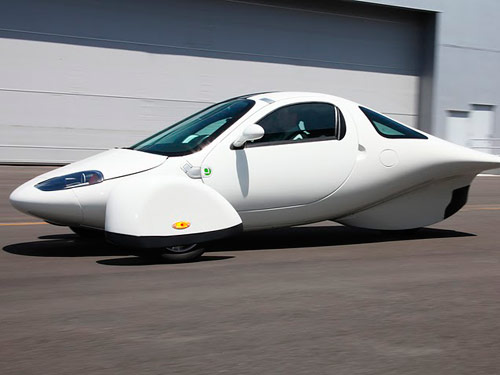
Aptera is an all electric three wheel vehicle with an EPA rating of 200mpg equivalent.   It is a beauty but they can’t get matching loan money to continue operation.  They announced that they are going out of business.

Sorry about that.

cbdakota

Fisker’s Karma Hybrid Gets Range Test


The Fisker Karma hybrid is a good looking car but perhaps beauty is only skin deep, as the old saying goes.

 This baby weighs in at about 5000 pounds. It is 16.5 feet long and has a 403 hp powerplant.  It costs $96,000.  EPA uses “inside volume” to determine the class and because it has less than 100 cu.ft., it is categorized a “Subcompact”.   The EPA fuel rating is 52 mpg-equivalent combined city and highway driving and it has a range on a full battery charge of 32 miles!!!!

The gasoline driven generator come on when the battery is exhausted,  and then it is rated at 20 mpg.

Fisker is promoting the test results they got using the European regulatory body TUV.  (It is said that their ratings are typically twice the EPA ratings.)  The TUV proclaimed the range 51.6 miles equivalent on electric-only mode.

cbdakota


Volt Outsells Leaf in October


The October sales for the Volt were 1108 and the Leaf were 849.  The last time this year that the Volt sold more than the Leaf was March.  The year-to-date figures are: Leaf—8066 and Volt—5003.

It is reported that Nissan and GM are targeting 10,000 sales for their vehicle—-about 2000 total or 1000 each month, November and December for the Leaf.   The Volt needs to average 2500 per month to meet the GM target.  Probably not going to happen.

cbdakota

DOE Ownership Cost Calculator–Cruze beats Volt


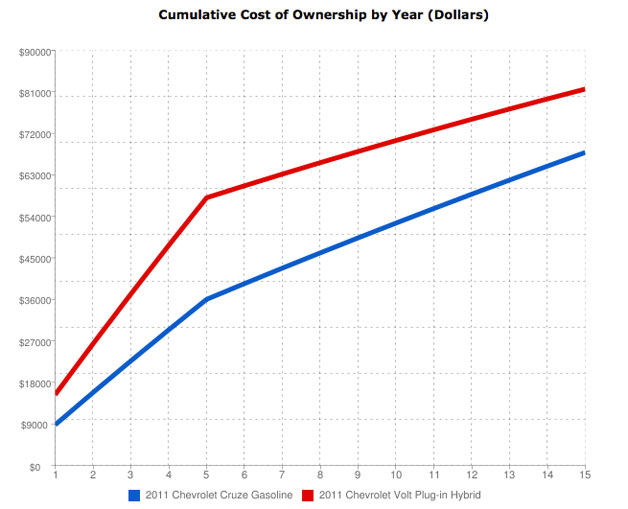
Using the new DOE cost calculator, the Chevy Cruze is a better buy than the Volt.

The chart above considers operating cost plus initial investment, expected depreciation and cost of maintenance at today’s prices.   The Volt does beat the Cruze when calculating only the cost of fuel.  The DOE uses a 2011  purchase price for the Volt at $40,280 and the Cruze at $18,125.  To make your own comparisons,  click here.

To read additional information, click here.

cbdakota