Category Archives: Alternative Energy

A RE-VOLT-ING DEVELOPMENT


Even in the face of high gasoline prices, Volt sales dropped from 608 cars in March to 493 in April.    The year-to-date sales of the Volt are 1703.  General Motors announced that they would produce in 2011 and 2012 a total of 100,000 Volts.

In January of this year, President Obama named Jeffery Immelt, CEO General Electric, to replace Paul Volcker as the Chairman of the Council on Jobs and Competiveness.  Following the announcement, Immelt promised to buy 50,000 Volts over the next two years.   A little math says that if GE does buy half the production run of 100,000, then GM only has to find 48,297 customers for the other half in the next 20 months.  That is a 566% monthly sales increase over the current monthly sales average.

But what signals are we getting from Immelt?   According to Junk Science Immelt has signaled that jobs are going to be more important to him than a “comprehensive energy strategy”.

At an event at the Massachusetts Institute of Technology on Tuesday, Immelt said,

“If I had one thing to do over again I would not have talked so much about green… Even though I believe in global warming and I believe in the science … it just took on a connotation that was too elitist; it was too precious and it let opponents think that if you had a green initiative, you didn’t care about jobs. I’m a businessman. That’s all I care about, is jobs… I’m kind of over the stage of arguing for a comprehensive energy policy. I’m back to keeping my head down and working. [Emphasis added]

If he means what he appears to be  saying, then one might infer that he will renege on his pledge or perhaps more realistically buy many less that 50,000 Volts.

That would be re-Volt-ing development.  For GM!!

cbdakota


MONBIOT ON DISCORD IN THE GREEN RANKS


George Monbiot writes for the UK Guardian newspaper and he is perhaps the most influential green blogger in Europe.  This week, beginning with a blog on 2 May and a follow-up several days latter, he discussed the problems within the green movement.  The title of his 2 May posting is  “Let’s face it: none of our environmental fixes break the planet-wrecking project”.  His subtitle for that posting is:”All of us in the green movement are lost before the planet’s real nightmare: not too little fossil fuel—but too much”.

Monbiot is a believer in catastrophic global warming resulting from fossil fuel use (the “planet-wrecking project”).  And his preferred solution is “sustainability” which means to allocate resources and wealth across the globe while at first reducing and eventually eliminating fossil fuel use.  Ultimately world societies would become less complicated and perhaps more agrarian.  De-developing the Western societies while developing those nations that are second and third world will be necessary to accomplish this.  A tenet of sustainability is that governments will have to exercise more control to assure the outcomes.  Saying it differently, you will surrender much of your freedom to the UN or some like group.

He was hoping that fossil fuels would become less available but he laments, that is not the case.

This posting is not to dispute Mr. Monbiot’s premise of catastrophic global warming due to fossil fuel uses, but rather to examine his view of the sects within the AGW crowd and their differences in beliefs. To begin, Mr. Monbiot is not my kind of guy.   When John Bolton, our UN Ambassador, traveled to England in 2008, Monbiot wanted to arrest him and try him for war crimes. Monbiot also began a campaign to have then Prime Minister Blair taken to court on similar charges related to the Iraq war.  His thoughts on things he thinks we should be doing, IMHO, demonstrate a low level of economic reality and a love of “Big Brother”.   Although our worldviews are quite different, he is quite intelligent so we need to keep track of what he is thinking.

He begins his first posting regarding discussions with his fellow warmers like this:”You think you’re discussing technologies, and you quickly discover that you’re discussing belief systems. The battle among environmentalists over how or whether our future energy is supplied is a cipher for something much bigger: who we are, whom we want to be, how we want society to evolve. Beside these concerns, technical matters – parts per million, costs per megawatt hour, cancers per sievert – carry little weight. We choose our technology – or absence of technology – according to a set of deep beliefs: beliefs that in some cases remain unexamined”.

He makes sense when he defends his recent acceptance of nuclear energy as a vital need going forward, with or without fossil fuels: “The case against abandoning nuclear power, for example, is a simple one: it will be replaced either by fossil fuels or by renewables that would otherwise have replaced fossil fuels. In either circumstance, greenhouse gases, other forms of destruction and human deaths and injuries all rise”.

“The case against reducing electricity supplies is just as clear. For example, the Zero Carbon Britain report published by the Centre for Alternative Technology urges a 55% cut in overall energy demand by 2030 – a goal I strongly support. It also envisages a near-doubling of electricity production. The reason is that the most viable means of decarbonising both transport and heating is to replace the fuels they use with low-carbon electricity. Cut the electricity supply and we’re stuck with oil and gas. If we close down nuclear plants, we must accept an even greater expansion of renewables than currently proposed. Given the tremendous public resistance to even a modest increase in windfarms and new power lines, that’s going to be tough”.

He believes that “accommodation” (read sustainability) is the goal but he says:”But even if we can accept an expansion of infrastructure, the technocentric, carbon-counting vision I’ve favoured runs into trouble. The problem is that it seeks to accommodate a system that cannot be accommodated: a system that demands perpetual economic growth. And adds: Accommodation makes sense only if the economy is reaching a steady state”.

He has been criticized in Simon Fairlie’s posting in the magazine The Land. To which he responds:”There’s a still bigger problem here: even if we make provision for some manufacturing but, like Fairlie, envisage a massive downsizing and a return to a land-based economy, how do we take people with us? Where is the public appetite for this transition?”

Monbiot adds that:   “A third group tries to avoid such conflicts by predicting that the problem will be solved by collapse: doom is our salvation. Economic collapse, these people argue, is imminent and expiatory. I believe this is wrong on both counts”.

He then gets to his central point about too much fossil fuel: “The problem we face is not that we have too little fossil fuel, but too much. As oil declines, economies will switch to tar sands, shale gas and coal; as accessible coal declines, they’ll switch to ultra-deep reserves (using underground gasification to exploit them) and methane clathrates.

Monbiot sums up his view of the current state of the environmental movement:”All of us in the environment movement, in other words – whether we propose accommodation, radical downsizing or collapse – are lost. None of us yet has a convincing account of how humanity can get out of this mess. None of our chosen solutions break the atomising, planet-wrecking project”.

In his second posting is “The green problem: how do we fight without losing what we are fighting for?”.  It is subtitled: “Environmentalism is stuck-factional and uncertain even of the goals we seek.  But we must face facts and engage in reality.”

In this posting he expands upon the point he made in the first posting and he adds some interesting things.  He  enumerats the disagreements that he believes permeate the green community: “We have no idea what to do next. We have no idea what to do next.  Partly as a result, we have started tearing each other apart. This is an understandable but unnecessary reaction. Those seeking to protect the landscape are not our enemies; nor are those advocating that renewables should replace fossil fuel; nor are those promoting nuclear power as the answer; nor are those opposing nuclear power. We are all struggling with the same problem, all bumping up against atmospheric chemistry and physical constraints”.

“The enmity arises when people go into denial. Denial is everywhere. Those opposing windfarms find it convenient to deny that climate change is happening, or that turbines produce much electricity. Those promoting windfarms downplay the landscape impacts. Nuclear enthusiasts ignore the impacts of uranium mining. Opponents of nuclear power dismiss the solid science on the impacts of radiation and embrace wildly-inflated junk numbers instead. Primitivists decry all manufacturing industry, but fail to explain how their medicines and spectacles, scythes and billhooks will be produced. Localists rely on technologies – such as microwind and high-latitude solar power – that cannot deliver. Technocratic greens refuse to see that if economic growth is not addressed, a series of escalating catastrophes is inevitable. Romantic greens insist that the problem can be solved without even engaging in these dilemmas, yet fail to explain how else it can be done”.

“We’re all responding to the same impulses, but we’re all being tripped up by denial. Denial, and a failure to see the whole picture, are our enemies. Or perhaps, as doctors say about alcohol, our false friends”.

He cites Paul Kingsnorth’s posting titled “The quants and the poets”.   Quants are numbers/facts people and poets are people that examine societies values and underlying mythology.  Kingsnorth’s posting is very well written and he too contrasts the various divergent opinions alive in the green world today.  He believes that Monbiot is loosing his credentials as a Poet.

Monbiot responds to this quants/poets issue here: “Perhaps we are less tolerant of myth than we used to be. Perhaps we should be. Is creating new, opposing myths the best way of confronting the founding myths of neoliberal capitalism? I don’t think so. Is it not better to fight them with withering analysis, quantification and exposure? But can we do this without becoming insensible to beauty, and to the impulse – a love for the world and its people, its places and its living creatures – which turned us green in the first place? I don’t know”.

Well this has been a long post and I thank all of you that read it all the way to the end.

cbdakota

BETWEEN THE ROCK AND THE HARD PLACE—U.S. ENERGY POLICY Part 1


Between the Obama administration’s plan to drive prices up in order to put fossil fuels out of business and the turmoil in the Middle East and North Africa (MENA), the U.S. is in real danger of another economic collapse, just as we seem to be coming out of the very deep recession.  In both cases the problem is ideology.  Obama’s ideology  apparently  is to cause the  US to become a second rate, socialist nation. (Perhaps I am redundant when I use “socialist” and “second rate” as descriptors.)  The ideology behind the turmoil in MENA is less clear.  In some cases it seems to be a move for a democratic society and in other it appears to be a power grab by the “Muslim brotherhood” for example.    Thumbs up for the former and thumbs down for the latter.

Part 1 of this entry will be a  look at the Obama Administration. Part 2 will be a look at the turmoil in MENA and the interconnections with the US Energy Policy.

Obama Administration Policies

President Obama made his position on energy perfectly clear, even before he was elected. He said he would cause the electricity rates to skyrocket.  He told people that if they put their money in coal plants he would see that they would go bankrupt.  see here

He is for offshore drilling in Brazil. In his recent visit to Brazil, he applauded their efforts and pledged billions of dollars in aid for their work.  But he does not like offshore drilling for the US.

He populated his Administration with people of the same mind.

Obama’s Science Advisor is John Holdren.  If you have followed Holdren’s career, you know that this man has made more bad predictions of things to come that anyone except possibly his cohort, Paul Ehrlich.  According to CNS News.com Holdren said:

In a video interview this week, White House Office of Science and Technology Director John P. Holdren told CNSNews.com that he would use the “free market economy” to implement the “massive campaign” he advocated along with Paul Ehrlich to “de-develop the United States.” (My emphasis added)

He and Ehrlich described de-development in their book, Human Ecology: Problems and Solutions ” as:  “Resources must be diverted from frivolous and wasteful uses in overdeveloped countries to filling the genuine needs of underdeveloped countries,”

Ken Salazar is the Secretary of the Interior.   He manages to minimize leases for new drilling and he prevents development of good potential fossil fuel resources sites by setting aside land.   He and Obama do not want the prize areas like ANWR developed although these and other could make us far less dependant on sources outside to the US.

Steven Chu the Secretary of Energy has said that we should figure out how to boost the price of gasoline to $8.    This Administration seems to be on track to do just that.

The EPA  Administrator Lisa Jackson has a big role in these policies.

Lets look at their latest outrageous abuse of power.    See full posting here

Shell has spent five years and nearly $4 billion dollars on plans to explore for oil in the Beaufort and Chukchi Seas. The leases alone cost $2.2 billion. Shell Oil Company has announced it must scrap efforts to drill for oil this summer in the Arctic Ocean off the northern coast of Alaska. The decision comes following a ruling by the EPA’s Environmental Appeals Board to withhold critical air permits. At stake is an estimated 27 billion barrels of oil. That’s how much the U. S. Geological Survey believes is in the U.S. portion of the Arctic Ocean. 

The closest village to where Shell proposed to drill is Kaktovik, Alaska. It is one of the most remote places in the United States. According to the latest census, the population is 245 and nearly all of the residents are Alaska natives. The village, which is 1 square mile, sits right along the shores of the Beaufort Sea, 70 miles away from the proposed off-shore drill site.

The EPA’s appeals board ruled that Shell had not taken into consideration emissions from an ice-breaking vessel when calculating overall greenhouse gas emissions from the project. 

“What the modeling showed was in communities like Kaktovik, Shell’s drilling would increase air pollution levels close to air quality standards,” said Eric Grafe, Earthjustice’s lead attorney on the case.

Who is on  the EPA appeals board that is appointed by the EPA Administrator, Shelia Jackson?

The Environmental Appeals Board has four members: Edward Reich, Charles Sheehan, Kathie Stein and Anna Wolgast. All are registered Democrats and Kathie Stein was an activist attorney for the Environmental Defense Fund

And here is another one:

A three-inch lizard that thrives in desert conditions could shut down oil and gas operations in portions of Southeast New Mexico and in West Texas, including the state’s top two oil producing counties.   Called the Dunes Sagebrush Lizard, it is being considered for inclusion on the federal Endangered Species listing by the U.S. Fish and Wildlife Service.  To read more click here.

And we don’t want to forget the cover his ever faithful friends, the mainstream media, are giving the Administration: click here

While Obama is taking some heat for the price of gasoline, he never forgets what his goals are.  Remember how he seemed to back off ObamaCare only until he found a way to get it approved through the back door of the Senate.  He is not pushing for Cap and Trade legislation.  He does not need to do that because the Supreme Court in a monumental example of bad judgment gave the EPA keys to our bank account when they said the EPA could write regulations for capping CO2 emissions.

His solutions are primarily wind farms and solar cell farms to make up for the fossil fuel powered utilities that he would see shutdown.  These renewable energy sources are not ready at the present time to accomplish this.  They may never be able to substitute for fossil fuel.  See these postings for more information on renewables:

dept-of-energy’s-analysis-says-wind-and-solar-not-competitive/

/real-wind-power-data—disappointing-performance/

https://cbdakota.wordpress.com/2011/03/07/are-windfarms-driving-the-uk-to-third-world-status/

https://cbdakota.wordpress.com/2011/03/05/treasury-few-renewable-energy-projects-deserve-funding/

In Part 2 we will look at what are the forces shaping the new energy world order.

cbdakota


Real Wind Power Data—Disappointing Performance


It is difficult to get comprehensive data on wind farm performance as it is shielded from view by “protection of competitive data” or by contract terms.  A new study bearing comprehensive data from Scotland confirms what skeptics have been saying about windfarm performance. This new study is perhaps the most comprehensive since the Bentek Energy(an energy analytics firm) study of Colorado and Texas windfarms.

Stuart Young Consulting with support from the JOHN MUIR TRUST (emphasis mine, to highlight that this study was commissioned by a green NGO) has released a report studying the ability of wind power to make a significant contribution to the UK’s energy supply. It concludes that the average power output of wind turbines across Scotland is well below the rates often claimed by industry and government.

This report examined 5 common claims by the wind industry and the Scottish Government.   The five claims are in RED with the actual result in BLACK:

1. ‘Wind turbines will generate on average 30% of their rated capacity over a year’ In fact, the average output from wind was 27.18% of metered capacity in 2009, 21.14% in 2010, and 24.08% between November 2008 and December 2010 inclusive.

2. ‘The wind is always blowing somewhere’ On 124 separate occasions from November 2008 to December 2010, the total generation from the windfarms metered by National Grid was less than 20MW (a fraction of the 450MW expected from a capacity in excess of 1600 MW). These periods of low wind lasted an average of 4.5 hours.

3. ‘Periods of widespread low wind are infrequent.’ Actually, low wind occurred every six days throughout the 26-month study period. The report finds that the average frequency and duration of a low wind event of 20MW or less between November 2008 and December 2010 was once every 6.38 days for a period of 4.93 hours.

4. ‘The probability of very low wind output coinciding with peak electricity demand is slight.’ At each of the four highest peak demand points of 2010, wind output was extremely low at 4.72%, 5.51%, 2.59% and 2.51% of capacity at peak demand.

5. ‘Pumped storage hydro can fill the generation gap during prolonged low wind periods.’ The entire pumped storage hydro capacity in the UK can provide up to 2788MW for only 5 hours then it drops to 1060MW, and finally runs out of water after 22 hours.

The final claim about “pumped storage” varies with the area where the windfarms are located.  In the US, an area such as the Great Plains, where wind availability is favorable to siting of windfarms, has little to no pumped storage hydro capacity available.   Availability in most other areas is either used or would be difficult to develop as environmental groups object to the use of dams.  Further there is a loss of efficiency when the windpower electricity is used to pump water to some higher elevation and then recovered in hydroelectric turbines.

The author of the report said:

It was a surprise to find out just how disappointingly wind turbines perform in a supposedly wind-ridden country like Scotland. Based on the data, for one third of the time wind output is less than 10% of capacity, compared to the 30% that is commonly claimed.

At the end of the period studied, the connected capacity of wind power was over 2500MW so the expectation is that the wind network will produce, on average, 750MW of energy. In fact, it’s delivering far less than everyone’s expectations. The total wind capacity metered now is 3226MW but at 3a.m. on Monday 28th March, the total output was 9MW.

To see the John Muir Trust posting in more detail, click here

For further information on the Bentex study mentioned at the begining of this posting click here.

cbdakota

Does your state have Renewable Electricity Mandates?


Twenty-nine States have passed legislation that requires utilities to sell or produce a certain percentage of electricity from renewable sources.   Electricity prices are higher in those states, partially due to these mandates.

According to the Institute for Energy Research these mandates are an expensive way to reduce carbon dioxide emissions.   In their posting The Status of Renewable Electricity Mandates in the States they note the following:

Some argue that renewable electricity mandates are a good way to reduce carbon dioxide emissions, but renewable electricity mandates are a very expensive way to reduce carbon dioxide emissions. According to the California Air Resources Board, it costs $133 per ton to reduce carbon emissions through the mechanism of a renewable electricity mandate. An internal Obama administration memorandum on subsidies for renewables recently noted that carbon dioxide emissions “would have to be valued at nearly $130 per ton for CO2 for the climate benefits to equal the subsidies.” To put these numbers in perspective, it currently costs about $15 a ton to purchase a certified carbon dioxide allowance traded on the European Climate Exchange.

There are currently no Federal renewable energy mandates. The Heritage Foundation has calculated the economic impact of enacting Fed mandates as follows:

Its researchers found that a mandate starting at 3 percent for 2012, and increasing by 1.5 percent per year until 2035, would:

• Raise electricity prices by 36 percent for households and 60 percent for industry;

• Cut national income (GDP) by $5.2 trillion between 2012 and 2035;

• Cut national income by $2,400 per year for a family of four;

• Reduce employment by more than 1,000,000 jobs; and

• Add more than $10,000 to a family of four’s share of the national debt by 2035.

Similarly, Credit Suisse estimated the capital expenditures necessary to achieve different levels of renewable generation by 2020. The bank noted that a nationwide 10 percent renewable electricity mandate would require capital expenditures of $350 billion, a 15 percent mandate would require $500 billion and a 20 percent requirement would require $750 billion. The California Air Resources Board has estimated that it will cost $115  billion in new infrastructure to meet California’s renewable electricity mandate in 2020 (33 percent).

I recommend that you open up this link to see how your State stacks up.

cbdakota

DELAWARE AND BLUEWATER WIND


For this posting  I want to use my neighboring state of Delaware and the proposed off-shore wind farm as an example of what the rate payers in that state are facing.

Several years ago furious because of what happened when the price of electricity was deregulated Delawareans were led to believe they could protect themselves from this happening again by installing an offshore windfarm to produce “renewable” electricity.   Driven by the perception that the price of electricity would be less expensive and that it would help save the planet by reducing the electricity produced by natural gas or coal,  they willingly accepted the idea of offshore windfarm.  Moreover the State mandated that a percentage of the electricity used in the State had to be produced from “renewable” energy.

With much political pressure being applied, Delaware Power (the major Delaware Utility) began negotiations with Bluewater Wind (BWW).   Delaware Power reluctantly signed a contract to buy the electricity from this proposed wind farm.

Unfortunately for the Delawareans who thought the deregulated price of electricity was high, they are in for a bigger shock if they allow the BWW offshore windfarm to become a fact.  And wherever windfarms are installed, they are so unreliable that equivalent fossil fuel electrical generating capacity must be installed to protect the electrical users from interruption of their supply. This adds more cost and does nothing to reduce carbon dioxide emissions.

PRICE OF ELECTICITY FROM OFF-SHORE WINDFARMS

Lets look first at cost.   The Department of Energy’s Energy Information Agency says that without subsidies the price of electricity from offshore windfarms is not viable.  The following table is the EAI’s latest estimate of the cost of electricity production in 2016 when BWW says they will be producing electricity:

LEVELIZED COSTS OF ELECTRICITY IN 2016

Look at the column “Total System Levelized Costs” for conventional coal, and conventional combined cycle (in the Natural Gas-fired grouping) and then compare these costs to the levelized cost of Wind-Offshore:

Coal is $94.8 per megawatt hour or more familiarly  $0.095 per kilowatt hour.

Natural gas is $0.066 per kilowatt hour

Wind—Offshore is $0.243 per kilowatt hour.

To give you a little background on these numbers, the EAI penalized the natural gas and coal plants estimates with a cost of buying CO2 credits which would be necessary if the our country ever losses its mind and passes “cap and trade”. These penalties do not currently exist but are included anyway.

The Wind—offshore costs do not reflect the subsidies that the government is handing out to cover the real costs shown in this chart.

CAPACITY FACTOR AND ITS AFFECT ON COSTS

The capacity factor is a measure of the percentage of the rated capacity that can be depended upon.  The main natural gas and coal plants operate most of the time at a percentage of rated capacity in the mid to upper 80tys.  The Wind—offshore has a capacity factor of 39.3%.   From what one reads in the literature where actual performance of windfarms is recorded, the number of 39.3% vastly overstates their performance, which is often said to be in the 19 to 20% range.  Were the EAI to use the lower capacity factor,  the cost for wind produced electricity would be even more expensive than the $0.243 per kilowatt hour.

Several of the Natural Gas fired cases are nearly as high as the wind cases.  This is because these cases are for the backup turbine units that utilities must have to meet unexpected changes in supply or demand.  These natural gas turbines have capacity factors of 30% but can achieve a much higher number.  However, they are more costly to operate and are only used, as noted earlier, as backup.

The US has a vast surplus of natural gas.   The forecast cost to produce electricity in a natural gas based plant based upon the Department of Energy’s forecast in 2016, is about 27% of the offshore windfarm for that same year.  Will there ever be a time that these wind farms can compete in the market place or will we rate payers always have to subsidize them?

The fundamental problem with windfarms (and solar) is the fact that they can be working one minute and not the next.  The wind (or cloudless sunny days) can not be scheduled.  The electrical grid operators must be able to rely upon the electrical generation units to provide the power needed to match the user’s demands.  The low cost plants, fueled by coal, natural gas or nuclear are used as the base load.  They are steady and reliable.   These base load units are not capable of rapidly increasing or decreasing the generation of electricity.   Delaware Power, like other producers of electricity have units on hot standby that can be put into service almost immediately to meet peak requirements by their customers.  And as this demand drops off, they can easily be backed down as necessary to stay in balance.

Why have wind farms unless they can provide base load electricity?  They cannot because these farms can not control the wind.    Often when very cold or very hot weather  occurs, the wind does not blow at all.   So instead of base loading they are relegated to being spot suppliers. It is widely understood that, on balance, for every kw of wind farm capacity that is brought on line, the equivalent amount of natural gas turbine capacity must also be added.    For skeptics of the theory of man-made global warming, the fact that windfarms did not result in any less CO2 vented to the atmosphere, is not a big concern.   But it surely should give the believers in manmade global warming a big case of indigestion.

BLUEWATER WIND

Delaware has an excellent source of information about BWW in the “Inside Energy” blog published by the Caesar Rodney Institute.   Recently they posted a blog  RE: Prediction: Bluewater Wind Project Will Crash and Burn. The blog notes that 2016 is the earliest startup date and adds:

The earliest start-up date for the offshore wind facility is now 2016 when the price will be $.142/Kilowatt-hour (KWh). Similar projects off the coasts of New England and Europe have set contract prices between $.19 and $.24/KWh. There is nothing magic about the waters off the coast of Delaware to justify the difference in price.

The higher prices in other locations already account for government construction subsidies which will come to $800 million for the Bluewater Wind project. However, the subsidies only extend to facilities built by the end of 2011. The US Congress, exhibiting symptoms of subsidy fatigue, may not extend the subsidies further for a mature industry that accounted for 39% of all new generating capacity in 2009. So an even higher price increase may be needed to sustain the project next year.

The wind project is expected to provide about 1.1 billion KWh of electricity a year. Wholesale power from conventional sources costs about $.06/KWH. The “Green Premium” for offshore wind power could range between $.08/KWH and $.20/KWh at full price with no government subsidies. This will cost Delaware consumers between $90 and $220 million a year.

There will be hearings on BWW in May and you are encouraged to join with the folks from the Caesar Rodney Institute.  Regarding this hearing they add:

NRG, the owners of Bluewater Wind, will have to seek a significant rate increase to justify the investment in its’ Delaware offshore wind project. The attempt could fail bringing the project to an end. The good news is this will save Delaware electricity consumers hundreds of millions of dollars a year in avoided price increases and could save hundreds of jobs.

In a future posting, I want to let you in on the reasons why there are many big companies pushing these windfarm schemes on the rate payers.

cbdakota

Nukes and Radiation Exposure


The internet is alive with questions and concerns about radiation poisoning that could result from the Japanese nukes that were damaged by the Tsunami.  So to put this into perspective, perhaps some background would be helpful.  Wikipedia discusses the relative exposure and dangers from release of radiation in the following:

The sievert (symbol: Sv) is the SI derived unit of dose equivalent radiation. It attempts to quantitatively evaluate the biological effects of ionizing radiation…. It is named after Rolf Sievert, a Swedish medical physicist…..

Most of you know how to read mSv but just a review for the uninitiated:  mSv=0.001Sv or 1X 10^-3 or stated as milli Sv.    Below you will see that eating a banana is said to dose a person with 0.0001 mSv.  That is equivalent to 0.0000001Sv.  If a lethal does of radiation is 10Sv,  you would have to eat something like 100 million bananas in one setting.

At the other end of the scale,  the lethal dose for a period of one day is 10Sv.

Single dose examples

 Eating one banana: 0.0001 mSv

Dental radiography: 0.005 mSv

Avg. dose within 16 km of TMI accident: 0.08 mSv; maximum dose: 1 mSv

Mammogram: 3 mSv

Brain CT scan: 0.8–5 mSv

Chest CT scan: 6–18 mSv

Gastrointestinal series X-ray investigation: 14 mSv

Yearly dose examples

Living near a nuclear power station: 0.0001–0.01 mSv/year

Living near a coal power station: 0.0003 mSv/year

Sleeping next to a human for 8 hours every night: 0.02 mSv/yr

Cosmic radiation (from sky) at sea level: 0.24 mSv/year

Terrestrial radiation (from ground): 0.28 mSv/year

Natural radiation in the human body: 0.40 mSv/year

Radiation from granite of the US Capitol building: 0.85 mSv/year

New York-Tokyo flights for airline crew: 9 mSv/year

Atmospheric sources (mostly radon): 2 mSv/year

Total average radiation dose for Americans: 6.2 mSv/year

Smoking 1.5 packs/day: 13-60 mSv/year

Current average limit for nuclear workers: 20 mSv/year

Lowest clearly carcinogenic level: 100 mSv/year

Elevated limit for workers during Fukushima emergency: 250 mSv/year

 Wiki makes clear that the severity of exposure is a function of time and amount.  The following shows the effect of high levels of radiation  exposure over a one day period  with the likely consequences:


Symptoms of acute radiation (within one day):

0 – 0.25 Sv (0 – 250 mSv): None


0.25 – 1 Sv (250 – 1000 mSv): Some people feel nausea and loss of appetite; bone marrow, lymph nodes, spleen damaged.


1 – 3 Sv (1000 – 3000 mSv): Mild to severe nausea, loss of appetite, infection; more severe bone marrow, lymph node, spleen damage; recovery probable, not assured.


3 – 6 Sv (3000 – 6000 mSv): Severe nausea, loss of appetite; hemorrhaging, infection, diarrhea, peeling of skin, sterility; death if untreated.

6 – 10 Sv (6000 – 10000 mSv): Above symptoms plus central nervous system impairment; death expected.


Above 10 Sv (10000 mSv): Incapacitation and death.


Another way of  illustrating this data (and more) can be seen by clicking here. The blog “xkcd” has a chart demonstrating in words and pictures the relative levels of radiation exposure from small everyday experiences to death dealing levels.  I recommend that you look at it because for many, it may be easier to  understand than trying to relate milliSvs to Svs.  The chart maker uses microSvs and those are 0.000001 Sv

Good reading

cbdakota


Can The Volt Save Windfarms? Can The Volt Save The Volt?


We often hear that renewable energy will reduce the US’s dependance on foreign crude oil.   Right now it’s difficult to see when that will happen. According to the DOE’s Energy Information Agency (EIA),  only about 1% of this nation’s electricity is produced by oil.
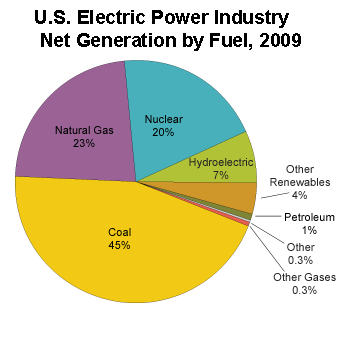
So its clear that displacing foreign crude oil will have to be done some other way than by reducing oil based electrical generating capacity.

If battery powered (EV) cars  become a significant part of our transportation sector,  then some substitution of electical energy for petroleum is likely.  But when?  Windpower installations are not economical and only are currently in the mix because of Federal and State subsidies. (see here for viability)  Further windpower needs electrical storage to be a viable supplier of electricity to the grid. (see here and here for storage)

So what is happening in the field of EVs?   The Poster child EV is the Chevy Volt. The second banana appears to be the Nissan Leaf.

The  Chevy Volt was named by Car and Driver  their “Car of the Year”.  But if the Volt presages the future for the battery powered car,  things  are not looking too strong at present.

Sales of the Volt in January were 321 cars and in February they sold 281.  Added to last years sales,  the total to date (throught February) is 928 cars.  Leaf, the Nissan hybrid has only sold 173 since they came on the market.

General Motors says not to worry.  They will make and sell 10k to 12k Volts this year.   They have not been helped by an underwhelming review by Consumer Reports. On 3 March, USA TODAY posted “Consumer Reports pans electric range of Chevrolet Volt, Nissan Leaf”.  The posting opens with this:

Consumer Reports magazine offers its initial assessment of the two reigning wondercars of our times, the Chevrolet Volt and Nissan Leaf, in its April issue and finds both may not be such good deals after all.

Not only has Consumer Reports’ test car been coming in at the low end of the electric-only mileage range — 23 to 28 miles, not 25 to 50 miles as billed — before the gasoline power kicks in, but CR had to pay over list to the get the car. It says it had to pay $48,700 — full price plus options and a $5,000 windfall to the dealer.

It gets worse. CR figures the cost of recharging the Volt would work out to about 5.7 cents a mile for electric mode and 10 cents a mile for gas. Yet a Toyota Prius, which gets about 50 miles a gallon, would cost 6.8 cents a mile to operate. A Prius costs half as much as a Volt.

CR seems to feel a little better about the all-electric Leaf. It borrowed one from Nissan while it awaits delivery of its own. The $35,270 electric car had its range severely restricted by the cold weather that has gripped the East, much like the Volt. The range has been averaging 65 miles, not the 100 miles that Nissan bills. Plus the mileage gauge isn’t that accurate in the cold when electric heaters gobble up kilowatts. Instead of the 36 miles of range that the car said it had, one tester got 19.

Ok, the Volt is a brand new design and with time, and with increased production, the vehicle will get better and the cost should go down.  While the Volt that Consumer Report bought was $5000 over MSRP,  the price of the Volt with options was still near $44,000.  Even with the Government subsidy of a $7,500 tax credit for the buyer, this is still probably above most buyer’s range.

The Battery

I, for one, worry a bit about the battery warrany that GM is providing.  I don’t believe that there is anywhere near enough actual experience for a 100,000 mile battery warranty. If these batteries don’t live up to the 100,000 miles, it could become very expensive for both the buyer and GM.  From GMs website this is the battery warranty:

Chevrolet Volt Coverage

Propulsion Battery Warranty Policy Like all batteries, the amount of energy that the high voltage “propulsion” battery can store will decrease with time and miles driven. Depending on use, the battery may degrade as little as 10% to as much as 30% of capacity over the warranty period. A dealer service technician will determine if the battery energy capacity (kWh storage) is within the proper limit, given the age and mileage of the vehicle. Typical tests can take up to 24 hours.

Repair If possible, components will be repaired or replaced, and the original battery will be returned to the vehicle.

Replace (If Necessary) Under warranty, the high voltage battery will be replaced with either a new or factory reconditioned high voltage battery with an energy capacity (kWh storage) level at or above that of the original battery prior to the failure. Your Volt battery warranty replacement may not return your vehicle as an “as new” condition, but it will make your Volt fully operational appropriate to its age and mileage.

I have read that these batteries began to wear out from the repeated charge and discharge cycles.  The words in the warranty appear to support this where it says “the battery may degrade from 10% to 30%” as miles are put on the EV.  I have read that the owner is warned not to operate below 20% of battery capacity and not to charge above of 80% of capacity.  What are the consequences regarding the range of the EV between charges when it approaches the 30% degredation?

Charging the Battery

Facilities to recharge batteries are needed to make the new electric car practical and they are few and far between.  Yes, putting in a low voltage system for recharging might not be too complex but the charge time for bringing the battery pack back to a full charge may require more time than you can afford.

The following chart illustrates the required time to place a full charge on several EVs.  The time required is a function of the voltage applied to the charger.

Vehicle EVrange 

Charge time120V Charge time220V Charge time440V
Nissan Leaf* 100 20 8 0.5
Chevy Volt* 60 10 4
Toyota Prius PHV** 13 3 1.5
Fold Focus Elect** 100est 12 6-8
MitsubishiI-MiEV** 100est 16 8

This information was from MSNBC posting and can be seen at these web addresses:

http://www.msnbc.msn.com/id/40200899/ns/technology_and_science-future_of_energy
**http://cosmiclog.msnbc.msn.com/_news/2010/11/20/5500395-cars-take-the-road-to-electrification

MSNBC says that the cost for a 220V charging station for your home is estimated at $2,200.   The 440V systems are likely to be impractical for most owners.  EV charging stations, similar in function to the ubiquitous gasoline station, would use these because of the much more rapid charging rate.   Wikipedia says that very rapid charging stations (10 minutes) carry a certain level of risk.

In practice, the energy efficiency of ten-minute charging is likely to be somewhat lowered in any case due to the ohmic losses caused by the required high current inside the vehicle. The lost energy is converted directly to heat, which could be detrimental to the battery pack or surrounding electronics; additional power may be required for cooling equipment that removes the excess heat. Increasing the capacity of the battery pack increases the required power, current and heat loss linearly,[citation needed] which is why ten-minute charging may require new innovations as vehicles with increased range are developed.

The reason EV manufacturers are looking at a rapid charge is because they hope to duplicate the time to fuel that is typical of the gasoline and diesel stations today.   Can you imagine waiting in line for several hours to get your EV charged?

Wiki points out another issue with very rapid charge stations.

The high peak power requirement of ten-minute charging can also stress the local power grid and might increase the risk of power brown- or black-outs during peak demand if enough vehicles choose to charge at these times.

I wonder if the Volt and its cousins,  might not be a better bet for success than windmills.  The EVs would probably experience lower cost electricity without the windmills in the mix.

cbdakota


Are Windfarms Driving the UK to Third World Status?


It is alarming that the UK is on the verge of plunging into third world status because the political class are so set on eliminating carbon emitting electrical generation facilities and replacing them with renewable energy  (read windmills) generation facilities.   The Telegraph (UK newspaper) carried an article on March 2nd saying that UK electrical customers were going to have to get used to black-outs or brown-outs based on the replacement strategy just mentioned.   Lets look at the article:

Here we have Steve Holliday, Chief Executive of the National Grid telling the Brits that the days of permanently available electricity may be coming to an end as wind farms become bigger suppliers of electricity.  He is quoted as saying “We are going to change our own behaviour and consume it when it is available and available cheaply.”  The National Grid is the electric power transmission network connecting power stations and substations and ensuring that generated electricity can be used to satisfy demand.  The Grid is where the “rubber meets the road” so to speak.  The grid system in the US has the same function.  But many industries cannot function profitable with intermittent power.  If you were a manufacturing company in the UK and you were to hear that power would become intermittent in the future, would you consider moving your business to someplace where zealots did not control the sources of electricity?

Is this the direction we want for the USA?   I think not.  But we have our zealots here as well.  Fortunately they have not gotten the degree of “say so” that is the case in the UK.

cbdakota

Treasury: Few Renewable Energy Projects Deserve Funding


The Treasury Department has been blocking many requests for renewable energy project subsidies.  They are doing this because there are so few that are technically or financially viable in their opinion.  The DOE has been complaining that the Treasury Department should back off.  So the President’s requested that his advisors look into this.  On 10/25/10 a memo from Larry Summers, Carol Browner and Ron Klain was sent to the President with their take on this squabble.

The memo was summed up in The Wall Street Journal (WSJ) posting “Wind Jammers at the White House” on 11/12/10.

“The trio walks through an interagency dispute about Energy Department subsidies for wind, solar and other forms of “renewable” power, which DOE claimed were being held up by the joint Treasury and White House budget office (OMB) reviews.”

The WSJ notes that the DOE has a lot of moneys it wants to spread around.

Recall that the stimulus transformed the government into the world’s largest private equity firm. The many tools now at DOE’s disposal include $6 billion to guarantee loans and another dispensation so that the department can convert an energy investment tax credit equal to 30% of a project’s cost into a direct cash grant to green developers.

The Summers memo notes that these two provisions alone reduce “the cost of a new wind farm by about 55% and solar technologies by about half relative to a no-subsidy case.” So taxpayers are more than majority partners in these private projects, except they get no upside.”

The last sentence is the kicker here,  “So taxpayers are more than majority partners in these projects, except they get no upside.”

The taxpayers not only get the downside because they pay  the capital cost but they then have to pay for the higher cost of electricity.  Now that’s a double whammy if I have ever heard of one.

The memo says that there are few viable projects to fund.   They said they found severe problems with “the economic integrity of government support for renewables.”  The WSJ continues with an example of the problem according to the  memo:

“Treasury and OMB singled out an 845-megawatt wind farm that the Energy Department had guaranteed in Oregon called Shepherds Flat, a $1.9 billion installation of 338 General Electric turbines. Combining the stimulus and other federal and state subsidies, the total taxpayer cost is about $1.2 billion, while sponsors GE and Caithness Energy LLC had invested equity of merely about 11%. The memo also notes the wind farm could sell power at “above-market rates” because of Oregon’s renewable portfolio standard mandate, which requires utilities to buy a certain annual amount of wind, solar, etc.”

“But then GE said it was considering “going to the private market for financing out of frustration with the review process.” Anything but that. The memo dryly observes that “the alternative of private financing would not make the project financially non-viable.”

“Oh, and while Shepherds Flat might result in about 18 million fewer tons of carbon through 2033, “reductions would have to be valued at nearly $130 per ton CO2 for the climate benefits to equal the subsidies (more than 6 times the primary estimate used by the government in evaluating rules).”

“So here we have the government already paying for 65% of a project that doesn’t even meet its normal cost-benefit test, and then the White House has to referee when one of the largest corporations in the world (GE) importunes the Administration to move faster by threatening to find a private financial substitute like any other business. Remind us again why taxpayers should pay for this kind of corporate welfare?”

Any questions?

cbdakota