Category Archives: AGW

AGW Computer “Fails” Resource


Following several brief comments about another AGW scientist owning up to the weakness of the computer models, is a site that lists failed AGW climate computer models projections.  Remember it is these computer projection upon which rests the entire rationale for the manmade global warming theory,

Kevin Trenberth is “Distinguished Senior Scientist in the Climate Analysis Section of the National Center for Atmospheric Research”.  Trenberth has been a lead author for IPCC Global Warming Reports. He is also one of the Climategate gang.  In one of the hacked emails he sent to his compatriots he said:   “The fact is that we can’t account for the lack of warming at the moment, and it is a travesty that we can’t. The CERES data published in the August BAMS 09 supplement on 2008 shows there should be even more warming: but the data are surely wrong. Our observing system is inadequate.”  (My emphasis)  He later explained that what he really meant is that the globe is still heating up but nobody can figure out where the heat is going.  Recently Dr Spencer and Dr Braswell seem to have explained this.   See here for their paper On the Misdiagnosis of Climate Feedbacks from Variations in Earth’s Radiant Energy Balance  Roy W. Spencer, and William D. Braswell.

So we are talking about a major leader in the AGW theory crowd.  He recently has published a paper in “Climate Research”.  In that paper according to CO2 Science:

…..(he) compares the projections of state-of-the-art climate models with what is known about the real world with respect to extreme meteorological events related to atmospheric moisture, such as precipitation and various types of storm systems, as well as subsequent extreme consequences such as droughts, floods and wind damage. So what does he find?

 The C3 blog  summarizes that paper as follows:

Specifically, Trenberth takes issue with the climate models’ inadequacies in regards to precipitation. Such as:

                  …all models contain large errors in precipitation simulations, both in terms of mean fields and their annual cycle, as well as their characteristics: the intensity, frequency, and duration of precipitation…”

                  “…relates to poor depiction of transient tropical disturbances, including easterly waves, Madden-Julian Oscillations, tropical storms, and hurricanes…”

                  “…confidence in model results for changes in extremes is tempered by the large scatter among the extremes in modeling today’s climate, especially in the tropics and subtropics…”

                  “…it appears that many, perhaps all, global climate and numerical weather prediction models and even many high-resolution regional models have a premature onset of convection and overly frequent precipitation with insufficient intensity,…”

                  “…model-simulated precipitation “occurs prematurely and too often, and with insufficient intensity, resulting in recycling that is too large…”

                  “…a lifetime of moisture in the atmosphere that is too short, which affects runoff and soil moisture…”

                  and finally, he has a NSS moment…”major challenges remain to improve model simulations of the hydrological cycle.”

Ok we skeptic were pretty sure that was the case.  But remember that group still wants us to bet the future on their models.

I want to lead you  to a treasure trove of AGW computer model “Fails”.  If you click HERE you will get a listing of computer models failures.

Here are some of the recent titles:

NASA Research Reveals Antarctica Ice Sheet Melt Just A Fraction of Climate Model Predictions

New Research: Experts Determine German Flooding Has Not Increased From Global Warming As Predicted

IPCC Prediction That Global Warming Would Cause More Wildfires Proves To Be Wrong

Last Week Had The Global Warming Alarmists Admit To Zero Warming Since 1998, Now An Admission That Models Don’t Work

Since 1990, IPCC’s Climate Predictions Have Been Wrong – Billions Wasted On Worthless Fortunetelling

A Spectacular Failure: Latest HadCrut & NASA Temperatures Significantly Below IPCC Climate Model Predictions

Hansen’s Global Climate Model In Total Fail: Predicted Ocean Heat Goes Missing

Look at the other links that take you to more good information.

cbdakota

Skeptics Ahead on Science but Lag on Politics/Media


The Skeptics are winning the science battle but are still running behind in the political /media arena.  What can we do to help?

SCIENCE

Scientists are abandoning the man-made global warming  (AGW) theory in increasing numbers.  They are recognizing the obvious:  The skeptic’s science is based upon observationally based science whereas the AGWers theory is based on computer projections.

Observationally Based Science versus Computer Projections

Amazingly, the AGWers will often say that the facts are wrong because their computer comes up with different answers.  This is most recently illustrated with respect to the recent reports on global sea level. From a WattsUpWithThat posting:

A few months ago a widely-publicized article by Houston and Dean was published in the Journal of Coastal Research (and on your site), noting that although sea-level is rising; the tide gauge data does not show any increased rate of rise (acceleration) for the 20th and early 21st centuries.  This augmented by a >).”>recent paper authored by an Australian scientist as well.

Houston and Dean (2011) considered only tide-gauge records with lengths greater than 60 years, noting that shorter record lengths are “corrupted” by decadal fluctuations.

Rahmstorf and Vermeer (RV) had previously reported on sea level change using their computer-aided program that provided different results of those of Houston and Dean.  RV attacked the Houston and Dean entry.  Houston and Dean responded to the RV criticism by saying:

RV link sea-level rise with temperature using a simple linear relationship with two free variables of opposite signs that allow them to “fit” any smooth data set. However, they are curve fitting, not modeling physics, so the approach cannot be used to predict future sea level.

A recent workshop of the Intergovernmental Panel on Climate Change (IPCC, 2010) considered the semi-empirical approaches of Rahmstorf (2007), Vermeer and Rahmstorf (2009), and others and concluded, “No physically-based information is contained in such models …” (p. 2) and “The physical basis for the large estimates from these semi-empirical models is therefore currently lacking” (p. 2). Other recent studies show slowing or reversal of the sea level.  See

The AGWers Are Getting Desperate

For some 12 years, global temperatures have not shown any discernable trend upward to match the increasing amounts of atmospheric CO2.   At last the AGWers know the reason, its volcanoes or it might be China’s coal based power plant emission.   Certainly we can be grateful that the computers have resolved (well sort of) this issue.  So coal based power plants actually make the global temperatures cooler and all along we have been told just the opposite.

For more information read this link and if you want a laugh read this link.

POLITICS AND THE MEDIA

The Need For an Informed Public

For the nearly 10 years that I have been actively involved in discussions and reporting on global warming, I have always believed that the science was on the skeptic’s side.   In a status review of global warming prepared for some State Senators in 2003, I stated that being right about the science would probably not be enough to win this struggle with the AGWers.  For example, the taxing and regulating authority that would stem from enacting Cap and Trade legislation will drive the politicians.   I think the beginning of the end of AGW driven legislation will take place when the public began experiencing pain of the resulting financial burden.   But are we going to be reduced to third-world status as a nation before we can turn the ship of state around?

How can we avoid this national  destruction on the altar of the watermelon (red on the outside/green in the inside)  movement?

First principle should be that the people who are going to be asked to pay for these green programs be completely informed of the consequences of the regulations or legislation being enacted.  This is not happening now.

LEGISLATION

Let’s remember that the House of Representatives in 2009 passed legislation for imposing Cap and Trade on fossil fuel use.  The bill was over a thousand pages long.  The Democrat leadership pushed this massive attempt to bring the nation’s energy under the control of the Government without anyone fully understanding what was in the bill.  The committee chairmen said they did not know!!!!!!   In an attempt to mollify the unhappy conservatives, they agreed to have the bill read.  So those clowns hired a speed-reader.  I believe that a legislative rule should be enforced that requires no bill can be voted upon without a minimum of a week’s worth of legislative sessions following proposed law being published unless a ¾ vote in favor of suspending the rule is passed.   This would not impose a significant burden upon the members.  The objective would be to raise their constituents’ understanding and the legislators should not be afraid of doing that.    Fortunately, as you know, the Senate failed to pass companion Cap and Trade legislation and thus it was never enacted.

REGULATION

Regulations for Cap and Trade are being written by the EPA.  Yes, the EPA is writing regulations for legislation that could not get approval in Congress.  Part of the blame for this are five  of the nine members of the Supreme Court.

  Massachusetts v. Environmental Protection Agency, 549 U.S. 497 (2007),[1] is a U.S. Supreme Court case decided 5-4 in which twelve states and several cities of the United States brought suit against the United States Environmental Protection Agency (EPA) to force that federal agency to regulate carbon dioxide and other greenhouse gases as pollutants.

Despite the knowledge that this legislation could not get passed in Congress and despite the fact that CO2 was excluded from the Clear Air Act, the Supremes gave the EPA the authority to determine if CO2 were a threat and if so, to write regulations to control it.

The EPA used the 2007 IPCC Global Warming report as their  science basis.  The EPA  asked for comments on their study and then they ignored any response that said that AGW science was badly flawed.  People within the EPA that expressed doubt were told to be quiet.  The EPA found CO2 to be a threat and began writing regulations.  These regulations are vast and growing.

There is a little irony here in that the environmentalists want all sources of CO2 to be regulated.  The EPA does not want to do that because the enormity of the ensuing burden.   Every furnace exhausts CO2, every hospital, every mall,  almost everything that makes our nation go would have to be monitored and reported.  The regulation overload will quickly result in demands for changes.  In fact I believe the EPA worries that it would result in legislation taking CO2 out of the Clean Air Act again.

Here again, the straightforward thing would be for your representatives to inform you of what the impact on them will be.  Congress should limit the damage the Supreme Court and The Executive (EPA) Branches do when they usurp the Legislatures prerogatives,   by passing legislations that restores the balance of powers.

Any other suggestions?

THE MEDIA

We all value the freedom of the press as guaranteed in the US Constitution. However the media, by and large, is supportive of BIG GOVERNMENT versus more individual freedom and responsibility. So they practice a form of soft censorship themselves by only reporting one side of the story.   One would expect better of them.  Although their domination of “what is fit to print” has been somewhat weakened by the ubiquitous Internet, it still is the primary input of news and information for most of the citizens of the US.  If our citizens would do less American Idol and pay more attention to what the politicians are doing, it would have a salutary effect on the their personal well-being and the nation’s well-being.

Surely some part of their misguided reporting of climate science is because they are not trained scientifically.  They apparently are too lazy or too intimidated to try to research the issues.  A science reporter from a newspaper in my area has obviously no curiosity or no understanding of what a millimeter is.  He reported about the danger of calving Antarctic Ice that would raise sea level several millimeters per year.  Recently he did a fairly straightforward report on the transfer of State Climatologist title from one PhD to another.  The one surrendering the title is a notable skeptic and frequent co-author of papers with other notables such as Willie Soon and Sallie Baliunas.   At the end of the report about the transfer, the reporter took a cheap shot at the skeptic saying that the skeptic was know to be a member of a group that was part of another group that once received money from Exxon.  If the reporter had any level of curiosity he could find out that the most of Exxon’s grant money is for groups that are working on alternative energy.  If the reporter believes funding by an advocate of a particular position is wrong, then why not then report on monies granted by Greenpeace, of the World Wildlife Fund to AGW scientists and groups. Secondly, the grants of money by AGW groups swamp the piddling amount the skeptics receive.  These grants are governmental and NGOs supplied and they total into the billions.  See these reports for further information about the distribution of monies.Here & here & here.

One suggestion is that you keep up with the skeptic blogs like WUWT, Ice Cap, Climate Depot, Heartland, Climate Audit, Science, etc and I hope, Climate Change Sanity and spread the information widely.

Also write to the newspapers.  Tell them when they are off base.  Suggest things they should look into.

If you have some thoughts on all of this, let me know.

cbdakota

Obama Plans to Nationalize the Energy Companies


This Administration’s actions lead me to believe that President Obama is planning to nationalize the energy companies.  When will he do this?   When gasoline hits somewhere around $10 per gallon as some predict it will this year.  See, see. Maybe you think that if gasoline prices get that high, he wont be re-elected?  That is why he will act.  His narrative will be that he had to do it to save the country. Many of our citizenry will applaud his actions. Unfortunately the idea that the government is everyone’s safety net is becoming too engrained.  If gasoline does not reach $10 in his first term and he gets a second term (and a Democrat majority in Congress, a real possibility if Obama is re-elected) he will wait until then.

Demonizing Energy Companies

So you think that this not something Obama and the Democrats would do.  They nationalized most of the automotive industry and got a way with it.   Obama Care is the first step on the way to nationalizing the Health Care industry.  The Congressional Democrats have long advocated nationalizing the Energy companies as have their echo chamber, the mainstream media. See, see, see, see. President Obama is not standing on the sidelines but rather is leading the charge against energy companies.

What Are The Signs

What is going on is an all out assault on the US energy companies by all of Obama’s administration.  Coal is being regulated out of business.  By managing permitting, Oil can’t increase the supply of crude domestically or from neighbors like Canada which will result in higher crude oil prices.  Natural gas re-emergence, resulting from fracking making available vast quantities of domestic gas, is facing the EPA and other environmental groups that want to outlaw or severely restrict the use of fracking.

And the Administration seems to want to reward our foreign foes or competitors while penalizing domestic Energy Companies.    What other conclusions can be derived from the way this President and his allies are conducting business?

The US has plenty of energy.  A recent study by the Congressional Research Service (CRS) determined that the USA has the world’s most abundant supply of fossil fuels.  The fuel resources counted were oil, coal and natural gas and all were equilibrated to the energy in barrels of oil equivalent  (BOE). The Chart below has the top seven nations from the study.

Nation Total Fossil Fuels in BOE
United States 973    billions of barrels equivalent
Russia 955                     “
China 474                      “
Iran 328                      “
Australia/New Zealand 315                      “
Saudi Arabia 309                      “
India 227                      “

Data from CRS Report “US Fossil Fuel Resources”:Issued 30Nov2010

We have the resources but President Obama does not want to use them.   All this leads to the obvious conclusion that the President is trying to create a “crisis” so he will, as Rahm Emanuel would say, “never let a crisis go to waste.”   Which brings us back to how will he use this crisis.  I believe it will be to nationalize the US energy companies.  If that happens, don’t be deluded into thinking that the Government will be able to provide us with “low prices”.  The private energy companies, e.g. BigOil, are motivated to innovate ways to locate and exploit reserves at the lowest cost possible.  They represent private enterprise at its best.  Don’t expect nationalized oil to provide this leadership or low prices.   Likely there won’t be any benefit to our economy, or boost in jobs and I suspect President Obama knows this.  The reason then must be the ultimate goal of socialists—– redistribution of wealth.

It is hoped, that the following discussion will help one understand the battle the Energy Companies are facing.

OIL

Another investigation is underway to find out if Big Oil (e.g. Exxon-Mobil, Chevron, Shell, BP, Conoco-Phillips) is manipulating the prices.   That Big Oil has been exonerated in all of the previous investigations, and will be in this one, is not the main issue here.  The Liberals know that this technique plants seeds of doubt in the publics mind. Typically, their accusations get all the headlines and the acquittal is seldom mentioned.

If Big Oil is driving up the prices how do they do it?  The American Petroleum Institute (API) listed the 20 Largest Oil and Gas Companies based upon their 2009 oil reserves.  It shows that 72% of the world’s oil reserves are owned by nations (not privately owned companies) such as Iran, Saudi Arabia, Venezuela, and Libya.  The biggest US Company to make the list was Exxon-Mobil at #17.   The Exxon-Mobil reserves as a percent of the world reserves are 0.68%.  Think about this situation where the OPEC type state owned companies have reserves 100 times greater than Exxon-Mobil.  Do you really believe that Exxon-Mobil is able to dictates the price of crude to OPEC?   Of course they can’t do that.

Well, there are those obscene earnings, right?  In 2010 the earnings as a percent of sales for Oil and Natural Gas was 5.7%.  Compare that to 19.4% for Beverages and Pharmaceuticals; 17.3% for Computers; and ALL MANUFACTURING was 8.5%.  So the average for manufacturing was 8.5% and Oil and Gas came in with 5.7%.    So, yes, their earnings are large but not out of line with their sales, in fact they are coming in lower than the average manufacturing business.  And further, U.S. oil and natural gas companies tax rates are considerably higher than the average manufacturing company. In 2010 income tax expenses (as a share of net income before income taxes) averaged 41.1 percent for Oil and Natural Gas companies compared to 26.5 percent for the average  S&P Industrial company.

Domestic oil production could make a real change in supply and it would significantly reduce our balance of payments deficit.  Further it would reduce the income of those countries that use the money to make problems for the US—Iran, Syria, Libya, Venezuela, etc.  It is said that Venezuela’s Chavez needs oil above $40 per barrel to have money to support his dictatorship.   And his friend President Obama wants to see the price much higher than $40, too.

Classic wrong headedness is illustrated by diddling over access to Canada’s rich tar sands.  From the IBD posting “China has its eye on Canada’s oil”:

Together, the U.S. and Canada have enough oil and natural gas locked up in shale formations, tar sands, Alaska, the Canadian Arctic and the Outer Continental Shelf to make OPEC pound sand. But we won’t drill for ours and apparently; we don’t want Canada’s.

With more than 170 billion barrels, Alberta has the world’s third-largest oil reserves, behind only Saudi Arabia and Venezuela and ahead of Russia and Iran. Daily production of 1.5 million barrels from the oil sands is expected to nearly triple to 3.7 million by 2025. The only question is, will this crude be flowing south to U.S. refineries or west for export to China?

At issue is the Keystone XL pipeline, parts of which have already been built, that would bring Alberta oil to Texas Gulf Coast refineries. The pipeline also could transport oil extracted from shale formations in the Rocky Mountain West.  The U.S. Geological Survey estimates the region, dubbed the Persia of the West, may hold more than 1.5 trillion barrels of oil, six times the proven reserves of Saudi Arabia, and enough to meet U.S. oil needs for the next two centuries. By 2015, oil executives and industry analysts say, the oil-rich lands of the West, including North Dakota’s booming Bakken formation, could produce 2 million barrels a day, more than the pre-Deepwater Horizon production rate in the Gulf of Mexico.

Environmental groups oppose Keystone XL on the grounds that tar-sands extraction harms the environment through water pollution, greenhouse gas emissions and potential pipeline leaks. The State Department, which must approve any pipeline entering the U.S. across international borders, has withheld its approval pending a final decision Nov. 1.  The Chinese aren’t waiting. Sinopec, a Chinese state-controlled oil company, has a stake in a $5.5 billion plan to build the Northern Gateway Pipeline from Alberta to the Pacific Coast province of British Columbia. Alberta Finance Minister Lloyd Snelgrove met this month with Sinopec and CNOOC, China’s other big oil company, and representatives of China’s banks.

While the U.S. dithers with concerns about “dirty oil” from Alberta’s rich tar sands, energy-hungry China makes Ottawa an offer it might not refuse. Memo to Washington: Pipelines can run west as well as south.

It is not that the President does not know that the laws of supply and demand are important to price of commodities.   When he pulled the stunt of releasing 30 million barrels of crude from our Strategic Petroleum Reserve (SPR), my guess is that his intent was twofold.  Maybe he thought that OPEC would see it as a threat that he would permit additional releases from the SPR if they did up their production and thus reduce crude prices.  As the 30 million only amounted to two days of US crude requirements, it’s likely they were not too worried.  Probably the real reason was to signal that things were out of control and he was trying one of the possible levers to stop the “runaway” gasoline pricing.

COAL

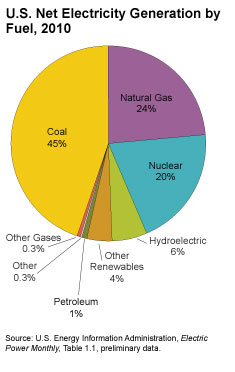
The US has the largest coal resources in the world. It is inexpensive relative to other fossil fuels and it is abundant. Coal is used to produce 45% of the nation’s electricity.    While electricity is very dependant on coal, coal is highly dependent on electricity as 93% of all US coal is used to generate electricity.  But Obama wants to put coal use in the past tense.   Obama announced before he was elected that he was going to put coal out of business and he means to do just that.  He is using the EPA to put very stringent emission restrictions on coal based electrical power plants.  The price increases for the ratepayers in the Mid-Western US States are going to be ugly.

A posting in the TownHall blog, “Clearing the Air”:

EPA’s proposed “mercury and air toxics” rules for power plants are built on the false premise that we are still breathing the smog, soot and poisons that shrouded London, England and Gary, Indiana sixty years ago. In reality, US air quality improved steadily after the 1970 Clean Air Act was enacted.

EPA’s “most wanted” outlaw is mercury. But for Americans this villain is as real as Freddy or Norman Bates. To turn power plant mercury emissions into a mass killer, EPA cherry-picked studies and data, and ignored any that didn’t fit its “slasher” film script. As my colleague Dr. Willie Soon and I pointed out in our Wall Street Journal and Investor’s Business Daily articles, US power plants account for just 0.5% of mercury emitted into North American’s air; the other 99.5% comes from natural and foreign sources.

Energy analyst Roger Bezdek estimates that utilities will have to spend over $130 billion to retrofit older plants, under the measly three year (2014) deadline that EPA is giving them………, On top of that, utilities will have to spend another $30 billion a year for operations, maintenance and extra fuel for the energy-intensive scrubbers and other equipment they will be forced to install.

Many companies simply cannot justify those huge costs for older power plants. Thus Dominion Power, American Electric Power and other utilities have announced that they will simply close dozens of generating units, representing tens of thousands of megawatts – enough to electrify tens of millions of homes and businesses.

Electricity costs are set to skyrocket, just as the President promised. Consumers can expect to pay at least 20% more in many states by 2014 or shortly thereafter. According to the Chicago Tribune, Illinois families and businesses will shell out 40-60% more! How’s that for an incentive to ramp up production and hire more workers? How’s that “hope and change” working out for families that had planned to fix the car, save for college and retirement, take a nice vacation, get that long-postponed surgery?

For a mid-sized hospital or factory that currently pays $500,000 annually for electricity (including peak-demand charges), those rate hikes could add $300,000 a year to its electricity bill.

And it’s not just private businesses that will get hammered. As the Chi Trib notes, if the Chicago public school system wants to keep the lights on and computers running for two semesters, by 2014 it will get hit for an extra $2.7 million it doesn’t have, to pay for skyrocketing electricity costs.

Carry those costs through much of the US economy – especially the 26 states that get 48-98% of their electricity from coal-fired power plants – and we are talking about truly “fundamental transformations.” Millions will be laid off, millions more won’t be hired, millions of jobs will be shipped overseas – and millions will endure brownouts, blackouts and social unrest.

The Chairman of the EPA’s Clean Air Scientific Advisory Committee Jonathan Samet implies there is no limit to the EPA authority according to a Junk Science Posting “Samet” No End To EPA Air Regulations:”

What Samet is saying is that there is no scientific basis for EPA not continually reducing manmade air emissions until there aren’t any. As Samet points out, under the Clean Air Act, the EPA could literally regulate us out of any sort of industry without regard to the consequences.

Classic doublespeak by those who are  our “betters” that want us to use mercury laden lights that are much more expensive than low cost incandescent bulbs (that they are banning) when Energy Secretary Steven Chu said “ We are taking away a choice that continues to let people waste their money.”

Natural Gas

Fracking technology involves pumping high-pressure water, sand and some chemicals into a borehole to create fractures in the shale formations in which natural gas and oil resides.  The fracturing of shale makes paths for the gas and oil to move to the collection piping and up to the surface.   This technology has been used by the oil and gas producers for some while but recently fracking has been used to tap massive quantities of natural gas. The quantities are so large that some estimates of the available natural gas are said to be equal to a 200-year supply for the US.

But the Obama administration never sleeps when it comes to seeking ways to deprive the nation of new supplies of energy.  The EPA has begin to study fracking:  National Review Online’s “The Fracas about Fracking” raises concerns about the likelihood of the study providing a fair review or a predetermined outcome which will reflect unfavorably on the practice of fracking:

In deciding on a policy on fracking, we should not wait for a congressionally mandated EPA report on the impacts of hydraulic fracturing on drinking water, due in 2012. A congressional hearing held in May revealed fatal flaws in what was supposed to be a definitive, vigorously peer-reviewed study. For one thing, it will be an inside job from the EPA; the study’s review panel excludes anyone with professional expertise in current industry practices or the technology of hydraulic fracturing. Under the current administration, industry experts, like highly credentialed professors of petroleum engineering, are assumed to be shills for greedy enterprises.

The EPA study has some other serious defects. It will cherry-pick only four wells, out of hundreds of thousands, for full forensic analysis, and it has excluded representatives of state regulatory agencies — which have six decades of experience in regulating this practice, which began in 1948 — from its review panel. Nor do the researchers seem aware of the difference between, on one hand, models of the assumed effects of hydraulic fracturing and, on the other, physical measurements of the results of hundreds of actual fracking treatments. To learn the fundamentals of this issue, the EPA would have to bother to speak with experts on the technology.

The study seems designed to substantiate a predetermined conclusion: that hydraulic fracturing poses grave risks. Therefore the EPA must either assert regulatory control on all drilling using this technology, or issue a “temporary” moratorium — as in the aftermath of the 2010 Gulf spill — until further study is complete. If fracking is delayed or discontinued, massive resources will remain untapped, hundreds of thousands of jobs will not be created, and billions of dollars of potential federal, state, and local tax revenues will be lost.

And some thoughts about this study from the American Thinker “Obama continues his war on cheap American Energy”:

Even if the panel should somehow miraculously decide that fracking is safe, there is a history of Obama appointees rewriting decisions from panels evaluating the safety of energy development, so as to change the outcomes to suit Obama’s biases against cheap and abundant (and American) energy. When the Gulf of Mexico oil-drilling platform Macondo sprang a leak, a panel’s conclusion regarding the safety of offshore oil drilling was doctored by White House political appointee Carol Browner (or someone operating under her authority) to make it appear that the panel of experts endorsed a moratorium on offshore drilling. When this manipulation of science was brought to light, many members of the panel objected to the distortion of their views and disavowed the “report”.

Stacking panels with ideological soul mates is Barack Obama’s modus operandi. If that does not work to accomplish his goals, creative re-writing is the next step. There is always one more trick in Obama’s pocket that he can use to keep us away from cheap, abundant and American energy.

There are some things we can do—–you probably know what they are.  Anyway, I will list some in my next blog.

cbdakota

Climate Models Not Ready For Prime Time


The preceding posting, Climate Modelers are Wizard of Oz’s Spawn,  noted that the backcasting used to prove the models,  was not scientifically viable/honest. I worked in systems operations in manufacturing facilities where solutions to problems were proposed and then tested to see if they worked in the real world.   The technique of  backcasting to fit an experience curve has been around for a long time. When the model seemed to match history, the  “solution”  resulting from that model was employed going forward.  Sometimes it worked and sometimes it did not work. In the real world, you have to test, test  and retest your premises to assess the confidence of the rightness of the solution.  The concept of proving your solutions is not the standard in the science of global warming climate modeling as far as I can tell.  And my view is that the global climate dynamic is vastly greater that any of the problems we were solving in the operating facilities, thus the likelihood of obtaining a high degree of certainty is problematic.

Lets look at a summary of a recent posting that lists 10 issues that demonstrates that the models are not ready for prime time. This is from The Hockey Schtick blog where more detail is provided in that posting and can be read by clicking here.

1,            IPCC admits climate models have not been verified by empirical observations to assess confidence

2            IPCC admits it is not clear about which tests are critical to verify and assess confidence in the models.

3            Of 16 identified climate forcings, IPCC admits only two have a high level of understanding. Most of the others are said to have a low level of understanding.

4            Of the two identified as having high level of understanding (greenhouse gases and positive feedback) they are actually not well understood with empirical satellite data showing sensitivity to doubling CO2 with feedback is only about 0.7°C which is a factor of 4 less than IPCC climate models.

5            Climate models falsely assume “back-radiation” from greenhouse gases can heat the oceans. In fact IR radiation can only penetrate the surface a few microns with all the energy used  in the phase change of evaporation–which in fact cools the oceans.

6            UV radiation is capable of penetrating the ocean to a depth of several meters. The IPCC models ignore UV.

7            IPCC is not certain whether clouds have a net cooling or warming effect even though it is shown empirically that clouds are many times more important than greenhouse gases.

8            Ocean oscillation can have huge effects on climate and these are not incorporated into the models.

9            The traditional climate models fail to properly reconstruct the correct amplitude of climate oscillations that have clear solar/astronomical signature.

10            Climate models continue to greatly exaggerate sensitivity to CO2 by 67%. Despite the climate modeler having admitted this, they are unwilling or unable to tweak the models to match observed temperatures.

cbdakota

Climate Modelers are Wizard of Oz’s Spawn


If you look closely, it’s not demonstrated science but the climate models that are the basis for all the forecasts of catastrophe will result from manmade global warming.  The models, cited by the IPCC in their reports, supposedly demonstrated that the global temperatures recorded from 1978 to 1998 could only have occurred because of additional atmospheric CO2 from the increased use of fossil fuels.  Thus we are to believe that they have modeled the atmosphere so when the models look to the future they must give accurate projections.

But we know that these same models do not forecast worth a damn.  How can it be the models that all showed agreement with the past don’t get the future right? But perhaps more importantly why is it that the future forecasts don’t agree with one another.  That mystery is explain by Warren Meyer in his 9 June 2011 posting in Forbes:

When I looked at historic temperature and CO2 levels, it was impossible for me to see how they could be in any way consistent with the high climate sensitivities that were coming out of the IPCC models.  

My skepticism was increased when several skeptics pointed out a problem that should have been obvious.  The ten or twelve IPCC climate models all had very different climate sensitivities — how, if they have different climate sensitivities, do they all nearly exactly model past temperatures?  If each embodies a correct model of the climate, and each has different climate sensitivity, only one (at most) should replicate observed data.  But they all do. 

The answer to this paradox came in a 2007 study by climate modeler Jeffrey Kiehl. To understand his findings, we need to understand a bit of background on aerosols. Aerosols are man-made pollutants, mainly combustion products, which are thought to have the effect of cooling the Earth’s climate.

What Kiehl demonstrated was that these aerosols are likely the answer to my old question about how models with high sensitivities are able to accurately model historic temperatures.  When simulating history, scientists add aerosols to their high-sensitivity models in sufficient quantities to cool them to match historic temperatures.  Then, since such aerosols are much easier to eliminate as combustion products than is CO2, they assume these aerosols go away in the future, allowing their models to produce enormous amounts of future warming.

Specifically, when he looked at the climate models used by the IPCC, Kiehl found they all used very different assumptions for aerosol cooling and, most significantly, he found that each of these varying assumptions were exactly what was required to combine with that model’s unique sensitivity assumptions to reproduce historical temperatures.  In my terminology, aerosol cooling was the plug variable.

The problem, of course, is that matching history is merely a test of the model — the ultimate goal is to accurately model the future, and arbitrarily plugging variable values to match history is merely gaming the test, not improving accuracy.

This is why, when run forward, these models seldom do a very credible job predicting the future.  None, for example, predicted the flattening of temperatures over the last decade.  And when we look at the results of these models, or at least their antecedents, from twenty years ago, they are nothing short of awful.  NASA’s James Hansen famously made a presentation to Congress in 1988 showing his model runs for the future, all of which show 2011 temperatures well above what we actually measure today.

Meyer adds that: “Rather than real science, the climate models are in some sense an elaborate methodology for disguising our uncertainty.  They take guesses at the front-end and spit them out at the back-end with three-decimal precision.  In this sense, the models are closer in function to the light and sound show the Wizard of Oz uses to make himself seem more impressive, and that he uses to hide from the audience his shortcomings.”

So there we have it, the modelers jigger the system with enough variables to have the predetermined variables such as the positive feedback that boosts CO2 effect by a multiple of 3 or 4 be over ridden when doing the back cast and then drop the jiggering (in this case, aerosols) for future forecasts.

cbdakota

“Cheshire Cat Sunspots”-Livingston and Penn


Future sunspots may behave like the Cheshire Cat“the smile is there (magnetic fields) but the body is missing (no dark markings)“.   Dr Bill Livingston and Dr Matt Penn of the National Solar Observatory have been recording the average magnetic field strength of sunspots for the past 13 years.  What they have found is a decline of about 50 gauss per year during Cycle 23 and continuing in Cycle 24.   See their chart below:

Typical sunspot magnetic field strength registers about “2500 to 3500 gauss” based upon their research.  But Cycle 24 spots are running about 2000 gauss and Livingston and Penn are estimating that if the sunspot field strength drops to 1500 gauss: “the spots will largely disappear as the magnetic field is no longer strong enough to overcome forces on the solar surface.”   That could occur in the next ten years, coinciding with Cycle 25.

Traditionally the measurements of sunspots seem to have focused on visible light and magnetic flux.  Livingston and Penn emphasized the sunspot IR and magnetic field strength and that has brought a new perspective which seems to correlate with the other recent discoveries that were announced on 14 June 2011 at the AAS meeting in Las Cruces NM.

Dr Leif Svalgaard used Livingston and Penn data to illustrate the interrelationship of the magnetic field strength and visibility.

The pink line is visibility where 1 means invisibility.  This “visibility/invisibility” is somewhat perverse.  The spot (black) will no longer be seen because its temperature at the Sun’s surface is essentially the same as the surrounding gases. The black line is magnetic field strength.

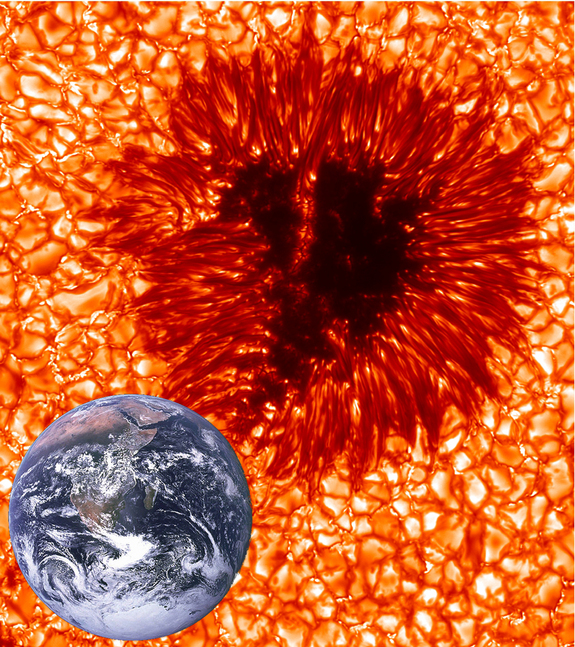
Sunspots appear dark because they are cooler than the rest of the solar surface.  From posting by Space.com: “The dark, heart of a sunspot, called the umbra, is surrounded by a brighter edge know as the penumbra, which is made of numerous dark and light filaments more than 1,200 miles long.   They are relatively thin at approximately 90miles in width, making it difficult to resolve the detail of how they arise.

A photo of a sunspot taken in May 2010, with Earth shown to scale. The image has been colorized for aesthetic reasons. This image with 0.1 arcsecond resolution from the Swedish 1-m Solar Telescope represents the limit of what is currently possible in terms of spatial resolution.

Now scientists have discovered these columns are rapid downflows and upflows of gas, matching recent theoretical models and computer simulations suggesting these filaments are generated by the movement of hot and cold gases known as convective flow.

The researchers used the Swedish 1-meter Solar Telescope to focus on a sunspot on May 23, 2010. They found dark downflows of more than 2,200 miles per hour (3,600 kph) and bright upflows of more than 6,600 miles per hour (10,800 kph). The models suggest that columns of hot gas rise up from the interior of the sunspot, widen, cool and then sink downward while rapidly flowing outward.

Solar Cycle 24-A Game Changer Revisited


On the 14th of June at the AAS conference in Las Cruces,  a group of scientist from the National Solar Observatory (NSO) suggested that the familiar sunspot cycle may be shutting down.   They observed that the spots were fading (weaker), that the current Cycle 24 was showing fewer spots and that Cycle 25 was behind the normal schedule in its formation.

Sunspots have been recorded for hundreds of years and they are a very visible proxy for solar activity.  Solar activity is also visible in the numbers and strength of flares and coronal mass ejections (CME).  The solar cycle is nominally about 11 years in duration.  It begins with a relatively quiet sun and then there is a ramping up of sunspots, etc. maximizing  about half way through a cycle.   At this time the Sun’s north and south magnetic poles “flip” and sunspots, etc. begin ramping down to a relatively quiet Sun.

Drs.Frank  Hill  of the NSO explains that he and his team are using “helioseismology to measure sun-wide oscillations of the solar surface”.   Sound waves of extremely low frequency that emanate from deep within the Sun induce up-and-down oscillations in the sun’s outer gas layer. Measurements of these surface motions can be used to make maps of solar surface velocity, called Dopplergrams, from which physical conditions such as temperature, composition and the interior magnetic field can be inferred.  Dr. Hill reported on “a jet-stream-like flow within the sun that they have been monitoring since 1995 using helioseismology.

The stream, which is coincident with the sunspots, has an east-west zonal flow inside the Sun at about 4000 miles beneath the Sun’s surface.   The following figure presented at the Conference is illustrative of what Hill and his team have discovered.

The annotated chart’s  yellow and red bands trace the solar jet streams.  The black contours denote sunspot activity.   Cycle 24 (the current cycle) streams can be seen beginning about 1998-1999 at about 60° lattitude north and south.  These streams begin converging toward the equator.  At about 22°, sunspot activity begins.  Ultimately the streams will reach the equator at a time of solar maximum.  See Cycle 24 and the Butterfly Diagram for more on this.

The stream that began at the 60° latitude splits with part of it going toward the poles and the other part toward the equator.

Note that Cycle 23 stream heading for the equator was more active when it reached approximately 22°  than is Cycle 24 and that the angle of approach to the equator was steeper than that currently occurring in Cycle 24.   Dr Hill reports that it took  3 years for Cycle 24 to cover a ten-degree range that only took 2 years for Cycle 23.   Thus Cycle 24 is “slower” than Cycle 23.

The determination of this magnetic jet stream was first made by the   instrumentation on the SOHO satellite launched  December 2, 1995 using  a Michelson Doppler Imager.  It was replaced by a Helioseismic and Magnetic Imager (HMI) in Feb 2010 on a Solar Dynamics Observation satellite.  The HMI is said to be many time more sensitive and it will report almost continuously.    The unit uses a 16 million-pixel camera  configured to show blue images where the Sun’s  oscillations are moving the surface toward the HMI camera and red when it moves away.  The satellite is in orbit about 22,000 miles above the Earth’s surface at about the point where the Sun’s and the Earth’s gravitational pull are equal.

Richard Altrock, manager of the Air Force’s coronal research program has observed that the remnants of the magnetic jet stream go poleward as far as 85° where they die.

Returning to the figure it can be noted that Cycle 24 magnetic jet stream was forming in the 1998-2000 timeframe.   Noted on the figure is “Cycle 25??? 2019? 2030?”. Dr Hill points out that the magnetic jet stream for Cycle 25 should have been forming already but there is no sign of it yet.  The press release for regarding this situation suggests that: Cycle 25 will be greatly reduced or may not happen at all.

Latter, I will post on the work by Matt Penn and William Livingston that shows a weakening trend in the strength of the sunspots.

So what do we make of this?  Because of the satellite programs underway in the US and Europe primarily, we are probably doubling our knowledge of the Sun every few year.  But we still don’t know much about the Sun.  Reading the postings on this topic leads me to believe that the solar experts are not of one mind on the idea that this means the climate is about to get much cooler.
My bias is to say that we are going to see years of global cooling.  I say that based upon the reconstructed history of the Maunder and other minimums.  The only good thing I believe that can come from a period of cooling is to put a stake in the heart of the corrupt science that is the AGW theory.  I am not sure we can say with any certainty that more CO2 in the atmosphere and perhaps more naturally caused global warming is a bad thing. Who is to say that 2 or 3 more degrees would be bad.  Only the models in their ignorance are sure of this.  But extended cold could cause a lot of starvation.  Lets hope this does not happen.

So,  stayed tuned.

cbdakota

Ideology vs Economics-Feds Plan to Buy 116 Electric Cars


Obama plans to buy some $4plus million dollars on Electric Vehicles to save $116 thousand annual fuel cost.  USA Today reports that the Obama Administration is planning on buying 116 electric vehicles and installing charging stations in five cities.

The usual ideology that the country needs to boost alternatively powered vehicles to reduce CO2 emissions and reduce foreign crude oil use is in play here.  This administration’s devotion to the man-made global warming theory is going to drive us to third world status if we don’t vote them out of power at the next election.

Based on Consumer Report’s analysis, the government would be better off to buy a Prius at half the cost and the Prius gets better mileage.  On March 3, 2011 USA Today posted the following:

Consumer Reports magazine offers its initial assessment of the two reigning wondercars of our times, the Chevrolet Volt and Nissan Leaf, in its April issue and finds both may not be such good deals after all.

Not only has Consumer Reports’ test car been coming in at the low end of the electric-only mileage range — 23 to 28 miles, not 25 to 50 miles as billed — before the gasoline power kicks in, but CR had to pay over list to the get the car. It says it had to pay $48,700 — full price plus options and a $5,000 windfall to the dealer.

It gets worse. CR figures the cost of recharging the Volt would work out to about 5.7 cents a mile for electric mode and 10 cents a mile for gas. Yet a Toyota Prius, which gets about 50 miles a gallon, would cost 6.8 cents a mile to operate. A Prius costs half as much as a Volt.

Using the Consumer Report price of $48,700 and a Prius price of nominally $28,000, the extra cost for getting the Volt would be about $20,000 per car. Is the actual price of the Volt $48thou versus the MSRP of $41thou?     The Los Angles Times reports that some Volt dealers are inflating the selling prices “more than $20,000 above GMs suggested retail price of $41,000”.

Using the difference in the purchase price, $20,000×116= $2.3 million premium for the same (or possibly worse) gas mileage. There is also a cost for the charging stations.    Chuck Rogers in an American Thinker posting estimated the five charging stations at…. “$75,000, including any and all land purchase or site lease costs.
Roughly we have about $2.4million dollars premium to save the same amount of annual fuel costs that could be achieved by buying the same number of Prius.  (Are more than one Prius, Prii?)

Ok, so “buy US” is a good thing for our government to do.  But my guess is that the Chevy Cruise would be a better buy.   Ideology gets in the way of common sense.

Cbdakota


SOLAR CYCLE 24 and the SUNSPOT BUTTERFLY DIAGRAM


I posted Solar Cycle 24- A Game Changer? which discussed the weak cycle 24 and what it might mean in terms of a cooler global climate.  As the posting was getting quite long, I elected to leave out the Butterfly Diagram for later posting.  So, now is later.

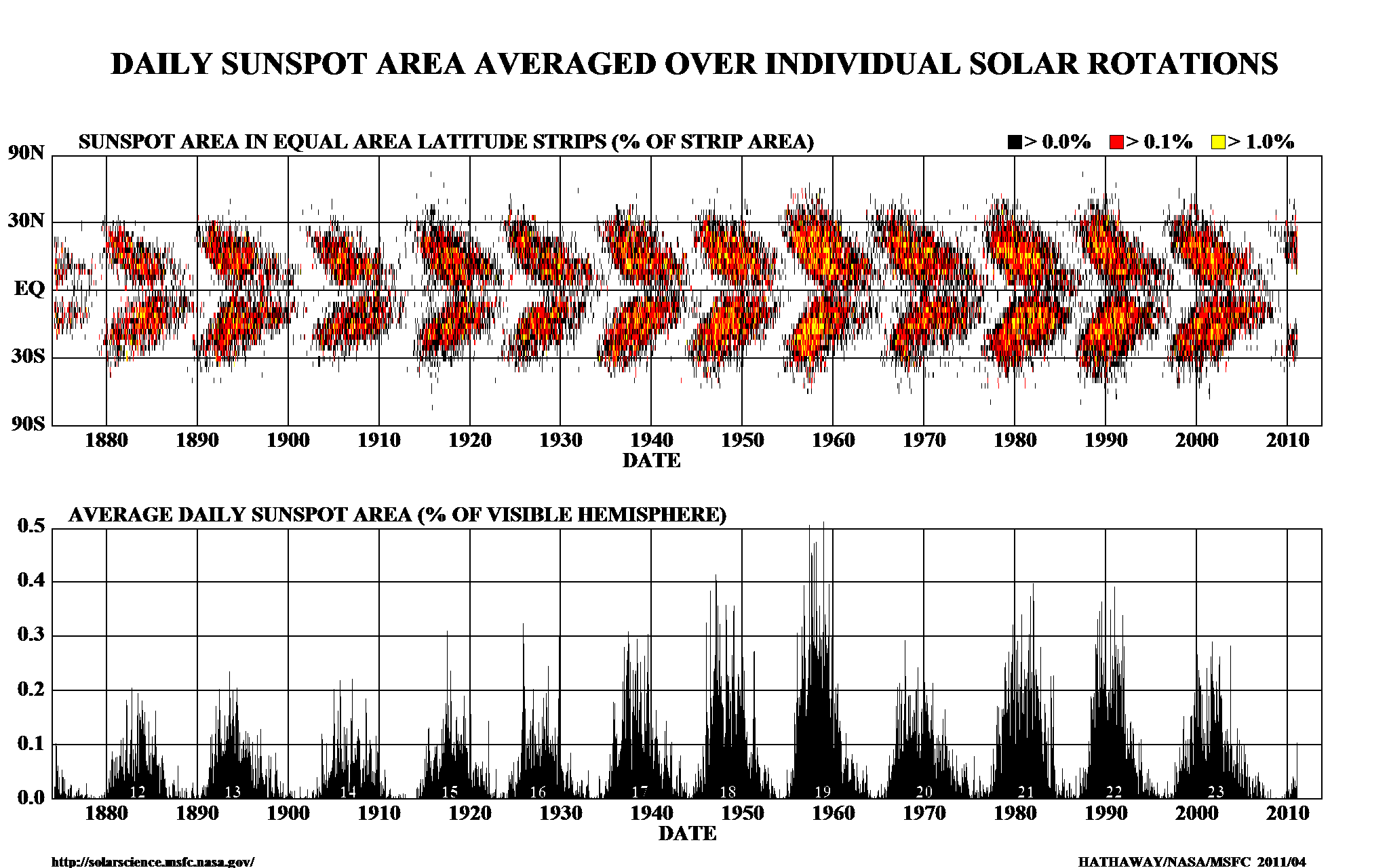
Cycle 24 is the plot just beginning now, 2010 and 2011.  The leftmost “butterfly” is Cycle 11.  (click on the chart to enlarge)

This figure is sometimes known as the Maunder Butterfly Chart as Maunder seems to be the first person to recognize the unique pattern formed by plotting the position of the sunspots on the face of the sun versus time.  When a new solar cycle begins, the sunspots become numerous.  In the beginning they appear away from the equator at about 35 degrees south and 35 degrees north.   With time the spots begin to converge at the equator.  When the “minimum” occurs, the spots  are basically upon the equator.

The butterfly chart for Cycle 24 is perhaps  showing sunspot formations that are relatively fewer than in recent Cycles 22 and 23.  Cycle 24 seems to resemble cycles that occurred many years ago.  If you occasionally check the progress of the spots toward the equator, you might be able to make a good guess on the length of Cycle 24.   Will it be much less than the average of 11 years?  The experts probably have a better feel than we amateurs,  but I am pretty sure that they would not bet the farm on their feel.

There is an interesting paper “First Solar Butterfly Diagram from Schwabe’s Observations 1825 1867” by Rainer Arlt and Anastasia Abdolvand, This paper uses the spots recorded by Schwabe during the named period to assemble butterfly diagrams for Cycles 7, 8 , 9  and 10.  These are the butterfly diagrams that immediately precede those in my first chart.  Cycle 8 was a weak cycle according to the authors.

cbdakota

Joanne Nova’s Guide to the Skeptic’s World.


Many in our country believe in the theory of man-made global warming.  They are busy with their own lives and problems and don’t have time to get informed to make their own judgment.   Others have just left school, high school or college, where the “educators”—many ill informed—have been preaching the theory to them.   Moreover, they often believe this because the media really only prints articles which are supportive of that theory

Yet the tide is turning against those who want us to believe that we must act quickly to prevent a global catastrophe.   How is it possible then, that in the face of the media barrage, and the educators, more people are becoming skeptical of what they are being told?

One reason, besides our citizen’s inherent common sense, is the internet’s unpaid (most of them anyway) cadre of skeptics that are providing factual discussions on the theory.  This information allows them to look at both sides of the issue.    One of the very best is Joanne Nova—A brilliant and prolific writer.

Nova has a posting “New Here? The “ten second” guide to the world of skeptics.”  I guess she put quotation marks around ten seconds, cause it will take you longer than that to read through the posting .  But I can’t think of anything that will get you up to speed regarding  most of the issues around the theory of man-made global warming faster or more comprehensively.

She tells you who is outspending Big Oil and by how much.

She illustrates why the banking community is so gung ho about the theory.

She points out how unscientific  the “scientific” underpinnings of the theory are.

She discusses climate history.

Etc.

Her posting is full of links that support her position.  If you don’t read them on the first time through the posting,  do it  at the time of your  second or third reading .

After that, you will be better able to navigate the murky waters of the man-made global warming theory and dig deeper into the science of this issue.  I bet you will come down on the side of the skeptics as your knowledge matures.

cbdakota