Climate Modelers are Wizard of Oz’s Spawn


If you look closely, it’s not demonstrated science but the climate models that are the basis for all the forecasts of catastrophe will result from manmade global warming.  The models, cited by the IPCC in their reports, supposedly demonstrated that the global temperatures recorded from 1978 to 1998 could only have occurred because of additional atmospheric CO2 from the increased use of fossil fuels.  Thus we are to believe that they have modeled the atmosphere so when the models look to the future they must give accurate projections.

But we know that these same models do not forecast worth a damn.  How can it be the models that all showed agreement with the past don’t get the future right? But perhaps more importantly why is it that the future forecasts don’t agree with one another.  That mystery is explain by Warren Meyer in his 9 June 2011 posting in Forbes:

When I looked at historic temperature and CO2 levels, it was impossible for me to see how they could be in any way consistent with the high climate sensitivities that were coming out of the IPCC models.  

My skepticism was increased when several skeptics pointed out a problem that should have been obvious.  The ten or twelve IPCC climate models all had very different climate sensitivities — how, if they have different climate sensitivities, do they all nearly exactly model past temperatures?  If each embodies a correct model of the climate, and each has different climate sensitivity, only one (at most) should replicate observed data.  But they all do. 

The answer to this paradox came in a 2007 study by climate modeler Jeffrey Kiehl. To understand his findings, we need to understand a bit of background on aerosols. Aerosols are man-made pollutants, mainly combustion products, which are thought to have the effect of cooling the Earth’s climate.

What Kiehl demonstrated was that these aerosols are likely the answer to my old question about how models with high sensitivities are able to accurately model historic temperatures.  When simulating history, scientists add aerosols to their high-sensitivity models in sufficient quantities to cool them to match historic temperatures.  Then, since such aerosols are much easier to eliminate as combustion products than is CO2, they assume these aerosols go away in the future, allowing their models to produce enormous amounts of future warming.

Specifically, when he looked at the climate models used by the IPCC, Kiehl found they all used very different assumptions for aerosol cooling and, most significantly, he found that each of these varying assumptions were exactly what was required to combine with that model’s unique sensitivity assumptions to reproduce historical temperatures.  In my terminology, aerosol cooling was the plug variable.

The problem, of course, is that matching history is merely a test of the model — the ultimate goal is to accurately model the future, and arbitrarily plugging variable values to match history is merely gaming the test, not improving accuracy.

This is why, when run forward, these models seldom do a very credible job predicting the future.  None, for example, predicted the flattening of temperatures over the last decade.  And when we look at the results of these models, or at least their antecedents, from twenty years ago, they are nothing short of awful.  NASA’s James Hansen famously made a presentation to Congress in 1988 showing his model runs for the future, all of which show 2011 temperatures well above what we actually measure today.

Meyer adds that: “Rather than real science, the climate models are in some sense an elaborate methodology for disguising our uncertainty.  They take guesses at the front-end and spit them out at the back-end with three-decimal precision.  In this sense, the models are closer in function to the light and sound show the Wizard of Oz uses to make himself seem more impressive, and that he uses to hide from the audience his shortcomings.”

So there we have it, the modelers jigger the system with enough variables to have the predetermined variables such as the positive feedback that boosts CO2 effect by a multiple of 3 or 4 be over ridden when doing the back cast and then drop the jiggering (in this case, aerosols) for future forecasts.

cbdakota

“Cheshire Cat Sunspots”-Livingston and Penn


Future sunspots may behave like the Cheshire Cat“the smile is there (magnetic fields) but the body is missing (no dark markings)“.   Dr Bill Livingston and Dr Matt Penn of the National Solar Observatory have been recording the average magnetic field strength of sunspots for the past 13 years.  What they have found is a decline of about 50 gauss per year during Cycle 23 and continuing in Cycle 24.   See their chart below:

Typical sunspot magnetic field strength registers about “2500 to 3500 gauss” based upon their research.  But Cycle 24 spots are running about 2000 gauss and Livingston and Penn are estimating that if the sunspot field strength drops to 1500 gauss: “the spots will largely disappear as the magnetic field is no longer strong enough to overcome forces on the solar surface.”   That could occur in the next ten years, coinciding with Cycle 25.

Traditionally the measurements of sunspots seem to have focused on visible light and magnetic flux.  Livingston and Penn emphasized the sunspot IR and magnetic field strength and that has brought a new perspective which seems to correlate with the other recent discoveries that were announced on 14 June 2011 at the AAS meeting in Las Cruces NM.

Dr Leif Svalgaard used Livingston and Penn data to illustrate the interrelationship of the magnetic field strength and visibility.

The pink line is visibility where 1 means invisibility.  This “visibility/invisibility” is somewhat perverse.  The spot (black) will no longer be seen because its temperature at the Sun’s surface is essentially the same as the surrounding gases. The black line is magnetic field strength.

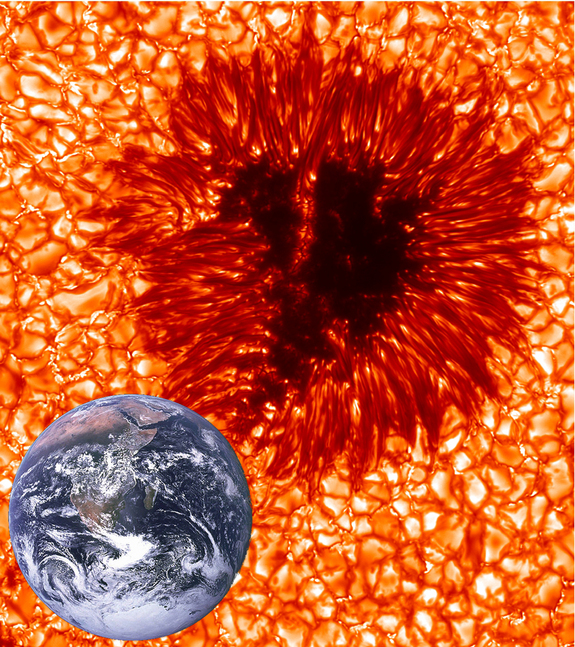
Sunspots appear dark because they are cooler than the rest of the solar surface.  From posting by Space.com: “The dark, heart of a sunspot, called the umbra, is surrounded by a brighter edge know as the penumbra, which is made of numerous dark and light filaments more than 1,200 miles long.   They are relatively thin at approximately 90miles in width, making it difficult to resolve the detail of how they arise.

A photo of a sunspot taken in May 2010, with Earth shown to scale. The image has been colorized for aesthetic reasons. This image with 0.1 arcsecond resolution from the Swedish 1-m Solar Telescope represents the limit of what is currently possible in terms of spatial resolution.

Now scientists have discovered these columns are rapid downflows and upflows of gas, matching recent theoretical models and computer simulations suggesting these filaments are generated by the movement of hot and cold gases known as convective flow.

The researchers used the Swedish 1-meter Solar Telescope to focus on a sunspot on May 23, 2010. They found dark downflows of more than 2,200 miles per hour (3,600 kph) and bright upflows of more than 6,600 miles per hour (10,800 kph). The models suggest that columns of hot gas rise up from the interior of the sunspot, widen, cool and then sink downward while rapidly flowing outward.

Solar Cycle 24-A Game Changer Revisited


On the 14th of June at the AAS conference in Las Cruces,  a group of scientist from the National Solar Observatory (NSO) suggested that the familiar sunspot cycle may be shutting down.   They observed that the spots were fading (weaker), that the current Cycle 24 was showing fewer spots and that Cycle 25 was behind the normal schedule in its formation.

Sunspots have been recorded for hundreds of years and they are a very visible proxy for solar activity.  Solar activity is also visible in the numbers and strength of flares and coronal mass ejections (CME).  The solar cycle is nominally about 11 years in duration.  It begins with a relatively quiet sun and then there is a ramping up of sunspots, etc. maximizing  about half way through a cycle.   At this time the Sun’s north and south magnetic poles “flip” and sunspots, etc. begin ramping down to a relatively quiet Sun.

Drs.Frank  Hill  of the NSO explains that he and his team are using “helioseismology to measure sun-wide oscillations of the solar surface”.   Sound waves of extremely low frequency that emanate from deep within the Sun induce up-and-down oscillations in the sun’s outer gas layer. Measurements of these surface motions can be used to make maps of solar surface velocity, called Dopplergrams, from which physical conditions such as temperature, composition and the interior magnetic field can be inferred.  Dr. Hill reported on “a jet-stream-like flow within the sun that they have been monitoring since 1995 using helioseismology.

The stream, which is coincident with the sunspots, has an east-west zonal flow inside the Sun at about 4000 miles beneath the Sun’s surface.   The following figure presented at the Conference is illustrative of what Hill and his team have discovered.

The annotated chart’s  yellow and red bands trace the solar jet streams.  The black contours denote sunspot activity.   Cycle 24 (the current cycle) streams can be seen beginning about 1998-1999 at about 60° lattitude north and south.  These streams begin converging toward the equator.  At about 22°, sunspot activity begins.  Ultimately the streams will reach the equator at a time of solar maximum.  See Cycle 24 and the Butterfly Diagram for more on this.

The stream that began at the 60° latitude splits with part of it going toward the poles and the other part toward the equator.

Note that Cycle 23 stream heading for the equator was more active when it reached approximately 22°  than is Cycle 24 and that the angle of approach to the equator was steeper than that currently occurring in Cycle 24.   Dr Hill reports that it took  3 years for Cycle 24 to cover a ten-degree range that only took 2 years for Cycle 23.   Thus Cycle 24 is “slower” than Cycle 23.

The determination of this magnetic jet stream was first made by the   instrumentation on the SOHO satellite launched  December 2, 1995 using  a Michelson Doppler Imager.  It was replaced by a Helioseismic and Magnetic Imager (HMI) in Feb 2010 on a Solar Dynamics Observation satellite.  The HMI is said to be many time more sensitive and it will report almost continuously.    The unit uses a 16 million-pixel camera  configured to show blue images where the Sun’s  oscillations are moving the surface toward the HMI camera and red when it moves away.  The satellite is in orbit about 22,000 miles above the Earth’s surface at about the point where the Sun’s and the Earth’s gravitational pull are equal.

Richard Altrock, manager of the Air Force’s coronal research program has observed that the remnants of the magnetic jet stream go poleward as far as 85° where they die.

Returning to the figure it can be noted that Cycle 24 magnetic jet stream was forming in the 1998-2000 timeframe.   Noted on the figure is “Cycle 25??? 2019? 2030?”. Dr Hill points out that the magnetic jet stream for Cycle 25 should have been forming already but there is no sign of it yet.  The press release for regarding this situation suggests that: Cycle 25 will be greatly reduced or may not happen at all.

Latter, I will post on the work by Matt Penn and William Livingston that shows a weakening trend in the strength of the sunspots.

So what do we make of this?  Because of the satellite programs underway in the US and Europe primarily, we are probably doubling our knowledge of the Sun every few year.  But we still don’t know much about the Sun.  Reading the postings on this topic leads me to believe that the solar experts are not of one mind on the idea that this means the climate is about to get much cooler.
My bias is to say that we are going to see years of global cooling.  I say that based upon the reconstructed history of the Maunder and other minimums.  The only good thing I believe that can come from a period of cooling is to put a stake in the heart of the corrupt science that is the AGW theory.  I am not sure we can say with any certainty that more CO2 in the atmosphere and perhaps more naturally caused global warming is a bad thing. Who is to say that 2 or 3 more degrees would be bad.  Only the models in their ignorance are sure of this.  But extended cold could cause a lot of starvation.  Lets hope this does not happen.

So,  stayed tuned.

cbdakota

Volt and the Leaf News—May Sales and Other Items


The numbers are in for sales of the Volt and the Leaf.    Leafs outsold Volts in May.  Leaf numbers were 1142, up from 573 in April.  The Volt sales in May were 481, down from the 493 in April.   Year-to-date sales of the Volt are 2184 while the Leaf’s total is 2167.

The US sales goal for the Leaf was originally set at 20,000 in 2011.   They now are estimating between 10,000 and 12,000 this year.  Nissan began accepting “reservation” in April 2010.  You had to submit $99 to be put on the list.  Nissan stopped accepting reservations in September when they had reached 20,000.   They now report that only about half are resulting in sales.   Nissan say there are many reasons why only about half are resulting in purchases.   To read the full report and the reasons,  click here.

And lastly,  some disturbing news regarding the Leaf.  Apparently some of them wont start.   Torque News posting about this problem is as follows:

Since Nissan hasn’t determined the exact cause of the Leaf electric vehicles that won’t start, the automaker has not yet decided whether they will issue a safety bulletin but if the problem continues to grow and they cannot discover a fix – a recall could be in order even though this issue doesn’t propose a direct safety issue. Right now, reports indicate that the company is looking at both the electrical components and programming involved with the air conditioning system but the longer it takes Nissan to figure out what is causing the no-start issues and how to address them, the consumer perception of the Leaf could take a massive hit.

cbdakota

Ideology vs Economics-Feds Plan to Buy 116 Electric Cars


Obama plans to buy some $4plus million dollars on Electric Vehicles to save $116 thousand annual fuel cost.  USA Today reports that the Obama Administration is planning on buying 116 electric vehicles and installing charging stations in five cities.

The usual ideology that the country needs to boost alternatively powered vehicles to reduce CO2 emissions and reduce foreign crude oil use is in play here.  This administration’s devotion to the man-made global warming theory is going to drive us to third world status if we don’t vote them out of power at the next election.

Based on Consumer Report’s analysis, the government would be better off to buy a Prius at half the cost and the Prius gets better mileage.  On March 3, 2011 USA Today posted the following:

Consumer Reports magazine offers its initial assessment of the two reigning wondercars of our times, the Chevrolet Volt and Nissan Leaf, in its April issue and finds both may not be such good deals after all.

Not only has Consumer Reports’ test car been coming in at the low end of the electric-only mileage range — 23 to 28 miles, not 25 to 50 miles as billed — before the gasoline power kicks in, but CR had to pay over list to the get the car. It says it had to pay $48,700 — full price plus options and a $5,000 windfall to the dealer.

It gets worse. CR figures the cost of recharging the Volt would work out to about 5.7 cents a mile for electric mode and 10 cents a mile for gas. Yet a Toyota Prius, which gets about 50 miles a gallon, would cost 6.8 cents a mile to operate. A Prius costs half as much as a Volt.

Using the Consumer Report price of $48,700 and a Prius price of nominally $28,000, the extra cost for getting the Volt would be about $20,000 per car. Is the actual price of the Volt $48thou versus the MSRP of $41thou?     The Los Angles Times reports that some Volt dealers are inflating the selling prices “more than $20,000 above GMs suggested retail price of $41,000”.

Using the difference in the purchase price, $20,000×116= $2.3 million premium for the same (or possibly worse) gas mileage. There is also a cost for the charging stations.    Chuck Rogers in an American Thinker posting estimated the five charging stations at…. “$75,000, including any and all land purchase or site lease costs.
Roughly we have about $2.4million dollars premium to save the same amount of annual fuel costs that could be achieved by buying the same number of Prius.  (Are more than one Prius, Prii?)

Ok, so “buy US” is a good thing for our government to do.  But my guess is that the Chevy Cruise would be a better buy.   Ideology gets in the way of common sense.

Cbdakota


SOLAR CYCLE 24 and the SUNSPOT BUTTERFLY DIAGRAM


I posted Solar Cycle 24- A Game Changer? which discussed the weak cycle 24 and what it might mean in terms of a cooler global climate.  As the posting was getting quite long, I elected to leave out the Butterfly Diagram for later posting.  So, now is later.

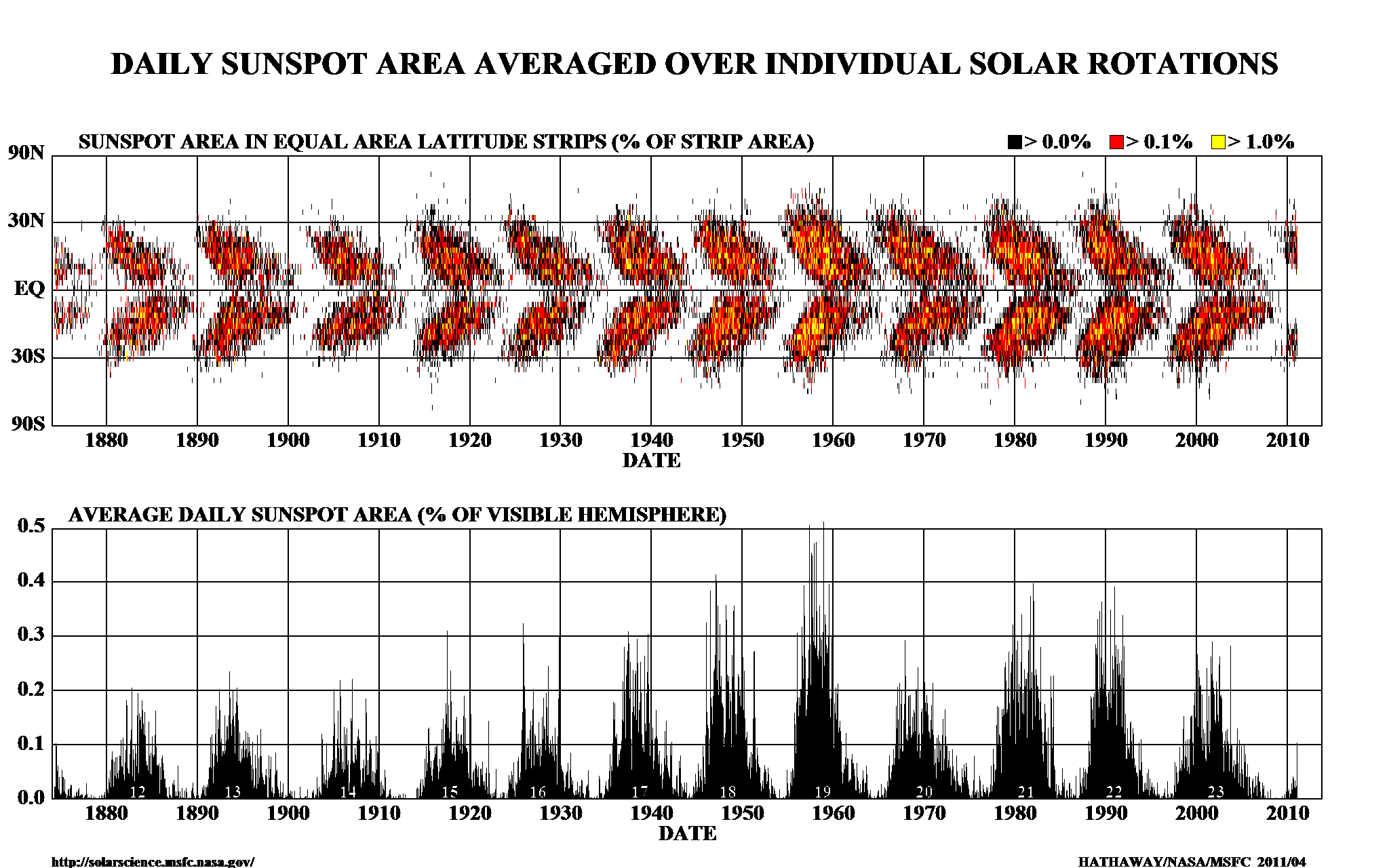
Cycle 24 is the plot just beginning now, 2010 and 2011.  The leftmost “butterfly” is Cycle 11.  (click on the chart to enlarge)

This figure is sometimes known as the Maunder Butterfly Chart as Maunder seems to be the first person to recognize the unique pattern formed by plotting the position of the sunspots on the face of the sun versus time.  When a new solar cycle begins, the sunspots become numerous.  In the beginning they appear away from the equator at about 35 degrees south and 35 degrees north.   With time the spots begin to converge at the equator.  When the “minimum” occurs, the spots  are basically upon the equator.

The butterfly chart for Cycle 24 is perhaps  showing sunspot formations that are relatively fewer than in recent Cycles 22 and 23.  Cycle 24 seems to resemble cycles that occurred many years ago.  If you occasionally check the progress of the spots toward the equator, you might be able to make a good guess on the length of Cycle 24.   Will it be much less than the average of 11 years?  The experts probably have a better feel than we amateurs,  but I am pretty sure that they would not bet the farm on their feel.

There is an interesting paper “First Solar Butterfly Diagram from Schwabe’s Observations 1825 1867” by Rainer Arlt and Anastasia Abdolvand, This paper uses the spots recorded by Schwabe during the named period to assemble butterfly diagrams for Cycles 7, 8 , 9  and 10.  These are the butterfly diagrams that immediately precede those in my first chart.  Cycle 8 was a weak cycle according to the authors.

cbdakota

Joanne Nova’s Guide to the Skeptic’s World.


Many in our country believe in the theory of man-made global warming.  They are busy with their own lives and problems and don’t have time to get informed to make their own judgment.   Others have just left school, high school or college, where the “educators”—many ill informed—have been preaching the theory to them.   Moreover, they often believe this because the media really only prints articles which are supportive of that theory

Yet the tide is turning against those who want us to believe that we must act quickly to prevent a global catastrophe.   How is it possible then, that in the face of the media barrage, and the educators, more people are becoming skeptical of what they are being told?

One reason, besides our citizen’s inherent common sense, is the internet’s unpaid (most of them anyway) cadre of skeptics that are providing factual discussions on the theory.  This information allows them to look at both sides of the issue.    One of the very best is Joanne Nova—A brilliant and prolific writer.

Nova has a posting “New Here? The “ten second” guide to the world of skeptics.”  I guess she put quotation marks around ten seconds, cause it will take you longer than that to read through the posting .  But I can’t think of anything that will get you up to speed regarding  most of the issues around the theory of man-made global warming faster or more comprehensively.

She tells you who is outspending Big Oil and by how much.

She illustrates why the banking community is so gung ho about the theory.

She points out how unscientific  the “scientific” underpinnings of the theory are.

She discusses climate history.

Etc.

Her posting is full of links that support her position.  If you don’t read them on the first time through the posting,  do it  at the time of your  second or third reading .

After that, you will be better able to navigate the murky waters of the man-made global warming theory and dig deeper into the science of this issue.  I bet you will come down on the side of the skeptics as your knowledge matures.

cbdakota

SOLAR CYCLE 24–A Game Changer?


The current solar cycle 24 might be a game changer in the global climate debate.   It is showing early signs of reaching the solar Maximum in two short years.  Solar Maximums on average occur some 5 to 6 years in to a typical 11-year cycle.

The Sun has a cycle of about 11 years from minimum to maximum and back to minimum magnetic activity.  This cycle can be observed by the numbers of sunspots formed on the surface of the Sun.  During a cycle, the sunspot numbers increase, flares are common and coronal mass ejections occur until the Sun’s polarity “flips”.   This usually is the point at which the so-called solar maximum is reached. The activity on the Sun begins to decrease.  The cycle eventually reaches a point where very few sunspots are observed.  This is the completion of a cycle.

The chart below shows the magnetic fields of several previous solar cycles and the current cycle 24.  The North polar field is nearing the zero on its way to swapping sides with the south polar field.  Note, also, that the magnitude of cycle 24’s field is not as large as the previous cycles.

Chart Source:   http//wso.stanford.edu

Cycle 24 has been a maverick.  Initially the solar cycle gurus said it would perform about the same as the previous two cycles—22 and 23.  However it did not seem to want to begin and when it did, it has under preformed expectations so significantly that the performance forecast has had to be lowered many times.   Cycle 24 has more in common with cycles of years ago that also exhibited reduced solar activity.  These cycles coincided with global cooling.

Galileo began counting sunspots in 1610.  Daily counting began  1749.   From 1645 to 1715, there were very few sunspots.  This period is known as the Maunder Minimum.   Few sunspots were visible during the period from 1790 until 1830. This period is known as the Dalton Minimum. Corresponding to the period of time that included the Maunder and the Dalton Minimums, the Earths climate was comparatively cool.  The climatic period, know as the “Little Ice Age” lasted from 1450 until 1820.  The chart below shows correlation between sunspots and the Minimums.

  (The chart shows non-systematically collected  sunspot numbers in red. Systematically collected observation spots are in blue.)
Chart courtesy of Robert A Rohde for Global Warming Art

Here is the current plot of sunspot count for cycle 24.   Also note how low the forecast of peak sunspot activity is compared to the previous cycle. Click Chart for clarity.

The “predicted values”  would indicate that the cycle 24 maximum will occur in 2013.   After a big jump in March,  the April count is heading down and so far the May sunspot count is rather low.

So, solar activity for cycle 24 is quite low compared to recent cycles.    But can we be sure that cycle 24 wont become very active?  No we can’t.  Can we be sure that if cycle 24 is short (less than 11 years) the climate will cool off?  No we can’t.    What we can say is that low solar activity appears to correlate with a cooler climate.

Why would a less active Sun result in lower global temperature?  The amount of radiation from the Sun to Earth does not vary much year to year.  No one knows for certain if the variation is enough to raise or lower global temperatures.  The Sun’s magnetic field weakens when the Sun is less active. Some theorize that this lets in cosmic rays and that these rays form low altitude clouds.  Low altitude clouds do lower the Earth’s temperature.  My philosophy is:  Even though the exact mechanism linking the Sun and global change has not been definitely established,  it is kind of like gravity–it is obvious.  If cycle 24 continues on its current track, we may see more confirmation that low activity correlates with cooler weather.  We will have to wait for several years to know.  Stay tuned.

cbdakota

A RE-VOLT-ING DEVELOPMENT


Even in the face of high gasoline prices, Volt sales dropped from 608 cars in March to 493 in April.    The year-to-date sales of the Volt are 1703.  General Motors announced that they would produce in 2011 and 2012 a total of 100,000 Volts.

In January of this year, President Obama named Jeffery Immelt, CEO General Electric, to replace Paul Volcker as the Chairman of the Council on Jobs and Competiveness.  Following the announcement, Immelt promised to buy 50,000 Volts over the next two years.   A little math says that if GE does buy half the production run of 100,000, then GM only has to find 48,297 customers for the other half in the next 20 months.  That is a 566% monthly sales increase over the current monthly sales average.

But what signals are we getting from Immelt?   According to Junk Science Immelt has signaled that jobs are going to be more important to him than a “comprehensive energy strategy”.

At an event at the Massachusetts Institute of Technology on Tuesday, Immelt said,

“If I had one thing to do over again I would not have talked so much about green… Even though I believe in global warming and I believe in the science … it just took on a connotation that was too elitist; it was too precious and it let opponents think that if you had a green initiative, you didn’t care about jobs. I’m a businessman. That’s all I care about, is jobs… I’m kind of over the stage of arguing for a comprehensive energy policy. I’m back to keeping my head down and working. [Emphasis added]

If he means what he appears to be  saying, then one might infer that he will renege on his pledge or perhaps more realistically buy many less that 50,000 Volts.

That would be re-Volt-ing development.  For GM!!

cbdakota


MONBIOT ON DISCORD IN THE GREEN RANKS


George Monbiot writes for the UK Guardian newspaper and he is perhaps the most influential green blogger in Europe.  This week, beginning with a blog on 2 May and a follow-up several days latter, he discussed the problems within the green movement.  The title of his 2 May posting is  “Let’s face it: none of our environmental fixes break the planet-wrecking project”.  His subtitle for that posting is:”All of us in the green movement are lost before the planet’s real nightmare: not too little fossil fuel—but too much”.

Monbiot is a believer in catastrophic global warming resulting from fossil fuel use (the “planet-wrecking project”).  And his preferred solution is “sustainability” which means to allocate resources and wealth across the globe while at first reducing and eventually eliminating fossil fuel use.  Ultimately world societies would become less complicated and perhaps more agrarian.  De-developing the Western societies while developing those nations that are second and third world will be necessary to accomplish this.  A tenet of sustainability is that governments will have to exercise more control to assure the outcomes.  Saying it differently, you will surrender much of your freedom to the UN or some like group.

He was hoping that fossil fuels would become less available but he laments, that is not the case.

This posting is not to dispute Mr. Monbiot’s premise of catastrophic global warming due to fossil fuel uses, but rather to examine his view of the sects within the AGW crowd and their differences in beliefs. To begin, Mr. Monbiot is not my kind of guy.   When John Bolton, our UN Ambassador, traveled to England in 2008, Monbiot wanted to arrest him and try him for war crimes. Monbiot also began a campaign to have then Prime Minister Blair taken to court on similar charges related to the Iraq war.  His thoughts on things he thinks we should be doing, IMHO, demonstrate a low level of economic reality and a love of “Big Brother”.   Although our worldviews are quite different, he is quite intelligent so we need to keep track of what he is thinking.

He begins his first posting regarding discussions with his fellow warmers like this:”You think you’re discussing technologies, and you quickly discover that you’re discussing belief systems. The battle among environmentalists over how or whether our future energy is supplied is a cipher for something much bigger: who we are, whom we want to be, how we want society to evolve. Beside these concerns, technical matters – parts per million, costs per megawatt hour, cancers per sievert – carry little weight. We choose our technology – or absence of technology – according to a set of deep beliefs: beliefs that in some cases remain unexamined”.

He makes sense when he defends his recent acceptance of nuclear energy as a vital need going forward, with or without fossil fuels: “The case against abandoning nuclear power, for example, is a simple one: it will be replaced either by fossil fuels or by renewables that would otherwise have replaced fossil fuels. In either circumstance, greenhouse gases, other forms of destruction and human deaths and injuries all rise”.

“The case against reducing electricity supplies is just as clear. For example, the Zero Carbon Britain report published by the Centre for Alternative Technology urges a 55% cut in overall energy demand by 2030 – a goal I strongly support. It also envisages a near-doubling of electricity production. The reason is that the most viable means of decarbonising both transport and heating is to replace the fuels they use with low-carbon electricity. Cut the electricity supply and we’re stuck with oil and gas. If we close down nuclear plants, we must accept an even greater expansion of renewables than currently proposed. Given the tremendous public resistance to even a modest increase in windfarms and new power lines, that’s going to be tough”.

He believes that “accommodation” (read sustainability) is the goal but he says:”But even if we can accept an expansion of infrastructure, the technocentric, carbon-counting vision I’ve favoured runs into trouble. The problem is that it seeks to accommodate a system that cannot be accommodated: a system that demands perpetual economic growth. And adds: Accommodation makes sense only if the economy is reaching a steady state”.

He has been criticized in Simon Fairlie’s posting in the magazine The Land. To which he responds:”There’s a still bigger problem here: even if we make provision for some manufacturing but, like Fairlie, envisage a massive downsizing and a return to a land-based economy, how do we take people with us? Where is the public appetite for this transition?”

Monbiot adds that:   “A third group tries to avoid such conflicts by predicting that the problem will be solved by collapse: doom is our salvation. Economic collapse, these people argue, is imminent and expiatory. I believe this is wrong on both counts”.

He then gets to his central point about too much fossil fuel: “The problem we face is not that we have too little fossil fuel, but too much. As oil declines, economies will switch to tar sands, shale gas and coal; as accessible coal declines, they’ll switch to ultra-deep reserves (using underground gasification to exploit them) and methane clathrates.

Monbiot sums up his view of the current state of the environmental movement:”All of us in the environment movement, in other words – whether we propose accommodation, radical downsizing or collapse – are lost. None of us yet has a convincing account of how humanity can get out of this mess. None of our chosen solutions break the atomising, planet-wrecking project”.

In his second posting is “The green problem: how do we fight without losing what we are fighting for?”.  It is subtitled: “Environmentalism is stuck-factional and uncertain even of the goals we seek.  But we must face facts and engage in reality.”

In this posting he expands upon the point he made in the first posting and he adds some interesting things.  He  enumerats the disagreements that he believes permeate the green community: “We have no idea what to do next. We have no idea what to do next.  Partly as a result, we have started tearing each other apart. This is an understandable but unnecessary reaction. Those seeking to protect the landscape are not our enemies; nor are those advocating that renewables should replace fossil fuel; nor are those promoting nuclear power as the answer; nor are those opposing nuclear power. We are all struggling with the same problem, all bumping up against atmospheric chemistry and physical constraints”.

“The enmity arises when people go into denial. Denial is everywhere. Those opposing windfarms find it convenient to deny that climate change is happening, or that turbines produce much electricity. Those promoting windfarms downplay the landscape impacts. Nuclear enthusiasts ignore the impacts of uranium mining. Opponents of nuclear power dismiss the solid science on the impacts of radiation and embrace wildly-inflated junk numbers instead. Primitivists decry all manufacturing industry, but fail to explain how their medicines and spectacles, scythes and billhooks will be produced. Localists rely on technologies – such as microwind and high-latitude solar power – that cannot deliver. Technocratic greens refuse to see that if economic growth is not addressed, a series of escalating catastrophes is inevitable. Romantic greens insist that the problem can be solved without even engaging in these dilemmas, yet fail to explain how else it can be done”.

“We’re all responding to the same impulses, but we’re all being tripped up by denial. Denial, and a failure to see the whole picture, are our enemies. Or perhaps, as doctors say about alcohol, our false friends”.

He cites Paul Kingsnorth’s posting titled “The quants and the poets”.   Quants are numbers/facts people and poets are people that examine societies values and underlying mythology.  Kingsnorth’s posting is very well written and he too contrasts the various divergent opinions alive in the green world today.  He believes that Monbiot is loosing his credentials as a Poet.

Monbiot responds to this quants/poets issue here: “Perhaps we are less tolerant of myth than we used to be. Perhaps we should be. Is creating new, opposing myths the best way of confronting the founding myths of neoliberal capitalism? I don’t think so. Is it not better to fight them with withering analysis, quantification and exposure? But can we do this without becoming insensible to beauty, and to the impulse – a love for the world and its people, its places and its living creatures – which turned us green in the first place? I don’t know”.

Well this has been a long post and I thank all of you that read it all the way to the end.

cbdakota