Category Archives: NASA/GISS

Mars Rover Curiosity Discovers “Paydirt”. Not Gold, But An Area Once Favorable To Organic Life


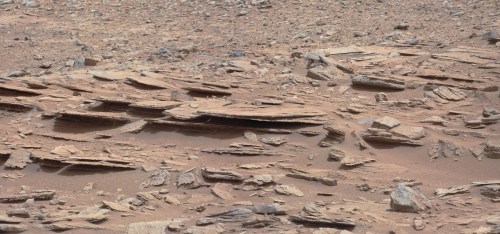
The Mars Rover Curiosity drilled in the John Klein area of Mars, (about 500 meters East of  where it landed) and the sedimentary rock samples were passed  to the on-board analyzers.  The objective was to determine if the minerals necessary to maintain life were in this sample.  Carbon, oxygen and sulfur in various forms were found.  The NASA team has concluded that the John Klein area was once a fresh water environment that would have been favorable to organic life.  Other Rovers samplings have  found areas that once contained water but the conditions were not considered suitable to support organic life.  On March 15 2013, the NASA team provided an informative video “Curiosity Rover Hits Paydirt”.  It can be seen by clicking on the link below:
cbdakota
Asteroid DA14 Passes By Earth Friday 15 Feb.


NASA provides the video animation of asteroid DA14 that passes  near-by the Earth on Friday 15 February 2013.  The asteroid will be about 17,150 miles (27,600 kilometers) above Earth’s surface.

http://www.nasa.gov/multimedia/videogallery/index.html?media_id=159813511

cbdakota

NASA Revises Cycle 24 Sunspot Prediction.


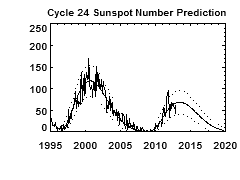
David Hathaway, NASA solar cycle expert, has a revised forecast for Solar Cycle 24 Sunspot number and Maximum timing.  In May 2012, he forecast the smoothed sunspot number maximum at 60 and the timing of the maximum as the spring of 2013.  His January 2013 Cycle 24  revised forecast is for 69 spots and maximum in the Fall of 2013.  He adds:
“ We are currently over four years into Cycle 24. The current predicted and observed size makes this the smallest sunspot cycle since Cycle 14 which had a maximum of 64.2 in February of 1906.”  
 jan13hathawayssn_predict
       Hathaway’s  NASA Revised January 2013 Sunspot Number Prediction

Mars Probe Curiosity Traverses Gale Crater


NASA has published the path that the Mars Rover, Curiosity, has taken since its August landing in the Gale Crater through the end of November, 2012.  The distance traveled is about 500 meters.  NASA says that the Gale Crater is approximately the size of Connecticut and Rhode Island combined, two small US States.  In the Center of the crater is Mount Sharp, some 3.4 miles high above the crate floor. (Click on photo to enlarge.)
curiositytravelsonMars710706main_Meyer-1-pia16577-43_946-710
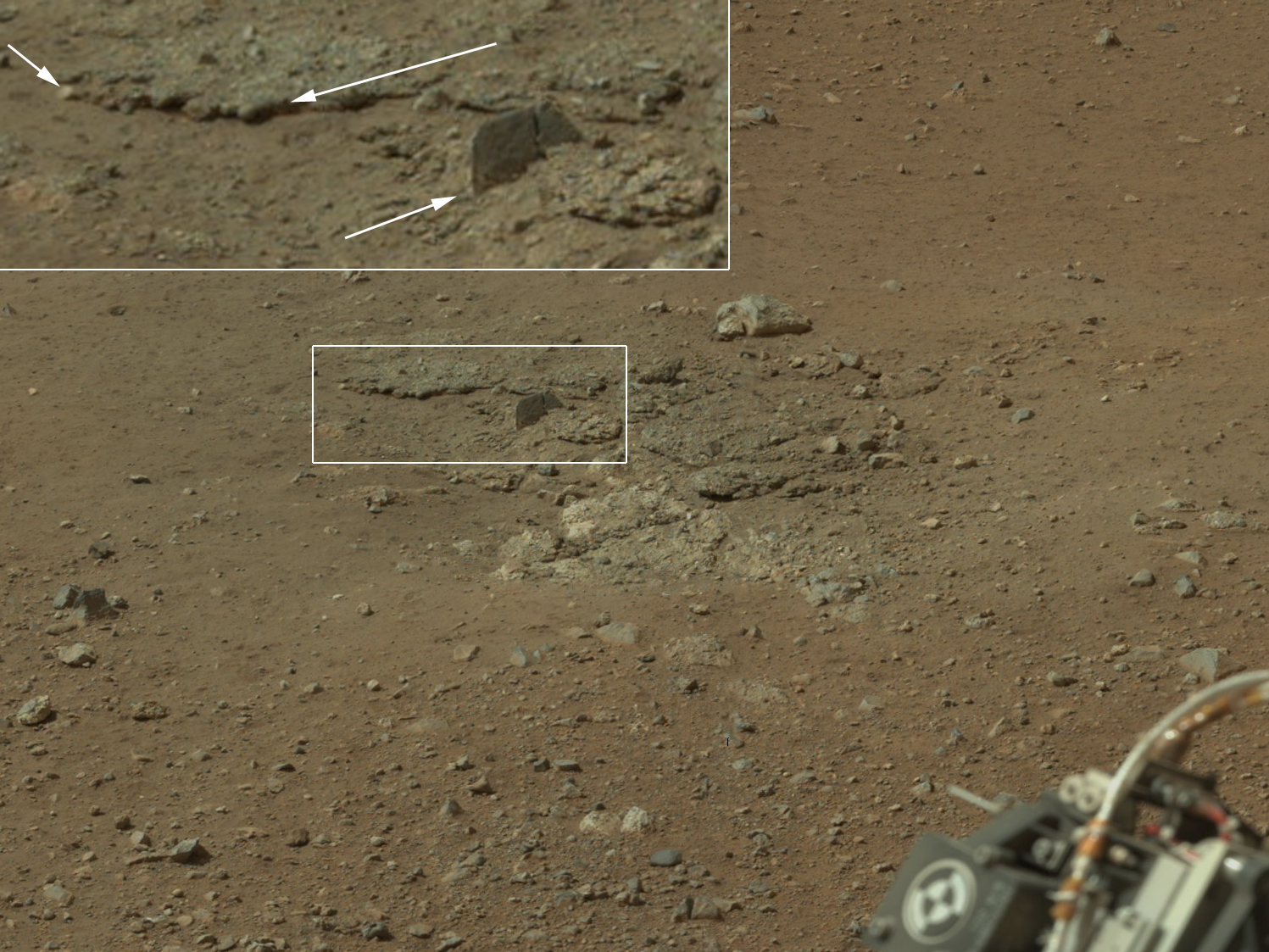
NASA tells of some of the work being done by Curiosity: “ It was at the easternmost waypoint on this map on Nov. 30, 2012. It worked on scoops of soil for a few weeks at the drift of windblown sand called “Rocknest.” The place called “Glenelg” is where three types of terrain meet. The depression called “Yellowknife Bay” is a potential location for selecting the first target rock for Curiosity’s hammering drill.”  The next target will be  Mount Sharp. 
 
 
The NASA photo below is of Glenelg.
MarscuriosityglenelgPIA16550_ip
 
To view more, click here.
cbdakota


Mayan Apocalypse And Earth’s Magnetic Field Reversal


NASA issued a bulletin that reviews the worried inquires people have made relative to the Mayan Apocalypse.  The “apocalypse” is that the Earth will end on 21 December 2012  when the Mayan 5125 year Long Count calendar ends. NASA said that a catastrophic celestial collision between Earth and the mythical planet Nibiru or  a disastrous crash with a comet are not going to happen.   Nibiru is supposed to be hiding behind the Sun. NASA says there is no planet hiding behind the Sun.  NASA also: “… rejected apocalyptic theories about unusual alignments of the planets, or that the Earth’s magnetic poles could suddenly “flip.”polarflips285px-Geomagnetic_polarity_late_Cenozoic
 
I am intrigued by the magnetic field flip. The North and South magnetic poles have flipped a number of times over the 5 billion year history of the Earth.  But generally scientists concur that the most recent flip occurred some 800,000+ years ago.  There are people that believe the magnetic poles have flipped much more recently.  One author, Robert Felix says, for example, that 11,000 years ago as well as 23,000 and 33,500 years ago, the polarity flipped.  He correlates these times with ice ages, eruptions of super volcanos and species mutations.
The legend on the chart to the right: Geomagnetic polarity during the late Cenozoic Era. Dark areas denote periods where the polarity matches today’s polarity, light areas denote periods where that polarity is reversed. (from Wikipedia–Click on chart to improve clarity)

Mars Rover Opportunity Has Been Operational Since 2004—See Photos Taken By That Rover


While the new, Mars Rover Curiosity is on everyone’s mind, Opportunity and Spirit Rovers have been on Mars since January of 2004.   Spirit’s mission was ended in May of last year after being stuck in sand for about a year. Opportunity is still operational.  Curiosity is more sophisticated than Opportunity and Spirit, but these two provided many new Martian mysteries to be solved.  NASA’s website has some of the pictures that Opportunity has taken that are full of wonder for us Earth bound.  You can see them here, and here and here.

The Mission Team for Opportunity and Spirit Rovers are to be awarded the Haley Space Flight Award.  At launch the targeted operational life of these two rovers, on Mars, was estimated at 90 days.  

cbdakota

New Panorama Photo of Mars by Curiosity


New panorama of Mars from Rover Curiosity.  To view click here.

cbdakota

NASA’s Stereo Mission Captures CME–Fastest Ever Recorded


On 23 July 2012, NASA’s Stereo **Mission spacecraft recorded a coronal mass ejection (CME).   The cloud of solar material ejected from the Sun sped out into space at a speed of “between 1,800 and 2,000 miles per second”.  That translates to about 7.2 million miles per hour or about 1.1% of the speed of light.  NASA says it is probably the fastest CME ever measured by any spacecraft.  Incredibly,  it is said that, on average,  the mass ejected into space is  1.6×10¹²kg.   A video of the  23 July CME can be seen by clicking here.

From the NASA announcement of this event:

“Measuring a CME at this speed, traveling in a direction safely away from Earth, represents a fantastic opportunity for researchers studying the sun’s effects. Rebekah Evans is a space scientist working at Goddard’s Space Weather Lab, which works to improve models that could some day be used to improve predictions of space weather and its effects. She says that the team categorizes CMEs for their research in terms of their speed, with the fastest ones – such as this one — labeled “ER” for Extremely Rare.”

**The STEREO mission consists of two spacecraft with orbits that for most of their journey give them views of the sun that cannot be had from Earth. Watching the sun from all sides helps improve our understanding of how events around the sun are connected, as well as gives us glimpses of activity we might not otherwise see.

cbdakota

Curiosity Provides Photos from Mars


NASA has posted pictures and drawings from the Curiosity Mars Rover.  There are 120 that you can see and/or download.  To see the gallery click here

Somewhat off my usual topic but I think you will enjoy the view.

cbdakota

Solar Cycle 24 Update July 2012


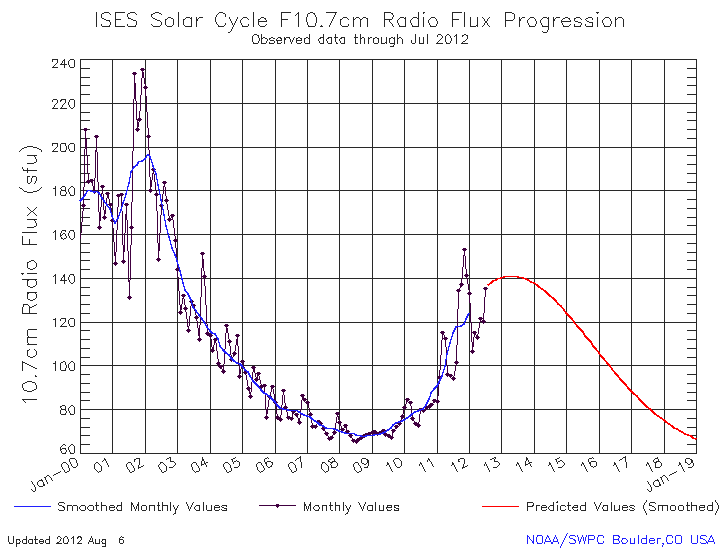
Solar Cycle24 July sunspot and F 10.7cm radio flux numbers are up slightly from June.  Pretty much in line with the activity projection and much below that of Solar Cycle 23. (Click on Graphs for Clarity)

Large Filament on the Sun

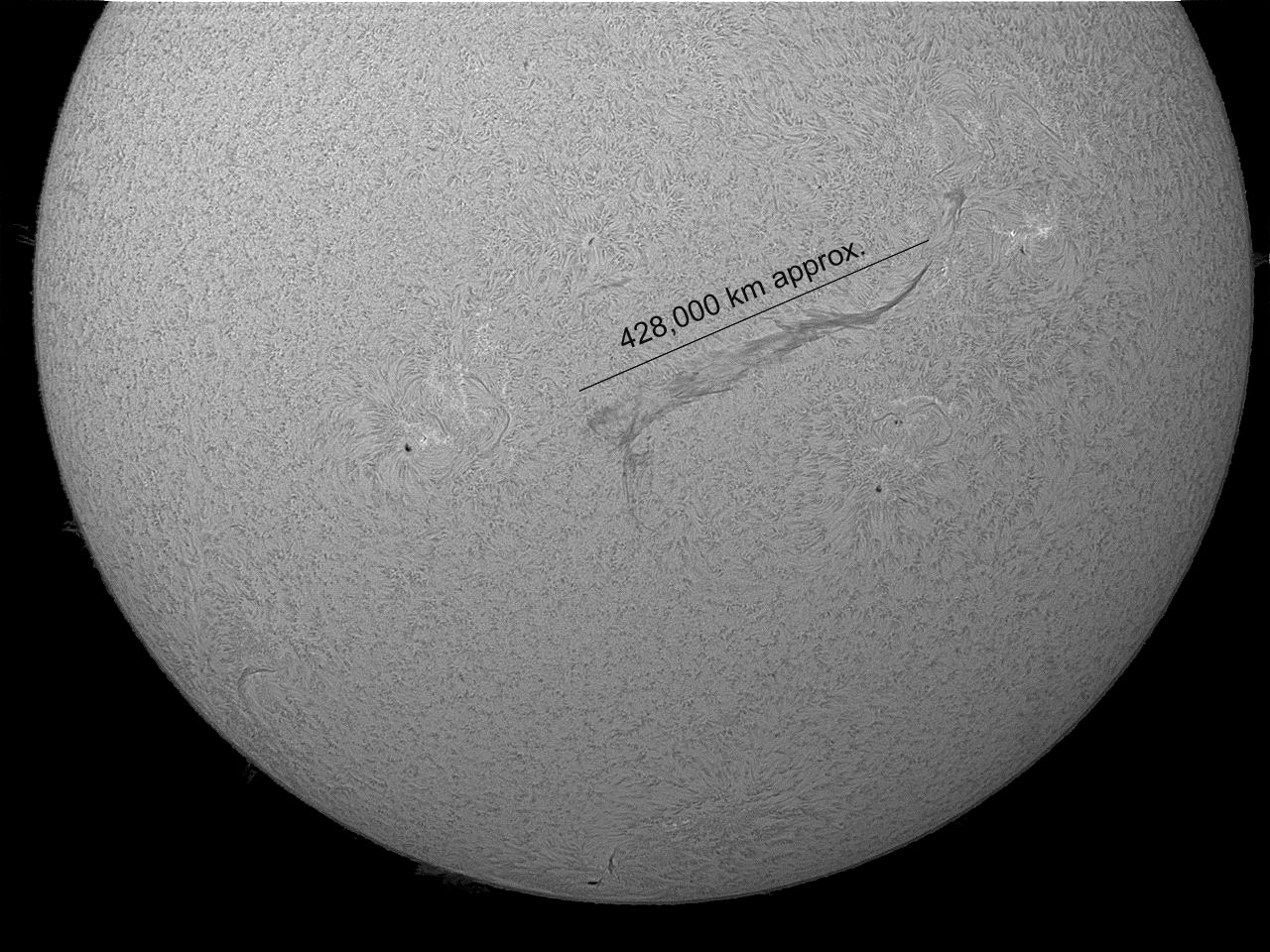
The Sun currently has a filament that stretches more that 400,000km across the face. Filaments are formed in magnetic loops that hold relatively cool, dense gas suspended above the surface of the Sun. Because they are cooler than the photosphere they can look dark.

courtesy of solarham.net

But when viewed in profile they look like a giant loop, called a prominence.

courtesy of NASA

Occasionally when these filaments collapse,  a coronal mass ejection (CME) can occur.   Because the filament is looking directly at the Earth,  a CME could cause problems.   Lets hope this does not happen.

cbdakota