The SPPI report on CO2 for November covers –Climategate; No global warming in the 20th century; Forecasts of atmospheric CO2 levels in 2100; Sea level rise in 2009; and other interesting topics. To read this report, click here.
Cbdakota

The SPPI report on CO2 for November covers –Climategate; No global warming in the 20th century; Forecasts of atmospheric CO2 levels in 2100; Sea level rise in 2009; and other interesting topics. To read this report, click here.
Cbdakota
This month’s CO2 report highlights charts of atmospheric global temperature, Ocean Heat Content, atmospheric CO2 content, sea level and additional discussions about Arctic and Antarctic sea ice, hurricane and tropical cyclone activity, a discussion of CO2 residence time in the atmosphere, etc. See full report here
Cbdakota
The “American Thinker” blog has an article by John McLaughlin that shows the weakness of the man-made global warming (AGW) theory. The article Global Warming ‘Science’ discusses the fact that the Intergovernmental Panel on Climate Change, sponsored by the UN, was ..
” Since its inception in 1988, the United Nations’ Intergovernmental Panel on Climate Change (IPCC) has sought to evaluate the risk of climate change brought about by human activity. There has never been a requirement to also evaluate potential natural causes.”
The author discusses the impact the infamous Hockey Stick Temperature Graph had on the IPCC reports.
“Their reports include a graph derived from mathematical models showing average global temperatures back to 1000 AD. The graph appears relatively flat for over 900 years. Then, about 1920, temperatures begin to rocket upward with but a brief pause around 1970 before heading still higher with no relief in sight. So startling was this graph when it first appeared, it became known as the “Hockey Stick” chart. The IPCC concluded the graph’s sudden change in character during the early 20th Century correlated with the introduction and increasing use of fossil fuel energy in that period, and that production of carbon dioxide (CO2) represented the principal man-made greenhouse gas culprit.”

The Hockey Stick Temperature Graph
(Note, no medieval warm period & the “hockey stick” jump in temperatures)
Then he walks you through the story of how the Graph was exposed as a fraud:
As political hysteria over “man-made” or anthropogenic global warming (AGW) increased, other scientists began checking the mathematical analysis and measurements behind the hockey stick chart because it did not correlate with other known historical temperature data. In 2003 Professor McKitrick teamed with a Canadian engineer, Steve McIntyre, in attempting to replicate the chart and finally debunked it as statistical nonsense. They revealed how the chart was derived from “collation errors, unjustified truncation or extrapolation of source data, obsolete data, incorrect principal component calculations, geographical mislocations and other serious defects” — substantially affecting the temperature index.
And perhaps worse, the National Academy of Sciences’ Committee on Applied and Theoretical Statistics concluded that:
“……the statistical methodology underpinning the hockey stick version was, indeed, profoundly flawed. The Wegman panel submitted a report to the U.S. House of Representatives (which should have been available to all House members including Rep. Waxman) which cited results of an earlier National Research Council panel endorsing the work and results of McIntyre and McKitrick. Wegman’s work also found the McIntyre and McKitrick analysis independently verifiable, their observations of the IPCC flaws correct and “valid,” and their arguments “compelling.”
McLaughlin also demonstrates that man-made carbon dioxide (CO2) can not be a significant cause of global warming.
“Numerous gases make up the Earth’s atmosphere. Of these, nitrogen represents about 78% by volume, oxygen comprises just under 21%, and other gases (including “greenhouse gases”) make up slightly over 1% by volume remaining. Of the principal greenhouse gases, water vapor is by far the most prevalent. Second place belongs to carbon dioxide (CO2) at 0.04% with methane and nitrous oxide finishing a very distant third and fourth.
What complicates analysis of any manmade greenhouse effect is the relatively overwhelming prevalence of water vapor — a gas ignored by the IPCC. The U.S. Department of Energy estimates water vapor makes up 95% of identified greenhouse gases and, of that amount, less than 0.001% can be attributed to manmade causes. Thus, the IPCC and AGW proponents have focused on CO2 as the principal anthropogenic greenhouse gas.”
And :
Put another way, if accumulation of greenhouse gases has any impact on global warming, Department of Energy data indicates nearly 99.9% would have to be attributed to natural causes. Nevertheless, AGW proponents blame approximately 1/1000 of all produced planetary CO2 — this trace gas which, in its totality, comprises less than 4/10,000 of the atmosphere — as the principal cause of climate change because it provides the only way to link global warming to human activity.
Numerous scientists and climatologists point to the terrible flaw that the IPCC analysis totally ignores the impact upon climate of solar activity, water vapor, and effects of cloud formation on global air pressure, temperature and winds. As Dr. Tim Ball, a former climate scientist at the University of Winnipeg, put it: “The analogy that I use is that my car is not running that well, so I’m going to ignore the engine (which is the sun) and I’m going to ignore the transmission (which is the water vapor) and I’m going to look at one nut on the right rear wheel (which is the human-produced CO2) … the science is that bad!“
He discusses that fact that actual data regarding global warming and sea level rise contradict the alarmists’ scare stories; the fallacy of the “Consensus “ argument; and finishes with conclusions that contradict the thinking ChairmanWaxman used to justify the House of Representatives passing of the Cap and Trade bill. To read the article in its entirety, click here
Many things have recently come to light that further contradict the man-made global warming theory. I will try to bring those to you in future blogs.
See The Weakness of the AGW Theory-Part 2
The Weakness of the AGW Theory-Part 3
Cbdakota
Several months ago, the Study of Environmental ARctic Change (SEARCH) ask experts to forecast the low point regarding the extent of Arctic sea ice for 2009.
These forecasts were based upon July sea ice data. As September is normally the low point, they were only forecasting 1 to 2 months into the future. The chart below was prepared by Anthony Watts of the blog, wattsupwiththat.com (see blogroll to access this blog)

Inspecting the chart one can see that the experts were all forecasting ice extent at 5 million square kilometers or less. When the chart was made 6 September 09, the ice extent was greater than their predictions at over 5.3 million square kilometers. The WUWT blog for this chart and comments can be seen here.
On the 15th of September, Watts updated the current ice extent.
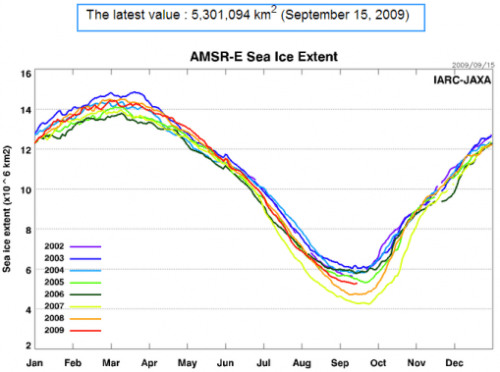
Watts prepared a table of daily values for the sea ice and the low will probably be that of 13 September with a value of 5,249,844 square kilometers. The area increased on the 14 and 15 September to 5,301,094 square kilometers.
It seems the experts were again pessimistic and missed the mark even though they were only predicting 6 weeks in advance of the low point.
For more on this entry by Anthony Watts, click here.
Cbdakota
Posted in Environment, Sea Ice
 Climate Change Sanity