Category Archives: Ocean heat content

4 Billion Years of Climate Change


For the past several weeks, I have been planning on sending the link to  “The Grand View: 4 Billion Years Of Climate Change”.  The article is from the book “The Resilient Earth” by Doug Hoffman and Allen Simmons. It is really informative and for those of us that can’t keep on geological Eras, Periods, or the years relating to them straight,  it is a reference you might want to keep.

early_bombardment-500 Early Earth–From “The Resilient Earth

To give you a taste of what is covered, look at the following:

Observations

That concludes our whirlwind tour of Earth’s climate history. There are a number of observations that can be made from our overview of the Phanerozoic:

Earth’s temperature is always changing.

Over time there have been periods when it has been colder than it is today.

For most of the Phanerozoic it has been much warmer than it is today.

Life has persisted during periods both hot and cold.

There is no one “right” temperature.

Carbon dioxide has always been present in Earth’s atmosphere.

Over time there have been periods when CO2 has increased and decreased     naturally.

For most of the Phanerozoic it has been much higher than it is today.

Life has persisted during periods with high CO2 and low CO2.

CO2 levels will change with or without human contributions.

Over time there have been a number of ice ages—Life has endured multiple ice ages.

For most of the Phanerozoic there have been no persistent polar ice caps.
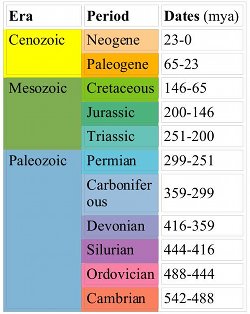
eras_and_periods-250

Eras and Periods from The Resilient Earth

To read the  article   click here

Cbdakota

Sea Surface Temperatures–Record Warmth?


The National Climate Data Center said that the average global ocean temperature in July was 62.6 degrees and that was the hottest since recording keeping began in 1880.  Seth Borenstein’s column on this reported record says:

Breaking heat records in water is more ominous as a sign of global warming than breaking temperature marks on land.  That’s because water takes longer to heat up and doesn’t cool off as easily, said climate scientist Andrew Weaver of the University of Victoria British Columbia.   “This is another yet really important indicator of the change that’s occurring,” Weaver said.

Sometimes the alarmist seem eager to overreach in order to be,  well , alarmists.  The real issue is that measuring sea surface temperature (SST) is only one piece of the information needed to measure OCEAN HEAT CONTENT.  Ocean heat content is the only way to know if our vast oceans are warming or cooling.  The record shows that the oceans have slightly cooled.

This claim that July 09 SST  is the hottest on record does not seem to be true.  Roy Spencer has a post discussing this and he shows that this is not a record.  And if you look at the data he provides, you can see that 1998 was a significant period of SST warming.  Spencer says “None of this represents proof that July 2009 was not a record warm month in ocean surface temperature, but it does cast significant doubt on the claim.  But the focus on a single month misses the big picture: recent years have yet to reach the warmth of 1998. “

Read Dr Spencer’s full post here